Building a Basque-Chinese Dictionary by Using English as Pivot
Xabier Saralegi, Iker Manterola, Iñaki San Vicente
Elhuyar R & DZelai haundi 3, Osinalde Industrialdea
20170 Usurbil (Basque Country), Spain
E-mail: [email protected], [email protected], [email protected]
Abstract
Bilingual dictionaries are key resources in several fields such as translation, language learning or various NLP tasks. However, only major languages have such resources. Automatically built dictionaries by using pivot languages could be a useful resource in these circumstances. Pivot-based bilingual dictionary building is based on merging two bilingual dictionaries which share a common language (e.g. LA-LB, LB-LC) in order to create a dictionary for a new language pair (e.g LA-LC). This process may include wrong translations due to the polisemy of words. We built Basque-Chinese (Mandarin) dictionaries automatically from Basque-English and Chinese-English dictionaries. In order to prune wrong translations we used different methods adequate for less resourced languages. Inverse Consultation and Distributional Similarity methods were chosen because they just depend on easily available resources. Finally, we evaluated manually the quality of the built dictionaries and the adequacy of the methods. Both Inverse Consultation and Distributional Similarity provide good precision of translations but recall is seriously damaged. Distributional similarity prunes rare translations more accurately than other methods.
Keywords: Bilingual Lexicons, Comparable Corpora, Less-Resourced Languages
1.
Introduction
Bilingual dictionaries1 are a key resource in a multilingual society. Their straight application can be found in a range of activities such as translation, language learning, etc. or as a basic resource for NLP tasks. However, the availability of such resources varies depending on the pair of languages. That is why most dictionaries include big languages such as English, Spanish, Chinese, etc., whereas dictionaries for languages with fewer speakers are scarce or even non-existent. When they exist, they are often limited to a major language (e.g. English-Basque) or to sociologically related languages (e.g Spanish-Basque, French-Basque...). Therefore, there are not many dictionaries which include two non-major languages (e.g Basque-Turkish) or even minor languages combined with some major languages (e.g. Basque-Chinese,
Basque-Russian, Basque-Arab...). Economic
considerations or the lack of great demand are the reasons for this.Automatically built dictionaries could be a useful resource in these circumstances.
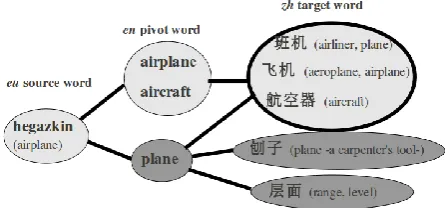
Pivot-based bilingual dictionary building is based on merging two bilingual dictionaries which share a common language (e.g. LA-LB, LB-LC) in order to create a dictionary for a new language pair (e.g LA-LC). However, this process may include wrong translations due to the polisemy of words. A pivot word can lead to wrong translations corresponding to senses not represented by the source word (See Figure 1). These senses can be completely different or related but with a narrower or wider meaning.
In this work we use the same methods (Inverse Consultation and Distributional Similarity) as in
1
In this paper we use a very flexible definition of dictionary. Using stricter lexicographic criteria it can be considered a list of bilingual equivalences.
(Saralegi et al., 2011) for building a Basque-Chinese dictionary via English. These methods are focused on less resourced languages. They just depend on easily available resources such as dictionaries including one major language and comparable corpora. In addition, we provide a manual evaluation of the resulting dictionaries. In the automatic evaluation performed by Saralegi et al. (2011) it was observed that several correct pairs were marked as wrong because they were not included in the reference dictionary. A manual evaluation allows us to measure the precision of the resulting dictionary more accurately. Furthermore, there is no Basque-Chinese dictionary that could be used as a reference.
Figure 1: Ambiguity problem
This paper is structured as follows. The next section describes related works. Next the experimental setup is explained. After that, both methods used for pruning wrong pairs (Inverse Consultation and Distributional Similarity) are explained. The sixth section presents the evaluation of the dictionaries and the results are discussed. Finally, some conclusions are drawn.
2.
Related work
and Chinese editions of the Bible. Such parallel corpora have been used in some basic Machine Translation systems (Phillips, 2001). Even if it is a small corpus (31,102 segments or verses) and has a relatively small and restricted vocabulary for creating a dictionary, it allows us to obtain the most probable translations for a number of words. We identified the most probable translations for the 1,596 Basque words whose frequency in the Bible corpus is greater than 10 ({weu:f(weu)>10}). We accepted as most probable translations for a source word weu the set comprised by all the translations that exceed a probability ratio of 0.8. This ratio is computed between the probability of the translation (p(wzh|weu))
and the maximum translation probability
(maxxzh(p(xzh|weu))):
{wzh: p(wzh|weu)/maxxzh(p(xzh|weu)) > 0.8}
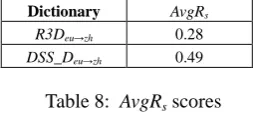
Results show (table 8) that DS (TOP3) is more effective to keep only most probable translations on the dictionaries. So although it offers a poor average recall of translations per entry (See table 6) it is useful for creating more precise dictionaries where coverage of the most probable translations is critical.
Dictionary AvgRs
R3Deu→zh 0.28
DSS_Deu→zh 0.49
Table 8: AvgRs scores
7.
Conclusions
This paper presents Basque-Chinese dictionaries. They were automatically created by means of pivot techniques, using IC and DS methods for pruning wrong translations. The quality of those dictionaries was manually evaluated. The pruning methods are useful for building dictionaries where precision of translations is required. IC is the most appropriate method for that propose. However, it suffers from low recall for translations and headwords. DS offers a poorer precision but a better balance between precision and recall. Nevertheless, the best balance between precision and recall is achieved when pruning methods (the baseline) are not applied. However, if we are interested in including only most probable translations DS offers a better performance than
the baseline.
8.
Acknowledgements
This work has been partially founded by the Industry Department of the Basque Government under grants IE09-262 (Berbatek project) and SA-2010/00245 (Pibolex+ project).
9.
References
Dunning, T. (1994) Accurate Methods for the Statistics of Surprise and Coincidence. In Computational Linguistics 19(1): 61-74. Cambrigde, Mass: The MIT Press.
Ezeiza N., Aduriz I., Alegria I., Arriola J.M., Urizar R. 1998. Combining Stochastic and Rule-Based Methods for Disambiguation in Agglutinative Languages. COLING-ACL.
Kaji H., Tamamura,S., Erdenebat D. 2008. Automatic construction of a Japanese-Chinese dictionary via English. LREC.
Mausam, Soderland S., Etzioni O., Weld D., Skinner M., Bilmes J. 2009. Compiling a massive, multilingual dictionary via probabilistic inference. ACL.
Paik K., Shirai S., Nakaiwa H. 2004. Automatic construction of a transfer dictionary considering directionality. MLR.
Phillips, J. D. 2001. The bible as a basis for machine translation. In Proceedings of PACLing 2001.
Saralegi X., Manterola I., San Vicente I. 2011. Analyzing Methods for Improving Precision of Pivot-Based Bilingual Dictionaries. EMNLP.
Shezaf D., and Rappoport A. 2010. Bilingual lexicon generation using non-aligned signatures. ACL. Sjöbergh J. 2005. Creating a free digital
Japanese-Swedish lexicon. PACLING.
Tanaka K., Umemura K. 1994. Construction of a bilingual dictionary intermediated by a third language. COLING.
Tseng H., Chang P., Andrew G., Jurafsky D., Manning C. 2005. A Conditional Random Field Word Segmenter. SIGHAN.