The SYNC3 Collaborative Annotation Tool
Georgios Petasis
Software and Knowledge Engineering Laboratory Institute of Informatics and Telecommunications National Centre for Scientific Research (N.C.S.R.) “Demokritos”
GR-153 10, P.O. BOX 60228, Aghia Paraskevi, Athens, Greece [email protected]
Abstract
The huge amount of the available information in the Web creates the need for effective information extraction systems that are able to produce metadata that satisfy user’s information needs. The development of such systems, in the majority of cases, depends on the availability of an appropriately annotated corpus in order to learn or evaluate extraction models. The production of such corpora can be significantly facilitated by annotation tools, which provide user-friendly facilities and enable annotators to annotate documents according to a predefined annotation schema. However, the construction of annotation tools that operate in a distributed environment is a challenging task: the majority of these tools are implemented as Web applications, having to cope with the capabilities offered by browsers. This paper describes the SYNC3 collaborative annotation tool, which implements an alternative architecture: it remains a desktop application, fully exploiting the advantages of desktop applications, but provides collaborative annotation through the use of a centralised server for storing both the documents and their metadata, and instance messaging protocols for communicating events among all annotators. The annotation tool is implemented as a component of the Ellogon language engineering platform, exploiting its extensive annotation engine, its cross-platform abilities and its linguistic processing components, if such a need arises. Finally, the SYNC3 annotation tool is distributed with an open source license, as part of the Ellogon platform.
Keywords:annotation tools, collaborative annotation, adaptable annotation schemas
1.
Introduction
The development and maintenance of annotated corpora can be significantly facilitated through the use of annota-tion tools, as annotaannota-tion tools can control most aspects of the annotation process, from the presentation of the rele-vant information to the annotators to the validation of an-notated information according to a predefined schema. A plethora of annotation tools has been presented during the last decade (Uren et al., 2006; Fragkou et al., 2008), cov-ering a wide range of annotation tasks and offcov-ering vari-ous levels of support. Annotation solutions can be divided into manual and semi-automatic methods: manual solutions provide the require infrastructure (i.e. storage management, graphical user interface, etc.) for annotators to annotate a corpus with a completely manual approach, where all infor-mation must be manually entered by the annotators. Semi-automatic solutions on the other hand, try to pre-annotate corpora, reducing the role of annotators into validation of existing pre-annotation. However, several of the existing annotation tools are desktop applications, allowing the an-notation of corpora found on a single computer. A more re-cent category of annotation solutions, aredistributedor col-laborativeannotation tools, where several annotators (not necessarily co-located) can annotate the same corpus, and in some cases even the same document. However, the con-struction of annotation tools that operate in a distributed en-vironment is a challenging task, while the majority of these tools are implemented as Web applications, having to cope with the capabilities offered by browsers. Annotator tools that operate as Web services are easier to implement, as the corpora are kept on a single server and annotation is hap-pening also on the server, triggered by actions that happen at the browser of each annotator. Despite the fact the
al-most all collaborative annotation tools follow this approach, there are a few disadvantages in comparison to desktop ap-plications:
• The graphical user interface of Web applications is less capable than a desktop user interface. Usability features like assigning keyboard-shortcuts to buttons, or special actions to mouse buttons, are usually miss-ing.
• It is very difficult to personalise the annotation tool for each annotator. Features like monitoring the actions of a specific annotator, and inducing a set of regular expressions to pre-annotate documents, are quite diffi-cult to be implemented.
• The annotation tool cannot store files or run applica-tion on the computer of the annotator. This suggests that any pre-annotation can only occur at the server, and not on the clients.
• An internet connection to the server is constantly re-quired. An annotator cannot annotate locally, upload-ing the annotation results at a latter time.
This paper describes the SYNC31collaborative annotation
tool, which implements an alternative architecture: it re-mains a desktop application, fully exploiting the advantages of desktop applications, but provides collaborative annota-tion through the use of a centralised server for storing both the documents and their metadata, while exploits instance messaging protocols for communicating events among all annotators. The annotation tool is implemented as a com-ponent of the Ellogon language engineering platform
(Peta-1
en-• Personalised automatic annotation support, through regular expression acquisition performed by monitor-ing the actions of each annotator.
• Easy to setup and administer, as the tool is distributed as a single executable file, and the central repository can be filled automatically by any instance of the tool, if it is new or empty.
In addition, the SYNC3 tool includes a complete distribu-tion of the Ellogon language engineering platform, suggest-ing that all its processsuggest-ing components are available from in-side the tool, and can be applied on a document/collection. Teamware offers similar functionality, but execution of linguistic processing components can happen only at the server, and not within the tool. Local execution of compo-nents within the SYNC3 tool allows access to the vast col-lection of Ellogon’s components, including operators that transform imported documents, linguistic annotation view-ers, annotation schema validators, inter-annotation agree-ment calculators, etc.
3.
The SYNC3 Annotation Tool
In order to develop an annotation tool that would be easy to use and generic enough to support a wide range of anno-tation tasks, we identified four basic requirements for our system:
• The tool should be user-friendly, easy to be understand and operated by the annotators.
• The operation must be based on annotation schemas that define the annotation task and guide the annota-tors in their work. The annotation tool must adapt its user interface automatically according to the loaded annotation schema.
• The system should support collaborative/distributed annotation, where the annotation process can be shared among different annotators at different loca-tions.
• The system should be tolerant to losses of internet con-nectivity, allowing the annotation to continue locally, if possible.
The architecture of the SYNC3 annotation tool is shown in figure 1. The central component is an SQL database server, where all tools are registering themselves upon start-up and termination. The database server is used to store collections of documents, either annotated or not, along with any other information required by the annotation tools. Each anno-tation tool communicates with the database server through SQL queries, and the supported databases are MySQL16,
PostgreSQL17, and Microsoft SQL Server18. A single
in-stance of the SYNC3 annotation tool can be run in any number of computers. Each instance registers itself with the database server, using the credentials of the user run-ning the application (taken from the operating system), and
16
http://www.mysql.com/
17
http://www.postgresql.org/
18
http://www.microsoft.com/sqlserver/en/us/default.aspx
SQL Database (MySQL, PostgreSQL, SQL Server)
Collections/Documents
Local copy of all corpora
Annotation Scheme Annotation
Tool User
Figure 1: The architecture of the SYNC3 annotation tool.
synchronises its local copy with the database server. Each annotation tool stores locally all information kept in the server, ensuring that all data can be restored even if the database server gets replaced with a new server, and at the same time providing the ability to annotate off-line.
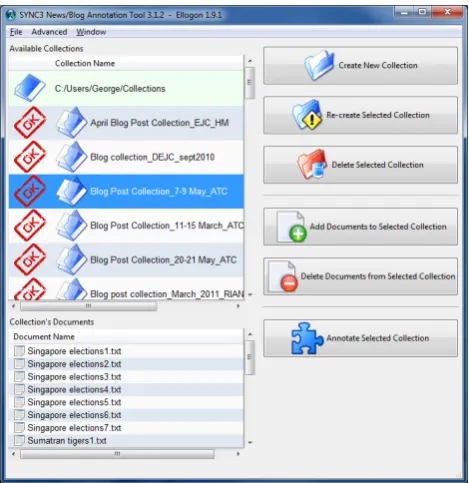
Figure 2: The main window the SYNC3 annotation tool.
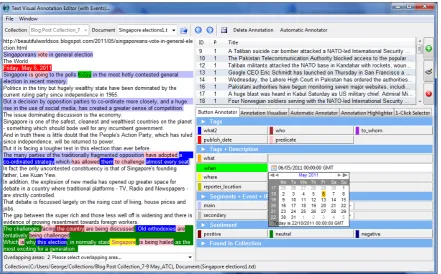
Figure 3: The annotation window of the SYNC3 annotation tool.
annotate them with a set of attributes, according to the an-notation schema. The user has complete control over the way segments are selected (i.e. by configuring mouse but-tons or key combinations to select whole words), and an-notated (i.e. by configuring key combinations for any cat-egory). In addition, the tool monitors the annotation per-formed by the user, and tries to extract regular expressions from already annotated items. The user is able to revise these expressions (if desired) and apply them to automati-cally annotate the rest of the document, or other documents.
The SYNC3 tool supports both distributed and collabo-rative annotation. The distributed mode is the most fre-quent and easy to use mode: each annotator locks a whole document for editing, by simply opening this document in its tool, preventing any other annotator to open the same document for annotation. The collaborative mode is more complex, and requires a different configuration of the tool. Withe the help of the open instance messaging protocol Jubber19, also used by Google Talk, actions performed by annotators are shared among all instances of the tool, ef-fectively sharing annotations among all users that annotate the same document. However, no conflict resolution is per-formed: if two users annotate the same text segment, both annotations are kept into the system, no matter if they are overlapping or contradicting. Finally, the annotation tool currently runs under the Windows (XP, Vista, 7) and Linux (32 and 64 bit) operating systems.
19The Jubber instance messaging protocol:
http://www.jabber.org/
4.
Reusing Ellogon’s Annotation Engine
The Ellogon language engineering platform (Petasis et al., 2002) offers an extensive annotation engine, allowing the construction of a wide range of annotation tools for both plain text and HTML documents. This annotation engine provides a wide range of features, including:
• cross-platform graphical user interface (supporting Windows, Linux and OS X),
• use of standard formats (including stand-off annota-tion in XML),
• support for user centered design and user friendly in-terface,
• support of customized annotation schemata,
• support for annotating rendered HTML pages,
• support for performing automatic annotation, and
• comparison facilities, to identify mismatches among independent annotations of the same document, or cal-culate inter-annotation agreement.
A
B
C
D
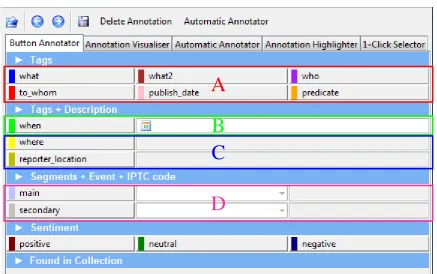
Figure 4: Various types of annotation input.
4.1. Annotation Schemes
The annotation engine of the Ellogon language engineer-ing platform is configurable through XML files, that de-fine annotation schemas. The tool reads the annotation schema from an XML file, and presents to the annotator a suitable GUI for annotating text segments. The SYNC3 tool follows a different approach than other tools, such as GATE Teamware: Instead of implementing floating win-dows which show only a small fragment of the annotation schema, the SYNC3 tool shows the whole schema, so as not to impose to the user the need to perform excessive mouse usage. In addition, the colours are not related to annotation groups (as in GATE Teamware), but on category/attribute values. The XML annotation schema language provides a variety of types that can be annotated. The most important types, along with their visual representation in the GUI, are shown in the following list:
• Acategory(figure 4-A) can be used to assign a spe-cific category to selected segments. It is usually rep-resented by a button widget. Typical usage of this schema type is to annotate POS tags, named-entity types, polarity, etc.
• Adate (figure 4-B) can be used to assign a specific category to selected segments and in addition asso-ciate a date. It is usually represented by a button wid-get along with a date picker, to select the associated date. The date can be formatted according to the for-mat specified in the annotation schema. Typical us-age of this type is when dates in text must be associ-ated/grounded with a normalised date, such as mark-ing the text segment “yesterday”, and ground its date to “21 May 2012” in the linguistic annotation.
• Acategorywith adescription(figure 4-C). This in-put type can be used to assign a category and an arbi-trary description (comment) to a selected segment. It is usually represented by a button widget and an entry widget, allowing the entry of arbitrary text. This type can be used when a category may be associated with a note/comment from the annotator.
• Acategorywith adetailand possibly adescription
(figure 4-D). This input type can associate a category to a segment, along with a “detail”, a sub-category of predefined values, along with a description (arbi-trary text). It is usually represented by a button widget and a combo-box widget, allowing the selection of a value among a set of predefined values. In case an op-tional description has been specified in the annotation schema, it is represented by an entry widget, allowing the entry of arbitrary text. Typical usage of this type is when a category has too many values to be repre-sented as buttons, and the values should be selected from a drop-down list. For example, the SYNC3 an-notation schema (shown in figure 3) includes a widget for defining “events” in its top-right corner: the anno-tator may identify the events contained in a news item, and define them, with a small description. Each de-fined event gets a unique id. In addition to the event definition, the annotator can mark the segment from where the event was extracted (figure 4-D), and select from the drop-down list the id of the defined event, so as to associate a segment to an event definition, which may be the same across many documents.
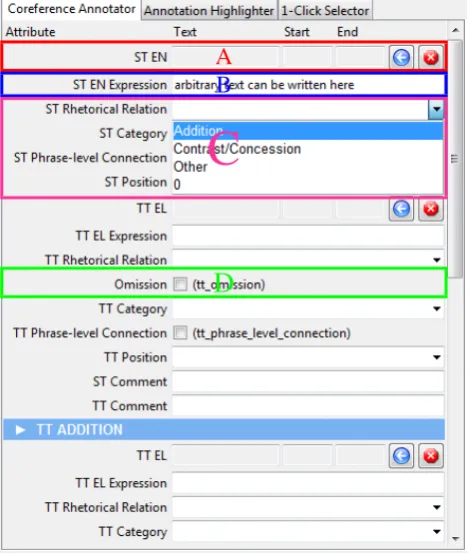
a single annotation, to facilitate annotation of co-reference or other types of relations:
A
B
C
D
Figure 5: Types of annotation input within groups.
• A spanor segment (figure 5-A). This input type is represented by a textual label (specified by the anno-tation schema), the text of the segment, its offsets, a button to fill in the segment from the current selection, and a button to clear the segment. It should be noted that the annotator is not required to type anything. For example, if the annotation schema defines a ”source” attribute, the annotator is expected to either select an already annotated segment, or select a text segment with the mouse, and press the button with the blue ar-row icon, to fill the ”source” property.
• Adescription(figure 5-B), which the user can fill with arbitrary text. Represented by a textual label and an entry widget, where arbitrary text can be entered.
• Acategory(figure 5-C), selectable from a set of pre-defined categories by the annotation schema. Repre-sented by a textual label and a combo-box widget, al-lowing the user to select a category from a set of pre-defined categories.
• Aboolean value(figure 5-D), denoting the presence or absence of an attribute. Represented by a textual label and a check-box widget.
Finally, the annotation inputs can be separated in groups having a label, through the annotation schema, as shown in figure 4. Some more annotation input types related to template element filling, can be found in Fragkou et al. (2008), while an annotation schema for linguistic analysis of connectives on bi-lingual aligned corpora, can be found in Tsoumari and Petasis (2011).
4.2. The SYNC3 Annotation Scheme
The objective of the SYNC3 project is to take media mon-itoring and tagging to another level by comparing the lat-est news from traditional media sources and the blogo-sphere, enabling users to track their evolution, and to share favourite stories. The SYNC3 system seeks to crawl tra-ditional news sources, and cluster news items in order to extract “events”, where an “event is a particular thing that happens at a specific time and place”. Having structured traditional media sources, SYNC3 tries to also structure the blogosphere, by locating blog posts, relevant to these “events”. More specifically, SYNC3 automatically builds a news thematology, based on a statistical modelling ap-proach that derives fine clusters of news articles, the so-called “news events”. These events are classified into a hierarchy of news topics and themes, based on the IPTC taxonomy20, and can be further labelled and linked with
each other, according to detected temporal, geographical, and causal relations. Subsequently, the system adapts the statistical news event models to the blogosphere domain, allowing the system to automatically find blog posts that comment on these events. Finally, SYNC3 aims to deter-mine the blog post author sentiment towards these events, through sentiment analysis.
An annotation corpus has been constructed, for evaluating various subsystems of SYNC3, using the SYNC3 annota-tion tool, essentially a minimal Ellogon distribuannota-tion, with a SYNC3-related annotation schema, and the distributed con-troller, packaged as a single executable for the Windows and Linux platforms. The annotation teams were located in Maastricht, the Netherlands, Athens, Greece, and Moscow, Russia. The central server was located initially in Athens, Greece, and re-located to Maastricht, the Netherlands, by simply transferring the database. Two corpora have been created, with the first one containing the “gold” corpus that will be used for evaluation, and with the second corpus con-taining a small subset of the first corpus, annotated for mea-suring inter-annotation agreement.
The corpus was partly created by the annotators: 1000 news items from various news agencies were selected: the news items were read by the annotators and events were identi-fied and annotated. The annotation engine of Ellogon al-lows not only to specify custom annotation schemas, but also to build an annotation tool by combining ready-to use components, such as the dynamic category definer (shown in top-right corner of figure 3), used in order to define the “events”. Once an event has been identified, it must be lo-cated on the news item, by annotating the segments that contain the event, and identify various actors, that answer the “what”, “who”, “to whom”, “when” and “where” ques-tions. The annotation schema devised is shown in detail in figure 4. The upper group, labeled “Tags” and marked with “A”, tries to capture exactly these categories, by of-fering buttons for what happened (“what” and “what2”), who did the event (“who”), and to whom the event was at-tributed to (“to whom”). The “when” tag is associated with a date selector, where the annotator must select the
cor-20Metadata Taxonomies for the News Industry. International
rect date, if the date cannot be automatically extracted cor-rectly from the selected text segment. The “where” and “re-porter location” are associated with free text entries, where the annotation may type additional information, if required by the annotation guidelines. Regarding events, the an-notators were requested to mark only two events in each news item, separating them into the primary event the news item is about (“main”), and the2nd most important event
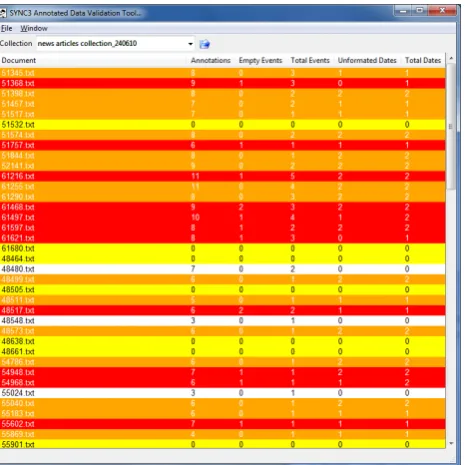
in the news item, marked as “secondary”. Once a segment has been annotated as containing either a primary or a sec-ondary event, the event id must be selected, from the drop-down list containing all the events defined in the system for all documents. Then the annotators were asked to search the Web, in order to locate blog posts relevant to the “main” event of the news item, import them to the corpus, and an-notate the blog post with the same information. In addition, blog posts must be annotated with polarity information, by marking segments that express polarity towards the event with the “positive”, “neutral” or “negative” categories. Once the annotation of a document has been completed, the annotator marked the document as finished in the tool, while once all documents of a collection has been marked as finished, the collection was also marked as finished au-tomatically. Once a collection has been marked as finished, the manager of the annotation process applied a set of valid-ity tests (figure 6) from within the SYNC3 annotation tool. If the collection passed validation tests, it was marked as validated and shown with the “OK” stamp icon within the tool, as shown in figure 2.
Figure 6: Applying validation checks within the SYNC3 annotation tool.
All annotation has been performed by journalists, using the SYNC3 annotation tool for all tasks, annotating a corpus of about 2500 news items and blog posts. Once the annotation has been finished, analysis has been performed outside the annotation tool, with facilities offered by the Ellogon plat-form, in order to calculate inter-annotation agreement, and
Figure 7: Comparing documents in the Ellogon language engineering platform.
examine cases of disagreement (figure 7). Measured inter-annotation agreement was good regarding the definition of events and event localisation/grounding on the documents (achieving a score of87.87%), but was lower regarding po-larity annotation, achieving an accuracy of50%on the doc-ument level, with Cohen’s kappa being equal to0.255.
5.
Conclusions and Future Work
In this paper we presented a new distributed/collaborative annotation tool, which tries to combine dis-tributed/collaborative annotation with desktop applications, following a different approach from Web based distributed annotation tools. The presented annotation tool is imple-mented as an extension (plug-in) of the Ellogon language engineering platform, exploiting facilities like graphical user interface elements and its extensive annotation engine. The annotation tool has been used in the context of the SYNC3 research project, in order to annotate news items and blog posts with various types of information, including events dynamically extracted from the news, and polarity towards these events in blog posts. As future work, we aim to enhance the ability of annotating a single document by more than one annotator, especially towards conflict resolution, as the currently provided conflict resolution facilities are quite limited.
Acknowledgments
The author would like to acknowledge partial support of this work from the European Community Seventh Frame-work Programme, as part of the FP7 – 231854 SYNC3 project.
6.
References
for NLP Frameworks (NLPFrameworks 2010), in Pro-ceedings of the 7th International Conference on Lan-guage Resources and Evaluation, LREC 2010, Valletta, Malta, May 22. ELRA.
Jon Chamberlain, Massimo Poesio, and Udo Kruschwitz. 2008. Phrase detectives - a web-based collaborative an-notation game. InIn Proceedings of I-Semantics. Oscar Corcho. 2006. Ontology based document
annota-tion: trends and open research problems. Int. J. Meta-data Semant. Ontologies, 1:47–57, January.
Hamish Cunningham, Diana Maynard, Kalina Bontcheva, Valentin Tablan, Niraj Aswani, Ian Roberts, Genevieve Gorrell, Adam Funk, Angus Roberts, Danica Daml-janovic, Thomas Heitz, Mark A. Greenwood, Horacio Saggion, Johann Petrak, Yaoyong Li, and Wim Peters. 2011.Text Processing with GATE (Version 6).
Pavlina Fragkou, Georgios Petasis, Aris Theodorakos, Van-gelis Karkaletsis, and Constantine Spyropoulos. 2008. Boemie ontology-based text annotation tool. In Nico-letta Calzolari (Conference Chair), Khalid Choukri, Bente Maegaard, Joseph Mariani, Jan Odjik, Stelios Piperidis, and Daniel Tapias, editors,Proceedings of the Sixth International Language Resources and Evaluation (LREC’08), Marrakech, Morocco, May. European Lan-guage Resources Association (ELRA). http://www.lrec-conf.org/proceedings/lrec2008/.
Jeff Heflin, James Hendler, and Sean Luke. 1999. Shoe: A knowledge representation language for internet applica-tions. Technical report.
Kazuaki Maeda and Stephanie Strassel. 2004. Annotation tools for large-scale corpus development: Using AGTK at the Linguistic Data Consortium. Proceedings of the
4th International Conference on Language Resources and Evaluation (LREC 2004), Lisbon, Portugal.
Christoph M¨uller and Michael Strube. 2006. Multi-level annotation of linguistic data with MMAX2. In Sabine Braun, Kurt Kohn, and Joybrato Mukherjee, editors, Corpus Technology and Language Pedagogy: New Re-sources, New Tools, New Methods, pages 197–214. Peter Lang, Frankfurt a.M., Germany.
Philip V. Ogren. 2006. Knowtator: A prot´eg´e plug-in for annotated corpus construction. In Robert C. Moore, Jeff A. Bilmes, Jennifer Chu-Carroll, and Mark Sander-son, editors,HLT-NAACL. The Association for Compu-tational Linguistics.
Georgios Petasis, Vangelis Karkaletsis, Georgios Paliouras, Ion Androutsopoulos, and Constantine D. Spyropoulos. 2002. Ellogon: A New Text Engineering Platform. In Proceedings of the 3rd International Conference on Lan-guage Resources and Evaluation (LREC 2002), pages 72–78, Las Palmas, Canary Islands, Spain, May 29–31. European Language Resources Association.
Borislav Popov, Atanas Kiryakov, Damyan Ognyanoff, Dimitar Manov, and Angel Kirilov. 2004. KIM - a se-mantic platform for information extraction and retrieval. Journal of Natural Language Engineering, 10(3-4):375– 392.
Mara Tsoumari and Georgios Petasis. 2011. Coreference Annotator - A new annotation tool for aligned bilingual
corpora. InProceedings of the Second Workshop on An-notation and Exploitation of Parallel Corpora (AEPC 2), in 8th International Conference on Recent Advances in Natural Language Processing (RANLP 2011), pages 43– 52, September 15.