RIDIRE-CPI: an Open Source Crawling and Processing Infrastructure for
Web Corpora Building
Alessandro Panunzi, Marco Fabbri, Massimo Moneglia, Lorenzo Gregori, Samuele Paladini
University of Florence
[email protected], [email protected], [email protected], [email protected], [email protected]
Abstract
This paper introduces the RIDIRE-CPI, an open source tool for the building of web corpora with a specific design through a targeted crawling strategy. The tool has been developed within the RIDIRE Project, which aims at creating a 2 billion word balanced web corpus for Italian. RIDIRE-CPI architecture integrates existing open source tools as well as modules developed specifically within the RIDIRE project. It consists of various components: a robust crawler (Heritrix), a user friendly web interface, several conversion and cleaning tools, an anti-duplicate filter, a language guesser, and a PoS tagger.
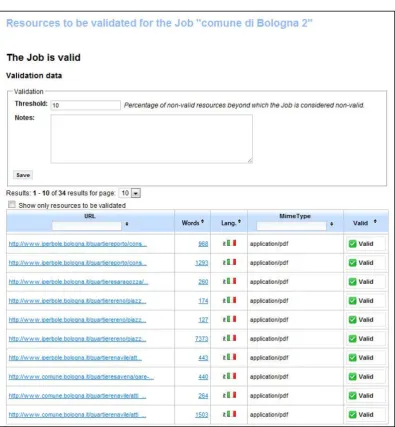
The RIDIRE-CPI user-friendly interface is specifically intended for allowing collaborative work performance by users with low skills in web technology and text processing. Moreover, RIDIRE-CPI integrates a validation interface dedicated to the evaluation of the targeted crawling. Through the content selection, metadata assignment, and validation procedures, the RIDIRE-CPI allows the gathering of linguistic data with a supervised strategy that leads to a higher level of control of the corpus contents. The modular architecture of the infrastructure and its open-source distribution will assure the reusability of the tool for other corpus building initiatives.
Keywords: web corpora, crawling, LRs construction.
1.
Introduction
1.1 Web corpora: a brief state of the art
In recent years, different practices about using the web as linguistic data source broke into the scientific community. The idea to use the web itself as a corpus “surrogate” gave rise to an interesting discussion between its supporters and detractors. The building of “reference” corpora starting from web materials might be considered inadequate due to the lack of representation of the “language of the web” and the low level of control on data (Ide et al., 2002). On the other hand, the web can be considered the largest linguistic corpus in the world (Kilgariff & Grefenstette, 2003).
Due to the enormous growth of the Internet, the language data collected in the web is not exclusively “the language of the web”. As a matter of fact, texts from many different sources can be found therein: literature, newspapers, academic and bureaucratic prose. Therefore, a collection of its linguistic data can exploit the huge richness and variety of the sources. Its balancing is not a problem related to the data sources, but, rather, depends on the methods of collection.
Different kinds of projects have been carried out in order to exploit the language data that populates the web. Some of them focused on the direct exploitation of the Internet through search engine techniques (e.g. WebCorp, Renouf et al., 2007). Others were interested in massive language collections (with an almost absence of further control and processing of data) for strict computational purposes (e.g. Clarke et al., 2002, 53 billion words).
Still others tried to extract more controlled corpora from the web, using methods that involve various steps of cleaning and tagging (e.g. CUCWeb, Boleda et al., 2006; Sharoff, 2006). Among these latter ones, the WaCky initiative (Baroni et al., 2009) represents the main effort by a group of linguists to produce mega corpora suitable for linguistic research. Four very large corpora have been collected for English, French, German and Italian, each one between 1.6 and 2 billion tokens. Within this initiative, an interesting and fully automated method has been designed in order to assure a certain degree of balancing and representativeness, exploiting corpus-based frequency lists and basic dictionaries to perform the web queries from which the data collection derives.
1.2 RIDIRE: project and tools
An even more controlled method has been developed in the RIDIRE project (Moneglia & Paladini, 2010), which aims to build a web-derived repository for the Italian Language (2 billion words), with a specific corpus design. The whole resource is composed of a set of sub-corpora, each one collecting texts of a specific functional or semantic domain (news, law/administration, economy, literature, fashion, architecture/design, food, sport, religion, fine arts, cinema, music).
This paper describes the tool that has been developed within the RIDIRE project for the crawling and the processing of the web resources: the RIDIRE Crawling and Processing Infrastructure (henceforth, RIDIRE-CPI). This tool will be delivered as an open source package and will be available for the development of other corpora. The infrastructure can be used for the building of domain-specific corpora for whatever computational purpose. Moreover, its user-friendly interface is specifically intended for allowing collaborative work performed by users with low skills in web technology and text processing.
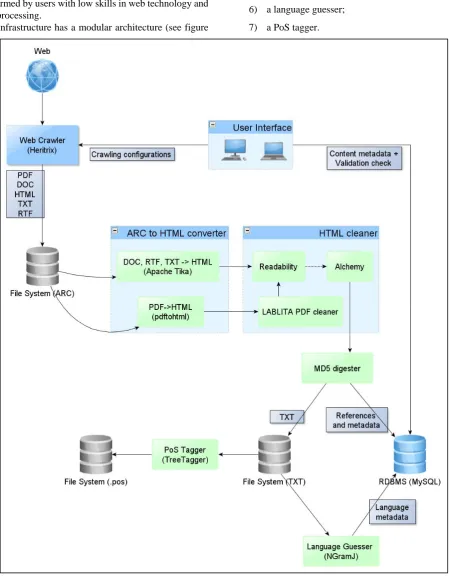
The infrastructure has a modular architecture (see figure
1), that consists of the following main components:
1) a web crawler;
2) a web interface for crawling management and validation;
3) conversion tools;
4) HTML cleaner tools;
5) anti-duplicate filters;
6) a language guesser;
7) a PoS tagger.
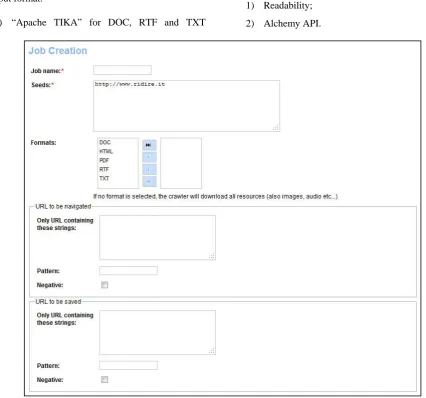
- which URLs the crawler has to add to the queue (“URL to be navigated”);
- which resources the crawler has to download to the file system (“URL to be saved”).
3.
Mapping process
3.1 Conversion to HTML and cleaning
It is well known that, for the aim of building a corpus that is adequate for linguistic research, the crawled data has to be processed by a complex procedure that includes, for instance, text cleaning, duplicate removal, and POS-tagging (Baroni et al., 2009).
To this aim, RIDIRE-CPI implements the “mapping” process, which corresponds to an automatic processing pipeline (i.e. a series of cascading procedures) on the downloaded resources in order to extract the running text that will constitute the corpus itself.
For each terminated job, the RIDIRE-CPI stores an ARC archive in the file system that contains the downloaded resources in different formats. To proceed to the subsequent steps, all the resources are first converted into HTML. For this task, several tools are used depending on the input format:
1) “Apache TIKA” for DOC, RTF and TXT
conversions;
2) “pdftohtml” plus an ad hoc cleaner (LABLITA PdfCleaner) for the PDF conversion.
The conversion is embedded in a common Java application (that can be executed on the command line, passing some parameters) that runs outside the main JBoss application. Again the loose coupling is made so that if the conversion ends in error or, worse, crashes, the main application is not affected.
Apache TIKA is used as a programming library by the conversion application. On the contrary, pdftohtml and PdfCleaner are, in turn, used as external programs: the first tool is used for the main conversion, while the second has been specifically developed for discarding tables, indexes, page numbers and notes from the converted HTML file.
After the conversion, the text cleaning is performed. Web pages, as is well known, contain text that is not relevant for the constitution of a corpus i.e. advertising, navigation menus, disclaimers, credits etc. (the so called “boilerplate”). This kind of text is removed using two external tools:
1) Readability;
2) Alchemy API.
provide. In Proceedings of the 3rd Language Resources and Evaluation Conference,LREC 2002. Paris: ELRA, pp. 839--844.
Kilgarriff, A. and Greffenstette, G. (2003). Introduction to the Special Issue on Web as Corpus. Computational Linguistics 29(3), pp. 1--15.
Moneglia, M. and Paladini, S. (2010). Le risorse di rete dell’italiano. Presentazione del progetto “RIDIRE.it”. In E. Cresti & I. Korzen (Eds.), Language, Cognition and Identity. Firenze: Firenze University Press, pp. 111--128.
Panunzi, A., Fabbri, M. and Moneglia, M. (2006). Integrating Methods and LRs for Automatic Keyword Extraction from Open-Domain Texts”, in Proceedings of the 5th Language Resources and Evaluation Conference, LREC 2006. Paris, France: ELRA, pp. 2205--2208.
Renouf, A., Kehoe, A. and Banerjee, J. (2007). WebCorp: an integrated system for web text search. In C. Nesselhauf, M. Hundt & C. Biewer (Eds.), Corpus Linguistics and the Web. Amsterdam: Rodopi, pp. 47--67.
Sharoff, S. (2006). Creating general-purpose corpora using automated search engine queries. In M. Baroni & S. Bernardini (Eds.), Wacky! Working papers on the Web as Corpus. Bologna: Gedit, pp. 63--98.
Project sites and Tools
Alchemy API. http://www.alchemyapi.com/ Apache Tika. http://tika.apache.org/
CucWeb. http://ramsesii.upf.es/cucweb/about.en_US.htm Heritrix. http://crawler.archive.org/
HTMLUnit. http://htmlunit.sourceforge.net/ Leeds collection of Internet corpora.
http://corpus.leeds.ac.uk/internet.htm NGramJ. http://ngramj.sourceforge.net/ pdftohtml. http://pdftohtml.sourceforge.net/ Readability. http://www.readability.com/ TreeTagger.
http://www.ims.uni-stuttgart.de/projekte/corplex/TreeT agger/
WaCky. http://wacky.sslmit.unibo.it/doku.php WebCorp. http://www.webcorp.org.uk/