ABSTRACT
SHELOW, GABRIELLA REMINGTON. Examining the Potential Impact for Interdisciplinary Co Teaching: An Action Research Study Exploring the Effects of Interdisciplinary Co-Teaching in Middle Grades English Language Arts and Social Studies. (Under the direction of Carl
Young).
This study explores the effect on students when English Language Arts and Social
Studies are co-taught using an interdisciplinary model. This study was conducted over the course
of one school year and examines students’ growth and overall student experience. By looking at
multiple data sets including students’ performance on standardized and teacher-made
assessments, as well as students attitudes throughout the process, the teacher researcher was able
© Copyright 2018 by Gabriella Remington Shelow
Examining the Potential Impact for Interdisciplinary Co-Teaching: An Action Research Study Exploring the Effects of Interdisciplinary Co-Teaching in Middle Grades
English Language Arts and Social Studies
by
Gabriella Remington Shelow
A thesis submitted to the Graduate Faculty of North Carolina State University
in partial fulfillment of the requirements for the degree of
Master of Education
Curriculum & Instruction
Raleigh, North Carolina
2018
APPROVED BY:
_______________________________ _______________________________
Dr. Michelle Falter Dr. Meghan M. Manfra
_______________________________ Dr. Carl A. Young
ii
BIOGRAPHY
Gabriella Remington Shelow is currently in her final semester of the New Literacies and
Global Learning Master’s program at North Carolina State University. She expects to graduate in
May of 2018 with a Masters of Science in Education. Gabriella received her Bachelor of Arts in
Journalism and Mass Communication from the University of North Carolina at Chapel Hill, and
her teaching license through the Middle Grades Education program at East Carolina University.
Gabriella is currently in her fifth year of teaching at the middle grades level. She currently
teaches eighth grade English language arts.
iii
TABLE OF CONTENTS
List of Tables……….….….… iv
Chapter 1: Introduction and Rationale………..….….…. 1
Chapter 2: Review of Relevant Literature….……….….… 5
Chapter 3: Methodology……….….… 12
Research Purpose & Context……….….… 12
School Demographics & Participant Sample……….….… 14
Sharrington Cohort……….…… 15
Control Group………. 16
Chapter 4: Implementation……….………. 18
Chapter 5: Data Collection……….……... 31
Quantitative Data………...………. 31
Qualitative Data……….………. 34
Chapter 6: Analysis of Data and Results………. 35
EOG Growth Score Analysis……….………. 35
Student Work Analysis………...………. 37
Student Survey Analysis………. 40
Student Interview Analysis………. 43
Research Journal………. 45
Chapter 7: Conclusions and Discussion………..………. 46
References………...………. 51
Appendices………..………. 52
Appendix A………. 53
Appendix B………. 54
Appendix C………. 55
Appendix D………. 58
Appendix E………. 60
Appendix F………..66
iv
LIST OF TABLES
Table 1 Curriculum Map………...……… 19
Table 2 Achievement Profiles (by class period and group)……….……… 53
Table 3 ELA EOG Student Growth Analysis………... 54
Table 4 Human Rights Seminar (Beg. of Year)……… 55
Table 5 Conflict Post 1939 Seminar (End of Year)……….………. 55
Table 6 Civil War Risk Takers Paper (Beg. of Year)………..………. 56
Table 7 Community Issues Research Paper (End of Year)……….. 56
Table 8 Average percentage growth on seminars by sub-group………...……… 56
Table 9 Average percentage growth on papers by sub-group………..……… 57
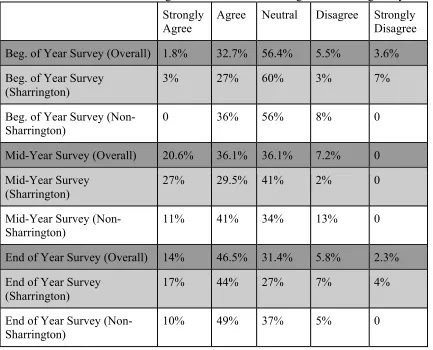
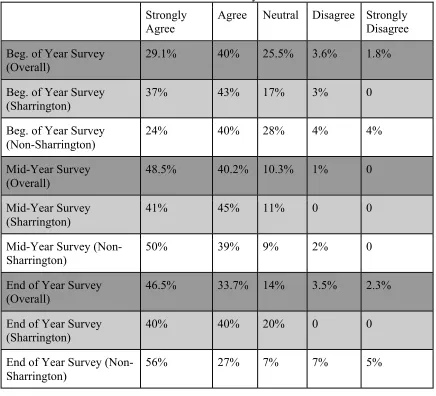
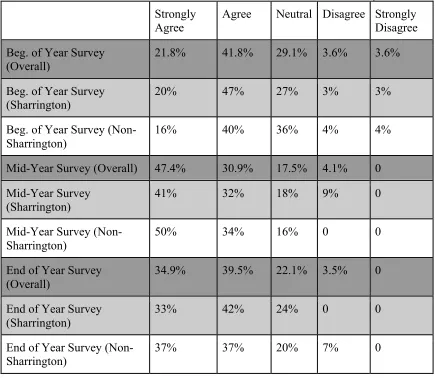
Table 10 Statement – I like finding connections between things I am learning in my classes……….………. 60
Table 11 Statement – I like to communicate with my classmates……….……… 61
Table 12 Statement – I feel that I learn best when I can communicate with my classmates……….………. 62
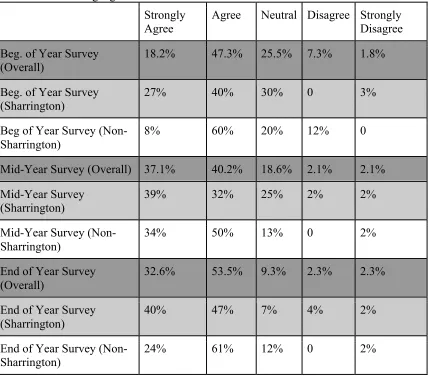
Table 13 Statement – I believe there is a connection between what we learn in social studies and what we learn in language arts……….……… 63
Table 14 Statement – I think I understand social studies better if there is a connection to language arts……….……… 64
1
CHAPTER 1 Introduction and Rationale
This action research project seeks to determine the impact on students in terms of growth
and experience when English language arts (ELA) and social studies (SS) are co-taught with an
interdisciplinary focus in a middle school context. This study will examine the effect on students
at all achievement levels--specifically struggling students (low achievement), average students
(medium achievement) and students who excel in the classroom (high achievement).
The initial reason for engaging in this study was the lack of time in our school’s eight
period schedule. Because our school is a gifted and talented magnet school, Martin Middle
students take four core classes and three elective classes each day. This results in 46 minutes
with each class, five days a week. A 46-minute class period tends to go by very quickly and often
makes it difficult to engage the class in an in-depth lesson. Teachers at my school find
themselves scrambling to fit in an entire lesson--trying to quickly move through the more basic
concepts in order to get to activities which require students to think critically. More often than
not, just as soon as students begin to get engaged or excited about something they are working
on, the bell will ring and they have to leave. As a result, students will begin an in-depth lesson
on day one and then return to it on day two, but this interruption can sometimes result in a lack
of student engagement and enthusiasm. When talking to the social studies teacher across the hall
in between classes one day, I realized that I was not the only teacher constantly fighting against
the clock in my classroom. This conversation started a series of conversations, which resulted in
our idea to co-teach ELA and SS. By co-teaching ELA and SS, we could have a 92 minute block
to work with both subjects, which would allow for a deeper exploration of the content without
2
The concept of co-teaching is not new in education or even at the school where I work.
However, what I have discovered about co-teaching, and what most educators will tell you, is
that it has many different variations. Depending on who you’re speaking to, co-teaching can
either be a blessing or a curse. At its most basic, co-teaching is when two teachers take
ownership of student learning in a given subject area. At my school, the most common
co-teaching practice is a partnership between an ELA or math teacher and a special education
teacher. Co-teaching an ELA and SS class was a new concept at my school, and we had to
convince our principal that changing the schedule to accommodate for the co-teaching would be
worthwhile, and that meant doing some research.
Prior to this study, I looked at several different co-teaching frameworks (which I will
discuss in my review of literature) in order to determine a model that would work best for my
co-teacher and me. When deciding on a co-teaching model, we took into account both the space we
had in our classrooms and also the number of students in the co-teaching cohort. In early
August, we found out that our cohort would be comprised of 54 students who were scheduled
with ELA and SS back to back. Each student would travel with the same group within the cohort
to both their ELA and SS classroom. My co-teacher and I had classrooms directly across the hall
from each other; however, neither room was big enough for all students to be in the same room
at one time. The only space in our school that was big enough to have all students together at the
same time was the media center.
After taking all of this into consideration, we decided that in our model we would
primarily be teaching half of the students at any given time in our respective rooms. On a few
occasions, we went to the media center and both taught together at the same time in the same
3
hear us. After making this discovery, we decided to primarily teach in our own rooms. At times
we taught identical lessons throughout the 92 minute block and the students stayed in one room.
Other times we taught coordinated lessons that were different but flowed together and had the
students switch classrooms at the 46 minute mark. Occasionally we taught unrelated lessons and
the students would attend both classes.
During the 92-minute block, my co-teacher and I frequently came into each others’
classrooms to see how things were going and to check in with the other half of the cohort.
Neither one of us had any issue with the other teacher spontaneously popping in during a lesson,
and occasionally my co-teacher and I decided to switch rooms and keep the students in the same
location. Thus, the students had the impression that both teachers carried equal weight in both
subjects. I was frequently asked “SS” questions and my co-teacher was frequently asked “ELA”
questions. Additionally, my co-teacher and I made sure to have identical procedural policies.
This helped the students to understand that, even though we were not in the same room at the
same time, we were a united team and held the same expectations for our students.
As I mention above, the initial conversation to co-teach SS and ELA began over
frustration about the short class periods. This shared frustration may have been coincidental, or
it may have been due to the similarities between the 8th grade ELA and SS curriculums. In 8th
grade, the ELA curriculum map explores many of the same topics as the SS curriculum, leading
to an easy combination of the two subjects. Additionally, the skill focus in both ELA and SS is
reading complex informational texts and answering text-based questions. The ease of combining
the curriculums made the co-teaching of ELA and SS a natural fit. I hypothesized that by giving
students more time with the two subjects, and by reinforcing ELA skills and social studies
teacher-4
made assessments when compared to students in traditional, non-teamed classrooms.
Additionally, I believed that students in the co-teaching cohort would have a more positive ELA
and SS experience due to the family environment created by the team-teaching approach.
When conducting my preliminary literary research for this study, I discovered there to be
a gap in literature that exists discussing the effects of co-teaching on students. At the start of my
study, I was trying to decide between looking at the effects of co-teaching on teachers or
students. While there have been numerous research studies done on the subject of co-teaching
SS and ELA, there have been no conclusive results on the effect that co-teaching has on students.
Most studies have, instead, focused on the effect co-teaching has had on teachers, the factors
that contribute to a successful co-teaching partnership, or how to successfully integrate two
curriculums.
Given the gap in the research literature, I decided to study the effects of co-teaching on
students. I realized that as a teacher-researcher, I have access to a large number of students on a
daily basis that many researchers at the university level do not have. As a teacher, I have access
to student growth scores on both standardized and teacher-made assessments. This information is
not typically shared with the public due to student confidentiality. While I maintain student
confidentiality throughout this study, I did have access to data that other researchers do not. This
provided me with the opportunity to take a close look at not only overall growth averages, but
growth averages for specific groups of students -low achievers, average students, and high
5
CHAPTER 2
Review of Relevant Literature
In my review of relevant literature on interdisciplinary co-teaching I found that the
research predominantly refers to this type of co-teaching as an interdisciplinary team. Crow and
Pounder (2000) state that interdisciplinary teacher teams “are designed to create work
interdependence and increased self-management, increasing members responsibility for the
group's performance and outcomes” (p. 217). While Crow and Pounder use the term “teacher
teams” rather than co-teaching, this is the theory my partner and I subscribed to at the onset of
the study to inform our efforts. We approached the combining of our subjects as an
interdisciplinary team in which both teachers had a common goal of increased student growth on
both standardized and teacher-made assessments. We also shared the goal of creating a
family-like environment in which students would feel more comfortable in their learning. Having
shared common goals filtered down into other aspects of our implementation which is discussed
in more detail later in this paper.
Applebee, Adler, and Flihan (2007) proposed the idea that interdisciplinary
instruction--or co-teaching with a teacher from a different discipline--exists along a continuum of
engagement. They suggest that the continuum begins with correlated curriculums, in which each
subject (English, social studies, math, science) is still taught as a distinct subject, but two or more
subjects may decide follow a similar timeline, such as chronological. An example of a correlated
curriculum would be an English class reading Night by Elie Wiesel, a book about a man’s
survival of the Holocaust, while World War Two is being studied in history class. In a correlated
curriculum, these two topics are related however the instructors make no direct or overt
6
curriculum, “important concepts are are sometimes overtly shared across disciplinary fields,
although discussions continue to be located within one or another of the independent disciplines”
(p. 1006). An example of this would be studying the Civil War and talking about specific figures
and assessing if they were risk takers in history class. Then, in English class, having the students
write an argument essay on a Civil War figure that they believed was a risk taker. In the social
studies class, students would discuss the content to be used in the paper, while in the English
class students would discuss how to organize and craft the paper with both classes making
purposeful connections to the shared topic. The last type of interdisciplinary curriculum on the
continuum is the reconstructed curriculum, which is the most integrated. Reconstructed
curriculums, “merge concepts and understandings across disciplines in order to create curricular
conversations that go beyond disciplinary boundaries” (p. 1006). In other words, lines between
distinct subjects are blurred and the curriculums are fully merged with each subject acting as a
lens by which the student can view an over-arching issue. An example of this type of instruction
would be to have students engage in a project-based learning activity in which they had to assess
community needs and create a service project that addresses those needs. This activity would
have components of the civics classroom and the English classroom embedded in it however,
there is no distinct line between what is the civics part and which is the English part of the
project.
Nikitina (2006) also discusses the different approaches teachers can take to
interdisciplinary curricula. However, she goes a step further to suggest that different approaches
are more suitable for different subject areas. The first approach is contextualization, which is
defined as “embedding knowledge in history, culture, philosophical questions, and personal
7
humanities as a means of finding broad connections between curriculums. However, its
drawback is that connections between curriculums are not based on “proof” but rather are
“arbitrary and speculative” (p. 268). The second approach, conceptualizing, is an
interdisciplinary practice geared more toward the sciences and maths, and is designed to look at
“underlying concepts” of each discipline and how they relate to each other (p. 261). A strength
of this approach is that the connections between the two disciplines are undisputable. However,
a drawback is that the connections are not as broad as they are with contextualization. Instead
they are limited to specific events (p. 261-263). Finally, problem-centering is an approach of
looking at problem “as an axis of connection among disciplines” (p. 263). In other words, using
two or more disciplines to approach and solve a real world problem. A strength of this strategy
is that, like contextualization, problem-centering is also far reaching. However, a drawback is
that often time pressures and urgency may make it difficult for students to have the time
necessary to explore the breadth of these connections, since the goal of this type of
interdisciplinary instruction is to produce a real-world solution to the problem.
Both Applebee, Adler, and Flihan (2007) and Nikitina (2006) provide a theoretical basis
for how to begin constructing an interdisciplinary approach to curriculum. Both studies look at
interdisciplinary instruction as a fluid and dynamic, suggesting that it may evolve over time as
instructors become more familiar with each other and continue to redefine their expectations.
While Applebee, Adler, and Flihan (2007) cite the instructor’s mindset to be the main
determining factor in how a curriculum will be structured, Nikitina (2006) suggests that the
content of the course will drive the structure of the interdisciplinary approach.
In addition to looking into the theoretical approaches of interdisciplinary instruction, I
8
Mosier and Wagner (2006) looked at the approach at the elementary level and found that to
successfully integrate language arts and social studies curriculums it is important to first study
the two curriculums separately and identify gaps in either that need to be filled. They then
suggest identifying big ideas or core concepts that overlap with the two content areas. Finally,
they suggest using the Understanding by Design framework suggested by McTighe and Wiggins
(2004) as an important scaffold for creating units. In this framework, teachers develop units by
first posing essential questions and determining the learning goals and assessments and then
creating the accompanying lessons and activities.
At the middle school level, Turk, Klein, and Dickstien (2007) suggest integrating
language arts and social studies curriculum primarily through studying historical literature.
While this article is not a case study, but rather a theoretical approach to integration, the authors
do present a rationale for using Shearman Alexie’s Reservation Blues to integrate the language
arts and social studies curriculum. Turk, Klein, and Dickstien (2007) suggest five strategies for
integrating literature into the context of a history or social studies class including: era driven,
theme based, essential questions, identity driven, and literature based strategies (p. 398-399).
Era driven integration suggests using the factor of time to select a piece of literature. The
authors say the term “era’ may refer to the time period in which the piece of literature was
written, the period about which a piece of literature deals, or the time period when the book
might have been widely read” (p. 398). Themebased integration suggests using a theme, such as
immigration as the basis for a novel selection, while the essential question approach suggests
creating first, an essential question, and then selecting a novel that will help to answer that
question. The identity driven approach suggests choosing a group of people to focus on, such as
9
Finally, a literature based approach suggests picking a novel based on its literary merits alone,
however, Turk, Klein, and Dickstein (2007) do not explicitly explain how this would then relate
back to the history curriculum.
While Turk, Klein, and Dickstien (2007) provide a good rationale for including literature
in the history classroom, I found their approach to be rather limited in terms of creating an
interdisciplinary curriculum. Including literature in the context of a history classroom is a
strategy that can and should be a part of interdisciplinary teaching, however, it is merely one
strategy that can be used. To fully integrate the curriculum, I found the big ideas approach
suggested by Mosier and Wagner (2006) to be more comprehensive. By first identifying the big
ideas -- or essential questions -- that connect the two curriculums, instructors can then decide
how to go about addressing these questions or ideas, whether it be through a literature study or
by using another approach such as project-based learning, paideia seminars, or any number of
meaningful learning experiences.
Perhaps one of the most influential pieces in the creation of my own research was an
action research study conducted by teacher-researchers Haring and Kelner (2016). In this study
the two teachers discuss their implementation and experience with co-teaching ELA and SS in a
7th grade classroom. They cite the implementation of Common Core curriculum as the impetus
for considering the co-teaching approach. In their co-teaching experience, Haring and Kelner
(2016) focused on specific projects throughout the year that combined ELA and SS standards.
What was particularly helpful to my own planning was the discussion of the successes and
challenges that they faced with the co-teaching model. Haring and Kelner (2016) make
10
creating a common language between the classrooms, combining class-time based on the project
demands, and making time to plan together a priority (p. 71-72).
The recommendations provided by Haring and Kelner (2016), echo those suggested by
Applebee, Adler, and Flihan (2007) after they conducted a series of case studies on eleven
different c0-teaching teams. Namely, the authors suggest that for an interdisciplinary team to be
successful the teachers involved must be willing and eager to participate in the co-teaching team
because it takes a lot of time, flexibility, and planning to successfully implement a co-taught
curriculum. In a related study, Crow and Pounder (2000), present a case study in which a school
is in its first year of implementing a team teaching approach. They cite lack of time for planning,
little to no leadership, scheduling considerations, and a disproportionate input of all team
members as the main reasons why the interdisciplinary teams fail (p. 248).
One of the few studies that addresses the effect of interdisciplinary teaching on students
is Ellerbrock (2012), who attempted to determine the effectiveness of interdisciplinary teaming
in meeting the developmental needs of ninth-grade students. In her study, Ellerbrock looked at
three large urban high schools that created a freshman academy team in order to better serve
student populations, reduce the risk of dropout, and create a supportive environment for both
students and teachers. Ellerbrock determined that teaming was very effective for teachers who
felt a sense of support and community from the other teachers on their team (p. 56). However,
because the teams weren’t “pure,” meaning the teamed teachers did not have all of the same
students, most students did not even realize they were teamed. The study shows that while kids
felt close to their teachers, and the data shows that students performed well when teamed, the
students, themselves, didn’t see a real difference between being on team or off team as most
11
to determine the effect of team teaching on students--is inconclusive with regard to students. As
can be seen from this review of literature, the impact of co-teaching on students is not
12
CHAPTER 3 Methodology Research Purpose and Context
The purpose of this study is to determine how interdisciplinary co-teaching in an ELA
and SS classroom would affect student experience and growth at all achievement levels: high,
medium, and low. For the purpose of this study, student growth is defined as improvement on
standardized assessments, as well as improvement on teacher-made assessments. I chose to use
an action research approach because it is particularly suited to the teacher-researcher and is
generally used by educators who are studying their own students. In action research, the primary
role of the researcher is actually that of a teacher. This is in contrast to other research models in
which the researcher's primary role is research.
As a framework for my study, I used the points of purpose for conducting action research
as outlined by Koshy (2010). They are:
• Action research is a method used for improving educational practice. It involves
action, evaluation and reflection and, based on gathered evidence, changes in
practice are implemented.
• Action research is participative and collaborative; it is undertaken by individuals,
with a common purpose.
• It is situation-based.
• It develops reflection based on the interpretations made by participants.
• Knowledge is created through action, and at the point of application.
• Action research can involve problem-solving, if the solution to the problem leads
13
• In action research findings emerge as action develops, but they are not conclusive
or absolute. (pp. 2-3)
This framework provided the best fit for my overall objectives for this study because I was able
to modify and adjust my study as new information was collected. This allowed me to implement
new strategies and techniques throughout the process, which resulted in a better educational
experience for my students.
According to Koshy (2010), action research originated with Kurt Lewin’s research in the
mid-1940s and evolved throughout the 1970s in the United Kingdom with the research of
Lawrence Stenhouse and others (p. 3). In the United States, action research came about
primarily through the work of universities and classroom teachers who wanted to take a
pedagogical approach to curriculum development (p. 4).
In undertaking an action research project, I first reviewed several action research models,
all with the basic aspects of planning, implementing, revising, re-implementing, and reflecting.
In my action research, I most closely followed the models presented by Kemmis and McTaggart
(2000) and O’Leary (2004). Kemmis and McTaggart (2000) suggest a spiral model in which the
actions of planning, acting and observing, reflecting, and revising repeat themselves infinitely as
a spiral would (as cited in Koshy 2010, p. 4). O’Leary (2004) presents an action research model
that is cyclical, and is very similar to Kemmis and McTaggart’s spiral model, with the main
difference being the division of action and observation, and the removal of the explicit revision
step. Rather, they label this step “plan” and it is implied that this plan will include a revision of
the previous plan. Koshy (2010) notes that O’Leary’s (2004) cycles “converge towards better
situation understanding and improved action implementation” (p. 7). In my action research, I
14
on my own observations and reflections and those of my co-teacher to formulate new strategies
and implement new plans.
Action research was particularly suited to my plan because it allowed for constant
revision and improvement within the process and did not follow such a rigid research pattern.
This allowed for my co-teacher and I to move from a what Applebee, Adler, and Flihan (2007)
defined as a shared curriculum at the beginning of the year to a reconstructed curriculum at the
end of the year. Additionally, the action research model was well-suited to this project due to its
duration. It took an entire school year to track student growth. As any teacher can tell you,
students change and develop throughout the year and what worked in September often needs to
be modified in May. Approaching this project with a model that did not provide for revision
would have been counter-productive.
For the many positive aspects that are present in the action research method, there are
some drawbacks. First, as a teacher researching her own students, there is inherent bias present
in the study. It is impossible for a teacher not to form some sort of relationship with students
(whether positive or negative) throughout a school year. That relationship will affect how the
researcher views results, makes adjustments in instruction, and can particularly affect the
interpretation of qualitative data. As such, I made sure to incorporate both quantitative and
qualitative data into my study. The purpose for doing this was to have data that gives some
concrete numbers and percentages that can be analyzed with as little bias as possible.
School Demographics and Participant Sample
This study took place in one 8th grade ELA and one 8th grade SS classroom. The school
is set up as a middle school, serving grades six through eight. According to the Wake County
15
1,017 students enrolled with 347 in the eighth grade. The school had a 25.5% free and reduced
lunch population and 4% Limited English Proficiency. In the eighth grade, 39% of students
were identified as academically or intellectually gifted (AIG). The school is located in Raleigh,
NC, inside the city limits and draws a majority of their student population from the surrounding
neighborhood and a satellite base located in Southeast Raleigh. Additionally, the school has a
Gifted and Talented Magnet program, which draws a small percentage of students from Cary,
and the western half of North Raleigh. In the 2016-2017 school year, the school’s demographic
breakdown was as follows: 0.3% American Indian, 10.2% Asian, 16.2% Black, 12.3% Hispanic,
0.1% Pacific Islander, 3.4% two or more races, 57.4% White.
Sharrington Cohort: In total, 54 students were in the co-teaching cohort, with students moving between the ELA and SS classroom. This group of students became known as the
Sharrington group, a name they gave themselves by combining the last names of me and my
co-teacher. The schedule was set up so that students in the test group took SS and ELA
back-to-back with a 46 minute lunch period in between. The students were “teamed” for ELA and SS
only (math and science were not teamed). The total time of instruction was 92 minutes
Monday-Friday. Depending on the day’s agenda, students spent an entire 92 minutes in one classroom, or
switched classes at the bell. Students were routinely switched between the two classes as
different grouping combinations were used. For example, a student who began in 5th period
ELA, may have -- at some point during the course of the year -- been put in a group and asked to
attend 5th period SS and 7th period ELA for a short duration of time. Since the students were
organized into cohorts, there was no risk of missed instruction when students switched classes.
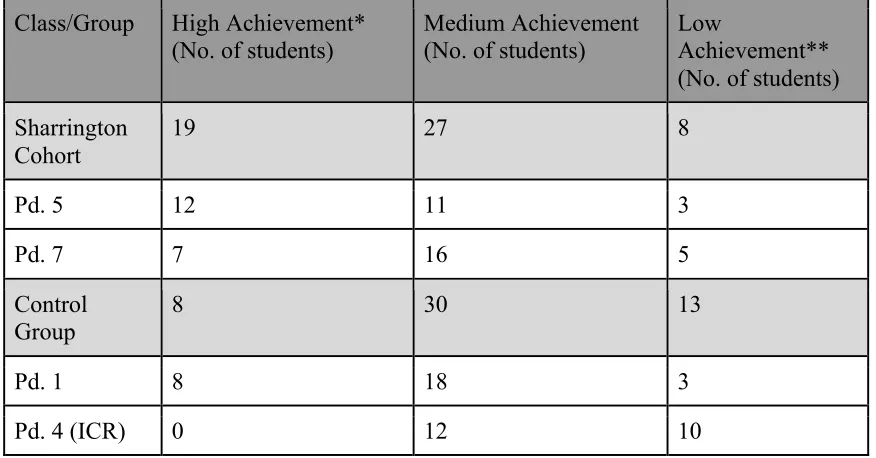
In the Sharrinton cohort, eight students were in the low achievement group. This
16
least two levels below grade level. These students continually scored at least two grades below
grade level on three standardized benchmarks (iReady reading assessments) given throughout the
year. Nineteen students in the cohort were determined to be AIG (academically and
intellectually gifted) in ELA at either the strong or very strong level. This determination was
made based off of four standardized assessments given to students in third grade. Those are the
IOWA, CogAt, the Woodcock Johnson, and RIST 2. These four assessments determine if a
student is academically or intellectually gifted and are usually only given once in a child’s
academic career. For the purposes of this study, these students made-up the high achievement
group. Finally, twenty-seven students had no label, and have consistently tested on grade level
on their EOG standardized assessments. These students were placed in the medium achievement
group.
It is important to note that these groups were created for the purposes of data analysis
only, and do not necessarily reflect the overall growth or potential of the student. This label is
merely an assessment of the achievement level of the student when they entered eighth grade -
-not their growth potential.
Control Group (un-teamed): The control group was comprised of students from my first and fourth period classes. Some of these students also had my co-teacher for social studies,
but that number was very small. There were no cross-curricular assignments planned for this
group, rather they followed the same curriculum as the rest of the grade level. At times, this
meant that the control group and Sharrington cohort were doing different activities. The makeup
of the control group was slightly different than the Sharrington cohort, namely because the
control group contained my ICR (in class resource) class. This class caters to students with IEPs
17
may be placed in these classes. As such, there is a higher number of low achieving students and
lower number of high achieving students in this control group. This group had a total of 51
students. Of those 51, thirteen were in the low achievement group, 30 in the medium
achievement group, and eight in the high achievement group. In an effort to compare the two
groups, percentages and averages have been used to analyze the data. This was done to account
for the differences in numbers per achievement group in the control group and Sharrington
18
CHAPTER 4 Implementation
The planning for this research began in the summer of 2016. My co-teacher and I began
our work by familiarizing ourselves with each other’s curriculums and looking for areas of
overlap. As suggested by Wagner and Mosier (2006), the curriculum mapping for
interdisciplinary co-teaching should emphasize, “a focus on topics, activities, literatures and
assessments all anchored by relevant big ideas and core concepts that overlap and transcend both
content areas” (p. 9). My co-teacher and I sat down with our respective curriculum maps
provided by Wake County (CMAPP) and our state standards (at the time of this study, the North
Carolina Common Core State Standards for ELA and the North Carolina Standard Course of
Study for SS). We identified areas of thematic overlap in the ELA and SS curriculum and
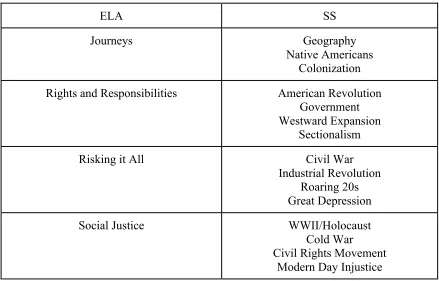
determined that in ELA there were four themes apparent in the curriculum map provided:
journeys, rights and responsibilities, risking it all, and social justice. We then filled in the SS
content areas that corresponded with each theme in the ELA curriculum. We created the below
19
Table 1: Curriculum Map
ELA SS
Journeys Geography
Native Americans Colonization
Rights and Responsibilities American Revolution
Government Westward Expansion
Sectionalism
Risking it All Civil War
Industrial Revolution Roaring 20s Great Depression
Social Justice WWII/Holocaust
Cold War Civil Rights Movement
Modern Day Injustice
We also identified our major goals for the upcoming year. First, we wanted to have
students participate in a service learning project where they could give back to the school and
community. Second, we wanted to focus on discussion skills and discussion based learning
activities such as Paideia seminars. Third, we wanted to create a team or family like
environment for our students. It was our belief that if students felt like their teachers cared and
that they were part of a group of peers that cared for them they would perform at a higher level
academically. Fourth, we wanted to focus on students’ written ability to answer questions
completely using evidence from the text to support their claims. Finally, we wanted to move
toward a completely reconstructed curriculum.
Once the school year was underway and before starting any integrated curriculum
20
identity. To do this, we used the 46 minute lunch period that broke up our 92 minute block.
After eating lunch, students participated in a series of ice-breaker activities to help them get to
know each other. During these activities, my co-teacher and I also participated. Our
participation showed our students that we were also part of this group and allowed our students
to get to know us as well. By sharing with students in this fun, low-pressure way we were able
to begin creating an environment in which students felt comfortable with us. Taking this time to
foster a sense of community within the cohort resulted in the students coming up with the
Sharrington name for their group. Throughout the year, this gave them a sense of identity that
was apparent not only to them but to other teachers and students in our building.
My co-teacher and I decided that we would stress a unifying academic concept at the start
of the year in both classes. The concept we chose was the APE (answer, prove, explain)
paragraph model. This addressed our fourth goal of improving students’ written responses.
Because students do a lot of writing and responding to text in both ELA and SS, we felt this
unifying concept would provide some cohesiveness to our group as well as provide a good
written-response model for students to follow. Additionally, this unifying academic concept
directly related to both the ELA and SS curriculum. To implement this unifying academic
concept in both classrooms, each teacher taught the concept in her respective classroom, students
heard the term being used by both teachers, and the use of APE paragraphs was included in
directions for assignments and on rubrics for both classes. Additionally, at the front of each
classroom were posters explaining the APE acronym. These posters contained identical
information and further reinforced the unification of the two classrooms.
One of our shared goals was to create a completely integrated or as Applebee, Adler, and
21
small. Co-teaching was a new experience for us both, and while we had the same goals and
objectives, our teaching styles were slightly different. We knew that, in addition to learning each
other’s curriculums, we would need to also learn more about each other’s teaching styles. For
our first co-taught activity, we had students engage in a discussion about food deserts. This
related to the SS curriculum in terms of content, and the ELA curriculum in terms of skills. We
decided to put the entire group of students together in the media center with both teachers
present. My co-teacher and I thought that this would help us to better align our teaching styles to
each other. We also asked the AIG teacher -- who had participated in a co-teaching classroom
the year prior -- to assist us with this project. We thought that having her as a third co-teacher
would help us to avoid some of the co-teaching pitfalls. As a class, we read and annotated an
article about food deserts. Once this was completed we brainstormed norms for a good small
group discussion. Finally, we broke into three small groups and had a co-teacher with each
group. We then broke down our groups of 16 into four small groups of four and each co-teacher
monitored these small groups as they discussed the food desert article.
It should be no surprise that this first co-teaching venture did not go smoothly. While
there were some positive outcomes -- for example the establishment of group discussion norms --
there were even more areas for improvement. After reflecting with my co-teacher, we realized
that the inclusion of a third teacher in the mix was too much. We quickly discovered that what
had worked in another co-teaching relationship would not necessarily work for us. The inclusion
of the third teacher brought in a new dynamic that made it hard for my co-teacher and I to figure
out how to work together. Had we included this third teacher later in the year, after we had
already established a rhythm and process, it might have worked better, however at that early
22
we needed to work on establishing a rhythm between the two of us before inviting others to
collaborate with in the future.
A positive outcome of this first activity was that we established the process of requesting
feedback from students about the activities that we did in the classroom. We used a feedback
form (see appendix G) to get feedback from students about the first integrated project.
Overwhelming the student feedback showed that having all 54 students together in one room
was too much. Students felt that it was too easy to get distracted or off task and the acoustics in
the room made it hard for all students to hear what the teachers were saying. Students reported
that they had missed parts of the instructions that were given beforehand, and then were confused
when it came to completing the discussion. Finally, students did not like the inclusion of the
AIG teacher as they sensed that it threw off the rhythm that had started to be established between
me and my teacher. The feedback that the students provided was similar to what my
co-teacher and I had concluded in our own reflections.
My co-teacher and I used this first collaboration as a learning opportunity. We decided
that if we were going to have all the students together in one room we needed to be more
strategic. We also realized that it might be more beneficial to teach the same thing in each of our
rooms -- situated across the hall from each other -- rather than try to both teach at the same time
in one large room. We became comfortable with the fact that, while our teaching styles may be
slightly different, our objectives were very similar, and we began to trust each other to deliver
information for the other -- a crucial step in our development as co-teachers.
The next collaboration was a debate about Christopher Columbus. Again, this project
integrated content from the SS curriculum with skills in the ELA curriculum. Students began by
23
to debate who was to blame for the mass murder of the Tainos and if we should honor
Christopher Columbus with Columbus Day. My co-teacher and I used the lessons we had
learned in the first activity to make improvements to the setup of this debate. Debates were held
in each classroom with both teachers monitoring the discussions and moving between
classrooms. With the teachers moving between classrooms, it helped us to notice the differences
between our two classrooms. What we noticed was that one classroom was very rigid and
orderly. In this room, students were speaking one at a time but without a lot of passionate
engagement. The other room was loud and chaotic, with students speaking frequently --
sometimes at the same time -- but in a very passionate and engaged way. At the halfway mark of
the block, students switched classrooms and continued their debates. Again, the classrooms
looked very different. This gave both the students and the teachers an opportunity to see the
different styles of instruction.
After the debate, we collected feedback from students. The students had the advantage of
being a part of both classrooms for an entire period and had observed the differences in the two
debates. Overall, the feedback we got from students was that there were pros and cons to the
environment in each classroom. This helped my co-teacher and I to identify areas of strength
and improvement for each approach, and allowed us to begin modifying our teaching styles to
more closely resemble each other. We also used the Columbus debate as our first opportunity
for co-grading an assignment. We each took one class and graded the assignment. Afterword,
we compared grades and looked at a few of the assignments together. Fortunately, with the help
of a clear rubric, our grading on the assignment had been nearly identical. With that hurdle out
24
As mentioned above, a goal we shared was to have the students engage in a
service-learning project. We were fortunate in that we had the opportunity to complete two service
learning projects during this study. The first was a Fall Festival that the students planned and
hosted for students in the SPMD (severely/profoundly mentally disabled) program at our school.
Prior to the festival, students underwent a training hosted by our SPMD teacher to help them
know how to best assist our students and their various needs. During the festival, students in our
cohort either ran one of the festival stations or signed up to be a buddy for a SPMD student,
which meant ushering them around the festival and helping them with the activities.
After the festival, we used a discussion format to get student feedback about the event.
The feedback was overwhelmingly positive. Students reported that they had gained an
appreciation for giving back and helping those students who don’t often get to do things outside
of their contained classroom. Many students admitted that before the festival they had been
afraid to speak with the SPMD students, but that they now felt more comfortable with these
students and planned to visit the SPMD classroom when they could. Students also reported
feeling a stronger sense of team identity after this project.
At the start of second quarter, we decided that our next collaboration would be a Paideia
seminar that focused on the Bill of Rights. Again, this activity integrated content from the SS
curriculum with skills from the ELA curriculum. For this activity, we decided that each teacher
would teach the same thing at the same time but in her respective room. Students were first
introduced to the Bill of Rights by analyzing the actual document itself using close reading skills
(an ELA standard) and a graphic organizer to break down the amendments. Next, students
completed research to prepare for their seminar. For the research day, we decided to have
25
bell. Finally, a seminar was conducted in each classroom with each co-teacher leading a
seminar. For this seminar we decided to mix-up the students from their original classes to allow
them to work with students from the other section of the cohort. This was the first time we did
this and we weren’t sure how it would go, but were pleasantly surprised to find that the students
were very receptive to the mixing of the classes and doing so helped to enhance the
conversations. During the seminar, students spent forty-six minutes in the inner circle, with
outer circle participants observing a partner from the inner circle. Halfway through the seminar,
there was a break for coaching where outer circle observers gave tips and helped to coach their
inner circle partner. What was interesting about this process is that students chose partners very
easily and did not necessarily pick someone they were friends with but instead partnered
someone they could easily see from where they had chosen to sit. The coaching proved to be a
valuable aspect of the seminar and most students greatly improved during the second half of the
seminar. During the second forty-six minute block, the two circles switched and students
switched classrooms. This ensured that all students had a turn in each circle, and also allowed
them to experience a seminar in each classroom with each teacher.
After this experience, my co-teacher and I met to discuss how things had gone in the
seminar. As hoped, we realized that we had become more unified in our teaching styles. To do
this, each teacher had made a conscious effort to identify areas where we could each improve
and where the other was strong. In turn, we each modified our practice to mimic the strengths of
the other teacher. This practice is something we did throughout the year and doing so helped us
both to become stronger teachers.
In November, we noticed that many students had mastered the APE paragraph format
26
were still struggling with this written response format. Since mastering the APE response format
was one of our shared instructional goals, we decided to host an APE writing workshop for those
eighteen students. We held the remediation in one classroom, and provided an enrichment
activity for the remaining students in the other classroom. This flexibility for remediation
proved to be a big benefit to the Sharrington cohort model. After the remediation workshop,
nearly every student who participated in the workshop significantly improved on their next APE
writing assignment.
By December, my co-teacher and I had identified thirteen students that continued to
struggle in our class. We decided to reach out to the parents of those students to set up mid-year
conferences. We were able to set up conferences with eight of the students’ parents. Of the
parents that we met with, about two-thirds of those students showed great improvement after the
meeting. For those students who continued to struggle, we had opened a line of communication
with the parents, and had an easy time working with them throughout the rest of the year. A
second attempt was made to schedule conferences with the parents we were not able to meet
with, however, we were unsuccessful in doing so. For those students whose parents we met
with, this helped to foster the sense of a family or team environment. Since we met with the
parents together, and provided feedback based on the performance in both classes, this helped to
firm-up the perception with parents that their child had a team of teachers.
After the winter break, we decided to do a seminar about the Standing Rock protests.
Over the break, Standing Rock had become a big news story and we wanted to give our students
a chance to interact with an issue that was current. We linked this activity with the SS
curriculum since they were studying the Trail of Tears at that point in the year. As part of
27
Diary of a Part-Time Indian, which linked literature with history as suggested by Turk, Klein,
and Dickstien (2007). Students spent time preparing for the seminar in both ELA and SS, but
they completed different activities in each class. The SS activities had more of a historical focus,
and the ELA activities had more of a literary and current event focus. I also did this seminar
with my non-cohorted students, however, they did not get the preparation from their SS teacher
that students in the Sharrington cohort received.
As with the previous seminar, each co-teacher held a discussion in her classroom for
forty-six minutes with a break halfway through for coaching. During the second forty-six minute
block, the students switched classrooms and the two circles switched to allow every student an
opportunity to be in the inner circle and in each classroom. Again, the students were mixed up
from their original class schedule to give the cohort a chance to discuss the topic with people
they didn’t see every day. I also held two, 46-minute discussions in my non-cohorted classes,
and the discussions took place over two days. I made note in my research journal that students in
the Sharrington cohort had much deeper discussions, and seemed more engaged in the process
than students outside of the cohort.
In mid-February, we formally began our final service learning project which would
culminate in a day of service for our students. We began by having students blog about issues in
their community and brainstorming about how they could help with these issues. These blogs
were short and intended to expose students to the many issues our community faced so that by
mid-March students could select topics they were interested in for their service-learning projects.
Once students selected their topics they were put into groups based on that selection. For the
duration of this project, students were mixed between the two classes to allow for some
28
issue, and as a component of the paper, provide an action plan for a student-led service project
that would help with this issue. Research and writing for these projects took place in both the SS
and ELA classroom. After completing their research papers, students put together pitches based
off of their action plans. These pitches were presented to the school administration. The goal of
the pitch was to get administration to select their group’s project as one of the Day of Service
project options. As with the paper, planning and preparation for the pitches took place in both
the SS and ELA classroom. After the administration team selected the service projects for the
Day of Service, all students were given the opportunity to participate, and all but two students in
the cohort chose to participate. Again, this project was also replicated in the non-cohorted class.
Unfortunately, students in the non-cohorted class did not have the opportunity to pitch to the
administration team, but instead pitched to the eighth grade teachers during a team meeting. A
larger number of students outside of the cohort chose not to participate in a service project at the
end of the year (even though two projects from the non-cohorted group were included as part of
the Day of Service).
The final project that we embarked on as a cohort represented a completely reconstructed
curriculum. Goals and outcomes for both ELA and SS were identical, and the work toward these
goals was equally shared in each classroom. We called this unit Conflict post-1939 and in this
unit we integrated the study of historical literature with major historical events from the end of
WWI to current day. As suggested by Turk, Klein, and Dickstein (2007), “Literature is also a
powerful tool for integrating and highlighting voices from the past - especially those of children,
minorities, women, and the poor - that may not be those generally heard or read by students in
their historical studies” (p. 397). For this unit, students were asked to select a historical fiction
29
groups based off of the book that they chose. This, again, required a mix-up of students from
their original classes, but by this point in the year students had become very flexible and
comfortable with changing their schedule during our class block. While students in each
literature circle were not reading the same book, their books had related themes -- for example
one literature circle had five students reading books about the Holocaust while another circle had
books that focused on Cold War spies.
The book study was enhanced by a look into these topics or conflicts in SS. The
selection of topics to cover in SS was strategic, and was based off of the books that students
selected for their literature study. Students in each literature circle group were then responsible
for facilitating a seminar for their peers. As with previous seminars, discussions were held for
forty-six minutes with a break for coaching. At the end of the first forty-six minute block, the
circles switched -- giving all students a chance to discuss the topic. Unlike the previous circles
the teacher was silent during this activity, allowing the students to carry on the discussion and
stepping in only if absolutely necessary. This unit was somewhat replicated in my non-cohorted
classes. Unfortunately, these students did not receive the benefit of strategic SS instruction. The
effect was noticeable, as students in these classes struggled in discussing more current day topics
that had not been covered in their SS class such as 9/11 and the War on Terror. This unit closed
out our year, with my co-teacher and I successfully reaching a point of teaching a reconstructed
curriculum. We also met all of our goals set forth at the beginning of the year in terms of
planning and implementation.
In addition to our planned activities, my co-teacher and I spoke constantly about
upcoming projects, what we were doing in our classes, and students in the cohort. We had these
30
morning before school, or any free moment that we had. This was in addition to our planned
meeting times. This constant flow of communication allowed us to make little connections to
each other’s classroom even when it wasn’t formally planned. Students knew that if they did
something in one class (good or bad) both teachers would know about it. Showing this
awareness of what was going on in each others classroom further helped us to achieve a
31
CHAPTER 5 Data Collection
To assess student growth and experience I used four data points: EOG growth scores,
students work, student survey results, and students interviews. The EOG growth scores and
student work analysis gave me quantitative information about how students actually performed
on assessment, while the student survey acted as a quantitative data point to assess students
attitudes and experiences throughout the process. The student interviews supplemented the
students survey data set as a qualitative measure of how students experienced the process.
Having information about student perspective allowed me insight to the raw data collected from
the EOG growth scores and student work samples. Additionally, I kept a teacher-researcher
journal that I used to qualitatively reflect on the process.
Quantitative Data
I used EOG growth scores as a form of non-biased, standardized growth assessment.
After students took the EOG and scores had been processed, teachers received a report that
detailed the student’s scale score, percentile rank, and achievement level. Student growth is
measured by the percentile rank. The North Carolina Department of Public Instruction also puts
together a report that predicts what a student’s percentile score should be if they have shown
growth in a given year. This projected score is determined by a confidential algorithm.
Therefore growth scores can be positive or negative. When looking at average growth scores,
+3 percentage points is considered a large improvement, and teachers with students whose
average growth is greater than or equal to 3% are labeled as exceeding growth expectations. The
converse is also true. Teachers whose students have greater than or equal to -3 percent average
32
scores, I compared the student’s percentile score with their projected percentile score and came
up with either a positive or negative percentile difference.
Analyzing average growth scores for each group provided me with some good
quantitative data, however, it is worth noting that standardized tests do not give a complete
picture of the students and that a variety of factors; including test anxiety, lack of sleep, or
hunger; can affect a student’s performance on the EOG. By using the growth score only, I was
able to determine if, according to the test, students had made the growth expected in 8th grade.
The second data set I used was student scores on teacher-made assessments to analyze
growth. To do this, I compared average scores from two assessments at the beginning with two
similar assessments as the end of the year. The assessments were a paper and a Paideia seminar
from the beginning of the year, and a paper and Paideia seminar from the end of the year. Both
assessments had very similar rubrics, with the skills required being identical. The only
differences in the rubrics was the content covered in each assessment.
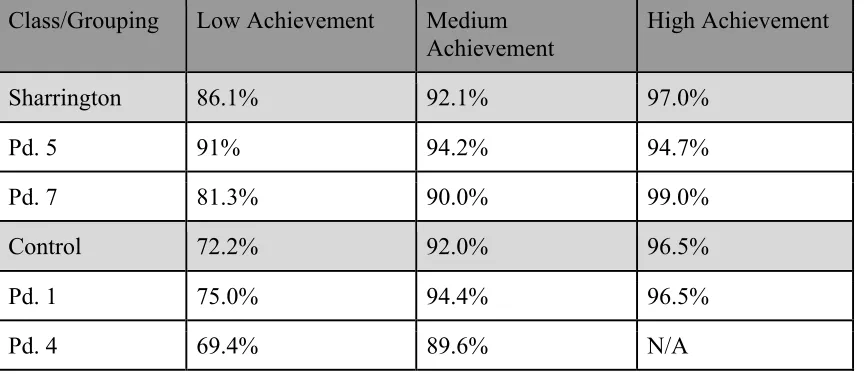
When determining growth using student work, I first averaged the scores for each
assessment, looking at both overall averages and sub-group averages (high achiever, medium
achiever, and low achiever) (See appendix C). I then evaluated the overall average increase from
the assessments at the beginning of the year to assessments at the end of the year. It is important
to note that in factoring these averages, I did not count zeros recorded for students that did not
turn in an assignment. I made this decision because turning in nothing doesn’t reflect student
growth (or lack thereof), but instead could be the result of various other factors unrelated to
student growth or ability.
When comparing the average scores for each sub-group, I considered the overall increase
33
focal point being growth and not proficiency, doing this helped to eliminate the concern over the
different numbers of students in each sub group. There is always the argument of bias in using
teacher-graded assessments to determine growth. However, since I graded each assessment that
eliminates some of the teacher bias that could be present if multiple teachers were grading an
assignment.
In addition to collecting data on student growth, I also collected data to discern student
experience. I wanted to see if there was any difference in attitudes and perception between
students in the Sharrington cohort and students in the control group. I evaluated student attitudes
through an online survey given via Google Forms (see appendix D). The survey was anonymous
and students used a Likert scale rating to show how much they agreed/disagreed with given
statements. The survey was given three times throughout the year to determine any changes in
student attitudes and perceptions.
The first survey was assigned for homework on Friday, September 9. Most students
completed the survey over the weekend, however, a few completed it on the following Monday.
A total of 55 students took the survey -- 30 students in the Sharrington cohort took the survey,
and 25 students in the control group took the survey. The Mid-Year survey was given in class on
February 17 to increase student participation. A total of 88 students took the mid year survey --
44 students in the Sharrington cohort, and 44 students in the control group. The end of year
survey was given in class on May 26. A total of 86 students took the end of year survey -- 45
students in the Sharrington cohort, and 41 students in the control group.
The analysis of the student survey concentrated solely on the statements that pertained to
the students’ thoughts and feelings towards their ELA and SS instruction. The survey results
34
percentages were categorized by cohort and were used as the basis for the analysis (see appendix
E).
Qualitative Data
Finally, I conducted seven interviews with select students within the Sharrington cohort.
For these interviews, I selected students representing each achievement group (high, medium,
and low) and used an interview protocol to gain insights on their experience within the
Sharrington cohort (see appendix F for a copy of the interview protocol). As the interviews were
being conducted, I took notes and scripted what the students said. To analyze the students
interviews, I followed Creswell’s (2009) framework for qualitative data analysis and
interpretation as it is presented in the Koshy (2010) Action Research text (p. 113). Creswell’s
(2009) framework is a six step process that includes first collecting raw data, then reading
through the data and using coding to determine themes or descriptions. Creswell (2009) then
suggests interrelating themes/descriptions with previous research or theory in order to interpret
or make meaning of the themes and descriptions in the data.
Additionally, throughout the research process, I kept a research journal where I took
notes, made plans, and recorded select observations. This journal was used for qualitative data
35
CHAPTER 6
Analysis of Data and Results EOG Growth Score Analysis
The first piece of data analyzed was the EOG growth analysis. To analyze this data, I
compared students’ projected percentiles with their actual performance percentiles on the EOG.
First, I determined the percent difference between the projected percentile and the actual
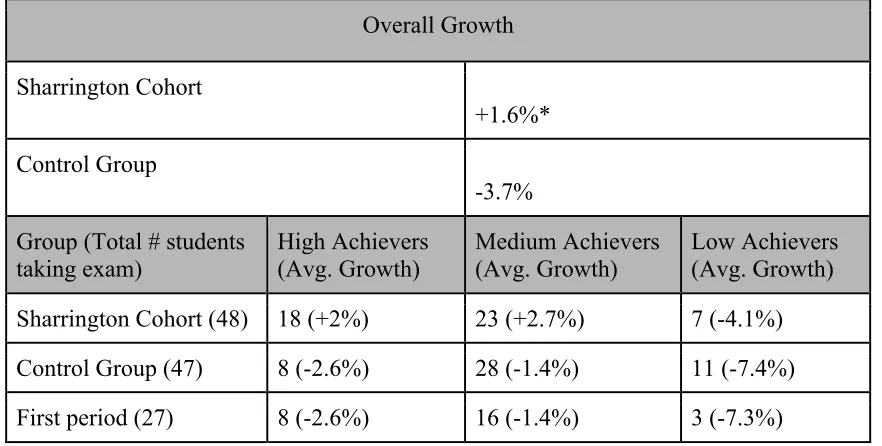
performance percentile. I then averaged these differences first by cohort and second by
achievement group. Appendix B shows the breakdown of growth based on EOG scores. The
percentile in the table represents the average number of percentage points students achieved
above or below their projected percentile.
As can be seen in appendix B, students in the Sharrington cohort overall had a positive
student growth, while students in the control group had an overall negative student growth. It is
important to remember that when looking at EOG scores an average growth of plus/minus three
percent is considered to be significant. While it would be easy to conclude from this data that
the interdisciplinary co-teaching positively impacted student growth, one must first examine the
validity of the data. While the Sharrington cohort and the control group were both
heterogeneously mixed classes, the number of high achieving students in the Sharrington cohort
is much larger than in the control cohort. This is because one of the classes in the control cohort
was an ICR (in-class resource) class. This means that students in this class have IEPs that
require an in-class resource teacher. The result of this requirement is that many of our students
with IEPs end up being tracked into this class. Additionally, it is against Wake County policy for
students who are labeled AIG to be in this class. Therefore, in the control group there is only
36
matters because the DPI predictor score has a much higher accuracy rating for high achieving
students than it does for low achieving students. What that means is that DPI is generally much
more confident in their predictor percentiles for high and medium achieving students than they
are for low achieving students. For example, a high achieving student, Student A, had a
predicted percentile of 95% with a 99.9% probability that he would score in at least the 95th
percentile. However, Student B, a member of the low achievement group, was predicted to score
in the 15th percentile, with only a 23% probability of meeting that score. Since student growth is
determined by comparing the predicted percentile to the actual percentile, it is possible that the
predicted percentile is less accurate for low achieving students. With this in mind it is hard to
make a conclusion that the Sharrington cohort positively affected student growth because there
are other factors at play. Therefore, the data was broken down by sub-groups and further
analyzed to make a more accurate determination.
The next step in this data analysis was to look at the growth averages by sub-group. As
can be seen in Appendix B, students in the Sharrington cohort that were labeled high or medium
achievers had positive student growth averages, while students in the control group that were
labeled high or medium achievers had negative student growth averages. This data more
strongly suggests that being a part of the interdisciplinary cohort does have a positive impact on
student growth. As discussed above, predictor scores for high and medium achievers tend to be
much more accurate. Therefore, by looking at the average growth at these two sub-groups alone,
it gives a more clear picture of overall student growth. All students in the study had the same
ELA teacher, and this test assesses growth in ELA. Since the primary difference between these
two groups is the interdisciplinary co-teaching, it stands to reason that this does have a positive