Removal of Artifacts in Image Using Adaptive
Neighboring Estimator Algorithm
Er.Mitika*, Er.Sukhpreet Kaur
* M.Tech Student, Dept. of CSE, SUSCET, Tangori, I.K. Gujral University, Punjab, India
H.O.D, Dept. of CSE, SUSCET, Tangori, I.K. Gujral University, Punjab, India
ABSTRACT
: Image compression is used to reduce irrelevance and redundancy of the image data to transmit data in an efficient form. Image compression is minimizing the size in bytes of a graphics file without degrading the quality of the image and it allows more images to be stored in a disk [20]. There are several different ways in which image files can be compressed. It can be Lossy Compression and Lossless compression. Although Lossy compression is very efficient, it introduces certain artifacts and noise [2].The quality of images is reduced after decompression especially if the compression ratio is high. There are many methods to reduce the artifacts [15]. This paper presents Patch Based Removal Method, Semi-Local Gaussian Process and proposed technique which is hybrid of these two algorithms and use fuzzy logic and nearest neighboring algorithm. Experimental results show that the proposed method achieves higher PSNR than both the algorithms and the processed images present good visual quality.KEYWORDS: Image Compression, Patch Based Deblocking, Semi-Local Gaussian Process, Adaptive Neighboring Estimator Algorithm.
I. INTRODUCTION
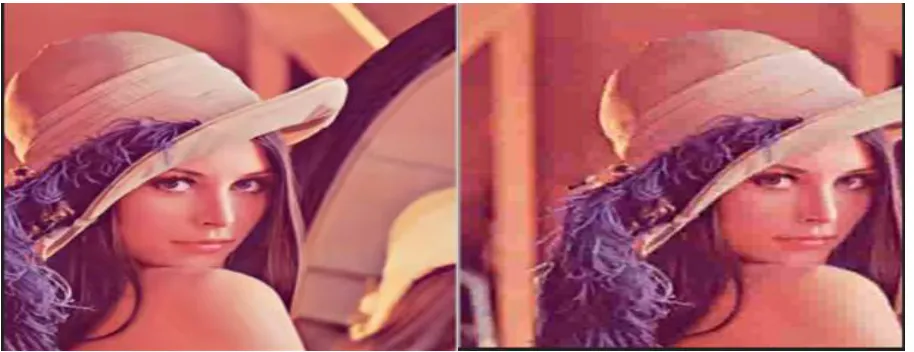
Artifact is any error in the perception or representation of any visual. Image compression is the basically reason for the artifacts [7].Different types of artifacts came when different algorithm are used for compressing the image as shown in Fig. 1.1.
II. RELATED WORK
In [7] authors focused upon the low-quality images that were usually not only with low-resolution, but also suffered from compression artifacts, e.g., blocking artifacts. It performs image super-resolution (SR) to a low-quality image, which distorted the visual quality of an image. Here, proper HR and LR image patches were compared. The main problem with this is that it didn’t properly convert low resolution to high resolution. Artifacts were removed but some cracks were left on the side edge of blocking parts and some color difference was also there i.e. lacked impainting. In [3] the authors emphasized upon patches of an image rather than the whole complete image. Before this, various difficulties found out with all the non local methods without any heuristic formulas. Here main problem was large area image impainting. In [4] it focused upon the image denoising and results were achieved using orthogonal dictionary. Here 3 patch based algorithm were used i.e. Patch Based Local PCA, Patch Based Global PCA, Patch Based Hierarchical PCA which performed thresholding on the coefficients of the patches. In [21] it emphasized that the fast patch based denoising technique was better than the patch by patch denoising and it was based upon the Geodesic Paths. Here patches of images were used and Euclidean line paths were used to connecting the two patches. Then giving weight to each patch and with the help of probabilities artifacts were removed. The main drawback of this was it was restricted to Gaussian noise, only handled the Poisson noise. In [17] authors focused upon the two techniques called LPF (Low Pass Filter) and ASLPF (Adaptive Spatial Low Pass Filter). LPF was used for only just identifying the artifacts present in the video image. ASLPF (Adaptive Spatial Low Pass Filter) was used to identify the artifacts present in horizontal or vertical position or near edges, it was converted into frames and each frame was then compared. ASLPF removed the artifacts either horizontally, vertically, or near the edges. But it produced some faded colors where algorithm were applied
III. PREVIOUS WORK
Patch based image deblocking method
Patch based image deblocking method using geodesic distance weighted low rank approximation is used by clustering similar patches, a low rank data matrix can be obtained. The singular value thresholding (SVT) algorithm is applied to solve the low rank approximation problem [1]. To compensate for the mismatch of the clustering procedure, patch based geodesic distance is utilized to weight different patches in the data matrix.
Steps:-
1. Read the original standard image.
2. For the compressed image, set patch as the reference patch and search for patches that are similar to within a neighborhood of position.
3. Apply SVT algorithm to solve low rank minimization problem.
4. Apply weighting method based on the geodesic distance to compensate for the mismatch of the clustering procedure.
5. Generate the final image.
Semi-Local Gaussian Processes Method
Instead of more time consuming training and testing of a single GP model on a large number of images, a set of sparse models are constructed at each point which is made by the corresponding sparse GP underlying global model. Gaussian processes have been used in various image enhancement problems.
Steps:-
Read the original standard image. Let I Be image data 1. Let Indata =I
2. Calculate egdePert
a) [Rmax, Gmax, Bmax] = MaxofInData (InData) AvgEpsilon = (Rmax + Gmax +Bmax) /3
ProcessData= bitor(ArgZ,abs(InData)) 3. Let sig = exp(Argz)
Apply Process and sig to Guassian process to calculate final Data.
III. PROPOSED WORK
In proposed method, first of all read an input image and then image is being compressed using any compression technique. It gives blocking artifacts after high compression. Artifacts can be removed by using Patch based image deblocking method, Semi-Local Gaussian Processes Method and proposed method i.e. Adaptive Neighboring Estimator Algorithm After that apply Unsharp Mask Filter and get the final image. The quality can be measured using the various quality metrics like MSE, PSNR, SSIM and SC.
Adaptive Neighboring Estimator Algorithm (ANE)
The algorithm, followed in order to fulfil the aim of this thesis is as follows:
Step1: Read the compressed image.
Step2: Calculate Threshold values of various algorithms.
Step 3: Apply Fuzzy logic.
Step4:Apply Laplacian α-Blending technique and generate the image.
Mathematical Computation of ANE
Let I be input image
=Patch (I)
= Gaussian Semi Local Process (I)
=Thresh ( )
= Thresh ( )
Let be blending image
Optimal =Fuzzy ( , , , )
= . --- (i)
= . ) --- (ii)
Where,
=Foreground Image
=Background Image
OutImg = +
FinalImg = UnSharp Mask(OutImg)
Flowchart Representation
ANE
ANE ANE
Load Image
Compress image
Remove artifacts blocks using
Semi-Local Gaussian Processes
Method
Start
Remove artifacts blocks using
Patch based image deblocking
method
Apply Unsharp Mask
Filter
Generate Final Image
Evaluate PSNR, MSE, and SSIM & SC
for various algorithms
Calculate Threshold values
Apply Fuzzy Logic
IV. RESULTS
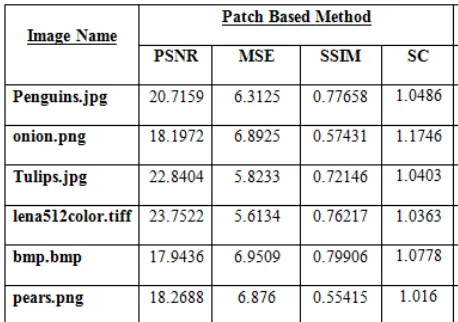
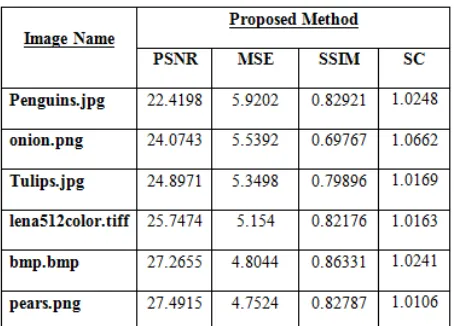
The values in Table 1 are able to show the different performance metrics by using the patch based method and the values in Table 2 shows the different performance metrics by using the Semi-Local Gaussian method and the values in Table 3 are able to show the different performance metrics by using the Proposed method which clearly shows that this image is better than above two images because PSNR value is very much high than previous two methods and error i.e. MSE value is less.These results are at 70% compressed level
Table 1: Comparison of PSNR.MSE, SSIM and SC on different compressed images using Patch Based Method
Table 3: Comparison of PSNR.MSE, SSIM and SC on different compressed images using Proposed Method
V. CONCLUSION
This paper presents a new method for artifacts removal from compressed image. Artifacts round the image degradion and the visual quality of image. Restoration method based on Adaptive Neighboring Estimator Algorithm (ANE) used to attain the good visual quality outcomes of the image. This paper successfully improves the visual outcomes of the compressed image and achieves better results than available method.
REFERENCES
[1] Account, C.,Signieee, P., Library, D., Spectrum, I., & Sites, M.”Patch based image deblocking using geodesic distance weighted low
rank approximation”, IEEE, pp.1–8, 2015.
[2] Anagha, R.”A Machine Learning Approach for Removal of JPEG Compression Artifacts: A Survey”, Vol.138 Issue.2, pp.24–28.
[3] D'angelo, E.“Patch-based methods for variational image processing problems”, Pour L'obtention DuGrade Docteur Es.Sciences,2013
[4] Deledalle, C.,Salmon, J.and Dalalyan, denoising with patch based PCA local versus global”, University Paris-Est Champs-sur-Marne,
France, pp.87-98.
[5] En,C."Hybridization of Image Enhancement Techniques: BBHE with DSIHE and Classical", IJIRCCE .
[6] Jou, I., En, O. F.,"An enhanced approach for blind measurements of blocking",Vol 37, pp.96-102, 2015.
[7] Kang, L.,Zhuang,B.,Hsu,C.,Lin,C.,&Yeh,C.“Self-Learning-Based Low Quality Single Image Super- Resolution”, IEEE,1(i), 2013.
[8] Kaur, A.“Reduction of Blocking Artifacts in JPEG Compressed Images Vol 17,pp.141–146,2016
[9] Kwon,Y., Kim, K. I.”Efficient Learning of Image Super-Resolution and Compression Artifact Removal with Semi-Local Gaussian
Processes”, IEEE transactions on pattern analysis and machine intelligence,Vol.37,Issue 9,pp.1792–1805, 2015.
[10] Pro, D. S.,“Reduction of Blocking Artifacts In JPEG Compressed Image Reduction of Blocking Artifacts In JPEG Compressed Image,”Vol
no 3. August, 2015.
[11] Quijas, J.”Machine Learning”, pp.77–80, 2014.
[12] Sachdeva, S.,“A Review on Digital Image Compression Techniques,” July 2013.
[13] Sahni, P.,“Study of Various Filtering Techniques, Genetic Algorithm and Fuzzy Logic for Reducing Blocking”, pp.10186–10193,2014.
[14] Science, C. and Studies, M. “Presence of Image Resizing,” pp. 90–101, 2014.
[15] Science,C.,& Studies, M. Approaches for Reducing Artifacts in JPEG Decompression : A Survey, 7782, pp.350–355,2015.
[16] Singh, J. (2016). A Compression Artifacts Reduction Method in Compressed Image Vol no.4, Issue 3, pp.1–5.
[17] Tec, A. I.” Performance & analysis of Blocking Artifacts Reduction using Gaussian Adaptive Spatial Low”, 68(1), 2014.
[18] Tejaswini, S. G., Ramalakshmi, M., Santhi, M., Rahul, H., & Nag, H. “Reduction of Blocking Artifacts of DCT Compressed Image
Based on Block Wiener Filtering”,Vol no.4,Issue 3 ,pp. 662–66
[19] Van Vliet, L. J. “Blocking artifacts removal by a hybrid filter method.”
[20] Verma, N. “Survey on JPEG Image Compression”,Vol no.4, Issue 3, pp.1072–1075, 2014.
[21] Xiaogang,C.,Kang,S.,Yang, J. and Yu, J.“Fast Patch-based Denoising Using Approximated Patch Geodesic Paths”, Microsoft Research,