Abstract
Dixon, William Stanley (Stan). Determining Need in A Rural County: The Case of Greene County (under the direction of R. David Mustian).
The purpose of the study was to identify the relationship between perceived needs of Greene County citizens in regard to
socio-demographic factors, community factors, and socio-psychological factors.
A survey instrument was mailed to 400 county residents, who were selected randomly from the 911 mailing list. Positional leaders (45) in the county were surveyed, from various agencies and local boards. One hundred and ninety-two usable questionnaires were returned, for a 48% response rate.
Description of variables was obtained by determining frequency distribution, perception of need by local citizens, and three sets of independent variables. The independent variables were
The findings revealed that Greene County citizens and leaders are satisfied with the county services received from the existing
departments. The primary needs of Greene County as expressed by study respondents are available quality water, advanced emergency management services and crime and safety protection.
Socio-demographic factors did not influence respondents’ perception of the three most important needs. But socio-demographic factors did
Determining Needs
in a
Rural County
The Case
Of
Greene County
by
W. Stan Dixon
A dissertation proposal submitted to the Graduate Faculty of North Carolina State University in partial fulfillment of the requirements for the Degree of
Doctor of Education
Department of Adult and Community College Education
Biography
William Stanley (Stan) Dixon was born in Clinton, North Carolina, on January 2, 1953. He was raised in rural Johnston County, near
Kenly, North Carolina. Stan graduated from North Johnston High School in 1971.
Stan entered North Carolina State University in the fall of 1971. He graduated with a Bachelor of Science degree in Recreation and Parks Administration in the School of Forestry.
In July 1975, the author accepted employment with the North Carolina Agricultural Extension Service as a county extension agent, 4-H, in Martin County. In 1979, Stan began graduate studies at North Carolina State University. In May 1982, he received a Master of Education in Adult and Community College Education.
Acknowledgements
This dissertation would not have been possible without the
support and assistance of numerous individuals. Sincere appreciation is expressed to Dr. David Mustian, chairman of my graduate committee, for all his support. Dr. Mustian’s counsel, guidance and encouragement made the completion of this dissertation a reality. Appreciation is
expressed to Dr. Dalton Proctor, Dr. Ron Shearon and Dr. David Jenkins, members of my graduate committee, for taking time out of their busy schedules to provide direction and support.
A special thanks to North Carolina Cooperative Extension, Greene Center staff for their patience and support during the course of study. I am extremely grateful and indebted to Gloria Artis and Frances Bunn for their technical expertise in typing this document . Without their support and help this dissertation would be hand written on yellow note paper. In addition, thank you North Carolina Cooperative Extension for allowing me time to pursue an advanced degree.
For assisting with the research questionnaire, thank you to
in size but it is large in citizens who care about others and lending a helping hand.
Many friends, colleagues, and family members have provided moral support and motivation during my graduate program. Thank you to my brother Greg Dixon, sister Patti Dixon, brother- and sister-in-law Mike and Belinda Davis for their interest and encouragement. A very special appreciation to my mother, Mildred Dixon, for her continual support and motivation in encouraging me to fulfill my goals. In remembrance of my father, William Dixon, a respected educator and beloved father, for instilling the desire to never stop learning.
Without the support of my wife Vanessa, and son, Brad, completion of this degree would not have been possible. Brad
Table of Contents
1. Introduction 1
Overview of Greene County 4
North Carolina Cooperative Extension 7
Purpose of the Study 11
Significance of the Study 13
Limitations of the Study 15
Definition of Terms 15
2. Conceptual Schema and Review of Literature 19
Introduction 19
Strategic Planning 19
Need 23
Environmental Scanning 34
Needs Assessment 45
Perception of Need 68
Community Collaboration 72
Community 77
County Government 85
Conceptual Schema 88
Relevant Studies 91
Locus of Control 128
3. Methodology 136
Research Design 136
Population 136
Sample 137
Identification of Potential Needs 138
Instrumentation 139
Reliability and Validity 145
Data Collection 146
Data Analysis 146
4. Findings 148
Description of Respondents 149
Reponses by Citizens and Leaders 162
Responses by Gender 179
Responses by Ethnic Group 190
Responses by Age 201
Responses by Place of Birth 212
Responses by Educational Level 223
Responses by Marital Status 234
Responses by Employment Status 245
Responses by Employment Location 255
Responses by Income 267
Responses by Locus of Control 278
Summary of Findings 288
5. Conclusions, Implications and Recommendations 290
Conclusions and Implications 290
Recommendations 312
References 315
Appendices 326
Appendix A: Delphi Technique Letter 327
L
L
i
i
s
s
t
t
o
o
f
f
T
T
a
a
b
b
l
l
e
e
s
s
TableNumber Table Name
Page Number
1 Distribution of Respondents by Age and Gender 151
2 Distribution of Respondents by Residence, County Native, And Occupation 154
3 Distribution of Respondents by Ethnic Background and Family Size 156
4 Distribution of Respondents by Educational Level, Marital Status, and
Employment Status 158
5 Distribution of Respondents by Locus Of Control 161
6 Distribution of Respondents Use of County Services by Leaders and
Citizens 163
7 Top Ten County Services Used by Respondents 164
8 Respondents’ Mean Satisfaction with County Services Scores 166
9 Satisfaction with County Services Used by Citizens 167
10 Satisfaction with County Services Used by Leaders 169
11 Mean and Rank of County Needs by Respondents, Leaders and
Citizens 172
12 Importance of County Needs by Respondents, Leaders and Citizens 175
13 Willingness to Pay Additional Property Tax for County Needs by
Respondents 178
14 Distribution of County Services Used by Gender 180
15 Top Ten County Services Used by Gender 181
16 Satisfaction with County Services Used by Gender 183
17 Mean and Rank of County Needs by Gender 185
18 Importance of County Needs by Gender 187
19 Willingness to Pay Additional Property Tax for County Needs by Gender 189
20 Distribution of County Services Used by Ethnic Groups 191
21 Top Ten County Services Used by Ethnic Groups 192
22 Satisfaction with County Services Used by Ethnic Groups 194
23 Mean and Rank of County Needs by Ethnic Groups 196
24 Importance of County Needs by Ethnic Groups 198
25 Willingness to Pay Additional Property Tax for County Needs by Ethnic
Groups 200
26 Distribution of County Services Used by Age 202
27 Satisfaction with County Services Used by Age 204
28 Mean and Rank of County Needs by Age 206
29 Importance of County Needs by Age 208
33 Mean and Rank of County Needs by County Native or Non-Native 217 34 Importance of County Needs by County Native or Non-Native 219
35 Willingness to Pay Additional Property Tax for County Needs by County Native or Non-Native 222
36 Distribution of County Services Used by Educational Level 225 37 Satisfaction with County Services Used by Educational Level 227
38 Mean and Rank of County Needs by Educational Level 229
39 Importance of County Needs by Educational Level 231
40 Educational Level Willingness to Pay Additional Property Tax for County Needs by 233
41 Distribution of County Services Used by Marital Status 235
42 Satisfaction with County Services Used by Marital Status 237
43 Mean and Rank of County Needs by Marital Status 239
44 Importance of County Needs by Marital Status 241
45 Willingness to Pay Additional Property Tax for County Needs by Marital Status 244
46 Distribution of County Services Used by Employment Status 246 47 Satisfaction with County Services Used by Employment Status 248
48 Mean and Rank of County Needs by Employment Status 250
49 Importance of County Needs by Employment Status 252
50 Willingness to Pay Additional Property Tax for County Needs by
Employment Status 254
51 Distribution of County Services Used by Employment Location 256 52 Satisfaction with County Services Used by Employment Location 258
53 Mean and Rank of County Needs by Employment Location 261
54 Importance of County Needs by Employment Location 264
55 Employment Location Willingness to Pay Additional Property Tax for County Needs by 266
56 Distribution of County Services Used by Income 269
57 Satisfaction with County Services Used by Income 271
58 Mean and Rank of County Needs by Income 273
59 Importance of County Needs by Income 275
60 Willingness to Pay Additional Property Tax for County Needs by Income 277 61 Distribution of County Services Used by Locus of Control 279 62 Satisfaction with County Services Used by Locus of Control 281
63 Mean and Rank of County Needs by Locus of Control 283
64 Importance of County Needs by Locus of Control 285
65 Willingness to Pay Additional Property Tax for County Needs by Locus
L
L
is
i
s
t
t
o
o
f
f
F
Fi
ig
gu
ur
re
es
s
FigureNumber Table Name
Page Number
Chapter 1
Introduction
“Rapid change” has become the catch phrase for the new century.
Failure to anticipate and plan for change can have tremendous negative
impact on public and private organizations. Morrison and Wilson (1996)
state, “Planning is an iterative activity. If the world did not change, we
would only have to develop one plan and stick to it. However, we live in
a turbulent world” (p.1). Ringland (1998) quotes several futurists that
proclaimed the following forecast about rapid change in the next twenty
years. Minkin (1995) “asserts that an epic transformation of our world
has already begun. By 2005, we will be in the middle of a number of
transitions of which the outcomes are highly uncertain. The gap
between old and young, rich and poor, and north and south, will spark
increased conflicts among different cultures. Political and economic
restructuring will mean short-term dislocation before we can reap their
promised long-term benefits. The emergence of information economies
raises fundamental questions about economic activity, growth and
wealth”
(pp. 40-41). Wacker (1997) “sees a convergence of a number of
of consumers increasing” (p.41). Change is diverse and cuts across all
lines, political, economic, social and technological of organizations.
Organizations, government and private are facing rapid change
brought about by the challenges of shifting economies from local to
global, diversity of clientele, and reduction in resources. Bryson (1995)
in referring to government, private and nonprofit organizations says,
“Upheaval and change surround them. Consider, for example, several
events and trends of the past two decades: demographic changes,
shifts in values, increased interest-group activism, the privatization of
public services, tax levy limits, unfunded priorities and state mandates,
shifts in federal and state responsibilities and funding priorities, a
volatile global economy and the increased importance of the nonprofit
sector” (p.3). Currently, these very same issues are impacting
government at all levels, private organizations and nonprofit
organizations.
Bryson further emphasizes that change is greatly affected by the
interconnectedness of the world. Bryson defines interconnectedness as
“changes anywhere typically result in changes elsewhere” (p.3).
Interconnectedness can be witnessed as the boundaries between
nonprofit fade. The blurring of global and domestic boundaries can
easily be seen in the economy, because we now live in a world
economy. A bumper crop of cotton in China can drive down the price of
cotton produced in the United States. An increase in oil prices affects
all areas of the United States’ economy. In the policy area, Bryson cites
the fact that educational policy reform is viewed as a method of
industrial policy as the United States trains and retrains its work force to
compete in the world economy. The erosion of lines between
government and the private sector can be seen by who provides health,
education and welfare. According to Bryson, “The nation’s health,
education, and welfare are a public responsibility, yet increasingly, we
rely on private and nonprofit organizations for the production of services
in these areas” (p.4). Rapid diverse change has caused government
and private organization to respond by strategically planning for the
future.
Strategic planning provides an organization the opportunity to
adapt to a changing external environment. According to Morrison,
Renfro and Boucher (1984), “Strategic planning aims to explore the
new and different opportunities of tomorrow” (p.7). Strategic planning
emerging needs and issues in the external environment. Strategic
planning “concentrates on understanding changing stakeholder needs,
technological developments, competitive position and competitive
initiatives. Decision, then, are better attuned to the external world”
(Morrison and Wilson 1996, p.2). With this information and knowledge
the organization can strategically manage the future. Strategic
management allows the organization to, not only develop plans to deal
with future needs and issues, but to guide it in daily operation. A critical
step in the strategic planning process is environmental scanning and
needs assessment. These can provide an organization with an early
warning system of emerging issues and needs as perceived by
stakeholders.
Overview of Greene County
Greene County was formed in 1799 and celebrated its
bicentennial May 1, 1999. The county is located in the central coastal
plains of North Carolina, bordered by Wilson County to the north, Pitt
County to the east, Lenoir County to the south, and Wayne County to the
west. Greene is one of the smaller counties in North Carolina, covering
Over the past ten years, Greene County has experienced a
sustained population growth rate higher than that of the state. This can
be partially explained by the eight percent in-migration of people,
primarily Hispanics, seeking jobs in agriculture. This population growth,
without increase in jobs, indicates that Greene is becoming a bedroom
community for nearby urban areas. The county seat, Snow Hill, lies on
the banks of the Contentnea Creek. There are only two other
incorporated towns within the county, Hookerton and Walstonburg.
Neither is experiencing population growth.
For most of Greene County’s history, agriculture has been the
backbone of the economy. Throughout its history, the major crops have
been tobacco and cotton. As farms have become more diversified and
larger over the last decade, agriculture has changed. Farmers are
growing a wider variety of crops, such as winter wheat, peppers,
cucumbers, sweet potatoes and grain. Livestock production,
particularly poultry and swine, has gained major importance in the
county. Livestock production is the leading agricultural income
commodity in the county, surpassing tobacco by eighty million dollars.
The income from agricultural products is extremely important to the
income. There are a few small industries in the county. These
manufacture fabricated rubber products, lumber, industrial tape,
apparel and animal products. Manufacturing employs only fourteen
percent of the work force. The majority of the people in the county,
thirty-seven percent, work in government. North Carolina Eastern
Correctional Center is located in Maury and employs a large number of
county citizens.
The public school system is comprised of one primary school, one
elementary school, one middle school, and one high school. These
schools have a total enrollment of two thousand students, kindergarten
through twelfth grade. There is one private, Christian school located in
Hookerton. The county is served by Lenoir Community College and has
a branch in Snow Hill. There are no hospitals in the county. The Health
Department and Greene County Home Health Care provide medical
care. The county has no recreational facilities, outside of several ball
fields and an old gym. There is no movie theater, bowling alley, or
public swimming pool. Citizens must leave the county and travel to
adjacent towns for recreation and shopping.
County government is of the commissioner-manager form. Five
year. County government-financed departments are:
• Department of Social Services • Health Department
• Wilson-Greene Mental Health • Emergency Medical Services • Public Works
• Sheriff’s Department • Register of Deeds • Board of Elections • Tax Office
• Veterans’ Affairs
• Cooperative Extension • Council on Aging
• Lenoir-Greene Library • Recreation Department
• Lenoir Community College, Greene Unit
The major source of revenue is property tax, at eighty-five cents per
one-hundred-dollar valuation. The 2001-2002 general fund budget was
$13,134,492.
North Carolina Cooperative Extension
The roots of Extension work are found in the nineteenth century.
The Morrill Act provided each state with grants from the sale of federal
mechanical arts, and classical studies. These land-grant universities
would become the state base for Extension. President Woodrow Wilson
formally organized the Extension Service with the signing of the
Smith-Lever Act of May 8, 1914. “The underlying philosophy of the system
was to ‘help people help themselves’ by ‘taking the university to the
people’” (Rasmussen 1989, vii). Extension was the first ‘form of cost
sharing; the Act required matching funds from state and local sources.
Thus, it will ultimately become known as the Cooperative Extension
System,” (Rasmussen 1989, p. vii). This three-way partnership
between federal, state and county government has resulted in current
educational programming that meets the needs of local citizens.
The Federal partner for Extension is the Cooperative State
Research, Education and Extension (CSREE) located within the U. S.
Department of Agriculture. “The CSREE mission emphasizes
partnerships with the public and private sectors to maximize the
effectiveness of limited resources” (U.S.D.A. Homepage). CSREE
accomplishes its mission by providing leadership through programs in
agriculture and national resources, 4-H/Youth, Family and Consumer
Science, and Rural Economic and Social Development. CSREE is
North Carolina Cooperative Extension administration is located on
the campuses of North Carolina State University in Raleigh and A&T
State University in Greensboro. A&T State University is the 1890
land-grant college in North Carolina. The Cooperative Extension state office
administers federal and state funds that are used for salaries, program
development, and county operations, including travel and postage.
Cooperative Extension operates four educational programs:
Agriculture/Natural Resources, Family and Consumer Science
Education, 4-H/Youth, and Community Resource Development. Within
these four program areas there are twenty County Extension Major
Programs that address issues facing North Carolina citizens. With input
by the Extension Advisory Leadership System with members from all
one hundred counties, these County Extension Major Programs were
developed. The County Extension Major Programs define specific goals,
objectives, and suggested educational delivery modes and programs.
County government is a very important and vital partner in the
Extension system. County government provides office space,
percentage of staff salaries, and an operating budget. Since the
beginning of Extension work in North Carolina, county government has
access to educational programs.
The Greene County Extension office is located in the County Office
Complex in Snow Hill and has a very close and open working
relationship with county government and its various departments. The
Greene Cooperative Extension office is staffed by a County Extension
Director, Family and Consumer Science Education Agent, Agriculture
Agent, a four-county area Environmental Agent, two secretaries, and
five program associates that work in human development programs.
The mission of the Greene Cooperative Extension office, as developed
by the staff is, “We improve the quality of life for all Greene County
citizens through research-based education.”
The Greene Cooperative Extension office delivers educational
programs in all four of the program areas. The County Extension
Director provides leadership for Community Resource Development.
“Through its community and rural development programs, Extension
works to build communities by training people to understand
organizational structure and leadership. Such training helps
participants learn to become leaders, to assess community needs, to
develop and acquire resources to meet their needs, and to work
concern” (Caldwell & Shore 1998, pp. 9-10). The Greene County
Community Resource Development program includes the objective
stating that citizens/leaders will increase their knowledge of the
community, public policy decision-making processes, and help citizens
to successfully participate in these processes. Under this County
Extension Major Program, strategic planning can be conducted through
the leadership of Cooperative Extension. Cooperative Extension,
because of its unique three-way partnership, is in the best position to
provide leadership for strategic planning. At the county level,
Cooperative Extension is able to utilize the resources of the Federal and
State partners in accomplishing tasks. The partnership allows the
county access to free research-based information that can be used in
the planning process. Cooperative Extension in Greene County is in a
position to be a major player in county strategic planning. Cooperative
Extension has the research and knowledge base to successfully lead the
strategic planning steps of environmental scanning and needs
assessment.
Purpose of the Study
Greene County finds itself in the same quandary as other counties
needs. Greene County, because of its small size and lack of adequate
funding sources, does not have the resources to engage in
environmental scanning and citizens needs assessment. Furthermore,
the county has no planning department. North Carolina Cooperative
Extension, Greene Center, in keeping with its mission of helping people
put knowledge to work to improve the quality of life, can engage
citizens in the strategic planning process. The Greene Cooperative
Extension Center can, in fact, in collaboration with county government,
spearhead the dual task of environmental scanning and needs
assessment. Cooperative Extension can bring the resources of the land
grant university to bear on the task of providing the county with citizens’
perception and prioritization of community needs.
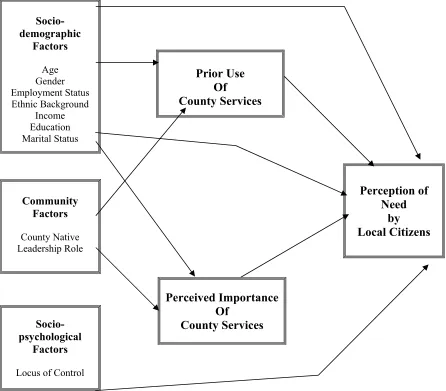
The major focus of this study is to identify the relationship between
perceived needs of Greene County citizens in regard to
socio-demographic factors, community factors, and socio-psychological
factors. The study answers the following questions:
1. Do Greene County citizens use county services and are citizens
satisfied with the service received?
2. What are the perceived needs of the citizens of Greene
3. Do socio-demographic factors influence perception of needs?
4. Do community factors influence the perception of needs?
5. Do socio-psychological factors influence perception of needs?
Significance of the Study
How can a small rural eastern North Carolina county prepare for
the new century? County governments are faced by a multitude of
citizen needs and issues that easily outstrip resources. With a new
millennium, local government must become in tune with citizens and
make them partners in the planned change process.
There are a variety of issues confronting government at all levels
but issues are often magnified in a small county. Issues that place
pressure on county government are agency downsizing, budgets,
economic development, education, and change in demographics. Small
counties find it difficult to keep abreast of the rapidly changing
information age. Government employees, as well as citizens, are
inundated with information from the media, educational organizations
and the Internet. To keep up with the information flow, they must
invest in technology that is costly and continuously changing. Agencies
services are being funneled down to county government, the lowest
level, by federal and state lawmakers every year. Funding problems
place county decision-makers in the position of prioritizing citizen
needs. This can lead to reducing or cutting services.
Shifting demographics places pressure on county government
striving to meet the demands of changing and diverse populations. As
the population ages, more senior citizen programs are needed. A baby
boom can cause the need for expanded schools. Immigration of a
culturally diverse population can strain department budgets as they
cope with a new language and culture.
One of the toughest issues facing a small county is economic
development. Attracting new business and industry is difficult for rural
counties because they often lack the needed infrastructure and
amenities that company officials desire. The cost of updating and
adding infrastructure can easily out-step a county’s resources when
these are based on property tax. These issues are daunting but cannot
be ignored by county officials and citizens. Working together they must
find solutions to the issues.
Utilizing the strategic planning tools of environmental scanning
information and data that will lead to the identification and
prioritization of emerging community needs.
Limitations of the Study
1. This study only applies to Greene County, North Carolina;
therefore, results may not apply to other counties.
2. The study is measuring an individual’s perception of need,
based on factors such as desire, wants, and situations that can
change daily.
3. The research instrument is self-reporting; therefore, validity of
data rests upon the respondent’s cooperation in answering
questions.
4. This study is descriptive in nature and represents one point in
time. Consequently, future trends in Greene County are
inferred, but may not be predictive.
Definition of Terms
Collaboration – Collaboration is working jointly, or together, with others,
especially in an intellectual endeavor; to cooperate with an
agency of instrumentality with which one is not immediately
Community - Community is people with common interests living in a
particular area.
Community and Rural Development – This is a program area of
Cooperative Extension that helps individuals, families and
communities improve the quality of their lives by enhancing the
agricultural, economic, environmental, and social well being of
North Carolina through education. It empowers community
leaders to make timely decisions or critical issues affecting
quality of life.
County - County is defined as geographic subdivision of the state that is
a body politic. A body politic is a civil division of the state for
purposes of governmental administration and is a legal entity
with a public function.
County Commissioner - Commissioners are the elected representatives
of the county that exercise the powers and discharge the
responsibilities of the county.
Economic Development - Economic development is a component of
community resource development that focuses on developing a
sound economic base but providing needed infrastructure for
Environmental Scan – Environmental Scan is a survey of all major
internal and external forces acting on an organization, particularly
forces which present either an opportunity or a threat to the
organization and its programs. They especially emphasize forces
that are in the process of changing--for example, population
growth or tax cut.
Need Assessment - Need assessment is the process of determining the
felt needs of people and can be accomplished using several
methods such as a survey or focus group.
Needs – Needs represent an imbalance, lack of adjustment, or gap
between the present situation or status quo and a new or
changed set of conditions assumed to be more desirable. Needs
can be viewed as the difference between what is and what ought
to be.
North Carolina Cooperative Extension - NCCE is the educational
outreach arm of the land-grant university (NCSU and A&T State
University) that disseminates research-based knowledge to the
citizens of North Carolina on Agriculture, Family and Consumer
Science, 4-H and Community and Rural Development.
state and federal governments.
Strategic Plan – This is a statement of long-range goals and directions
developed with particular attention to environmental factors; a
process to provide direction and meaning to day-to-day activities.
It examines an organization’s values, current status, and
environment, and relates these factors to the organization’s
Chapter 2
Conceptual Schema and Review of Literature
Introduction
Strategic planning is an organizational development tool that has
been successfully used by a variety of private, public and non-profit
organizations to develop a vision and action plan for the future.
Strategic planning is based on the perceived needs of organization
stakeholders, who can be citizens, leaders and employees. An
important step in the process is to become knowledgeable about the
environment in which the organization functions. Two tools are
available in the strategic planning arsenal to complete the task;
environmental scanning and needs assessment. This chapter examines
the concepts of strategic planning, need, environmental/scanning,
needs assessment, perception, community, community collaboration
and county government.
Strategic Planning
Organizations large and small, for profit and non-profit alike, have
objectives. According to Morrison, Renfro and Boucher (1984), “The
primary tasks of strategic management are to understand the
environment, define organizational goals, identify options, make and
implement decisions, and evaluate actual performance” (pp. 6-7).
Strategic planning can be used by an organization to enhance its ability
to steer a course in a changing external environment.
Swiss (1996) stated, “Strategic planning, with its few broad goals,
tells us the general direction in which we wish to move (p. 131).”
According to Renkow and Garber (1993), “Strategic planning is an
orderly process that allows people in rural counties and towns to
identify and address pressing issues in their communities” (p. 1).
Renkow and Garber further emphasize that strategic planning is not a
panacea for all that is wrong with a community but the process can
focus resources on its most pressing issues. McCune (1986) states that
in the strategic planning process; “the role of the organization is
examined within the content of its environment and provides the means
for an organization to adapt its services and activities to meet changing
needs in the environment” (p. 34).
Several strategic planning models have been developed that are
proposed a strategic planning process that “consists of six identifiable
stages: environmental scanning, evaluation of issues, forecasting, goal
setting, implementation, and monitoring” (p. 6). The model is a merger
of long-range planning and environmental scanning allowing
“identification of issues and trends that must be used to modify the
internal” (p. 6) workings of the organization.
A strategic planning process successfully used by county
government consists of eight steps: (1) customer/stakeholders’
identification; (2) stakeholder needs and expectations; (3)
environmental scan (internal and external); (4) values audit; (5) develop
mission statement; (6) develop vision statement; (6) goal setting; (7)
action plans; and (9) adjustments and implications (Liles, 1995). Swiss
(1996) outlined five strategic planning steps to be undertaken by a
planning committee as follows:
Step #1: Committee identifies stakeholders and
incorporates their views.
Step #2: Committee identifies opportunities and threats
by an environmental scan.
Step #3: Committee identifies agency strengths and
Step #4: Committee drafts the mission, vision and
long-range goal-statements.
Step #5: Agency connects the strategic plan to the
management system” (p. 152).
At the heart of strategic planning is an environmental scan
identifying emerging community needs in conjunction with needs
assessment of citizens to determine their perception of needs
identified. Environmental scanning entails the collection of information
regarding conditions in the external environment that may impact an
organization’s future. To accurately assess the perceived needs of
citizens, the process of needs assessment can be employed. The
versatility of needs assessment enables the process to be used in
determining individual perceived needs. Environmental scanning, on
the other hand, is a global process aimed at ascertaining emerging
issues.
A key to a successful strategic plan, which is implemented and
not left on the shelf, involves the organizations’ clientele. Swiss (1996)
states that, “Once stakeholders have been identified, an agency must
consider their views about the agency’s mission and its future” (p. 143).
views of one particular stakeholder group, the agency’s service
recipients (i.e., its customers)” (p. 144). In county government the
primary recipients of services are citizens, whom reside within its
boundaries. Due to time constraints and lack of resources, obtaining
customer input through open meetings is impractical. Needs
assessment, however, offers a means of engaging citizens in the
strategic planning process. Swiss confirms this by asserting that a
planning process that includes citizen views is more successful. In
government, which operates in a political environment, not including
citizen’s input can result later down the road with opponents and
obstacles to change.
Need
Need is not a concept unique to modern man. Aristotle said that
need, or desire, is what moves man to action. Aristotle indicated that
the fundamental need of man was happiness (Vanier, 2002). According
to Leagans (1964), “Needs represent an imbalance, lack of adjustment,
or gap between the present situation or status quo and a new or
changed set of conditions assumed to be more desirable” (p. 89). “Tyler
the present condition of the learner and an acceptable norm” (Boone,
Jones & Safrit, in press, p. 98).
When studying needs and determining what motivates people to
change and to change their communities to meet their needs, one must
understand Maslow’s Need Hierarchy Theory. Maslow (1954) stated
this theory in his book, Motivation and Personality, in which he closely
ties need, desire, and drive together. He stated that, “The typical drive
or need or desire is not and probably never will be related to a specific,
isolate, localized somatic base. The typical desire is much more
obviously a need of the whole person” (p. 65). Average needs or desires
have an important similarity in “that they are usually means to an end
rather than ends in themselves” (p. 65). The Hierarchy Theory is
particularly relevant when looking at needs in relation to the community
or county. For example, citizens concerned with stray animals lead to
the creation of an animal control agency.
Maslow (1954) developed his Hierarchy of Needs because needs
do not arrange “themselves in an arithmetical sum of isolated, discrete
members” (p. 70). He stated that they place themselves “in a hierarchy
of specificity” (p. 70). He explained this using the example of a stack of
“The most important hypothesis in Maslow’s motivation theory is his
‘hierarchy hypothesis’, which states, “that human beings are motivated
by an hierarchical system of basic, ‘instinctoid’ needs” (Madsen, 1974,
p. 298). Maslow’s theory is based on individuals striving to satisfy five
modes of needs:
1. Physiological needs, including the need for food, water, air, and
sex.
2. Safety needs, or the need for security, stability, and freedom from
fear or threat.
3. Social needs, including the need for friendship, affection,
acceptance, and interaction with others.
4. Esteem needs, including both a need for personal feelings of
achievement or self-esteem, and a need for recognition or respect
from others.
5. Self-actualization needs, a feeling of self fulfillment or the
realization of one’s potential” (Buford & Bederiam 1988, p. 148).
According to Madsen (1974), “When a need is satisfied, or
‘gratified’ as Maslow prefers to put it, a higher need can dominate and
determine the individual’s behavior” (p. 298). Individuals can go up
Ponsioen “suggested that a society’s or community’s first
responsibility is to meet the basic survival needs of its members”
(Kettner, Moroney & Martin 1999, p. 34). He defines basic needs as
biological, social, emotional and spiritual. With this theory in mind a
society develops standards below, which no citizen shall fall. In
Ponsioen’s framework, “social need exists when some groups do not
have access to these ‘necessary goods and or services, whereas, others
do” (p. 34). In this context, need becomes relative, an issue of
distribution and redistribution of goods and services.
Over the years, according to William G. Huitt (1998), other
theorists have categorized human needs into three levels. William
James (1892/1962) “hypothesized the levels of material (physiological,
safety), social (belongingness, esteem), and spiritual. Mathes (1981)
levels were physiological, belongingness, and self-actualization; he
considered security and self-esteem as unwarranted” (Huitt, pp. 2&3).
Kettner, Moreney and Martin (1999) state that need is a hard
word or concept to define. In 1974, federal legislation, Title XX
Amendments to the Social Security Act defined need as “any
identifiable condition, which limits a person or individual, or a family
expressed in social, economic or health related terms and are
frequently qualitative statements” (p. 36). Kettner, Moroney and Martin
further express, “That need itself is elastic and relative rather than static
and absolute” (p. 37).
According to Suarez, “The most widely used definition of ‘need’ for
needs assessment is that of a discrepancy” (Husin & Postlethwaite
1994, p. 4057). Kaufman formulated the discrepancy definition of
need. Kaufman (1972) said, “An educational need is defined as the
measurable discrepancy (or gap) between current outcomes and
desires or required outcomes” (p. 5). He further clarified the term gap
as, “The measurable gap between what is and what is required” (p. 5).
Kaufman’s definition closely parallels the definition of need by Leagans
and Loomis (1971) which stated that “More specifically, needs may be
defined as the differences between what is, and what ought to be and,
hence, always imply a gap between these two conditions” (p. 131).
Leagans and Loomis (1971) further state “What is can be determined
by a study of the situation including facts about the people their
attitudes, knowledge, what they think their needs are”(p. 131). The
‘what ought to be’ “can be determined by examining both research
This is the process of determining objectives, action steps, and defining
the program to meet the people’s needs. Leagans and Loomis (1971)
warn that the “Final decisions about the selection, or rejection, of needs
on which to focus programs are crucial not only because the future of a
people and their conditions will be influenced, but because extensive
physical, monetary, and human resources will be committed to meeting
the needs”(p. 132).
Another definition of need utilizing four categories is important in
the need assessment process. Bradshaw (1972) expressed that “Need
may be conceived of as normative, perceived, expressed, or relative”
(Kettner, Moroney & Martin 1999, p. 39). Normative need is defined by
the term normative, which “implies the existence of standards or
norms.” When we add the concept of need, “the existence of some
standards or criterion established by custom, authority, or general
consensus against which the quantity or quality of a situation or
condition is measured” (p. 40). Perceived “need can be defined in
terms of what people think their needs are or feel their needs to be” (p.
40). The authors further state that felt needs can be unstable based in
the individual and the situation and these can change. Expressed need
The last category of need is relative need. Ketner, Moroney and Martin
(1999) say, “Relative need is measured as the gap between the level of
services existing in one community and those existing in similar
communities or geographic areas” (p. 42). Stufflebeam’s definition of
need is similar to the perceived need definition. The definition is often
referred to as the “democratic view”. Stufflebeam said, “a need is a
change desired by a majority of some reference group” (Husin &
Postlethwaite 1994, p. 4057). This definition “requires determination of
the perceptions of needs of selected individuals or groups” (p. 4057).
Queeney (1995) states that, “Needs can be classified in a number
of different ways. Perceived needs are those needs that individuals
believe they have; assessed needs are identified through a structured
assessment process. This pair of needs is the most important to the
concept of needs assessment, for if no difference existed between
needs individuals perceive they have and those identified through
assessment, the role of needs assessment would be limited to asking
individuals to identify the discrepancies between their current levels of
knowledge, skills, or performance abilities and those they wish to
attain” (p. 82). Most of the time according to Queeney (1995) there is a
discovered through assessment.
“Felt needs are those which individuals are somewhat conscious
of but do not discuss” (Queeney, p. 83). Expressed needs occur “When
people go beyond awareness of needs to articulating them” (p. 83).
People are often reluctant to express their felt needs because it can be
perceived as a lack of knowledge or skill. Queeney (1995) said that,
“People having felt needs often view needs assessment as a test with
the potential for failure” (p. 84).
Homan (1999) in his book, Promoting Community Change, states
that need, in regard to community, can be defined through five
categories. The five categories of needs are:
1. Physical--People and the things they make or build. Example,
medical care, transportation.
2. Social and Emotional--”Forming and maintaining relationships
is an integral function of the community” (p. 116). Example,
Do people feel a part of the community?
3. Political--”Each community faces a set of political needs, and it
will develop a governance or decision-making structure if it
4. Economics is based on a system that “provides a way for its
members to develop the means to acquire things that are
important to them” (pp. 117-118).
5. Educational and communication--”The community needs to
know about itself and the world in which it operates” (p. 118).
Homan (1999) says even with these five categories, “Needs are
often undiscovered, undeclared, or considered unimportant by those in
charge” (p. 119). This can happen because needs are impacted by
individual’s life experiences. Reviere, Berkowitz, Carter and Ferguson
(1996) state that “Specific historical antecedents condition individuals
to certain levels of expectations, which, in turn, influence how they
define what is needed or necessary to meet some basic standard” (p.
4). Furthermore, McKillip (1987) introduced “The concept of values into
the discussion of needs” (p. 5). Values are defined as “ideas about what
is good, right, and desirable” (p. 5). Values should be discussed up front
as to their role in the assessment process. This is reinforced by
Bradshaw who “argued that how needs are defined may reflect the
values and perspectives of different groups” (p. 7).
According to McMahon (1970) throughout history need has been
thirty years research has focused more on group or community needs.
“The solution of problems by the piece-meal method of individual
achievement no longer suffices” (p. 3). He quotes Miller (1967) in
saying that “...personal needs do not operate in a vacuum; they are
shaped, conditioned, and channeled by the social structures and forces
of the human society in which each individual is born” (p. 3). Individual
needs cannot be totally forgotten but the researcher must expand his
understanding of need to include the community. “The community
must have help to build the bridges between its economic needs and
the educational needs of the residents who must solve the economic
problems” (p. 3).
McMahon (1970) elaborates on the definition of need by citing
Kramer (1960) who said, “The real need is a desirable element or
condition that is lacking in, and would improve, a situation. Felt needs
are what people with problems recognize as the elements necessary to
improve their situation”(p. 13). This definition shows “The importance
of the ‘real’ situation in attempting to establish the meaning of need”
(p. 13). Boone, Jones and Safrit (in press) state that “The needs of
individuals are meaningful to the extent that they perceive that
with their defined cultural context and social environment” (p. 39).
Needs are from individuals or communities based on their situation:
economic, educational, age, gender or race. The basic tasks of living,
which is a developmental needs framework created by Havighurst and
Orr could possibly be the link between community and individual needs.
“The developmental tasks of being a parent, a spouse, a worker, a
citizen, or filling other social roles are set by the ‘expectations of values
of our society’ as well as by ‘our own personal values or aspirations’” (p.
13). McMahon (1970) summaries the importance of community as
“Yesterday’s focus was in the individual; today, the emphasis is on
community needs” (p. 3).
Hamilton (1992) reinforced McMahon’s belief that community
needs are even more relevant today. “Most community problems today
are not limited to individuals, but affect an entire community” (p. 58).
Individual problems cumulatively over time can impact the community.
He further emphasizes that community needs have two dimensions.
“First is to focus on the learning deficits of groups in the community.
Second is to recognize the structural defects of institutions that serve
the community” (p. 59). Learning needs focus on people and structural
emphasis because they have a faster return on benefits (p. 59).
Roger Kaufman (1995) states that need is most often used in life
and planning as a verb. “So ingrained in our common language is need
as a verb that we are always prescribing to others how they should do
things, what they should use, and the way they should live their lives” (p.
53). He believes that in planning, need should be used as a noun “a
gap between current results and desired ones” (p. 53). This step is
critical because in planning it allows for the selection of ends that are
pertinent before identifying the proper means for obtaining the end.
“Ends are results, consequences, accomplishments, and payoffs
delivered. Means are the ways to deliver ends” (p. 11). Means equal
resources such as people, time, equipment, supplies and money. This
means that “Need is a gap between current results and desired or
required ones not a gap in resources or methods and means” (p. 54).
Thus, planning would reflect the perceived or expressed need, of people
in the community.
Environmental Scanning
Environmental scanning is a strategic planning tool that can be
environment in respect to emerging issues and needs. “Brown and
Weiner (1985) define environmental scanning as a kind of radar to scan
the world systematically and signal the new, the unexpected, the major
and the minor” (Morrison 1992, p.1). Morrison and Wilson (1997)
define environmental scanning through comparison with monitoring.
Both terms are often used interchangeably, but there are differences.
The authors state that “scanning is focused mainly on the future (what
may happen); monitoring, in the past and present (what has happened
or is happening). Scanning is largely unfocused, taking a 360-degree
horizon; monitoring is highly focused. Scanning identifies early warning
signals of new trends that might become important; monitoring tracks
developments in trends of known importance” (p. 1).
Coates (1985) identified the following purposes of an
environmental scanning system:
• detecting scientific, technical, economic, social, and political
trends and events important to the institution.
• defining the potential threats, opportunities, or changes for the
institution implied by those trends and events,
• promoting a future orientation in the thinking of management
• alerting management and staff to trends that are converging,
diverging, speeding up, slowing down, or interacting” (Morrison
1992, pp. 1-2).
Morrison simply says that the goal “of environmental scanning is
to alert decision makers to potentially significant external changes
before they crystallize so that decision makers have sufficient lead time
to react to change. Consequently, the scope of environmental scanning
is broad” (p. 2).
Morrison and Wilson (1997) emphasize that the external
environment can be divided into three parts: market, industry, and
macro environment. The market environment refers to an
organization’s clientele, which is specific to the organization. A county’s
market environment would be citizens, employees, leaders, agencies
and businesses within its borders. “The industry environment
comprises all enterprises associated with” (p. 2) an organization.
According to the authors, “The macro environment focuses on changes
in the social, technological, economic, environmental and political
(STEEP) sector that could effect” (p. 2) the organization directly and
indirectly. Macro environment represents the broadest level of the
East affects gasoline prices resulting in quicker depletion of an
organization’s travel budget.
Anderson (1989) describes the external environment as
consisting of six elements that need to be scanned for data relevant to
an organization. The six elements are similar to Morrison’s and
Wilson’s macro environment (STEEP) but adds the sixth element of
cultural. Cultural refers to “Lifestyles, worker expectations, consumer
preferences, and social structures of the communities” (p. 2). This
element is relevant to agencies and organizations that provide services
to communities. Anderson defined the five other elements as:
• Social. Age, mobility patterns, educational attainment,
socioeconomic status, gender, and race.
• Economic. Employment opportunities, allocation of
public dollars, and economic health of the food and
agriculture system.
• Technological. New technologies, use of technology,
potential of technology, and the innovations.
• Environment. Natural resource issues, housing and the
near environment, aesthetic values, and health choices.
their goals for the community, how the community is
adjusting to shrinking federal funds, and how political
decisions are made. (pp.1-2).
Morrison, Renfro and Boucher (1984) identify two methods of
scanning, passive and active. Passive scanning of the environment is
informal and conducted continuously by most individuals and
organizations. Passive scanning is as simple as reading the daily
newspaper. Often the information from passive scanning is not used by
organizations for planning. Morrison (1992) stated that, “Active
scanning focuses attention on information resources that span the task
and industry environments as well as the macro environment. In active
scanning, it is important to include information resources that represent
different views of each STEEP section” (p. 3).
A very important question in the environmental scanning process
is what to scan. According to Morrison, Renfro and Boucher (1984)
“scanning must be limited to those resources reporting issues that have
a primary or major impact on an institution, whether the issues
originate in the external world or not” (p. 16). The authors further share
an inexhaustible list of potential resources to scan such as newspapers,
resident experts and newsletters.
Most likely organizations do not have active continuous scanning
operations or departments. Morrison (1992) suggests that
organizations that have limited resources, human, fiscal, and time,
could operate periodic or irregular scanning processes. Morrison states
that, “A quick way of getting started is to interview major decision
makers regarding their view of the most critical trends and
developments that could affect the institution” (p. 6). Mustian and
others (1999) provide several periodic methods that can be used to
identify emerging issues and needs. The methods are:
• Meetings. Lists of issues and needs can be generated
during brainstorming sessions at meetings (p.2) of
various committees, civic groups and advisory councils.
• Mass Media. An organization “can use appearances on
radio and television programs or columns in local
newspapers to solicit public opinions about community
issues and educational needs (p.2).
• Networking. Develop networks and collaborate with
thoughts on issues and needs.
• Focus Groups. Informal meetings with small groups of
citizens can be a very effective tool for identifying issues
and needs because they provide an opportunity for group
members to interact with each other and for the leader
to probe for greater detail on promising topics (p. 2).
Morrison, Renfro and Boucher (1984) agree that survey questions
can be used to obtain data about important issues and needs.
“Collecting judgments on an event’s probability, impact, and degree of
control can be done by using simple questionnaires or interviews and
quantifying participants’ opinions using various scales” (p. 10).
Often scanning leads to more issues than an organization can
manage. Morrison, Renfro and Boucher (1984) emphasize that “The
issues must be limited to some manageable number to ensure the
organization’s effectiveness. This limiting process is achieved by a
rigorous, objective evaluation of the issues” (p. 9). There are several
methods that can be used to evaluate and prioritize issues and needs.
“One method of limiting the issues or needs is to use probability--impact
the probability of the issue happening in the future, what effect will it
have on the organization and does the organization have the resources
to handle the emerging issue. Another method proposed by Morrison,
Renfro and Boucher is impact networks. “Impact networks are a
brainstorming technique designed to identify potential impacts of key
events on future developments” (p. 13). The technique is simple to use
and results in a list of positive and negative impacts from an issue. The
more impacts identified, the higher priority the issue has to the
organization.
Delphi technique is a valuable method that can be used to gather
and prioritize issues and needs. According to Ringland (1998), “The
Delphi technique, named after the ancient Greek oracle, was developed
by the RAND Corporation in the 1950's as a method for gathering
information about the future” (p. 19). Delphi was developed to gather
and prioritize data by “asking experts in their various fields to estimate
individually the probability that certain events will occur in the future”
(p. 19). Delphi technique does not require face-to-face meetings of the
experts. Morrison, Renfro and Boucher (1984) list four rules for
conducting Delphi. “First, no participant is told the identity of the other
questionnaire or individual interviews. “Second, no single opinion,
forecast, or other key impact is attributed to the individual who provided
it or to anyone else. Third, the results from the initial round of
forecasting must be collated and summarized by an intermediary (the
experimenter) who feeds these data back to all participants and invites
each to rethink his or her original answers in light of the responses from
the group as a whole” (p. 21). Fourth, repeat the process of step
number three until, “The consensus within the group is close enough for
practical purposes (p. 21).
There are several advantages to using the Delphi Techniques.
Delphi “solicits independent responses, negates the influence of strong
personalities, and allows individuals to change their views without
losing face as the process continues” (Mustian and et al., 1999, p. 4).
The Delphi technique can save time and resources by not requiring
face-to-face meetings, which are often costly.
The institutional vulnerability audit is an environmental scanning
tool that is a combination of the Delphi technique and nominal group
process proposed by Morrison and Keller (1993). The audit is an
efficient and effective method for obtaining information about the
scanning only those portions of society’s changes that directly impinge
on the central features” (p.2) of an organization. The audit
accomplishes this by putting boundaries on the environmental scan.
The vulnerability audit can be conducted by a team of six to ten
members for a small organization and ten to sixteen for a large
organization. The audit is comprised of five simple steps.
Step one, is the team determining vital environmental
underpinnings of the organization. Underpinnings can be as simple as a
steady pool of clientele. The question is what is the organization
dependent for its continual stability and operation.
Step two, “is to identify the forces, shifts, trends, and events that
could damage the institution’s health and quality” (p.3). During this
step team members are encouraged to be imaginative and creative in
thinking about all the emerging issues that could impact the
organization. This step could be accomplished using scenarios.
According to Morrison and Wilson (1996) scenarios are graphic,
dynamic illustrations of possible futures an organization may encounter
because of an emerging issue or need. By using scenarios an
organization can think outside the box by looking at alternative futures.
impact on the organization from a light level to a catastrophic level.
The authors recommend the team use the Delphi technique for this
exercise. Step four, is a “ review of the overall pattern of threats to the
institution and the degree of its vulnerability” (p.5). This step is
conducted by plotting the probability of the issue impacting on the
organization. The team can use a vulnerability chart that plots issues by
four quadrants, none, vulnerable, moderate and annoyances. Step five
is the team process of developing strategies or action steps that can be
employed to overcome vulnerable issues. The best advantage of the
vulnerability audit is that it provides results without wasting resources
of time and funds.
Conducting an environmental scan can be a valuable asset to an
organization as it plots and plans future direction. An environmental
scanning process or system illustrates to an organization such as
county government important emerging issues and needs that will
impact the operation of providing services to its citizens. The next step
in the overall schema is to conduct a need assessment to provide
Needs Assessment
An important step in any planning process, strategic or program is
needs assessment of the target audience. Leagans (1962) in his paper,
“A Concept of Need “states that the ‘What is’ can be determined by a
study of the situation” (p. 4). There are many approaches to needs
assessment. Gupta (1999) presented that “Needs assessment is a
process for pinpointing reasons for gaps in performance or a method for
identifying new and future performance needs” (p.4). Hirumi (1994)
defines needs assessment as “a systematic procedure for identifying
problems, setting priorities and making informed decisions about how
to reduce and/or eliminate performance discrepancies. It’s purpose is
to identify those areas where solutions are required and to set criteria
for their resolutions” (p. 23).
Kaufman and English (1976) state that “For now, we define needs
assessment as a formal process which determines the gaps between
current outputs; places those gaps in priority order; and selects the
most important for resolution” (p. 8). They further present that “Needs
assessment, then, is central to selecting the correct problems for
resolution and will provide the necessary information for determining
assessment as a process that “(a) identifies gaps between current
results and desired ones, (b) priorities the gaps in results (needs); and
(c) selects the most important needs for closure or redirection” (p. 56).
Reviere, Berkowitz, Carter and Ferguson, (1996) say, “According
to the United Way of America (1982) needs assessment is a systematic
process of collection and analysis as inputs into resource allocation
decisions with a view to discovering and identifying goods and services
the community is lacking in relation to the generally accepted
standards, and for which there exists some consensus as to the
community’s responsibility for their provision” (p.6). They quote York
(1982) “That needs assessment is a ‘measure of how much of what is
needed” (p.6).
According to “McKillip (1987), needs assessment is a process of
‘ordering and prioritization’ of community needs” (p. 6). Reviere,
Berkowitz, Carter and Ferguson (1996) synthesize these definitions into
their definition of needs assessment which is “Needs assessment is
defined here as a systematic and ongoing process of providing usable
and useful information about the needs of the target population--to
those who can and will utilize it to make judgments about policy and
In 1953, Blackwell proposed the concept of a community study.
He based this on the idea “That there are community needs apart from
the needs of individuals and that there are such things as community
pressures” (McMahon 1970, p. 16).
Ashan, Garcia and Samuels (1995) defined needs assessment in
the context of community. They described a community assessment
process that “is a systematic way to identify the resources and needs of
residents by gathering data, soliciting the perspectives of residents and
leaders, and surveying service providers and other community
resources” (p. vi).
Just as important as what is a needs assessment is what is not a
needs assessment. English and Kaufman (1976) said, “A needs
assessment is not instant validity, instant wisdom, instant reliability, or
instant anything” (p. 22). Needs assessments are not perfect or
infallible but they can be corrected. They also cautioned that a needs
assessment is not a one time complete authority on the issue or
problem being studied. “A needs assessment is not a casual affair. It
(needs assessment) is formal and it collects attitudinal, value, and
performance data. It is not something to be ‘winged’ or used as a