ISSN(Online): 2320-9801
ISSN (Print): 2320-9798
I
nternational
J
ournal of
I
nnovative
R
esearch in
C
omputer
and
C
ommunication
E
ngineering
(An ISO 3297: 2007 Certified Organization)
Vol. 4, Issue 8, August 2016
A Prognostic COPD Clinical Support System
Bharati S Pochal,
Divya D Kulkarni
Asst. Professor, Dept. of Computer Application, Visvesvaraya Technological University, Post Graduate Centre,
Kalaburagi, Karnataka, India
MCA Student, Visvesvaraya Technological University, Post Graduate Centre, Kalaburagi, Karnataka, India
ABSTRACT:The care indicator is a main characteristic feature of Hospital readmission. It imitates objection in nature of in-patient consideration and the trouble of coordination of consideration after they move again into the group. It is a powerful money related stress particularly identified to Medicare and Medicaid money for present and future. In 2020, the COPD is the main sources of incapacity and destruction around the world, also relied upon to wind up third reason for death and fifth reason for handicap balanced life. So it is a essential , price and statistically important to create prognostic clinical support system to handle the patients in better way with their situation in order to enhance the nature of consideration while controlling expenses through keeping away from avertable readmission of patient with COPD at the same time.
KEYWORDS: Chronic Obstructive Pulmonary Disease COPD, Clinical records, Healthcare, Readmission, Support system, Structured and Unstructured data.
I. INTRODUCTION
At the time of first clinical test, the hospital re-entry prices are assumed to be a valuable mark and care of status, so that there might be a follow up plans of charge and also managing low price of patient among association. In the United States of America, there is extensive data on readmissions and their costs. For example in the year 2009, over a period of 30days, approximately 20% of patients who are released and again took readmission in the same hospital and their cost for treatment are paid by Medicare. The results were even more pronounced over a longer duration with 34.0% being readmitted in 90days and over 56 % in a year. Also Medicare Payment Advisory Commission (Med PAC) established that approximately 19 % of patients readmitted in 30days of discharge. 11.3% in 15days and 62% in 7days. According to Med PAC the readmission of patients within 30days cost Medicare $15 billion. Given the magnitude of the expenses for the system we focus on the one of most expensive diseases that the third largest cause of death worldwide and are one of the top five triggers of the disabilities. This disease called COPD which is abbreviated as Chronic Obstructive Pulmonary Disease is a lung based attack and occurs all around the world. The point of our study is on which is one of the well-known agents of infirmity and fatality around the world, and is expected to be, the 3rd reason for death and 5th reason for injury in 2020. So to find ways to reduce the cost of such a chronic disease will help not only the individual patients and their families but also the societies that they are in.
II. RELATED WORK
ISSN(Online): 2320-9801
ISSN (Print): 2320-9798
I
nternational
J
ournal of
I
nnovative
R
esearch in
C
omputer
and
C
ommunication
E
ngineering
(An ISO 3297: 2007 Certified Organization)
Vol. 4, Issue 8, August 2016
discharge was approximately less than 40% and still remaining less which is appropriately 80% at 5 weeks, moving exactly 35% for initial care. Released process often needed main information like diagnosis test results approximately 33 to 63%, treatments (7-22%), released medication (2-40%), test results pending nearly 70%, and family member or patient approximately 95% and results from 2 to 40%. Used pattern zed formats to focus the most related facts, revised the noticed feature of documents. In [3] the re-entry ratio of clinics has been projected as a main sign of effect estimated from normal demography. Though, most regularly used part rise theoretical arguments. We desired to calculate the value of the programmed algorithm for describing unnecessary re-mission on the basis of minimal tendency, original validness and evaluation accuracy. A entry of 131,809 medical care sick persons released awake from49 clinics were used to observe the prognostic achievement of risk adaptation procedures subdivision of a arbitrary model of 570 medical notes of released couples in 12 hospitals were inspected to evaluate the portending rate of the protecting of conceivably preventable readmission.
Existing System
The main aim of healthcare transfer and settlement restore is to reduce the readmission which has the adverse effect on nature of patient’s life and heavy stress on system of healthcare. Therefore this is scientific, commercial necessary to enhance the problem of patient readmission. Simultaneously, there are increasing industrial capacity to construct predicting logical results in a various fields considering healthcare. To get good communication between professional techniques and client reactions industries have taken advantage of ordered and unordered information. These ideas and technologies that make it profitable to enhance the problem of readmission.
Disadvantages:
Huge stress on healthcare system for the reduction of readmission of patients.
Cost efficiency.
Clinical and Commercial problem of patient.
Misuse of structured and unstructured data by industries.
Proposed System
In present system, a design is constructed to lower readmissions and there price of patients who are in need. According to patient hospital records and released concise, this project decides the sketch of patient readmission and who are suffering from the disease. Appropriate interruption equitable gives a good feature and care that avail to prohibit re-missions. We are implementing two main factors which specify particular part of a body where the disease occurs (lungs) and particular disease and its symptoms (cough). It consists of five layers those are the pre established directories.
Advantages:
Reduction of readmission of patients in hospitals.
The profile of patients suffering from COPD is decided by analyzing the patient clinical records.
Both patient and doctor can save the time by avoiding queues.
Patient records can be in the form of plain text.
III. MODULES DESCRIPTION
1. Document Pre-processor Layer:
Document preprocessor layer is the initial step of the clinical support system. This module converts CDA reports to user readable form, also generates some tokens. The date mentions, numerical notations and fraction mentions are extracted by these layers which are used for obtaining patient details.
2. Lexical Analyzer Layer:
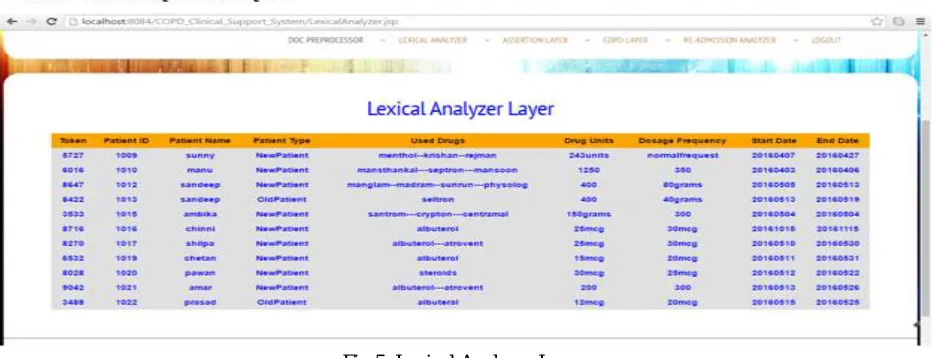
Lexical Analyzer considers the parts of speeches and produces keys in the form of tokens and which further becomes a key element in surmising re-mission.
3. Assertion Layer:
ISSN(Online): 2320-9801
ISSN (Print): 2320-9798
I
nternational
J
ournal of
I
nnovative
R
esearch in
C
omputer
and
C
ommunication
E
ngineering
(An ISO 3297: 2007 Certified Organization)
Vol. 4, Issue 8, August 2016
4. COPD Layer:
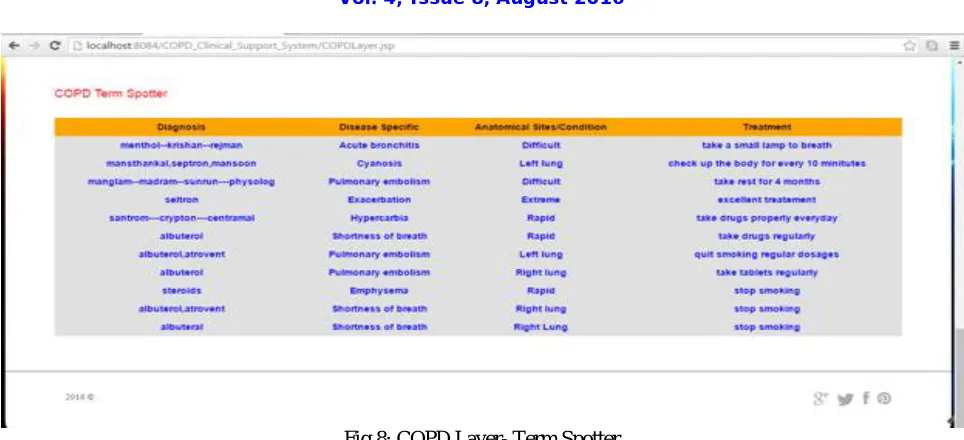
COPD Layer fetches all information about disorders, particular part of the body where the disease has attacked and there problems by already given dictionaries. And also extracts drug mentions and its date of start and end, dosages and effects caused because of disorder combinations or medications. There are 2 dictionaries included in this layer: Anatomical sites and disease specific. Example-COPD term spotter is a pipeline or continuous process of clinical note which specifies the treatment and diagnosis. Classifying every record is the main feature of COPD.
5. Readmission Analyzer Layer:
Readmission Analyzer Layer contains 3 categories – Low, Medium and High Probabilities which are based on the patient’s admission and readmission into the hospital.
IV. ARCHITECTURE
Fig 1: Architecture of Support System
This System is located on predicting analysis of ordered and disordered data of patient to construct a profile of risk for a discharged patient who has taken first step of COPD treatment. The whole design of disordered element of system is given in this system. The five steps of COPD clinical support system.
Step 1: Document Pre-processor Layerwill create sections and tokens when the CDA (Clinical Document architecture) documents are converted into plain text form.
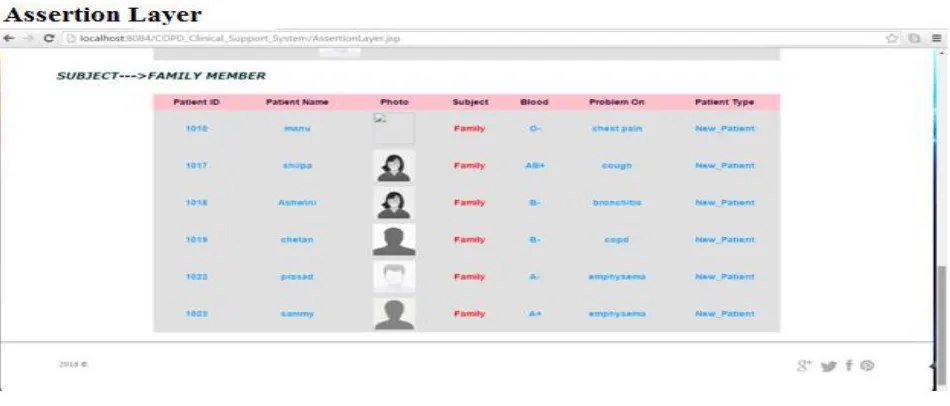
Step 2: Lexical Analyzer Layerdetermines all tags and tokens according to matching parts of speeches. Step 3: Assertion Layerwill determine that the considered user is Family Member or Patient.
Step 4: COPD Layerwill consists of two types Drug named entity recognition and COPD term spotter. Step 5: Readmission Analyzer Layerdetermines the probability of a patient.
V. SIMULATION RESULTS
ISSN(Online): 2320-9801
ISSN (Print): 2320-9798
I
nternational
J
ournal of
I
nnovative
R
esearch in
C
omputer
and
C
ommunication
E
ngineering
(An ISO 3297: 2007 Certified Organization)
Vol. 4, Issue 8, August 2016
Fig 2: Home Page of Clinical support System
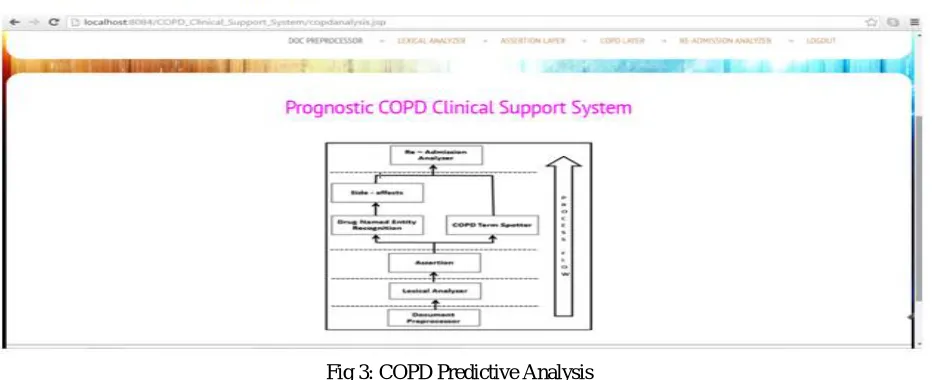
Home Page consists of three users – Patient, Doctor and Admin. Patient can do registration or if has registered previously then directly he can login and do admission. Doctor can register here and he can check the admissions and readmissions of the patient. Admin is the main person of this support system. Admin will send the information from patient to doctor and vice versa. Admin consists of a module called COPD predictive analysis – it contains five layers which show the flow of support system for COPD treatment.
’ Fig 3: COPD Predictive Analysis
ISSN(Online): 2320-9801
ISSN (Print): 2320-9798
I
nternational
J
ournal of
I
nnovative
R
esearch in
C
omputer
and
C
ommunication
E
ngineering
(An ISO 3297: 2007 Certified Organization)
Vol. 4, Issue 8, August 2016
Fig 4: Document Pre-processor Layer
Document Pre-processor layer is the first layer of the Predictive analysis which contains information about drugs and dosages and also CDA documents. The CDA documents can be downloaded by the patient which will be in user readable form. This layer will generate a particular token for the patient which will be further used as key factor.
Fig 5: Lexical Analyzer Layer
ISSN(Online): 2320-9801
ISSN (Print): 2320-9798
I
nternational
J
ournal of
I
nnovative
R
esearch in
C
omputer
and
C
ommunication
E
ngineering
(An ISO 3297: 2007 Certified Organization)
Vol. 4, Issue 8, August 2016
Fig 6: Assertion Layer
Assertion layer which gives information about the subject of patient that the patient belongs to family member or others.
Fig 7: COPD Layer-Drug Named Entity Recognition
ISSN(Online): 2320-9801
ISSN (Print): 2320-9798
I
nternational
J
ournal of
I
nnovative
R
esearch in
C
omputer
and
C
ommunication
E
ngineering
(An ISO 3297: 2007 Certified Organization)
Vol. 4, Issue 8, August 2016
Fig 8: COPD Layer- Term Spotter
COPD term spotter is a part of COPD layer. COPD term spotter is a pipeline process in which the diagnosis and treatment of patient is given according to the disease specific and analogical sites selected by the patient from the two inbuilt dictionaries.
Fig 9: Readmission Analyzer Layer
Readmission Analyzer Layer consists of three probabilities according to patient admission and readmission. They are: 1. Low Probability
2. Medium Probability 3. High Probability
VI. CONCLUSION AND FUTURE WORK
ISSN(Online): 2320-9801
ISSN (Print): 2320-9798
I
nternational
J
ournal of
I
nnovative
R
esearch in
C
omputer
and
C
ommunication
E
ngineering
(An ISO 3297: 2007 Certified Organization)
Vol. 4, Issue 8, August 2016
will also recognize the drugs mentioned like dosage frequency, route and text from plain text for or CDA document form. It will also supply the information that which drugs in the list gives which drugs mentioned. Future enhancement of this project gives information about additional clinical records of the patient like diagnosis reports and particular clinical reports. Analysing the text engine the unordered information is recognized and the clinical reports are utilized to construct particular formula’s. Using larger data set, the predictive positive value and meaningful classification is tested.
REFERENCES
[1] Savova GK , Ogre PV, Duffy PH, Bunt rock JD, Chute CG, “Mayo clinic NLP system for patient smoking status identification,” J Am Med Inform Assoc, 15:25-28, 2008.
[2] Kripalani, S , LeFevre, F., Phillips, C. O., et al., “Deficits in communication And information transfer between hospital based and primary care physicians,”JAMA 297(8):831841, February 28, 2007.
[3] Halfon, P., Eggli, Y., PretreRohrbach, I., et al., “Validation of the potentially Avoidable hospital readmission rate as a routine indicator of the quality of Hospital care,” Medical Care 44(11):972981, November 2006.
[4] Han X, Rao R., “The Method of Medical Named Entity Recognition Based on Semantic Model and Improved SVM-KNN Algorithm,”IEEE, 2011.
[5] Miller, M. E., “Statement of executive director of the Medicare Payment Advisory Commission, before the Subcommittee on Health, Committee On Energy and Commerce,” U.S. House of Representatives. April 18, 2007.
[6] Pakhomov S, Hemingway H, Weston S, Jacobsen S, Rodeheffer R, Roger V, “Epidemiology of Angina Pectoris: Role of Natural Language Processing of the Medical Record,” Am Heart J, 153(4):666–673, 2007
[7] Friedman, B. and Basu, J., “The rate and cost of hospital readmissions for preventable conditions,” Medical Care Research and Review 61(2):225240, June 2004.
[8] Egner MT, Lorch M, Biddle E., “UIMA GRID: Distributed Large-scale Text Analysis,” IEEE, 2007. [9] Cao Q, Guo W, Cui Y., “The semantic search based on UIMA,” IEEE, 2009.
[10] Uzuner O, Goldstein I, Luo Y, Kohane I, “Identifying Patient Smoking Status from Medical Discharge Records,” J Am Med Inform Assoc, 15:14–24, 2008.
[11] Clark C, Good K, Jeziernyb L, Macpherson M, Wilsonb B, Chajewska U: “Identifying Smokers with a Medical Extraction System.” J Am Med Inform Assoc, 15:36-39, 2008.
[12] Elixhauser A., Au D. H., Podulka J., “Readmissions for Chronic Obstructive Pulmonary Disease,” Statistical Brief #121, Healthcare Cost and Utilization Project, Agency for Healthcare Quality and Research, Sept. 2011.