Effective Video Quality Estimation Using
Wavelet Based Watermarking Technique
Anjali Krishna1, Shanavaz K T2
PG Student, Department of ECE, College of Engineering, Kallooppara, Thiruvalla, India 1
H.O.D, Department of ECE, College of Engineering, kallooppara, Thiruvalla, India2
ABSTRACT:Image and video quality measurement is a challenging problem in many of the image processing fields.
The paper addresses the Image Quality Assessment (IQA) problem using the objective metrics of the watermarks. The proposed scheme helps to assess the quality of a video by using a tree structure based watermarking method without accessing the cover video.Process of the watermarking is done in the wavelet domain of the cover video .The watermarking coefficients are embedded in the selected trees of the decomposed video.Comparing the original watermark and the extracted watermark will indicate the quality degradation of the original cover video. Applications of video watermarking in copy control, broadcast monitoring, finger printing, video authentication, copyright protection etc is immensely rising Performance can be evaluated in terms of the PSNR,SSIM under different distortions.
KEYWORDS:Videowatermarking,Waveletdecomposition,Quadtreedecomposition,watermarkembedding,distortion,qu
ality estimation.
I. INTRODUCTION
In the recent years,the evaluation of image and video quality estimation plays an important role in the digital media such as image processing, broadcasting etc.Qualitymetrices are of three types:FullReference,Reduced Reference and No Reference metrices. The Full Reference metric requires the original image to estimate the quality.therefore Reduced Reference metric and the No Reference metric are more useful and practical in many cases. Watermarking techinque is a better method to assess quality in terms of either a Reduced Reference or a No Reference metrics.The phenomenal growth of the Internet has highlighted the need for mechanisms to protect ownership of digital media.The extension of this concept in the digital world is the digital watermarking.Exactly identical copies of digital information, such as images,videos, text or audio, can be produced and distributed easily. Digital watermarking is a technique that provides a solution to the longstanding problems faced with copyrighting digital data Digital watermarking rapidly growing research area of digitised images, video and audio has urged the need of copyright protection, which can be used to produce verification against any illegal attempt to either reproduce or manipulate them in order to change their identity.Watermarking is the method of hiding the secret information into the digital media using some strong and suitable algorithm. Algorithm plays an essential role in watermarking as, if the used watermarking technique is capable and strong then the watermark being embedded using that technique cannot be easily detected
.
Video watermarking is moderately a latest technology that has been considered to solve the dilemma of fraudulent misuse and distribution of digital video. The main aim is that hiding the information into the video for protection. Video watermarking study predictable fewer attention than image watermarking due to is take over complexity, alternatively, lots of algorithms have already been proposed. Transform-domain watermarking techniques proved to be extra robust and imperceptile compared to spatial domain techniques because disband the watermark in the particular domain of video frame, making it extremely not easy to remove the embedded watermark.
II. RELATED WORK
quality.: Define the structural information in an image as those attributes that represent the structure of objects in the scene, independentof the average luminance and contrast.In [3], introduce a practical quality-aware image encoding, decoding and quality analysis system. Here use a reduced-reference image quality assessment algorithm based on a statistical model of natural images and a previously developed quantization watermarking-based data hiding technique in the wavelet transform domain. An effective way for digital watermarking, copyright protection, a process which embeds (hides) a watermark signal in the host signal to be protected is suggest in [2]. A new method introduce for assessing perceptual image quality. Here proposed SSIM indexing approach, which are analyses on structural similarity.As in the RR metric we are providing the partial or side information about the reference image this information usually consists of relevant features extracted from the original media which are transmitted and compared with the analogous features extracted from the degraded media[3]. The side information consists of two distinct types of measurements: spatial measurement extracted from the frames edges, and temporal measurements extracted from frames differences.The watermark embedding process is implemented in the DWT domain, because the DWT can decompose an image into different frequency components .Different frequency components have different sensitivities to image compression, which makes it much easier to control the watermark vulnerability. The vulnerability of a watermark is mainly affected by two factors: the amount of watermark bits embedded into each frequency component of the image and the corresponding watermark embedding strength which is controlled by the quantization parameter. At the receiver side, the image quality is estimated based on the degradation of the extracted watermark [10]. the watermark embedding and extraction are implemented in the 3-level DWT domain of the original image using the quantization method.
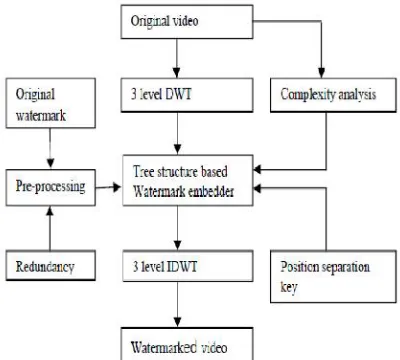
III.PROPOSED ALGORITHM A. Block diagram:
The proposed method which performs watermark embedding into video content is based on Discrete Wavelet Transform (DWT). Reasons for the usage of this orthogonal transformation are its good results in applications which deal with image processing. Thedescribed method is based on watermarking instillimages
.
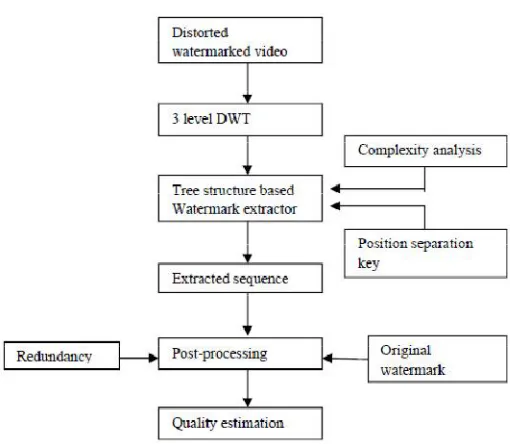
Fig 2 Watermark extraction and quality estimation
B. Description of the Proposed Algorithm:
IAquisition of cover video and 3level DWT
Quality of the video is estimated by using watermarking technique. Selectingvideo as the cover medium and also select watermarkas an image. The video has to convert into frames. Then each frame will experience, decomposition, embedding and extraction. The watermark embedding strength is estimated by analyzing the quality degradation of the cover video.The correlated DWT coefficients are grouped together using the SPIHT tree structure.The DWT decomposed video is further decomposed into a set of bitplane images. The binary watermark bits are embedded into the selected bitplanes After the watermark embedding, the inverse 3- level DWT is applied to obtain the watermarked video.In order to estimate the quality of the degraded video, extract watermark from the watermarked video. By comparing the original watermark with the extracted watermark consequences the quality degradation information.The TDR of the extracted watermark will be calculated to evaluate the degradation of the watermark.
(i).Decomposition using Haar wavelet
The image is read in the form of matrix and the image is decomposed upto n levels that produce 2 different sets of coefficients. For this experiment, the value of n is selected as 3.The Haar wavelet is also the simplest possible wavelet.It is also the only symmetric wavelet in the Daubechiesfamily.The technical disadvantage of the Haar wavelet is that it is not continuous, and therefore not differentiable,which can be a problem for some applications, like compression and noise removal of audio signal processing.So,here we are using another wavelet that is biorthogonal(4.4)wavelet.
II.Acquisiton of watermark and preprocessing.
III.Quadtree generation and Data Embedding
The tree structure based watermark embedder is designed to embed the binary watermark bits into the selected bitplanes of the selected DWT coefficients of the selected trees. The tree structure based watermark embedder has three functions,
(a)Forming the tree structure,
(b)Selecting the trees and the DWT coefficients for the watermark embedding
(c)Embedding the binary watermark bits into the selected bitplanes of the selected coefficients.
(a)The Formation of the Tree Structure:
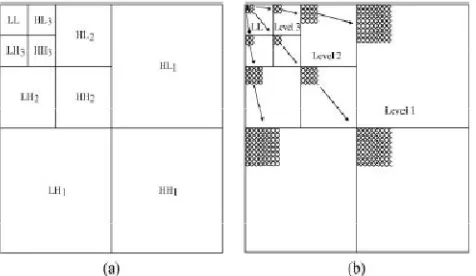
The tree structure is formed by categorizing the DWT coefficients with inherent similarities across all the DWT subbands. The correlated coefficients build up the parent-descendants relationship and form a tree.
(b)The Selection of Trees and DWT Coefficients:
For the applications of the watermarking based quality estimation, it is desirable to embed watermark throughout the cover video so that, even the watermarked image is locally tampered, the extracted watermark can still reflect the quality degradation of the cover image. According to the length of the watermark sequence, the trees for watermark embedding are chosen using the position separation key. To keep the embedded watermark invisible and limit the image quality degradation caused by the watermark embedding, the watermark bits are not embedded into the LL subband of the DWT decomposed image.
Fig 3.The tree selection from the three DWT orientations.
(c)The watermark embedding
:
The binary watermark bits are embedded into the selected bitplanes of the selected DWT coefficients. Here, the watermark bit denoted as , the DWT coefficient bit on the selected bitplane represent as c and the watermarked DWT coefficient bit as c. Then, the watermark bit will be embedded using the following
c if
c if c c
, ,
The content complexity of the cover image is assessedusing the following equation
n
i
i i
N complexity
1
2
Here the quad-tree decomposed images are achieved using the threshold Tint=0.17, where the maximum intensity value of the cover image is not bigger than 1.
eq (1)
IV.Extraction & quality estimation
The video group index transmitted from the sender side isused to retrieve the watermark bit.In one tree, the bitplane indices for all the DWT coefficients on each DWT level are averaged. This strategy effectively reduce the watermark extraction error caused by the bitplane selection in the watermark extraction scheme. Recall that Redundancy=3. The extracted redundant watermark sequence is used to recover the three distorted watermarks.
0 1 0 1 , 0 , 1 , N N N N j i e Then, the three distorted watermarks are compared bit bybitand the watermark is extracted using equation.
bits watermark of number total bits watermark ected correctly of number
TDR det
MSE, PSNR, and SSIM are the most commonly used objective image/video quality measures. Mean Squared Error is the average squared difference between a reference image and a distorted image. It is computed pixel-by-pixel by adding up the squared differences of all the pixels and dividing by the total pixel count. Peak Signal-to-Noise Ratio is the ratio between the reference signal and the distortion signal in an image, given in decibels. The higher the PSNR, the closer the distorted image is to the original. Structural Similarity is based on the idea that the human visual system is highly adapted to process structural information, and the algorithm attepts to measure the change in this information between and reference and distorted image.
IV.SIMULATION RESULTS
The proposed method has been applied on various images and successful results based on the quality of the watermark extracted have been received. Quality of the watermark is defined by the robustness, amount of noise in the watermark and so on. Also, it is resistant to different security breaches that may affect the authenticity of the information. Attacks likeSubtractive attack, Distortive attack, Additive attack, Filtering, and others do not have significant effects on the original information embedded in the working video. The video used in the algorithm is an uncompressed „.avi‟ file. The watermark has been invisibly embedded in the frames and it isembedded with the help of DWT. In this paper we concentrate onno reference objective quality metric. In our experiment we have both the original and the distorted watermark images to measure the quality of the video.
(a) (b)
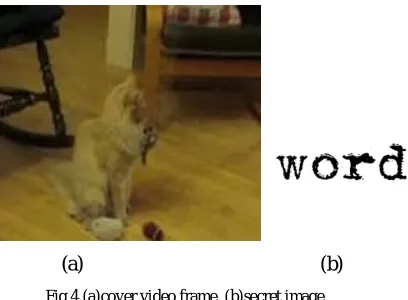
Fig 4.(a)cover video frame (b)secret image
Here a video file in “.avi”file was taken as the input which has 241 frames and embedding an image of “jpg”format with size 100100.
eq(3)
Fig 5.Watermarked video
This shows the frame in which watermark image is embedded and next is the distorted frame with a salt and pepper noise(noise level=1).
.(a) (b)
Fig 6.(a)distorted watermarked video frame (b)extracted secret image
The above figure(b) represents the extracted secret image with same distortions in the watermarked frame
.
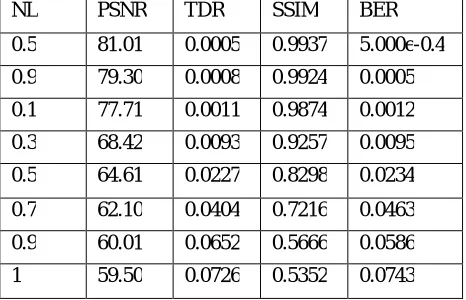
Here performances is evaluated by comparing the original watermark and extracted watermark and it is shown in the table below .
NL PSNR TDR SSIM BER
0.5 81.01 0.0005 0.9937 5.000e-0.4
0.9 79.30 0.0008 0.9924 0.0005
0.1 77.71 0.0011 0.9874 0.0012
0.3 68.42 0.0093 0.9257 0.0095
0.5 64.61 0.0227 0.8298 0.0234
0.7 62.10 0.0404 0.7216 0.0463
0.9 60.01 0.0652 0.5666 0.0586
1 59.50 0.0726 0.5352 0.0743
V. CONCLUSION AND FUTURE WORK
The proposed scheme has good computational efficiency to estimate the image/video quality.Embed the watermark in the coefficients of a 3-level DWT decomposition to make the algorithm robust to geometric attacks and maintain the original quality of the watermarked video.Placing the watermark in the level coefficients of the DWT decomposition is robust to geometric attacks and lossy compression and distortion in chrominance is less noticeable than distortion in luminance.The watermark embedding strength is assigned to an image by pre-analyzing its content complexity in the spatial domain.The watermark is not embedded in the approximation sub band during watermark embedding to reduce the loss image quality. In future work, the proposed scheme will be further developed to estimate the quality of an image/ video distorted by multiple distortions.
ACKNOWLEDGMENT
The authors would like to thank all the staffs of Department of ECE, college of engineering, kallooppara for their constant encouragement and support.
REFERENCES
1 Sha Wing ,Dong Zheng,Jiying Zhao, a member ,IEEE,Wa James Tam and FilippoSperanza,”Adaptive watermarking and tree structure based image quality estimation” IEEE transaction on multimedia, vol 16,no 2,feb 2014.
2 Z. Wang, A. C. Bovik, H. R. Sheikh, and E. P. Simoncelli, “Image quality assessment: From error visibility to structural similarity,” IEEETrans. Image Process., vol. 13, no. 4, pp. 600–612, 2004.
3 S.Wang, D. Zheng, J. Zhao, W. J. Tam, and F. Speranza, “An image quality evaluation method based on digital watermarking,” IEEETrans. Circuits Syst. Video Technol., vol. 17, no. 1, pp. 98–105, 2007.
4 M. Schneider and S.-F.Chang, “Digital Watermarking for TelltaleTamperProofing and Authentication,” in Proc. IEEE Int. Conf.Image Processing, 1996, vol. 3, pp. 227–230.
5 D. Zheng, J. Zhao, W. Tam, and F. Speranza, “Image quality measurement by using digital watermarking,” in Proc. IEEE Int. Workshop Haptic, Audio and Visual Environments and Their Applications, 2003,pp. 65–70.
6 A. Mishra, A. Jain, M. Narwaria, and C. Agarwal, “An experimental study into objective quality assessment of watermarked images,” Int.J. Image Process., vol. 5, no. 2, pp. 199–219, 2011.
7 J. D. Koch, M. D. Smith, and R. Telang, Camcording and Film Piracy in Asia-Pacific Economic Cooperation Economies. Washington, DC, USA: International
Intellectual Property Institute, Aug. 2011. [2] B. Stelter and B. Stone, Digital Pirates Winning Battle with Studios. Fair Harbor, NY, USA: The New York Times, Feb. 2009.
8 G. C. Langelaar, I. Setyawan, and R. L. Lagendijk, “Watermarking digital image and video data. A state-of-the-art overview,” IEEE Signal Process. Mag., vol. 17, no. 5, pp. 20–46, May 2000.
9 G. Doërr and J.-L.Dugelay, “A guide tour of video watermarking,” Signal Process., Image Commun., vol. 18, no. 4, pp. 263–282, 2003.
10 K.-S. Kim, H.-Y.Lee, D.-H.Im, and H.-K. Lee, “Practical, real-time, and robust watermarking on the spatial domain for high-definition video contents,” IEICE
Trans. Inform. Syst., vol. E91-D, no. 5, pp. 1359–1368, May 2008.
11 K.-S. Kim, D.-H.Im, Y.-H.Suh, and H.-K. Lee, “A practical real-time video watermarking scheme robust against downscaling attack,” in Proc. 6th Int. Workshop Digit.Watermarking, vol. 5041. 2008, pp. 323–334. [7] Y. Wang and A. Pearmain, “Blind MPEG-2 video watermarking robust against geometric attacks: A set of approaches in DCT domain,” IEEE Trans. Image Process., vol. 15, no. 6, pp. 1536–1543, Jun. 2006.
12 M. Carnec, P. Callet, and D. Barba, “Full reference and reduced reference metrics for image quality assessment,” in Proc. 7th Int. Symp.Signal Processing and Its Applications, 2003, vol. 1, pp. 477–480.
13 A. Said andW. Pearlman, “A new, fast and efficient image codec based on set partitioning in hierarchical trees,” IEEE Trans. Circuits Syst. Video Technol., vol. 6, no. 3, pp. 243–250, 1996.
14 S. Altous, M. K. Samee, and J. Gotze, “Reduced reference image quality assessment for jpeg distortion,” in Proc. IEEE 7th Int. Symp.ELMAR, 2011, pp. 97–100.
BIOGRAPHY
.
Anjali Krishna is currently pursuing M-TECH in electronics with specialisation in signal processing, College of Engineering, kalloopppara. She received her B-Tech(ECE) from the Musaliar College of Engineering and Technology, Pathanamthitta in 2014.Her areas of interest are Digital communication, Digital image processing and embedded design.