PREM SWAROOP, SHANTHA MURTHY. Design Techniques for High Efficiency Highly Linear RF Power Amplifier. (Under the direction of Dr. Kevin Gard).
Power consumption is a key parameter to be considered in designing wireless sys-tems, especially for cellular applications. Lower power consumption by designing
highly power efficient transceiver circuits is extremely desirable as it results in lower
battery size, higher talk time, lower heat generation and lower cost. Very high spectral efficiency is sought after in present day communication systems. In order to achieve
very high data rates, sophisticated non-constant envelope modulation schemes are
used. This places very stringent requirements on the transceiver design. One of the
key requirements is spectral linearity or purity, wherein the transmitter signal spec-trum has to be clean within the signal bandwidth and outside the signal bandwidth
as specified by FCC regulations for the wireless standard.
Output RF power amplifier (PA) consumes most of the power in a transmitter and is the key to high efficiency transmitter design. This research focuses on novel
techniques to maximize power efficiency of the RF power amplifier and at the same
time having high spectral linearity to meet FCC specifications. This research attempts to achieve the goal of high efficiency and high linearity by two different methods
-signal conditioning and smart circuit design.
A new crest factor reduction (CFR) technique to developed to reduce peak to average ratio (PAR) of high PAR signals. Trade-offs between the in-band and
out-of-band distortion is analyzed for maximum reduction in PAR of the signal.
A novel high efficiency linear transmitter architecture based on power quadrature modulation is proposed. High efficiency differential class D power supply modulator
is designed in Jazz 0.18 µm process.
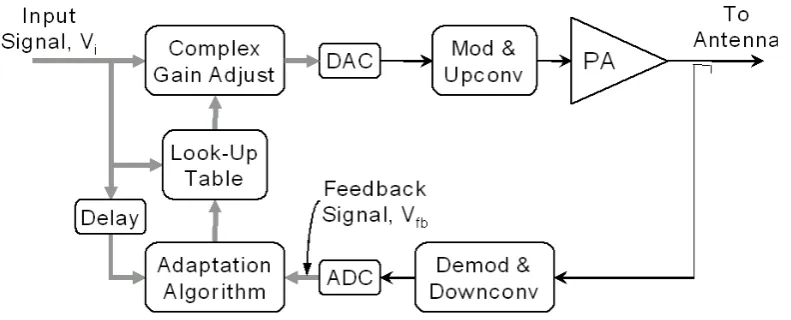
A lookup table based digital predistortion (DPD) engine is developed in
MAT-LAB to improve linearity performance in RF power amplifier. A DPD algorithm is demonstrated to improve the distortion performance of a Gallium Nitride RF PA at
by
Shantha Murthy Prem Swaroop
A dissertation submitted to the Graduate Faculty of North Carolina State University
in partial fullfillment of the requirements for the Degree of
Doctor of Philosophy
Electrical Engineering
Raleigh, North Carolina
2010
APPROVED BY:
Dr. Alex Huang Dr. Harvey Charlton
DEDICATION
To
BIOGRAPHY
Shantha Murthy Prem Swaroop was born and raised in Bangalore, India. He received
his B.Tech (Bachelors of Technology) degree in Electrical Engineering from Indian Institute of Technology, Madras in 2002. He worked as an IC design engineer in the
high resolution data converter group at Analog Devices in Bangalore from 2002 to
2004. He received Masters degree in English Literature from Karnataka State Open
University, Mysore in 2004.
He joined the department of Electrical and Computer Engineering at North
Car-olina State University in 2004 to pursue a Ph.D in the Radio Analysis and Design
group. His research interests include analog and RF integrated circuits for wireless and biomedical applications.
He is a student member of Institute of Electrical and Electronics Engineers (IEEE)
and Eta Kappa Nu (HKN). He was the Indian National Puzzle Champion in 2003 and has represented India in the 9th, 12th, and 14th World Puzzle Championships at
Stamford, USA, Papendal, Netherlands and Eger, Hungary in 2000, 2003, and 2005
respectively. He is the recipient of Analog Devices Outstanding Student Design Award in 2006. He was one of the top 5 finalists in Semiconductor Research Consortium
ACKNOWLEDGMENTS
I would like to thank my parents for their undying support and encouragement
throughout my student life. It is their dreams that I am fulfilling with this PhD. I want to thank my wife and sweetheart Divya for her support, understanding
and standing by me through times - happy and tough, long distance and waiting
for weekends. I want to thank my Parents-in-law and Deepa for their unswerving
support throughout this time. I really appreciate their help and effort in making the long distance relationship work smoothly.
I have made some good friends during this time. Thanks to all who have made
a mark on me. I would like to thank two special friends Anand and Pochih, unique in their way, for their unconditional friendship. I really enjoyed all the coffee shop
hangouts, counselling sessions, question and answer bouts.
Special thanks to Two Cents of Hope and all its volunteers (each and everyone over the past 5 years) for making my life at NC State worthwhile and meaningful.
Thanks to Ravi Jenkal for all the lunches and interesting perspectives about life
and everything; Mithun for all the enjoyable racquetball, squash duels and the steam room outings!; My room mates for two years Akshay, Amar and Vineet for making
my start here a memorable one; Steve Lipa, Jonathan Wilkerson, Gautham
Krish-namurthy for help in the lab and perspectives about life in the ECE department; Elaine Hardin for being such a sweetie and making my life comparitively easier in the
bureaucratic-form-filling-make-your-life-miserable ECE department and its policies.
Thanks to Tony Montalvo of Analog Devices for the internships and being on my committee. Thanks to folks at Analog Devices, especially David Maclaurin for all
the fun times at AD and for giving me an insight into how lethal the combination of
super smartness and humility looks like.
Lastly, I would like to appreciate my Advisor Kevin Gard for his great insight, his cool attitude, his guidance and direction. It could have been a better ending, but I
TABLE OF CONTENTS
LIST OF TABLES . . . ix
LIST OF FIGURES . . . xi
1 INTRODUCTION . . . 1
1.1 Background . . . 1
1.2 Linearity . . . 3
1.3 Peak to Average Ratio . . . 7
1.4 Efficiency . . . 8
1.5 Problem Statement . . . 9
1.6 Overview of Thesis . . . 10
2 Linearization and Efficiency Improvement Techniques . . . 11
2.1 Linearization Techniques . . . 11
2.1.1 Back-off . . . 12
2.1.2 Feedback . . . 12
2.1.3 Feedforward . . . 16
2.1.4 Predistortion . . . 18
2.1.5 Summary . . . 21
2.2 Efficiency Enhancement Techniques . . . 22
2.2.1 Types of Amplifiers . . . 22
2.2.2 Envelope Elimination and Restoration . . . 23
2.2.3 Envelope Tracking . . . 27
2.2.4 Polar Modulation . . . 29
2.2.5 Comparison of Various Techniques . . . 31
3 Crest Factor Reduction through In-band and Out-of-band Distortion Optimization . . . 33
3.1 New CFR Technique . . . 35
3.2 Optimization . . . 40
3.2.1 WCDMA . . . 41
3.2.2 WLAN . . . 43
3.3 PA Measurement Results . . . 48
3.4 Digital Predistortion . . . 48
4 High Efficiency Linear Transmitter . . . 55
4.1 Motivation . . . 55
4.2 Proposed Architecture . . . 57
4.3 Class-D Amplitude Modulator Design Procedure . . . 60
4.3.1 Pulse Width Modulation . . . 61
4.3.2 Comparator . . . 63
4.3.3 Output Power Stage . . . 64
4.3.4 Level Shifter . . . 72
4.4 Layout . . . 72
4.4.1 Power Stage . . . 72
4.4.2 Comparator . . . 74
4.4.3 ESD Protection . . . 75
4.5 Packaging . . . 75
4.6 Design/Simulation Results . . . 75
4.6.1 Comparator . . . 75
4.6.2 Driver Supply Voltages . . . 76
4.6.3 Optimal Output Widths . . . 77
4.6.4 Modulation Index . . . 78
4.6.5 Dead-time . . . 79
4.6.6 Switching Frequency . . . 81
4.6.7 Output Filter . . . 81
4.6.8 Optimized Design . . . 82
4.6.9 Corner Simulation Results . . . 84
4.7 Board Design . . . 87
4.7.1 Supply Decoupling Capacitors . . . 88
4.7.2 Output Filter . . . 89
4.8 Design Issues and Modifications . . . 89
4.9 Measurement Results . . . 90
4.10 Shortcomings and Justifications . . . 92
5 Memoryless Digital Predistortion Linearization . . . 95
5.1 Theory . . . 95
5.2 Implementation . . . 96
5.3 Experimental Results . . . 98
6 Conclusions and Future Work . . . 102
6.1 Conclusions . . . 102
6.2 Future Work . . . 103
Appendices . . . 111
Appendix A: Cadence Schematics . . . 112
Appendix B: Layout . . . 116
Appendix C: Crest Factor Reduction MATLAB Code . . . 124
LIST OF TABLES
Table 1.1 Summary of various wireless communication standards . . . 2
Table 2.1 Performance of various linearization techniques . . . 22
Table 2.2 Performance of different classes of linear amplifier . . . 22
Table 2.3 Comparison of power efficiencies for various design techniques . . . 32
Table 3.1 Noise Filtering due to Different Values of Weighting Factors . . . 40
Table 3.2 Forward Link WCDMA FCC Specifications . . . 41
Table 3.3 EVM due to different Clipping Levels and Weighting Factors . . . 46
Table 3.4 WLAN Spectral Requirements . . . 46
Table 3.5 EVM for Two Stage CFR . . . 47
Table 3.6 EVM for Three Stage CFR . . . 49
Table 4.1 Class-D Modulator Target Specifications . . . 60
Table 4.2 Class-D Modulator Top Level Pad Description . . . 74
Table 4.4 Reverse Link IS-95 FCC Specifications . . . 83
Table 4.5 Two-tone Signal Simulation Results . . . 84
Table 4.6 Two-tone Signal Simulation Results . . . 84
Table 4.7 Corner Simulation Results . . . 86
Table 4.8 Board Description . . . 88
Table 4.9 Decoupling Capacitor Bank . . . 89
Table 4.10 Output Filter Capacitor Bank . . . 89
Table 4.11 Sinusoidal Input Spur Suppression . . . 91
Table 4.12 Spectral Requirements for 900 MHz and 1800 MHz EDGE Handset signal . . . 91
LIST OF FIGURES
Figure 1.1 Generic Gain System . . . 3
Figure 1.2 Output spectrum of a non-linear system for a two-tone input . . . 4
Figure 2.1 Negative Feedback Block Diagram . . . 12
Figure 2.2 Cartesian Feedback Block Diagram . . . 15
Figure 2.3 Polar Feedback Block Diagram . . . 15
Figure 2.4 Feedforward System Block Diagram . . . 17
Figure 2.5 Predistortion Block Diagram . . . 19
Figure 2.6 Graphical Representation of Predistortion . . . 19
Figure 2.7 Envelope Elimination and Restoration Block Diagram . . . 24
Figure 2.8 Envelope Tracking Block Diagram . . . 27
Figure 2.9 Polar Modulation Block Diagram . . . 29
Figure 3.1 New CFR Technique Signal Flow Diagram . . . 35
Figure 3.2 Original and Clipped Signals . . . 36
Figure 3.3 Original and Clipped Signals and their corresponding spectrum . . . . 37
Figure 3.4 New CFR Technique Block Diagram . . . 38
Figure 3.5 Correlated and Uncorrelated Spectrum of a Clipped Signal . . . 39
Figure 3.6 WCDMA ACPR for various values of PAR andwO;wI = 1 . . . 42
Figure 3.7 WCDMA EVM for various values of PAR andwO;wI = 1 . . . 43
Figure 3.9 WCDMA EVM for various values of wO and wI; PAR= 5.7 dB . . . 44
Figure 3.10 WCDMA ACPR for various values of wO and wI; PAR= 7 dB . . . 45
Figure 3.11 WCDMA EVM for various values of wO and wI; PAR= 7 dB . . . 45
Figure 3.12 WLAN EVM for different values ofwI,wO . . . 47
Figure 3.13 Modified three stage CFR technique for WLAN signals . . . 48
Figure 3.14 Optimized three stage CFR WLAN Output Spectrum . . . 50
Figure 3.15 Optimized EVM for various PAR using CFR . . . 51
Figure 3.16 PA Output: ACPR for various values of wO and wI; PAR= 5.7 dB . 51 Figure 3.17 PA Output: EVM for various values of wO and wI; PAR= 5.7 dB . . 52
Figure 3.18 PA Output: ACPR for various values of wO and wI; PAR= 7 dB . . . 52
Figure 3.19 PA Output: EVM for various values of wO and wI; PAR= 7 dB . . . . 53
Figure 3.20 PA Output: ACPR and PAE with and without CFR+DPD . . . 53
Figure 3.21 PA Output: EVM with and without CFR+DPD . . . 54
Figure 4.1 Proposed Power Quadrature Modulator Architecture . . . 58
Figure 4.2 H-Bridge Class-D Modulator Block Diagram . . . 61
Figure 4.3 PWM Single-ended and Differential Spectra . . . 62
Figure 4.4 Comparator Circuit . . . 63
Figure 4.5 Dead-time Generation Circuit . . . 65
Figure 4.6 Outputs of Dead-time Generation Circuit . . . 66
Figure 4.7 Effect of Dead-time in the Power Stage . . . 67
Figure 4.8 Second Order Filter Magnitude Response . . . 71
Figure 4.10 Bonding Diagram on a 44 pin QFN package . . . 76
Figure 4.11 Simulation plots of PMOS and NMOS on-resistance for various Gate-Source voltages . . . 77
Figure 4.12 Simulation results of power losses for various power stage widths . . . 78
Figure 4.13 Simulated Power efficiency for various Power stage widths . . . 78
Figure 4.14 Simulated Modulator output power and power efficiency for various modulation indices . . . 79
Figure 4.15 Simulated IMD Vs Dead-time . . . 80
Figure 4.16 Simulated Power Efficiency Vs Dead-time . . . 80
Figure 4.17 Simulated Second Harmonic IMD Vs Switching frequency . . . 82
Figure 4.18 Simulated Power Efficiency Vs Switching frequency . . . 82
Figure 4.19 Two-Tone Differential Output spectrum . . . 84
Figure 4.20 Two-Tone Single Ended Output spectrum . . . 85
Figure 4.21 IS-95 Differential Output spectrum. . . 85
Figure 4.22 IS-95 Single Ended Output spectrum . . . 86
Figure 4.23 Two Layer Board Design . . . 87
Figure 4.24 Differential and Single Ended Modulator Output Spectrum for 200 KHz Sinusoidal Input Signal . . . 90
Figure 4.25 Nearband Differential and Single Ended Spectrum for EDGE Input Signal . . . 92
Figure 4.26 Wideband Differential and Single Ended Spectrum for EDGE Input Signal . . . 93
Figure 4.27 Measured, Simulated and Modelled modulator power efficiency . . . 94
Figure 5.1 Digital Predistortion Block Diagram . . . 96
Figure 5.3 Post DPD ACLR and PAE Vs Gate Bias Voltage . . . 99
Figure 5.4 Pre and Post DPD Output Spectra . . . 99
Figure 5.5 Post DPD + CFR ACLR and PAE Vs Output Power . . . 100
Figure 5.6 EVM Vs PAR . . . 100
Figure 6.1 HELT Characterization Block Diagram . . . 104
Figure A-1 Comparator Schematic . . . 112
Figure A-2 Bias Generator Schematic . . . 113
Figure A-3 Dead-time Generation Schematic . . . 113
Figure A-4 Dead-time Fine Delay Schematic . . . 114
Figure A-5 Dead-time Coarse Delay Schematic . . . 114
Figure A-6 P-Driver Level Shifter Schematic . . . 115
Figure A-7 N-Driver Level Shifter Schematic . . . 115
Figure A-1 Class-D Modulator Top Level Layout . . . 116
Figure A-2 Comparator Layout . . . 117
Figure A-3 Bias Generator Layout . . . 118
Figure A-4 ESD Power Supply Clamp Layout . . . 119
Figure A-5 I/O connecting ESD Diodes Layout . . . 120
Figure A-6 Dead-time generation Circuit Layout . . . 121
Figure A-7 P-Driver Level Shifter Layout . . . 122
Chapter 1
INTRODUCTION
1.1
Background
In first generation (1G) wireless systems like NMT (Nordic Mobile Telephone) and
AMPS (Advanced Mobile Phone System), the throughput rates were pretty moderate
(few kbps). Constant envelope modulation schemes were used to achieve the necessary data rates. In GSM (Global System for Mobile Communications), a second
gener-ation (2G) system, GMSK (Gaussian Minimum Shift Keying), a constant envelope
modulation scheme is used to obtain data rate of about 270 Kbps. EDGE (Enhanced
Data Rate for GSM Evolution) provides three times the data rate as GSM by addition of amplitude modulation along with phase modulation, however utilizing the same
bandwidth. IS-95 (Interim Standard), a 2G standard pioneered by Qualcomm, and
branded as cdmaOne, uses CDMA (Code Division Multiple Access) as opposed to TDMA (Time Division Multiple Access) used by GSM or Frequency division
multi-plexing used by 1G cellular systems. Here QPSK (Quadrature Phase Shift Keying),
a non-constant envelope scheme is used to obtain higher throughput rate of 1.2288 Mbps. 3G systems like WCDMA (Wideband Code Division Multiple Access) make
use of non constant envelope schemes to achieve higher data rates. WCDMA has a
data rates up to 54 Mbps. WiMAX (Worldwide Interoperability for Microwave Ac-cess) uses OFDM (802.16d) and SOFDMA (Scalable Orthogonal Frequency Division
Multiple Access) (802.16e) and can achieve data rates as high as 70 Mbps. Summary
of various wireless communication standards is presented in table 1.1 [3].
Table 1.1: Summary of various wireless communication standards
Spectral efficiency is an extremely important parameter in present day communi-cation systems. In order to achieve very high data rates, sophisticated modulation
schemes are used, which use non-constant envelope schemes. Very stringent
require-ments are put on the transceiver design. One of the key requirerequire-ments is spectral linearity or purity, wherein the transmitter signal spectrum has to be clean within
the signal bandwidth and outside the signal bandwidth as specified by FCC
regula-tions for the wireless standard.
Power consumption is a key parameter to be considered in wireless systems, espe-cially for cellular applications. Lower power consumption by designing highly power
efficient transceiver circuits is extremely desirable as it results in lower battery size,
Concepts of Linearity and Power efficiency are explained in detail from the trans-mitter point of view in the following subsections.
1.2
Linearity
A system is called linear if the output varies in direct proportion to the input.
Conversely, a system is called non-linear if the output is a non-linear function of the
input.
x
G(x)
y
Figure 1.1: Generic Gain System
Consider the system shown in fig. 1.1. As per eqn. 1.1, the output of the system y
is given in terms of the input x and system gain G. The system is linear if the system
gain is independent of the input x.
y = G(x) x (1.1)
Polynomial modelling can be used to model the non-linearity of a system as shown
in eqn. 1.2.
y = g0+g1 x+g2 x2+g3 x3+...+gn xn (1.2)
Hereg0−gn are constant complex coefficients obtained from narrowband
A two-tone analysis helps in understanding the different spectral components gen-erated due to non-linearities in the system. Consider a two-tone input signal as given
by eqn. 1.3
x = A Cos(w1 t) +A Cos(w2 t) (1.3)
Herew1 and w2 are the two input frequencies and A is the amplitude of the input
tones.
DC FIRST
HARMONIC
SECOND HARMONIC
THIRD HARMONIC DC w2- w1 2w2- w1 w1 w2 w- 2 w2 1 2w1 w2+ w1 2w2 3w1w+ 2w2 12w2 + w 13w2
Figure 1.2: Output spectrum of a non-linear system for a two-tone input
Limiting the polynomial expansion to third order, the output spectrum obtained is shown in fig. 1.2. The output spectrum contains components around DC, first,
second and third harmonics of the input frequencies. There are frequency components
at DC and the envelope frequency (w2−w1) due to second order non-linearities in the
system. The components around the first harmonic are atw1andw2due to first order
signals and mixing products due to third order distortion. There are also components
at 2w1−w2 and 2w2−w1 due to third order non-linearities in the system. There are
spectral components around second and third harmonics of the input frequency due
to second and third order non-linearities in the system.
cannot be removed as they are very close to the signal band. Substituting eqn. 1.3 in eqn. 1.2, the amplitude of first harmonic components (Y1) and the IM3 components
(Y3) are given by eqns. 1.4 and 1.5
Y1 = g1+
9 4 g3 A
3 (1.4)
Y3 =
3 4 g3 A
3
(1.5)
The second term in eqn. 1.4 corresponds to gain compression/expansion and Y3
in eqn. 1.5 corresponds to intermodulation distortion.
Writing g3 as a complex number
g3 = g3R+j g3I (1.6)
and substituting eqn. 1.6 in 1.4
Y1 = Y1AM P tan−1(φ1) (1.7)
Where,
Y1AM P = g1 A s
1 + 9 4
g3R A2
g1 2
+
g3I A2
g1 2
(1.8)
φ1 =
1 g3R
g3I
+ 9 g1
4 g3I A2
(1.9)
Y1AM P is a measure of AM-AM distortion and φ1 is a measure of AM-PM
Note: Expressing a signal as a polynomial expansion is a narrow band represen-tation. It is just a qualitative measure of linearity of a signal and cannot be extended
to wide-band signals.
In digital communication systems, BER (Bit Error Rate) is a system performance
metric that quantifies the reliability of the entire system, defined by eqn. 1.10.
BER = Number of errors
Total number of bits transmitted (1.10)
SNR (Signal to Noise Ratio), EVM (Error Vector Magnitude) and ρ (waveform quality factor) are system performance metrics used to measure distortion in the
channel. SNR is the ratio of the signal power to the total noise power in the channel. EVM is a measure of the departure of signal constellation from its ideal reference
because of nonlinearity. ρis a measure of the correlation between a scaled version of the input and the total in-channel output waveforms. The relationship between these metrics has been established in [1].
EV M =
r
1
SN R (1.11)
ρ = SN R
SN R+ 1 (1.12)
Further, the in-band distortion contains distortion components that are correlated
and uncorrelated to the input signal. The correlated component results in gain
com-pression/expansion, whereas the uncorrelated component represents the in-band noise floor. The ratio of the desired output signal power to the power of the uncorrelated
distortion component is used to calculate SNR, EVM and ρ. Correlation techniques are used in [2] to separate the correlated and uncorrelated distortion components. An analytical evaluation of BER using the SNR obtained from the output spectrum is
verified using simulations.
distortion results in the degradation of SNR and ultimately BER itself. Out-of-band distortion results in degradation of SNR of adjacent channels. ACPR (Adjacent
Channel Power Ratio) is a measure of out-of-band distortion, which is the ratio of
the channel signal power to the noise added in the adjacent channel.
Receiver noise is a critical specification in transmitter design. It determines how
much noise is allowed at receiver frequencies and is measured in dBc/Hz. Noise at
the receiver limits receiver sensitivity. Thermal noise in the resistance of the signal
source is the fundamental limit on achievable signal sensitivity. Noise floor Power (NFP) is given by
N F P = k T B (1.13)
Here,
K is Boltzmann Constant = 1.38 X 10⁻²³ J/K T is the absolute temperature in ◦K
B is the noise bandwidth in Hz
Noise floor power at 290 K (the standard for definition of noise floor) using eqn. 1.13 is equal to -174 dBm/Hz.
Other noise sources in the transmitter affecting the receiver sensitivity are phase
noise from the local oscillator and wideband out-of-band distortion due to the non-linearity of the RF PA.
1.3
Peak to Average Ratio
PAR (Peak-to-Average Ratio) is a method of defining the statistics of a modulated signal in terms of Peak power and Average power. PAR is defined as the ratio of Peak
power of the signal to the average power of the signal. It is usually expressed in dB.
Qualitatively PAR is a measure of the dynamic range of the signal. Higher the PAR,
given in eqn. 1.14. Here E is the statistical mean of the signal.
P AR = 10 log
max(|x|)2
E(|x|)2
(1.14)
Other measures like CF (Crest Factor) are used to determine the statistical nature
of the modulated signal. CF is the ratio of the peak amplitude to the rms amplitude
of the signal.
1.4
Efficiency
Spectral purity and spectral efficiency are two very important parameters involved
in the design of a cellular data transmission system. Spectral purity translates to lin-earity and spectral efficiency translates to throughput rate. One other very important
parameter in the design of cellular networks is the power consumption.
Power consumption is a very important parameter both in Base station as well as Handset designs. Handsets, since running on batteries, rely heavily on lower power
consumption to maximize talk-time or on-time. Base stations on the other hand would
desire lower consumption keeping in mind the thermal effects caused by temperature increase due to heavy power consumption. A very big portion of the power consumed
in a transmitter goes into the PA. So, the designed PA has to be power efficient.
Power efficiency and Power Added Efficiency (PAE) are two important measures of efficiency of a system.
Power efficiency is defined as
η = POU T PDC
(1.15)
Where POU T is the Output RF power and PDC is the power consumed from DC
source.
P AE = POU T −PIN PDC
(1.16)
1.5
Problem Statement
Present day 2.5 G and 3 G communication systems use sophisticated non-constant
envelope schemes like WCDMA and OFDM to achieve high spectral efficiency. These modulation schemes have very high PAR, often execeeding 10 dB. The output of
the transmitter needs to be highly linear over a wide dynamic range when using
linear mode RF power amplifiers (PA) like class A, B, AB and C amplifiers, since the information is contained in amplitude as well as phase of the signal.
It is clear that the IM3, IM5 and other higher order distortion components increase
by 3 dB, 5 dB and so on for every dB increase in the output power, thereby degrading the linearity as the output power increases. Hence, the amplifier average output power
needs to be backed-off from the 1 dB gain compression point by at least the PAR of
the input signal. The PA has to be designed for the peak power but will be operating mostly around the average power level.
From eqn. 1.16, it is also clear that higher the RF power delivered to the load,
higher is the PAE. Also, beyond the 1-dB compression point, the output power de-livered remains constant, not changing with increase in input power. This decreases
the PAE of the PA. So, in order to obtain highest possible efficiency, it is desired
to drive the PA as hard as possible just close to its 1-dB compression point but not
going beyond the compression point. Hence, working in a backed-off mode results in really poor power efficiency of the PA and the transmitter.
This implies that there is a direct trade-off between the linearity and power
effi-ciency for spectrally efficient modulation schemes. One seems to be achieved at the expense of the other. Hence, it is imperative to have external linearization schemes
to improve the linearity and power efficiency enhancement schemes to improve the
The underlying problem is to design systems with improved linearity and at the same time improving or at least not degrading the system power efficiency, knowing
that an inverse relationship exists between the two parameters.
1.6
Overview of Thesis
The focus of this research is to design high efficiency, highly linear CMOS RF amplifiers for 2.5 G and 3 G communication systems using spectrally efficient
mod-ulation schemes. This research attempts to achieve the goal of high efficiency and
high linearity by two different methods - signal conditioning and smart circuit design. Chapter 2 describes the various linearization and efficiency improvement techniques
available in literature. A new CFR (Crest Factor Reduction) technique to reduce
the PAR of high PAR signals is presented in chapter 3. Reduction of PAR results in increased power efficiency of the system. Trade-off between the in-band and
out-of-band distortion is presented for the maximum reduction in PAR of the signal. The
proposed CFR technique is demonstrated using WCDMA and WLAN signals on a Gallium Nitride (GaN) RF Power Amplifier (PA). A new HELT (High Efficiency
Lin-ear Transmitter) architecture using CMOS switch-mode RF amplifiers and class D
amplitude modulators is proposed in chapter 4. Detailed discussion of the motivation
behind the proposed technique, theory of operation, design of the class D modulator and measurement results are presented in this chapter. Chapter 5 describes a LUT
(Look Up Table) based DPD (Digital Predistortion) technique used to improve the
linearity of the RF PA. A DPD algorithm is demonstrated to improve the distortion performance of a GaN (Gallium Nitride) PA at a particular output power level. DPD
in conjunction with CFR can be used to improve the overall linearity and PAE of the
Chapter 2
Linearization and Efficiency
Improvement Techniques
2.1
Linearization Techniques
This section describes some of the popular linearization techniques available in
literature. Detailed analysis of various linearization techniques is done in [4], [5], and [6].
Any system can be linearized by one or more of the following methods.
1. Fabrication of more linear devices.
2. Limiting operation of devices to most linear region of operation.
3. Deliberate addition of distortion somewhere in the system to compensate for non-linearities created by the devices in the system.
Working within the realms of circuit design techniques, only the second and mainly
2.1.1
Back-off
The simplest means of achieving a good linearity is to back-off from the 1-db
compression point by at least the PAR of the modulation signal. This may give better linearity performance but heavily at the cost of efficiency. This technique has
limited scope of use.
2.1.2
Feedback
Feedback is probably the simplest and most intuitive linearization technique. The basic essence of feedback is to reduce the error or distortion in the output signal by
feeding a portion of the output signal back to the input. The feedback applied can
be of two types-positive and negative. Positive feedback increases the error, whereas,
on the other hand, negative feedback reduces the error in the system.
x e G y
f v
Σ
+-Figure 2.1: Negative Feedback Block Diagram
Consider the block diagram shown in fig. 2.1. Prior to feedback, the output signal in terms of the input signal is given by eqn. 2.1.
Here G is the non-linear gain of the system. On applying negative feedback with feedback factor f,
y = G e (2.2)
Here, e is the error signal fed to the system given by eqn 2.3
e = x−f y (2.3)
Simplifying,
y = G
1 +G f x (2.4)
For a high value of the loop gain G f, i.e, G f 1, eqn. 2.4 reduces to
y = 1
f x (2.5)
The feedback is done usually through a linear element and hence the feedback
factor f is highly linear. So from the above equation, the output signal y is dependent on the input signal x and the linear parameter f. It is independent of the system
non-linear gain G. Hence the output signal is a linear amplified version of the input
signal.
What essentially happens is that the input signal to the system is a very small
signal e of value 1+G f1 x. Since the input seen is a small signal, the output is naturally a linear version of the input signal. Another way of looking at it is that the input e
to the system is predistorted automatically by the feedback in such a way that the output is linear. It is to be noted that the feedback, though linearizes the output
signal, reduces the gain of the system. The gain is reduced from G to f1 by a factor of G f, which is the loop gain of the system.
One critical aspect of any feedback system is the loop stability. It is to be ensured
that the feedback loop is stable under all conditions as stated by the Nyquist stability
The input, output and feedback signals in the system can be signals of any type-voltage, current, phase, frequency, etc. The main system is an active system, whereas,
the feedback system is usually a linear passive element. The feedback can be of two
types - series and shunt feedback.
Feedback for RF systems RF itself. Feedback at RF This puts in a huge bandwidth
requirement on the system. An alternative to this is to down-convert the output RF
signal to baseband and provide feedback to the input baseband signal. Feedback can
also be provided at IF.
Applying feedback for RF systems, it is very important to match the delays for
the forward path and the feedback path. Delay mismatches reduce the effectiveness
of feedback. It may also lead to instability.
Based on the choice of coordinate system used to fully describe the modulation,
baseband feedback can be of two types, namely cartesian feedback and polar feedback.
If the complex baseband input signal is represented in terms of cartesian or I-Q format as in eqn. 2.6, then it is termed as cartesian feedback. The RF output is given in
eqn. 2.7 in terms of RF carrier w0. Simplified block diagram of cartesian feedback is
shown in fig. 2.2.
x(t) = I(t) +j Q(t) (2.6)
y(t) = I(t)Cos(w0 t) +Q(t) Sin(w0 t) (2.7)
Polar feedback makes use of polar representation of the complex baseband signal
as shown in eqn. 2.8. The RF output is shown in eqn. 2.9. Simplified block diagram
of polar feedback is shown in fig. 2.3. A PLL (Phase Locked Loop), a negative feedback control system is used to control the phase of the signal and frequency of
operation. Following down-conversion of the output signal, the amplitude is fed back
LO (w ) DOWN CONVERTER CONVERTER RF PA I Q y o
Σ
Σ
+
+
-Figure 2.2: Cartesian Feedback Block Diagram
RF OUTPUT AMPL MOD PHASE MOD SWITCH-MODE RF PA SWITCH-MODE/LINEAR ENVELOPE AMPLIFIER PHASE MAGNITUDE Rectangular To Polar I Q A Φ PLL VCO DOWN CONVERTER
Figure 2.3: Polar Feedback Block Diagram
y(t) = A(t) Sin(w0 t+φ(t)) (2.9)
Both types of feedback employ two feedback control loops. Polar feedback uses
one loop for the amplitude and one for the phase, whereas cartesian feedback uses two identical loops.
Ideally, a Cartesian feedback system functions as two identical, decoupled feedback
loops: one for the I component, and one for the Q component. However, in practice, due to delay through the RF PA, phase shifts of the RF carrier due to the reactive
load of the antenna, and mismatched interconnect lengths between the LO (local
oscillator) and the I-Q mixers result in phase misalignment and hence coupling of the I-Q loops. As a result, the stability of the feedback loops is greatly compromised.
A detailed analysis of phase misalignment in cartesian feedback and robust design
techniques to overcome this problem is presented in [7].
Similar problem exists in polar feedback. Here the problem is more severe as there are two different kinds of loops in polar feedback as compared to cartesian feedback,
where two identical loops are used. The phase and amplitude bandwidths are many
times higher than the baseband I-Q modulation bandwidth. Designing stable feedback loops for such high bandwidths is very challenging. The phase feedback loop is most
difficult to design as its spectrum extends all the way to infinity. Compromising on
the bandwidth results in severe spectral degradation, which is not acceptable to the present day wireless standards.
2.1.3
Feedforward
Feedforward linearization is similar to feedback linearization except that the
cor-rection is applied at the output of the system rather than the input of the system as in feedback. A simplified block diagram of feedforward linearization technique is
shown in fig. 2.4. The output v of the main non-linear RF PA A1 is given by eqn.
2.10. Here G1 is the linear gain of the amplifier and G(x) is the input dependent
G(x)
G(x)
1/G
1
x
y
e
v
Figure 2.4: Feedforward System Block Diagram
v = G1 x+G(x) (2.10)
This output is fed to an attenuator having an attenuation factor G1 equal to the
linear gain of the main RF amplifier. Error signal e given by eqn. 2.11 is obtained
by subtracting the attenuated signal by the input to the RF PA.
e = v
G1
−x (2.11)
Substituting eqn. 2.10 in eqn. 2.11,
e = G(x)
G1
(2.12)
The error signal is amplified by a similar RF PA A2. Since, the signal level is
low, the output of this amplifier is fairly linear. Output of A1 is subtracted from the
y = v−G1 e (2.13)
Substituting eqns. 2.12 and 2.10 in eqn. 2.13,
y = G1 x (2.14)
We see from eqn. 2.14 that the output is linearly amplified version of the input. Feedforward linearization offers the benefits of feedback linearization without the
disadvantages of instability and bandwidth limitations.
Some of the disadvantages and challenges of feedforward linearization are
• An extra PA is required to amplify the error signal.
• The distortion performance of the additional PA places an upper limit on the
distortion correction offered by this technique.
• Accurate gain and phase tracking is required by the various elements in the
system.
• The tracking needs to be maintained over the modulation bandwidth of the
input signal, which can be as high as 10s of MHz depending on the modulation
scheme.
• Tracking also needs to be maintained over temperature and time.
2.1.4
Predistortion
Predistortion is a linearization technique which involves creation of distortion characteristic which is complementary to the RF PA distortion characteristic so that
the cascaded system is independent of distortion. Simplified block diagram of a
x
F(x)
v
G(v)
y
Predistortion
Function
Non-Linear
Amplifier
Figure 2.5: Predistortion Block Diagram
x F(x)
v G(v)
x y
Figure 2.6: Graphical Representation of Predistortion
linear function of the input x. A graphical representation of predistortion is shown
in fig. 2.6. An analytical expression for F is given through eqns. 2.15-2.19.
v = F(x) (2.15)
y = G(v) (2.16)
y = G(F(x)) (2.17)
The predistortion function F is chosen such that
G(F(x)) = C x (2.18)
Here C is a complex constant. Hence,
F(x) = G−1 (C x) (2.19)
And,
y = C x (2.21)
Based on the frequency at which the predistortion function operates, the
lineariza-tion technique is classified as RF, IF, or baseband predistorlineariza-tion. Various implemen-tations of these predistortion techniques are presented in [4].
The advantages of RF/IF predistortion techniques are
• Unconditionally stable. Predistortion technique is essentially open loop.
• Easy to implement. Lesser number of components required.
• Easy to use at high frequencies.
• Very high linearization bandwidth.
Some of the disadvantages are
• Modest linearity improvement compared to other techniques such as feedforward
or cartesian feedback.
• Difficult to compensate for higher order distortion terms.
• Optimum performance only at one power level.
With vast improvement in DSPs (Digital Signal Processor), Baseband
predistor-tion has become very attractive. Gain and phase weighting coefficients of the
predis-tortion function are stored in a DSP at baseband before upconversion to RF. Since, the predistortion function is in the digital domain, this technique is called DPD
(Dig-ital predistortion). The DSP coefficients can be constantly updated using feedback
from the output signal through downconversion to baseband. This technique is called Adaptive DPD.
DPD can compensate for higher order distortion terms and can give linearity
• Sampling rate must be several times the modulation bandwidth of the signal.
• Very high DSP speeds and hence high power consumption.
• The coefficients take several iterations to converge to proper values. This poses
a challenge for real time operation.
• Handling memory effects.
Memory effect is a phenomenon in which the output signal is not only a function of
the instantaneous input signal, but also a function of previous input values. Changes in amplitude and phase of distortion components are caused by changes in
instanta-neous bandwidth or modulating frequency of the input signal. The distinction from
non-linearity is that non-linearity generates new spectral components, whereas mem-ory effects shape the existing spectral components. It is to be noted that memmem-ory
effects have very high time constants.
A detailed analysis of memory effect and its various causes is done in [8]. Memory effect has been characterized and quantified in [9], [10], and [11]. A hybrid
predistor-tion correcpredistor-tion scheme is proposed in [12] in which adaptive DPD is used to correct
for wideband errors and an analog predistortion loop is used to compensate for the long time constant memory effects.
Chapter 5 covers in detail an adadptive DPD algorithm used to linearize GaN
PAs used for base-station purposes.
2.1.5
Summary
Table 2.1 summarizes the performance of various linearization techniques [13].
Adaptive DPD seems most favourable technique for our purposes as it provides rea-sonable linearity improvement at low cost for high modulation bandwidth wireless
Table 2.1: Performance of various linearization techniques
Linearization Correction capability Correction Bandwidth Relative
Technique (dB) (MHz) Cost
Feedback 10-20 <5 Medium
Feedforward 25-35 >100 High
RF/IF PD 5-10 > 25 Low
Adaptive DPD 10-20 > 50 Medium
2.2
Efficiency Enhancement Techniques
2.2.1
Types of Amplifiers
RF PAs are broadly classified into two categories, namely linear amplifiers and
switch-mode amplifiers. If the PA devices operate in the linear amplifying region,
then they are called linear amplifiers. If the devices operate as a switch, switching between the two power supply rails then they are termed switch-mode amplifiers.
Linear Amplifiers
Linear amplifiers are further classified into different classes - A, B, AB and C
based on the time of conduction of current, the operating bias point, or alternatively,
the conduction angle in the PA devices. Performance of different classes of linear
amplifier is presented in table 2.2. A detailed description of each of the PAs and efficiency calculations are present in [4] and [5].
Table 2.2: Performance of different classes of linear amplifier Class Time of conduction Maximum Theoretical Distortion
per cycle (%) Efficiency (%)
A 100 50 Lowest
B 50 78.5 High
AB 50-100 50-78.5 Medium
C <50 >78.5 Highest
It is to be noted that the efficiency numbers are obtained at peak output power level and for a constant amplitude sinusoidal waveforms. The efficiency numbers further
drop down at lower output power levels and high PAR input signals.
From the above observations, it can be concluded that linear amplifiers are not suitable for design of highly efficient PAs. Doherty PA is a technique proposed to
obtain high efficiency for high PAR signals [4], [5], [6]. However the efficiency cannot
go beyond the maximum theoretical efficiency given in table 2.2.
Switch-mode Amplifiers
Switch-mode PAs are amplifiers in which the power devices are used as switches:
They are either completely turned on or off. Theoretically these PAs have 100 % power efficiency as there is no current-voltage overlap. This means that when there
is current flow in the device, there is no voltage across it and similarly, when there
is a voltage across it, there is no current flow in the device. Switch mode PAs are classified in variety of classes such as D, E, F,F−1, S, and T. The classification is based
on architectural differences due to various factors such as frequency of operation,
accounting of circuit imperfections, and filtering of higher order harmonics of the signal frequency.
Switch-mode PAs can be used with constant envelope schemes as the devices need
to be completely turned on or off. They cannot operate in the linear amplifying region. Hence, they are not suitable for non-constant envelope schemes. Also, the
distortion performance of switch mode PAs is poorer compared to linear amplifiers.
The following subsections describe efficiency enhancement schemes used for non-constant envelope schemes.
2.2.2
Envelope Elimination and Restoration
EER (Envelope elimination and restoration) is a technique proposed by Kahn [14] that provides high power efficiency when using non-constant envelope schemes when
A conceptual block diagram of an EER system is shown in fig. 2.7. As the name Envelope Elimination and Restoration suggests, the envelope of the signal is first
“eliminated” by a limiter to generate a constant amplitude phase signal.
Simultane-ously, the magnitude information is extracted by an envelope detector. The phase information is amplified using a non-linear switch-mode RF amplifier. The
magni-tude is amplified separately by an envelope amplifier which can be either linear or
switch-mode type. The amplified magnitude and phase signals are then recombined
to “restore” the desired RF output signal. The amplitude and phase signals can be easily recombined if the amplified magnitude signal directly modulates the power
supply of the switch-mode RF PA.
RF INPUT
RF OUTPUT ENVELOPE
DETECTOR
LIMITER
SWITCH-MODE RF PA SWITCH-MODE/LINEAR
ENVELOPE AMPLIFIER
PHASE MAGNITUDE
Figure 2.7: Envelope Elimination and Restoration Block Diagram
The greatest advantage of this architecture is that a switch-mode RF PA can be used to provide maximum power efficiency using non-constant envelope input signal.
The overall system efficiency η is given by eqn. 2.22. Here ηRF and ηEN V are the
η = ηRF ∗ηEN V (2.22)
The linearity of an EER transmitter depends primarily on parameters such as
bandwidth of the envelope amplifier that modulates the power supply of the RF PA and the delay mismatch between the magnitude and phase signals when they are
recombined at the RF PA. Linearity performance does not depend on the linearity
of the RF PA itself. the effects of delay mismatch and finite envelope bandwidth are shown through analysis and measurements in [15]. Intermodulation distortion due to
delay mismatch for a two tone input is shown to be
IM D ≈ 2π BRF2 ∆τ2 (2.23)
Here BRF is the bandwidth of the RF signal and ∆τ is the delay mismatch.
A feedback path from the RF output to the input of the envelope amplifier ensures amplitude tracking between RF input and output waveforms. The feedback loop
reduces non-linearities due to delay mismatch between phase and envelope paths. It
also reduces non-linearities introduced by the switch-mode amplifier when it deviates from its ideal behaviour. [16] uses a feedback loop to the envelope path followed by
a Σ−∆ class-D switching power supply modulator. [17] uses a class S modulator
having a dual feedback loop structure: One from the RF output to the envelope input
and the other internally within the envelope modulator. The second feedback loop helps in reducing non-linearities in the envelope path due to the envelope detector.
A Wideband EER system using a linear opamp and a buck converter is presented in
[18].
Some of the practical issues with EER architecture are discussed in the subsection
below.
Practical Issues
can be expressed in terms of cartesian coordinates I(t) and Q(t) or in terms of polar coordinates A(t) and φ (t) shown in eqns. 2.6 and 2.8 respectively. The envelope and phase signals are expressed in terms of the baseband quadrature signals as shown
below
A(t) = pI(t)2+Q(t)2 (2.24)
φ(t) = tan−1
Q(t) I(t)
(2.25)
The envelope signal is a non linear function of the baseband I-Q signals. Hence,
the bandwidth of the envelope signal is much higher than that of the I and Q signals. Hence, the envelope modulator has to be designed for much higher bandwidth than
the baseband bandwidth. Design of the envelope modulator becomes very challenging
for high modulation bandwidth input signals such as WCDMA and WiMax. The envelope path must have bandwidth in several 10s of MHz range.
The phase signal bandwidth is many times the baseband signal bandwidth. Hence
the RF PA must have a much higher bandwidth. This calls for higher precision in alignment of the envelope and phase signals as per eqn. 2.24.
It is also very difficult to design limiters with very high peak to minimum signal
ratio. Designing envelope detector can be challenging in CMOS technology due to
the lack of ideal diode operating at RF frequencies.
Use of linear envelope amplifiers for power supply modulation, makes the system
power inefficient. Use of switch-mode power supply modulation requires a reference
clock whose frequency is several times that of the envelope signal bandwidth. Higher the switching reference frequency, higher are the switching losses in the modulator
and hence, lower is the power efficiency. Also this implies higher envelope modulator
bandwidth, which makes the design very challenging.
The output of the power supply modulator requires a low pass filter to filter out the
clock frequency, its harmonics and IMD products of the envelope signal frequencies
MHz range implies the usage of bulky discrete L-C components. This is extremely undesirable for mobile applications which is heading towards single chip solution.
Suppression of clock spurs to the desired FCC levels is a considerable challenge in
this technique.
2.2.3
Envelope Tracking
ET (Envelope Tracking) is a technique whose architecture is very similar to EER.
Conceptual block diagram of ET system is shown in fig. 2.8. The only difference is that ET uses the RF input directly to the PA instead of the phase signal and makes
use of a linear RF PA instead of a switch-mode PA.
RF INPUT
RF OUTPUT ENVELOPE
DETECTOR
LINEAR RF PA SWITCH-MODE/LINEAR
ENVELOPE AMPLIFIER
MAGNITUDE
Figure 2.8: Envelope Tracking Block Diagram
A mathematical model for time alignment requirement is proposed in [19]. High efficiency ET systems for different wireless applications are proposed in [20], [21].
The advantages of ET over EER are as follows:
• Bandwidth of the RF input signal is lesser than that of the phase signal. Hence,
• Modest time alignment required when compared to precise time alignment
re-quired in case of EER.
• Envelope path bandwidth is lesser than that of EER since amplitude
informa-tion is present in the RF input signal. However, the bandwidth is greater than baseband I-Q bandwidth.
ET has the same challenges as EER in terms of suppression of clock spurs at clock
harmonics and IMD products of clock and envelope signal frequencies. The problem of envelope bandwidth vs power efficiency due to the choice of switching frequency
still exists. However the case is better when compared to EER.
Linearization schemes such as DPD can be used to improve in-band and near-band out-of-band distortion. However these cannot mitigate far away clock spurs.
A hybrid EER technique is proposed in [18], [22] to utilize the high efficiency
operation of EER and at the same time obtain the relaxed time alignment benefit of
ET. In this technique, the PA input signal is still the modulated RF signal. However, the RF PA is designed to operate in switch-mode for high output power levels and in
linear mode for lower output power levels.
The principle behind using this hybrid technique is as follows. A large portion of the energy of the non-linear envelope signal is concentrated from DC to several
KHz (85 % for OFDM) and almost all the energy (99 %) is concentrated below the
modulation bandwidth. This implies that a “split-band” envelope amplifier composed of a wideband but rather low efficiency linear stage and a high-efficiency narrowband
switch stage can achieve a high efficiency over a wide bandwidth. The overall average
efficiency η is a combination of the linear and switch-mode stage efficiencies namely ηLIN and ηSW respectively, given by eqn. 2.26. Here α is the power ratio given by
the ratio of the signal power from the switch stage to the total signal power.
η = 1
α ηSW
+ 1−α ηLIN
The switching frequency is chosen such that the switching spurs are hidden within the modulation bandwidth. This satisfies the FCC specifications for out-of-band
emissions. However additional care has to be taken to meet the in-band distortion
specification namely EVM.
2.2.4
Polar Modulation
Simplified block diagram of a polar modulator is shown in fig. 2.9. The concept
is very similar to EER except that the magnitude and phase signals are generated directly at baseband and not at RF. The phase signal is then upconverted to RF and
fed to the RF PA. A PLL is used to control the phase of the signal and frequency of
operation. This architecture eliminates the necessity of an envelope detector and a limiter.
RF OUTPUT AMPLITUDE
MODULATION
PHASE MODULATION
SWITCH-MODE RF PA SWITCH-MODE/LINEAR ENVELOPE AMPLIFIER
PHASE MAGNITUDE Rectangular
To
Polar I
Q
R
θ
PLL
VCO
Figure 2.9: Polar Modulation Block Diagram
EDGE (Enhanced Data Rate for GSM Evolution) is a modulation format that
mudulation format in GSM. The downside of achieving higher data rate is that the transmitter PA has to now deal with phase modulation as well as amplitude
modu-lation. Hence, it is not possible to just use a non-linear switching PA as in the case
of GSM. The power efficiency takes a considerable hit. There are also stringent re-quirements for the received SNR, thus reducing the coverage area of EDGE reception
when compared to GSM. Use of linear RF PAs, not only is power inefficient, but
also has degraded noise performance when compared to switch-mode RF PAs. An
additional RF filter at the transmitter output is required to meet the receive band noise specifications (most stringent: -156dBc/Hz @ 20MHz offset). Use of external
filters increases the implementation cost severely.
Due to the stringent requirements in EDGE to modulation accuracy and spectral purity, as well as output power range and accuracy, use of open loop polar
modu-lation architecture is extremely unviable. Non-linearities are generated in the form
of AM-AM and AM-PM distortions that is unsuitable for most wireless applications. Time alignment mismatch between the amplitude and phase paths causes significant
distortion. Power control over the whole amplitude range becomes extremely difficult
especially at lower power levels, where the impact of non-linearities is most significant. Several polar modulation architectures for EDGE application using a feedback
loop for amplitude control and phase feedback from the output to the input of PLL
control are available in literature [23], [24], [25], [26]. Block diagram of this architec-ture is shown in eqn. 2.3 in section 2.1.2. Polar modulation provides an excellent high
efficiency solution for EDGE applications, meeting the spectral requirements without
the use of RF filters and the architecture being an extension of GSM architecture. The challenges faced in polar modulation design are similar to EER. Spectral
mask performance degradation can happen due to the following:
• Inadequate bandwidth in the amplitude and phase modulators.
• Time alignment mismatch between the amplitude and phase paths.
• Finite isolation between the phase modulator output and the transmitter
• DC offsets in the amplitude path. Offsets provide a leakage path for the phase
modulated signal to the transmitter output.
Extension of the concept of polar modulation to higher bandwidth modulation
schemes such as CDMA 2000 and WCDMA is not trivial. Spectral regrowth in polar modulators is analyzed in [27]. Firstly, the modulation bandwidth of these signals
are much higher than GSM/EDGE. The bandwidth of the non-linear amplitude and
phase signals are further several times higher than the signal modulation bandwidth as discussed in section 2.2.2 on page 25. Theoretically, the spectra of these signals
broadens up infinitely.
The main challenges for design of Polar loop transmitter for wideband modulation
schemes are:
• Stability of the PLL for wide bandwidth phase modulated signals.
• Very accurate time alignment between the amplitude and phase modulation
signal paths.
• Isolation between the phase modulated signal and the transmitter output over
the entire dynamic gain control range (>80dB for WCDMA).
2.2.5
Comparison of Various Techniques
Table 2.3 provides a comparison of power efficiencies for various design techniques
in literature for various wireless applications.
Some of the other efficiency enhancement schemes [4], [5], [6] are Chireix’s
Out-phasing Amplifier also known as LINC (LInear amplification using Non-linear
Table 2.3: Comparison of power efficiencies for various design techniques Ref. Tech. Appln. Op. Power Power Eff. Comments
(dBm) (%)
Su EER NADC 29.5 49 Mod: CMOS
[16] (100 KHz) (Peak) (Peak) RF: GaAs
Raab EER Two Tone 40 57 Mod: GaAs
[17] (150 KHz) (Avg) (Avg) RF: MESFET
Class S
Wang EER WLAN 19 28 Mod: CMOS
[18] (20 MHz) (Avg) (PAE) RF: Si BJT
Hybrid
Wang ET WLAN 20 30 Mod: HFET
[19], [21] (20 MHz) (Peak) (Drain) RF: GaAs
Hanington ET IS-95 NA NA Mod:
[20] (1.2288 MHz) AlGaAs HBT
RF: GaAs
Wang EER WLAN 19 28 (PAE) Mod: CMOS
[22] (20 MHz) (Avg) 36 (Avg) RF: Si BJT
Hybrid
Mccune Polar NADC/EDGE NA NA CMOS
[23] (100/270 KHz)
Elliott Polar EDGE NA NA SiGe BiCMOS
[24] (270 KHz)
Sowlatti Polar EDGE 27 35 Mod: BiCMOS
[25] (270 KHz) (Avg) (Avg) RF PA: GaAs
Reynaert Polar EDGE 27 34 RF CMOS
Chapter 3
Crest Factor Reduction through
In-band and Out-of-band
Distortion Optimization
Section 1.5 shows the trade-off between spectral linearity and power efficiency for
high PAR signals. Output power of the RF PA needs to be backed-off from the 1 dB
gain compression point by at least the PAR of the input signal to minimize distortion
components. However working in back-off mode compromises the efficiency of the PA as the PA will be designed for peak power level but will be operating at the average
power level. This implies that there is a direct trade-off between the linearity and
power efficiency for spectrally efficient modulation schemes. However, if the PAR of the signal is reduced, then the amplifier can operate at higher average powers for the
same linearity and thereby achieve higher power efficiency.
Conditioning of the input signal to reduce the PAR, results in the amplifier op-erating at higher average power level, thereby achieving higher PAE. PAR reduction
approaches such as selected mapping, companding, and partial transmit sequence
require receiver side modifications and hence are not attractive for existing commu-nication systems.
frequent peaks of the signal and achieve lower PAR. Simple CFR techniques [28], [29] to reduce PAR clip off the peaks of the signal resulting in wide-band distortion, which
is filtered out; however, the distortion generated over the signal bandwidth cannot be
filtered resulting in degradation in EVM for reduction in PAR.
[30], [31] and [32] use an interpolation technique to reduce CFR by selectively
adding uncorrelated in-band noise to the signal. [33] adopts a peak windowing method
to avoid addition of adjacent channel power. In the above mentioned techniques,
complete PAR reduction is achieved by addition of in-band distortion. The out-of-band is completely filtered out or is not added in the first place. Constrained
clipping [34] does separate in-band and out-of-band processing following the hard
limiter. Clipping reduces the PAR of the signal. In-band processing is done to limit the EVM to the FCC specifications and is followed by out-of-band processing to limit
the out-of-band processing. The three processes are done serially and no trade-off is
demonstrated between them.
Different communication systems have different requirements and different FCC
specifications that are stringent. For example, Wireless LAN systems have very
strin-gent EVM specification, with a relaxed ACPR specification. On the other hand, WCDMA systems have stringent ACPR specification with relaxed EVM
specifica-tion.
We have come up with a new CFR technique [35], [36] that trades-off the clipping distortion between in-band and out-of-band spectrum for a desired level of PAR.
This work shows that there is an explicit trade-off between the clipping level, in-band
distortion and out-of-band distortion. It is shown that the EVM can be significantly reduced when the out-of-band distortion is allowed to increase and vice versa.
Section 3.1 describes the proposed CFR technique in detail. The CFR technique
is used on base-band WCDMA and WLAN signals with appropriate optimizations to
minimize PAR, meeting the FCC specifications in Section 3.2. Measurement results on a Gallium Nitride (GaN) PA using the CFR technique are presented in section
3.3. ACPR and EVM performance improvement at higher power levels using Digital
3.1
New CFR Technique
HARD
LIMITER
CORRELATOR
FILTER
SUMMER
INPUT SIGNAL
OUTPUT
SIGNAL
CLIPPING
LEVEL
SIGNAL + NOISE
UNCORRELATED NOISE COMPONENT
CORRELATED SIGNAL COMPONENT
OUT-OF-BAND NOISE
IN-BAND NOISE W
I W
O WEIGHTED OUT-OF-BAND
NOISE
WEIGHTED IN-BAND
NOISE
Figure 3.1: New CFR Technique Signal Flow Diagram
The block diagram of the proposed technique is shown in fig.3.1. Simple hard limited clipping is used to reduce PAR of a signal by limiting its magnitude to a fixed
threshold value. Example of a WCDMA signal before and after clipping with the
0 1 2 3 4 5 6 7 8 9 10
x 104 0 0.1 0.2 0.3 0.4 0.5 0.6 0.7 0.8 0.9 1 Sample Number N o rm a liz e d M a g n it u d e Input Signal Clipped Signal
Figure 3.2: Original and Clipped Signals
Matlab implementation of the proposed CFR technique is shown in fig. 3.4. For a clipping level threshold of CL, the output y, in terms of the input signal x is given
by eqn. 3.1.
y=
(
CL ejx |x|> CL
x |x|< CL (3.1)
Clipping results in the generation of uncorrelated noise in-band and out-of-band.
0 2 4 6 8 10 12 14
x 104 -130
-120 -110 -100 -90 -80 -70 -60 -50
Frequency (MHz)
P
o
w
e
r
(d
B
m
)
Input Signal Clipped Signal
Figure 3.3: Original and Clipped Signals and their corresponding spectrum
signal is the valuable desired signal, whereas the component uncorrelated with the input signal is the unwanted noise.
The correlated component yC and the uncorrelated component yU are given by
eqns. 3.2 and 3.3 respectively.
yC =
Rxy(0)
Rxx(0)
x (3.2)
yU = x−yC (3.3)
Here Rxx and Rxy are autocorrelation and cross-correlation functions in terms of
Rxx(0)
Rxy(0)
÷
Σ
Σ
Σ
wI wO
x y
yc yu
yI yO
+
+ +
+ +
-yOUT
Figure 3.4: New CFR Technique Block Diagram
Rxx(τ) = E[x(t)x∗(t+τ)] (3.4)
Rxy(τ) = E[x(t)y∗(t+τ)] (3.5)
The uncorrelated component contains both in-band and out-of-band noises. They are further separated by passing yU through a band-pass filter. Filtering is done using
the filtfilt function in Matlab, which performs zero phase digital filtering. In-band
distortionyI and out-of-band distortionyOare given by eqns. 3.6 and 3.7 respectively.
h is the time domain representation of the band-pass filter.
yI = yU⊗h (3.6)
yO = yU−yI (3.7)
-25 -20 -15 -10 -5 0 5 10 15 20 25 -200
-180 -160 -140 -120 -100 -80 -60
Frequency (MHz)
P
o
w
e
r
(d
B
m
)
x (Input Signal) yi (In-band Distortion) yo (Out-of-band Distortion) yc (Correlated Signal)
Figure 3.5: Correlated and Uncorrelated Spectrum of a Clipped Signal
yI and yO are weighted by independent weighting factors wI and wO and added
with the correlated signal to give the desired output signal yOU T.
yOU T =yC +wI yI+wO yO (3.8)
3.2
Optimization
The three parameters clipping level threshold CL, and the weighting factors wI,
and wO determine the PAR, In-band and out-of-band distortions. CL determines the
amount of energy that is transferred from the signal to uncorrelated noise. wI andwO
determine the amount of uncorrelated noise energy retained within and outside the
signal bandwidth respectively. The effect of different weighting factors is tabulated
in table 3.1. Weighting factors in the range of 0 to 1 essentially translates to different levels of noise component filtering, with 0 representing complete noise filtering and
1 representing no noise filtering. Weighting factor greater than 1 will amount to
addition of extra uncorrelated noise.
Table 3.1: Noise Filtering due to Different Values of Weighting Factors wI, wO Noise Filtering
w = 0 Complete Filtering 0 < w < 1 Partial Filtering
w = 1 No Filtering w > 1 Addition of Noise
Filtering of the noise component is equivalent to transferring of lesser amount of
energy from signal to noise and hence an increase in PAR of the signal. Weighting
factor greater than one is tantamount to transfer of more energy from the signal to uncorrelated noise. This reduces the PAR of the signal. The weighting factors wI
and wO improve or degrade the EVM and ACPR respectively, accordingly as they
are lesser or greater than 1.
CFR optimization using weighting factors depends on which distortion component,
ACPR or EVM, is more critical. The following subsections describe two different
optimization schemes for WLAN and WCDMA signals wherein EVM and ACPR
3.2.1
WCDMA
FCC specifications for forward link WCDMA signal are given in Table 3.2. We
can see that for WCDMA, ACPR specification is more stringent compared to EVM specification. This means that for a WCDMA signal, PAR reduction through CFR
can be achieved by degrading EVM, while meeting ACPR specifications.
Table 3.2: Forward Link WCDMA FCC Specifications Specification Value
EVM 17 %
ACPR (at 5 MHz Offset) 45 dBc ACPR (at 10 MHz Offset) 50 dBc
Plots of ACPR at 5 MHz offset and EVM for different values of PAR and wO,
keeping wI = 1 are shown in fig. 3.6 and fig. 3.7 respectively. CL varies from 0.7 to
0.45 in steps of 0.05.
From fig. 3.6 and fig. 3.7, we can infer that complete filtering of out-of-band distortion (w0 = 0) [28], [29], or no out-of-band distortion [30], [31], [32] does not
optimize EVM performance. w0 =0 provides worst EVM values for a particular
reduction in PAR, even though it results in best ACPR values. ACPR can be slightly degraded to obtain better EVM performance. There is an explicit trade-off that can
be made between EVM and ACPR based on the requirement. The trade-off can be
observed from the plots of ACPR and EVM for PAR=5.7 dB and PAR =7 dB for different values of wI and wO in fig. 3.8 - 3.11 respectively.
ACPR performance of a WCDMA base station is limited to -45 dBc while the EVM
performance is limited to 17.5 % therefore a CFR ACPR of -50 dBc is reasonable for comparing trade-offs between EVM and ACPR. The ideal out-of-band filtering CFR
case ofwO=0 andwI=1 yields an EVM of 6.9 % and 19.5 % at PAR of 7 dB and 5.7
dB respectively. For these values of PAR, the EVM drops to 5 % and 11 % for the wO=0.2 and wI=1.4 case and wO=0.1 and wI=1.4 case respectively, when allowing
the out-of-band CFR distortion to degrade to 50 dBc. This represents a 3 dB and