
Difficult furnishes
15
0
0
Full text
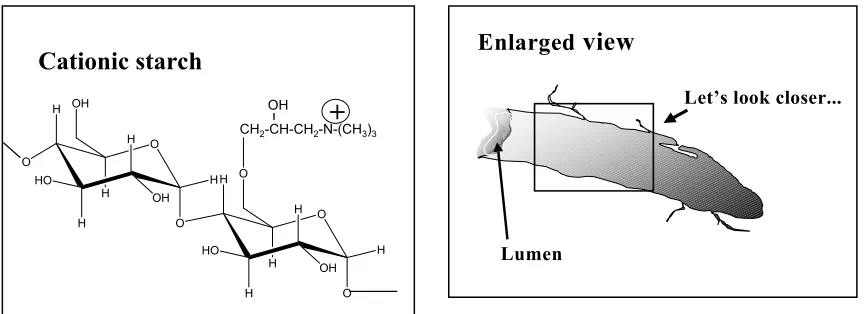
(2) “EASY” FURNISH Let’s start by considering the attributes of an “ideal” fiber furnish, one that drains well and produces strong paper. Since ancient times papermakers have known that they could achieve good strength and drainage by forming paper from relatively long fibers. The dimensions of wood fibers, as illustrated in Fig. 2, represent a compromise. A length-to-width ratio near to 50 means that each fiber in the sheet will be in contact with up to 20-40 of its neighbors [1]. The hydrogen bonds that join the fibers together are not as strong as the covalent bonds within the fibers themselves. However, the multiple contacts provide strength. At the same time an aspect ratio of 50 is not so large as to make it difficult to disperse the fibers. Relatively long, slender fiber such as some softwood fibers are especially useful in achieving targets of high tear and tensile strength. As the length-to-thickness ratio increases above a value of 50 there is increased tendency for entanglement and floc formation [2-3]. The subject of fiber flocculation and its effects on formation have been reviewed elsewhere [4].. Fiber. L/W ≈ 50. Figure 2. Length-to-Thickness Ratio of Typical Papermaking Fiber Our next concern is drainage. Again, the general shape of an intact cellulose fiber has advantages. To a first approximation the process of forming paper can be modeled as a filtration and thickening operation [5]. Fibers tend to lie down in a semi-random, layered structure. The random, crisscross pattern of fibers provides multiple paths by which water can drain from the sheet. Vacuum pulses caused by passage of the forming fabric over hydrofoils repeatedly compress the mat. Rapid cycling of vacuum pulses keeps the water flowing efficiently from the wet sheet as it forms. Taking a closer look. Surfaces play a dominant role relative to both drainage and strength. Keeping in mind the large length-to-thickness ratio, the next step is to look closer at the fiber surface (Fig. 3). Figure 4 shows features that explain why fibers are able to bond together to make a strong sheet of paper.. Enlarged view. Fiber. Fibrillation Pores. Let’s look closer .... Lumen collapse Surface charge ( - ). Figure 3. Section of Fiber to be Enlarged. Proc. TAPPI ’99, 1353-1367. Figure 4. Enlarged View of Fiber Surface Features. 1354.
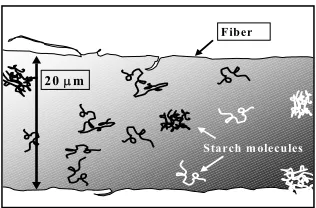
(3) As shown in Fig. 4, cellulose fibers have hollow centers called lumens. When lumens collapse the result resembles a ribbon. Ribbon-like, flexible fibers are able to drape over each other, achieving close contact over relatively large areas. The process of collapse is favored by chemical pulping to remove lignin from the cell wall [6]. Also, passing the pulp through a refiner tends to make the cell wall flexible so that the lumens will collapse by the time the paper sheet has been pressed and dried [7]. Refining also causes partial delamination of the cell. As illustrated in Fig. 4, this results in fibrils at the surface of a refined fiber [7]. Some of the fibrillation consists of smaller ribbons of cell wall material. At a 10-100 nm scale, the surface is covered with a “fuzz” of protruding microfibrils. The extent of fibrillation depends on the intensity of refining and cumulative energy experienced by the fiber surface. Fibrils, being much thinner and more flexible than the fibers themselves, can be helpful in achieving close contact and bonding between fibers. An ideal refining strategy depends on the grade of paper and its requirements for strength, apparent density, and other characteristics. Excessive fibrillation hurts drainage. The fibrils tend to block the flow of water and obstruct pores between fibers within the wet sheet of paper as it is formed Another factor that makes cellulose fibers ideal for papermaking is their negative surface charge. The negative charge on most papermaking fibers is due to the presence of carboxylic acid groups. The charge densities of various types of commercial paper pulp are in the range 2-24 micro-equivalents per gram [812]. With increasing charge there is greater tendency of the fibers to swell [12]. The swelling effects can be attributed to repulsion between adjacent charged groups within the fiber walls. Swollen fibers tend to be more flexible, achieving higher relative bonded area [13]. The negative charge of fibers also helps the papermaker achieve efficient retention of cationic wet-end additives [14-17]. Cationic starch is one of the most heavily used wet-end chemicals and one of its main roles is to increase dry strength. As shown in Fig. 5, the cationic starch molecule is rich with water-loving OH groups. These groups are able to form hydrogen bonds with cellulose when the paper is dried. The fraction of cationically charged monomeric groups is usually in the range 0.02 to 0.04. Like the starch, cellulose is covered with -OH groups, but the net charge is opposite. Because of the opposite charges a typical furnish is able to adsorb 0.5 to 1.5% by mass of cationic starch. The flexible coils of starch macromolecules increase the effectiveness of bonding between the two materials. Looking closer still. To complete this review of factors contributing to ideal strength and drainage we need to take an even closer look at the fiber surface (Fig. 6). We have to enlarge the scale in order to appreciate the relative sizes of the starch molecules deposited onto the weakly anionic surfaces of fibers. These are shown in Fig. 7. Even at this scale Fig. 7 exaggerates a little by showing the starch molecules in a more stretched out conformation than would be expected to result from random motions of the chain.. Enlarged view. Cationic starch OH. [. H. 2. O. O HH. HO. H H. Let’s look closer.... + CH -CH-CH -N-(CH ). H OH. 2. 3 3. O. OH. H O. O H. HO. H H. OH O. Figure 5. Cationic Starch Chemical Structure. Proc. TAPPI ’99, 1353-1367. Lumen. Figure 6. Area to be Further Enlarged. 1355.
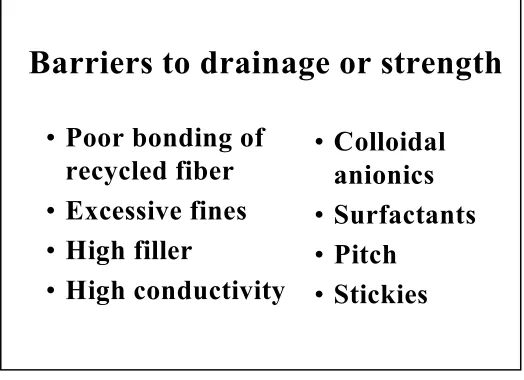
(4) F iber. 20 µm. Starch m olecules. Figure 7. Cationic Starch Adsorbed onto Fiber For wet-end chemical applications we usually want the starch to have as high a molecular mass as possible. The linear amylose molecules of starch may have molecular masses in the range 150,000 to 600,000 g/mole [15,17]. Branched amylopectin molecules get up to tens of millions of grams per mole. The bigger the polymer, the more irreversibly it will tend to attached itself to the fiber. To function as a binder we want the additive to stay out on the external surface of the fiber, not migrate into the pores of the cell wall [17]. The charged groups on cationic starch affect its conformation in solution. Repulsion between the adjacent charges causes the random coils of a cationic starch molecule to be more extended [18]. In other words, it acts like it is bigger. The result is greater effectiveness in wet-end applications. The same is true for other additives such as retention aids. Molecules large enough to bridge the spaces between fibers and fines [19] tend to be more effective for strength as well as retention. Up to this point the discussion has focused on factors which cause our ideal long-fiber furnish to drain well and produce strong paper. Strength was achieved by the high length-to-width ratio of fibers, their flexibility, their increased surface area due to fibrillation, their ability to form hydrogen bonds, and the increased effective area of contact due to flexible polyelectrolytes such as cationic starch. But there are many factors that work against strength, drainage, and general runnability of a furnish on a paper machine. Some of the key factors will be considered below. DIFFICULT FURNISHES Reduced Bond Strength As noted already, Fig. 1 lists some primary interferences to strength, drainage, and general papermaking efficiency. The first item involves changes to the surfaces of the long fibers resulting from recycling. Recycled fibers can be used to make most of the same products as virgin fibers, but they tend to yield lower strength [20-23]. Part of the strength deficit is due to a loss of flexibility. In the case of kraft pulps the virgin fibers are covered with narrow, slit-like pores in the size range of 1-10 nm [24]. Capillary forces during sheet formation and compressive forces in the press section cause these pores to close. Only a fraction of these closed pores are capable of opening up again after the dried paper is placed back in water [25-26]. Some strategies to improve the bonding strength of secondary fibers include gentle refining and the use of dry-strength chemicals [7,15,27]. The same changes to the fiber wall that occur when paper is dried also affect the relative amount of fines produced if the furnish is further refined. Secondary fibers, in general, tend to be rich in fine material. On the one hand the fibers already have gone through a process of refining. Consequently recycled pulp typically will contain cell wall fragments and other fine material. In addition, the brittle nature of the secondary fiber surface works against the papermaker’s objectives. When secondary fiber is refined there’s an increased tendency to break fragments from the cell walls of recycled fibers, rather than just fibrillate the surfaces [21-23].. Proc. TAPPI ’99, 1353-1367. 1356.
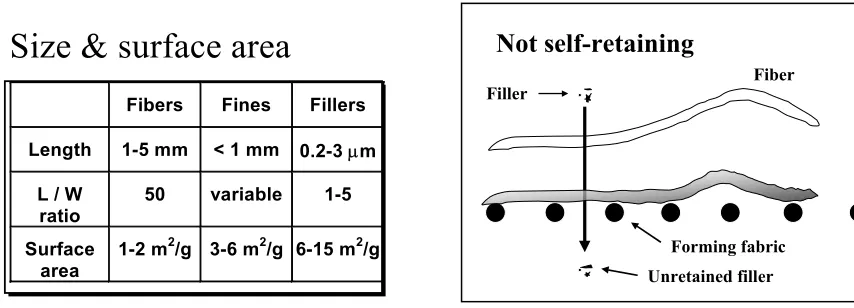
(5) Fines Fines can be a major cause of poor drainage [28] and poor dimensional stability of the resulting paper. Much of the fault for these problems is related to the size and surface areas of fines. Figure 8 shows typical values for dimensions and dry surface areas of fiber, fiber-fines, and commercially important mineral fillers used in papermaking.. Size & surface area. Not self-retaining. Fibers. Fines. Fillers. Length. 1-5 mm. < 1 mm. 0.2-3 µm. L/W ratio. 50. variable. 1-5. Surface area. 2. 2. 2. 1-2 m /g 3-6 m /g 6-15 m /g. Figure 8. Sizes and Surface Areas of Dried Fibers, Fiber Fines, and Filler Particles. Filler. Fiber. Forming fabric Unretained filler. Figure 9. Relative Sizes vs. Self-Retention. As shown, the surface area of fiber fines tends to be three to five times greater, per unit mass, compared to that of the long fibers in the same pulp. The higher surface area means that water has to follow more tortuous paths as it drains from the forming sheet of paper. The effect of fines on drainage also depends on the mechanism of retention. As shown schematically in Fig. 9, a typical fiber is expected to bridge across three or more strands of forming fabric. Very little is expected to pass through into the white water. The story is different for fillers, fiber fragments, or other fine material. As illustrated by the figure, filler particles are too small to be retained by the forming fabric itself. Those not retained by the fiber mat pass right on through the wire. In practice, the meaning of the word “fines” is closely related to whether the material can pass through the forming fabric. There are basically two ways in which fine materials can be retained. First, they can be attached to the surfaces of the fibers by colloidal forces. These forces include the relatively weak London dispersion component of van der Waals forces. Dispersion forces always operate between adjacent materials, irrespective of their charge. In addition, there are stronger forces due to bridging of retention aid molecules and other polyelectrolytes between adjacent surfaces. When fines are attached to fibers in this manner, the result tends to be a relatively uniform distribution in the final sheet [29]. The second way that fiber fines, filler, or other fine materials can be retained is by a sieving mechanism. As noted in Fig. 10, this is the mechanism of retention that causes drainage problems. As shown by Gess [28], the adverse effect of fines on drainage increases with the quantity of fines and the basis weight of the paper. During the drainage process it appears that the fines migrate within the sheet. As a consequence of flow these fines move to positions where they block the choke points of channels between the fibers.. Proc. TAPPI ’99, 1353-1367. 1357.
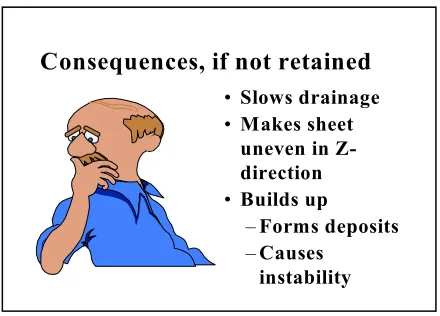
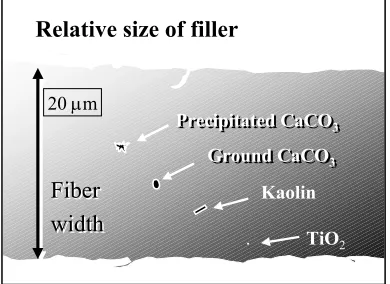
(6) Consequences, if not retained • Slows drainage • Makes sheet uneven in Zdirection • Builds up – Forms deposits – Causes instability. Fig. 10. Consequences of Low Fines Retention The sieving mechanism of retention, and its tendency to produce an uneven fines distribution across the thickness of a paper sheet, also can result in curl problems. Compared to long fibers, fiber fines have a much greater relative change in dimensions with changes in humidity. Hydrofoils and related dewatering equipment on the paper machine can help overcome the plugging effect of fines by momentarily disturbing the microstructure of the wet sheet [5]. Unfortunately, the hydrofoils also tend to wash fines and filler from the wire side of the sheet [29]. Poor fines retention also can have an adverse effect on the performance of wet-end chemicals. On most paper machines the majority of filler or fiber fines passing through a forming fabric will be retained eventually due to multiple recirculation of white water to the headbox. Delayed retention can have an adverse effect on unstable additives such as sizing agents [30]. As noted by Marton [31], fines tend to collect a disproportionate amount of wet-end additives due to their higher surface area, compared to fiber. Consequently, if fines retention is poor, then rosin acid emulsions and alkaline sizing agents have more time to hydrolyze and lose their effectiveness [30]. As shown by Strazdins [32], the efficiency of strength resins is likely to be reduced if it is adsorbed on fines, relative to what it would have been if it had been adsorbed on the long fibers. Unretained materials also increase the likelihood of deposits in chests, in the headbox, and elsewhere in the system. Deposits on papermaking equipment are often related to episodes of slime, headbox streaks, holes, and spots in the product. When the relative load of fines in the headbox is twice or more than the corresponding level in the thick stock, then the situation becomes unstable. Any small change in pH, refining, or wet-end chemistry will tend to produce swings in retention. Momentarily high retention will cause a momentary increase in basis weight. In addition to being higher in weight, the sheet with more fines will tend to retain more water. Instabilities of this type are responsible for web breaks and decreased productivity. Fillers When they are well retained, fillers seldom hurt drainage. Difficulties in retaining fillers usually can be overcome with a modern program of retention chemicals. But strength effects can place some serious limitations on how much filler can be used. As shown in Fig. 11, the kinds of mineral particles most commonly used in papermaking are very small relative to the fiber, so they are unable to contribute much to the three-dimensional structure of the sheet. Their surfaces are rigid and relatively nonporous, so they do not contribute much to bonding. As suggested by Fig. 12, the presence of fillers tends to reduce the relative bonded area between adjacent fibers. The loss of bonding depends on the filler content, the size of the. Proc. TAPPI ’99, 1353-1367. 1358.
(7) fillers, and their shape [33-34]. Assuming constant shape, filler particles having their diameter reduced by a factor of two will tend to block potential bonding sites over twice as much of the fiber surface area.. And if retained … filler reduces strength. Relative size of filler 20 µm. Lumen. Precipitated Precipitated CaCO CaCO33 Ground Ground CaCO CaCO33. Fiber width. Kaolin .. TiO2. Figure 11. Relative Sizes of Fillers vs. Fiber. Blockage of bond sites. Loss depends on : • filler content • size (surface area) • shape. Figure 12. Filler Interference with Bonding. Despite their adverse effect on strength, there has been a persistent trend to raise filler levels to still higher levels in most grades of paper. Motivating factors include costs of materials and rising opacity requirements. There are a couple of things that papermakers can do to achieve strength requirements and still add the desired level of filler. The key is to find other ways to maintain the relative bonded area between the fibers. One approach is to reduce the effective surface areas of the filler. For instance this can be done by selecting a coarser grade of filler [33-34]. Alternatively, one can agglomerate the filler [35]. Each of these strategies may be limited by need to achieve specified levels of brightness, opacity, or caliper. Another way to compensate for the debonding effect of filler is to increase the level of refining. Refining definitely increases the effective area of fiber surface available for bonding. But refining always hurts drainage. Papermakers employ drainage aids to maintain machine speed and still obtain the strength benefits of refining. For the same reasons outlined already, a good chemical program to enhance drainage begins with retention of the fines. Even if nothing else is done, attaching fines to the fibers and keeping them out of the white water will reduce the adverse impact on drainage due to the sieving mechanism of retention. Other chemical programs have been devised to go much further. Addition of a highly cationic material such as alum or polyamine tends to increase drainage up to the point where the electrical potential (zeta potential) of the furnish solids approaches zero [36]. The so-called microparticle and micropolymer systems involve a two-step addition [37-38]. The first additive usually is a high-mass cationic flocculant or cationic starch. The second additive may be colloidal silica, bentonite microparticles, or branched acrylate copolymers. The small-sized second additive appears to penetrate the polymeric loops and bridges created by the high-mass additive. Interactions with the microparticles cause the gel-like polyelectrolyte structure to contract and allow water to flow more freely from the sheet. Salts Up to this point we have blamed fiber bonding deficiencies, fines, and fillers for poor drainage and strength of paper. Further problems are often blamed on “interfering substances.” These substances help explain why that some papermaking furnishes do not respond well to strength additives such as cationic starch [3940]. The same furnishes may respond poorly to retention aids, sizing agents, and other wet-end additives. For the purposes of this discussion we will use a broad definition of interfering substances. The main classes of interfering substances we need to consider are high levels of salts, anionic colloidal and polymeric materials, and surface-active materials.. Proc. TAPPI ’99, 1353-1367. 1359.
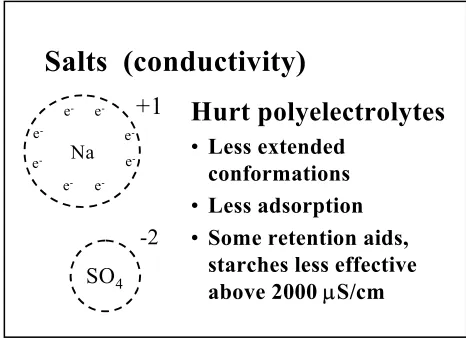
(8) Salts are not preferentially retained in the paper web. Rather, they tend to stay in the process water. The resulting conductivity depends on the efficiency of washing after pulping and bleaching operations, as well as the types and amounts of additives. Increased recirculation of water back to the headbox increases the levels of ions and the conductivity rises [41-42]. As their concentration increases, simple ions tend to interfere with processes that depends on electrical charges. Most commercially available wet-end additives are adversely affected as conductivity rises over the range 1000 to 3000 µS/cm and higher. Figure 13 shows examples of two ions that are especially prevalent in paper machine water systems. It is worth recalling that the sodium atom is very stable in water solution in its ionized form with a single plus charge. When ionized to the plus-one condition, the number of electrons surrounding the nucleus is just right to complete an especially stable set of eight outer-most electrons. The net charge of +1 results because the number of electrons surrounding the nucleus is one less than the number of protons. The sulfate ion is an example of an ion composed of more than one atom. In that case the molecule has a tendency to acquire two extra electrons to fill the most favorable molecular orbital. Due to the high stability of these ions in solution there is relatively little tendency for them to be retained in the paper.. Salts (conductivity) eee-. e-. Na e-. +1. eee-. -2 SO4. Hurt polyelectrolytes • Less extended conformations • Less adsorption • Some retention aids, starches less effective above 2000 µS/cm. Figure 13. Ions Contributing to Conductivity Various effects of salts in the wet end can be explained in terms of the forces between surfaces of microscopic particles and other colloidal materials such as charged polymers in solution. According to theory [43-44] salts shorten the effective range of electrostatic forces between materials suspended in water. This fact applies not just to particles such as fibers, fillers, and other fines. It also applies to the electrostatic forces in the pores of the cell walls and between the fibrils at the surface of the fiber. With increased salt content, the pores of the cell walls contract [26]. The fibrils tend to lie down on the fiber surface due to decreased electrostatic repulsion. In general, the fiber becomes less swollen with water and less flexible. Less mutual repulsion of charged groups within a fiber means less swelling and less flexibility. Salts also decrease the molecular extension within the random coils of charged polymers. A study reported by Maltesh and Shing [45] showed that increased white water conductivity had an adverse effect on the performance of retention aids. Surprisingly, the conductivity of the water used during initial preparation of the polymer solution made little difference. These results are consistent with models of bridging flocculation. A polyelectrolyte molecule exposed to higher levels of salt will have less internal repulsion between adjacent charged groups. The resulting compressed conformation is expected to be less effective in forming molecular bridges between suspended particles [19]. A related effect of high salt levels is to reduce adsorption of polyelectrolytes such as cationic starch onto oppositely charged surfaces [17]. As the conductivity is increased the driving force for adsorption is reduced. Increasing conductivity above 1000 µS/cm gradually tends to make the furnish more resistant to the effects of typical wet-end additives. There has been some success in meeting the challenge of increased conductivity by increasing the charge density of cationic starch and other additives [46]. However, such approaches don’t work well at the yet higher levels of conductivity found in paper mills that discharge little. Proc. TAPPI ’99, 1353-1367. 1360.
(9) or no liquid effluent. Conductivities in the range 2-18 mS/cm have been reported [42]. Strategies for removing salts, such as reverse osmosis and distillation, are not often used in papermaking. Anionic Materials Anionic interfering substances are blamed for many wet-end problems [40,47-52]. Other names for the same substances include “anionic dissolved polymeric and colloidal substances,” “DCS,” or “anionic trash.” Figure 14 shows one example. Hemicellulose is a natural component of wood. A moderate level of hemicellulose attached to the fiber surface contributes to bonding. Already in its native state hemicellulose has acidic groups. As a consequence it has a strong negative charge in water at pH values above 4. Bleaching processes tend to oxidize the molecule, increasing the number of anionically charged groups. It then goes into solution. Its negative charge and its breakdown into smaller oligomeric units make it more soluble. Another factor which tends to make hemicellulose go into solution is the branched structure of the macromolecule (see Fig. 14). The side groups prevent hemicellulose and its breakdown products from forming crystallites of the type that make cellulose itself so insoluble.. Anionics. [. o. o. OH. O. O. O OAc. OH. o. OAc. OH. OAc. O. O OH. o. COOH. o. O. OAc. ]. o. OH. O OH. Acid group. OCH3 OH. Hemicellulose (hardwood). Figure 14. Example of Colloidal Anionic Substance Once in solution, hemicellulose byproducts and other anionic interfering substances can form complexes with cationic starch, cationic retention aids, and other cationic polymers such as wet-strength agents [4648]. The oppositely charged groups in the anionic substances and the cationic additives join up in pairs. The effective charge of the cationic additives is reduced. As noted earlier, charge also affects the extension of the macromolecules in solution. Partial or complete neutralization of the charge on cationic starch or retention aid molecules makes them behave as if they were smaller. Once neutralized there is a tendency for the complexes of anionic interfering substances and their cationic additive hosts to remain in suspension as a colloidal dispersion rather than adsorb onto fibers. Complexes formed from colloidal material can add to the effective levels of fines. As noted earlier, an increased fines level is expected to hurt drainage, the stability of basis weight over time, and the dimensional stability of the sheet. The nature of the anionic interfering substances often depends upon the type of pulp. Mechanical pulp, especially if it is bleached with peroxide, is rich in hemicellulose derivatives [49]. Unbleached kraft furnish tends to contain sulfonated lignin byproducts, soaps, and hemicellulose byproducts. Broke from a coating operation tends to contain high levels of polyacrylate dispersants. A common feature of these materials, in addition to their charge, is their water-loving character. That fact implies that there is a danger of build-up. Unless the papermaker washes the substances from the pulp or adds something to precipitate them onto fibers, they will stay with the recirculating water. Briefly, the most common way to deal with dissolved and colloidal anionic materials is to add a relatively cheap, highly cationic chemical. Aluminum sulfate (alum) is a top candidate if the paper machine system has a pH below 6. Highly charged polymers such as polyamines and diallyldimethylammonium chloride. Proc. TAPPI ’99, 1353-1367. 1361.
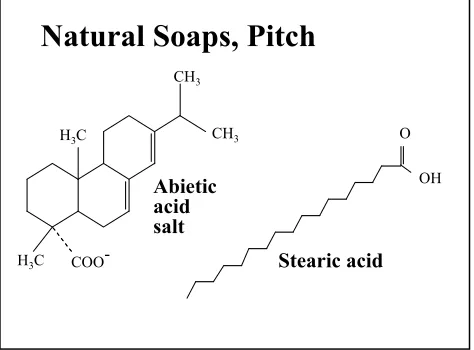
(10) (DADMAC) are effective at all pH values. Poly-aluminum chloride (PAC) and polyethyleneimine (PEI) can be very effective at low pH as well as neutral pH values. Whatever the strongly cationic additive, its dosage rate can be critical. As shown by Spence [52], the amount of cationic additive ought to be enough to neutralize the colloidal material, but not so much as to neutralize all of the negative charges at the surface of the long fibers. Surface Active Materials and Pitch Problems with sizing, strength, and foam arise in cases where the furnish has too high a concentration of surface-active materials. By definition surface active materials migrate to air-water interfaces and reduce the surface tension. As noted by McCallum [53] and Windaus et al. [54], low surface tensions can result in low paper strength. Campbell [55] was the first to propose that some or all of the strength loss is due to effects of surface tension. A low surface tension at the air-water interface means that there will be weak capillary forces drawing the fibers together as the water drains from the sheet. Even when the adjacent fiber surfaces are forced together by pressing, adsorbed surface active molecules are expected to interfere with hydrogen bonding in the same way that soap on a macroscopic object hurts adhesion. Two examples of potentially surface active materials are shown in Fig. 15. The key to surface activity is that some part of the molecule has water-loving groups such as –OH groups or ionized groups. Another part or parts of the molecule are water-hating, e.g. hydrocarbon chains or rings. The balance between the two parts of the molecule determines its behavior with respect to foam problems, strength problems, or deposits. Difficulties in achieving hydrophobic sizing sometimes can be traced to the presence of surfaceactive materials that act as wetting agents [56-57].. Natural Soaps, Pitch CH3 H3C. CH3. O OH. Abietic acid salt H 3C. COO-. Stearic acid. Figure 15. Chemistry of Natural Soaps Whether the molecules illustrated in Fig. 15 behave like “soaps” or like “pitch” depends on their environment. That fact can make pitch problems hard to predict and control [58-60]. The surface activity of resin acids and fatty acids is strongly affected by pH. An increase in pH tends to shift the equilibrium in the direction of anionic, carboxylated species, as shown in the case of the abietic acid (rosin) salt at left. These “soap” species tend to cause foaming and hurt both sizing and strength. Conversely, a reduction in pH tends to shift the equilibrium more in the direction of uncharged, protonated species, as shown in the case of stearic acid (Fig. 15, right side). Multivalent cations such as Al+3 or Ca+2 tend to precipitate these ionic species as pitch deposits or sticky colloidal fines [59-60]. As already noted, the bad news is that precipitation of the pitch particles often produces unwanted deposits. However there is also some good news; when colloidal particles composed of resin and fatty acid salts are precipitated onto fibers with aluminum salts or cationic polymers, then they are retained in the sheet and their potential adverse effect on drainage, sheet breaks, and product quality is greatly reduced.. Proc. TAPPI ’99, 1353-1367. 1362.
(11) Problems with natural pitch often can be minimized if one considers what happens in the fibers. Most natural pitch-like resin present in a papermaking furnish remains harmlessly within the cell walls and lumen of fibers and parenchyma cell fines. Pitch deposits or spots in the product don’t occur until a threestep process is completed. In the first step a fraction of the pitch-like material becomes suspended as colloidal particles. Such release of colloidal pitch from the fibers is encouraged by the presence of salt forms of the resin acids and fatty acids (see, e.g. abietic acid salt, left side of Fig. 15). The same anionically charged molecules initially tend to keep the pitch particles in stable solution. Step two involves mixing of the resinous material with other water-hating or surface active materials, such as antifoams, the oils used to disperse emulsions of retention aids, latex particles, and byproducts of sizing agents. The tackiness of the mixture may differ from that of any single ingredient. Step three involves destabilization of the suspended pitch particles by shear, multivalent cations, cationic polymers, or decreased pH. Papermakers fight the battle against pitch on may fronts, using such approaches as detackification with talc and synthetic chemicals, charge neutralization and retention, dispersants to keep pitch in suspension, and spraying of forming fabrics to reduce their hydrophobic character and tendency to adhere to pitch particles. Figure 16 shows typical examples of nonionic surface-active agents [71-72]. These often enter the process as dispersants for coating latex, stabilizers for retention aid emulsions, and as deinking additives. The good news about these materials is that their effects are relatively easy to predict. The pH and other ions don’t affect their behavior. The two examples shown in Fig. 16 are sufficiently water-loving that they tend to remain in solution, where they lower surface tensions, hurt sizing, and contribute to foam problems. In contrast, other nonionic surfactants used as foam inhibitors are more hydrophobic. Consequently they tend to contribute to pitch-like deposit problems. The bad news is there is little we can do to modify whatever it is that the nonionic surfactants are doing in the wet end. In extreme cases froth flotation can be used to remove surfactants from process water. Usually the best approach is to limit nonionic surfactants coming into the system by careful attention to the additives and the types of waste paper pulp.. Nonionic surfactants OH O. Branched alkylphenol ethoxylate. O O O. O. t Wa. O O O. g vin o l er-. OH O. O. O O. O. ter a W ing hat. O O O. Linear alcohol ethoxylate. Figure 16. Common Non-Ionic Surfactants Stickies Synthetic tacky particles in a paper machine furnish are known as “stickies” [61-67]. Prime sources of stickies are coated broke and recycled papers. Styrene-butadiene resin (SBR), as shown in Fig. 17, is a major component of paper coatings and adhesives. Ethylene vinyl acetate (EVA), as shown in Fig. 18, is widely used in pressure sensitive adhesives. Synthetic materials that comprise stickies are mainly nonionic. However, association with wood pitch, hemicellulose, and dispersants provides stickies with a negative effective surface charge. Other materials such as waxes are present too, and these affect tackiness.. Proc. TAPPI ’99, 1353-1367. 1363.
(12) SBR (white pitch). [. EVA (another sticky component). ][. ]. n. m. [. ][. ]. n. m. O. butadiene. O. styrene. Figure 17. Styrene-Butadiene Latex Chemistry. Figure 18. Ethylene Vinyl Acetate Chemistry. Stickies coming from waste paper pulp are best controlled in the pulping operation and related processing steps. As shown by Moss [68], screening, flotation, or washing of the pulp will remove sticky particles of different particle size ranges. Within the paper machine system a common strategy to minimize deposits, felt-filling, and other problems related to stickies is to add a highly charged cationic polymer to the thick stock at a point where the sticky particles are still small. Further work is needed to clarify how the treatment works. Published evidence suggests that it takes a higher exposure of cationic materials to fully neutralized the fiber surface, compared to the tacky, synthetic materials [50,69] and other colloidal anionic matter [52]. This behavior is consistent with the porous nature of the cellulose surface [24]. Over time, through a process called reticulation, the cationic polymer works its way into pores. The fiber surface tends to revert back to its original anionic character. In contrast, relatively nonporous materials such as latex particles tend to remain cationic and to stick to the fibers. The situation of cationized sticky particles and anionic fibers provides a good start for efficient retention. Use of an effective retention aid program can complete the process [70]. What Else Are We Adding? When searching for reasons why a particular furnish drains poorly, causes deposits, or produces weak paper, it’s good to start be considering what is being added. The user of secondary fiber is at a particular disadvantage. Unless the secondary fiber comes from the same mill, papermakers may have little hope of influencing the prior history of the furnish [73]. Over-refining or over-drying of paper will hurt its strength and drainage characteristics after the pulp is recycled [21-22]. Secondary fiber is a rich source of slimeforming bacteria. Though slime problems can be controlled [74], this can be more difficult when the furnish quality is variable. An area where the papermakers have greater control is in what additives they use in their own manufacturing process. There is an implied duty of responsible manufacturers to avoid additives that harm the value of their product as a potential source of secondary fiber [74]. Fortunately, many of the additives and processing conditions which produce high quality paper the first time around also contribute to its value when recycled [22,73]. CONCLUSIONS This review has described factors that tend to make papermaking furnish weak, difficult to drain, and difficult to run on a paper machine. Some of the major interferences to strength and drainage were listed in Fig. 1. These include loss of bonding ability of secondary fiber surfaces, effect of fillers, fines, salts, anionic colloids, surface-active materials, pitch, and stickies. As shown in Fig. 19 there are few common features among the listed items. Most of the interferences involve substances that are too small to be selfretained on the forming fabric. They tend to build up in recirculated white water. Most have a high surface. Proc. TAPPI ’99, 1353-1367. 1364.
(13) area. The relative charge, hydrophobic character, or surface-active nature of interfering substances affects their behavior in the system. Each problem, by itself, has potential solutions. Taken together, especially when conditions vary, the interfering substances tend to make the furnish “difficult” in terms of strength, drainage, and process efficiency. Strategies for meeting the challenges of difficult furnishes are given in the papers that follow.. Conclusions • Size –L / W – Self retention • Surface area – Demand • Charge – Conductivity • Surface activity. Figure 19. Conclusions RERERENCES 1 2 3 4 5 6 7 8 9 10 11 12 13 14 15 16 17 18. Page, D. H., Tappi, “A theory for the tensile strength of paper,” 52 (4): 674 (1969). Dodson, C. T. J., Tappi J., “Fiber crowding, fiber contacts, and fiber flocculation,” 79 (9): 211 (1996). Kiviranta, A., Proc. TAPPI 1996 Papermakers Conf., “Fiber and forming-related mechanisms affecting formation,” 239. Beghello, L., and Eklund, D., Nordic Pulp Paper Res. J., “Some mechanisms that govern fiber flocculation,” 12 (2): 119 (1997). Räisänen, K., Paperi Puu, “High vacuum dewatering in a paper machine wire section – literature review,” 78 (3): 113 (1996). Jang, H. F., Tappi J., “Using confocal microscopy to characterize the collapse behavior of fibers,” 81 (5): 167 (1998). Robinson, J. V., Pulp and Paper Chemistry and Chemical Technology, J. P. Casey, Ed., Third Ed., Vol. 2, Ch.7, “Fiber Bonding,” p. 915. Herrington, T. M., and Petzold, J. C., Colloids Surf., “An investigation into the nature of charge on the surface of papermaking woodpulps. 2. Analysis of potentiometric titration data,” 64: 109 (1992). Marton, J., and Marton, T., Tappi, “Wet end starch: adsorption of starch on cellulosic fibers,” 59 (12): 121 (1976). Goulet, M. T., and Stratton, R. A., Nordic Pulp Paper Res. J., “The effect of pulping, bleaching, and refining operations on the electrical properties of wood fibers,” 5 (3): 125 (1990). Lloyd, J. A., and Horn, C. W., Nordic Pulp Paper Res. J., “The determination of fiber charge and acidic groups of radiata pine pulps,” 8 (1): 48 (1993). Laine, J., and Stenius, P., Paperi Puu, “Effect of charge on the fiber and paper properties of bleached industrial kraft pulps,” 79 (4): 257 (1997). Lindstrom, T., and Kolman, M., Svensk Papperstidning, “The effect of pH and electrolyte concentration during beating and sheet forming on paper strength,” 85 (15): R140 (1982). Linke, W. F., Tappi, “Retention and bonding of synthetic dry strength resins,” 51 (11): 59A (1968). Steelhammer, J. C., PIMA Mag., “Starch in papermaking,” 74 (11): 53 (1992). Howard, R. C., and Jowsey, C. J., J. Pulp Paper Sci., “The effect of cationic starch on the tensile strength of paper,” 15 (6): J225 (1989). Malton, S., Kuys, K., Parker, I., and Vanderhoek, N., Appita J., “Adsorption of cationic starch on eucalypt pulp fibers and fines,” 51 (4): 292 (1998). Flory, P. J., Principles of Polymer Chemistry, Cornell Univ. Press, Ithaca, 1953, see pp. 629-637.. Proc. TAPPI ’99, 1353-1367. 1365.
(14) 19 Healy, T. W., and La Mer, V. K., J. Phys. Chem., “Adsorption-flocculation reactions of a polymer with a dispersion,” 66: 1835 (1962). 20 McKee, R. C., Paper Trade J., “Effect of repulping on sheet properties and fiber characteristics,” 155 (21): 34 (1971). 21 Pycraft, C. J. H., and Howarth, P., Paper Technol. Ind., “Does better paper mean worse waste paper?,” 21 (12): 321 (1980). 22 Guest, D. A., and Voss, G. P., Paper Technol. Ind., “Improving the quality of recycled fibre,” 24 (11): 256 (1983). 23 Ellis, R. L., and Sedlachek, K. M., Secondary Fiber Recycling, “Recycled- versus virgin-fiber characteristics: a comparison,” Spangenberg, R. J., Ed., TAPPI Press, Ch. 2, p. 7, 1993. 24 Allan, G. G., and Ko, Y. C., Cellulose Chem. Technol., “The microporosity of pulp. The forces influencing the intra and inter-fiber pore structure and pore size distribution in pulp and paper,” 29: 479 (1995). 25 Maloney, T. E., Li, T.-Q., Weise, U., and Paulapuro, H., APPITA, “Intra- and inter-fiber pore closure in wet pressing,” 50 (4): 301 (1997). 26 Lindstrom, T., and Carlsson, G., Svensk Papperstidning, “The effect of carboxyl groups and their ionic form during drying on the hornification of cellulose fibers,” 85 (15): R146 (1982). 27 Strazdins, E., Pulp Paper, “Chemical aids can offset strength loss in secondary fiber furnish use,” 58 (3): 73 (1984). 28 Gess, J. M., TAPPI 1991 Adv. Topics Wet-End Chem. Short Course Notes, “The fines sensitivity of papermaking furnishes,” 70. 29 Tanaka, H., Luner, P., and Coté, W., Tappi, “How retention aids change the distribution of filler in paper,” 65 (4): 95 (1982). 30 Hodgson, K. T., APPITA, “A review of paper sizing using alkyl ketene dimer versus alkenyl succinic anhydride,” 47 (5): 402 (1994). 31 Marton, J., Tappi J., “Practical aspects of alkaline sizing: alkyl ketene dimer in mill furnishes,” 74 (8): 187 (1991). 32 Strazdins, E., Papier, “New approaches towards optimizing dry strength of waste paper containing stock furnishes,” 34 (10A): 49V (1980). 33 Bown, R., Paper Technol., “Particle size, shape and structure of paper fillers and their effect on paper properties,” 39 (2): 44 (1998). 34 Han, Y.-R., and Seo, Y.-B., J. Korea Tappi, “Effect of particle shape and size of calcium carbonate on physical properties of paper,” 29 (1): 7 (1997). 35 Gerischer, G., Murray, L. J., and van Wyk, W. J., Paperi Puu, “Improved retention of filler clay by means of preflocculation and selective dosing,” 78 (1/2): 51 (1996). 36 Allen, L. H., and Yaraskavitch, I. M., Tappi J., “Effects of retention and drainage aids on paper machine drainage: a review,” 74 (7): 79 (1991). 37 Pierre, C., and Carré, B., Proc. TAPPI 1993 Papermakers Conf., “Complementarity between two dewatering and retention microparticle systems: ‘cationic starch / anionic colloidal silica,’ and ‘potato starch / aluminum salts’,” 163. 38 Swerin, A., Ödberg, L., and Wågberg, L., Colloids Surf., “An extended model for the estimation of flocculation efficiency factors in multicomponent flocculation systems,” 113 (1/2): 25 (1996). 39 Beaudoin, R., Gratton, R., and Turcotte, R., J. Pulp Paper Science, “Performance of wet-end cationic starches in maintaining good sizing at high conductivity levels in alkaline fine paper,” 21 (7): J238 (1995). 40 Laleg, M., and Pikulik, I. I., Proc. 1996 Intl. Paper Coating Chem. Symp., “The effect of dissolved materials and fines on the efficiency of strength polymers,” 67. 41 Pietschker, D. A., Proc. TAPPI 1996 Papermakers Conf., “The 100% closed water system – what to expect,” 521 (1996). 42 Foster, C., and Rende, D., PIMA’s Papermaker, “How recycling, water reuse impact chemistry,” 79 (1): 48 (1997). 43 Scott, W. E., Principles of Wet End Chemistry, “Surface and colloid science concepts important to papermaking chemistry,” TAPPI Press, 1996, p. 21. 44 Winters, J., Retention of Fines and Fillers During Papermaking¸ “Introduction to the electrokinetics of papermaking,” Gess, J., Ed., Ch. 3: 29 (1998).. Proc. TAPPI ’99, 1353-1367. 1366.
(15) 45 Maltesh, C., and Shing, J., Proc. TAPPI 1998 Intl. Environ. Conf., “Effects of water chemistry on flocculant makedown and subsequent retention and drainage performance,” 227 (1998). 46 Bobacka, V., Näsman, J., and Eklund, D., J. Pulp Paper Science, “Interactions between cationic starch and anionic trash of a peroxide-bleached TMP at different salt concentrations,” 24 (3): 78 (1998). 47 Glittenberg, D., Bergh, N.-O., and Hemmes, J.-L., Proc. TAPPI 1993 Papermakers Conf., “Use of cationic starches in systems containing high levels of ‘anionic trash’,” p. 639. 48 Brouwer, P. H., Wochenbl. Papierfabr., “Surface treatment starches and wet-end chemistry,” 124 (1): 19 (1996). 49 Sundberg, K. E., Sundberg, A. C., Thornton, J. W., and Holmbom, B. R., Tappi J., “Pectic acids in the production of wood-containing paper,” 81 (7): 131 (1998). 50 Lorz, R., Mönch, D., and Bohlmann, K., Wochbl. Papierfabr., “How to increase the effectiveness of process chemicals in contaminant loaded circuit systems,” 122 (22): 888 (1994). 51 Bley, L., and Winter, E., Proc. TAPPI 1997 Eng. Papermakers Conf., 297 (1997). 52 Spence, G., Underwood, R., and Yarnell, J., PaperAge, “Titration procedure for determining the level of anionic impurities in a pulp furnish,” 113 (7): 30 (1997). 53 McCallum, J. R., Pulp Paper Mag. Can., “A new wet-web strength tester and its application in paper mill process research and control,” 58 (Convention Issue): 232 (1957). 54 Windaus, G., Petermann, E., Johansen, B., and Mörch, K., Alg. Papier Rundschau, “The effect of surface-active substances on thee dry strength and sizing of kraft papers,” 18 (4): 636 (1970). 55 Campbell, W. B., Paper Trade J., “Academic aspects of paper stock preparation,” 125 (19): 82 (1947). 56 Brinen, J. S., and Kulick, R. J., Int. J. Mass Spectrom. Ion Processes, “SIMS imaging of paper surfaces. Part 4. The detection of desizing agents on hard-to-size paper surfaces,” 143: 177 (1995). 57 Boone, S. R., Prog. Paper Recycling, “How does the use of recycled fiber affect sizing chemistry – both internal sizing and surface or on-machine sizing?” 99 (1996). 58 Cratin, P. D., and Murray, J. M., Jr., Tappi, “A quantitative surface chemical characterization of pitch,” 53 (10): 1960 (1970). 59 Abernathy, R. E., Paper Trade J., “Research data: Fundamental reasons for the development of pitch problems,” 165 (23): 37 (1981). 60 Allen, L. H., Sennett, P. S., LaPointe, C. L., Truitt, R. E., and Sithole, B. B., Tappi J., “Pitch deposition in newsprint mills using certain kaolin pigments,” 81 (7): 137 (1998). 61 Doshi, M. R., Prog. Paper Recycling, “Properties and control of stickies,” 1 (1): 54 (1991). 62 Doshi, M., Prog. Paper Recycling, “Quantification, control and retention of depositable stickies,” 2 (1): 45 (1992). 63 Mouyal, P., Proc. TAPPI 1996 Papermakers Conf., “Pitch or stickies,” 539 (1996). 64 Hodgson, K. T., Prog. Paper Recycling, “Surface science and process factors affecting removal of sticky contaminants,” 6 (2): 80 (1997). 65 Klein, R., and Grossman, H., Paper Technol., “The measurement and control of microdisperse and colloidal stickies,” 38 (5): 45 (1997). 66 Douek, M., Guo, X.-Y., and Ing, J., Proc. TAPPI 1997 Recycling Symp., “An overview of the chemical nature of deposits/stickies in mills using recycled fiber,” 313 (1997). 67 Venditti, R. A., Zhang, C., Buchanan, C. G., Gilbert, R. D., Abubakr, S., and Bormett, D., Proc. TAPPI 1998 Recycling Symp., “Deposition analysis of pressure sensitive adhesives,” 475 (1998). 68 Moss, C. S., Tappi J., “Theory and reality for contaminant removal curves,” 80 (4): 69 (1997). 69 Capozzi, A. M., Proc. TAPPI 1994 Pulping Conf., “Particle management: an effective stickie control approach,” 643 (1994). 70 Fogarty, T. J., Tappi J., “Cost-effective, common sense approach to stickies control,” 76 (3): 161 (1993). 71 Borchardt, J., Cano, M., Tortonici, P. Wallace, J., Kravetz, L., Guin, K., Dubey, S., Salanitro, J., and Dorn, P., Proc. TAPPI Intl. Environ. Conf., “Environmental aspects of alcohol ethoxylates in pulp and paper mills,” 495. 72 Johansson, B., and Ström, G., Nordic Pulp Paper Res. J., “Surface chemistry of flotation deinking: effects of various chemical conditions on ink agglomerate character and floatability,” 13 (1): 37 (1998). 73 Roberts, J., Pulp Paper Eur., “Duty of chemical suppliers: What goes in must come out,” 1 (2): 23 (1996). 74 Stitt, J., PIMA’s Papermaker, “Slime and deposit control: The alkaline challenge,” 79 (9): 54 (1997).. Proc. TAPPI ’99, 1353-1367. 1367.
(16)
Figure

+7

Related documents