Improving the Network Lifetime and
Throughput Using DEL-CMAC and Cross
Layer Approach
Manasa M1, Asha2, Dr. G. Mahadevan3PG Student, Dept. of Computer Science & Engineering, Dr. AIT, Bangalore, India1
Associate Professor, Dept. of Computer Science & Engineering, Dr. AIT, Bangalore, India1
Principal, Annai College of Engineering and Technology, Kumbakonam, Tamilnadu, India 3
ABSTRACT: A remote correspondence Network comprise of portable hubs, where Networklifespan of these versatile hubs is more noteworthy in light of the fact that versatile hubs are battery fueled. There are numerous dynamic exploration to enhance the Network lifespan. To upgrade the force productivity, lifespan of the Network, throughput and lessen blackout likelihood, agreeable correspondences with handing-off hubs are exceptionally viable. Handing-off actuate convoluted medium access connections, to handle these associations and to underwrite the advantages of collaboration an effective Cooperative MAC convention is required. This paper proposes,Distributed Energy-versatile Location-based CMAC convention, in particular DEL-CMAC with cross layer agreeable assorted qualities approach for MANET.The target of DEL-CMAC is to enhance the Networklifespan. Cross layer handles the association between higher layer and lower layer. Helpful differences is utilized for assorted qualities pick up as a part of the Network where transfer hubs are utilized. The utilization of agreeable differences in the Network prompts increment in dependability in the Network. The outline goal of proposed work is to enhance the Networklifespan of MANET by decreasing the force utilization and enhancing the throughput.
KEYWORDS:Cooperative MAC, DEL-CMAC, Network Lifespan, throughput, Cross layer.
I. INTRODUCTION
Portable Ad Hoc Networks (MANETs) comprises of an accumulation of versatile hubs which are not limited in any infrastructure. Nodes in MANET can speak with each other and can move anyplace without limitation. This non-confined portability and simple sending qualities of MANETs make them extremely famous and exceptionally appropriate for crises, characteristic fiasco and military operations. Mobile terminals, for example, PDAs, convenient gaming gadgets, individual advanced associates, (PDAs) and tablets all have remote Networks administration capacities. By taking an interest in MANETs, these terminals may achieve the Internet when they are not in the scope of Wi-Fi access focuses or cell base stations, or speak with each other when no Network administration base is accessible. MANETs can likewise be used in the calamity salvage and recuperation. One essential issue with persistent cooperation in MANETs is the Network lifespan, on the grounds that the previously stated remote terminals are battery fuelled, and vitality is a rare asset.
The continuous applications are need of high calibre of Service (QoS) support in remote and versatile Networks administration situations. The QoS alludes to capacity of Network to handle movement that addresses administration issues of utilizations. The QoS support lessens end-to-end transmission postpone and upgrades throughput to ensure the consistent correspondence between cell phones and remote bases. The most imperative objective of QoS is to give need dedicated bandwidth, controlled jitter and inactivity (required by some continuous and intelligent movement), and enhanced loss characteristics. In this paper we are concentrating on Network lifespan and throughput. We can expand Network lifespan by vitality proficient calculation and throughput by cross layer approach
founded on the two measurements: I) Minimizing all out transmission vitality ii) expanding Network lifespan. The main metric spotlights on the aggregate transmission vitality used to send the bundles from source to destination by selecting the transfer hub. Second metric spotlights on the leftover battery vitality level of whole Network or individual battery vitality of a hub [1].
Helpful correspondence (CC) is a promising method for preserving the vitality utilization in MANETs. The show way of the remote medium (the alleged remote telecast point of interest) is abused in cooperative design. The remote transmission between a couple of terminals can be gotten and handled at different terminals for execution pick up, instead of be considered as an obstruction generally. CC can give picks up as far as the required transmitting power because of the spatial assorted qualities accomplished by means of client cooperation [2].
In this paper, we propose a novel conveyed vitality versatile area based CMAC convention, in particular DELCMAC, for MANETs. In DEL-CMAC we concentrate on enhancing the Network lifespan of MANETs. From the viewpoint of data hypothesis, higher diversity gain can be gotten by expanding the quantity of transfer terminals. From a MAC layer perspective, be that as it may, more relays lead to the amplified impedance ranges and additional control outline overheads. We utilize single hand-off terminal in this paper to decrease the extra communication overhead [3]
The aim of Cross-Layer plan, just expressed, is to endeavour data from numerous layers to together advance execution of those layers. Cross-Layer outline [4], [5] that dispenses with repetition of the information at various layers, its engineering for trading security data between layers. So a Cross-Layer calculation is composed that permits the trading of data among the non-contiguous layers to expand throughput.
In this paper, DEL-CMAC with cross-layer outline is displayed. Whatever remains of the paper is sorted out as takes after: segment 2 gives a data about related work, segment 3 presents about calculation of this paper, segment 4 presents re-enactment and results, segment 5 closes the paper.
II. RELATED WORK
Co-operative Communication (CC) have been inquired about on the data theoretic point of view [1], [2], [3], [4], [5] and on the issues of hand-off choice [6], [7], [8], [9], [10].Recently, the work on CC concerning cross-layer plan by considering participation in both physical layer and MAC layer pulls in more consideration. Cross-layer plan [25] highlight on the ideal Network execution by qualifyingdistinct layers of the correspondence stack to contribute state data or to compose their activities to upgrade entire Network execution. It is a human mindset and brain science that if another configuration worldview is proposed, we contrast it and the current one. Consequently the idea of cross layer outline must be contrasted and the customary layered engineering with the goal that individuals can be propelled towards the utilization of the infringement of the layered design.Collaborative MAC (CMAC) convention is key because of thought of reasonable part of CC. Liu et al. have proposed a CMAC conventions named CoopMAC [11] to exploit the multi-rate capacity withintent at alleviating the throughput bottleneck created by the low information rate hubs, so that the throughput can be expanded. With the comparable objective, Zhu and Cao [12] have planned a CMAC convention or remote specially appointed Network. Be that as it may, gainful participation considering flagging overhead is not tended to in [11] and [12]. An occupied tone-based cross-layer CMAC convention [13] has been proposed to stay away from crashes in joint effort situation utilizing occupied at the expense on transmitting force, range, and execution unpredictability.
Additionally, Moh and Yu [14] have proposed a CMAC convention named CD-MAC that utilizations space-time deciphering Network which permit the hand-off to transmit all the while. Shan et al. [15] have investigated an idea of participation district, whereby gainful community oriented transmissions can be distinguished. Nonetheless, vitality utilization is not evaluated for them two. The current CMAC conventions for the most part focus on the throughput upgrade butfails to concentrate on the Networklifespan or vitality productivity.
III. SYSTEMMODEL
The overall algorithm is summarized as follows:
After creating topology, implement the DEL-CMAC protocol to find relay node for passing the data from source to destination that helps in increasing the network lifespan [16].
Later we implement the cross layer design with DEL-CMAC to enhance throughput.
A. Wireless network topology
The network model used consists of 30 mobile nodes randomly deployed in an area of 1000 m by 1000 m.Here we are setting the node configuration like mac-type is MAC/802_11, the channel is Wireless Channel because nodes are Wireless Nodes, and antenna type is Omni Antenna for transmitting and receiving the data.The channel used is wireless channel. Each node is static and has a transmission range of 250 m. Source node send the data packet to destination node using relay node. Each mobile node in the wireless network is deposited with an initial energy. According to the activities of the network the node consumes the required energy.The Initial Energy of the nodes is set to 200 joules. Configure the nodes and channels before simulation.
B. THE DEL-CMAC PROTOCOL
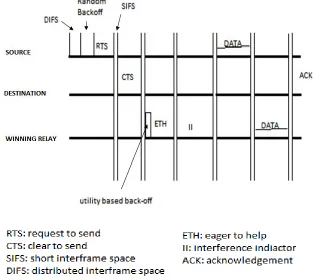
To manage dynamic transmitting power and relaying, DEL-CMAC uses RTS, CTS and ACK and additional control frames. Fig.1 shows of DEL-CMAC protocol. Two new control frames have been used in DEL-CMAC protocol to make the transmission easy, i.e., Eager-To-Help (ETH) and Interference- Indicator (II). The Eager-To-Help frame is used for selecting the best relay in a distributed manner considering the power consumption factors, and distance. In DEL-CMAC protocol, the best relay will be selected based on maximum residual energy and minimum transmitting power among the capable relay candidates. In order to enhance the spatial reuse an Interference indicator frame is employed which reconfirms that the interference range of allocated transmitting power is only at the winning relay.
Fig 1. The Frame Exchanging Process
Frame exchange process of DEL-CMAC:
2. If channel is idle for DIFS, it chooses a random back-off timer. 3. If random back-off timer==0, source node send RTS to destination. 4. Destination sends CTS after it receives RTS.
5. All nodes that receives RTS and CTS is can act as relay candidate. But best relay node is selected by following steps:
Relay after receiving both RTS and CTS, checks whether it can reduce total energy consumption, if so every capable relay candidate starts back-off timer.
The back-off at a better relay expires earlier and best relay node sends out an ETH to source node, destination node and other relay nodes. Finally Best relay node is selected
After selecting the relay node, packets will be transmitted from source to destination via relay node using cross layer approach.
C. Cross layer communication
This section gives the implementation details of Accessing Physical Layer from Routing Layer.
Fig.2. Cross Layer Design
The Fig.2 shows the design of the cross layer interface.In order to transfer the packets from one layer to another layer, we have to create an interface in both physical layer and network layer. A network interface is set at both Network Layer and Physical Layer. The network interface consist of node id and location of destination node. This information is used for direct of transmission data between network layer and physical layer.
IV. SIMULATION RESULTS
The experiment was conducted on ns2.35 simulator with 30 nodes deployed initially. Here we compare the existing system results with proposed system.
The Fig.3 shows the deployment of the nodes. Once the nodes have been deployed the user will be asked to enter the source node and destination node. After choosing them relay node will be selected based on the amount of the energy in the nodes. Once the relay node is selected then RTS signal will be forwarded from the source node to destination node and CTS will be sent vice versa. Then ETH message will be forwarded and finally message will be forwarded.
Throughput:
The network throughput is the number of bits transmitted from source to destination over communication channel in a second.
Fig. 4. Throughput of the system
The Fig.4. Shows throughput of the Network. X axis represents time in milliseconds. Y axis represents packets received in KbpsAs shown in the graph we can observe that in proposed algorithm as time increases the amount of packet received by the destination also increases. This shows that the throughput is high and the algorithm performs better than existing system.
Network Lifespan:
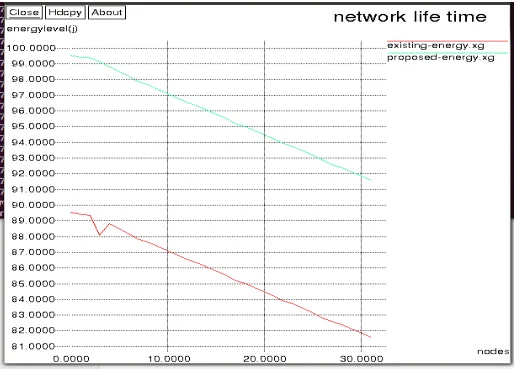
The network lifespan refers to active lifespan of a node i.e. active time of node in network until it runs out of energy.
The Fig.5 represents the network lifespan of the Network clearly showing the amount of energy present after the simulation time ends. X axis representsnumber of nodes Y axis representsnetwork lifespan. Here as number of packets increases, the network lifespan decreases. The proposed system shows us that it can sustain network lifespan compared to existing system. As the number of nodes increases, the network lifespan decreases but still it can sustain energy level compared to existing system.
V. CONCLUSION AND FUTURE WORK
In this paper, a novel distributed energy-adaptive location based MAC protocol along with effective cross layer optimization with cooperative diversity routing approach is given for MANET. By using the DEL-CMAC protocol we can prolong the network lifespan. Cross layer design is used to increase throughput.The simulation results showed that the proposed algorithm performs better and increases the network lifespan of the system. The proposed algorithm provides energy efficient path for data transmission and maximizes the lifespan of entire network.As the performance of the proposed algorithm is analyzed between two metrics in future with some modifications in design considerations the performance of the proposed algorithm can be compared with other energy efficient algorithm. We have used very small network of 30 nodes, as number of nodes increases the complexity will increase. We can increase the number of nodes and analyze the performance in future work.
REFERENCES
1. J.N. Laneman, D.N.C. Tse, and G.W. Wornell, “Cooperative Diversity in Wireless Networks: Efficient Protocols and Outage Behaviour,” IEEE Trans. Information Theory, vol. 50, issue no. 12, pp. 3062-3080, Dec. 2004.
2. A. Sendonaris, E. Erkip, and B. Aazhang, “User Cooperation Diversity-Part I: System Description,” IEEE Trans. Comm., vol. 51, issue no. 11, pp. 1927-1938, Nov. 2003.
3. Xiaoyan Wangand Jie Li, “Improving the Network Lifespan of MANETsthrough Cooperative MAC Protocol Design” IEEETransactions On Parallel And Distributed Systems, vol. 26, issue no. 4, pp.1010 – 1020, APRIL 2015
4. M.D.Nikose, “A Review of Cross Layer Design” International Journal of Emerging Trends in Engineering & Technology (IJETET), Vol. 02, issue no.01, pp. 7-18, 2013.
5. M. Conti, G. Maselli, G. Turi, and S. Giordano, “Cross-Layering in Mobile Ad Hoc Network Design”, IEEE Computer, vol. 37, issue no. 2, pp. 48–51, 2004.
6. T. Himsoon, W.P. Siriwongpairat, Z. Han, and K.J.R. Liu, “Lifetime Maximization via Cooperative Nodes and Relay Deployment in Wireless Networks,” IEEE J. Selected Areas in Communications, vol. 25, issue no. 2, pp. 306-317, 2007
7. A.K. Sadek, W. Yi, and K.J.R. Liu, “On the Energy Efficiency of Cooperative Communications in Wireless Sensor Networks,” ACM Transaction on Sensor Networks, vol. 6, issue no. 1, article 5, pp. 1-21, Dec. 2009.
8. S. Kadloor and R. Adve, “Relay Selection and Power Allocation in Cooperative Cellular Networks,” IEEE Trans. Wireless Comm., vol. 9, issue no. 5, pp. 1675-1685, May 2010.
9. A. Ibrahim, A.K. Sadek, W. Su, and K.J.R. Liu, “Cooperative Communications with Relay-Selection: When to Cooperate and Whom to Cooperate with?” IEEE Trans. Wireless Comm., vol. 7, issue no. 7, pp. 2814-2827, July 2008.
10. Beres and R. Adve, “Optimal Relay-Subset Selection and Time-Allocation in Decode-and-Forward Cooperative Networks,” IEEE Trans. Wireless Comm., vol. 7, issue no. 7, pp. 2145- 2156, July 2010.
11. P. Liu, Z. Tao, S. Narayanan, T. Korakis, and S.S. Panwar, “CoopMAC: A Cooperative MAC for Wireless LANs,” IEEE J. Selected Areas in Comm., vol. 25, issue no. 2, pp. 340-354, Feb. 2007.
12. H. Zhu and G. Cao, “rDCF: A Relay-Enabled Medium Access Control Protocol for Wireless Ad Hoc Networks,” IEEE Trans. Mobile Computing, vol. 5, issue no. 9, pp. 1201-1214, Sept. 2006.
13. H. Shan, P. Wang, W. Zhuang, and Z. Wang, “Cross-Layer Cooperative Triple Busy Tone Multiple Access for Wireless Networks,” Proc. IEEE GLOBECOM 2008-2008 IEEE Global Communication Conference, pp. 1-5, Dec. 2008.
14. S. Moh and C. Yu, “A Cooperative Diversity-Based Robust MAC Protocol in Wireless Ad Hoc Networks,” IEEE Trans. Parallel and Distributed Systems, vol. 22, issue no. 3, pp. 353-363, Mar. 2011.
15. C.E. Perkins and E. Royer, “Ad-hoc On-demand Distance Vector Routing,” Proc. IEEE Workshop Mobile Computing Systems and Applications, pp. 90-100, 1999.
16. Xiaoyan Wang, and Jie Li, “Improving the Network Lifespan of MANETs through Cooperative MAC Protocol Design,” IEEE Transactions On Parallel And Distributed Systems, Vol. 26, issue No. 4, pp. 1010-1020, April 2015.
BIOGRAPHY
ASHA is currently working as Associate Professor, Department of Computer Science and Engineering, Dr. Ambedkar Institute of Technology. Bangalore. She obtained her Bachelor ofEngineering, Masters of Engineering in Computer Science and Engineering. She has published more than 15 papers in refereed international journals and conferences. Her research interests are in the field of Wireless Networks.