University of Windsor University of Windsor
Scholarship at UWindsor
Scholarship at UWindsor
Electronic Theses and Dissertations Theses, Dissertations, and Major Papers
1-1-1971
Internal-external control, power position, and position satisfaction
Internal-external control, power position, and position satisfaction
in task-oriented groups.
in task-oriented groups.
Igor Hrycenko University of Windsor
Follow this and additional works at: https://scholar.uwindsor.ca/etd
Recommended Citation Recommended Citation
Hrycenko, Igor, "Internal-external control, power position, and position satisfaction in task-oriented groups." (1971). Electronic Theses and Dissertations. 6710.
https://scholar.uwindsor.ca/etd/6710
INTERNAL-EXTERNAL CONTROL, POWER POSITION,
AND POSITION SATISFACTION IN
TASK-ORIENTED GROUPS
hy
Igor Hrycenko, ■
B :.Sc. (Hons.), University of London, 1968
A Thesis
Submitted to the Faculty of Graduate Studies; through the Department of' Psychology in partial
Fulfillment of the Requirements for the Degree of Master of Arts at
the University of Windsor
UMI Number: EC53078
INFORMATION TO USERS
The quality of this reproduction is dependent upon the quality of the copy
submitted. Broken or indistinct print, colored or poor quality illustrations and
photographs, print bleed-through, substandard margins, and improper
alignment can adversely affect reproduction.
In the unlikely event that the author did not send a complete manuscript
and there are missing pages, these will be noted. Also, if unauthorized
copyright material had to be removed, a note will indicate the deletion.
®
UMI
UMI Microform EC53078
Copyright 2009 by ProQuest LLC.
All rights reserved. This microform edition is protected against
unauthorized copying under Title 17, United States Code.
ProQuest LLC
789 E. Eisenhower Parkway PO Box 1346
A & x s 7 f &
APPROVED BY:
/ / „ . A i K"-"yr'
ABSTRACT
On the hasis of a conceptualized congruency between
the expected locus of control and the preferred locus
of control, it was hypothesized that the personality
variable of internal-external control would interact with
power position in determining: (1) subjects' satisfaction
with their position; and (2) subjects' satisfaction with
the person assigning them to their power position. These
hypotheses were tested via an experimental design' in which
subjects were led to believe that they possessed either
high or low power in a triadic communication network, whose
goal was to complete a group task with maximum efficiency.
Fifty-two subjects of both sexes were selected for exper
imental sessions on the basis of’ highly internal or highly
external scores on a Personal Control factor, which had
emerged from a prior factor analysis of Rotter's I-E Scale.
Subjects' responses' to a post-experimental questionnaire
provided support for both hypotheses for'males, but not
for females. These results are interpreted as supporting
the hypothesized relation between the expected and preferred
loci of control, and the validity of the personal control
construct. Interpretations are offered for the sex differences
obtained, and the theoretical and practical implications of
the results are discussed.
PREFACE
The author wishes to express his particular gratitude
to Dr, H, Minton, the Chairman of his thesis committee,
for his valuable advice and comments in all phases of this
study. He is also indebted to the other members of his
thesis committee, Drs, A, Kubota, J. La, Gaipa, and F.
Schneider, for their helpful comments, and to Dr, G.
ilairdkas, for providing the practical facilities for the
study. Finally, thanks are due to Dana Dean, Frits Lindever,
and Pacey Sugar, who assisted during experimental sessions
as confederates, and to all the students who contributed
their time during a very busy stage of the academic year
to servo as subjects.
Table of Contents
Page
ABSTRACT ... Ill
P R E F A C E ... ... lv
LIST OF TABLES ... VI
LIST OF FIGURES ... vii
Chapter
I INTRODUCTION ... ,1
II METHOD ... 2k
III RESULTS ... ^1
IV DISCUSSION ... 63
APPENDIX A The Internal-External Control Scale .... 7^
APPENDIX B The Nine Items Used to Measure ...
Personal Control ... 78
APPENDIX C Form Letter Sent to all Potential ... Subjects.. ... ... 80
APPENDIX D Experimental Task and Programmed ...
Messages ... „8l
APPENDIX E Post-Experimental Questionnaire ... 8^
APPENDIX F Analyses of Variance of Responses ... to Items 1, 2, 5» 6, and 9 ... 87
APPENDIX G Questionnaire Responses of Individual ..
Subjects ... . 92
REFERENCES ... ... 98
VITA AUCTORIS ... 102
Li sir of Tables
Table Page
i-i-• « *
3- Feelings of Independence in the Differer'
Experimental Conditions ... k2.
Feelings of Independence in the Different , Experimental Conditions (Males and Females
oB pa rate In) 9 3
99
« • «
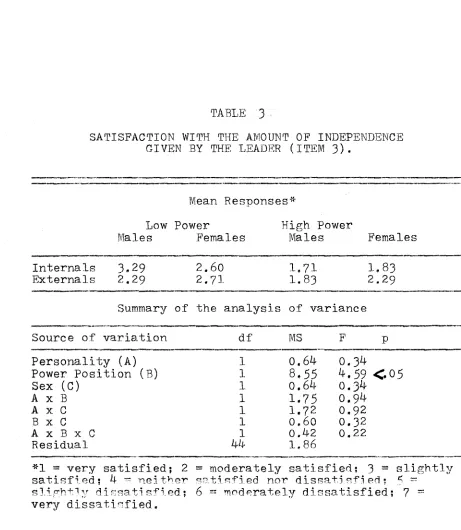
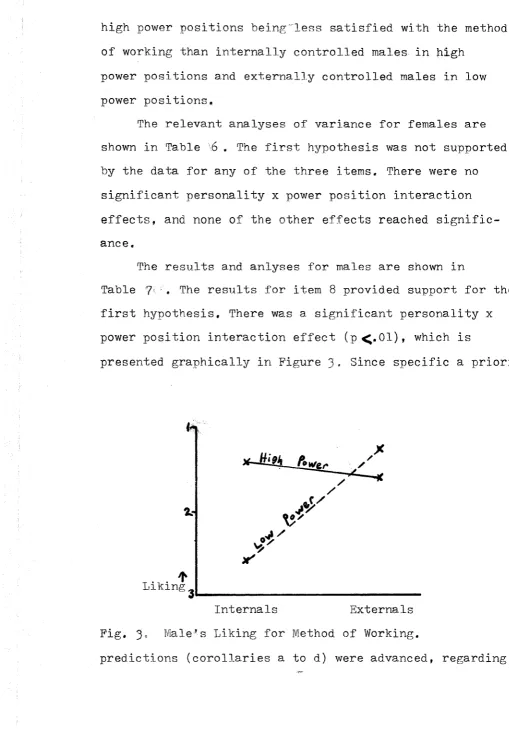
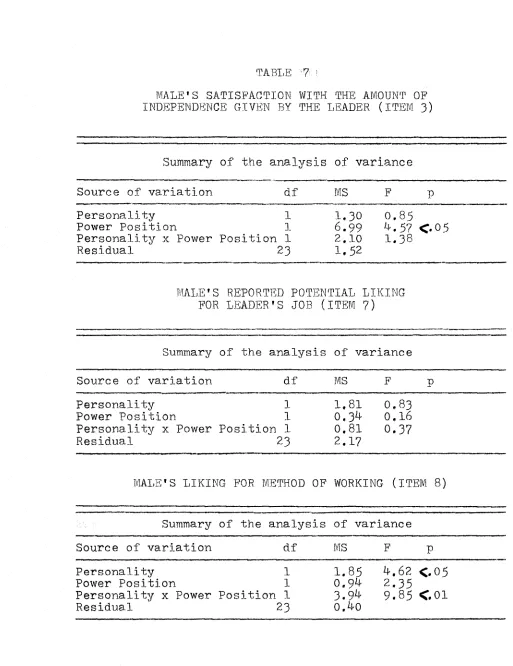
Satisfaction with the Amount of Independence .» Given by the Leader (Ttem 3) ... ^5
k Reported Potential Liking; for Leader's
Job (Item 7) to
5 Liking for the Method of Working (Item 8) 5-7
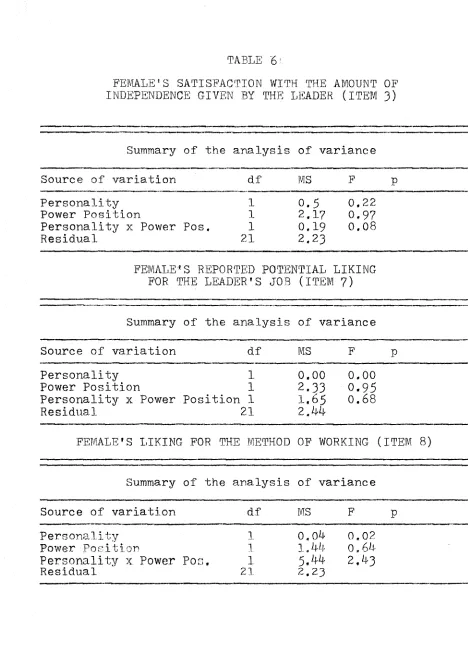
6 Female's Satisfaction with the Amount of
Independence Given by the Leader (Item 3) ♦ .... t-9
7 Male's Satisfaction with the Amount of ..
Independence Given by the Leader (Item 3) ... 51
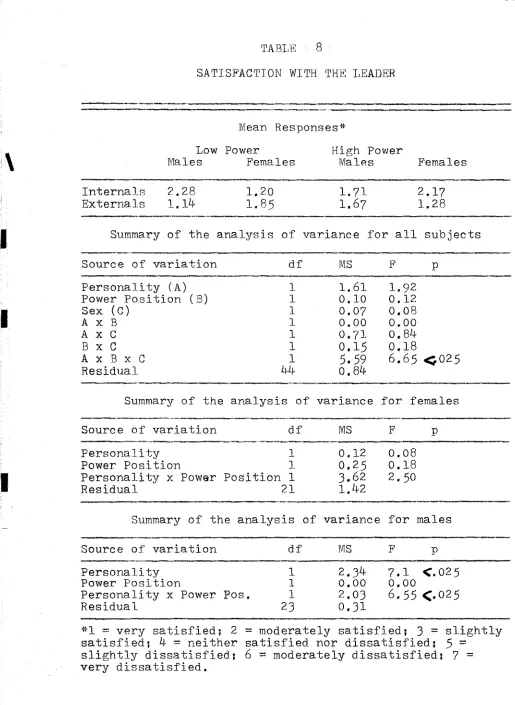
8 Satisfact.i on with the Leader ... 53
9 Mean Responses for Items Checking for ,
Confounding Variables 55
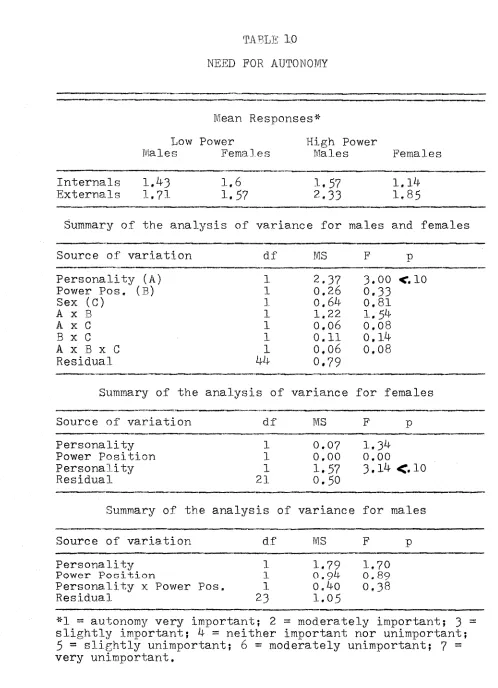
10 Meed for Autonomy ... 58
11 Analyses of Variance across Items 3» 5. ... 7. and 8 for Female Groups ... 61
3 2 Analyses of Variance across Items 3» 5* ... 7, and 8 for Male Groups ... 62
Ltst of Pn score c
Figure Pap-e
1 Triadic Centralized and Decentralized
Communi rati on Feta ... ' a - V 1 •*• --•> «94 *9$ «9 e9« n4i i! « 4 « t « I « * I M « :1 > in-XV./
T h P K l r i p f i m p J i + n l ' s p t + i n 0' o o
1 P'T1 * T 1 V 1 "’■'Ip- ppj -v-* P p-FU ~. -T -P 1;j^ * -v’) ,~c /1 O
v'?r- ^ ~~ * *pn r*‘I~n t-tn H-V-. -H !•'■o T el oy> r'j | .^ati r.-facii or wi i;h ppv'fni~™r,<' r> <o
CHAPTER I
INTRODUCTION
The general aim of this study is to examine the
relative effects of personality and situational variables
in determining behaviour. The personality variable of
special concern refers to an individual's predominant
beliefs regarding his ability to control his own outcomes.
The situational variable is the amount of social power
actually possessed by an individual in a group situation,
and the dependent variable is the satisfaction of individual
with their power position.
The personality construct of internal-external control
has been used to operationalize one's beliefs regarding
the locus of control of outcomes. The literature relating
to internal-external control, satisfaction, and social power
will be reviewed in the following sections,
Internal-External Control
The concept of internal-external control is derived
from the social learning theory of Rotter (195^. 1966),
This theory conceptualizes behaviour to be a function of
the expectancy and value of reinforcement. The internal-
external control construct refers to an individual's
perception of whether the occurrence of a reinforcement
" follows from or is contingent upon his behaviour
0;r B,"t"hTl ^ r p y* 313 pi t h 0 -f-.r) V7"h i qV\ 1^0 "Pf *o ^ ^ p
t H "j r« O 0 ‘V'i "h 0 1 1 ’H** r " P - P ' Y P p r*' P 1 ^ 1 7 ^ 0 P "p V> i -0 ^
THH V O C C 1! ^ * >-> ('j 0 T 1 Pv " ' r } f - v ' \ h ’ r O -P V*11 S OW r i £3. c t '" ^ O T I S ' ( t t . G " T ^ "I O f t f > f p- # 1_ )
In the process cP social learning in a variety of
situations, the individual will progressively develop
generalized expectancies regarding the locus of control
of reinforcement, Internal control describes the belief or
generalized expectancy that life's outcomes are predominant
ly the result of one's own actions, while external control
refers to the prevailing belief that one's outcomes are
mainly determined by external forces such as chance, fate,
or more powerful others. Internal-external control therefore,
is conceived as a continuum on which an individual may
be placed; that is, it reflects a personality dimension.
The Internal-External Control (I-E) Scale (Rotter, 1966)
is the most commonly used measure of this construct.
This scale is a forced-choice questionnaire consisting
of alternative expectancy statements, one characteristic
of a belief in internal locus of control and the other
of a belief in external locus of control.
In Rotter's theory, expectancies regarding the locus
of control of behaviour-reinforcement contingencies are
considered to be both situation-specific and generalized.
An individual's generalized expectancies are postulated
to exert an important influence on his behaviour, under
a variety of different stimulus conditions. This influence
which lack prior situation-specific expectancies, or in
ambiguous situations in which no immediately appropriate
specific expectancy can be engaged.
The conceptual],zed relationships between internal-
external control and a number of behavioural criteria
have received extensive empirical validation. Reviews
of this work are provided by Lefcourt (1966), Rotter
(1966), and Minton (1971a), The behavioural dimensions
which have been shown to be related to the internal-
external control construct include four major categories:
(1) performance in controlled laboratory tasks; (2)
attempts to control the environment; (3) performance in
achievement situations; and (*f) reactions to social influence.
Thus in comparison to externally controlled individuals,
individuals characterized as internally controlled have
tended to be: (1) more efficient and more motivated in
tasks involving skill rather than chance; (2) more alert
to their surroundings and more active in attempting to
improve environmental conditions; (3) more involved and
persistent in achievement tasks; and (4) more resistant
to attempts at influence,
Internal-External Control and Satisfaction
An area of research with the internal-external control
construct, especially relevant to the purpose of this
study, is the relationship between locus of control and
task satisfaction, „ Several, studies have demonstrated
14
-locus of control. These 'studies have hypothesized that
individuals will prefer those situations which they believe
will lead to a maximization of outcomes. Thus, externally
controlled individuals, believing their reinforcements
to be outside their control., would prefer situations
in which their outcomes were in fact controlled by others.
Internally controlled individuals on the other hand,
believing their reinforcements to be in their own hands,
would prefer situations in which they could be self-
controlling.
The results of studies by Cromwell, Rosenthal,
Shakow, and Zahn (1 9 6 1) and by Rotter and fulry (1965)
provided support for this postulated relation between
the expected locus of control and the preferred locus
of control. In the former study, schizophrenic subjects,
who were significantly more externally controlled than
normal subjects, preferred conditions of external control
and performed better under them, than did normal, internally
controlled subjects. The study by Rotter and Mulry showed
that internally controlled subjects valued skill-determined
rewards more than chance-determined rewards, while externally
controlled subjects placed more value on chance-determined
rewards; that is, externally controlled subjects seemed
to prefer rewards which derived from external sources,
while internally controlled subjects preferred rewards
obtained through their own efforts.
5
of preference for situations which maximized outcomes
and the findings of these two studies, Watson and Baumal
(1967) predicted that in a situation in which expected locus
of control and actual locus of control were lncongruent,
subjects would experience dissatisfaction and anxiety. These
negative emotional reactions would resuit In performance
which was Inferior to that obtained in a congruent situation.
They obtained support for this view in a study In which
subjects were led to believe that the efficient learning of
nonsense syllables would either be instrumental in the
avoidance of later shocks, or largely irrelevant in avoiding
these shocks. As predicted, internally controlled individuals
made more errors when they anticipated that they would have no
control over their later situation, while externally controlled
individuals made more errors when they anticipated that they
would have control over their later situation. The authors
concluded that these findings lent strong support to their
hypothesis concerning the congruency of the expected locus of
control with the preferred locus of control. Further supporting
evidence was reported by Schneider (1 9 6 8), who obtained a very
correlation between internal-external control and a
forced-choice "Activity Preference Scale" composed of pairs of skill
and chance activities. Internally controlled individuals
preferred activities which were dependent mainly on skill,
while externally controlled individuals preferred activities
Lichtman, and Ryekmau (1968) obtained evidence which
corroborated internally controlled individual's preference
for circumstances in which they could exert control over
their outcomes. In a dart-throwing task, they preferred
to throw from a shorter rather than a longer distance,
even though probabilities of success at the two distances
were equalized by the number of throws allowed.
Further conceptual support for a positive relation
between the expected and preferred loci of control can
be obtained from the work of some personality theorists.
Several of them have hypothesized that unpleasantness is
associated with the incongruence of actual and expected
events - and incorporated this as a major assumption of
their theoretical positions. Thus Kelly (1955) conceived
of prediction and control as the main aims of life, resulting
in the formation of systems of constructs defined by
expectancies, with disconfirmation of expectancies leading
to anxiety, Festinger (1958) engendered considerable research
interest with his theory of "cognitive dissonance", which
regarded the disconfirmation of expectancies as an unpleasant
occurrence leading to a state of "dissonance".
The evidence which has been discussed suggests that
there may be a positive relation between the expected and
preferred loci of control, which will mediate affective
reactions in situations involving control. When a person
is able to exert control over the outcomes of another,
person. Therefore, it appears that the internal-external
control construct may he of relevance to the analysis of
affective reactions to interpersonal control or power
relations. The literature relating internal-external control
to areas in the study of power will be reviewed in the
following section,
Internal-External Control and Power
The concept of internal-external control has been
widely applied to the study of minority groups, particularly
blacks in the United States (Forward & Williams, 1970;
Gurin, Gurin, Lao, & Beattie, 1969). In this area of
reasearch, internal-external control is regarded as a
useful measure of the individual’s sense of power. Members
of disadvantaged groups tend to hold the predominant
belief that major events in their lives are outside their
control, that is, they are externally controlled in terms
of the personality dimension of internal-external control
(Gurin & Gurin, 1970), This sense of powerlessness was one of the criteria used by Seeman (1959) to define his
concept of "alienation"— a concept which has achieved
extensive usage in recent years as a basis for attempted
explanations of the disenchantment reactions of industrial
workers, students, and minority racial groups, Clark
(1965) has pointed out that, power in an ever-nresn-''4-.
frvva-P-i T) f) 7? ^ 1 Vh tfT 0 1 1 C * "Ti f * r>; *h ^ ^ X% 1 f D ? 1 T p> Q "D
the need to expand the scientific knowledge of power, in
of the mechanics of social, economic, and political change.
In its context as a prime determinant of reality and change
in reality, Clark suggests that power might profitably be
regarded, as the major unifying concept for the social
sciences in general.
Minton (19?la) has developed a psychological analysis
of power in which he conceives of power as relevant both to
a given situation (social power) and as a relatively
consistent attribute of an individual across situations
(personal power). In this latter sense, therefore, power
may be regarded as a personality variable, with individuals
varying along a given dimension of power, such as one's
beliefs about personal power or one’s ability to success
fully exercise power. Minton uses the term, "subjective
power", to refer to the individual's evaluation of his
ability to produce Intended effects. Within this conceptual
scheme, Minton regards Internal-external control as an
operationally useful representation of individual differ
ences along the dimension of subjective pover , that is the individual's personal beliefs concerning his ability to
implement his intentions. An individual's position on the
personality dimension of subjective power determines the
generalized expectancies he will tend to bring to a given
situation, concerning the actual social power he will posse
Social Power and Satisfaction
Social power may be defined as the relative power
o
situation. One type of situation that lends itself to the
study of social power is a communication network, because
it allows systematic variation of relative access to
communication channels and to information. Typically a,
communication network isolates group members from one
another and restricts their method and channels of communication
to those prescribed by the experimenter, such as written
messages passed through slots in vertical partitions, or
verbal communication through an intercom system, etc.
The channels of communication are under the control of
the experimenter and can be manipulated to form any desired
pattern. The amount of information available to each group
member, relating to the group task in hand, is similarly
under experimental control, Therefore it is possible
to systematically vary the relative social power of group
members by appropriate manipulation of relative access
to communication channels and to task-relevant information.
Those group members who have greater access to communication
channels or information possess.-greater ability to control
the outcomes of the group, and can therefore be considered
to wield greater social power. However, an individual
possesses power over another only to the extent that he
can control the other's reinforcements (Shaw, 1971),
Therefore, social power differentials can operate within
a group, only if successful performance of the group task
has reinforcing properties for group members— that is,
10
the relevant outcomes, to become ego-involved in the
group task,
Central positions in communication networks afford
their occupants greater access to communication channels
than do peripheral positions. Therefore, individuals
in central positions possess more social power than those
in peripheral positions, Furthermore, greater satisfaction
is shown by members of decentralized communication nets,
than centralized communication nets, A centralized commun
ication net is characterized by a hierarchical pattern
of communication, in which, one or more group members have
superior access to communication channels, whereas a
decentralized communication net involves an equalitarian
pattern of communication, with relative equality of access
to communication channels (Fir, lA ,
Fig, 1 Triadic Centralized Triadic Decentralized Communication Net Communication Net
Generally then, individual's satisfaction in commun
ication nets appears to be associated with the possession:
position, Leavitt (1951) considered that independence
of action, through access to information, was the primary
determinant of satisfaction in communication nets, and
therefore mediated the relation between satisfaction and
centrality, or social power, Leavitt1s concept of independ
ence lias subsequently expanded by Shaw (I96A) to refer to
the total decree of freedom with which an ind.ivl.dual could
function in the group, Thus, Shaw’s concept of independ
ence includes other situational and personal factors apart
from simply accessibility of information, and is considered
to determine both group efficiency and member satisfaction
in the communication network.
Mulder (1.9 6 0) has reported a. study which casts some
light on the motivational aspects of satisfaction in
communication networks. He found that Mself-realization11,
operationally defined in terms of the ability to complete
one’s own task by oneself, did not affect satisfaction^;'n
even though there was a clear difference in the availability
of information between the low and high "self-realization"
conditions. The major variable in determining satisfaction
seemed to be the exercise of power, in the sense of
determining the behaviour of others. Although their own
outcomes were controlled by the more powerful group leader,
"high power" subjects were able in turn to control the
outcomes of two less powerful group members. These subjects
were more satisfied than "low power" subjects, who had no
the exercise of power pgr se appeared in general, to be
the major determinant of satisfaction in communication
n e t w o r k s .
Watson and Bromberg (1965) manipulated power position
in a communication network by instructing subjects assigned
to high power positions to issue commands and make the
final decisions concerning solutions to tasks, while low
power subjects were instructed to obey these commands.
All messages were intercepted and prepared messages sub stituted, in order to assure greater control of oossible
C OTVf*01"!T">r] i T’- i/Pt y1i "H 1nh ? ^1 ^ n h r>r|i^rjpr*^r of TO0SSSirr^ T*0C ©O"t*i OO
and amount of information reception. The authors reported
that in this strictly solution-oriented situation ,the
occupants of high power positions were more satisfied than
the occupants of low power positions. The results of this
study support Mulder's (i960) view that the exercise of
power per se is a major motivational variable underlying
satisfaction.
Much of the research with communication networks
however, has tended to neglect the possibility of an
interaction between the personalities of individual group
members, and their position in the communication network,
in the determination of subsequent behaviour. This represents
a failure to take adequate account of the fact that behaviour
is a function of both personality and situational variables.
For example, Hunt (1965) has emphasized that variations
differences among subjects, nor of variations in situations,
but rather the result of their interactions. Block (1968)
suggested that failures to take into account environmental
factors may Ice one of the major reasons for the inconsistent
findings in the literature, concerning relationships
between personality and behaviour, Shaw (19?1) stressed
the importance of taking into consideration the personality
characteristics of group members in the analysis of group
processes:
The characteristics of individuals who compose the group thus constitute a personal environment in which the group must operate. One cannot
hope to fully understand group process without knowing the ways in which this personal environ
ment influences group behaviour (Shaw, 1971* p. 155)*
Hare (1962) in his review of small group studies,
also conceived of behaviour as a compromise between
the tendencies of personality and role expectations"
(Hare, 1962, p. 276), but found only two studies in the
literature which had investigated the interaction between
personality and position in a communication network. There
have been few studies of this type since, though Zander
and Forward (1968), and Schneider and Delaney (In press)
have recently reported studies which do fall into this
category. In the former study, the personality variables
of need for achievement and t e s t anxiety were found to
interact with position in a communication network, in
determining group members' desire for success in the
group task. The latter study showed that the need for
with problem complexity in determining the speed of solution
of group problems.
One of the studies cited by Hare (Berkowitz, 1956)
examined the relation between the personality trait of
ascendance and behaviour in central and peripheral positions
in a communication network. Degree of ascendance appeared to
have no effect on satisfaction, with both low and high
ascendants showing: no difference in satisfaction between
central and peripheral positions. Personality did appear to
mediate initial differences in performance, but over time,
these differences became minimal. Berkowitz interpreted
these results as supporting his theoretical analysis of the
interaction between personality and situation. In his view,
personality structure determined the position of a response
in the individual’s response hierarchy. Initially, responses
from the upper levels of this hierarchy would be favoured,
regardless of situational factors. However, as time passed,
there would be a process of adaptation to the specific sit
uation, and other lower level responses could be called upon
(assuming they were present in the hierarchy) as dictated by
the requirements of the role or situation. In a given situati
then, initial personality-mediated behavioural differences
between group members would gradually decrease, leading to
relatively uniform behaviour.
The other study cited by Hare (Trow, 1957) showed that
in reactions to position in a communication net, Task-
oriented groups communicated by passing written messages,
which in fact were intercepted and replaced by prewritten
messages designed to create the illusion of either centrality
or peripherality, and autonomy or dependence. Centrality-
peripherality was defined in terms of access to communication
channels and autonomy-dependence in terms of access to
task-relevant information. Thus in the autonomous condition,
subjects were supplied with all the information required
for the performance of the task, and therefore were able
to direct their activities themselves, while in the dependent
condition, they lacked essential task-relevant information.
In the latter condition therefore, at various stages in
the performance of the task, subjects required direction
from a possessor of this crucial information.
No relation was found between central!ty-peripherality
and satisfaction, but degree of autonomy was related to
satisfaction. Subjects were more satisfied in the autonomous
than in the dependent condition, the extent of this relation
being mediated by subjects’ need for autonomy as defined
by responses to a pre-experimenta1 questionnaire. Thus,
subjects categorized as having a high need for autonomy
were more satisfied in the autonomous than in the dependent
condition, while subjects with a low need for autonomy
showed no difference in satisfaction under the two conditions.
Therefore, Trow concluded that the relation between autonomy
16
autonomy, the strength of the "relation varying directly
as the strength of the need. This relation, he suggested,
might explain the generally observed relationship between
centrality and satisfaction, since central positions in
communication nets are usually characterized by relatively
high degrees of autonomy.
However, in view of Mulder's (i960) later work, Trow's
interpretation of his findings must be questioned. Mulder
pointed out that Trow's "autonomy" condition might have
included more than simply the self-sufficiency factor
attributed to it by Trow, Since the possession of autonomy
by an individual group member enabled him to increase the
efficiency of the whole group, elements of social power
may also have been engaged. Thus, Trow's autonomy condition
might more correctly be termed a "high power" condition.
This interpretation of Trow's results would make them
compatible with the findings of Mulder, with respect to
the relation between satisfaction and the exercise of
power.
Research in other areas of power relations has also
pointed to the importance of taking account of personality
characteristics. For example, in the laboratory setting,
Smelser (1961) found that the most effective performance
of a task resulted when the personality structure of the
subordinate (his score on the dominance-submission dimension
of the California Personality Inventory) and his social
1?
studies conducted in industrial settings, Vroom (1959i
i960) showed that the opportunity to participate in decision
making generally had a positive effect on both attitudes
and job performance. That is, the possession of some measure
of social power tended to have beneficial effects on
workers. However, the personalities of workers also affected
their preferrence for and response to different styles
of supervision, Workers who were dependent or authoritarian
preferred authoritarian leadership to participative leader
ship, and performed better under it, while v/orkers with
the p e r s omlity characteristic of independence preferred
the participative style of leadership and were most productive
with this kind of leader, This work appears to demonstrate
that satisfaction with rcsition in a pra.ct5.cal situation
may be a function of personality. Vroom (1959) emphasized
that studies of participation which failed to consider
the interaction between participation and personality
could only lead to average statements for all members
of the group under investigation. These average statements
would necessarily be inaccurate in some individual cases,
O ’Brien (1969) in his analysis of leadership in
organizational settings has also stressed the need to pay
greater attention to personality variables!
Theories of organizational leadership are alike in asserting that both organizational
and personality variables are important. However, most of them fail to define specifically the
1 8
worker satisfaction (O'Brien, 1 9 6 9. p. ^7)«
The evidence which has been discussed Indicates that
though there is a general tendency to prefer a position
of high social power, individuals' satisfaction in power
relations may be mediated by personality variables. The
form of this interaction between personality and social
power may be of particular relevance for an understanding
of real-life situations outside the laboratory. Thus the
personality of a member of an organization is similarly
likely to be an Important determinant of his satisfaction
with prevalent organizational power structures.
Job Satisfaction
The worker's attitude toward his role in an organisation
is usually termed "job satisfaction", or "morale" (Vroom,
I9 6 9). Though it is now generally accepted that job satisfac
tion and productivity are not necessarily related in the
short-term (Kahn, I9 6O; Vroom, 196^), job satisfaction
has been a variable of considerable importance in prevailing
contemporary approaches to organizational and social
functioning. Such approaches, drawing on the classic
Hawthorne studies, and the work of Maslow (1964) tend to
emphasize a human relations orientation both as valuable
in itself and as offering the most effective means of
achieving organizational efficiency in the long-term.
Indeed, some definitions of total organizational efficiency
take into account workers' p e r s o n a l outcomes (Kahn, i9 6 0).
affect such long-term Indices of organizational efficiency
as absenteeism and labour turnover (Tannenbaum, Weschler,
& Mas sari, k, I96I), though these concomitants of workers' affective reactions may not he evident in daily productivity
returns,
Herzberg (1959) focussed narticular attention on
job satisfaction in the context of a -general analysis
of the motivation for work, and extended his analysis in
a later -publication to anniv to motivation in veneral
(Herzberg, 1966), His two factor "Motivation-Hygiene"
theory of motivation conceives of satisfaction and dissat
isfaction as independent and parallel continua. Job
dissatisfaction is mediated by hygiene factors, which refer
to the individual's attitudes toward the context in which
his work is performed, and. are related particularly to the
rewards obtained in exchange for work. Job satisfaction
is mediated by "motivation" factors, which refer to the
individual's attitudes toward the content of the job,
and relate to factors like intrinsic interest in the task
and the degree of responsibility held for the performance
of the task. Thus "hygiene" factors appear to be controlled
mainly by avoidance needs and simply perform a maintaining
function, maintaining the individual free from basis wants.
"Motivation" factor;; seem to act in the service of a need,
to utilize and expand creative capacities, and also appear
to imply a desire for the attainment of increased social
rower, therefore, in terms of Herzberg* s analysis, the
20
appears to depend on aspects'* inherent in the work, which
will allow the exercise of power and lead to increased
possibilities of self-fulfillment.
Rogers (1968) has expressed concern at the deficiencies
of modern society with respect to human relations, and
called for greater emphasis within organizations on the
needs and feelings of people. He pointed out that ",,,only
out of the communicated knowledge of all members of
the organizations can innovation and progress come,,,"
(Rogers, 1968, p. 276). In order to achieve effective levels
of ease and efficiency in communication, a foundation of
satisfactory interpersonal relations is, he believes,
indispensable, In response to Sogers’ point, Duhl (1969)
agreed that modern society is inadequate in its treatment
of human relations and reiterated the importance of taking
into account interpersonal relations variables in the design
of organizational activities. In an analysis of current
trends and their effect on the future, he predicted:
"...the new ideology and the new value system will be the
ideology and value system that go with high regard for
interpersonal relations, for love, for concern..." (Duhl,
1969, p. 283).
Internal-External Control, Social Power, and Satisfaction
The evidence which has been presented suggests that
an individual’s expected locus of control of reinforcement,
represented by the personality dimension of internal-
of control of reinforcement,"'Therefore, it seems that an
individual’s satisfaction with the amount of control he
possesses in a given situation, will he a function of
the degree of congruency between his standing on the
personality dimension of internal-external control and
the actual locus of control. Actual locus of control may
be empirically represented in terms of power position in
a communication network. For those individuals with a
high degree of social power, the actual control of relevant
outcomes resides within themselves. For those who possess
a low degree of social power, the actual control of relevant
outcomes emanates more from others than from themselves.
This line of reasoning suggests that satisfaction
with power position may be a function of the interaction
between power position and internal-external control.
Specifically, it is hypothesized that:
(1) Satisfaction with power position in a task-oriented
communication network will be determined, by the interaction
of the personality dimension of internal-external control
with the actual degree of social power possessed.
The following four corollaries can be derived from
hypothesis (l)s
-(a) Individuals with a belief in internal control as opposed
to external control will show greater satisfaction with
a position of high power than a position of low power,
(b) Individuals with a belief in external control as opposed
a position of low power than, a position of high power,
(c) In the high power position, individuals with a belief
in internal control will be more satisfied than individuals
with a. belief in external control.
(d) In the low power position, individuals with a belief
in external control will be more satisfied than individuals
with a belief in internal control.
If individuals are assigned to their power position
by a person with whom they are unacquainted, it follows
that their affective reactions to this person will be
analogous to their affective reactions to their power
position. Therefore, hypothesis (2) follows logically
from hypothesis (1):
(2) Satisfaction with the person assigning pov/er in a
communication network will be determined by the interaction
of the personality dimension of internal-external control
with the actual degree of social power assigned.
The following four corollaries can be derived from
hypothesis (2):
(e) Individuals with a belief in internal control as
opposed to external control will be more satisfied with
a person who assigns them to a position of high power,
than with a person who assigns them to a position of low
power,
(f) Individuals with a belief in external control as opposed
to internal control will be more satisfied with a person
23
person who assigns themTto a position of high power.
(g) When assigned to a position of high power, individuals
with a belief in internal control will be more satisfied
with the assigning person, than individuals with a belief
in external control,
(h) When assigned to a position of low power, individuals
with a belief in external control will be more satisfied
with the assigning person, than individuals with a belief
CHAPTER II.
METHOD
Subjects
Subjects were drawn from a sample of three hundred
and twenty-one students (one hundred, and seventy males,
one hundred and fifty-one females) enrolled in introductory
psychology classes at the University of Windsor, On the
basis of scores on a personality inventory, fifty-two
subjects (twenty-seven males, twenty-five females) were
selected for the experimental sessions.
Materials
Internal-External Control Scale
The Internal-External Control (I-E) Scale (Rotter,
1966) is a forced-choice questionnaire consisting of twenty-
nine items, six of which are filler items (see Appendix A).
Each item consists of alternative expectancy statements -
one characteristic of a belief in internal locus of control
and the other of a belief in external locus of control.
The scale is scored in the direction of external control.
Rotter (1966) reported the results of factor and item
analyses, which showed that the scale had high internal
consistency. Extensive reliability studies indicated test-
retest reliability ranging from to .83. There were
25
the same variable, such as: a Likert scale; interview
assessment; and. a projective technique. Low, non-significant
correlations of the scale with such variables as intelligence,
social desirability, and political liberalness, indicated
discriminant validity. The relationships between I-E Scale
scores and the behavioural criteria previously described
(see page 3) a re evidence of construct validity.
Hersch and Scheibe (1 9 6 7) provided further support
for the reliability and validity of the I-E Scale. They
reported test-retest reliability ranging from .43 to .84;
no significant correlation with Intelligence; a significant
positive correlation between internal control and self chara
cterization on the Gough Adjective Check List as powerful,
independent, effective, active; and a significant positive
relation between internal control and actual personal achieve
ment in a mental hospital setting. These researchers also
noted however, that internally controlled subjects tended
to be more homogeneous in their test performance than extern
ally controlled subjects. It was suggested that there might
be a diversity in the psychological meaning of external contr
ol, possibly in terms of the extent to which external forces
were considered to be benevolent or malevolent.
This initial doubt concerning the homogeneity of
the I-E Scale has gathered greater force with subsequent
research. Thomas (1970) administered the I-E Scale to
liberal and conservative parents of college students, who
2 6
criterion conceptually related to internal control), He
found that loth the literal parents and their student
offspring scored lower on internal control than the
respective conservative groups, Thomas interpreted these
results as evidence of a conservative bias in the I-E
Scale, He pointed out that, these findings indicated that
performance on the I-E Scale might be affected as much
by political and social beliefs as by the generalized
expectancy of locus of control,
Gurin, Gurin, Lao, and Beattie (1969) performed a
factor analysis of the I-E Scale using black American
college students as subjects and obtained two major factors.
The factorial distinction seemed to be based on whether items
referred to one's personal outcomes or to the outcomes of
others. Items phrased in the first person loaded heavily
on a factor labelled as "Personal Control", while items
phrased in the third person loaded heavily on a factor
labelled "Control Ideology", which seemed to measure the
degree of acceptance of the traditional Protestant Ethic,
The "Personal Control" factor appears to be closer both
to Rotter's notion of internal-external control, and
Minton's notion of subjective power, while the "Control
Ideology" factor appears to refer to cultural beliefs.
Q'urin et al, found in fact that it was the Personal Control
factor which related in the predicted manner to expectancy
of success, self-confidence, and achievement, while scores
Lao (1970)» in another study with black college
students, found that an internal score on the Personal
Control factor was related to academic performance,
academic self-confidence, and educational expectations
and aspirations, while an internal score on the Control
Ideology factor was related to socially innovative behaviour,
Lao noted that the I-E scale seemed to be more heavily
loaded on the Control Ideology factor, since a larger
proportion of items were in the third person. S h e :suggested
that previous research results obtained with the I-E
Scale might be explicable in terms of a lesser discrepancy
between Personal Control and Control Ideology for whites
than for blacks,
Mirels (1970) and Minton (1971b) have also found
a factorial distinction in responses to the I-E Scale by
predominantly white subjects. They used student samples
from. 3. .1 arae Midwestern state university In the United,
States, and the University of Windsor in Canada, respect
ively, Both studies utilized a similar factor analytic
method. Response intercorrelations were factored by the
principal components method with a minimum eigen-value of
.8 for computation of components. Components were rotated
by means of Kaiser's (1958) Varimax method, using a minimum
eigen-value of 1.0 for factor rotation. The responses of
males and females were analysed separately.
This method, In both studies, yielded two factors
showed a considerable degree of overlap in terms of the
items which loaded most heavily on the two factors. Items
loading heavily on the first factor seemed to refer to
the relative importance of ability and hard work as against
luck or fate, in achieving personally relevant outcomes
(e.g. "In my case getting what I want has little or
nothing to do with luck" vs. "Many times we might just as
well decide what to do by flipping a coin,"). Items loading
heavily on the second factor were concerned mainly with the
individual's beliefs regarding: the sources of political
and social power (e.g. "The average citizen can have an
influence in government decisions," vs. "This world is run
by the few people in power, and there is not much the
little guy can do about it,"). Thus, while items loading
on the first factor (labelled "Personal Control" by Minton)
were concerned largely with control at the personal level;
items loading on the second factor (labelled "System
Modiflability" by Minton) referred to control at the societal
and global levels.
The factorial distinction which emerged in these two
studies is somewhat different from, that obtained by Gurin
et a l . Thus, within items relfecting the theme of personal
control, Gurin et al, found a distinction between those
items stated in the first person, and those stated in the
third person. Gurin et al, h? Personal Control Ideology
factor referred to the items stated in the first person.
refer-ring to personal outcomes was not fffund in the studies
of Mirels and Minton, Thus, Minton's "Personal Control"
factor includes items phrased in the third person as well
as the person, The "System. Mod if iabi lity" factor
found by Mirels and Minton is similar to a minor factor
obtained in Gurin gj; gj., *s work (accounting for only a
small part of the variance for black subjects). Minton
(1971a) points out that the lack of equivalence among
factor analytic results may be due to the different samples
of subjects used« Thus, the first person-third person distinc
tion may have been a more salient element in the power
beliefs of black students as opposed to white students.
The findings of Mirels and Minton suggest that the
factorial discrepancy in the I-E Scale which has appeared
since Rotter's original factor analysis (in the early
i9 6 0's) may reflect general changes in the last few years,
particularly for college students, who have become increas
ingly involved in political affairs during the last decade,
Minton suggests that:
As a consequence of this involvement many
students may now make a distinction between
beliefs concerning felt mastery over the course
of one's life (personal control) and beliefs
concerning the responsiveness of political instit utions to citizen efforts toward active part
icipation in political and social affairs (system modiflability) (Minton, 1971a, p. .8).
Procedure
The I-E Scale was administered to a number of classes
January 1971, and was completed by three hundred and twenty-
one students. Subjects were selected on the basis of their
scores on the Personal Control factor alone, rather than
the total scale scores, since it was felt that this factor
offered a purer measure of "subjective power". Personal
Control was measured by responses to nine items (see Appendix
B), each of which loaded -.25 or greater for both males
and females, on the Personal Control factor (Minton, 1971b),
Consistent with the keyed direction of the total I-E Scale,
the Personal Control items were scored in the direction
of external control. Those subjects whose scores fell
within the upper and lower thirds of the distribution of
Personal Control scores, were classified as externally
controlled and internally controlled respectively. The
upper third of the distribution included scores of five
to nine, while the lower third of the distribution included
scores of zero to two, A form letter (see Appendix C)
was sent to all persons within these two populations.
T l i0 l 0 ' b * t 0 T r' r 0 n u 6 s ^ 0 d 0 o .1 p .1 © ri f 0 o o - o d ^ 113. 5 o p 3. 0 n11 ^ i0 0 p
3 3P Oy’ity* * rer*"hp 0O"^10 T t ' ,f rv'myrn x-vn *00,p ' oy~\ of*
people in proxies who are working at sironle tasks", whose
findings it was hoped would lead to improvements in organ
izational relations.
Subjects were randomly selected from the populations
of internally and externally controlled individuals, and
randomly assigned to one of two experimental" conditions
31
therefore had no knowledge of subjects * I-E scores when
conducting the experiment. Selected subjects were sub
sequently contacted again by telephone, and their partic
ipation in the experiment was requested. During the telephone
conversation, emphasis was placed on the simplicity of
the tasks to be performed; the group aspects of the
experiment; and the potential utility of the research
in advancing the understanding of organizational relations.
Experimental groups were made up of subjects of the
same sex, in order to avoid the possible confounding
effects of sex in mixed-sex groups. Three subjects were
scheduled for each experimental session. If only two
appeared, a confederate filled in as the third subject, since
it was necessary for the groups to appear to be of size
three, though all three did not need to be bona fide
subjects. The experimental task was similar to that employed
by Trow (195?)» H consisted of a series of eight common
objects, whose outlines were to be cut out of plain paper,
in the given order, by means of scissors (see Appendix D ) ,
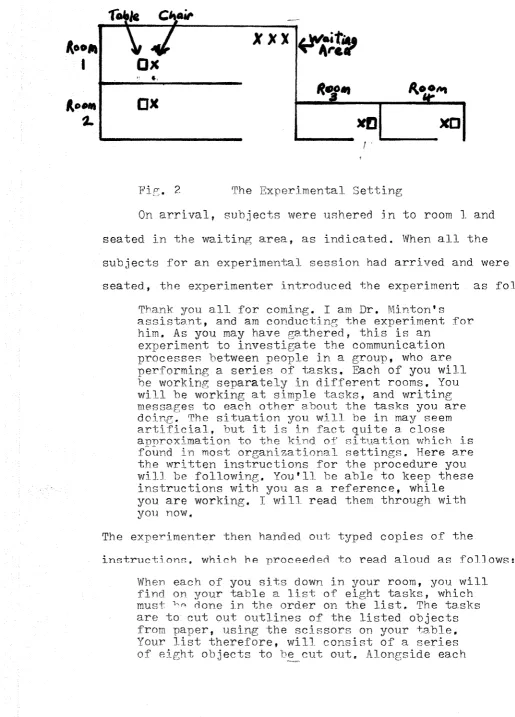
The x^hysical arrangement for the experimental sessions
consisted of a network of four interconnected small rooms,
as shown below. Each room was equipped with a table and
a chair. Each table was supplied with plain paper, pencils,
and scissors, and three small cardboard trays marked:
"IN” , "OUT* and "COMPLETED OUTLINES". The list of tasks
32
1oUe O t « *
I
fa*«I 2.
w
***
Ox
Ox
vO
XO
Fig. 2 The Experimental Setting
On arrival, subjects were ushered in to room 1 and
seated in the waiting area, as indicated. When all the
subjects for an experimental session had arrived and were
seated., the experimenter introduced the experiment as follows
Thank you all for coming. I am Dr, Minton's assistant, and am conducting the experiment for him. As you may have gathered, this is an
experiment to investigate the communication processes between people in a group, who are performing a. series of tasks. Each of you will be working separately in different rooms. You will be working at simple tasks, and writing messages to each other about the tasks you are doing. The situation you will be in may seem artificial, but it is in fact quite a close approximation to the kind of situation which is found, in most organizational settings. Here are the written instructions for the procedure you will, be following. You'll be able to keep these instructions with you as a reference, while you are working, I will read them through with you now.
The experimenter then handed out typed copies of the
instructions, which he proceeded to read aloud as follows:
33
of the objects wITT'be a. number. This number is the code number for that object, and in your written messages you can refer to objects only
by means of their code numbers. The objects are
common objects, which should be fairly simple
to cut out in outline, e.g. horse, tree, fork. You should try to make the outlines recognizable
depictions of the objects, but beyond this do
not be too concerned with their quality, There
are sixteen different tasks altogether, for the whole group to do. This means that some of the tasks on your list will be identical with those of other broup members.
The goal of the group is to finish as many different tasks as possible, in as short a time as possible. Since some of your tasks will be
identical with those of other group members, you will clearly need to communicate with one another in order to avoid duplicating outlines, and
therefore increase the efficiency of the group,
However, the only way you are allowed to communicate is by writing notes and passing them to me to
deliver. The only thing you are allowed to write in your notes are two numbers, one of these numbers being the code number for the object which you
will be cutting out presently, and the other the code number for the object which you will be cutting out next. In the upper left-hand corner of the
sheet of paper with your list of tasks, you will find a letter, which will be either W, X, or Y, This is your identification letter and you must sign all your notes with it, and address all your notes with the appropriate identification letters.
For example, if you should be given the
identification letter W and you want to write notes
to oth°T' uTOup tn0T310rh to toll ttorn 113.t ttr? cod© numbers of your next two tasks are seven and ten, you should write two serarate notes, like this;
To X._?, 10 " To Y. 7, 10
From W, From W,
There will be trays marked IN and OUT at the corners of your table, I will place all the messages which have been addressed to you in the IN tray, and you should put the messages you wish to send in the OUT tray, where I will pick them up. The
tray in the middle of your table is for completed
outlines,
311
-code numbers in a note that you receive do not correspond to any of the code numbers in your list, there can be two possible explanations: (1) the other group member is cutting out objects which are not on your list; (2) you do have one or both of these objects which are on your list, but your code numbers for these objects are not the same as the other person'a code numbers. Therefore, in order to interpret any code numbers that are sent to you, you need to have access to the key in which all of the sixteen objects and their
associated code numbers are listed. One of you, whose identification letter will be X will find that you have been given this key underneath
your list of tasks. It is purely a matter of chance
which of you receives the key, because the room
in which the key is placed is varied from experiment to experiment, The person,who has the key
will be the leader of the group. Unlike the rest of you, the leader is not limited to the kinds of messages shown above. He can write whatever he likes in his notes and therefore he can use the key in any manner that he thinks will be most efficient in preventing duplication of effort.
When you sit down in your room then, this is what you actually have to do:
Turn over the top sheet of paper. In the top left-hand corner will be your identification
letter. Below this, will be your list of eight objects to be cut out, with their code numbers alongside.
If you are the leader of the group, your identification letter will be X, and the key will
be printed on another sheet of paper underneath.
You must then decide how to use the key in order to
maximize the efficiency of the group, and send
messages to the other group members felling them
which method of working you have chosen for the group. Remember you must still complete your own list of eight tasks.
If you are not the lea.der, but are given, identification letter W or Y, you should follow this procedure:
Write notes to the other two group members, giving the code numbers of your first two objects. Then begin to cut them out. While you are doing this, you will receive messages from the other two group members. One of these messages will be from the group leader and will explain how he has decided to use the key. You should then adopt this three-step working procedure:
you, cross off your list any objects which are referred to in incoming notes,
(2) Write your notes, giving the code numbers of your next two tasks’.~'Send "separate notes~~to‘
both of the other group members, unless the leader directs otherwise, in which case follow the leader's instructions,
(3) Do your two tasks, Continue to go through this same three-step procedure, until all the
eight tasks of your list have either been done by you, or crossed off your list. Then raise your arm. to indicate that you have finished. You will then be given a brief questionnaire.
The major points in the instructions were then repeated
by the experimenter, and subjects were encouraged to ask
questions about any aspects of the instructions which might
be unclear.
When a subject indicated that he had finished the task,
his time of finishing was noted, and he was given a post-
experimental questionnaire to fill out. When all subjects
had completed this questionnaire, the purpose and methods
of the experiment were explained,and subjects were requested
not to discuss the experiment with anyone else during
the following two weeks.
The purpose of the instructions was to give the subjects
the impression that they were part of a functioning
communication network, with the experimenter acting as the
message carrier. In actuality, working from room 3* the
experimenter intercepted all messages, and substituted
H9't of -■--y*>r5 pc] reom r-fg/r0 lT,'n* r-S'---O v>*T3011"bG! rv'i3.1,"i3_Tj\)"Lcl"h^ O10
allowed t'm nlacing of all subjects in exactly the same
position (W) in the communication network. All subjects