PERFORMANCE STUDY OF VIRTUAL FENCING
USING WIRELESS SENSING NETWORK
CHAN HUI TING
PERFORMANCE STUDY OF VIRTUAL FENCING USING WIRELESS SENSING NETWORK
CHAN HUI TING
A project report submitted in partial fulfilment of the requirements for the award of the degree of
Master of Engineering (Electrical - Electronics & Telecommunications)
Faculty of Electrical Engineering Universiti Teknologi Malaysia
ACKNOWLEDGEMENT
I wish to express my sincere appreciation to my supervisor, Professor Dr. Tharek bin Abd Rahman for his guidance and advices. I am also very thankful to Research Officer WCC UTM, Arsany bin Arsad for participating in the experiments. Liao Ji Hau, a PhD student in NCU, Taiwan also deserves special thanks for his assistance in supplying the relevant information and knowledge sharing. Without their continuous support and help, this thesis would not have been the same as presented here. I am also thankful to Universiti Teknologi Malaysia (UTM) and Wireless Communication Center UTM for funding this project. Last but not least, I am grateful to all my family members and friends for their love and support.
ABSTRACT
This project report presents the experiments and performance analysis of virtual fence unit consists of microwave motion detector and IEEE 802.15.4 wireless sensor network for maximum sensing range. In particular, the analysis is focusing on the maximum sensing range of virtual fence unit in terms of azimuth angle, elevation angle, height, sensitivity level for indoor and outdoor implementation. The WSN platform is developed using Octopus II sensor nodes while the microwave motion detector is HB100 which detect movement using Doppler effect. Results show the maximum sensing range is maximum at 0º angle in both azimuth and elevation. The maximum sensing range of virtual fence unit is decreasing as azimuth angle increasing. For elevation angle, a significant increment of maximum sensing range at 45º and 60º elevation angle in downwards direction compared to 45º and 60º elevation angle in upwards direction is observed. With high sensitivity level of virtual fence unit, the maximum sensing range of virtual fence unit is larger than the maximum sensing range of virtual fence unit at normal sensitivity level. However, high sensitivity level will not further increase the maximum sensing range if the virtual fence unit has reached its maximum sensing range. Results also show virtual fence unit behaves differently in indoor and outdoor environment and the virtual fence unit has longer maximum sensing range in indoor environment than outdoor environment.
ABSTRAK
Laporan projek ini membentangkan eksperimen dan analisis prestasi unit pagar maya yang terdiri daripada pengesan pergerakan gelombang mikro dan sensor rangkaian wayarles IEEE 802.15.4 untuk mengkaji jarak pengesanan object
yang maksimum . Khususnya , analisis ini memberi tumpuan kepada jarak pengesanan object maksimum dari segi sudut azimut , sudut dongakan, ketinggian , tahap sensitiviti untuk aplikasi dalaman dan luaran. Platform wayarles dibina dengan menggunakan sensor nod Octopus II manakala pengesan pergerakan
gelombang mikro adalah HB100 yang mengesan pergerakan menggunakan kesan Doppler. Keputusan menunjukkan jarak pengesanan object yang paling maksimum
adalah pada sudut 0º untuk azimut dan dongakan. Jarak pengesanan objek maksimum unit pagar maya semakin berkurangan semasa sudut azimuth semakin meningkat. Untuk sudut dongakan, kenaikan yang ketara dalam jarak pengesanan objek maksimum dikesan pada sudut tunduk 45º dan 60º berbanding dengan sudut dongakan 45º dan 60º. Jarak pengesanan objek maksimum unit pagar maya dengan tahap sensitivity yang tinggi adalah lebih besar daripada unit pagar maya dengan tahap sensitivity di tahap sensitiviti biasa. Walau bagaimanapun, tahap sensitivity yang tinggi tidak akan meningkatkan pelbagai jarak pengesanan objek maksimum unit pagar maya jika unit pagar maya telah mencapai jarak pengesanan objek yang maksimum. Keputusan juga menunjukkan prestasi unit pagar maya berbeza dalam persekitaran dalaman dan luaran. Unit pagar maya mempunyai jarak pengesanan objek maksimum yang lebih jauh dalam persekitaran dalaman dibanding dengan persekitaran luar .
TABLE OF CONTENTS
CHAPTER TITLE PAGE
DECLARATION
ACKNOWLEDGEMENT ABSTRACT
ABSTRAK
TABLE OF CONTENTS LIST OF TABLES LIST OF FIGURES
LIST OF ABBREVIATIONS LIST OF SYMBOLS
LIST OF APPENDICES
ii iii iv v vi ix x xiii xiv xv
1 INTRODUCTION
1.1 Project Background 1.2 Problem Statement 1.3 Objectives
1.4 Scopes
1.5 Thesis Outline
2 LITERATURE REVIEW
2.1 Introduction 5
2.2 WSN 5
2.3 Theory of Doppler Effect 2.4 Concept of Virtual Fencing 2.5 Related Work
2.6 Summary
9 12 15 18
3 METHODOLOGY 19
3.1 Introduction 19
3.2 Flowchart of the Project 3.3 Octopus II
3.4 HB100
3.5 Virtual Fence Unit 3.6 Experimental Setup 3.7 Field Measurement Setup 3.7.1 Measurement Setup 3.7.2 Location of Measurement 3.7.2.1 Indoor
3.7.2.2 Outdoor 3.7.3 Virtual Fence 3.8 Programming
3.9 Summary
20 21 22 24 25 28 28 35 35 35 36 37 39
4 RESULTS AND DISCUSSIONS
4.1 Introduction
40 40
4.2 Different Azimuth Angle at Different Height 4.2.1 Introduction
4.2.2 Results and Data Analysis
4.3 Different Elevation Angle at Different Height 4.3.1 Introduction
4.3.2 Results and Data Analysis 4.4 High Sensitivity of Virtual Fence Unit
REFERENCES
Appendices A - B
4.4.1 Introduction
4.4.2 Results and Data Analysis 4.5 Environment
4.5.1 Introduction 4.5.2 Data Analysis
4.6 Summary
CONCLUSION AND FUTURE WORKS
5.1 Introduction 5.2 Conclusion 5.3 Future Works
5
47 47 53 53 53 54
55 55 55 57
LIST OF TABLES
TABLE NO. TITLE PAGE
2.1 2.2 2.3
Summary of Wireless Sensor Platform Properties of Different Types of Sensors Comparison of Infrared Sensor and Accelerometer Sensor
7 9 9
LIST OF FIGURES
FIGURE NO. TITLE PAGE
1.1 Conventional Fence 2
1.2 Virtual Fence 3
2.1 WSN 6
2.2 Radiation Pattern of PIR Sensor 8
2.3 Doppler Effect 11
2.4 Doppler shift caused by relative motion of the target 12
2.5 Concept of virtual fencing 13
2.6 Concept of sending warning to worker-on-foot 14
2.7 Concept of Virtual Fence 16
2.8 Wireless Infrared Intrusion Detection System Architecture 17
3.1 Virtual Fence System using WSN 20
3.2 Flowchart of the Project 20
3.3 Octopus II Sensor Node 21
3.4 Expansion board 22
3.5 Principle of HB100 23
3.6 HB100 23
3.7 Virtual Fence Unit 24
3.8 Flowchart of Virtual Fence Unit 25
3.9 Virtual Fence System using WSN for WCC UTM 26 3.10 Virtual Fence Setup for this project 27 3.11 Connection between virtual fence unit, sink node and 27
monitoring room
3.12 Setup to evaluate the performance of virtual fence unit 28
3.13 Measurement of height 29
3.14 Flowchart of getting maximum sensing range at different 29
azimuth angle 3.15 Virtual fence unit at 0º azimuth angle 30
3.16 Virtual fence unit at 70º azimuth angle 30
3.17 Virtual fence unit at 125º azimuth angle 31
3.18 Flowchart in getting maximum range at different elevation 32
angle in this project 3.19 Virtual fence unit at 0º elevation angle 32
3.20 Virtual fence unit at -15º elevation angle 33
3.21 Virtual fence unit at +45º elevation angle 33
3.22 Measurement of maximum sensing range 34
3.23 Indoor site for measurement 35
3.24 Outdoor site for measurement 36
3.25 Demonstration Setup 37
3.26 Diagram of virtual fence setup in this project 37
3.27 GUI of Octopus II Flash Programmer 38
4.1 Indoor performance at different azimuth angle at 30cm, 42
60cm and 90cm height 4.2 Outdoor performance at different azimuth angle at 30cm, 42
60cm and 90cm height 4.3 Radiation pattern of HB100 at azimuth angle 43
4.4 Maximum sensing range with HB100 set at different elevation 45 angle at different heights in indoor environment 4.5 Maximum sensing range with HB100 set at different elevation 45 angle at different heights in outdoor environment 4.6 Radiation pattern of HB100 at elevation angle 46
4.7 Comparison of maximum sensing range when HB100 is set at 48 30cm height with normal sensitivity level and HB100 is set at 60cm and 90cm height with high sensitivity level in indoor environment
4.8 Comparison of maximum sensing range when HB100 is set at 49 30cm height with normal sensitivity level and HB100 is set at 60cm and 90cm height with high sensitivity level in outdoor environment
4.9 Maximum sensing range at different azimuth angle for HB100 50 set at 60cm height in indoor environment
4.10 Maximum sensing range at different azimuth angle for HB100 50 set at 60cm height in outdoor environment
4.11 Maximum sensing range at different azimuth angle for HB100 51 set at 90cm height in indoor environment
4.12 Maximum sensing range at different azimuth angle for HB100 51 set at 90cm height in outdoor environment
LIST OF ABBREVIATIONS
ADC - Analog to Digital Converter
FMCW - Frequency Modulated Continuous Wave
IR - Infrared
LED - Light Emitting Diode MMS - Multimedia Messages
PIDS - Perimeter Intrusion Detection System PIR - Passive Infrared
RF - Radio frequency
RFID - Radio Frequency Identification SBC - Single Board Computer
UTM - Universiti Teknologi Malaysia WCC - Wireless Communications Center WSN - Wireless Sensor Network
LIST OF SYMBOLS
co - Velocity of light
fD - Doppler Frequency
Fd - Doppler Frequency
Fi - Incident Frequency
fo - Transmit Frequency
Fr - Reflected Frequency
v - Velocity of moving object
α - Angle between microwave beam and target’s path
LIST OF APPENDICES
APPENDIX
A B
TITLE
Source Code Datasheet
PAGE
xv
CHAPTER 1
INTRODUCTION
1.1 Project Background
A wireless sensor network (WSN) consists of sensors equipped with wireless interfaces to communicate wirelessly with each other or base station to form a network. These sensors are small, lower cost than traditional network but with limited processing and computing resources. These sensor nodes can collect useful information from the physical environment they are deployed in, process the data and transmit the sensed data to the user based on the local decision process. The sensed data can be reported to one or multiple sink nodes which can process the received data and extract useful information.
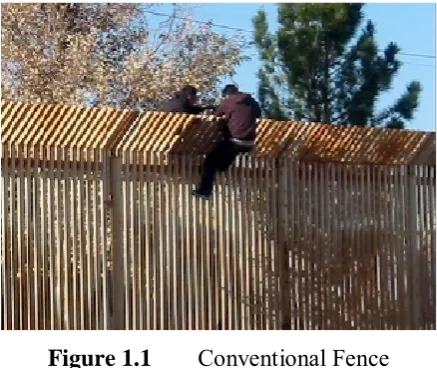
Infrastructure and site surveillance is imperative with the increasing concern on security and safety. The best way to prevent disruption to a facility is creating an interactive perimeter that able to detect the intruders and alerts on the potential threats are sent before the break in occur. Detection of people attempting to cut through or climb over fences as shown in Figure 1.1 is not available with conventional fence.
Figure 1.1 Conventional Fence
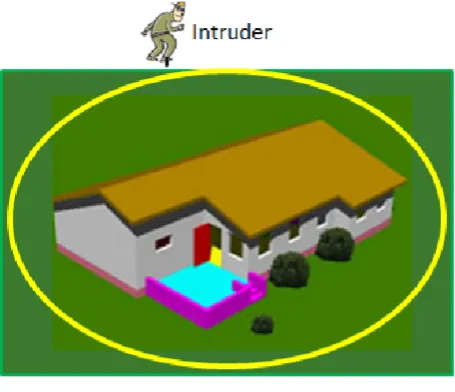
There are two main problems when a conventional fence is used to safe guard a building or a site. Conventional fence has a physical barrier to allow an intruder to hide before breaking into the building or the protected site and there is no notification when an intruder crossed the physical barrier. The problems can be overcome by virtual fencing using wireless sensor network which can detect and localize the intrusion. The virtual fence is designed to serve as an enclosure or a boundary without physical barrier. The system replaces the need for building a fence, installation of multiple cameras and hiring security guards to walk around the perimeters. It has no weather or other environmental limitations. Virtual fence is invisible and thus it is difficult to defeat. Intruders are unaware of the existence of the virtual fence but intrusion can be detected once intruder is moving through the barrier as indicated in yellow circle as shown in Figure 1.2.
Figure 1.2 Virtual Fence
1.2 Problem Statement
Virtual fence system using wireless sensor network is built from a collection of virtual fence unit. Virtual fence unit plays an important role in overall performance of virtual fence system using wireless sensor network. However, performance of virtual fence unit is different in different environment and orientations.
1.3 Objectives
This main objective of this project is study the performance of virtual fence unit of virtual fence system using wireless sensor network.
Other objectives of this project are:
• To determine the maximum sensing range of virtual fence unit in terms of azimuth angle, elevation angle, height and sensitivity for indoor and outdoor environment.
• To detect and localize the intrusion.
1.4 Scopes
In this project, WSN platform is made up with Octopus II sensor node while microwave motion sensor HB100 is used as the motion detector. Test environments of this project are ground floor of Wireless Communication Center (WCC) Universiti Teknologi Malaysia (UTM) as indoor environment and rooftop of WCC UTM as outdoor environment. The maximum sensing range of virtual fence unit is evaluated from 0⁰ to 180⁰ azimuth angle and from 0⁰ to 90⁰ elevation angle when it is set at 30cm, 60cm and 90cm height with normal and high sensitivity level of virtual fence unit in indoor and outdoor environments.
1.5 Thesis Outline
This thesis is divided into five chapters to describe the project works. Chapter 1 provides an overview of the project. Chapter 2 presents the literature review on related researches that have been done. Chapter 3 describes the methodology of this project starting from setting up the virtual fence unit until the data collection. Measurement results are shown and discussed in the Chapter 4. Chapter 5 covers the conclusion and future works of this project.
REFERENCES
1. Miguel J. Prieto , Alberto M. Pernía, Fernando Nuño, Juan Díaz and Pedro J. Villegas. Development of a Wireless Sensor Network for Individual Monitoring of Panels in a Photovoltaic Plant. Sensors .2014. 14: 2379-2396
2. Tao Yang, Dejun Mu and Wei Hu. Energy-Efficient Coverage Quality Guaranteed in Wireless Sensors Network. Applied Mathematics & Information Sciences. 2013.7(5): 1685-1691
3. Deepika.R, Gomathi.B, Karthik.J. Study of Wireless Sensor Network and Its Current Trend in Application. International Journal of Engineering Science and Innovative Technology (IJESIT). 2014. 3(1):134-137
4. Inacio Henrique Yano, Vitor Chaves de Oliveira, Eduardo Veiga de Araujo, Adriana Gama Campagnuci, Braulio Fabiano and Antonio Carlos Demanboro.
Wireless Sensor Networks For Measuring The Consumption Of Save Water Taps. American Journal of Applied Sciences . 2014. 11(6): 899-905
5. Media Aminian and Hamid Reza Naji. A Hospital Healthcare Monitoring System Using Wireless Sensor Networks. Health & Medical Informatics.
2013. 4(2)
6. Rahim Khan, Ihsan Ali, M. Asif Suryani, Mushtaq Ahmad and Muhammad Zakarya. Wireless Sensor Network Based Irrigation Management System for Container Grown Crops in Pakistan. World Applied Sciences Journal. 2013.
24( 8): 1111-1118
7. Jyoti Yadav, Sandeep Mann. Coverage in Wireless Sensor Networks: A Survey. International Journal of Electronics and Computer Science Engineering. 2(2):465-471
8. Basma M. Mohammad El-Basioni , Sherine M. Abd El-kader and Mahmoud Abdelmonim Fakhreldin. Smart Home Design using Wireless Sensor Network and Biometric Technologies . International Journal of Application or Innovation in Engineering & Management (IJAIEM). 2013. 2(3):413-429
9. Emad Felemban . Advanced Border Intrusion Detection and Surveillance Using Wireless Sensor Network Technology. Int. J. Communications,
Network and System Sciences. 2013. 6:251-259
10. M. Sheik Dawood, J. Suganya, R. Karthika Devi and G. Athisha. A Review on Wireless Sensor Network Protocol for Disaster Management. International Journal of Computer Applications Technology and Research.
2013. 2(2):141 146
11. Almir Davis and Hwa Chang . Airport Protection Using Wireless Sensor Networks. IEEE. 2012
12. Prashant Kharat , Jayashree Kharat. Wireless Intrusion Detection System Using Wireless Sensor Network: A Conceptual Framework. International
Journal of Electronics and Electrical Engineering . 2014. 2( 2) :80-84
13. Ramzi Bellazreg, Noureddine Boudriga, Khalifa Trimèche and Sunshin An. Border Surveillance : A dynamic deployment scheme for WSN-based solutions. IEEE. 2013
14. Sidhant Gupta, Dan Morris, Shwetak N Patel and Desney Tan. SoundWave: Using the Doppler Effect to Sense Gestures. Session: Sensory Interaction Modalities CHI 2012. May 5–10, 2012, Austin, Texas, USA:
ACM.2012.1911-1914
15. Huichen Tong and Dong Wang. A Novel RFID Indoor Positioning System based on Doppler Effect. Applied Mechanics and Materials. 2014. 513- 517:3292- 3295
16. Jim Baun. Physical Principles of General and Vascular Sonography.2009.
17. Ashita Vermani ,Vidhi Rana and Surabhi Govil. Virtual Fencing for Animals Management Using RF Module. Conference on Advances in Communication and Control Systems 2013 (CAC2S 2013). Atlantis Press .2013.360-362
18. Cheng Zhang, Amin Hammad, Mohammad Soltani, Shayan Setayeshgar and Ali Motamedi. Dynamic virtual fences for improving workers safety using BIM and RTLS .14th International Conference on Computing in Civil and Building Engineering. 27-29 June 2012. Moscow, Russia. 2012.
19. Indrajeet Ghorpade and B.Persis Urbana Ivy. Development of Virtual Fence (A Technology for Controlling Animals). IJCSET. 2011. 1(11): 742-744
20. Lynette M. T. and J. M. Kudargi. A review on RF based intruder detection using CW Doppler radar. IOSR Journal of Electronics and Communication Engineering (IOSR-JECE). 2013. 4(6):28-31
21. Vinay Negi, Sanjeev Kumar Shah, Sandeep Singh and Arun Shekhar. Equalization of Doppler Effect Using Constellation Diagram of 8-PSK Modulation. International Journal Of Computational Engineering Research (ijceronline.com). 2013. 3(3):203- 208
22. S.Raja and G.Ilangovan. Selection of Motion Sensor for Smart Applications: A Characteristic Analysis. International Journal of Advanced Research in Computer Engineering & Technology (IJARCET). 2013. 2(11):2882-2884
23. Walker Butler. Design Considerations for Intrusion Detection Wide Area Surveillance Radars for Perimeters and Borders. Proc.of SPIE. 2009. 7308(10)
24. Hajime Kubo, Taketoshi Mori and Tomomasa Sato. Detection and measurement of human motion and respiration with microwave Doppler sensor. The 2010 IEEE/RSJ International Conference on Intelligent Robots and Systems. October 18-22, 2010. Taipei, Taiwan: IEEE. 2010.5416-5423
25. K.Babulu, M.S.S. Bhavani and Anil Nagpal. Design and Development of Doppler Sensor Based Security System Using Advanced Microcontroller. International Journal For Advance Research In Engineering And Technology. 2013. 1(VII):66-72
26. Rubble G. N. Zade, S. S. Thakare, D. S. Chaudhari . A Modern Life detection System to Detect Human Being Trapped under Earthquake. International Journal of Engineering and Innovative Technology (IJEIT) . 2012. 1(5):279-
282
27. Absar-ul-Hasan, Ghalib A. Shah and Ather Ali. Intrusion Detection System using Wireless Sensor Networks. EJSE Special Issue: Wireless Sensor Networks and Practical Applications (2010) . 2010. 90-99
28. Gabriel Y. Keung, Bo Li, Fellow and Qian Zhang. The Intrusion Detection in Mobile Sensor Network. IEEE/ACM Transactions On Networking. 2012. 20( 4): 1152-1161
29. Jun-Horng Chen, Teng-Hui Tseng, Chin-Lun Lai and Sheng-Ta Hsieh. An Intelligent Virtual Fence Security System For The Detection Of People Invading. 2012 9th International Conference on Ubiquitous Intelligence and Computing and 9th International Conference on Autonomic and Trusted
Computing. IEEE. 2012. 786-791
30. Vladimir Skvortsov, Keun Myoung Leey and Seung Eui Yang. Inexpensive Radar- Based Surveillance: Experimental Study . IEEE. 2012
31. Robert L. Barnard . Intrusion Detection Systems. 2nd. ed. United States of
America:Butterworth-Heinemann. 1988
32. The SmartDetect Project Team. Wireless Sensor Networks For Human Intruder Detection. Journal of the Indian Institute of Science Indian journal. 2010.
90(3):347-380
33. Brian Matthew Wihl. Design Of A Low Power Cargo Security Device Using A Micropower Ultra-Wideband Impulse Radar . Master of Science in Electrical
Engineer ing. Facult y o f Ca lifornia Polytechnic State Universit y, San Luis Obispo; 2013