Abstract
REID, JR., WAYNE STANLEY. Exploring Duckweed (Lemna gibba) as a Protein Supplement for Ruminants Using the Boer Goat (Capra hircus) as a Model. (Under the direction of Matthew Poore.)
Duckweed is the common name used to refer to members of the aquatic plant family Lemnaceae. Duckweed commonly grows on stagnant, nutrient enriched waters throughout tropical and temperate zones. Growth conditions include water temperatures of 6 – 33oC and a wide pH range. Under ideal conditions, duckweed can double its biomass every sixteen hours to four days. Its nutrient uptake
capability helps to account for a CP of 15 – 40% and high growth rate. Scientists have studied duckweed’s feed attributes for fish, poultry, swine, and ruminants. A duckweed feeding trial was carried out at North Carolina State University
Metabolism Educational Unit with 19 goat wethers fed four different diets. The objective of the trial was to characterize the composition of wastewater grown duckweed and evaluate its use as a protein supplement for ruminants. Our
hypothesis was that duckweed is a suitable protein source for goats and will behave in a similar fashion to soybean meal. The diets included a negative control, positive control (all of the supplemental protein from soybean meal), 1/3 duckweed, and 2/3 duckweed (1/3 and 2/3 of the supplemental protein came from duckweed,
There was no significant difference among treatments for DMI, ADF, and NDF digestibility. Nitrogen intake, N digested (g/d), and N retained (% of digested) showed no significant differences among the supplemental protein diets. Nitrogen retained as a percent of intake and N retained (g/d) tended to be slightly lower in the diets containing duckweed. Serum urea nitrogen levels also showed no significant differences for the protein diets except for a linear response (P = 0.09). The P balance showed no significant difference for P intake but both linear and quadratic responses for P retained (g/d), and P digested (g/d) as well as a linear response for P retained (% of digested). Similarities of the rumen pH, NH4 and VFA data among the diets show that duckweed does not abnormally affect rumen function and is comparable to soybean meal in dietary function. Duckweed appears to be a viable source of protein and phosphorus (at lower dietary levels) supplementation for ruminants and is nearly comparable to soybean meal in its utilization.
EXPLORING DUCKWEED (LEMNA GIBBA) AS A PROTEIN SUPPLEMENT FOR RUMINANTS USING THE BOER GOAT (CAPRA HIRCUS) AS A MODEL
by
WAYNE STANLEY REID, JR.
A thesis submitted to the Graduate Faculty of North Carolina State University
In partial fulfillment of the Requirements for the Degree of
Master of Science
ANIMAL SCIENCE
Raleigh
2004
APPROVED BY:
____________________ ____________________
Personal Biography
Wayne Stanley Reid, Jr. was born in Gastonia, North Carolina to Wayne S.
Reid, Sr. and Johnnie B. Reid. Growing up, he spent much of his time outdoors
where he learned to appreciate the natural world. He graduated from Belmont
Abbey College in the spring of 2001 with a Bachelor of Science Degree in Biology
with minors in Biological Techniques, Chemistry, and Environmental Science. He
entered the Animal Science Department in the fall of 2001 in pursuit of a Master’s of
Science Degree. He graduated from North Carolina State University with a Master’s
Degree in the summer of 2004. He continued his education by pursuing a Doctor of
Veterinary Medicine Degree at North Carolina State University’s College of
Table of Contents
Page
List of Tables . . . . v
List of Figures . . . . . vii
1. Literature Review . . . . 1
Introduction . . . 1
Botanical Facts . . . . 2
Research . . . . 6
Wastewater Nutrient Removal . . . . 7
Animal Feed Source . . . . . 11
Fish . . . . 19
Poultry . . . . 20
Swine . . . . 22
Ruminants . . . . 23
Literature Cited . . . 27
2. Exploring Duckweed As A Protein Supplement For Ruminants Using The Meat Goat As A Model . . . . 32
Introduction . . . . 32
Materials And Methods . . . . 35
Preparation of Samples for Chemical Analysis . . 44
Laboratory Analyses . . . 45
Statistical Analyses . . . 46
Results . . . 47
Duckweed Harvests . . . 47
Drying Methods . . . 51
Experimental Duckweed Diets . . . . 52
Intake and Digestibility . . . 55
Nitrogen, Urine, Phosphorus, and Serum Data . . 58
Page
Discussion . . . 64
Duckweed Harvests . . . 64
Drying Methods . . . 66
Experimental Duckweed Diets . . . . 67
Intake and Digestibility . . . 69
Nitrogen, Urine, Phosphorus, and Serum Data . . 72 Rumen Ammonia and Volatile Fatty Acid Data . . 77
Implications . . . 79
Conclusion . . . 80
Literature Cited . . . 82
3. Appendix A: Description of setbacks faced during the
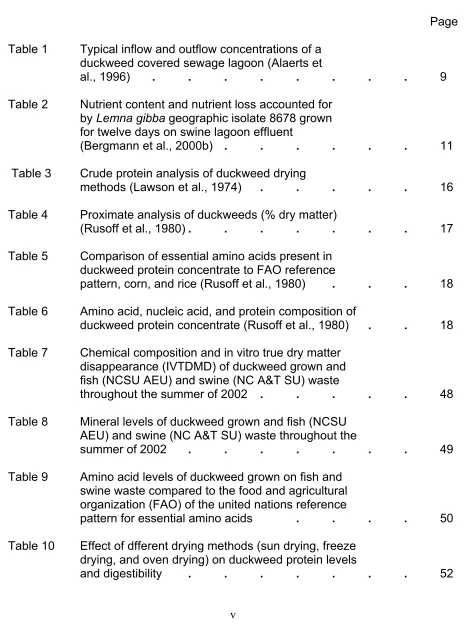
List of Tables
Page
Table 1 Typical inflow and outflow concentrations of a duckweed covered sewage lagoon (Alaerts et
al., 1996) . . . 9
Table 2 Nutrient content and nutrient loss accounted for by Lemna gibba geographic isolate 8678 grown for twelve days on swine lagoon effluent
(Bergmann et al., 2000b) . . . 11
Table 3 Crude protein analysis of duckweed drying
methods (Lawson et al., 1974) . . . 16
Table 4 Proximate analysis of duckweeds (% dry matter)
(Rusoff et al., 1980). . . 17
Table 5 Comparison of essential amino acids present in duckweed protein concentrate to FAO reference
pattern, corn, and rice (Rusoff et al., 1980) . . . 18
Table 6 Amino acid, nucleic acid, and protein composition of
duckweed protein concentrate (Rusoff et al., 1980) . . 18
Table 7 Chemical composition and in vitro true dry matter disappearance (IVTDMD) of duckweed grown and fish (NCSU AEU) and swine (NC A&T SU) waste
throughout the summer of 2002 . . . 48
Table 8 Mineral levels of duckweed grown and fish (NCSU AEU) and swine (NC A&T SU) waste throughout the
summer of 2002 . . . 49
Table 9 Amino acid levels of duckweed grown on fish and swine waste compared to the food and agricultural organization (FAO) of the united nations reference
pattern for essential amino acids . . . . 50
Table 10 Effect of dfferent drying methods (sun drying, freeze drying, and oven drying) on duckweed protein levels
Page
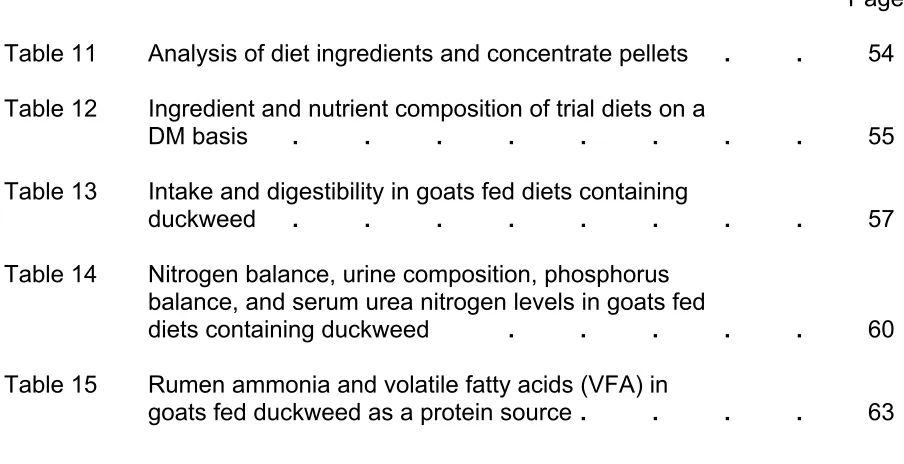
Table 11 Analysis of diet ingredients and concentrate pellets . . 54
Table 12 Ingredient and nutrient composition of trial diets on a
DM basis . . . . . . 55
Table 13 Intake and digestibility in goats fed diets containing
duckweed . . . 57
Table 14 Nitrogen balance, urine composition, phosphorus balance, and serum urea nitrogen levels in goats fed
diets containing duckweed . . . 60
Table 15 Rumen ammonia and volatile fatty acids (VFA) in
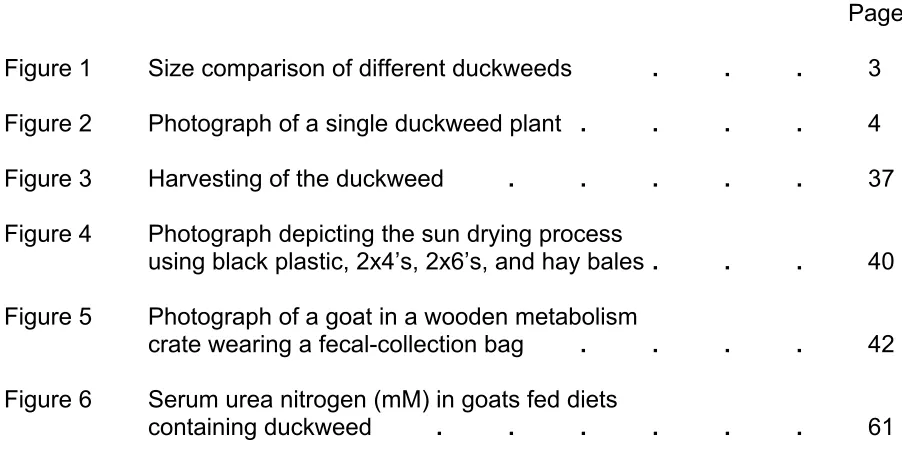
List of Figures
Page
Figure 1 Size comparison of different duckweeds . . . 3
Figure 2 Photograph of a single duckweed plant . . . . 4
Figure 3 Harvesting of the duckweed . . . 37
Figure 4 Photograph depicting the sun drying process
using black plastic, 2x4’s, 2x6’s, and hay bales . . . 40
Figure 5 Photograph of a goat in a wooden metabolism
crate wearing a fecal-collection bag . . . . 42
Figure 6 Serum urea nitrogen (mM) in goats fed diets
Literature Review
Introduction
Throughout agricultural history, people have always experimented with novel
and unconventional practices to better the production and economic aspects of their
operations. With current concerns of waste and by-product under-management and
mismanagement, the area of alternative feeds has found itself on the frontline of
improving agriculture along with the environment. Asia has long used alternative
feeds in its agricultural practices due to the poor economic status of its village
farmers. Village farmers use whatever is at hand to feed not only their animals, but
themselves as well. In many respects, the Asian countryside is far ahead of many
industrialized agricultural nations (including the United States) in its use and
management of waste and waste by-products as alternative feed. Much of the
research conducted on the feasibility of duckweed as a feed or feed supplement
originates from Asia.
One of the most interesting alternative feeds is a small, aquatic plant known
as duckweed. Duckweed is the common name used to refer to the aquatic plant
family of Lemnacea. Lemnacea cosists of five genera: Lemna, Spirodella, Landoltia,
Wolffia, and Wolffiella with over forty identified species. Distributed throughout the
temperate and tropical zones of the world, duckweed is among the smallest of the
flowering plants in the world (Skillicorn et al., 1993). Duckweed is commonly found
water. Indeed, the presence of duckweed is considered a diagnostic sign of nutrient
pollution in bodies of water.
Botanical Facts
The plant itself is the smallest of the flowering plants with species measuring
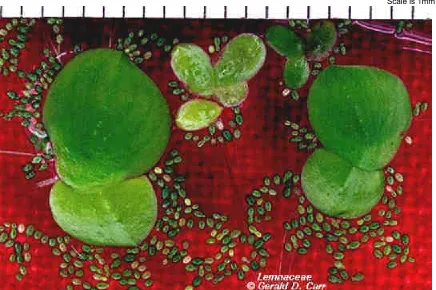
only 0.3 – 20 millimeters in length (Landolt, 1986). Figure 1 presents a size
comparison among three separate duckweeds (Spirdella, Lemna, and Wolffia). The
entire duckweed plant consists of a flat, ovoid frond. The frond has no leaf, stem, or
any other specialized structures. Many species do have roots that aid in stability as
well as improved nutrient uptake (Skillicorn et al., 1993). Figure 2 depicts a solitary
duckweed plant. The cell walls of duckweed plants lack lignin thereby increasing
their digestibility and making them an ideal feed source (Leng et al., 1995). Because
duckweed is a small, floating plant, it will not survive in water moving faster than 0.3
meters per second. Duckweed spreads among bodies of water through migrating
Figure 1. Size Comparison of Different Duckweeds.
Scale is 1mm
This photograph depicts three distinct duckweed plants. The largest duckweed shown is Spirodela. The medium size duckweed is Lemna and the smallest is
Wolffia (Photograph by Gerald Carr, University of Hawaii).
The ideal habitat for duckweed is the surface of brackish water which
contains decaying organic matter and is sheltered from the wind (Skillicorn et al.,
1993; Leng et al., 1995). Wind is considered detrimental to optimal duckweed
growth since wind blows the duckweed against the shore thereby allowing some of
the duckweed to dry out and die on land. Also, efficient nutrient uptake is best
achieved when duckweed is spread uniformly across the surface of the water.
Duckweed can grow at water temperatures between 6 – 33oC (43 – 91oF), however
also tolerant of a wide pH range, but does best between 4.5 – 7.5. Duckweed
growth is inhibited by numerous physiological stresses including a water
temperature above 35oC (95oF), a pH higher than 10, high concentrations of metals
and ammonia, a deficiency of nitrogen, overcrowding from other duckweed plants,
and competition with other plants for light and available nutrients (Skillicorn et al.,
1993; Leng et al., 1995).
Figure 2. Photograph of a single duckweed plant.
This is a photograph of a single Lemna gibba plant. Notice the two ovoid fronds and the two roots emanating from the underside of the plant (Tsatsenko and Malyuga, 2002).
Duckweed is capable of both sexual and asexual reproduction. Sexual
reproduction of duckweed involves the budding of daughter fronds (leaves) from a
meristematic region in a reproductive pouch located on a mother/mature frond
(White and Wise 1998). A single frond is capable of reproducing 20 – 50 times
during its life cycle which can span 10 days to several weeks (Skillicorn et al., 1993).
Duckweed is capable of over wintering in colder climates by producing either seeds
or turions. However, it should be noted that duckweed can survive several
consecutive days of freezing temperatures without showing any detrimental effects.
In the southern United States, duckweed is capable of growing all year long (Culley
and Epps, 1973). Duckweed seeds are designed to sink to the bottom of the water
source where they lay dormant until favorable growth conditions return. Seeds are
resistant to both freezing and desiccation. However because sexual reproduction is
rare, seeds are likewise uncommon. A more common sight is the production of
turions which are dormant vegetative buds produced by the fronds of the plant.
Turions sink to the bottom of the water and remain dormant like seeds, but unlike
seeds, they are susceptible to freezing and desiccation (Landolt 1986).
What makes duckweed such a promising feed is its spectacular growth rate.
Under ideal growth conditions of optimal nutrient availability, sunlight availability, and
water temperature duckweed is capable of doubling its biomass in 16 hours to 4
days. This reproduction rate is faster than almost any other known plant, and all
known forages. Anh and Preston (1997a) presented evidence that the optimum
found the optimum harvesting frequency to be at 2 day intervals (Anh and Preston,
1997a). Extrapolated duckweed harvests reach amounts of 183 metric tons/ha/year
of DM. However due to real world conditions (factoring in loss due to harvesting
methods, run-off, and less than ideal harvesting methods), yields are closer to 10 –
40 metric tons/ha/year of DM (Skillicorn et al., 1993; Leng et al., 1995). For
comparison, alfalfa can yield 11 metric tons/ha/year, hybrid bermudagrass yields 10
metric tons/ha/year, and endophyte-infected fescue yields 4.5 metric tons/ha/year
(Chamblee and Green 1995).
Research
Interest concerning duckweed first surfaced in the scientific community in the
late 1960’s to the early 1970’s. Initial tests showed that the protein content of
duckweed DM commonly fell between 15 – 40%. Duckweed grown on enriched
lagoons such as swine or dairy waste easily reached the 40 – 45% protein level
(Landolt, 1986). Research involving duckweed originally began on two separate
fronts: as a wastewater treatment and as a feed resource. Asian society has long
been incorporating duckweed into their daily lives as a wet feed source for poultry
and livestock, a human food source, and for wastewater treatment of both human
and animal waste. Due to duckweed’s prevalent use in Asian society, most of the
Wastewater Nutrient Removal
Duckweed has a naturally high rate of nutrient uptake due to its accelerated
growth rate. Duckweed prefers to take up nitrogen in the form of ammonium ions
(Skillicorn et al,. 1993). Ammonium uptake is critically important in wastewater
because ammonium increases eutrophication in open ponds and can result in the
formation of nitrates if released into local groundwater (Oron et al., 1988). Due to its
high nutrient uptake, duckweed is capable of tolerating the high nutrient levels
commonly found in both domestic and animal wastewater. Landolt (1986) reported
Spirodela polyrrhiza growth in the presence of 1.0 g/L nitrogen and 1.5 g/L
phosphorus. Korner et al. (1998) conducted a study on the degradation of organic
matter in duckweed covered versus non-duckweed covered (control) domestic
wastewater system. Researchers found that after a 3 day time frame, removal
efficiencies for the duckweed system were 74 – 78% while the removal efficiencies
of the control system were lagging at 52 – 60%. Duckweed was found to enhance
degradation of organic material in terms of chemical oxygen demand or COD (the
quantity of oxygen needed for both biological and non-biological oxidation of matter
in the effluent) and consequently biological oxygen demand or BOD (the quantity of
oxygen that would be consumed if all the organics of the effluent were oxidized by
bacteria and protozoa) over uncovered wastewater systems (Korner et al., 1998).
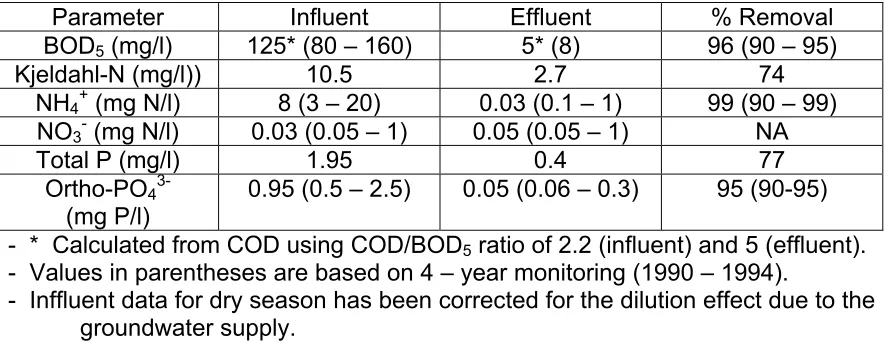
Alaerts et al. (1996) presented data on the performance analysis of a
concentration reductions of 90 – 97% for COD, and 95 – 99% for BOD over a 5 day
time period (BOD5), and 74 – 77% for Kjeldahl nitrogen and total phosphorus.
Ninety percent of the nutrient uptake occurred in the first 7.3 days of the wastewater
occupying the lagoon. Likewise, 80 – 90% of BOD load removal occurred within the
first 7.3 days giving the lagoon an equivalent loading rate of 80 – 90 kg BOD5/m2 d-1
compared to a loading rate of 48 - 60 kg BOD5/m2 d-1 for the entire lagoon. This
loading rate discrepancy suggests that the lagoon is capable of accommodating
higher loadings and that the lagoon’s design could be further optimized. Harvesting
the duckweed within the first 7.3 days of retention time proved capable of removing
60 – 80% of the N and P loads or 0.26 g N/m2 d-1 and 0.05 g P/m2 d-1. Managing the
lagoon proved to be sustainable for several years with a biomass production of 58 –
105 kg (dry weight)/ha d-1 or 715 – 1200 kg (wet weight)/ha d-1. Table 1 provides
the typical concentration reduction performance of the lagoon. Kjeldahl-N of the
wastewater was reduced by 74% (10.5 mg/l inflow to 2.7 mg/l outflow). Likewise,
total wastewater P was reduced by 77% (1.95 mg/l inflow to 0.4 mg/l outflow). A
reduction of 99% also occurred for NH4+ (8 mg/l inflow to 0.03 mg/l outflow). It
should be clarified however, that duckweed was not the single cause of these
reductions. A mass balance showed that nutrient uptake by duckweed accounted
for a 46.6% reduction in total P and a 42.5% reduction in total N (excluding NO3-).
Duckweed harvesting accounted for only 8.1% of both N and P removal. The rest of
the reduction percentages presented in Table 1 are due to percolation,
Table 1. Typical inflow and outflow concentrations of a duckweed covered sewage lagoon (Alaerts et al,. 1996).
Parameter Influent Effluent % Removal
BOD5 (mg/l) 125* (80 – 160) 5* (8) 96 (90 – 95)
Kjeldahl-N (mg/l)) 10.5 2.7 74
NH4+ (mg N/l) 8 (3 – 20) 0.03 (0.1 – 1) 99 (90 – 99)
NO3- (mg N/l) 0.03 (0.05 – 1) 0.05 (0.05 – 1) NA
Total P (mg/l) 1.95 0.4 77
Ortho-PO43- (mg P/l)
0.95 (0.5 – 2.5) 0.05 (0.06 – 0.3) 95 (90-95)
- * Calculated from COD using COD/BOD5 ratio of 2.2 (influent) and 5 (effluent). - Values in parentheses are based on 4 – year monitoring (1990 – 1994).
- Inffluent data for dry season has been corrected for the dilution effect due to the
groundwater supply.
In 2000, a project was undertaken at North Carolina State University to select
superior duckweed genotypes for the utilization of nutrients in animal wastes
(Bergmann et al., 2000a). A two-step protocol was implemented to select promising
duckweed geographic isolates from forty-one isolates obtained from the worldwide
germplasm collection. Total protein production per culture was used for selecting
the superior geographic isolates since total protein production differed 28 fold
between the extremes of the forty-one isolates. These superior isolates were then
reduced to three through a growth trial with full-strength swine lagoon effluent.
Lemna gibba 8678, Spirodela punctata 7776, and Lemna minor 8627 were selected
Subsequent studies were then conducted on the superior isolates ability for
nutrient removal from swine lagoon effluent (Bergmann et al., 2000b; Cheng et al.,
2002). It should be noted that the duckweed used in the present feed trial is
believed to originate with the Lemna gibba 8678 isolate that somehow escaped the
swine effluent trials and found its way into a neighboring fish waste pond. A Lemna
gibba variety of duckweed began growing on a fish waste pond adjacent to the
NCSU Swine Unit while the Bergmann et al. (2000b) trial was being conducted.
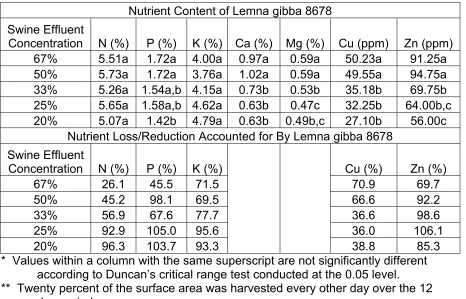
Table 2 shows the nutrient content of the Lemna gibba 8678 isolate along with the
nutrient loss accounted for by the isolate over a 12 day period. The nutrient content
of the duckweed increased with the increasing concentration levels of the swine
effluent. However, nutrient uptake did not increase but decreased with the
increasing concentrations of swine effluent. Only copper had a higher nutrient loss
at 67% effluent than at 20% effluent. The proportion of nutrient loss began to
decline at the 33% and 50% swine effluent concentration levels. Consequently,
Bergmann et al. (2000b) concluded that the 8678 isolate should be grown on a
swine effluent concentration of 50, 30, or 25% for the best effluent treatment and for
Table 2. Nutrient content* and nutrient loss accounted for by Lemna gibba
geographic isolate 8678 grown for twelve days** on swine lagoon effluent (Bergmann et al., 2000b).
Nutrient Content of Lemna gibba 8678 Swine Effluent
Concentration N (%) P (%) K (%) Ca (%) Mg (%) Cu (ppm) Zn (ppm)
67% 5.51a 1.72a 4.00a 0.97a 0.59a 50.23a 91.25a
50% 5.73a 1.72a 3.76a 1.02a 0.59a 49.55a 94.75a
33% 5.26a 1.54a,b 4.15a 0.73b 0.53b 35.18b 69.75b
25% 5.65a 1.58a,b 4.62a 0.63b 0.47c 32.25b 64.00b,c
20% 5.07a 1.42b 4.79a 0.63b 0.49b,c 27.10b 56.00c
Nutrient Loss/Reduction Accounted for By Lemna gibba 8678 Swine Effluent
Concentration N (%) P (%) K (%) Cu (%) Zn (%)
67% 26.1 45.5 71.5 70.9 69.7
50% 45.2 98.1 69.5 66.6 92.2
33% 56.9 67.6 77.7 36.6 98.6
25% 92.9 105.0 95.6 36.0 106.1
20% 96.3 103.7 93.3 38.8 85.3
* Values within a column with the same superscript are not significantly different according to Duncan’s critical range test conducted at the 0.05 level. ** Twenty percent of the surface area was harvested every other day over the 12
day period.
Animal Feed Source
Duckweed has been fed to a variety of animals including rats (Phuc et al.,
2001; Hanczakowski et al., 1995), cattle (Huque et al., 1996.; Rusoff et al., 1978),
chickens (Islam et al., 1997; Samnang, 1999), ducks (Anh and Preston, 1997b; Men
et al., 2001; Men et al., 2002), swine (Leng et al., 1995; Rodriquez and Preston
1996; Men et al., 1997; Lai, 1998; Gutierrez et al., 2001; Dung et al., 2002; Ly et al.,
1999; Fasakin et al., 2001; Bairagi et al., 2002), and humans (Rusoff et al., 1980).
Dry matter production of duckweed is high compared to that of other crops.
Edwards et al. (1992) reported a dry matter production of 20.4 t/ha/yr for Spirodella
polyrhiza while Oron et al. (1988) reported 54.8 t/ha/yr for Lemna gibba.
Duckweed is considered by many researchers to be an ideal candidate for
utilization as a feedstuff for several reasons including: can be easily harvested, high
protein content, low fiber and lignin content, high mineral absorption capability,
extended growing and harvesting periods, nontoxic to domestic stock, and
susceptible to few pests (Culley and Epps, 1973). Duckweed is considered to be
easy to harvest since it floats on the surface of the water. A simple skimming device
is sufficient to harvest duckweed from any body of water (Culley and Epps, 1973).
Although harvesting duckweed sounds simple enough, harvesting duckweed takes
either more man-power or more machinery than most articles allude to in their
materials and methods section. Duckweed grown under ideal conditions on
domestic or animal waste and harvested regularly will commonly have a crude fiber
content of 5 – 15% and a protein content of 35 – 45% (Skillicorn et al., 1993). Anh
and Preston (1996a) reported that a high level of protein (35 – 40%) in duckweed
dry matter could be consistently achieved when the concentration of nitrogen in the
water is kept between 10 – 30 mg/l. Duckweed contains low levels of fiber and lignin
since it floats on water and does not need to stand erect like terrestrial plants. The
is well documented. Duckweed possesses an extended growing and subsequent
harvesting period due to adaptation to temperate and tropical climates. The
Southeast United States provides an ideal environment for duckweed. Since the
winters are mild, duckweed often grows year round or only experiences short
periods of dormancy (Culley and Epps, 1973). Like any other food, duckweed is
only toxic/detrimental upon exceeding specific dietary levels. However, it should be
noted that duckweed toxicity is still much in debate. Many researchers allude to the
non-toxic effects of duckweed after only a short feed trial with little refusal or orts.
Researchers are currently investigating the dietary limits at which duckweed can be
added to domestic animal feed. Duckweed has an apparent immunity to most pests
associated with other forages (Culley and Epps, 1973). Spirodella, Lemna, and
Wolffia have only a few serious pests. Therefore unlike traditional agricultural crops,
the cost for pest management of duckweed stands would be negligible (Culley and
Epps, 1973).
Since duckweed grows and floats on water, water constitutes a major part of
the plants composition. Culley and Epps (1973) and Skillicorn et al. (1993)
considered the high water content of duckweed to be the main deterrent against its
use as a mainstream feed. Duckweed stands regularly contain 92 – 95% water
(Rusoff, 1980). Culley and Epps reported duckweed samples ranging from 90 –
97% water (1973). Duckweed can be fed fresh, straight off the pond or lagoon, or it
feeding both raw and dried duckweed, but most research in the United States deals
with feeding only dried duckweed. This difference in not drying and drying
duckweed is partly due to the cultural differences between agriculture in Asian
countries and the United States. Much of the duckweed research in Asian countries
is geared toward the small village farmer. The village farmer either has access to a
private water source or in many cases a community water source. With duckweed
growing on the water source, the Asian farmer has adapted his animals to eat the
duckweed wet (harvested straight off the water source) and subsequently saves the
farmer the time and expense of drying. The farmer also only harvests enough
duckweed to feed his animals for the day. He has no need in drying and stockpiling
duckweed to feed his animals later. This feeding technique is in stark contrast to
farming in the United States where the majority of the feed is fed dried and harvests
are as large as possible in order to accommodate stockpiling and selling of any
un-needed feed.
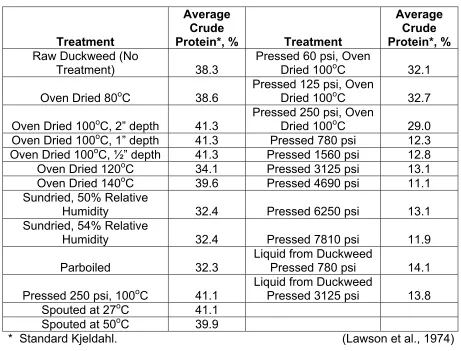
Lawson et al. (1974) conducted research on different procedures one could
use to dry duckweed (Spirodela oligorrhiza) including: sun drying, oven drying,
pressing, parboiling, and spout bed drying (forced air drying). Lawson’s findings on
how drying affects the crude protein level of duckweed are presented in Table 3.
The raw duckweed with no drying treatment contained 38.3% CP. Oven drying the
duckweed at different depths of ½, 1, and 2 inches had no result on the crude
duckweed sometimes had a higher CP than the raw duckweed. Although depth did
not influence CP, the temperature of the oven did impact the CP of the duckweed. If
duckweed is dried in an oven, it is recommended that the temperature not exceed
100oC. Duckweed dried at 120oC and above exhibits a definite burned appearance
upon exiting the oven. However, Lawson et al. (1974) conclude that due to the high
moisture content of duckweed, it would be cost prohibitive for farmers to oven dry
duckweed in large quantities. Using a mechanical press under very high pressure to
squeeze water out of the plant is detrimental due to the loss of nitrogen. The
spouted bed drying method failed to be productive when using wet duckweed.
Although slower, sun drying is the most economical method of drying duckweed,
especially if time is not a major concern (Lawson et al., 1974). However, the sun
dried duckweed contained a lower CP (32.4%) than oven drying at 100oC (41.3%) or
raw duckweed (38.3%). Upon losing its water content, duckweed presents another
problem by becoming extremely lightweight thereby making stability and
containment on a windy day a major concern (Culley and Epps, 1973, Lawson et al.,
1974). Solar drying duckweed methods should include some form of wind barrier to
Table 3. Crude protein analysis of duckweed drying methods.
Treatment
Average Crude
Protein*, % Treatment
Average Crude Protein*, %
Raw Duckweed (No
Treatment) 38.3
Pressed 60 psi, Oven
Dried 100oC 32.1
Oven Dried 80oC 38.6 Pressed 125 psi, Oven Dried 100oC 32.7
Oven Dried 100oC, 2” depth 41.3 Pressed 250 psi, Oven Dried 100oC 29.0
Oven Dried 100oC, 1” depth 41.3 Pressed 780 psi 12.3
Oven Dried 100oC, ½” depth 41.3 Pressed 1560 psi 12.8
Oven Dried 120oC 34.1 Pressed 3125 psi 13.1
Oven Dried 140oC 39.6 Pressed 4690 psi 11.1
Sundried, 50% Relative
Humidity 32.4 Pressed 6250 psi 13.1
Sundried, 54% Relative
Humidity 32.4 Pressed 7810 psi 11.9
Parboiled 32.3
Liquid from Duckweed
Pressed 780 psi 14.1
Pressed 250 psi, 100oC 41.1
Liquid from Duckweed
Pressed 3125 psi 13.8
Spouted at 27oC 41.1
Spouted at 50oC 39.9
* Standard Kjeldahl. (Lawson et al., 1974)
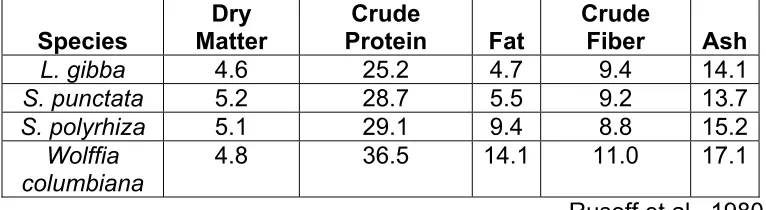
In 1980, Rusoff et al. reported the protein and amino acid composition of four
species of duckweed (Lemna gibba, Spirodela polyrhiza, Spirodela punctata and
Wolffia columbiana) grown on an anaerobic dairy waste lagoon. Table 4 presents
the compositional analysis of the four duckweed species. The table shows clearly
that freshly harvested duckweed is commonly 94 – 96% water. The crude protein of
duckweed is relatively high with a low of 25.2% for Lemna gibba and a high of 36.5
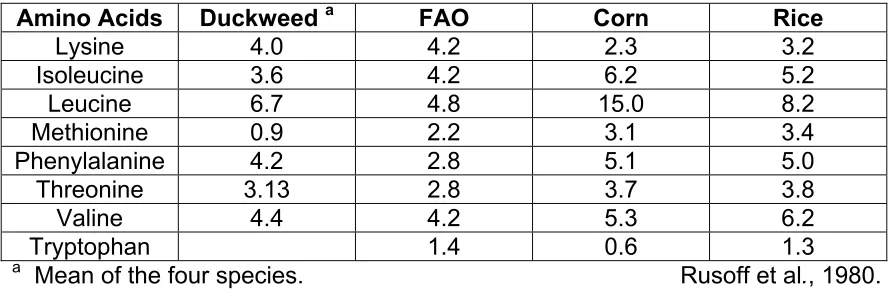
duckweeds (mean of the 4 species) compared to the content of the FAO reference
pattern, corn, and rice. The mean of the 4 duckweeds does not meet the FAO
reference for Lysine, Isoleucine, or Methionine but does meet the standard for
Leucine, Phenylalanine, Threonine, and Valine. The duckweed mean also shows
similarity to amino acid profile of both rice and corn. The absence of the amino acid
cysteine does not preclude the presence of the amino acid in the plant’s
concentrate, but does indicate that cysteine levels were below the detection limits (>
0.05 g/100 g of protein). Table 6 gives the amino acid profile, nucleic acid, and
protein content of the different duckweed species. The data indicates that with the
exception of methionine, the levels of essential amino acids present in wastewater
grown duckweed meets the recommendation set forth in the FAO reference pattern.
It is also evident that duckweed is a good source of the amino acid lysine, which is
only present in low amounts in grains (Rusoff et al., 1980).
Table 4. Compositional analysis of duckweeds (% Dry Matter)
Species
Dry Matter
Crude
Protein Fat
Crude
Fiber Ash
L. gibba 4.6 25.2 4.7 9.4 14.1
S. punctata 5.2 28.7 5.5 9.2 13.7
S. polyrhiza 5.1 29.1 9.4 8.8 15.2
Wolffia columbiana
4.8 36.5 14.1 11.0 17.1
Table 5. Comparison of essential amino acids present in duckweed protein concentrate to FAO reference pattern, corn, and rice (g/100 g of Protein).
Amino Acids Duckweed a FAO Corn Rice
Lysine 4.0 4.2 2.3 3.2
Isoleucine 3.6 4.2 6.2 5.2
Leucine 6.7 4.8 15.0 8.2
Methionine 0.9 2.2 3.1 3.4
Phenylalanine 4.2 2.8 5.1 5.0
Threonine 3.13 2.8 3.7 3.8
Valine 4.4 4.2 5.3 6.2
Tryptophan 1.4 0.6 1.3
a Mean of the four species. Rusoff et al., 1980.
Table 6. Amino acid, nucleic acid, and protein composition of duckweed protein concentrate
L. gibba S. polyrhiza S. punctata Wolffia Columbiana Mean
g/100 g of Protein
Aspartic 7.12 7.55 7.38 5.63 6.92 ± 0.88 a
Threonine 3.20 3.45 3.31 2.55 3.12 ± 0.40
Serine 2.61 2.80 2.83 2.28 2.63 ± 0.25
Glutamic 7.60 8.00 7.69 5.76 7.26 ± 1.01
Proline 2.93 3.28 2.95 2.41 2.89 ± 0.36
Glycine 3.79 3.95 3.93 2.04 3.68 ± 0.43
Alanine 4.59 4.48 4.79 3.75 4.40 ± 0.45
Valine 4.96 4.40 4.71 3.49 4.39 ± 0.64
Methionine 0.83 0.83 1.07 0.87 0.90 ± 0.15
Isoleucine 3.87 3.75 3.76 3.06 3.61 ± 0.37
Leucine 7.15 6.85 6.88 5.83 6.68 ± 0.58
Tyrosine 2.91 3.05 3.14 2.17 2.82 ± 0.44
Phenylalanine 4.45 4.20 4.38 3.60 4.16 ± 0.39
Histadine 1.89 2.15 1.90 1.18 1.78 ± 0.42
Lysine 4.13 4.30 4.26 3.37 4.01 ± 0.43
Arginine 4.29 5.25 4.86 3.78 4.54 ± 0.64
True Protein b 66.32 68.29 67.80 52.77 63.80 ± 7.40
g/100 g of Dry Matter
Nucleic Acid 6.0 6.2 6.3 6.4 6.25
Crude Protein (N x 6.25)
37.5 40.0 42.0 44.7 41.05
Fish
Duckweed has long been used as a feed source on Asian fish farms, but
recent research is intensifying its use as a protein supplement. Porath and Koton
reported that the weight of grass carp could be tripled from 100 g to 300 g in a span
of only 50 days by feeding a mixture of Lemna gibba and Lemna minor (1977).
Fasakin et al. used duckweed to supplement the diets of Nile tilapia fingerlings
(2001). The results of the study showed that duckweed could be used to replace
fish meal protein up to 10% of the diet without adversely affecting growth patterns.
Due to the decreased growth rates of the fingerlings, Fasakin concluded that the
complete replacement of fish meal protein by duckweed should be avoided in tilapia
diets (2001). This conclusion agrees with previous work conducted by El-Sayed
(1992), Almazan et al. (1986), Fasakin et al. (1999b), and Bairagi et al. (2002). In
1999, Fasakin et al. presented data to support the use of duckweed in tilapia diets,
but not as the sole source of protein. They found the most cost effective (cost/unit
weight gain in fish) diet to be one with 30% duckweed inclusion. Utilization of up to
30% duckweed to replace commercial fish meal was found to be cost effective for
supporting both growth and profitability (Fasakin et al., 1999b).
Research conducted by Bairagi et al. (2002) compared fermented duckweed
meal with raw duckweed meal as replacements for fish meal protein supplements
fed to rohu fingerlings. A bacterial strain isolated from a common carp intestine was
were found to be superior to raw duckweed diets in both growth and feed utilization
efficiencies. Protein digestibility was shown to decrease with increasing levels of
duckweed regardless of type (raw or fermented). Data shows that a diet including
30% fermented duckweed resulted in the best food conversion ratio and protein
efficiency ratio. The 30% fermented duckweed diet yielded the rohu fingerlings with
the highest carcass protein and lipid deposition. The conclusion is that fermented
duckweed can be incorporated in diets up to 30% with no adverse effects while raw
duckweed can only be incorporated up to 10% of the diet without showing adverse
effects (Bairagi et al., 2002).
Poultry
Duckweed has been researched as a protein supplement for both chickens
and ducks. Anh and Preston presented evidence in 1997 that duckweed has an
equivalent biological value to that of soybean meal but duckweed protein is slightly
less utilized by growing ducks than soybean protein. The lower protein utilization is
probably caused by duckweed’s higher fiber content, 10% for duckweed DM while
only 5% for soybean DM. Anh and Preston (1997b) concluded that duckweed can
totally replace soybean meal in a growing ducks diet, and can be used as the sole
source of dietary protein for growing ducks. In 1999, Samnang showed that the
growth rate of chickens along with the producer’s profit margin can be increased by
Men et al. (2001) completely replaced commercial protein supplements used
in diets for meat ducks with duckweed. No significant differences in carcass yield,
chest and thigh muscle weight, and internal organ weights were found between birds
on the control diet and birds on the duckweed diet. Researchers did note a poorer
feed conversion rate for the duckweed diet compared with the traditionally used
soybean commercial diet. Nevertheless, fresh duckweed can completely replace
commercial protein supplements used for ducks with no reduction in growth
performance or carcass traits. However if the duckweed is locally grown, managed,
and harvested by the farm manager/owner, the savings over commercial protein
supplements can reach as high as 48% (Men et al., 2001).
In 2002, Men et al. conducted a follow-up study to their 2001 research using
local and exotic breeding ducks. The conclusion reached by the researchers was
that duckweed could replace commercial protein supplements used in the diets of
laying ducks without adversely affecting their reproductive performance. In spite of
this conclusion, a reduction in the hatchability for diets where duckweed composed
the major source of protein was apparent. Nevertheless when the economics of
locally producing, managing, and harvesting the duckweed was factored into the
equation, researchers recommended using duckweed to replace some of the
commercial protein supplements but not all of the supplements. The lower hatching
rate associated with the total duckweed protein diet outweighs the benefit from
of producing, managing, and harvesting duckweed on the farm reached up to 36%
over purchasing commercial supplements (Men et al., 2002).
Swine
Duckweed fed to pigs has been found to reduce back-fat deposition, improve
reproductive performance, and decrease economic costs. Duckweed used to
replace protein supplements for fattening pigs showed no reduction in growth rate
and produced a leaner carcass with less deposition of back-fat (Van et al., 1996).
Research conducted by Men et al. (1997) showed that replacing 50% of
conventional protein sources such as fish meal and soybean meal with fresh/raw
duckweed resulted in a larger litter size, higher litter survival rates, and heavier litter
weights. Men et al. (1997) showed that by replacing half of conventional protein
sources with duckweed, farmers are able to improve the reproductive performance
of their sows. Gutierrez et al. presented data in 2001 that showed a 10% duckweed
diet being fed without any negative effects on productive performance. It was noted
by Gutierrez et al. (2001) that although pigs fed duckweed consumed more feed and
grew faster, the duckweed diet was not digested as efficiently as the
sorghum/soybean meal control diet. However, this discrepancy could be due to the
experimental 10% duckweed diet containing 2.3% more fiber thereby altering its
Ruminants
Little research has been conducted on the use of duckweed as a feed source
for ruminants. This lack of research is due to a variety of reasons including the
difficulty of harvesting sufficient amounts of duckweed for a valid feed trial. However
as the interest in duckweed continues to grow, more ruminant research is starting to
be conducted.
Huque et al. (1996) reported on the feed potential of Spirodela, Lemna, and
Wolffia for cattle. Three rumen cannulated bulls (317.0 kg average LW) had an
average duckweed consumption of 10% of their live weight (LW). Both the dry
matter and crude protein of the three duckweed types were shown to be highly
degradable (Spirodela 71% and 80%, Lemna 71% and 86%, and Wolffia 91% and
93% respectively) in the rumen over a 72 hour period. As would be expected,
degradibilities decreased with reduced time in the rumen (At 48 hours: Spirodella
61% and 72%, Lemna 61% and 79%, and Wolffia 88% and 91%; at 24 hours:
Spirodella 41% and 53%, Lemna 57% and 74%, and Wolffia 73% and 78% for DM
and CP respectively). Huque et al. (1996) concluded that duckweed incorporated as
a component of a concentrate mixture can be fed to cattle without negative results.
Huque bases his conclusion on the results of a 7-day feed trial using 3 rumen
cannulated bulls and the previously discussed 72-hour in situ study. Khan et al.
(2002) used a similar in situ study along with an in vitro gas production study to
warrants consideration of their use to supplement poor quality or deficient diets.
Both studies also agree that more research on animal, specifically ruminant,
response to incorporation of duckweed into the diet is needed.
O’Bryan et al. (1998) carried out a feed trial using Holstein steers in order to
examine their nitrogen and phosphorus utilization when fed duckweed. The
duckweed was grown in artificial wetland cells which were supplied with wastewater
from an adjacent dairy farm. The duckweed diet was formulated to be both
isonitrogenous and isophosphoric with the control diet. The researchers discovered
that the percentage of phosphorus digested (P<.05), the absolute retention in g/d
(P<.01) and the percentage of phosphorus retained (P<.05) were greater for the
calves on the duckweed diet than for the control diet calves (O’Bryan et al., 1998).
The duckweed diet yielded means of 63.89% phosphorus digested, 9.03 g/d
absolute retention, and 55.41% phosphorus retained while the control diet produced
means of 56.77% phosphorus digested, 7.41 g/d absolute retention, and 46.58%
phosphorus retained. Nitrogen was reported to be used with equal efficiency for all
variables measured in both diets. O’Bryan et al. (1998) concluded that the nitrogen
and phosphorus in duckweed was able to be used with the same degree of
efficiency as the nitrogen and phosphorus from other conventional feeds.
Damry et al. (2001) noticed that after a short adjustment phase, Merino sheep
researchers to deduce that the beneficial properties of duckweed outweighed any
detrimental effects. Damry et al. (2001) reported that duckweed was more effective
than urea and as effective as cottonseed meal as a protein source for wool growth.
However, protein degradation data did not support the findings of Huque et al.
reporting that duckweed was highly degradable. Damry’s data showed rumen
ammonia concentrations for duckweed similar to that of cottonseed meal which is
considered a good source of ‘escape’ protein for ruminants. A plausible explanation
is that the duckweed used by Damry had a higher resistance to ruminal microbial
degradation compared to the duckweed used by Huque et al. The difference could
simply be due to the varying ruminal conditions between the sheep and cattle and/or
the actual residence time the duckweed spent in the rumen. It is also possible that
the composition of the duckweed itself varied depending on the water source it was
grown on and how the duckweed was dried before feeding (Damry et al. 2001).
Huque et al. (1996) report that the duckweed used was grown on domestic
wastewater and sun dried. Damry et al. (2001) report that the duckweed was sun
dried but give no indication of how the duckweed was grown. Although both studies
report sun drying the duckweed, variation in the temperature, weather conditions,
and apparatus used could also affect the composition of the final dried duckweed.
Undoubtedly more research is recommended which brings us to the present study of
In summary, duckweed holds great promise as an alternative feed
supplement. One of the smallest plants known to man could help us produce
cleaner water while at the same time providing a high quality feed for domestic stock
animals (poultry, swine, and cattle). The nutrient uptake ability possessed by
duckweed along with its fast reproductive rate and environmental requirements
make it easy to manage. The problem with duckweed is in the harvesting of the
small plants and removing the excess water. Assuming that can be done efficiently,
we will be well on our way to making new strides in the supplemental feeding of
Literature Cited
Alaerts, G. J., R. Mahbubar, and P. Kelderman. 1996. Performance analysis of a full-scale duckweed-covered sewage lagoon. Wat. Res. 30(4):843-852.
Almazan, G. J., R. S. V. Pullin, A. F. Angels, T. A. Manalo, R. A. Agbayani, and M. T. B. Trono. 1986. Azolla pinnata as dietary components for Nile tilapia,
Oreochromis niloticus. Pages 523-528 in J. L. Maclean, L. B. Dizon, and L. V. Hosilos, eds. The First Asian Fisheries Forum. Asian Fisheries Society.
Manila, Philippines.
Anh, N. D., and T. R. Preston. 1997a. Effect of management practices and fertilization with biodigester effluent on biomass yield and composition of duckweed. Livest. Res. Rural Develop. 9(1). Available: http://www.cipav .org.co/lrrd/lrrd9/1/anh91.htm. Accessed July 1, 2003.
Anh, N. D., and T. R. Preston. 1997b. Evaluation of protein quality in duckweed (Lemna spp.) using a duckling growth assay. Livest. Res. Rural Develop. 9(2). Available: http://www.cipav.org.co/lrrd/lrrd9/2/anh92.htm. Accessed
July 1, 2003.
Bairagi, A., K. S. Ghosh, S. K. Sen, and A. K. Ray. 2002. Duckweed (Lemna polyrhiza) leaf meal as a source of feedstuff in formulated diets for rohu
(Labeo rohita Ham.) fingerlings after fermentation with a fish intestinal bacterium. Biores. Technol. 85:17-24.
Bergmann, B. A., J. Cheng, J. Classen, and A.-M. Stomp. 2000a. In vitro selection of duckweed geographical isolates for potential use in swine lagoon effluent renovation. Biores. Technol. 73:13-20.
Bergmann, B. A., J. Cheng, J. Classen, and A.-M. Stomp. 2000b. Nutrient removal from swine lagoon effluent by duckweed. Trans. Am. Soc. Agric. Eng. 43(2):263-269.
Chamblee, D. S. and J. T. Green, eds. 1995. Production and utilization of pastures and forages in North Carolina. Tech. Bull. No. 305. North Carolina Research Service, North Carolina State University.
Culley, D. D. and E. A. Epps. 1973. Use of duckweed for waste treatment and animal feed. J. Wat. Poll. Cont. Fed. 45(2):337-347.
Damry, H., J. V. Nolan, R. E. Bell, and E. S. Thomson. 2001. Duckweed as a protein source for fine-wool Merino sheep: its edibility and effects on wool yield and characteristics. Asian-Aust. J. Anim. Sci. 14(4):507-514.
Dung, N. N. X., L. H. Manh, and P. Uden. 2002. Tropical fibre sources for pigs – digestibility, digesta retention and estimation of fibre digestibility in vitro. Anim. Feed Sci. Technol. 102:109-124.
Edwards, P., M. S. Hassan, C. H. Chao, and Pachara-Prakiti. 1992. Cultivation of duckweeds in septage-loaded earthen ponds. Biores. Technol. 40:109-117.
El-Sayed, A. F. M. 1992. Effects of substituting fish meal with Azolla pinnata in practical diets for fingerlings and adult Nile tilapia, Oreochromis niloticus L. Aquacul. Fisheries Manag. 23:167-173.
Fasakin, E. A., A. M. Balogun, and B. E. Fasuru. 1999. Use of duckweed, Spirodela polyrrhiza L. Schleiden, as a protein feedstuff in practical diets for tilapia,
Oreochromis niloticus L. Aquacul. Res. 30:313-318.
Fasakin, E. A., A. M. Balogun, and O. A. Fagbenro. 2001. Evaluation of sun-dried water fern, Azolla aficana, and duckweed, Spirodella polyrrhiza, in practical
diets for nile tilapia, Oreochromis niloticus, fingerlings. J. App. Aquacul. 11(4):83-92.
Gutierrez, K., L. Sangines, F. Perez, and L. Marinez. 2001. Studies on the potential of the aquatic plant Lemna gibba for pig feeding. Cuban J. Agr. Sci.
35(4):343-348.
Hanczakowski, P., B. Szymczyk, and M. Wawrzynski. 1995. Composition and nutritive value of sewage-grown duckweed (Lemna minor L.) for rats. Anim. Feed Sci. Technol. 52:339-343.
Huque, K. S., S. A. Chowdhury, and S. S. Kibria. 1996. Study of the potentiality of duckweeds as a feed for cattle. Asian-Aust. J. Anim. Sci. 9(2):133-137.
Khan, M. J., H. Steingass, and W. Drochner. 2002. Evaluation of some aquatic plants from Bangladesh through mineral composition, in vitro gas production and in situ degradation measurements. Asian-Aust. J. Anim. Sci. 542.
Korner, S., G. B. Lyatuu, and J. E. Vermaat. 1998. The influence of Lemna gibba L. on the degradation of organic material in duckweed-covered domestic
wastewater. Wat. Res. 32(10):3092-3098.
Lai, N. V. 1998. On-farm comparison of Mong Cai and Large White pigs fed ensiled cassava root, rice bran and duckweed. Livestock Research for Rural
Development. 10(3).
Landolt. E. 1986. Biosystematic investigations in the family of duckweeds
(Lemnaceae) (vol. 2). The family of Lemnaceae – a monographic study. Vol. 1 of the monograph: Morphology; Karyology; Ecology; Geographic
Distribution; Systematic Position; Nomenclature; Descriptions. Zurich, Switzerland; Veroffentlichungen des Geobotanischen Institutes der ETH.
Lawson, T. B., H. J. Braud, and F. T. Wratten. 1974. Methods of drying duckweed,
Lemnaceae. Paper presented at the Winter Meeting of the American Society of Agricultural Engineers Winter Meeting. Chigago, Ill. December 10 – 13.
Leng, R. A., J. H. Stambolie, and R. Bell. 1995. Duckweed – a potential high-protein feed resource for domestic animals and fish. Livest. Res. Rural Develop. 7(1). Available: http://www.cipav.org.co/lrrd/lrrd7/1/3.htm. Accessed July 1, 2003.
Ly, J., P. Samkol, and T. R. Preston. 2002. Nutritional evaluation of aquatic plants for pigs; pepsin/pancreatin digestibility of six plant species. Livest. Res. Rural Develop. 14(1). Available: http://www.cipav.org.co/lrrd/lrrd14/1/ly141a .htm. Accessed July 1, 2003.
Men, B.X., B. Ogle, and J. E. Lindberg. 2001. Use of duckweed as a protein supplement for growing ducks. Anim. Sci. 14(12):1741-1746.
Men, B.X., B. Ogle, and J. E. Lindberg. 2002. Use of duckweed as a protein supplement for breeding ducks. Asian-Aust. J. Anim. Sci. 15(6):886-871.
O’Bryan, S., T. F. Brown, and R. D. Wittie. 1998. Utilization of phosphorus by Holstein steers fed duckweed (Lemna minor) grown on diary wastewater. J. Dairy Sci. 81(Suppl. 1):327. (Abstr.)
Oron, G., A. de-Vegt, and D. Porath. 1988. Nitrogen removal and conversion by duckweed grown on wastewater. Wat. Res. 22(2):179-184.
Phuc, B. H. N., J. E. Lindberg, B. Ogle, and S. Thomke. 2001. Determination of the nutritive value of tropical biomass products as dietary ingredients for
monogastrics using rats: 1. comparison of eight forage species at two levels of inclusion in relation to a casein diet. Asian-Aust. J. Anim. Sci. 993.
Porath, D., and A. Koton. 1977. Enhancement of protein production in fish ponds with duckweed (Lemnaceae). Isr. J. Bot. 26:51.
Rodriquez, L. and T. R. Preston. 1996. Comparative parameters of digestion and N metabolism in Mong Cai and Mong Cai Large White cross piglets having free access to sugar cane juice and duckweed. Livest. Res. Rural Develop. 8(1). Available: http://www.cipav.org.co/lrrd/lrrd8/1/lylian.htm. Accessed July 1, 2003.
Rusoff, L. L., S. P. Zeringue, A. S. Achacoso, and D. D. Culley. 1978. Feeding value of duckweeds for ruminants. Paper presented at the annual meeting of the American Dairy Science Association, Michigan State University, East Lansing, Mich. July 9 – 13.
Rusoff, L. L., E. W. Blakeney, Jr., and D. D. Culley, Jr. 1980. Duckweeds
(Lemnaceae family): a potential source of protein and amino acids. J. Agric. Food Chem. 28:848-850.
Samnung, H. 1999. Duckweed versus ground soya beans as supplement for scavenging native chickens in an integrated farming system. Livest. Res. Rural Develop. 11(1). Available: http://www.cipav.org.co/lrrd/lrrd11/1 /sam111.htm. Accessed July 1, 2003.
Skillicorn P., W. Spira, and W. Journey. 1993. Duckweed aquaculture – a new aquatic farming system for developing countries. The World Bank. Washington, D.C. 76pp.
Van, B. H., L. T. Men, V. V. Son, and T. R. Preston. 1996. Duckweed (Lemna spp.) as protein supplement in an ensiled cassava root diet for fattening pigs. Livest. Res. Rural Develop. 9(1). Available: http://www.cipav.org.co/lrrd/lrrd9 /1/lemen912.htm. Accessed July 1, 2003.
White, S. L., and R. R. Wise. 1998. Anatomy and ultrastructure of Wolffia
EXPLORING DUCKWEED AS A PROTEIN
SUPPLEMENT FOR RUMINANTS USING THE
MEAT GOAT AS A MODEL
Introduction
Mismanagement of industrial by-products is a concern to the world
population. The agricultural industry of the United States has come under harsh
criticism from many different fronts such as Robert F. Kennedy’s legal attack of the
conventional swine production industry (Phipps 2001). Much of the criticism centers
on the use or rather the misuse of animal waste nutrients. Animal waste nutrients
are an unavoidable byproduct of any animal operation, large or small. The
cornerstone of the animal waste argument is how the waste is treated once it is
produced. Misuse of animal waste has led scientists to investigate aquatic plants as
a treatment solution. Some of these aquatic plants have presented themselves as a
possible feed source for the animals producing the waste.
One of the most intriguing aquatic plants being investigated for both
wastewater treatment and as an animal feed source is the plant family of Lemacea,
commonly known as duckweed. The plant itself is small, measuring only 0.3 – 20
mm in size and floats on top of the water’s surface (Landolt, 1986; Skillicorn et al.,
1993). Duckweed can be found growing in almost any temperate or tropical climate
conditions (Skillicorn et al., 1993). The accelerated growth rate combined with the
plant’s nutrient uptake capability give duckweed amazing potential for wastewater
treatment (Skillicorn et al., 1993). The nutrient uptake capability of this small plant
also gives it the necessary composition to be used as a dietary supplemental feed
source for a number of animals including poultry, swine, and cows (Rusoff et al.,
1978; Skillicorn et al., 1993; Leng et al., 1995; Huque et al., 1996; Anh and Preston,
1997b). Research involving duckweed originally began on two separate fronts: as a
wastewater treatment and as a feed resource. Duckweed has a high capacity for
concentrating protein, phosphorus, and other minerals. According to Culley and
Epps (1973), duckweed is an ideal candidate for utilization as a feedstuff for several
reasons including; it can be easily harvested, it has a high protein content, it has a
low fiber and lignin content, it displays high mineral absorption capability, it has
extended growing and harvesting periods, it is nontoxic to domestic stock, and it is
susceptible to few pests.
Duckweed grown under ideal conditions on domestic or animal waste and
harvested regularly will commonly have a crude fiber content of 5 – 15% and a
protein content of 35 – 45% (Skillicorn et al., 1993). Lawson et al. (1974) showed
that the particular method implemented to dry the harvested duckweed could play an
instrumental role in its compositional make-up. Lawson concluded that sun drying
duckweed was the best economical choice since it was inexpensive to implement
grass carp could be tripled from 100 g to 300 g in a span of only 50 days by feeding
a mixture of Lemna gibba and Lemna minor. Anh and Preston presented evidence in
1997 that duckweed protein fed to ducks has an equivalent biological value to that of
soybean meal protein but is slightly less utilized (based on live weight gain over the
trial period) than soybean protein. In other words duckweed has a similar
compositional profile to that of soybean meal, but the nutrients in duckweed are
used at a lesser degree. Ahn and Preston surmised that the decreased utilization of
duckweed protein was likely due to a lower digestibility (1997). Men et al. (2001)
completely replaced commercial protein supplements used in diets for meat ducks
with duckweed. No significant differences in carcass yield, chest and thigh muscle
weight, and internal organ weights were found between birds on the control diet and
birds on the duckweed diet. Duckweed used to replace protein supplements for
fattening pigs showed no reduction in growth rate and produced a leaner carcass
with less deposition of back-fat (Van et al., 1996). Men et al. (1997) showed that by
replacing half of conventional protein sources with duckweed, farmers are able to
improve the reproductive performance of their sows and consequently increase litter
size, litter weights, and litter survival rates. Damry et al. (2001) reported that
duckweed was more effective than urea and as effective as cottonseed meal as a
protein source for wool growth of Merino sheep. Damry’s data showed rumen
ammonia concentrations for duckweed similar to that of cottonseed meal which is
considered a good source of ‘escape’ protein for ruminants. Huque et al. (1996)
dry matter and crude protein of the three duckweed types were shown to be highly
degradable (Spirodela 71% and 80%, Lemna 71% and 86%, and Wolffia 91% and
93% respectively) in the rumen of cannulated bulls over a 72 hour period (Huque et
al., 1996). Based on an in situ study and a 7 day feed trial, Huque et al. (1996)
conclude that duckweed incorporated as a component of a concentrate mixture can
be fed to cattle without negative results. Khan et al. (2002) used a similar in situ
study along with an in vitro gas production study to conclude that the high protein
content of duckweed along with other aquatic plants warrants consideration of their
use to supplement poor quality or deficient diets. O’Bryan et al. (1998) concluded
that the nitrogen and phosphorus in duckweed fed to Holstein steers was able to be
used with the same degree of efficiency as the nitrogen and phosphorus from other
conventional feeds. The objective of this study was to characterize the composition
of wastewater grown duckweed (Lemna gibba) and evaluate its use as a protein
supplement for ruminants through the feeding of three duckweed diets to 20
Boer-cross goat (Capra hircus) wethers. Our hypothesis was that duckweed is a suitable
protein source for ruminants and will behave in a similar fashion to soybean meal.
Materials and Methods
Research began with the harvesting of duckweed (Lemna gibba) produced at
the NC A&T Swine Unit (SU). The NC A&T SU pumps their swine effluent from the
hog house into an adjacent lagoon. The waste is then pumped up-hill to a holding
with fresh water and allow duckweed, cattails, and nature to purify the hog waste
before returning the purified water to another lagoon. Duckweed harvested from NC
A&T SU was used in chemical analysis and in a drying method comparison.
Duckweed was harvested from the wetland cells using a floating leaf skimmer
(USABlueBook, Gurnee, IL). The duckweed was then placed into 5 gallon buckets
that had holes drilled into the bottom for drainage. The duckweed was hand
squeezed prior to being placed in the bucket and then hand pressed to eliminate as
much excess water as possible. The buckets were then used to transport the
Figure 3. Harvesting of the duckweed*.
* The black pipe was used to draw the duckweed closer to the bank in order to increase the efficiency of the pool skimmer when there was no wind.
Due to compositional variation in duckweed caused by different drying
methods,duckweed was dried using three separate methods following the initial
harvest. Using the findings of Lawson et al. (1974) as a guide, we evaluated sun
drying, freeze drying, and oven drying to help determine how the duckweed should
be dried for use in subsequent experiments. The oven dried duckweed was spread
in aluminum bake pans 1 – 1.5 inches deep. Holes were then “punched” into the
duckweed to allow the hot air to get to the bottom of the pans. The pans were then
placed in the oven at 55oC and stirred three times daily. The duckweed dried
duckweed was dried using wooden frames with window screens stapled to the
frames. The window screen holes (1mm x 1mm) allowed air underneath the wet
duckweed thereby letting the duckweed dry from both the top and bottom.
Twenty-four hours was sufficient to sun-dry the duckweed. Following the initial harvest, a
green house was constructed at NCA&T Swine Unit which allowed subsequent
duckweed samples to dry at 107 – 108oF without any wind interference. Duckweed
samples dried in the greenhouse were primarily from two wetland cells, and were
composited over 2 week periods to include samples taken across the summer of
2002.
Due to increasing ammonia levels, the duckweed at NC A&T SU died off
during harvesting. Normally, rainwater helps to dilute the nutrient concentration
levels in the wetland cells of NC A&T. However, the summer of 2002 saw the climax
of a 5-year drought in North Carolina thereby helping to concentrate the nutrients
within the wetland cells past their normal standards. During the last days of May
2002, algae started to corrupt the pure duckweed stands within the wetland cells.
The duckweed died off completely at the beginning of June. The NC A&T SU
wetland cells had to be completely flushed with fresh water then plumbed in order for
the swine effluent to be more effectively mixed with fresh water to achieve better
control over the mixing of the cells. The duckweed began to grow back at the end of
June and constituted pure stands by mid July. Nevertheless, we searched for and
new duckweed stand was located at the waste pond of the NCSU Aquaculture
Educational Unit (AEU). We used an ordinary swimming pool skimmer for the
harvesting at NCSU AEU (Figure 3). Duckweed amounts for the feed trial required a
larger drying operation than the green house was capable of offering. Utilizing a
24x100 foot (7.5x31 meter) roll of black plastic along with numerous 2x4’s, 2x6’s,
and bales of hay, the fresh duckweed was dried at the NCSU Metabolism
Educational Unit (Figure 4). Once the black plastic was unrolled on level ground,
hay bales were strategically placed depending on the direction of the wind. The hay
bales were placed inside black plastic trash bags and served to both block the wind
and to catch as much dry duckweed as possible. The wooden boards were used to
weight down the plastic to keep it from moving in the wind, and a border of boards
was made around the entire perimeter of the plastic drying bed. Figure 4 is a
photograph of the set-up used for sun drying the duckweed. Once everything was
set up, the duckweed was spread as evenly as possible (<0.75 inches thick) across
the surface of the black plastic (Figure). Forty-eight hours was sufficient to dry most
of the duckweed, after which time it was placed in a forced air oven for 24 hours to
complete the drying process. Due to the expediency and scale of drying offered by
Figure 4. Photograph depicting the sun drying process using black plastic, 2x4’s, 2x6’s, and hay bales.
The metabolism trial evaluated the duckweed (Lemna gibba) from the NCSU
aquaculture facility as a protein supplement for goats. Experimental diets included a
negative control with no supplemental protein and three diets supplemented with
protein. The three protein diets contained three levels of duckweed: 0 supplemental
protein from duckweed, 1/3 of supplemental protein from duckweed, and 2/3 of
supplemental protein from duckweed. The Ca:P ratio of all four diets was adjusted
to be constant across the diets by altering the supplemental levels of limestone or
The metabolism portion of the project received Institutional Animal Care and
Use Committee approval and was conducted at North Carolina State University’s
Metabolism Educational Unit (MEU) in Raleigh, North Carolina. Nineteen of 24
goats were selected for the metabolism study. The goats were fed once daily at
8:00 AM throughout the entire trial. The goats were adapted to the duckweed diets
while being housed outside. The goats were contained in a single paddock with
access to fresh water and fed with 2 feed troughs. Initial feeding of loose
concentrate resulted in the goats sorting through the feed and not eating the
concentrate. The concentrate was subsequently pelleted, eliminating the ability to
sort. The goats readily consumed the pelleted concentrate which was gradually
increased with consumption. The goats were moved inside the Metabolism Unit on
day 28 and assigned randomly to 1 of the 4 diets. Indoor, goats were fed
individually at 4% body weight (as fed) in raised, slotted floor metabolism crates and
had access to trace-mineralized salt blocks and automatic waterers. Goats were
given 10 days to adapt to the metabolism crates (days 1 - 10). Concentrate in the
form of pellets were fed to the goats first with a 30 to 45 minute lag before hay was
fed.
Following the crate adaption phase, goats were fitted with canvas
fecal-collection bags (Figure 5) and allowed 5 days (days 10 - 15) to adapt to them before
initiation of a 5 day fecal collection. The fecal-collection bags consist of a collar
collection bag contains a zipper for easier emptying. Fecal-collection bags were
emptied twice daily.
Figure 5. Photograph of a goat in a wooden metabolism crate wearing a fecal-collection bag.
Collection of feed samples began on day 16. Weigh-back or ort sampling