Article
On the Noise Complexity in an Optical Motion
Capture Facility
Przemysław Skurowski1* and Magdalena Pawlyta1,2
1
2
3
4
5
6
7
8
9
10
1 InstituteofInformatics,SilesianUniversityofTechnology,Akademicka16,44-100Gliwice,Poland;
[email protected](P.S.);[email protected](M.P.)
2 Polish-JapaneseAcademyofInformationTechnology,Koszykowa86,02-008Warsaw,Poland;
* Correspondence:[email protected];Tel.:+48-32-2372151
Abstract: Optical motion capture systems are state-of-the-art in motion acquisition, however as
any measurement systemsthey arenoterrorfree – noiseis theirintrinsic feature. Theworks so
far mostly employ simple noise model, expressing the uncertainty as a simple variance. In the
workweprovetheexistenceofseveraltypesofnoiseanddemonstratehowtoquantifythemusing
Allanvariance. Fortheautomatedreadoutofthenoisecoefficientswesolvethemultidimensional
regressionproblemusingsophisticatedmetaheuristicsinexploration-exploitationscheme. Besides
classic types of noise weidentified thepresence of the correlated noises and periodic distortion
in ourfacility. We hadalso opportunity to observethe influenceof camerafailure tothe overall
performance.
Keywords: motion capture; evaluation; noise modelling; noise color; Allan variance; simulated
annealing;antcolonyoptimization
11
1. Introduction 12
Synthesis and analysis of human motion is an active research area having a plurality of
13
applications in biomechanics and entertainment. Contemporary technologies, allow to capture and
14
process the movement (Mocap) with high realism and accuracy, however, they are not error-proof.
15
Various methods were proposed for the motion acquisition, yet the optical motion capture (OMC)
16
technique, based on tracking of retro-reflective markers in IR images is considered as a gold standard
17
in this field of research. It outperforms other techniques and it has been used for verification of
18
the other technologies – inertial [1,2] or optical [3]. OMC is also considered as a reference motion
19
acquisition for the applications of other Mocap technologies in such demanding areas as medical
20
[4–6] or space research [7].
21
The uncertainty in optical motion capture systems depends on numerous factors, such as type
22
and amount of used cameras, their physical setup, and mounting, marker size, environmental
23
conditions such as air temperature or humidity, camera noise, and quality of the calibration of the
24
motion camera in the motion capture system. Though, almost all these factors can be controlled by
25
re-calibration of the system or ensuring constant environmental conditions, yet the noise present in
26
the cameras is an inevitable factor that cannot be easily neglected or removed.
27
In this article we characterize the types and levels of noise in three types of Vicon Motion
28
Capture Camera – MX-T40, Bonita10 and Vantage 5, we use Allan variance (AVAR) [8]n which
29
is a handy tool for identification and evaluation of noise types. We propose how to address the
30
non-trivial regression problem of ADEV curve, by matching it with the component functions using
31
metaheuristics – simulated annealing (SA) and ant colony optimization (ACO). Moreover, thanks
32
to the observed malfunction of one of the devices we were able to demonstrate, that the proposed
33
approach can be used for quite complex cases of correlated and periodic distortions.
34
The article is organized as follows – in the p. 2 we provide theoretical background and we
35
demonstrate, that simple variance-based noise quantification is not enough and we introduce Allan
36
variance as an alternative; in p. 3we describe experimental part – laboratory setup and procedure,
37
next it is followed with an algorithm for parameters estimation description and comments on
38
unexpected phenomena observed during the experiment; p.4discloses the experimental results and
39
their analysis followed by a discussion of results ; p.5summarizes the article and provides ideas for
40
future work.
41
2. Background 42
2.1. Previous works 43
The accuracy and precision in different OMCs were subject to analysis in several works [9–12]. In
44
those works, the most frequently studied OMCs are one of Vicon System (MX, Bonita, and V-series),
45
or OptiTrack system. Regardless of the system used, the authors of these studies agree that the
46
most important factor that influences the data is camera calibration. Camera calibration originates
47
from photogrammetry [13], it relies on positioning the cameras in a virtual 3D space so that they
48
correspond to the cameras positions in the laboratory. This position and several (minimum two)
49
2D camera projections of markers are used to reconstruct markers in 3D space [14]. The calibration
50
quality is determined using average re-projection error. This is the mean distance between the 2D
51
image of the markers on camera and 3D reconstructions of those markers projected back to the
52
camera’s sensor in pixels.
53
Windolf et al. [10] reported, that performance of OMC strongly depends on their individual
54
setup and that accuracy and precision should be determined for an individual laboratory installation.
55
They tested both accuracy as a root-mean-square (RMS) error from ground truth and precision as a
56
standard deviation of measured positions in four camera Vicon 460 system. As a ground truth they
57
employed custom-built robot mounted L-shaped template. They verified influence of changing the
58
camera setup, calibration volume, marker size and lens filter application. In the best case they report
59
63±5accuracyµm and 15µm precision.
60
In another study, Jensenius et al. [12] tested two OMC systems – Optitrack and Qualisys. They
61
used constancy of position as a quality criterion and identified marker position drifting over the
62
time. They measured drifting velocity (in mm/s) and drifting range (in mm) that identifies volume of
63
uncertainty for marker position. They also emphasize role of proper calibration for the performance
64
of OMC, and coverage of the area within calibration procedure.
65
In the work of Carse et al. [11], three optical 3D motion analysis systems were compared, one
66
of which was a new low-cost system (Optitrack), and two which were considerably more expensive
67
(Vicon 612 and Vicon MX). They used rigid cluster of markers and measured inter-marker distance
68
and its standard deviation (SD) as a quality criterion. They reached SD values between 0.11 - 3.7 mm
69
depending on the OMC system used.
70
Results confirming high quality position measurement, using Vicon MX with 5 Vicon F-40
71
cameras, were obtained in the work of Yang et al. [15]. They considered whether the OMC could
72
be used for the subtle bone deformation during exercises – the task required accuracy better than
73
20µm. As a test template they used markers mounted on the computer numerical controlled (CNC)
74
milling machine having 1µm spatial resolution. They tested influence of marker size for cameras
75
located very close to the observed, quite small, volume. They confirmed it is possible to achieve the
76
RMSE accuracy and precision to be 1.2–1.8µm and 1.5–2.5µm respectively.
Eichelberger et al. [9] investigated the influence of various recording parameters on the accuracy
78
using Vicon Bonita cameras. These are the number of cameras (6, 8 and 10), measurement height (foot,
79
knee and hip) and movement (static and dynamic). All these affected system accuracy significantly.
80
Another notable works were conducted by Merriaux et al. [16]. They performed two
81
experimental error estimations in 8 Vicon T40 camera OMC for static and dynamic (fast rotating
82
blade) cases. They used two sophisticated robotic templates. In the static case the estimated errors
83
are mean absolute error (MAE) 0.15 mm for accuracy and RMSE of 0.015 mm for precision. In the
84
dynamic case the observed accuracy was larger, yet still satisfying, it achieved values between 0.3mm
85
to <2 mm. They demonstrated also, that it depends on the object velocity and sampling frequency.
86
Slightly different, yet interesting study on noise [17] involved aquatic OMC based on Vicon T40
87
cameras, where the scene was a water-filled tank, cameras are located externally in dry locations
88
and the markers made of dedicated reflective tape (SOLAS) are submerged. They demonstrated no
89
significant difference in accuracy and precision due to various mediums in the optical path.
90
2.2. Simple Preliminary Gaussian Model 91
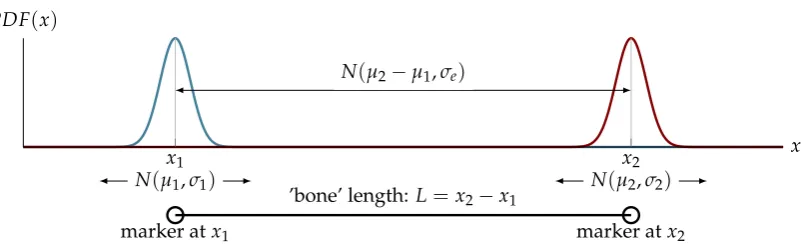
Locating markers in a scene is a continuous process occurring frame-by-frame at the requested sampling frequency. The measurement of the location of a marker can be presumed to be an actual location signal plus additive Gaussian white noise, consequently, locating of each marker location is
an independent statistical process. One dimensional case, as depicted in Fig.1, can be described with
normal probability density function:
loc(Mk)≈xk=N(µk,σk), (1)
where: loc(Mk)denotes actual location of kth marker in a scene. N(·) denotes normal (Gaussian)
92
distribution, which for real location atxk is estimated as a meanµk, and standard deviationσk, that
93
(at best) should be common for all the same markers (of a same size).
94
The typical uncertainty analysis in measurements employs two factors accuracy and precision
95
[18] – the accuracy that describes how close the estimateµkis to actual locationxkand describes the
96
systematic error, whereasσkreflects the precision of measurement and describes random part of the
97
error.
98
Extending the estimation of a marker model to the estimation of a length (L) of a bone, it
yields a difference of double marker location measurements, hence its probability density function is described:
length(x1,x2)≈PDF(L) =|N(µ2,σ)−N(µ1,σ)|=N(µe,σe), (2)
where: µe = |x2−x1| - expected (in common sense) mean value,σe - expected standard deviation,
99
which might take different forms, depending on the case:
100
A. σA=σ
√
2 – for two identical (σ1=σ2), independent variances (covarianceσ12 =0),
101
B. σB=
q
σ12+σ12– for two different (σ16=σ2), independent variances (σ12=0),
102
C. σC=
q
σ12+σ22−2σ12– for two different (σ16=σ2), correlated variances (σ12 6=0).
103
In this paragraph, we would like to refer in advance to the experimental part described in p.
104
3.1-4. Just to introduce it briefly – the recorded model were two markers of a T-frame template,
105
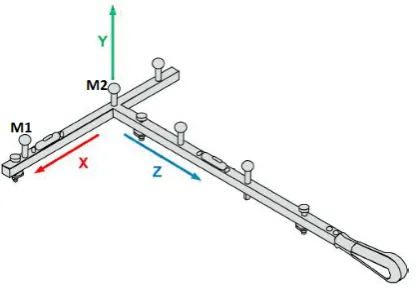
that was laying steadily on the floor for several hours. T-frame (Fig. 7) is a reference rigid tool for
106
calibrating the OMC systems, where markers are mounted permanently in known locations. The
107
location of two markers and their distance (a bone) were measured with three different types of IR
108
cameras. For the detailed description of the experimental setup please refer to the p.3.
109
The brief results – markers location and their distance are gathered in Tab. 1. It contains
110
estimated parameters for locations and lengths, we provide also theoretically calculated values for
111
length. These are: locations mean values and their standard deviations, covariance, and correlation
N(µ1,σ1) N(µ2,σ2)
N(µ2−µ1,σe)
marker atx1
’bone’ length:L=x2−x1
marker atx2
x1 x2 x
PDF(x)
Figure 1.Schematic of situation and corresponding theoretic probability - two markers atx1andx2
identifying a single rigid body (bone) of lengthl,
(ρ12) as well, furthermore it contains mean value(µL) and standard deviation (σL) for length as it was
113
reported by the Vicon software. Calculated statistical descriptors are the length (µe) and standard
114
deviation in four variants – σA..C as listed above, with two A variants assuming either markers as
115
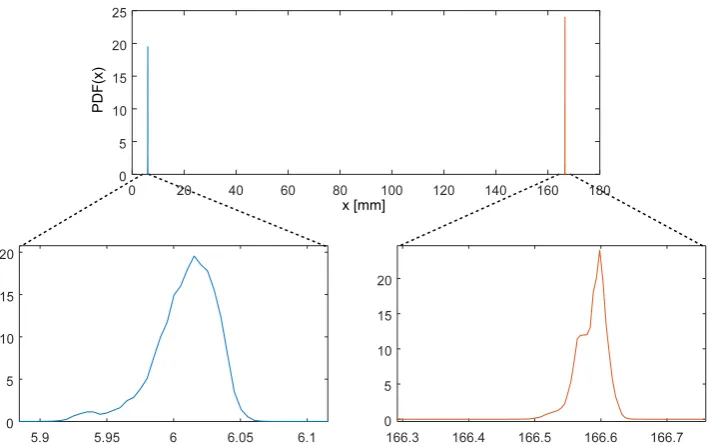
a potential source of variance value. Figure2demonstrates exemplary kernel estimates of location
116
PDFs for one of the camera sets.
117
Table 1.Stats
Measured [mm] Theoretic [mm]
µ1 σ1 µ2 σ2 σ12 ρ12 µL σL µe σA1 σA2 σB σC
T40 166.5863 0.0217 6.0088 0.0234 0.0004 0.8006 160.5818 0.0143 160.5774 0.0307 0.0331 0.0319 0.0143
Bonita 165.9766 0.1635 5.6644 0.1032 0.0011 0.0670 160.3168 0.1870 160.3121 0.2312 0.1459 0.1933 0.1874
Vantage 166.1736 0.0721 5.7363 0.0942 0.0034 0.4980 160.4388 0.0852 160.4374 0.1020 0.1332 0.1186 0.0855
All 166.4613 0.0157 5.9478 0.0176 0.0001 0.4257 160.5176 0.0178 160.5136 0.0222 0.0249 0.0236 0.0179
Generally, the measurement results conform to the theoretic considerations for correlated
118
random variables – obviously the length measurement results confirmed (not included in the paper)
119
in Chi-squared statistical tests their origin in Gaussian distribution with σC. In the considered
120
measurements it is visible in the dispersion of measurements, which is considered as noise. For
121
the low-cost Bonita cameras, the location variance is relatively large, moreover, it is non-correlated
122
to each other (low correlation and covariance), therefore it can be considered as noise. On the other
123
hand, overall dispersion for the high-end T40 cameras is small but highly correlated.
x [mm]
PDF(
x)
Figure 2.PDF kernel estimation of location forM1andM2using Vicon T40 cameras
159.5 160 160.5 161 161.5
L [mm]
0 5 10 15 20 25 30
PDF(
L)
T40 Bonita Vantage All
Figure 3. Variable PDF estimation of the same length measurement in OMC with different sets of
cameras
The other issue of the error quantification is the lack of reliable ground truth. The Vicon systems
125
return their results with 1/100 mm resolution. It is difficult to obtain a physical template (like the
126
T-frame) manufactured with precision and accuracy comparable or better. For this reason, it is
127
hardly feasible to evaluate the accuracy (bias) of the length estimation with mean values without
128
sophisticated equipment. Fortunately, this aspect is of lesser concern as it describes the systematic
129
error, which is easy to compensate. Moreover, each of the camera sets reports slightly different mean
130
value (see Fig.3), though the discrepancies between the camera sets are on the level rather satisfactory
131
for the most applications – tenth part of a millimeter.
132
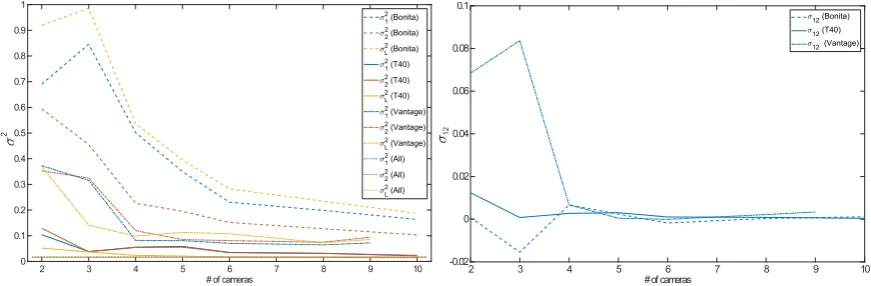
The number of cameras used for position reconstruction is another factor, that has a significant influence on the uncertainty of measured position – increasing the number of cameras could be considered as an increasing number of measurements. Multiple measurements of the real value reduce an error of measured value, which is described as a standard error calculated based on the standard deviation for observed value:
σx¯= √σ
where: N is a number of observations, σ - standard deviation of observed value. This theoretic,
133
quasi-hyperbolic relationship is depicted in Fig. 4. One can denote clearly visible similarity (with
134
some fluctuations) to the real observed decrease in variations for increasing number of cameras
135
shown in Fig.5a.
136
1 2 3 4 5 6 7 8 9 10
.. . 1/√4 1/√3 1/√2 1
N
σx¯
Figure 4.Standard error for estimating actual position with increasing number of measurements
However, as it is depicted in Fig.5b, the covariance is rather constant regardless of the number
137
of cameras (except very low numbers of cameras), whereas the overall variance decreases as the
138
number of cameras grows. It suggests the presence of a process of unknown origin, that is rather
139
common to the markers and affects their registration then physical devices – e.g. it could be either
140
signal processing or a common mechanic micro trembling of cameras. Hence, according to metrology
141
guidelines [18], if the input quantities are correlated in time, then simple experimental mean or
142
standard deviation might be not enough to describe the uncertainty in the system. In such a situation
143
a dedicated tool, namely Allan variance, is recommended.
144
2 3 4 5 6 7 8 9 10 # of cameras
0 0.1 0.2 0.3 0.4 0.5 0.6 0.7 0.8 0.9 1
2
1 2(Bonita)
2 2(Bonita)
L 2(Bonita)
1 2(T40)
2 2(T40)
L 2(T40)
1 2(Vantage)
2 2(Vantage)
L 2(Vantage)
1 2(All)
2 2(All)
L 2(All)
2 3 4 5 6 7 8 9 10
# of cameras -0.02
0 0.02 0.04 0.06 0.08 0.1
12
12(Bonita)
12(T40)
12(Vantage)
Figure 5.Variances (a) and covariances (b) for variable numbers of cameras of different types
2.3. Allan variance 145
Allan variance (AVAR) a two-sample variance and its square root – Allan deviation (ADEV) are
146
statistical descriptors that were developed for the evaluation of the stability of the time and oscillation
147
in clocks. A notable advantage of this approach that there is no need to provide reference value –
148
ground truth.
149
Nowadays, the measure is effectively used for quantifying the noises in the measurement of
150
other quantities [19,20], but particularly for inertial motion capture sensors [21,22].
Allan variance [8] is defined as:
σy2(τ) =12(y(t+τ)−y(t))2, (4)
whereτis the time intersample spacing,h·idenotes expected value.
152
The AVAR analysis consists of identifying the linear parts of certain slopes of the log-log plot of
153
τsteps versus ADEV (square root of AVAR). It is demonstrated in schematic ADEV plot in Fig.6. It is
154
a highly beneficial advantage of the AVAR noise quantification over the power spectral density (PSD)
155
– capability not to clutter different noise processes and to precise discriminate several types at once.
156
However, there is also a disadvantage, AVAR is sensitive to the outliers and requires considering
157
outlier cleaning to obtain reliable results.
158
The conventional types of noise can be identified by their PSD distribution with the power law.
The ’color’ is given as power relation with respect to frequency (S(f) ∝ 1/fα). Therefore, overall
noise characteristics, comprising different basic noise types are:
S(f) =
∑
αhαfα. (5)
It corresponds to:
σy2(τ)≈
∑
τ
hαKατµ, (6)
which for a conventional set of noises yields:
σy2(τ)≈Ah−2τ+Bh−1+Ch0τ−1+ (Dh1+Eh2)τ−2. (7)
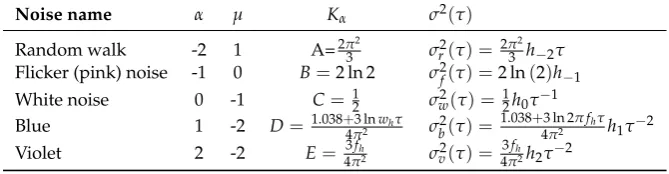
Conventional (color) noise types are gathered in Tab.2,
159
Table 2.Power-law noise types and their Allan variance representation
Noise name α µ Kα σ2(τ)
Random walk -2 1 A=2π2
3 σr2(τ) = 2π
2
3 h−2τ
Flicker (pink) noise -1 0 B=2 ln 2 σ2f(τ) =2 ln(2)h−1
White noise 0 -1 C= 12 σw2(τ) = 12h0τ−1
Blue 1 -2 D= 1.038+3 lnwhτ
4π2 σ
2
b(τ) =
1.038+3 ln 2πfhτ 4π2 h1τ
−2
Violet 2 -2 E= 3fh
4π2 σ
2
v(τ) = 43fh
π2h2τ
−2
where fhis bandwidth limit for the measurement system.A..Erespective scaling factorsKα.
160
Additionally, two complex distortions can be identified using Allan variance – exponentially
161
correlated (Markovian) and sinusoidal. The Markovian noise is visible in the Allan deviation plot as
162
a single ’bump’ with slopes±1
2. Periodic (sinusoidal) distortion is represented in respective plot as a
163
decaying series of bumps with left-sided slope 1 and right side bump series with constant envelope
164
of a slope−1, however, it is the only case, which is more convenient to be observed and to analyze
165
the distortion in Fourier spectral domain.
166
Correlated noise PSD is given as:
Sc(f) =
(qcTc)2
1+ (2πf Tc)2, (8)
and corresponding Allan variance has a form:
σc2(τ) = (qcTc)
2
τ
1− Tc
2τ
3−4e−Tcτ +e−2Tcτ
where:qcis the noise amplitude,Tcis the correlation time.
167
Sinusoidal noise PSD has a form of two peaks, modeled with Dirac delta:
Ss(f) = 1
2A
2
s(δ(f− f0) +δ(f +f0)), (10)
and respective Allan variance form:
σs2(τ) =A2s sin
2(
πf0τ)
πf0τ
!
, (11)
where:Asis the amplitude, f0is the frequency,δ(·)is Dirac delta peak.
168
10-3 10-2 10-1 100 101 102 103 104 105
10-6
10-5
10-4
10-3
10-2
-1/2
0
1/2 -1
correlated noise
sinusoidal noise violet/blue noise
white noise
flicker noise
random walk
τ [s]
σy
(
τ
) [mm/s]
Figure 6. Schematic view on Allan Deviation log-log plot (axis values are for illustrative proposes)
3. Materials and Methods 169
3.1. Environment 170
The experimental setup was employed in the Human Motion Laboratory (HML) at the Research
171
and Development Centre of Polish-Japanese Academy of Information Technology in Bytom1. Motion
172
system used in this laboratory consists of a total of 30 Vicon Motion cameras of three different types:
173
• 10 Vicon MX-T40,
174
• 10 Vicon Bonita10,
175
• 10 Vicon Vantage V5.
176
These cameras can record data independently or can be integrated into one larger system with
177
capture volume 9 m x 5 m x 3 m. In order to minimize the impact of external interference like infrared
178
interference from sunlight or vibrations, all windows are permanently darkened and cameras are
179
mounted on scaffolding instead of tripods (as is shown in Fig. 8) The basic information and main
180
differences between used cameras are shown in Table3.
181
Table 3.Vicon camera difference
Camera model MX-T40 Bonita10 Vantage V5
Resolution [MP] 4 1 5
Max Frame Rate [HZ] 370 @ 4 MP 250 @ 1 MP 420 @ 5 MP
Focal length [mm] 18 4 8.5
Sensor type CMOS CMOSIS CMOS
Type of,LEDs 180 nm NIR 780 nm NIR 850 nm (IR)
Number of LEDs 252 68 22
AOV (HxV) 49.15 x 37.14 70,29 x 70,29 63.5 x 55.1 Dimensions [mm],(HxWxD) 207 x 130 x 75 122 x 80 x 79 166.2 x 125 x 134.1
Weight [kg] 1,8 1 1,6
3.2. Data capture 182
For the noise analysis needs, a special, nine-hour recording of the two 14 mm markers from the
183
calibration T-frame template (wand) was made. The wand (demonstrated in Fig. 7) was placed in
184
the center of motion capture volume. The three other markers were removed. Data was recorded
185
simultaneously by all the 30 cameras at 120 Hz in standard Vicon software (Vicon Blade version
186
3.3.1). The XYZ coordinate system was by default oriented according to the T-frame as it is depicted
187
in Fig.7. Camera calibration was made once with all thirty cameras according to the standard Vicon
188
procedure. The reprojection error for this session, for all the cameras was less than 0.2 pix – mean
189
error for Bonita - 0,1946 pix; Vantage - 0,1891 pix; T40 - 0,1535 pix as reported by the software after
190
the calibration procedure. Additionally, in order to minimize the environmental noise, laboratory
191
technicians were not present in the room during this recording - after the system calibration, all the
192
necessary operations and supervision (start and stop record, system status verification, etc.) were
193
done remotely.
194
Figure 7. Vicon calibration wand schema (T-frame)
3.3. Data processing 195
In the post-processing stage in Vicon Blade (Version 3.3.1) software, markers were reconstructed
196
and labeled only, no other filtering or processing was used. This stage was done several times
197
– separately for each camera configuration (including different numbers of cameras of each type).
198
Reconstruction settings were set to the default, for each camera type except the initial set of 2 cameras
199
of each type, where it required to override the demand of marker visibility by three cameras at least.
200
In this trial, the parameter -’Minimum Cameras to Start Trajectory’had to be set to 2. All those data
201
were used to create the few datasets, containing several realizations of the same sequence:
202
• Data set 1: based on all cameras
203
• Data set 2: based on T40 cameras
• Data set 3: based on Bonita cameras
205
• Data set 4: based on Vantage cameras
206
The data sets 2-4 consists of 7 trials, in which a different number of cameras used for 3D markers
207
reconstruction (Table4). The location of each camera is shown in the Fig.8. To characterize the noise
208
in different camera type, in all datasets the x,y,z trajectories of both markers and their Euclidean (Eq.
209
12) distance were analyzed.
210
L=d(M1,M2) = p
(x1+x2)2+ (y1+y2)2+ (z1+z2)2 (12)
Table 4.Number and (incrementally) IDs of cameras used for 3D marker reconstruction
Cameras MX-T40 Bonita10 Vantage V5
2 21,26 2,17 3,4
3 +28 +19 +10
4 +22 +16 +11
5 +27 +18 +7
6 +20 +15 +30
8 +24,29 +13,14 +9,8
ALL +23,25 +1,12 +5
Figure 8.Camera locations:a) Schematic view in Vicon Blade software,b) actual setup in HML. Color
denotes camera series: violet – Vantage, green – Bonita, red – T40
Processing operations in Vicon Blade were limited to 3D reconstruction of marker trajectories
211
and exporting the data to the .c3d file format. Further filtering, analysis, and processing of data were
212
done with Matlab (Version R2016b).
213
3.4. Noise parameters estimation 214
For the computing of AVAR from the experimental data we used an implementation by
215
Czerwinski [20]. It implements various AVAR versions, including overlapping estimator, that we
216
chose to use as it is more stable and boundary error prone than conventional one.
The notable advantage of Allan deviation plots is their simple visual interpretation. Moreover,
218
identification of complex – sinusoidal or correlated – distortions is possible just by visual inspection
219
[21] for the presence of bumps in the plot. Another beneficial feature is the ability to estimate the
220
parameters by simple line or poly-line matching to log-log plot [22]. However, straightforward
221
distinguishing between blue and violet noises is not possible in such a case – to obtain these phase
222
dependant noises it would be necessary to employ much slower variant – modified AVAR estimation.
223
The method for the noise parameters readout from the ADEV curve, used in this research was
224
proposed by Vernotte et al. in [23] – the model employs minimization of weighted least squares
225
(WLS). As it was demonstrated in [19], such an LS model allows even to identify blue and violet
226
noises which are represented jointly byτ−2component.
227
The weighted LS is represented as following minimization problem that reduces the weighted
error between measured AVAR values ˆσy2(τ)and a sum of estimated componentsσi2(τ)-s :
ˆ
H= arg min
h−2,...,h2,qc,Tc,As,fo≥0
∑
τ
1 ˆ
σy2(τ)
ˆ
σy2(τ) −
∑
i={v,b,w,f,r,c,s}
σi2(τ)
2
. (13)
Obtaining reasonable results for such a complexand multideimensional non-linear model is
228
a challenging issue. Therefore, we followed roughly a multi-start hybrid algorithm proposed in
229
[24] – multi-start simulated annealing followed by local minimum search, where multiple starts
230
prevent dependence on the initialization. It follows exploration-exploitation scheme, in the first stage
231
simulated annealing (SA), known for avoiding of getting stuck in local minimum, finds solution close
232
to global optimum, which is then refined by local pattern search – for the latter we propose to use
233
ant colony optimization (ACO), specifically the ACOR variant for continuous domains [25]. Our
234
additional modification is in the initialization stage of the ACO solver, which is at start populated
235
with values jittered around the solution returned by the SA stage. Exemplary regression results
236
are visually demonstrated in Fig. 9, compared with ordinary (non-weighted) LS obtained with
237
Levenberg-Marquardt algorithm.
238
10-3 10-2 10-1 100 101 102 103 104
[s]
3 4 5 6 7 8 9 10
y
(
) [mm/s]
10-3
allan deviation
LS (Levenberg-Marquardt):135389 WLS (SA+ACO)1:0.0045466 WLS (SA+ACO)2:0.0049994 WLS (SA+ACO)3:0.0048763 WLS (SA+ACO)4:0.0050471 WLS (SA+ACO)5:0.0047075 WLS (SA+ACO)6:0.0049197 WLS (SA+ACO)7:0.004868 WLS (SA+ACO)8:0.0050131 WLS (SA+ACO)9:0.0045466 WLS (SA+ACO)10:0.0046885
Figure 9.Regression results for an excerpt from the experimental data, demonstrates complex ADEV
As it was mentioned in the p. 2.3 it is necessary to remove the outliers before the AVAR
239
estimation. For that purpose Hampel filter [26] was employed. It checks the signal whether it is
240
larger than the 3 sigma rule threshold computed robustly on the median absolute deviation (MAD)
241
within a sliding window (in our case 1 second of the past and future values) and replaces outlying
242
values with the local median.
243
3.5. Remarks on the results 244
During the data analysis, two issues emerged, its worth to mention them in advance as they
245
could contaminate the results or cause confusion during the interpretation. First, that while recording
246
there occurred a slight seismic crump. The second issue was the failure of one of the cameras (IR LED
247
emitter) during the recording.
248
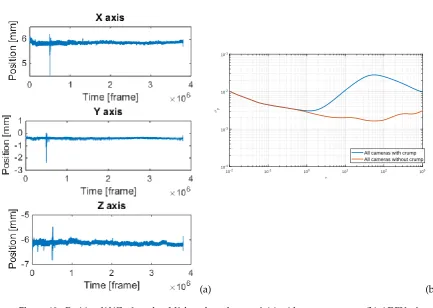
The crump can be observed in the trajectories of the markers (Fig.10a) as a heavy outlier. It has
249
a significant effect on the Allan variance results (see Fig. 10b). That fact draws attention to the need
250
for the careful screening of the measurements for the outliers and proper filtering if necessary – such
251
as the aforementioned Hampel filter.
252
(a)
10-2 10-1 100 101 102 103
10-4
10-3
10-2
10-1
y
All cameras with crump All cameras without crump
(b)
Figure 10. Position X,Y,Z of marker M1 based on data set 1 (a) with crump present, (b) ADEV of
marker distance based on data with and without crump.
The second issue was identified because of the noise levels for data set 4 (Vantage cameras).
253
They were aberrant, for some camera combination the noise levels were increasing when taking more
254
cameras into the reconstruction process. It appeared that one of the cameras was out of order and it
255
would have broken soon after our recordings. Therefore, we excluded it from our analyses and we
256
used up to 9 cameras in the reconstruction for the Vantage data set. Fig. 11illustrates, how such a
10-2 100 102 104 10-2
10-1
y
x1
10-2 100 102 104
10-2 10-1
x2
10-2 100 102 104
10-2 10-1
L
3 9 10
Number of cameras
Figure 11. ADEV for Vantage cameras demonstrating the performance loss due to one damaged
camera (tenth).
failing device, increases the noise in the results forxdimension – the most contributing to the length
258
(L). It is visible in the figure, that we observe larger ADEV values for 10 cameras than for 9, another
259
noteworthy fact is that markers positions are affected to different extents, and the distance is therefore
260
affected to an intermediate extent. The reason for such an observation remains unclear as the internal
261
details of triangulation in Vicon software are kind of a black box. We suspect the inner quality control
262
procedure, that could, for example, select just some subset of cameras.
263
There were also indirect consequences of the failing camera. We could observe slight cross-talk
264
of distortions to the other cameras mounted at similar heights (Vantage and T40), resulting in the
265
presence of short term correlated noise (verified in p4.5). Fortunately-or-not it resulted finally in
266
much more complex ADEV curves we had to analyze, proving that the proposed method is capable
267
to adapt to all the noise types known from the Allan variance literature. The exeplary ADEV curve,
268
obtained for the data after changing the failing camera is included in AppendixBfor comparison. It
269
demonstrates ADEV of the whole system in the facility free of the distortions caused the failing IR
270
LEDs.
271
4. Results and discussion 272
4.1. Overview 273
Using the single long sequence recorded with a regime as described in sections3.1-3.3, we have
274
obtained a pool of sequences obtained with different camera sets. The results were analyzed with an
275
overlapping Allan variance estimator. These results are grouped by camera type and presented as
276
families of Allan deviation plots in Fig.12with a varying number of cameras used in the process.
277
Next, Allan variance noise component parameters were estimated with the procedure described
278
in p. 3.4. The presence and number of correlated and periodic components were examined visually,
279
the verification, whether they are not coming from the periodic distortion, was done by examination
280
of the PSD estimator. The noise parameter estimation results are demonstrated in Figs. 14and15,
281
in logarithmic and linear scales to adapt to large range of values. Numerical values are attached in
282
AppendixAin TablesA1–A3.
283
Finally, the less conventional noises were considered in p.4.5. These are multiple occurrences of
284
correlated noise and periodic distortion.
285
4.2. Overall ADEV characteristics 286
Overall ADEV characteristics for all camera types – T40, Bonita and Vantage are shown in Fig.12.
287
They reveal that theσyvalues gradually decrease with the increasing number of cameras, however,
288
there are some ’drops’ along the camera number axis. That suggest, that certain camera setup is
289
notably better suited for the recorded object – these setups are: 3 cameras for T40, 5 cameras for
290
Bonita, and 4 cameras for Vantage.
291
Another interesting observation in the overall plots can be denoted when analyzing ADEV plots
292
for measured values along the temporal axis. Theσyvalues for the distanceLare larger than for the
contributing locationsx1andx2within the range of short-time noisesτ≈ 10−2. . . 101, although for
294
the longer time ranges these values are on par or even ADEV values are smaller for the distance than
295
for contributing locations. Apparently, flicker and random walk noises do not add in the system.
296
We can also observe all the slopes (-1, -1/2, 0, 1/2) from the Tab.2in the characteristics plots. The
297
presence of random walk could be a bit confusing at first, if we omit the results of Jensenius [12], one
298
could expect such distortion not to appear. The triangulation process is done frame-by-frame in the
299
system, therefore the position of a marker should be steady, with flicker, white and higher frequency
300
color noises present. However, there might be implicit denoising present in the system done by low
301
pass filtering, such filters act as integrators, therefore they could introduce some low-frequency noises
302
from the higher noise components.
303
4.3. Comparing the camera types 304
The logical corollary of results demonstrated in the previous paragraph is a direct comparison of
305
camera types. In Fig.13we demonstrate the ADEV plots for each of the camera types at its maximum
306
performance configuration (all cameras). It shows length (L) and marker positions inxas the most
307
important dimension. Comparing the camera types by visual plot inspection confirms the expected
308
outcome, that low-cost Bonita cameras have much higher ADEV values (are more noise affected) than
309
two other camera types. However, ADEV values of up-to-date Vantage cameras indicate that they are
310
more noise affected than relatively old T40s.
311
10-2 10-1 100 101 102 103
10-3 10-2 10-1
x1 x2 L
10-2 10-1 100 101 102 103
10-3 10-2 10-1
10-2 10-1 100 101 102 103
10-3 10-2 10-1
T40 (10 cameras) Vantage (9 cameras) Bonita (10 cameras) all (29 cameras)
y
Figure 13. ADEV for maximal numbers of cameras of each type separately and altogether.
4.4. Estimation of basic noise coefficients 312
Several remarks on the noise colors present in the system, that are based on the noise estimated
313
coefficients (Figs.14and15):
314
• Random walk and white noise diminishing with the increasing number of cameras, roughly
315
follow quasi-hyperbolic characteristics described with Eq.3,h≈10−5
316
• Flicker and blue noise levels orders of magnitude are relatively constant with low-moderate
317
valuesh≈10−10
318
• Violet noise levels are negligibly smallh≈10−20..10−300
319
We could also observe intense peak fluctuations in plots ofh coefficient characteristics. They
320
could originate from two potential sources – numerical errors in the optimization process, and/or
321
very specific camera geometric configuration, that could improve or degrade the results. However,
322
the general rule (Eq.3) of decreasing uncertainty with an increasing number of measurements could
323
be observed to some extent for all the noise coefficients (h), but violet one, where it rather seems to be
324
random fluctuations.
325
4.5. Unconventional distortions 326
Regarding the less conventional, correlated noises, a series of interesting observation relates to
327
their presence. In Fig. 16a one can observe, that they are mostly independent of the number of
2 3 4 5 6 7 8 9 10
No of cameras
10-50
100
h-1
[flicker coef]
2 3 4 5 6 7 8 9 10
No of cameras
10-8
10-6
10-4
h0
[white noise coef]
2 3 4 5 6 7 8 9 10
No of cameras
10-50
100
h1
[blue noise coef]
2 3 4 5 6 7 8 9 10
10-300
10-200
10-100
100
h2
[violet noise coef]
No of cameras
2 3 4 5 6 7 8 9 10
No of cameras
10-40
10-30
10-20
10-10
100
2 3 4 5 6 7 8 9 10
No of cameras
10-5
10-4
10-3
10-2
2 3 4 5 6 7 8 9 10
No of cameras
10-20
10-15
10-10
10-5
2 3 4 5 6 7 8 9 10
10-300
10-200
10-100
100
No of cameras
2 3 4 5 6 7 8 9
No of cameras
10-25
10-20
10-15
10-10
10-5
2 3 4 5 6 7 8 9
No of cameras
10-5
10-4
10-3
10-2
2 3 4 5 6 7 8 9
No of cameras
10-30
10-20
10-10
2 3 4 5 6 7 8 9
No of cameras
10-200
10-150
10-100
10-50
100
2 3 4 5 6 7 8 9 10
No of cameras
10-100
10-50
100
h-2
[random walk coef]
T40
x1
x2 y1
y2
z1
z2
L
2 3 4 5 6 7 8 9 10
No of cameras
10-15
10-10
10-5
Bonita
2 3 4 5 6 7 8 9
No of cameras
10-60
10-40
10-20
100 Vantage
Figure 14. Color noises (h−2..h2) coefficients in logarithmic scale; in columns left to right: T40, Bonita,
2 3 4 5 6 7 8 9 10 No of cameras
0 0.5 1 1.5 2 2.5 h-1 [flicker coef] 10-9
2 3 4 5 6 7 8 9 10
No of cameras 0 0.5 1 1.5 2 h0
[white noise coef]
10-5
2 3 4 5 6 7 8 9 10
No of cameras 0 1 2 3 4 5 6 h1
[blue noise coef]
10-8
2 3 4 5 6 7 8 9 10
No of cameras 0 0.2 0.4 0.6 0.8 1 1.2 h2
[violet noise coef]
10-11
2 3 4 5 6 7 8 9 10
No of cameras 0
2 4 6
8 10-4
2 3 4 5 6 7 8 9 10
No of cameras 0
1 2 3 4
5 10-3
2 3 4 5 6 7 8 9 10
No of cameras 0
1 2 3
4 10-6
2 3 4 5 6 7 8 9 10
No of cameras 0
0.5 1 1.5 2
2.5 10-10
2 3 4 5 6 7 8 9
No of cameras 0
0.2 0.4 0.6 0.8
1 10-5
2 3 4 5 6 7 8 9
No of cameras 0 1 2 3 4 5
6 10-3
2 3 4 5 6 7 8 9
No of cameras 0
1 2 3
4 10-6
2 3 4 5 6 7 8 9
No of cameras 0
0.5 1 1.5 2
2.5 10-8
2 3 4 5 6 7 8 9 10
No of cameras 0 0.5 1 1.5 2 2.5 h-2
[random walk coef]
10-7 T40
x1 x2 y1 y2 z1 z2 L
2 3 4 5 6 7 8 9 10
No of cameras 0
0.5 1 1.5
2 10-5 Bonita
2 3 4 5 6 7 8 9
No of cameras 0
0.5 1 1.5 2
2.5 10-6 Vantage
Figure 15. Color noises (h−2..h2) coefficients in linear scale; in columns left to right: T40, Bonita,
cameras –Tcandqcparameters remain relatively constant. Moreover, one could note from Fig.16b,
329
that for correlated noises in the system the longer the time constant the lower amplitude. We could
330
also identify three correlated noise ’classes’ of a different correlation time constants. Their sources
331
remain unknown, however, at least we could speculate about their origins based onTc. Removing
332
the failed camera made the first two of them (see App.B) disappear. Hence our guesses are:
333
• 10−2−100s– due to failed camera, though we considered signal processing based first,
334
• 100−101s– due to failed camera, at first we suspected mechanical based microtrembling of
335
camera support,
336
• 102−103s– environmental based such as changes in room temperature.
337
2
4
no of cameras
6 10-4
10-14
10-12 8
10-10
qc
10-8 10-6 10-2
10-4
10 10-2
100 100
Tc
[s]
102 104
T40 Bonita Vantage x y z
10-14 10-12 10-10 10-8 10-6 10-4 10-2 100
qc
10-3 10-2 10-1 100 101 102 103 104
Tc
[s]
Figure 16. Distribution of correlated noisesqcversusTc.
Finally, the occurrences of periodic noise of f0 ≈ 15Hz frequency had to be checked as it was
338
an unexpected outcome. The verification was done using Welch estimator of PSD (see Fig. 17),
339
and it is present in each of the reconstructions using T40 and Vantage cameras. However, it is
340
usually negligibly small phenomenon, barely observable in most of ADEV plots. Its origin cannot
341
be connected with a recording of any specific camera, but since all the cameras were recording
342
concurrently, it is probably due to some environmental source. Cameras appeared sensitive to a
343
different extent, surprisingly vertical dimensions obtained from the T40 cameras were the most
344
sensitive to this distortion. In case of the Vantage or Bonita cameras it is negligibly small. It requires
345
very large zoom to observe appearance of respective bumps in either PSD or ADEV plots.
346
0 10 20 30 40 50 60
Frequency (Hz) -60
-50 -40 -30 -20 -10 0 10 20 30
PSD (dB/Hz)
T40 Vantage Bonita
Figure 17. Exemplary verification of periodic distortion using PSD forz1reconstructed with maximal
5. Summary 347
In the article, we demonstrated how to evaluate with Allan variance a compound structure of
348
noise present in the optical Mocap system. The proposed tool was invented for situations when the
349
reliable ground truth is inaccessible. We demonstrated, that it provides outcomes convenient for
350
visual inspection to identify qualitatively noise types actually present in the system or to compare
351
two systems. We have also demonstrated how to employ sophisticated solvers to read the noise
352
parameters from the characteristic ADEV curve, even when it gets quite complicated form.
353
For our facility, we proved that the main contribution to the imprecision comes from the random
354
walk and white noise, whereas flicker noise and blue noise contributions are several orders of
355
magnitude smaller. The influence of violet noise is negligibly small. We have identified also the
356
presence of quite a long term (tens of minutes) correlated noise, probably due to environmental
357
influence. The registration of the noise connected with camera failure was an additional and
358
unforeseen outcome.
359
Future works might include extending the basic approach by analysis of AVAR for bone
360
orientation, though it would require preparing quaternionic AVAR. Other interesting aspects are the
361
variability of AVAR depending on the location in the scene, or how much the results are affected
362
by the presence and activities of staff in the lab. The experiments could be also repeated in different
363
Mocap facilities or laboratories of a different kind, but including Mocap as a feature such as interactive
364
rehabilitation platform Motek CAREN2.
365
Acknowledgments:Grant number goes here - will be provided later.
366
Author Contributions: P.S. conceived the idea, provided the theory, and prepared the analysis tools; M.P
367
conducted the experiments and performed the computations; both authors analyzed and discussed the concepts 368
and results; both authors wrote the paper. 369
Conflicts of Interest:The authors declare no conflict of interest. 370
Abbreviations 371
The following abbreviations are used in this manuscript:
372
ACO: ant colony optimization
373
AVAR: Allan variance
374
ADEV: Allan deviation
375
LS: least squares
376
Mocap: motion capture
377
OMC: optical motion capture
378
RMSE: root mean square error
379
PSD: power spectral density
380
SA: simulated annealing
381
SD: standard deviation
382
WLS: weighted least squares.
383
Appendix A. Estimated noise coefficients 384
Allan variance numerical values for noise component parameters, estimated with the procedure
385
described in p. 3.4. Tables A1-A3 demonstrate results for T40, Bonita, and Vantage cameras
386
respectively.
387
Table A1.Estimated noise parameters of T40 cameras type for 2..10 devices
a)x1
h−2 h−1 h0 h1 h2 qc1 Tc1 qc2 Tc2 qc3 T3 qc4 Tc4
All 1.55e-10 2.37e-13 9.26e-07 1.35e-13 5.59e-106 5.00e-02 1.00e-02 1.33e-02 2.25e-01 2.04e-03 5.89e+00 3.06e-04 2.00e+03
8 2.99e-09 1.33e-12 1.12e-06 2.91e-09 2.01e-15 5.56e-03 1.62e-01 9.80e-03 3.00e-01 1.92e-03 6.36e+00 2.39e-04 2.00e+03
6 2.82e-09 4.50e-12 1.27e-06 5.42e-09 4.54e-136 4.93e-03 5.48e-01 1.21e-02 2.05e-01 2.13e-03 7.03e+00 3.20e-04 2.00e+03
5 1.03e-08 3.62e-12 2.09e-06 9.57e-09 3.92e-226 5.38e-03 5.63e-01 1.43e-02 2.42e-01 3.02e-03 6.30e+00 3.66e-04 2.00e+03
4 3.96e-09 3.24e-12 2.63e-06 1.39e-08 2.40e-16 1.99e-02 1.99e-01 7.45e-03 6.35e-01 3.12e-03 7.22e+00 6.01e-04 2.00e+03
3 9.57e-09 9.04e-12 3.83e-06 9.82e-09 3.15e-32 2.09e-02 1.95e-01 5.62e-03 5.68e-01 4.60e-03 6.57e+00 6.51e-04 1.41e+03
2 7.65e-08 3.26e-18 5.09e-06 4.60e-09 1.96e-21 9.28e-03 4.54e+00 2.46e-02 1.79e-01 7.63e-10 5.74e+01 5.36e-10 1.55e+03 b)y1
h−2 h−1 h0 h1 h2 qc1 Tc1 qc2 Tc2 qc3 Tc3 As f0
All 4.59e-08 6.11e-22 1.40e-06 3.91e-22 1.47e-157 1.58e-02 1.00e-01 4.72e-03 1.00e+00 6.36e-12 6.21e+02 1.75e-03 5.00e-02
8 4.62e-08 2.45e-20 1.29e-06 1.55e-08 3.73e-172 1.41e-02 1.00e-01 3.78e-03 1.93e+00 6.78e-11 6.73e+02 1.22e-03 2.98e-01
6 4.56e-08 3.32e-19 1.72e-06 2.21e-08 6.14e-265 1.71e-02 1.00e-01 4.26e-03 2.72e+00 4.65e-11 3.65e+02 1.75e-03 2.98e-01
5 5.04e-08 1.59e-19 1.73e-06 2.43e-08 1.50e-69 1.76e-02 1.00e-01 4.62e-03 2.70e+00 5.84e-11 8.47e+02 1.72e-03 2.98e-01
4 5.53e-08 3.88e-19 1.58e-06 2.35e-08 2.12e-70 1.99e-02 1.00e-01 5.84e-03 2.54e+00 8.04e-11 6.60e+02 1.51e-03 2.98e-01
3 6.34e-08 5.93e-19 2.06e-06 2.56e-08 8.38e-187 2.03e-02 1.00e-01 5.74e-03 3.62e+00 9.94e-11 3.88e+02 1.38e-03 2.98e-01
2 7.30e-08 1.29e-14 3.58e-08 7.00e-10 1.29e-51 2.91e-01 1.76e-03 8.38e-03 3.72e+00 2.22e-08 9.20e+02 2.99e-03 5.00e-02 c)z1
h−2 h−1 h0 h1 h2 qc1 Tc1 qc2 Tc2 qc3 Tc3 qc4 Tc4 As f0
All 3.23e-09 4.20e-12 1.26e-06 1.04e-13 3.12e-198 1.87e-02 1.00e-01 6.76e-03 5.10e-01 1.69e-03 7.75e+00 1.70e-04 4.43e+02 3.56e-03 1.44e+01
8 5.04e-09 3.53e-13 1.83e-06 9.68e-09 1.36e-105 3.15e-06 5.29e-02 1.23e-02 3.22e-01 2.29e-03 7.66e+00 2.48e-04 6.75e+02 4.19e-03 1.44e+01
6 2.00e-08 8.84e-19 4.33e-06 2.72e-08 1.16e-21 5.48e-08 7.75e-02 2.11e-02 2.95e-01 4.17e-03 5.20e+00 7.09e-11 3.98e+02 6.69e-03 1.44e+01
5 4.22e-08 1.61e-19 4.71e-06 4.26e-08 4.48e-22 2.31e-08 2.61e-02 2.32e-02 2.74e-01 5.26e-03 4.24e+00 7.81e-11 7.27e+02 5.30e-03 1.44e+01
4 4.40e-08 1.18e-09 4.49e-06 4.44e-08 2.16e-30 2.06e-02 9.77e-02 2.30e-02 3.06e-01 5.31e-03 4.38e+00 6.32e-07 4.34e+02 1.69e-01 2.21e+04
3 4.39e-08 3.06e-16 7.38e-06 3.40e-08 2.34e-47 1.57e-05 1.44e-02 2.91e-02 2.19e-01 6.44e-03 5.22e+00 3.55e-04 1.00e+03 4.31e-01 1.03e+18
2 1.39e-07 1.44e-15 6.49e-06 6.02e-08 2.54e-114 6.43e-07 8.02e-02 3.32e-02 1.53e-01 1.33e-02 3.87e+00 1.19e-08 5.01e+02 6.25e-03 1.41e+01 d)x2
h−2 h−1 h0 h1 h2 qc1 Tc1 qc2 Tc2 qc3 T3 qc4 Tc4
All 3.87e-09 2.76e-49 1.13e-06 1.48e-49 1.15e-233 1.16e-02 1.20e-01 7.82e-03 3.20e-01 1.84e-03 6.67e+00 1.58e-04 2.00e+03
8 7.28e-09 5.06e-13 1.21e-06 3.81e-09 7.99e-16 8.67e-03 2.00e-01 7.56e-03 3.00e-01 2.11e-03 5.85e+00 2.68e-07 6.23e+02
6 8.11e-09 4.65e-12 1.40e-06 5.46e-09 1.46e-14 1.17e-02 1.95e-01 6.44e-03 3.68e-01 2.34e-03 6.27e+00 8.61e-05 2.00e+03
5 1.28e-08 6.62e-13 1.89e-06 9.90e-09 7.36e-175 1.36e-02 2.00e-01 7.82e-03 4.21e-01 3.06e-03 5.69e+00 2.65e-04 2.00e+03
4 1.06e-08 7.01e-13 2.36e-06 9.55e-09 6.19e-43 2.02e-02 1.94e-01 7.42e-03 5.61e-01 3.27e-03 6.42e+00 4.45e-04 2.00e+03
3 5.84e-14 1.90e-13 4.40e-06 5.61e-09 1.75e-50 2.38e-02 1.79e-01 7.00e-03 6.40e-01 4.99e-03 6.26e+00 7.95e-04 1.59e+03
2 1.17e-07 6.66e-18 6.11e-06 2.10e-17 1.25e-33 2.83e-02 1.85e-01 2.75e-03 8.07e-01 1.12e-02 4.24e+00 1.54e-10 1.25e+03 e)y2
h−2 h−1 h0 h1 h2 qc1 Tc1 qc2 Tc2 qc3 Tc3 As f0
All 4.60e-08 1.19e-22 1.29e-06 2.56e-23 1.83e-163 1.55e-02 1.00e-01 4.85e-03 1.00e+00 1.78e-12 6.32e+02 1.34e-03 3.69e-02
8 4.87e-08 2.22e-20 9.29e-07 1.79e-08 3.87e-23 1.55e-02 1.00e-01 4.86e-03 1.37e+00 3.11e-13 5.27e+01 3.82e-03 1.37e+01
6 4.97e-08 4.97e-22 1.69e-06 1.10e-08 9.16e-25 1.68e-02 1.00e-01 6.71e-03 1.00e+00 1.71e-12 4.53e+02 2.51e-03 2.68e-02
5 6.18e-08 3.91e-21 1.99e-06 1.49e-08 4.88e-23 1.76e-02 1.00e-01 7.23e-03 1.03e+00 7.33e-11 1.42e+03 3.50e-03 2.35e-02
4 7.04e-08 1.11e-19 1.62e-06 1.40e-08 8.68e-23 2.07e-02 1.00e-01 7.57e-03 1.45e+00 5.02e-11 5.73e+02 3.77e-03 2.40e-02
3 7.77e-08 1.15e-18 1.67e-06 2.28e-08 2.64e-309 2.12e-02 1.00e-01 7.22e-03 3.65e+00 1.15e-10 1.20e+03 3.66e-03 1.41e+01
2 9.83e-08 5.57e-12 8.11e-09 3.93e-09 1.25e-15 2.75e-01 2.30e-03 9.90e-03 2.74e+00 6.15e-07 9.29e+02 6.39e-03 1.95e-02 f)z2
h−2 h−1 h0 h1 h2 qc1 Tc1 qc2 Tc2 qc3 Tc3 qc4 Tc4 As f0
All 6.01e-09 2.51e-19 1.11e-06 1.10e-19 1.56e-25 7.49e-02 1.00e-02 1.56e-02 1.98e-01 2.20e-03 5.61e+00 5.15e-11 4.07e+02 1.08e-03 1.70e-01
8 1.13e-08 1.98e-18 2.22e-06 1.29e-09 2.76e-21 5.57e-08 1.03e-02 1.31e-02 2.67e-01 2.63e-03 6.34e+00 1.09e-10 2.01e+02 1.11e-03 1.81e-01
6 2.68e-08 5.11e-19 4.83e-06 4.89e-09 6.68e-117 2.57e-08 2.65e-02 2.16e-02 2.52e-01 4.65e-03 3.95e+00 5.00e-11 3.20e+02 1.50e-03 1.92e-01
5 4.92e-08 3.92e-20 5.20e-06 2.41e-08 2.20e-55 3.60e-08 2.53e-02 2.26e-02 2.38e-01 5.64e-03 4.02e+00 3.51e-11 3.69e+02 2.01e-03 2.63e-01
4 5.09e-08 7.10e-19 4.83e-06 1.95e-08 1.63e-82 9.90e-08 1.67e-02 2.76e-02 2.21e-01 5.93e-03 3.81e+00 1.57e-10 8.56e+02 1.93e-03 2.17e-01
3 7.67e-08 7.72e-19 7.65e-06 2.43e-08 4.60e-21 1.12e-08 8.42e-02 3.15e-02 1.71e-01 7.61e-03 4.47e+00 1.30e-10 5.86e+02 2.28e-03 3.83e-01
2 2.14e-07 8.77e-18 9.50e-06 1.65e-08 8.49e-49 3.99e-08 5.36e-02 3.34e-02 1.65e-01 1.52e-02 3.96e+00 6.98e-10 1.16e+02 5.07e-09 3.21e-01 g) distance -L
h−2 h−1 h0 h1 h2 qc1 Tc1 qc2 Tc2 qc3 T3 qc4 Tc4 As f0
All 1.11e-09 3.69e-16 2.13e-06 3.64e-17 1.37e-20 1.63e-02 1.63e-01 1.77e-03 4.95e+00 2.78e-04 2.18e+02 6.50e-10 7.88e+02 1.56e-03 3.14e+00
8 1.28e-09 2.73e-16 2.21e-06 8.55e-09 1.08e-64 1.32e-02 2.20e-01 1.84e-03 5.04e+00 1.30e-08 1.93e+02 3.28e-04 2.20e+02 1.81e-03 1.44e+01
6 1.48e-09 4.97e-10 2.87e-06 1.05e-08 2.48e-114 1.55e-02 2.15e-01 2.02e-03 5.35e+00 2.95e-04 2.24e+02 2.22e-04 2.27e+02 9.97e-01 5.59e+06
5 8.19e-10 8.50e-17 4.42e-06 2.08e-08 7.00e-19 1.88e-02 2.29e-01 2.48e-03 3.67e+00 4.52e-04 3.06e+02 9.20e-09 2.26e+03 7.95e-01 8.45e+37
4 1.17e-09 8.99e-10 5.59e-06 1.66e-08 5.18e-294 2.46e-02 2.12e-01 2.73e-03 3.71e+00 7.55e-05 3.32e+02 4.53e-04 3.32e+02 7.65e-01 1.91e+04
3 5.57e-09 1.19e-09 1.03e-05 8.12e-10 2.96e-52 2.80e-02 2.19e-01 4.20e-03 4.67e+00 2.29e-04 9.60e+02 3.80e-04 1.11e+03 7.18e-01 6.24e+03
2 9.01e-09 1.14e-11 1.73e-05 1.54e-08 1.21e-36 3.86e-02 2.30e-01 9.01e-03 4.29e+00 2.99e-06 5.32e+02 8.25e-04 1.94e+03 5.27e-02 6.47e+27
Appendix B. Supplementary measurement Allan deviation 388
For the verification, because of the camera failure, we repeated the testing steady sequence
389
capture after replacing the failing camera. In Fig. A1we demonstrate ’z’ dimension of M1 marker
390
for maximal numbers (10) of each camera type and all the cameras together. We could observe that
391
short term correlated noises disappeared, whereas the bumps representing periodic and long-term
392
correlated noises remain.
393
Bibliography 394
1. Szcz˛esna, A.; Skurowski, P.; Pruszowski, P.; P˛eszor, D.; Paszkuta, M.; Wojciechowski, K. Reference Data 395
Table A2.Estimated noise parameters of Bonita cameras type for 2..10 devices
a)x1
h−2 h−1 h0 h1 h2 qc1 Tc1 qc2 Tc2 qc3 T3
All 1.51e-07 5.10e-14 1.08e-04 4.69e-07 9.44e-24 2.03e-01 4.23e-02 8.49e-07 4.32e+02 5.23e-03 5.84e+02
8 4.22e-07 6.06e-14 2.57e-04 4.45e-15 7.44e-154 8.85e-02 1.24e-01 1.43e-06 2.88e+02 6.70e-03 3.63e+02
6 6.41e-07 3.29e-13 2.79e-04 1.87e-14 1.63e-16 7.32e-02 1.78e-01 3.56e-04 3.66e+02 8.14e-03 3.66e+02
5 1.73e-06 2.04e-06 4.87e-04 1.92e-14 1.63e-74 4.14e-02 1.11e+00 1.25e-02 3.32e+02 3.48e-06 4.75e+02
4 2.15e-06 1.44e-14 7.99e-04 5.05e-14 1.11e-16 6.25e-02 4.36e-01 1.40e-05 3.46e+02 1.35e-02 3.41e+02
3 8.61e-06 1.74e-04 3.22e-03 4.35e-15 1.68e-70 3.23e-01 1.00e-01 6.61e-06 2.56e+02 3.23e-02 2.84e+02
2 4.81e-06 8.80e-05 2.09e-03 8.38e-19 4.38e-52 2.74e-01 1.00e-01 3.18e-05 2.90e+02 2.59e-02 2.81e+02 b)y1
h−2 h−1 h0 h1 h2 qc1 Tc1 qc2 Tc2 qc3 T3
All 3.05e-07 3.40e-15 5.03e-05 5.84e-08 1.16e-34 6.69e-02 4.23e-02 8.00e-03 1.00e+00 1.89e-03 2.80e+02
8 5.37e-07 1.13e-12 5.22e-05 8.25e-07 3.69e-15 4.38e-01 1.05e-02 1.14e-02 1.27e+00 2.08e-03 2.13e+02
6 5.89e-07 1.64e-14 7.07e-05 3.66e-07 6.40e-15 2.39e-01 1.53e-02 1.43e-02 1.43e+00 3.84e-03 2.13e+02
5 3.05e-07 1.87e-14 1.10e-04 1.24e-13 3.13e-73 7.00e-02 1.00e-02 2.04e-02 1.96e+00 7.53e-03 2.39e+02
4 1.52e-06 2.15e-14 1.15e-04 1.73e-06 4.07e-16 7.00e-01 1.00e-02 2.75e-02 1.75e+00 8.78e-03 2.19e+02
3 1.67e-06 4.26e-12 6.83e-04 2.03e-12 1.82e-15 1.00e+00 1.44e-02 3.97e-02 1.26e+00 2.01e-02 3.82e+02
2 3.83e-06 1.16e-12 1.04e-03 2.15e-13 1.69e-31 1.00e+00 1.89e-02 3.84e-02 1.30e+00 2.08e-02 3.72e+02 c)z1
h−2 h−1 h0 h1 h2 qc1 Tc1 qc2 Tc2 qc3 T3 qc4 Tc4
All 1.58e-07 1.14e-14 8.87e-05 2.07e-14 2.67e-231 1.12e-01 6.35e-02 7.39e-08 2.01e+00 2.59e-05 4.44e+02 4.81e-03 4.44e+02
8 2.24e-07 5.38e-13 1.37e-04 3.07e-07 4.51e-135 1.82e-01 3.85e-02 1.50e-02 1.00e+00 5.96e-03 3.46e+02 2.46e-07 1.39e+03
6 1.79e-07 5.87e-14 7.45e-05 1.30e-13 1.02e-53 9.75e-02 7.88e-02 1.40e-07 4.62e+00 1.01e-03 5.00e+02 4.86e-03 5.00e+02
5 2.14e-07 1.81e-14 8.08e-05 4.81e-14 1.17e-16 1.13e-01 6.13e-02 3.04e-03 1.00e+00 2.75e-07 2.72e+02 5.66e-03 3.04e+02
4 8.68e-07 1.47e-14 1.47e-04 1.39e-13 1.26e-75 1.68e-01 4.97e-02 1.40e-02 1.00e+00 6.90e-06 3.58e+02 8.86e-03 3.41e+02
3 1.11e-06 5.33e-19 4.60e-04 7.17e-18 4.83e-55 1.00e+00 1.74e-02 4.29e-07 3.33e+00 3.79e-06 3.46e+02 1.15e-02 3.42e+02
2 1.63e-06 2.21e-13 8.59e-04 1.76e-13 1.46e-124 1.00e+00 1.91e-02 2.25e-07 3.42e+00 1.18e-06 9.87e+02 1.49e-02 3.08e+02 d)x2
h−2 h−1 h0 h1 h2 qc1 Tc1 qc2 Tc2 qc3 T3
All 2.84e-08 1.72e-15 3.75e-05 4.99e-16 6.55e-278 6.39e-02 9.30e-02 2.06e-07 1.96e+02 3.80e-03 2.89e+02
8 2.60e-08 2.22e-21 6.59e-05 2.49e-17 5.03e-136 8.46e-02 9.43e-02 5.75e-07 1.93e+02 5.32e-03 2.34e+02
6 1.26e-07 2.89e-06 9.24e-05 6.32e-17 7.76e-23 1.01e-01 1.18e-01 5.15e-06 1.86e+02 7.25e-03 1.82e+02
5 2.56e-07 5.80e-16 8.06e-05 3.26e-13 2.45e-10 2.02e-01 4.48e-02 4.89e-08 1.96e+02 3.50e-03 2.22e+02
4 2.28e-07 1.87e-13 1.97e-04 1.48e-15 1.24e-29 1.48e-01 1.07e-01 2.77e-07 1.78e+02 9.28e-03 1.85e+02
3 2.84e-07 3.01e-04 7.19e-04 1.58e-12 2.72e-20 4.52e-01 5.79e-02 3.65e-02 5.95e+01 7.31e-03 9.28e+02
2 1.23e-06 7.34e-04 7.60e-04 3.99e-06 9.54e-48 7.65e-01 2.94e-02 6.96e-02 3.21e+01 1.87e-02 2.63e+02 e)y2
h−2 h−1 h0 h1 h2 qc1 Tc1 qc2 Tc2 qc3 T3
All 2.49e-07 8.04e-16 2.97e-05 1.15e-16 9.63e-203 6.98e-02 9.21e-02 4.87e-03 5.87e+01 6.49e-10 7.55e+02
8 3.58e-07 1.49e-15 4.00e-05 5.21e-17 1.23e-19 6.87e-02 9.73e-02 3.83e-03 5.96e+01 1.26e-09 5.54e+02
6 3.55e-07 3.23e-16 6.27e-05 8.38e-17 1.34e-84 1.01e-01 9.35e-02 7.53e-03 5.43e+01 1.51e-08 6.63e+02
5 6.67e-08 7.32e-35 4.09e-05 4.11e-14 8.14e-56 9.46e-02 5.76e-02 2.30e-07 2.40e+02 2.46e-03 8.78e+02
4 4.91e-07 1.26e-15 9.85e-05 4.51e-17 1.74e-80 1.39e-01 8.15e-02 7.58e-03 6.38e+01 4.36e-09 4.58e+02
3 1.17e-07 2.90e-13 2.36e-04 8.80e-14 2.58e-64 2.10e-01 8.00e-02 1.28e-02 6.35e+01 2.52e-03 1.00e+03
2 2.75e-07 5.17e-05 3.92e-04 4.11e-13 1.22e-16 2.50e-01 7.43e-02 2.18e-02 5.30e+01 3.78e-03 6.58e+02 f)z2
h−2 h−1 h0 h1 h2 qc1 Tc1 qc2 Tc2 qc3 T3 qc4 Tc4
All 1.09e-07 2.60e-16 2.66e-05 5.01e-15 1.27e-17 6.71e-02 7.44e-02 1.92e-08 3.79e+00 2.06e-07 3.26e+02 4.26e-03 2.72e+02
8 7.80e-08 4.66e-16 4.29e-05 2.39e-14 6.73e-17 8.26e-02 6.47e-02 9.21e-08 1.90e+00 5.16e-07 2.99e+02 4.56e-03 3.49e+02
6 9.31e-08 8.69e-32 3.32e-05 8.88e-19 1.54e-41 5.64e-02 8.44e-02 1.41e-07 2.41e+00 3.86e-07 3.71e+02 3.98e-03 3.56e+02
5 1.25e-17 5.20e-14 2.47e-05 3.35e-07 1.92e-15 1.90e-01 2.02e-02 2.22e-07 2.62e+00 6.31e-07 9.16e+02 2.85e-03 1.39e+03
4 2.27e-07 1.22e-27 6.65e-05 7.89e-08 2.24e-16 8.96e-02 6.13e-02 1.72e-08 6.01e+00 4.84e-03 2.41e+02 8.49e-08 1.32e+03
3 3.29e-07 2.29e-14 2.18e-04 1.37e-14 1.90e-17 1.06e-01 1.26e-01 1.84e-07 2.95e+00 1.04e-07 3.77e+01 9.09e-03 1.83e+02
2 5.91e-07 6.08e-12 4.52e-04 5.51e-13 1.14e-80 1.93e-01 9.98e-02 1.97e-02 1.00e+00 6.15e-03 2.67e+02 1.72e-02 1.00e+02 g) distance -L
h−2 h−1 h0 h1 h2 qc1 Tc1 qc2 Tc2 qc3 T3
All 3.66e-07 1.07e-14 1.42e-04 9.68e-07 1.64e-57 2.71e-01 3.80e-02 3.60e-06 5.77e+02 4.54e-03 6.29e+02
8 4.76e-07 1.65e-14 3.66e-04 6.23e-07 7.35e-134 2.54e-01 4.96e-02 6.34e-08 7.52e+02 5.71e-03 5.66e+02
6 8.36e-07 2.17e-14 4.73e-04 4.08e-14 1.44e-281 2.32e-01 7.01e-02 4.49e-07 6.75e+02 7.86e-03 3.67e+02
5 1.67e-06 6.51e-13 1.09e-03 9.42e-14 8.56e-85 1.23e-01 1.65e-01 1.35e-06 4.90e+02 1.09e-02 3.77e+02
4 2.13e-06 7.89e-14 1.29e-03 4.91e-13 7.31e-101 3.31e-01 7.02e-02 9.45e-06 5.40e+02 1.21e-02 5.22e+02
3 1.78e-05 2.76e-04 4.52e-03 2.25e-14 5.49e-79 1.00e+00 4.68e-02 3.76e-02 8.31e+01 2.27e-02 2.00e+02
2 1.10e-05 4.28e-04 4.09e-03 1.84e-13 1.29e-38 1.00e+00 4.81e-02 6.18e-02 2.92e+01 3.17e-02 2.00e+02
In Computer Vision and Graphics; Chmielewski, L.J.; Datta, A.; Kozera, R.; Wojciechowski, K., Eds.; 397
Springer International Publishing: Cham, 2016; Vol. 9972, LNCS, pp. 509–520. 398
2. Szcz˛esna, A.; Skurowski, P.; Lach, E.; Pruszowski, P.; P˛eszor, D.; Paszkuta, M.; Słupik, J.; Lebek, K.; Janiak, 399
M.; Pola ´nski, A.; Wojciechowski, K. Inertial Motion Capture Costume Design Study. Sensors2017, 17, 612. 400
3. Nichols, J.K.; Sena, M.P.; Hu, J.L.; O’Reilly, O.M.; Feeley, B.T.; Lotz, J.C. A Kinect-based movement 401
assessment system: marker position comparison to Vicon. Computer Methods in Biomechanics and 402
Biomedical Engineering2017, 20, 1289–1298. 403
4. Al-Amri, M.; Nicholas, K.; Button, K.; Sparkes, V.; Sheeran, L.; Davies, J.L. Inertial Measurement Units 404