www.mdpi.com/journal/ijerph
Article
1
Title Reliability and validity of the Center for Epidemiologic Studies Depression (CES-D) scale
2
for adolescents in Lao PDR
3
4
Sachi Tomokawa1, 2*, Takashi Asakura2, 3, Ngouay Keosada4, Vannasouk Bouasangthong4,
5
Vanthala Souvanhxay4, Kethsana Kanyasan4, Kimihiro Miyake1, Sithane Soukhavong4,
6
Khamseng Thalangsy4, Kazuhiko Moji5
7
8
1 Faculty of Education, Shinshu University; [email protected]
9
2 Japanese Consortium for Global School Health and Research; [email protected]
10
3 Faculty of Education, Tokyo Gakugei University; [email protected]
11
4 Faculty of Education, National University of Laos; [email protected]
12
5 School of Tropical Medicine and Global Health, Nagasaki University; [email protected]
13
14
* Correspondence: [email protected]; Tel: +81-26-238-4167
15
16
Affiliation:
17
1 Faculty of Education, Shinshu University, 6-Ro Nishi -nagano, Nagano City, Nagano 380-8544,
18
Japan,
19
2 Japanese Consortium for Global School Health and Research, 207 Uehara, Nishihara, Okinawa
903-20
0215, Japan.
21
3 Faculty of Education, Tokyo Gakugei University, 4-1-1 Nukuikita-machi, Koganei-City, Tokyo
184-22
8501, Japan
23
4 Faculty of Education, National University of Laos, P.O. Box 7332, Dongdok, Campus, Vientiane
24
Capital, Lao PDR
25
5 School of Tropical Medicine and Global Health, Nagasaki University, Nagasaki, 1-12-4 Sakamoto,
26
Nagasaki 852-8523, Japan
27
28
Received: date; Accepted: date; Published: date
29
30
Abstract
31
This study aimed to develop a Laotian adolescent version of the Center for Epidemiologic Studies
32
Depression Scale (CES-D), determine its reliability and validity, and examine its factorial properties.
33
The study targeted at 7,554 students in lower secondary schools and teacher training colleges in Lao
34
PDR. Self-administered questionnaires were collected from 2012 to 2014. Exploratory factor analysis
35
performed in three age groups using the weighted least square mean and variance adjusted estimation
36
with robust maximum likelihood methods. The factor structure for each age group was the same;
37
therefore, data from the full sample were analyzed further. The model was then tested by
38
confirmatory factor analysis. A 2-factor model was determined as a common model among the age
39
groups by using paralleled analysis. We determined a best-fitting structure comprising two factors:
40
“Negative affect” and “Positive affect.” The Cronbach’s alpha was .81. “Effort” items loaded on the
41
“Somatic and retarded activity” factor in the original model but loaded on the “Positive affect” factor
42
in the adolescent model. “Depressed affect,” “Somatic and retarded activity,” and “Interpersonal”
43
items were combined into the “Negative affect” factor in the adolescent model.
44
45
Keywords: adolescents, depression, Laos, psychometric testing
46
47
1. Introduction
48
One in six people are aged 10–19 years [1]. Mental health disorders commonly emerge during
49
adolescence [2], and mental health disorders account for 16% of the global burden of disease and
50
injury in 10–19 years [3]. Further, previous research has reported that half of all mental health
51
disorders start by the mid-teens [2,4]. In order to prevent mental health disorders in adolescents, early
52
detection and treatment are essential. However, children's and adolescents' mental health needs have
53
been neglected, especially in low- and middle-income countries [5].
54
Mental health disorders are emerging public health issues, especially in developing Asian
55
countries. Nearly half of all people who have mental health disorders live in South-East Asia and
56
Western Pacific regions [6]. Lao PDR is one of the least developed countries in South-East Asia;
57
however, it is now undergoing rapid development and, thus, drastic changes are affecting people’s
58
lifestyles. A previous study reported that these changes might give rise to physical and mental
59
disorders [7]. Physical, emotional, and social changes can relate to mental health in adolescents [3].
60
In Laos, the proportion of adolescents aged 10-19 makes up 20% of the total population [8].
61
Moreover, the net enrollment rate for secondary education in Laos, which was 40.0% in 2000, has
62
improved to 60.0% in 2018 [9]. Regarding the response to adolescents’ health, including mental health
63
disorders, the government of Laos expanded its target of school health activities from primary to
64
added the importance of providing a healthy psychosocial environment in school as one of the
66
components of the revised school health policy [10]. However, in Laos, less attention has been paid
67
to mental health problems, and there is a lack of appropriate tools to assess mental health disorders
68
in adolescents. The World Health Organization (WHO) has advocated strengthening adolescent
69
health as an important agenda for the next decade [11]. Besides, risk and protective factors for
70
adolescent mental health-related to various health problems and behaviors. Therefore, a
population-71
based survey on mental health may help maintain good adolescent health and early detection of
72
mental health disorders. Besides, the early detection of mental health disorders can promote early
73
interventions for other adolescent health disorders and health risks.
74
Previous research on Laotian high school students estimated the prevalence of depression in
75
clinical setting [12]. However, this study used the Beck Depression Inventory [13].
76
The Center for Epidemiologic Studies Depression Scale (CES-D) is a 20-item questionnaire for
77
detecting depression. The CES-D has been translated and used in many countries for epidemiological
78
research. Radloff’s original CES-D compose four factors: “Depressed affect,” “Somatic and retarded
79
activity,” “Positive affect,” and “Interpersonal.” This instrument is one of the most frequently used
80
to evaluate the depressive situation in community samples [14]. Tomokawa et al. [15] developed a
81
CES-D Laotian version and confirmed its validity and reliability. However, this Laotian version has
82
only been examined with adult population samples and, thus, its applicability to other age groups is
83
unknown.
84
There are various versions of the CES-D for adolescents, and the factor structures of the developed
85
models have been tested. Results have indicated that the factor structure and number of factors differ
86
among the developed CES-D models. For example, research on factor analysis with Filipino
87
American adolescent samples reported two-factor solutions [16]. However, studies on Native
88
American Indian adolescents [17], Chinese American adolescents [18], mainland Chinese adolescents
89
[19], Malaysian adolescents [20] and Chinese and Korean adolescents [21], and have reported
three-90
American youths [22], young Chinese children [23], and Taiwanese adolescents [24]. A five-factor
92
structure was reported in a study on Chinese American college students [25]. These differences in the
93
number of factors may indicate differences in mental health characteristics across countries and
94
cultures. Thus, it is necessary to develop a CES-D for Laotian adolescents. However, CES-D for
95
Laotian adolescents has not yet developed. Therefore, this study aimed to develop a CES-D for
96
Laotian adolescents, investigate its reliability and validity, and examine its factorial properties.
97
2. Materials and Methods
98
2.1. Participants
99
This study included students in ten secondary schools (grades 2 to 7) and two teacher training
100
colleges (grades 1 to 4) in the provinces of Luangprabang (northern area), Savannakhet (south-central
101
area), and Champasak (southern area) in Lao PDR from 2012 to 2014.
102
103
2.2. Research tools
104
Participants evaluated their mental health situation in the past week with a self-administered
105
questionnaire ― the Laotian CES-D for adolescents ― which was developed by modifying the
106
existing Laotian CES-D for adults [15]. The CES-D for Laotian adolescents includes 20 items, with a
107
4-point Likert scale. Four items are reverse scored. In the development of the Laotian CES-D for
108
adolescents, items relating to the factors that were excluded in a previous study on the Laotian
CES-109
D for adults ― “Bothered,” “As good,” “Keeping mind,” “Effort,” and “Unfriendly” ― were
110
modified in terms of translation between Laos and English to employ phrases that better matched
111
the intended meanings of the items.
112
113
2.3. Statistical analysis
114
Data were analyzed by SPSS (Version 21.0) and Mplus (8.3). The statistical significance was set at
115
p<.05. Cronbach's alpha coefficient was calculated and evaluated the internal consistency and item
116
There are several different definitions of the age range of adolescents. The WHO defines "very
118
young adolescents" is children aged 10-14 years [26] , "adolescents" as individuals aged 10-19 years,
119
and “youth” as those aged 15-24 years [27]. The United Nations Children's Fund (UNICEF) applies
120
the age range of 10-19 years to "adolescents," and the adolescent population is divided into two
121
groups in the UNICEF definition: early adolescence (10-14 years) and late adolescence (15-19 years)
122
[28]. Meanwhile, a previous study defined adolescence with an age range of 10–24 years that
123
corresponds more closely to adolescent growth of their life stage than 10-19 years [29]. However, in
124
the Laotian education system, secondary school starts at the age of 11, and the participants of this
125
study included only individuals aged more than ten years. Therefore, in this study, we targeted
126
students aged 11-24 years and defined this age group as “adolescent.” Further, in statistical analyses,
127
we divided the data into three age groups, namely, early adolescence (11-14 years), late adolescence
128
(15-19 years), and young adulthood (20-24 years), and analyzed the data of each group separately,
129
and then aggregated the sample data (11-24 years).
130
First, we performed exploratory factor analysis (EFA) for each age group, using the weighted least
131
square mean and variance adjusted estimation. Considering the resulting eigenvalues and the
132
interpretability of factors, we identified a 3-factor model. However, the early adolescents' model
133
differed in model structure from those for the other two age groups. Therefore, we then performed a
134
parallel analysis to determine the number of factors in each age group. Based on this analysis results,
135
we suspected that the number of factors was two in all age groups. Then, we conducted EFA and
136
confirmed that all groups had a two-factor structure. Next, multi-group analysis (11-14 years, 15-19
137
years, and 20-24 years) was performed using a two-factor structure as a configurable model. In the
138
multi-group analysis, we examined whether the factor structure, that is, the number of factors and
139
the factor loading patterns of the items related to the factors, was the same. Based on the result of the
140
multi-group analysis, we determined that a factor model was common among age groups. The
2-141
factor model for the aggregated data from all three groups tested with confirmatory factor analysis
142
Model fit was evaluated with a chi-square test, root mean square error of approximation
144
(RMSEA), standardized root mean square residual (SRMR), and comparative fit index (CFI). RMSEA
145
values less than .05 indicate good fit, and values as high as .08 represent acceptable errors of
146
approximation in the population [30]. RMSEA values ranging from .08 - .10 indicate moderate fit and
147
values greater than .10 indicate a poor fit. A value of less than .08 is generally considered a good fit
148
[31]. Values for CFI range from 0 - 1.00, with values greater than .95 considered representative of a
149
good model fit [32].
150
Ethical approval was obtained from the Committee of Tokyo Gakugei University (No. 158) and
151
the National Ethics Committee for Health Research in Lao PDR (No. 172). We researched with the
152
agreement of the Ministry of Education and Sports in Lao PDR and the National University of Laos.
153
Written informed consent was obtained from the student. Before distributing the questionnaire, we
154
explained the aims, procedures, and potential risks and benefits of this study to school directors and
155
classroom teachers and obtained their approval. After that, we provided the same information to
156
participating students in their native Laotian dialect. We also explained to them that participation
157
was voluntary, and they could withdraw at any time. Besides, we explained that participation in the
158
survey was not related to school performance evaluation.
159
160
3. Results
161
3.1. Participant characteristics
162
Data were collected from 7,554 students (aged 11-24 years), of whom 3,391 (44.9%) were males
163
and 4,163 (55.1%) were females. The average age for the total sample was 17.8±2.7 years; the average
164
age was 18.0±2.8 for males and 17.7±2.6 for females. The number of participants in each age group was
165
789 (10.4%) for the early adolescents (11-14 years), 4,631 (61.3%) for the late adolescents (15-19 years),
166
and 2,134 (28.2%) for the young adults (20-24 years). Table1 shows participants' characteristics by
167
prefecture.
168
Table 1. Participants’ characteristics
170
Prefecture Area Sex Number % Age
Luang
Prabang North
Male 1148
2700 42.5 35.7 19.4±2.6 19.0±2.6
Female 1552 57.5 18.7±2.4
Savannakhet South- central
Male 648
1419 45.7 18.8 17.8±1.6 17.5±1.5
Female 771 54.3 17.3±1.4
Champasak South Male 1595 3435 46.4 45.5 17.0±2.8 16.9±2.9
Female 1840 53.6 16.9±2.9
171
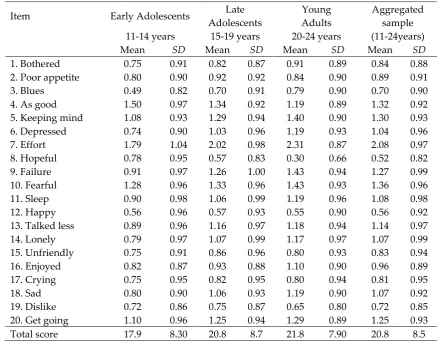
3.2. Descriptive statistics
172
Table 2 shows the means and standard deviations for the developed CES-D for adolescents by age
173
group and the aggregated sample.
174
175
Table 2. Means and standard deviations of the developed CES-D for adolescents for each age group
176
and the aggregated sample
177
Item Early Adolescents Late
Adolescents
Young Adults
Aggregated
sample (11-24years)
11-14 years 15-19 years 20-24 years
Mean SD Mean SD Mean SD Mean SD
1. Bothered 0.75 0.91 0.82 0.87 0.91 0.89 0.84 0.88 2. Poor appetite 0.80 0.90 0.92 0.92 0.84 0.90 0.89 0.91 3. Blues 0.49 0.82 0.70 0.91 0.79 0.90 0.70 0.90 4. As good 1.50 0.97 1.34 0.92 1.19 0.89 1.32 0.92 5. Keeping mind 1.08 0.93 1.29 0.94 1.40 0.90 1.30 0.93 6. Depressed 0.74 0.90 1.03 0.96 1.19 0.93 1.04 0.96 7. Effort 1.79 1.04 2.02 0.98 2.31 0.87 2.08 0.97 8. Hopeful 0.78 0.95 0.57 0.83 0.30 0.66 0.52 0.82 9. Failure 0.91 0.97 1.26 1.00 1.43 0.94 1.27 0.99 10. Fearful 1.28 0.96 1.33 0.96 1.43 0.93 1.36 0.96 11. Sleep 0.90 0.98 1.06 0.99 1.19 0.96 1.08 0.98 12. Happy 0.56 0.96 0.57 0.93 0.55 0.90 0.56 0.92 13. Talked less 0.89 0.96 1.16 0.97 1.18 0.94 1.14 0.97 14. Lonely 0.79 0.97 1.07 0.99 1.17 0.97 1.07 0.99 15. Unfriendly 0.75 0.91 0.86 0.96 0.80 0.93 0.83 0.94 16. Enjoyed 0.82 0.87 0.93 0.88 1.10 0.90 0.96 0.89 17. Crying 0.75 0.95 0.82 0.95 0.80 0.94 0.81 0.95
18. Sad 0.80 0.90 1.06 0.93 1.19 0.90 1.07 0.92
19. Dislike 0.72 0.86 0.75 0.87 0.65 0.80 0.72 0.85 20. Get going 1.10 0.96 1.25 0.94 1.29 0.89 1.25 0.93 Total score 17.9 8.30 20.8 8.7 21.8 7.90 20.8 8.5
178
3.3.1. Results of EFA by age group.
180
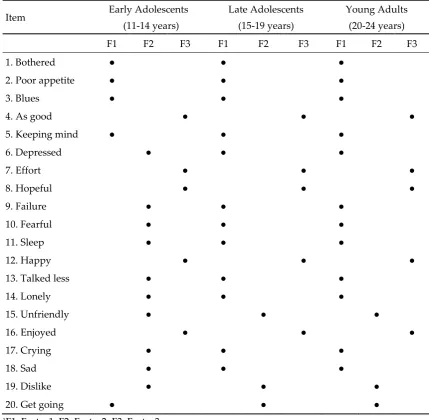
Table 3 shows the results of EFA by age group. We decided upon a 3-factor model for all three
181
age groups. However, the factor structure for early adolescents differed from that of the other two
182
age groups. Factor 1 in the model for early adolescents included five items, while Factor 1 for late
183
adolescents and young adults included 12 items. Similarly, Factor 2 in the model for early adolescents
184
included ten items, while Factor 2 for late adolescents and young adults included three items. Factor
185
3 included the same five items for all three age groups.
186
187
Table 3. Results for the exploratory factor analysis by age groups in Laotian adolescents
188
Item Early Adolescents
(11-14 years)
Late Adolescents (15-19 years)
Young Adults (20-24 years)
F1 F2 F3 F1 F2 F3 F1 F2 F3
1. Bothered ● ● ●
2. Poor appetite ● ● ●
3. Blues ● ● ●
4. As good ● ● ●
5. Keeping mind ● ● ●
6. Depressed ● ● ●
7. Effort ● ● ●
8. Hopeful ● ● ●
9. Failure ● ● ●
10. Fearful ● ● ●
11. Sleep ● ● ●
12. Happy ● ● ●
13. Talked less ● ● ●
14. Lonely ● ● ●
15. Unfriendly ● ● ●
16. Enjoyed ● ● ●
17. Crying ● ● ●
18. Sad ● ● ●
19. Dislike ● ● ●
20. Get going ● ● ●
1F1: Factor1, F2: Factor2, F3: Factor3
189
190
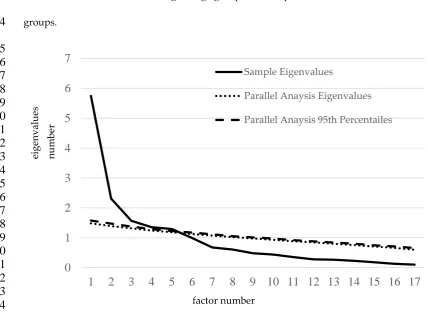
3.3.2. Results of parallel analysis.
Figure1 shows the results of the parallel analysis. Based on this analysis, we assumed a 2-factor
192
model as a common model among the age groups and adopted a common solution for all three age
193
groups.
194
195
196
197
198
199
200
201
202
203
204
205
206
207
208
209
210
211
212
213
214
Figure 1: Results of parallel analysis with aggregated data across the three age groups
215
216
217
3.3.3. Results of multi-group analysis.
218
Results of the multi-group analysis indicated good fit (χ2 = 5648.636, df = 619, p<.01, RMSEA =
219
.059, 90% confidence interval [CI]: .058–.061), p<.01, CFI = .912, and SRMR = .058). Based on the results
220
of the multi-group analysis, we determined that a 2-factor model was a common model among the
221
age groups.
222
223
3.3.4. Results of CFA.
224
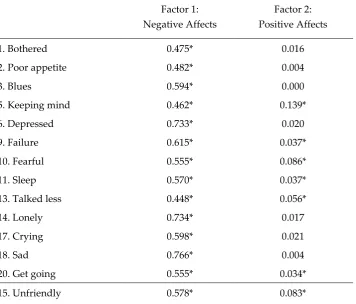
As a result of CFA, we confirmed that the 2-factor model, which had been identified in the
multi-225
group analysis, was the best fitting structure for the aggregated data with all three age groups. The
226
best-fitting structure comprised two factors: “Negative affect” (F1) and “Positive affect” (F2) (Table
227
4). The first factor contained 15 items, and it had to combine items indicating “Depressed affect,”
228
0
1
2
3
4
5
6
7
1
2
3
4
5
6
7
8
9
10 11 12 13 14 15 16 17
Sample Eigenvalues
Parallel Anaysis Eigenvalues
Parallel Anaysis 95th Percentailes
factor number
eigenva
lues
n
um
be
“Somatic and retarded activity,” and “Interpersonal.” The second factor contained five items:
229
“Positive affect” and “Somatic and retarded activity.” Results of the CFA with the 2-factor model
230
indicated good fit (χ2 = 5808.733, df = 169, p<.01, RMSEA = .066, 90% confidence interval [CI]: .065–
231
.068), p = .01, CFI = .911, and SRMR = .056). Cronbach's alpha coefficient was .81. Regarding factor
232
correlations, there was a significant correlation between factor scores for “Negative affect” and
233
“Positive affect” (r = .137, SE = .020, p<.05). Therefore, we concluded that the developed model could
234
be applied as a scale for depressive symptoms among Laotian adolescents.
235
Although the Laotian adult model [15] consists of three factors, the Laotian adolescent model
236
consisted of two factors. The “Effort” item loaded on the “Somatic and retarded activity” factor in
237
Radloff’s model [14], while it was excluded in the Laotian adult model and loaded on the “Positive
238
affect” factor in the Laotian adolescent model. Moreover, “Depressed affect,” “Somatic and retarded
239
activity,” and “Interpersonal” items were combined into one factor (“Negative affect”) in the Laotian
240
adolescent model.
241
242
Table 4. Solution for the confirmatory factor analysis in Laotian adolescents
243
Factor 1: Negative Affects
Factor 2: Positive Affects
1. Bothered 0.475* 0.016
2. Poor appetite 0.482* 0.004
3. Blues 0.594* 0.000
5. Keeping mind 0.462* 0.139*
6. Depressed 0.733* 0.020
9. Failure 0.615* 0.037*
10. Fearful 0.555* 0.086*
11. Sleep 0.570* 0.037*
13. Talked less 0.448* 0.056*
14. Lonely 0.734* 0.017
17. Crying 0.598* 0.021
18. Sad 0.766* 0.004
20. Get going 0.555* 0.034*
19. Dislike 0.628* 0.098*
7. Effort 0.158* 0.544*
4. As good_(r) 0.013 0.464*
8. Hopeful_(r) 0.063* 0.643*
12. Happy_(r) -0.124* 0.568*
16. Enjoyed_(r) -0.264* 0.419*
1 Fit indices: Chi-Square Test of Model Fit (Value: 5808.733, Degrees of Freedom: 169, p<.01), RMSEA
244
(Estimate .066, 90 Percent C.I.: .065-.068, Probability RMSEA <= .05: p<.01), SRMR: .056, CFI: .911
245
2 (r): reverse-scored item
246
3 * significant at 5% level
247
248
4. Discussion
249
This study developed a CES-D for Laotian adolescents and examined its reliability, validity, and
250
factorial properties. As a result, we found a 2-factor structure consisting of “Negative affect” and
251
“Positive affect” as the best fitting model for the Laotian adolescent.
252
In the following discussion, we focus on the differences between the Laotian adolescent model,
253
the Laotian adult model, Radloff’s model, and other adolescent models in Asia.
254
We identified three differences between the Laotian adult model and the Laotian adolescent model.
255
First, the Laotian adult model comprises three factors: “Sadness/loneliness,” “Psychosomatic
256
symptoms,” and “Lack of positive affect” [15], while the Laotian adolescent model consists of two
257
factors. Second, interpersonal items behaved differently in the two models. “Dislike” and
258
“Unfriendly” loaded on “Negative” items in the adolescent model, but “Dislike” loaded on
259
“Sadness/loneliness,” and “Unfriendly” was excluded from the adult model. Third, the “Effort” item,
260
indicating “Somatic and retarded activity,” was combined with the items “Happy,” “Enjoyed,”
261
“Hopeful,” and “As good as” in the Laotian adolescent model, and the aggregate of these items
262
formed “Positive affect,” as in Radloff’s model, but unlike the adult model, in which “As good as”
263
was excluded because of its low loading. This may be why the Laotian adolescent model developed
264
in this study consisted of factors similar to the Depression Self-Rating Scale for Children (DSRS-C),
265
which was developed for children rather than adults [33].
266
A possible reason why the Laotian adolescent model is composed of two factors, namely
267
symptoms as a result of suppression of mental depressive mood. On the other hand, in adolescents,
269
mental function and sociality are still immature and developing, and thus, mental depressive mood
270
and physical symptoms often remain undifferentiated or not fully differentiated [34]. In addition, it
271
is thought that the factors that differentiate such experiences of depression are the influence of
272
developmental factors and social culture, and the nature of the event that causes depression (the
273
stressor) [35]. Other possible reasons for the differences between the adults and adolescents model
274
are that the translation of the CES-D for adolescents was improved compared with the model for
275
adults. Besides, the size of the adolescent sample was much larger than that of the adult sample.
276
In the comparison between Radloff’s model and the Laotian adolescent model, we identified three
277
differences. First, Radloff’s model comprises four factors, whereas the Laotian adolescent model
278
comprises two factors. Second, items in “Depressive affect,” “Somatic and retarded activity,” and
279
“Interpersonal” were distinguished as individual factors in Radloff’s model, while items in these three
280
factors were combined into one factor (“Negative affect”) in the Laotian adolescent model. Third, the
281
Laotian adolescent model combined the “Effort” item that indicates “Somatic and retarded activity”
282
with other items indicating “Positive affect” as one factor.
283
As for the second point, the lack of distinction between “Depressed affect” items and “Somatic and
284
retarded activity” items are one of the same characteristics as reported in several previous studies with
285
adolescent samples in Asia [16,18,20,21,25]. In addition, the Laotian adolescent samples did not
286
distinguish “Unfriendly” and “Dislike” as “Interpersonal.” These results supported the findings of
287
previous studies with samples of Filipino American adolescents [16], Taiwanese adolescents [24],
288
Mainland Chinese adolescents [19], Malaysian adolescents [20], and Korean adolescents [21]. These
289
previous studies could not distinguish the “Depressed affect” and “Somatic and retarded activity”
290
items from the interpersonal items.
291
Moreover, regarding the third point, the “Effort” item indicating “Somatic and retarded activity”
292
loaded on “Positive affect” in the Laotian adolescent model. This is one of Laotian CES-D models'
293
interpretation of the reason for the different loading of “Effort,” the meaning of the “Effort” item may
295
have a positive nuance because of the cultural and expressive characteristics of the Lao language.
296
When developing the CES-D in a language other than English, it is necessary to carefully consider
297
the meaning and nuances of every word, phrase, sentence, expression, and cultural context behind
298
the language.
299
Besides, a possible reason for the overlap between “Depressive affect” and “Somatic retarded
300
activity” items in the adolescent model is that Laotians may tend to regard somatic symptoms as
301
depressive affective symptoms, and report them in such a manner and, what is more. Laotian people
302
may show somatic symptoms and related psychological symptoms, as is confirmed by other studies
303
in Asian samples [36,37], including the Laotian adult population [15].
304
There are several limitations to this study. First, the sample covered only three areas of Lao PDR,
305
and none of the three were remote areas. Therefore, the sample is not representative of the general
306
Laotian adolescent population. In general, adolescents are at higher risk of mental health disorders
307
because of their fragile living conditions, stigma, discrimination, or exclusion because of belonging
308
to minority ethnic or sexual backgrounds or other discriminated groups, or lack of access to quality
309
support and services [3]. Therefore, it is needed to examine if the developed CES-D applies to Laotian
310
adolescents who live in remote areas or under other living conditions, including adolescents with
311
disadvantages such as belonging to minority groups. Second, it is necessary to clarify depressive
312
tendencies in Laotian adolescents and factors related to these tendencies in future studies. Multiple
313
factors ranging from socioeconomic problems to the quality of children’s home life or relationships
314
with friends and guardians are recognized as risks to mental health [3]. Clarifying factors related to
315
adolescent mental health in the Laotian context will contribute to developing effective mental health
316
programs in Laos.
317
5
. Conclusions
318
This study developed a Laotian version of CES-D for adolescent, and examined its reliability and
319
comprising two factors: “Negative affect” and “Positive affect.” “Effort” items loaded on the “Somatic
321
and retarded activity” factor in the original model but loaded on the “Positive affect” factor in the
322
adolescent model. “Depressed affect,” “Somatic and retarded activity,” and “Interpersonal” items
323
were combined into the “Negative affect” factor in the adolescent model.
324
325
Author Contributions:
326
Conceptualization, Sachi Tomokawa and Takashi Asakura; Formal analysis, Sachi Tomokawa and
327
Takashi Asakura; Funding acquisition, Sachi Tomokawa; Investigation, Sachi Tomokawa, Takashi
328
Asakura and Kimihiro Miyake; Methodology, Sachi Tomokawa, Takashi Asakura, Ngouay Keosada,
329
Vannasouk Bouasangthong , Vanthala Souvanhxay, Kethsana Kanyasan and Kimihiro Miyake;
330
Project administration, Sachi Tomokawa, Ngouay Keosada, Vannasouk Bouasangthong , Vanthala
331
Souvanhxay, Kethsana Kanyasan, Sithane Soukhavong and Khamseng Thalangsy ; Resources, Sachi
332
Tomokawa; Supervision, Takashi Asakura, Sithane Soukhavong, Khamseng Thalangsy and
333
Kazuhiko Moji; Writing – original draft, Sachi Tomokawa and Kimihiro Miyake; Writing – review &
334
editing, Sachi Tomokawa, Takashi Asakura, Ngouay Keosada, Vannasouk Bouasangthong , Vanthala
335
Souvanhxay, Kethsana Kanyasan, Kimihiro Miyake, Sithane Soukhavong, Khamseng Thalangsy and
336
Kazuhiko Moji.All authors have read and agreed to the published version of the manuscript.
337
338
Funding: Please add:
339
This research was funded by JSPS KAKENHI Grant Number JP 18K19671, and Grant from National
340
Centre for Global Health and Medicine(30-4).
341
342
We would like to thank students in provinces of Luangprabang, Savannakhet, and Champasak,
344
who participated in this research.
345
346
Conflicts of Interest: The authors declare no conflict of interest.
347
348
References
349
1. World Health Organization. Adolescents: health risks and solutions. Available online:
350
https://www.who.int/news-room/fact-sheets/detail/adolescents-health-risks-and-solutions
351
(accessed on 23 July 2020).
352
2. Kessler, R.C., Amminger, G.P., Aguilar-Gaxiola S., Alonso J., Lee S. , Ustün T.B. Age of onset of
353
mental disorders: a review of recent literature. Curr Opin Psychiatry. 2007a.20(4), 359-64.
354
https://doi.org/10.1097/YCO.0b013e32816ebc8c
355
3. World Health Organization. WHO Adolescent health key fact. Available online:
356
https://www.who.int/news-room/fact-sheets/detail/adolescent-mental-health (accessed on 23 July
357
2020).
358
4. Kessler, R.C., Angermeyer, M., Anthony, J.C., de Graaf, R., Demyttenaere, K. Gasquet, I. Lifetime
359
prevalence and age-of-onset distributions of mental disorders in the World Health
360
Organization's World Mental Health Survey Initiative. World Psychiatry. 2007b. 6(3), 168-76.
361
5. Kieling, C., Baker-Henningham, H., Belfer, M., Conti, G., Ertem, I., Omigbodun, O., Rohde, … N.,
363
Rahman, A. 2011. Child and adolescent mental health worldwide: evidence for action. Lancet,
364
378(9801), 1515-25. https://doi.org/10.1016/S0140-6736(11)60827-1.
365
6. World Health Organization. Depression and other common mental disorders, Global health estimates,
366
Available online:
http://apps.who.int/iris/bitstream/10665/254610/1/WHO-MSD-MER-2017.2-367
eng.pdf (accessed on 23 July 2020).
368
7. Asakura, T., Hein, M., Tomokawa, S., Moji, K. Kobayashi, J. The ecosystem approach to health is
369
promising strategy in international development: lessons from Japan and Laos. Global Health. 2015.
370
11(3), https://doi.org/10.1186/s12992-015-0093-0
371
8. Laos statistical Information Service. Available online:
372
https://laosis.lsb.gov.la/tblInfo/TblInfoList.do?fbclid=IwAR1Rx_2fzFhNpoXS9ca1BpAd57ybHeu
373
MhSxtUR9weTz0ONFMqvkvJTumKmo (accessed on July 2020).
374
9. United Nations Educational, Scientific, and Cultural Organization. UNESCO Data for the Sustainable
375
Development Goals, Browse by country, Lao People's Democratic Republic. Education and literacy,
376
Available online: http://uis.unesco.org/country/LA (accessed on 23 July 2020).
377
10. Ministry of Education and Ministry of Health, Lao PDR. National School Health Policy, Ministry
378
of Education, and Ministry of Health, Lao PDR, Vientiane, Lao PDR. 2010. pp. 1-15
379
11. World Health Organization. Health for the World’s Adolescents A second chance in the second decade.
380
Available online:
381
https://apps.who.int/iris/bitstream/handle/10665/112750/WHO_FWC_MCA_14.05_eng.pdf?seque
382
12. Phanthavong, P., Naphayvong, P., Reinharz, D. Depression among last-year high school
384
students in Vientiane, capital city of Lao PDR. Asia Pac J Public Health. 2015. 27(2),1995-1998,
385
https://doi.org/10.1177/1010539513489135
386
13. Beck, A.T., Ward, C.H., Mendelson, M., Mock, J. , Febraugh, J. An inventory for measuring
387
depression. Arch Gen Psychiatry. 1961.4, 561-71.
388
https://doi.org/10.1001/archpsyc.1961.01710120031004
389
14. Radloff, S. L. The CES-D scale: A self-report depression scale for research in the general
390
population. Appl Psychol Meas. 1977.1, 3, 385-401 https://doi.org/10.1177/014662167700100306
391
15. Tomokawa, S., Asakura, T., Keosada, N., Miyake, K. Khamheang, U., Moji, K. Preliminary study
392
of the reliability and validity of the Center for Epidemiologic Studies Depression Scale in Lao PDR.
393
Psychology. 2018.9(10), 2396-2410. https://doi.org/ 10.4236/psych.2018.910137
394
16. Edman, J.L., Danko, G.P., Andrade, N., McArdle, J.J., Foster, J. , Glipa, J. Factor structure of the
395
CES-D (Center for Epidemiologic Studies Depression Scale) among Filipino-American
396
adolescents. Soc Psychiatry Psychiatr Epidemiol. 1999. 34(4), 211-215.
397
https://doi.org/10.1007/s001270050135
398
17. Dick, R.W., Beals, J., Keane, E.M., Manson, S. Factorial structure of the CES-D among American
399
Indian adolescents. J. Adolesc. 1994. 17, 73-79. https://doi.org/10.1006/jado.1994.1007
400
18. Yen, S., Robins, C.J., Lin, N. A cross-cultural comparison of depressive symptom manifestation:
401
China and the United States. J Consult Clin Psychol. 2000. 68(6), 993-999.
402
19. Wang, M., Armour, C., Wu, Y., Ren, F., Zhu, X.,Yao, S. Factor structure of the CES-D and
404
measurement invariance across gender in Mainland Chinese adolescents. J. Clin. Psychol.
405
2013.69(9), 966-979. https://doi.org/ 10.1002/jclp.21978.
406
20. Ghazali, S.R., Elklit, A., Balang, R.V., Chen, Y.Y. Concurrent validity and exploratory factors
407
analysis of the Malay version of center for epidemiologic studies depression scale (CESD) among
408
Malaysian adolescents, ASEAN Journal of Psychiatry. 2016.17(1), 71-78.
409
21. Heo, E.H., Choi, K.S., Yu, J.C., Nam, J.A. Validation of the Center for Epidemiological Studies
410
Depression Scale among Korean Adolescents, Psychiatry Investig. 2018. 15(2), 124-132.
411
https://doi.org/10.30773/pi.2017.07.19.
412
22. Crockett, LJ, Randall, B.A., Shen, Y.L., Russell, S.T, Driscoll, A.K. Measurement Equivalence of
413
the Center for Epidemiological Studies Depression Scale for Latino and Anglo Adolescents: A
414
National Study. J Consult Clin Psychol. 2005. 73(1), 47-58.
https://doi.org/10.1037/0022-415
006X.73.1.47
416
23. Li, H.C., Chung, O.K., Ho, K.Y. Center for Epidemiologic Studies Depression Scale for Children:
417
psychometric testing of the Chinese version. J Adv Nurs. 2010.66(11), 2582-2591.
418
https://doi.org/10.1111/j.1365-2648.2010.05440.x.
419
24. Cheng, C.P., Yen, C.F., Ko, C.H., Yen, J.Y. Factor structure of the Center for Epidemiologic
420
Studies Depression Scale in Taiwanese adolescents. Compr Psychiatry. 2012. 53(3), 299-307.
421
25. Ying, Y.W., Lee, P.A., Tsai, J.L., Yeh, Y.Y., Huang, J.S. The conception of depression in Chinese
423
American college students. Cultur Divers Ethnic Minor Psychol. 2000. 6(2), 183-195.
424
https://doi.org/10.1037/1099-9809.6.2.183
425
26. World Health Organization. Very young adolescents. Available online:
426
https://www.who.int/reproductivehealth/topics/adolescence/very_young_ados/en/(accessed on
427
23 July 2020).
428
27. World Health Organization. Available online: Adolescent health in the South-East Asia Region.
429
https://www.who.int/southeastasia/health-topics/adolescent-health (accessed on 23 July 2020).
430
28.United Nations Children's Fund. Early and late adolescence, Available online:
431
https://www.unicef.org/sowc2011/pdfs/Early-and-late-adolescence.pdf(accessed on 23 July 2020).
432
29. Sawyer, S.M., Azzopardi, P.S., Wickremarathne, D., Patton, G.C. The age of adolescence.
433
Lancet Child Adolesc Health. 2018. 2(3), 223-228. https://doi.org/ 10.1016/S2352-4642(18)30022-1.
434
30. Browne, M.W. & Cudeck, R. Alternative ways of assessing model fit. In Testing structural equation
435
models. Bollen, K.A., Long, J.S. (Eds.) Newbury Park, CA: Sage, 1993. pp.136–162.
436
31. Hu, L., Bentler, P. M., Cutoff criteria for fit indexes in covariance structure analysis:
437
Conventional criteria versus new alternatives. Struct Equ Modeling. 1999.6,1–55.
438
https://doi.org/10.1080/10705519909540118
439
32. Bentler, P.M. Comparative fit indexes in structural models. Psychol Bull. 1990. 107(2), 238-246.
440
https://doi.org/10.1037/0033-2909.107.2.238
441
33. Birleson, P., The Validity of Depressive Disorder in Childhood and the Development of a
Self-442
Rating Scale: A Research Report. J Child Psychol Psychiatry. 1981.22, 73-88.
443
34. Denda, K. Kodomo no utsu byou (Depression in children). Tokyo, Japan, Kongo syuppan, 2002.
445
pp.14-17.( in Japanese )
446
35. Falicov, C.J., Culture, Society and Gender in Depression. J Fam Ther. 2003. 25(4), 371–
447
387. https://doi.org/10.1111/1467-6427.00256
448
36. Parker, G., Cheah, Y.C., Roy, K. Do the Chinese somatize depression? Across-cultural study.
449
Soc Psychiatry Psychiatr Epidemiol. 2001. 36, 287-293. https://doi.org/10.1007/s001270170046
450
37. Ryder, A. G., Yang, J., Zhu, X., Yao, S., Yi, J., Heine, S. J., The Cultural Shaping of Depression:
451
Somatic Symptoms in China, Psychological Symptoms in North America? . J Abnorm Psychol . 2008,
452
117, 300-313. https://doi.org/10.1037/0021-843X.117.2.300