Context-Processing in Schizophrenia:
Differential Relationships Between Symptoms
TRACEY BROWN
D.Clin.Psy 2002
University College London
All rights reserved
INFORMATION TO ALL USERS
The quality of this reproduction is dependent upon the quality of the copy submitted.
In the unlikely event that the author did not send a complete manuscript and there are missing pages, these will be noted. Also, if material had to be removed,
a note will indicate the deletion.
uest.
ProQuest U642746
Published by ProQuest LLC(2015). Copyright of the Dissertation is held by the Author.
All rights reserved.
This work is protected against unauthorized copying under Title 17, United States Code. Microform Edition © ProQuest LLC.
ProQuest LLC
789 East Eisenhower Parkway P.O. Box 1346
ABSTRACT
1
INTRODUCTION
3
Overview 3
What is Schizophrenia? 4
Issues in Categorising the Symptoms of Schizophrenia 5 Cognitive Deficits in Schizophrenia 8 What are Illusory Conjunctions? 17 Illusory Conjunctions and Context Processing in Schizophrenia 20
The Present Study 25
The Effects of Medication During Cognitive Testing 33
METHOD
36Participants 36
Allocation o f the Schizophrenia Participants to the Symptom
Groups 39
Allocation o f the Schizophrenia Participants to the * Duration o f
Illness ’ Groups 42
Allocation o f the Schizophrenia Participants into the Medication
Groups 42
Ethics 43
Materials 44
Procedure 47
Design 50
Reliability 51
Validity 51
Utility 52
Hypothesis One 54
Hypothesis Two 61
Hypothesis Three 62
Hypothesis Four 62
Hypothesis Five 63
Medication 64
Summary 66
DISCUSSION
69Overview 69
Schizophrenia Versus Non-psychiatric Controls 71 Non-significant Findings Between Symptom Sub-types 77 Neurological Implications for Schizophrenia 80
Methodological Limitations 82
Data Collection 82
Design 83
Schizophrenia Group 85
Comparison Group 87
Medication 87
Clinical Implications for a Cognitive Model of Schizophrenia 88
Conclusion 91
REFERENCES
92Figure 1. Example of a trial with objects presented to the left foveal field. This shows a possible illusory conjunction as the features ‘red’ and ‘triangle’ may erroneously combine Figure 2. Example of a trial with objects in the peripheral field.
This shows a ‘target’ trial as it has a red triangle
45
45
Figure 3. Graph to illustrate the number of illusory conjunctions seen As the attention load increased over the three conditions for
schizophrenics and controls 56 Figure 4. Graph to illustrate the number of target errors made as the
attention load increased over the three conditions for
schizophrenics and controls 57 Figure 5. Graph to illustrate the number of total errors seen as the
attention load increased over the three conditions for
Table 1. Sex, ethnicity and education data for the schizophrenia group
and controls 38
Table 2. Age differences between the schizophrenia and control group 39
Table 3. Number of patients with each symptom rated at 4 or above on
theBPRS 41
Table 4. ANOVAs for the schizophrenia group versus the non-psychiatric control group for number of illusory conjunctions, target errors
and total errors seen. 55
Table 5. Bonferroni pairwise comparisons showing the mean differences between the schizophrenia group versus the non-psychiatric control group and the mean differences between each condition for number of illusory conjunctions, target errors and total errors
seen 59
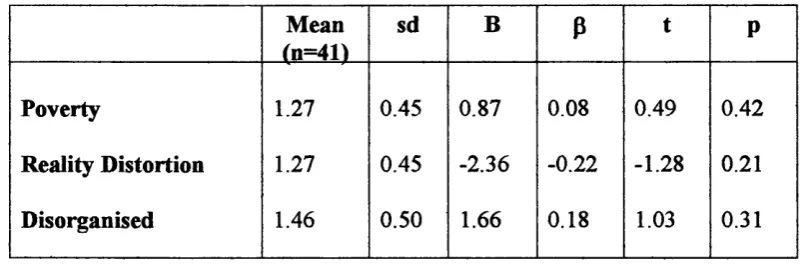
Table 6. Multiple regression analysis of the number of illusory
conjunctions seen for the three schizophrenic symptoms 62
Table 7. Multiple regression analysis of the total number of errors made
for the three schizophrenic symptoms 63
Table 8. ANOVA showing the differences between the number of
illusory conjunctions seen and the duration of illness 64
Table 9. ANOVAs showing the differences between the dosages of antipsychotic medication in relation to the number of illusory
conjunctions, target errors and total errors made 65
Table 10. T-tests showing the differences between anticholinergic medication and the number of illusory conjunctions, target
The context processing theory of schizophrenia proposes that when processing information, there is a dedicated mechanism used to select task appropriate responses over task irrelevant ones. It is suggested that in schizophrenia there is a weakening of context processing mechanisms, which causes irrelevant information to be attended to and given greater significance than is required. An illusory conjunction task was designed to test the hypothesis that people with schizophrenia perform differently on context-sensitive tasks to non-psychiatric controls. As it has been suggested that context processing is more deficient in certain sub-types of schizophrenia it was further hypothesised that patients categorised into ‘poverty’, ‘reality distortion’ and ‘disorganised’ symptoms would have significant differences in their performance and that acute symptoms of schizophrenia would see more illusory conjunctions than those with chronic symptoms.
Overview
The presentation of symptoms of schizophrenia can raise a considerable challenge to clinicians working in the field of mental health. They are fi"equently severe, multidimensional in nature, a range of symptoms can be present at the same time and are quite likely to change over the course and duration of the illness. They can produce debilitating cognitive difficulties that can be very distressing to both the person suffering and to their family and fiiends. Clinicians have to be skilled in recognising the presentation of psychotic symptoms and to be able to diagnose and treat as quickly as possible to enable the best level of care. Understanding the cognitive disturbances that underlie schizophrenia is useful for clinicians, as it gives added insight into the difficulties that patients might face. It is not surprising therefore that there has been considerable research into the effects of schizophrenia upon cognitive processes and the implications this provides for the classification of different subtypes of the disease.
perceptual problems found in schizophrenia will be discussed, paying particular attention to the theories surrounding context processing and illusory conjunctions, as these are the basis of the following research. Examples of previous research on context processing and illusory conjunctions with regards schizophrenia will be given, including a discussion of their findings and methodological weaknesses. Finally the aims of the present study will be discussed and reasons given for why this piece of research is important to the continuing study of cognitive and perceptual deficits in schizophrenia.
What is Schizophrenia?
schizophrenia, yet all are completely different in their presentation. He described one man as withdrawn, fixated on religious themes, having auditory hallucinations of water pouring and tactile hallucinations of his food tasting wrong. Another man became pre occupied with odd ideas, such as believing his rent book was falsified and fluctuated between extremes of emotions within minutes. He also described one woman as unable to produce coherent sentences, who would sit in a chair for only a few minutes and then wander around the room picking up articles or sit on the floor. Such examples suggest that there seems to be no one ‘true’ set of symptoms that can define schizophrenia. Furthermore, it seems to be independent of culture and socio-economic status, its course and duration appear difficult to define and outcome is not predictable. It is not surprising therefore that there is a great deal of controversy as to how schizophrenia should be categorised.
Issues in Categorising the Symptoms of Schizophrenia
are more likely to develop over time and become more chronic in their presentation. Crow believed that these categories were independent entities, reflecting different pathological processes.
The categorisation of schizophrenia into the two distinct sub-types defined by Crow has been used extensively when studying cognitive deficits in schizophrenia. However a literature search on the positive and negative symptoms of schizophrenia has shown that there is still some uncertainty as to whether the symptoms that have been designated to these categories are the correct ones. Nicholson, Chapman & Neufeld (1995) state that there have been at least seven different constructs of the sub-types that make up schizophrenia. For example, Andreasen (1982) included inappropriate affect into the negative schizophrenia group whereas Crow (1980) included it in the positive group. Similarly, Servan-Schreiber, Cohen & Steingard (1996) included conceptual disorganisation into the positive group but Cohen et al. (1999) have used this as a separate category altogether. Factor analytic studies suggest that using two categories does not sufficiently capture the complexities of schizophrenia and some believe that a three-factor model is more appropriate (Liddle, 1987a; Arndt, Alliger & Andreason, 1991; Cohen et al., 1999). Liddle named these factors: Reality Distortion (hallucinations and delusions). Poverty (poverty of speech, motor retardation) and Disorganisation (incoherent speech, inappropriate effect).
al., 1986; Frith et al., 1995) and positive symptoms are associated with deficits within the temporal lobes (Dolan et al., 1995; Fletcher et al., 1996). Frith at al. (1995) used functional imaging during a verbal fluency task on 18 patients with negative-type symptoms and six ‘normal’ controls. They found that there was reduced activity in the prefi'ontal region for the schizophrenia group, which was not found in the control group. Dolan et al. (1995) used functional imaging on a verbal fluency task on 12 patients with positive-type symptoms and 12 healthy controls. They found that the schizophrenia group had a failure of deactivation in the temporal region, which was not present in the control group.
Neuropsychological tests have also indicated that patients with negative symptoms perform poorly on fi"ontal lobe tests such as verbal fluency and patients with positive symptoms perform poorly on temporal lobe tests such as figure-ground perception (Liddle, 1987b; Liddle et al., 1989). Studies have also shown that the disorganisation syndrome has specific deficits of its own. For example, using the Stroop Task, Cohen et al. (1999) found that people with disorganised-type symptoms of schizophrenia were slower at naming the ink colour of a colour word than other symptom sub-groups and normal controls. Jensterle et al. (2000) found that on the Hayling Sentence Completion Task, patients with disorganised symptoms had more difficulty in fitting the correct word to the context than normal controls and would produce unusual words.
whose symptoms were originally assigned to both positive and negative groups, is now seen as a separate sub-group. The majority of symptoms for the disorganisation group relate to a disorder in form of thought, which has in the past been seen as central to schizophrenia (Bleuler, 1911; Harrow, Silverstein & Marengo, 1983; Liddle, 1987a, 1987b). Johnstone & Frith (1996) have produced further evidence that the groups known as ‘poverty’ ‘reality distortion’ and ‘disorganisation’ are separate dimensions of schizophrenia. They used a sample of 329 unselected patients diagnosed with schizophrenia and found that the categories differed significantly in relation to mental state variables, physical treatments administered, movement disorder, demographic and historical features and cognitive function. Cognitive fiinction is of particular importance, as the ability to indicate differences in cognitive deficits between schizophrenic symptoms should lead to an increase in understanding its aetiology. As Berrios states, ‘the reliability and validity of schizophrenia depends upon the ‘coherence, stability and clarity of the symptom cluster’ (Berrios, 1995, pl2).
Cognitive Deficits in Schizophrenia
suggested that people with positive symptoms of schizophrenia, may have more difihculty in carrying out bottom-up processing. For example, Carr, Dewis & Lewin (1998a) found that patients with the hallucination symptoms from the positive sub group were more likely to have longer reaction times when searching for a target letter amongst a range of letters than other sub-groups of schizophrenia. They also found that patients with delusional symptoms required longer exposure times when searching for an arrow amongst line distractors than other sub-groups of schizophrenia (Carr, Dewis & Lewin 1998b). This suggests that people with positive symptoms of schizophrenia may have a reduced information processing capacity, which means that they are more likely to make errors of object recognition when attention becomes focused.
deficits that influence the categorisation of symptoms in schizophrenia.
Top-down processing refers to the use of prior experiences and the context of the situation to guide interpretation of incoming stimulus. People with negative symptoms may be more likely to have difficulty carrying out top-down processing as it has been suggested that they have deficits within the fi*ontal cortex (Andreasen et al., 1986; Frith et al., 1995) which is linked to the processing of contextual information (Cohen & Servan-Schreiber, 1992). One theory that has tried to identify particular cognitive deficits between symptoms during top-down processing is the context processing theory. This has been researched extensively by Cohen and Servan-Schreiber (Cohen & Servan-Schreiber, 1992; Cohen et al., 1994; Servan-Schreiber & Blackburn, 1995; Servan-Schreiber, Cohen & Steingard, 1996; Cohen et al., 1999), who believe that several of the deficits observed in people with schizophrenia can be related to the processing of contextual information. Context processing involves using pre-defined, related, information to help in the processing of new information. Servan-Schreiber, Cohen & Steingard (1996) propose that contextual information is 'information that has to be actively held in mind in such a form that it can be used to mediate an
appropriate behavioural response' (pi 105). Contextual information can be task instructions, the processing of a sequence of prior stimuli, or specific prior stimuli that have been leamt over time. The latter are also known as schemata, which are 'stored traces o f earlier experiences that allow fo r rapid unconscious processing o f redundant
A reduction in the ability to use contextual information causes difficulty in suppressing strong, inappropriate responses when carrying out a task. In normal information processing, when a dominant response is irrelevant to the task in hand, context is important to select the weaker appropriate response. Therefore context processing is more than just the ability to select the appropriate behavioural response, it also involves selecting material from previously held schemas about the world to aid in the selection of the correct response. Gray et al. (1991) state that during normal automatic processing, information that is not required for the task is inhibited to reduce processing demands. Prior experiences are also involved to help reduce processing demands and must be limited to that which is relevant to the situation. In schizophrenia there is a weakening of inhibitory processes and the ability to select past experiences to aid in current perception. A lack of inhibitory processes causes irrelevant information to be attended to and given greater significance than is required. Therefore ‘a patient's thoughts may be imbued with a significance that is out o f proportion to their real
importance simply because they happen to capture the attentional focus ’ (Gray et al., 1991, p3).
Both attention and inhibition are used to select task-relevant information over other competing sources of information, whilst active memory is useful to hold the relevant information in mind until the response is required. As Braver et al. (2001) state,
'Because context representations are maintained on-line, in an active
state, they are continually accessible and available to influence
o f working memory. Specifically, context can be viewed as the subset
o f representations within working memory that govern how other
representations are used. In this manner, context representations
simultaneously subserve both mnemonic and control functions ’ (p748).
mechanism is utilized to support weaker responses when in competition with stronger ones and so the inhibitory mechanism is used to ignore the dominant response and attention is used to select the weaker, appropriate response.
Cohen et al. (1999) found that people with disorganised-type symptoms of schizophrenia were slower at naming the ink colour than normal controls due to an inability to use contextual information. Making the word a different colour to the ink colour caused the task-irrelevant information to become dominant. This dominant, but irrelevant, information became harder to inhibit and so patients took longer to give a correct answer than normal controls. People with reality distortion and poverty symptoms of schizophrenia did not show this effect. However the Stroop task only utihses the suppression of task irrelevant information and does not include a delay between a contextual cue (i.e. task instructions) and the appropriate response, which Cohen et al. indicate, is fundamental when making tasks sensitive to disturbances in context processing. Cohen et al. tried to remedy this situation by incorporating either a one-second or five-second delay between the task instructions and the response. However, it is questionable as to whether this delay was sensitive enough to create an effect for all schizophrenic sub-types.
Stimuli that was inhibited on the previous trial. For example, the first word, ‘red’ is written in blue ink, the second word, ‘green’ is written in red ink and the third word, ‘yellow’ is written in green ink. The participant must ignore the word and name the ink colour. With ‘healthy controls’ it should take longer to say the ink colour on each subsequent trial, due to the previous inhibition.
The CPT task (Rosvold et al., 1956), which has also been used to test the context processing theory, looks at active memory processes. It is suggested that in order to respond to information there must be some form of instructions or prior experience actively held in mind. To test this theory, participants were asked to push a button when they detected a pre-arranged target letter in a series of briefly exposed letters. It has been shown that people with schizophrenia spot fewer targets and have more false hits than normal controls (Neuchterlein, 1983, 1984; Comblatt et al., 1989). It has also been shown that people with schizophrenia respond slower to the correct stimuli than healthy controls (Nestor et al., 1990; Van den Bosch, 1995). Van den Bosch suggests that in healthy controls context processing mechanisms allow for rapid and flexible use of pre-arranged, contextual information. The slower performance by schizophrenics on the CPT indicates that there is a slowing down of their use of schemata during information processing.
only be done if information regarding the previous stimuli is held in mind. For example, to press a button when one sees an ‘X’ but only if it is proceeded by an ‘A’. The previous stimulus then provides a context for the task. Cohen & Servan-Schreiber (1992) found that participants with schizophrenia had difficulty in maintaining the internal representation of context (i.e. the task instructions) and gave fewer correct responses than healthy controls.
Stratta et al. (2000) found similar results to the Cohen and colleagues (Cohen & Servan-Schreiber, 1992; Servan-Schreiber, Cohen & Steingard, 1996; Cohen et al., 1999) when they modified the AX-CPT task on patients with schizophrenia and healthy controls. They used differential presentation times to manipulate the delay between the contextual cue and response. In their study patients had both positive and negative symptoms of schizophrenia. Context processing was found to affect both short and long delay times for the schizophrenia group only, with a progressive worsening of performance when there was a long delay. They also found that chronic patients had more errors than acute patients.
argue that although on CPT tasks one can infer a specific deficit, differential performance on tasks between schizophrenics and normal controls may well be due to the schizophrenic’s global performance deficits. This gives little in the way of insight into the difficulties that people with schizophrenia may have. Knight and Silverstein suggest that when comparing different groups, tasks that show similar results on easier levels but differences on harder levels are more likely to discriminate between specific and generalised deficits. Therefore to fijither research into the context processing theory a task that incorporates all elements of context processing (attention, inhibition and active memory) and one that increases group performance differences over various levels of difficulty may be more reliable than previous tasks.
The present study has taken such issues into consideration and, by using further research as a guide, it would seem that designing a new task that involves illusory conjunctions would be more appropriate for testing context processing deficits in schizophrenia.
What are Illusory Conjunctions?
perceived may be incorrectly combined to form illusory conjunctions' (Prinzmetal, Henderson & Ivry, 1995, pl363). Treisman & Gelade (1980) give the impression that all features are free floating in space and those within the same area as the spotlight of attention are ‘grabbed’. Lack of attention causes the wrong feature to be grabbed. They state that,
*^Any features which are present in the same central fixation o f attention are
combined to form a single object.... With memory decay or interference the
features may disintegrate and flo a t free once more, or perhaps recombine to
form illusory conjunctions ’ (p98).
An example of illusory conjunctions caused by a lack of attention can be seen in the study by Treisman & Schmidt (1982). They presented three coloured letters with flanking black digits to healthy participants. They had to first report the digits and then the coloured letters. In nearly 40% of trials participants reported illusory conjunctions. For example, when seeing a red T, a blue N and a green X, they would report an illusory conjunction of a green T. It was believed that the reporting of the digits first, had loaded up the attention needed to correctly combine the letters and colours. Therefore less attention was given to the letters and colours, which caused the illusory conjunctions to occur.
According to Hazeltine, Prinzmetal & Elliott location uncertainty occurs during visual processing. When identifying the shape and colour of an object separate areas of the visual system are used. For example, one area processes form whilst another area processes colour. Each area has a number of ‘feature detectors’, which are tuned to pick up on a certain feature. Each feature detector has a receptive field so that if the feature falls within this field the feature detector is fired. However, sometimes the feature detector does not fire when the feature is in the receptive field, or fires when the feature is not there. One possible reason may be that the receptive fields overlap slightly and so firing from a neighbouring receptive field may cause the feature detector to fire by mistake. Therefore the wrong colour may be connected to the wrong form to give a location uncertainty. For example, Ashby et al., (1996) presented healthy participants with a brief display of coloured letters from which they had to indicate when the target letter appeared. They found that illusory conjunctions occurred when the target and non-target letters were sufficiently close to each other and when no attention-demanding task was given (17% illusory conjunctions when letters were
1.6mm apart and 7% when 19.8mm apart).
into what we have seen during the pre-attentive stage of visual processing. During normal visual processing, the visual fields that hold task-relevant stimuli are more likely to be attended to. Task instructions therefore, provide the necessary context to choose the correct visual stimuli. If there is an error in the pre-attentive binding stage of visual processing due to a high attention load or a misperception of location, the context will override the weaker, correct response and an illusion may occur. For example, given the instructions to look for red triangles among a range of objects, the contextual information will be ‘red triangle’. Once the task instructions have been provided contextual processing mechanisms will attend to the information required (anything coloured red and any triangle), inhibit any information that is not required (ignoring the colour blue and any square shapes) and use active memory to hold the task instructions in mind whilst the task is being carried out. However, in normal visual processing there is a limit to how much a person can attend to at any one time. When attention is focused upon more than one task at the same time, thereby causing an overload to the attention capacity, the pathways for ‘blue triangle’ and ‘red square’ may be close enough together for a location uncertainty to occur. Context processing mechanisms are dominant over weaker responses even when the weaker response is correct. Therefore the dominant task instructions (‘look for red triangles’) inhibit the correct response and the triangle and the red colour fi’om the two different objects may be erroneously selected and an illusory conjunction of a red triangle is seen.
niusory Conjunctions and Context Processing in Schizophrenia
processing mechanisms are deficient. If this is the case then the evidence so far suggests that people with schizophrenia may be less likely to be ‘fooled’ by context. A comprehensive literature search was therefore undertaken to try to provide evidence for this hypothesis. It would seem that there are very few research studies looking at the phenomenon of context processing mechanisms within illusory conjunctions using schizophrenic groups. Those that have been found are described below.
Silverstein et al. (2000) have suggested that context processing is impaired in schizophrenia due to abnormal perceptual organisation during the binding of object features. They explain that visual processing involves binding stimuli into a 'context-appropriate coherent whole' (p i2), much the same as words or concepts are bound into coherent thoughts. They suggest that studies of parietal lobe damage in individuals has shown that both linguistic and visual representations are impaired and that these impairments have also been shown to be impaired in people with schizophrenia. Their study consisted of people with chronic schizophrenia who had symptoms pertaining to the disorganisation sub-type, non-schizophrenic psychiatric controls and staff controls. Participants had to identify shape contours among an array of Gabor elements on a card, which was presented to them on a table, one at a time. Gabor elements are,
'gaussian-modulated sinusoid luminance distributions which model the known
integration abilities, which causes an inability to detect groupings among a range of visual stimuli. Silverstein et al. (2000) state that schizophrenic patients with disorganised symptoms would be less susceptible to visual illusions 'due to poor spatial integration capacities and therefore reduced contextual effects' (p i7). However, in relation to the context processing theory, some of the criteria required to produce a context-sensitive task was not included in Silverstein et al.’s study. For example, participant’s working memory was not being manipulated, as they were only required to trace a contour on a card rather than remember task instructions. There was also no delay between instructions and a response. Furthermore, Silverstein et al. found a significant difference in education ability between the schizophrenia and control groups and a significant correlation between task score and education level. This suggests that the results may only indicate a generalised educational difficulty rather than a specific deficit in people with schizophrenia.
do not have perceptual grouping deficits. However, using the context processing theory as a guide, it could also be suggested that the schizophrenic group were unable to use top-down processing mechanisms to aid in the selection of the correct stimuli and so were not ‘fooled’ by the task instructions as shown in the control group. Also, by taking into consideration the above experiment by Silverstein et al. (2000), perceptual grouping deficits may only occur in schizophrenics with the disorganisation sub-type. As it would seem that Carr, Dewis & Lewin used an undisclosed homogenous group of patients with schizophrenia it may be possible that those with the disorganisation sub-type were not represented in their study.
Brennan & Hemsley suggest that this difference is due to a deficit of attentional processes for participants with paranoid symptoms and difficulties in accessing contextual information for participants with non-paranoid symptoms. They state that amongst the paranoid group;
'...having established schemata with which to organise incoming
stimuli, they moved to automatic processing whereby they assigned
most stimuli to these categories without much attention to the stimulus
fie ld (Brennan & Hemsley, 1984, p226).
The above examples help to show how context processing deficits will affect the different symptoms of schizophrenia during an illusory conjunction task. Unfortunately such studies seem to be limited within the growing body of knowledge regarding schizophrenia. As these studies have produced some evidence for the context processing theory, it would seem appropriate to pursue further research into how illusory conjunctions can help to explain context processing and also help define sub- types of schizophrenia. The present study, described below, is proposed to help explain these issues.
The Present Study
naming a sound and then searching for the object’. Patients were categorised into three separate groups depending upon their symptom sub-types, namely, ‘poverty’, ‘reality distortion’ and ‘disorganisation’. These groups were chosen from evidence by Liddle (1987a, 1987b) and Silverstein et al. (2000) that the disorganisation group is a separate category with its own distinct features that will perform differently during cognitive tasks to other symptom sub-types of schizophrenia.
echoic memory processes, which are hypothesised to be two separate areas within the sensory store (Sperling, 1960; Treisman, 1964). It is believed that iconic memory is used when brief visual stimuli are presented to a person (Coltheart, 1983). Therefore, recalling a target letta" will activate the iconic memory in the sensory store. Echoic memory is used when auditory stimuli are presented to a person. Recalling a sound will activate the echoic memory in the sensory store. Therefore, if two attention-demanding tasks come from different parts of the sensory store there will be less of an overload of the memory capacity for each sensory store and so any illusions seen will be less likely due to memory decay. Furthermore Cohen et al. (1999) explain that memory for context (instructions) is different to short-term memory. They define short-term memory as the, "temporary storage o f recently presented information which may or may not have relevance fo r later behaviour' (pl21). Memory for context, however, is part of the working memory structure which provides an, "on-line maintenance and manipulation o f information necessary to perform a cognitive task’ (pi 21).
Patients with poverty symptoms of schizophrenia have been described as having a deficit in top-down processing and so contextual information is less likely to aid the binding of objects together during visual processing. Van den Bosch (1995) explains that many patients with negative-type symptoms of schizophrenia describe a fi-agmentation of their environment. It is as if they can no longer see the whole picture, but only small, detailed fi’agments of it. He believes that this is caused by a deficit in the ability to hold onto contextual information within the working memory during feature binding. Other researchers have suggested that ‘withdrawal’, a symptom of the poverty sub-type, is a protective mechanism to cope with the increasing overload of sensory input (Venables & Wing, 1962; Liddle, 1987a; Van den Bosch, 1995). As it seems that contextual information cannot be maintained, these patients are more likely to say what is really there during the illusory conjunction task, rather than be ‘fooled’ by the task instructions. For example, during the condition which gives the highest processing demands (name a letter and a sound and then search for the red triangle), if a red square and a blue triangle are close enough together in the presentation of shapes, there may be an uncertainty as to whether a red triangle has been seen. In normal controls the context of the task instructions, ‘find a red triangle’, will be strong enough to override the true answer and a red triangle may be seen. For patients with poverty symptoms, they cannot access this contextual information and so are more likely to say that there is no red triangle (the correct response). It is predicted, therefore, that illusory conjunctions will be less likely to occur.
as people without schizophrenia on the illusory conjunction task. However reality distortion symptoms have also been associated with attentional difficulties due to a reduced processing capacity (Brennan & Hemsley, 1984). It has been suggested that people with reality distortion symptoms have difficulty in inhibiting information that is not appropriate to the task in hand (Gray et al., 1991). This would mean that they are more likely to attend to irrelevant information within the environment thereby increasing information processing demands on a limited processing capacity system. This lack of inhibition causes the person to see significance in irrelevant material and to see illusions when they are not really there. In the present study, when attention is diverted away from the task, as in the letter and sound naming conditions, there will be even less processing capacity to conjoin the correct features of objects than for the controls. It is predicted that for these patients there will be more errors in binding objects and illusory conjunctions will increase.
‘An accumulation o f ‘non-fortuitous coincidences'... would, over time
make it less and less possible to integrate normal and abnormal
precepts within the subjects mental model o f the world' (p83).
If the above statement is true then participants with disorganised symptoms should perform much worse than any other group overall in the present illusory conjunction task.
As the disorganisation sub-type has elements of both positive and negative symptoms (Silverstein et al., 2000), this may suggest an attention deficit plus poor contextual coordination and visual integration abilities, which affect contextual processing. In the present study, this will serve to increase interference between the visual pathways and feature binding is less likely to occur. This means that when attention is focused only on the task in hand as in the easiest condition (e.g. searching for red triangles with no additional task) people with disorganised symptoms may perform worse than other groups, as they are more likely to produce inappropriate responses. As the attention load increases in the following two conditions (letter naming and sound naming), object binding reduces to a greater extent than other groups and so true targets may also be missed. This means that patients with disorganised symptoms would be more likely to see red triangles when there is no ‘red’ or ‘triangle’ object and to say there are no red triangles when there actually are.
number of symptoms relating to all three sub-types at the same time. If, as suggested above, different sub-types of schizophrenia perform differently on cognitive tasks, then the question arises how can one tell what is really being tested? Can one be specific, or should schizophrenia be defined as a generalised deficit? Johnstone & Frith (1996) however, suggest that the cognitive deficits within symptom sub-groups are completely independent of each other. They tested 329 patients with schizophrenia on various cognitive tests and found that patients did not have to have purely one symptom sub- type to produce cognitive deficits. This would suggest that a patient could have, for example, both positive and negative symptoms but still produce similar cognitive deficits for each sub-group as someone with purely positive or negative symptoms. Therefore in the present study each patient will be categorised into all three dimensions (poverty, reality distortion and disorganisation) if appropriate.
The rationale described above has given rise to a number of hypotheses relating to the following illusory conjunction task. These are:
Hypothesis 1 - Patients with schizophrenia will perform differently on an illusory conjunction task than non-psychiatric controls.
Hypothesis 2 - Patients with ‘poverty’ symptoms of schizophrenia will see fewer illusory conjunctions than any other symptom group.
sound naming and target’) for patients with ‘reality distortion’ symptoms of schizophrenia than any other symptom group.
Hypothesis 4 - There will be more errors overall (illusory conjunctions, target errors, feature errors, and colour errors) for patients with ‘disorganised’ symptoms of schizophrenia than any other symptom group.
at the same time, but as the duration of the illness increases, the negative symptoms become stronger. Therefore those patients that are within the ‘less than 2-years’ category should see more illusory conjunctions than other categories, as they are more likely to have positive symptoms.
Hypothesis 5 - Acute patients will see more illusory conjunctions than chronic and long-term chronic patients.
The Effects of Medication During Cognitive Testing
medicated patients gained similar significant results to the original paper by Servan- Schreiber, Cohen & Steingard (1996), who used un-medicated patients. This would suggest that medication might not affect context processing deficits in some patients with schizophrenia.
A further study by Doniger et al. (2001) found no correlation between neuroleptic dose and performance. They quote a paper by Harris, Gelbtuch & Phillipson (1986) who found that visual acuity was not affected by haloperidol and explain how patients with Parkinson’s disease, who have a deficiency in dopamine, do not show deficiencies in visual acuity. This suggests that the effect of dopamine-blocking medication on patients with schizophrenia may also not influence visual acuity.
processing tasks when using the Stroop test and AX-CPT.
METHOD
Overview
The present pilot study used a computerised test to investigate visual processing in patients diagnosed with schizophrenia. Participants were presented with different coloured shapes, and then had to indicate if they had seen a red triangle. There were three separate tasks (described below) designed to increase the attention load and thereby increase the error rate. The number of illusory conjunctions seen, number of target errors made, and number of errors overall were recorded.
Participants
The participants were in-patients from a mental health unit of a suburban London hospital. Participants were included if they had a current diagnosis of schizophrenia as diagnosed by one of the unit’s Psychiatrists. Participants were excluded if they suffered from a visual field deficit (such as hemianopia), their diagnosis was uncertain, they had a schizo-affective disorder, or were deemed to be suffering at the time of the testing from an acute psychotic episode that might hinder their co-operation. A control group was also recruited which was comprised of staff from the mental health unit and people known to the experimenter. It was decided that a psychiatric control group would not be required as the intention of the study was to measure differences between different categories of schizophrenia and ‘healthy’ controls.
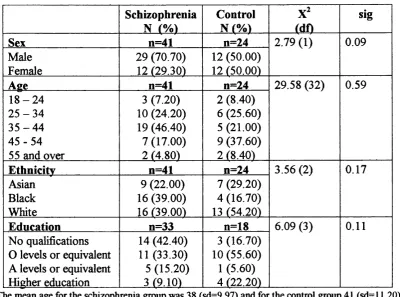
Table 1. Sex, ethnicity and education data for the schizophrenia group and controls. Schizophrenia
N (Vo)
Control
N (Vo) (df)
sig
Sex n=41 n=24 2.79 (1) 0.09
Male Female 29 (70.70) 12 129.30) 12 (50.00) 12 150.00)
Age n=41 n=24 29.58 (32) 0.59
1 8 - 2 4 2 5 - 3 4 3 5 - 4 4 4 5 - 5 4 55 and over
3 (7.20) 10 (24.20) 19 (46.40) 7(17.00) 2 14.80) 2 (8.40) 6 (25.60) 5 (21.00) 9 (37.60) 2 18.40)
Ethnicity n=41 n=24 3.56 (2) 0.17 Asian Black White 9 (22.00) 16 (39.00) 16 r39.00) 7 (29.20) 4 (16.70) 13 (54.20)
Education n=33 n=18 6.09 (3) 0.11 No qualifications
0 levels or equivalent A levels or equivalent Higher education
14 (42.40) 11 (33.30) 5 (15.20) 3 (9.10)
3 (16.70) 10 (55.60)
1 (5.60) 4 (22.20)
The mean age for the schizophrenia group was 38 (sd=9.97) and for the control group 41 (sd=11.20).
compared with 27.8% of the control group. Data concerning educational qualifications could not be obtained for eight of the schizophrenic participants and six of the control participants. This was due to the information not being present in the files for the schizophrenia group or withheld by participants in the control group.
Although there seemed to be quite a few differences in the demographic data between both groups, statistical analysis using Pearson’s Chi-square (see Table 1) showed that none of these differences were significant.
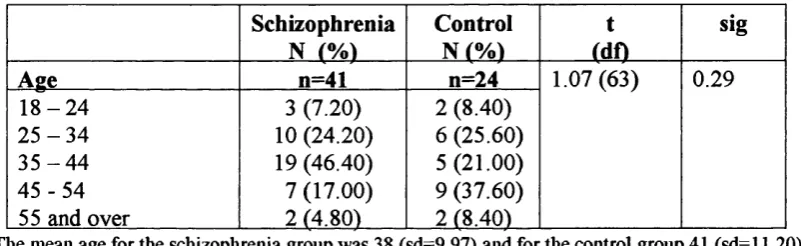
Table 2. Age differences between the schizophrenia group and controls
Schizophrenia N r/o)
Control N (%)
t (dn
sig
Age n=41 n=24 1.07 (63) 0.29
1 8 - 2 4 2 5 - 3 4 3 5 - 4 4 4 5 - 5 4 55 and over
3 (7.20) 10 (24.20) 19 (46.40) 7 (17.00) 2 (4.80) 2 (8.40) 6 (25.60) 5(21.00) 9 (37.60) 2 (8.40)
Tlie mean age for the schizoplirenia group was 38 (sd-9.97) and for tlie control group 41 (sd -11.20).
Table 2 shows that the majority of patients were younger in the schizophrenia group with 21.8% being over the age of 44 compared with 46% of the control group. However, the T-test (see Table 2) showed that the differences between the two groups were not significant.
Allocation o f the Schizophrenia Participants to the Symptom Groups
The BPRS is an 18-item questionnaire, which has a 7-point rating scale. The ratings can be seen below:
1 - not present 2 = very mild 3 = mild 4 = moderate
5 = moderately severe 6 = severe
7 = extremely severe.
The BPRS was originally designed to measure symptom change in patients with psychotic illness. The items measure; somatic concern, anxiety, emotional withdrawal, conceptual disorganisation, guilt feelings, tension, mannerisms and posturing,
grandiosity, depressive mood, hostility, suspiciousness, hallucinatory behaviours,
motor retardation, uncooperativeness, unusual thought content, blunted affect,
excitement and disorientation. The BPRS can also be used as a tool to distinguish certain sub-groups of schizophrenia (Overall & Gorham, 1988). To do this, some of the items are excluded from the categorisation procedure as they are designed to distinguish mood disorders rather than sub-classes of schizophrenia.
For the purpose of the present study the BPRS was used to categorise the patients into three symptom groups as suggested by Cohen et al. (1999). These are known as ‘poverty’, ‘disorganised’ and ‘reality distortion’ symptoms of schizophrenia. The items used to categorise the ‘poverty’ group were motor retardation, blunted affect and
emotional withdrawal. The items used to categorise the ‘disorganised’ group were
conceptual disorganisation and mannerisms and posturing. The items used to categorise the reality distortion’ group were hallucinatory behaviours, suspiciousness
scored 4 or more on the 7-point rating scale on any one of the items that related to the symptom group. For example, if a patient scored 4 or more on the item, blunted affect,
they would be placed into the ‘poverty’ symptom group. If a patent scored 4 or more on the item, unusual thought content, they would be placed into the ‘reality distortion’ symptom group. The rating of 4 became a cut-off point as Lukoff et al. (1986) suggest that a rating below 4 does not indicate a pathological entity of that symptom.
The majority of patient’s scores, however, were not exclusive to just one symptom group. For example one patient was rated as 4 for conceptual disorganisation, 4 for
suspiciousness, 4 for hallucinatory behaviour, 5 for unusual thought content and 5 for
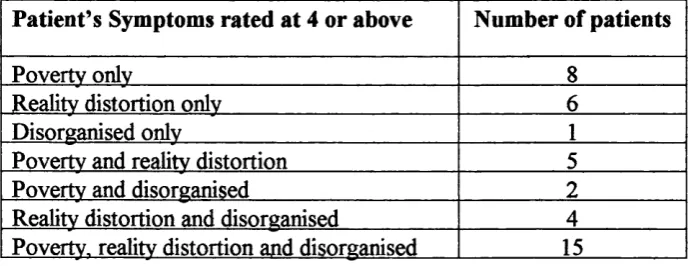
blunted affect. This meant that the patient had symptoms of a pathological entity for all three of the symptom sub-groups. If this occurred patients were placed into all three symptom groups. The data showing the allocation of each patient’s symptoms to the symptom groups can be seen in Table 3 below.
Table 3. Number of patients with each symptom rated at 4 or above on the BPRS Patient s Symptoms rated at 4 or above Number of patients
Povertv onlv 8
Realitv distortion onlv 6
Disorganised onlv 1
Povertv and realitv distortion 5 Povertv and disorganised 2 Realitv distortion and disorganised 4 Povertv. realitv distortion and disorganised 15
not mutually exclusive and so a multiple regression analysis would need to be used to calculate the results. As most patients were placed into more than one group it meant that in total there were 30 patients in the ‘poverty’ symptom group, 22 patients in the ‘disorganisation’ symptom group and 30 patients in the ‘reality distortion’ symptom group.
Allocation o f the Schizophrenia Participants to the * Duration o f Illness ’ Groups
Data was gathered from the patient’s files as to when they were first diagnosed with schizophrenia. From this date it was calculated how long each participant had been identified as schizophrenic and they were then allocated to one of three groups as suggested by Kay (1990) and Brown (1960). These groups were labelled ‘acute’, ‘chronic’ and ‘long-term chronic’. Patients that had been diagnosed for up to 2 years were placed into the acute group. Patients that had been diagnosed for between 3 and 10 years were placed into the chronic group. Patients that had been diagnosed for over 10 years were placed into the long-term chronic group. There were 4 patients in the acute group, 13 patients in the chronic group and 20 patients in the long-term chronic group. The remaining three patients were excluded from this analysis, as data could not be obtained concerning when they were first diagnosed with schizophrenia.
Allocation o f the Schizophrenia Participants to the Medication Groups
chlorpromazine equivalents was 572.05mg (sd=541.94). Patients were then placed into three categories, namely ‘small’, ‘medium’ and ‘high’ dosages as indicated by previous research by Johnstone et al. (1991). If patients were taking less than 400mg of chlorpromazine equivalents they were placed into the ‘small dosage’ group. If patients were taking between 401 mg and 800mg of chlorpromazine equivalents they were placed into the ‘medium dosage’ group. If patients were taking over 800mg of chlorpromazine equivalents they were placed into the ‘high dosage’ group. There were 20 patients in the small dosage group, 10 patients in the medium dosage group and nine patients in the high dosage group. For the remaining two patients, there was no mention in their file that they were on any antipsychotic medication at the time of the study.
Patients were also placed into a further category for anticholinergic medication. Patients were divided into those that were taking anticholinergic medication and those that were not, as indicated by the patient’s file. The mean daily dosage was 15.71 mg (sd= 15.66). There were seven patients placed into the anticholinergic group and 34 patients placed into the no anticholinergics group.
Ethics
more detail (appendix C).
Materials
The experiment was carried out on a Packard Bell EasyNote VX laptop computer. It was decided by the experimenter and the field supervisor that a laptop computer was more appropriate as patients who were on locked wards could also take part. It also meant that the experiment could be carried out as soon as the patient agreed, rather than having to wait for a member of staff to escort the patient to the research building.
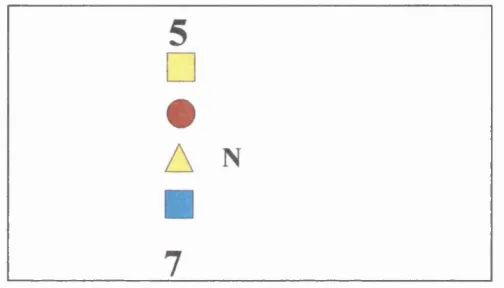
the same amount of time as the objects. The objects were presented vertically on the computer screen in either the participant’s peripheral or foveal visual field. Examples can be seen in figures 1 and 2 below. For a description of the presentation of objects for all 32 trials see appendix D.
Figure 1. Example of a trial with objects presented to the left foveal field. This shows a possible illusory conjunction as the features ‘red’ and ‘triangle’ may erroneously combine.
Figure 2. Example of a trial with objects in the peripheral field. This shows a ‘target’ trial as it has a red triangle.
was no target object, (i.e. no triangle), but did include a different red square or circle. The remaining 16 were illusory conjunctions. They contained either a red circle or square and a blue or yellow triangle amongst the four objects (see fig. 1 above). There were eight illusory conjunctions with the target features next to each other, and eight with the target features separated by another object. Each of the three conditions used the same trials but the presentation order was different (see appendix E).
The objects were 5cm in height for the foveal presentations and 8cm high for the peripheral presentations. The objects shown in the participant’s peripheral field were larger as previous research had found that small objects are only seen distinctly when they are near the fovea, and so larger objects should be used in the periphery (Harrington & Drake, 1990; Petersen et al., 1994). The presentations of objects in the peripheral field were 6° from the central fixation cross and 1.5 ° for the foveal presentation.
The exposure duration of the objects was based on studies by Ashby et al. (1996), Hazeltine, Prinzmetal & Elliott (1997), Treisman & Schmidt (1982) and Brown & Wright (1998) who obtained significant results using a similar method. The duration was different depending on the condition being tested. For condition 1, foveal presentation time was 300ms and peripheral 500ms. For conditions 2 & 3, foveal presentation time was 300ms and peripheral presentation was reduced to 400ms in order to increase the attention load.
remove any phosphor traces of the stimuli. Knight & Silverstein (1998) believe that the duration between the mask and following stimuli should be no less than 300ms otherwise the mask may cause interference in attending to the following trial. In this experiment the researcher controlled the presentation of each trail by using a mouse, which allowed time for participants to respond before the next trial was given. This meant that the duration between mask and following stimuli was no less than one second, which should not cause any interference in attending to following trials.
Scorecards were also designed to write down the participant’s responses (see Appendix F), which were checked for errors against the data showing the sequence of trials (appendix E).
Procedure
The members of staff that made up part of the control group were tested in the same environment as the in-patients that belonged to their ward. The rest of the control group were tested in their own home, in a quiet room, away from others. The control group were given a slightly different information sheet from the in-patients (see appendix H). This only differed in its reference to the participants in their group and details about patient care.
If participants agreed to take part they were asked to sign a consent form (appendix I). Both the information sheet and consent form were read by the researcher to all participants so that those with reading difficulties could understand the intentions of the study. All participants were given time to ask questions before the consent form was signed. Once signed, the test instructions were explained to the participant (see appendix J). As shown in appendix J there were three conditions to the test and the instructions were slightly different depending on which condition was being presented. However, the instructions for the second and third conditions were not read out until the participant had completed the previous part.
objects\ Participants were asked to look at the fixation cross and when it changed to a letter say what the letter was. They then had to verbalise ‘high’ or ‘low’ in response to the sound and then say ‘yes’ or ‘no’ if they saw a red triangle. During the testing participants were allowed as much time as needed to give a response. The experimenter controlled the presentation of the objects on the screen so that each following trial was not presented until a response had been given and the participant was ready to proceed. The whole process took between 15 minutes and half an hour, depending on how many questions were asked prior to the test and the length of time it took for each participant to respond to each trial.
As all participants were tested in a place that was convenient for them, measures were taken to make the test conditions as similar as possible. A portable, wooden screen was placed behind and around the sides of the computer to reduce external distractions. The screen was 60cm in height, 120cm wide and painted black. The height of the laptop was measured so that the participant’s eye level was always in the centre of the screen. Participants were always seated 59cm away from the computer screen to give maximum visual effect^.
’The low tone was taken from the Action! file; MEDIA\ SOUNDEFX\ EDUCATE\ NOTE_Dl.WAV. The high tone was taken from the Action! file; MEDIA\ SOUNDEFX\ EDUCATE\ NOTE_C3.WAV.
Design
The experiment followed a repeated measures design as participants had to complete three trials of the same design, which were manipulated to increase the level of difiSculty. There were three between-subject, independent variables, which were ‘participant group’, ‘duration of illness’ and ‘medication’. The ‘participant group’ independent variable was comprised of a schizophrenia group and a non-psychiatric control group. The schizophrenia group was further divided into three sub-groups: ‘poverty’, ‘reality distortion’ and ‘disorganised’. The ‘duration of illness’ independent variable was comprised of three factors: ‘acute’, ‘chronic’ and ‘long-term chronic’. The ‘medication’ independent variable was comprised of two groups of medication: ‘antipsychotic’ and ‘anticholiergic’. There was one main, within-subject independent variable, which was ‘attention’. This comprised of three conditions manipulated to increase attention. These were ‘target only’, ‘letter name and target’ and ‘letter name, sound name and target’.
been presented and feature errors occur when a red triangle is reported but no triangle has been presented.
Reliability
As this is a pilot study there are no previous measures to indicate its reliability. Reliability assesses whether the test gains similar results on subsequent occasions. Due to time restrictions participants were not re-tested at a later time in order to measure test-retest reliability. However, the participants were given the task three times during testing. Each time the test was re-administered it had an additional task to load the level of attention being used and so should be harder. If participants increased the number of illusory conjunctions over the three tests it would indicate that it is a good measure of reliability.
Validity
performed the worst this indicates that the design does indeed measure attentional processes.
The design was also carefully considered as to whether it would be measuring context processing mechanisms (attention, active memory and inhibition). Particular attention was paid to using similar properties to other tests that show deficits in context processing mechanisms such as the Stroop task and the AX-CPT task. For example, active memory was manipulated by producing a delay between the contextual cue and response (used in the AX-CPT task). Attention was manipulated by the need to actively select an object from a range of objects (used in the AX-CPT task). Inhibition was manipulated by having to ignore the contextual cues when an uncertainty occurs during feature binding (used in the Stroop task).
Utility
Planned Statistics
RESULTS
The results section will analyse each hypothesis in turn as stated in the introduction. Firstly an analysis will be made between the schizophrenic group as a whole and the non-psychiatric control group. This will determine if people with schizophrenia perform differently to the control group. Next, the three sub-groups of schizophrenia, as defined in the methodology section will be analysed to determine if there are any symptom differences. Finally the effects of medication will be analysed to see if the amount of medication taken by the patients has had any effect upon the performance of the schizophrenic group.
Before analysis could take place the participants were scored on how many errors they made. These were categorised into three error types: illusory conjunctions, target errors, and total errors overall. The group, ‘total errors overall’, included illusory conjunctions, target errors, colour errors, and feature errors. The raw scores can be seen at appendix K.
Hypothesis One
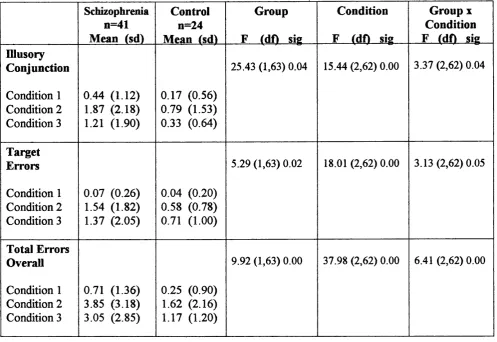
and total errors overall. The results can be seen in Table 4 below.
Table 4. ANOVAs for the schizophrenia group versus the non-psychiatric control group for number of illusory conjunctions, target errors and total errors seen.
Schizophrenia n=41 Mean fsd)
Control n=24 Mean tsdl
Group
F tdfl sig
Condition
F (dfl sig
Group X Condition F (df) sig Illusory
Conjunction
Condition 1 Condition 2 Condition 3
0.44 (1.12) 1.87 (2.18) 1.21 (1.90)
0.17 (0.56) 0.79 (1.53) 0.33 (0.64)
25.43 (1,63) 0.04 15.44 (2,62) 0.00 3.37 (2,62) 0.04
Target Errors
Condition 1 Condition 2 Condition 3
0.07 (0.26) 1.54 (1.82) 1.37 (2.05)
0.04 (0.20) 0.58 (0.78) 0.71 (1.00)
5.29 (1,63) 0.02 18.01 (2,62) 0.00 3.13(2,62)0.05
Total Errors Overall
Condition 1 Condition 2 Condition 3
0.71 (1.36) 3.85 (3.18) 3.05 (2.85)
0.25 (0.90) 1.62 (2.16) 1.17 (1.20)
9.92 (1,63) 0.00 37.98 (2,62) 0.00 6.41 (2,62) 0.00
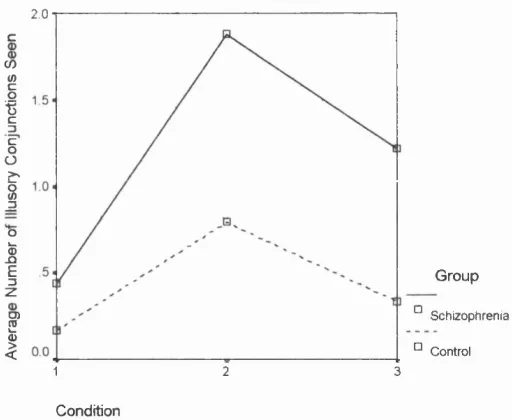
than non-psychiatric controls. The fifth column shows the interaction between group and condition. This indicates that the main effect was qualified by the significant results shown in the interaction between group and condition for illusory conjunctions and total errors overall. The interaction between group and condition, however, only showed a trend for target errors. The graphs below illustrate the differences between the two groups as attention load increased for the three types of errors.
Average Number of Illusory Conjunctions Seen for People
With Schizophrenia versus Controls
2.0
c
CO
(0
I
3 § ÜI
o
È
E
3
z
s
I
1 2 3
Group
° S ch izoph ren ia ° Control
Condition
Figure 3. Graph to illustrate the number of illusory conjunctions seen as the attention load increased over the three conditions for schizophrenics and controls.
additional tasks to complete. These two conditions also had their presentation time reduced from 500ms (as shown in condition 1) to 400ms. It is interesting to note that the third condition, although harder, did not on average cause more illusory conjunctions than condition 2. This will be discussed further in the discussion below.
Average Number of Target Errors Made for People
With Schizophrenia versus Controls
2.0
(D T3
(0
E
E
o
m O)
o
E
I
2 < 0.0
1 2 3
Group
^ Schizophrenia Control
Condition
Figure 4. Graph to illustrate the number of target errors made as the attention load increased over the three conditions for schizophrenics and controls.
Average Total Number of Errors Made for People with
Schizophrenia versus Controls
5
4
<D ■O OJ
E
3
o
(U
o
E
3
C
2
' - t l
1
3
2
Group
Schizophrenia Control
Condition
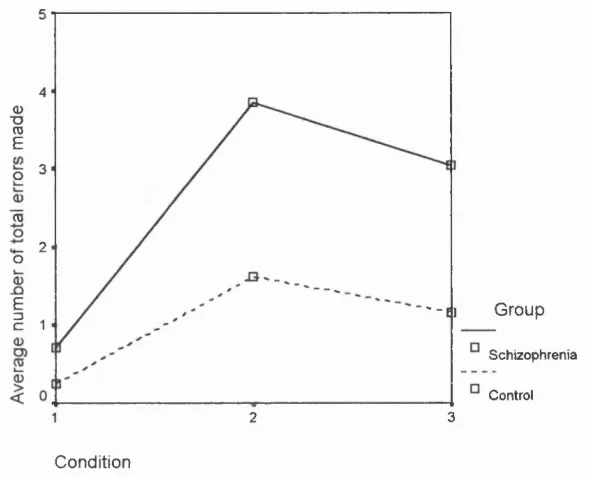
Figure 5. Graph to illustrate the number of total errors seen as the attention load increased over the three conditions for scliizophrenics and controls.
Figure 5 is also very similar in its presentation to figures 3 and 4. The two groups were very similar in the total amount of errors seen in the first condition. In conditions 2 and 3, however, the schizophrenia group increased in total number of errors overall, whereas the control group remained roughly the same. Again it is shown that the third condition, although harder, did not on average cause more total errors overall than condition 2. This will be discussed ftirther in the discussion.
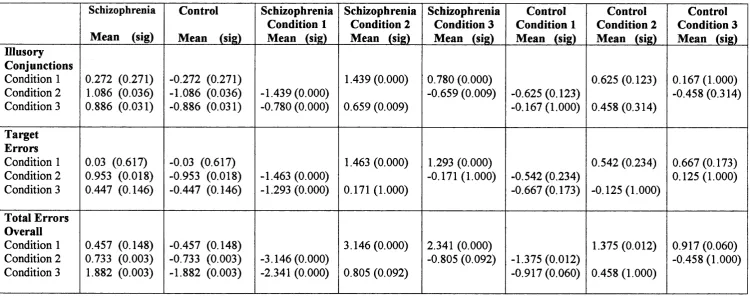
group and the mean differences between each condition for number of illusory conjunctions, target errors and total errors seen.
Schizophrenia
Mean (sig)
Control
Mean (sig)
Schizophrenia Condition 1 Mean (sig)
Schizophrenia Condition 2 Mean (sig)
Schizophrenia Condition 3 Mean (sig)
Control Condition 1 Mean (sig)
Control Condition 2 Mean (sig)
Control Condition 3 Mean (sig) Illusory
Conjunctions
Condition 1 Condition 2 Condition 3
0.272 (0.271) 1.086 (0.036) 0.886 (0.031)
-0.272 (0.271) -1.086 (0.036) -0.886 (0.031)
-1.439(0.000) -0.780 (0.000)
1.439(0.000) 0.659 (0.009)
0.780 (0.000)
-0.659 (0.009) -0.625 (0.123) -0.167(1.000) 0.625 (0.123) 0.458 (0.314) 0.167(1.000) -0.458(0.314) Target Errors
Condition 1 Condition 2 Condition 3
0.03 (0.617) 0.953 (0.018) 0.447 (0.146)
-0.03 (0.617) -0.953 (0.018) -0.447 (0.146)
-1.463 (0.000) -1.293 (0.000)
1.463 (0.000) 0.171 (1.000)
1.293 (0.000)
-0.171 (1.000) -0.542 (0.234) -0.667 (0.173)
0.542 (0.234) -0.125(1.000)
0.667 (0.173) 0.125 (1.000)
Total Errors Overall
Condition 1 Condition 2 Condition 3
0.457 (0.148) 0.733 (0.003) 1.882 (0.003)
-0.457 (0.148) -0.733 (0.003) -1.882 (0.003)
-3.146 (0.000) -2.341 (0.000)
3.146 (0.000) 0.805 (0.092)
2.341 (0.000)
-0.805 (0.092) -1.375 (0.012) -0.917(0.060)
1.375 (0.012) 0.458(1.000)
0.917 (0.060) -0.458(1.000)