https://doi.org/10.5194/nhess-18-1373-2018 © Author(s) 2018. This work is distributed under the Creative Commons Attribution 3.0 License.
Dynamics of avalanche-generated impulse waves: three-dimensional
hydrodynamic simulations and sensitivity analysis
Rachel E. Chisolm and Daene C. McKinney
Department of Civil Architectural and Environmental Engineering, University of Texas at Austin, Austin, TX, USA
Correspondence:Rachel E. Chisolm ([email protected]) Received: 10 March 2017 – Discussion started: 13 June 2017
Revised: 22 March 2018 – Accepted: 26 March 2018 – Published: 17 May 2018
Abstract. This paper studies the lake dynamics for avalanche-triggered glacial lake outburst floods (GLOFs) in the Cordillera Blanca mountain range in Ancash, Peru. As new glacial lakes emerge and existing lakes continue to grow, they pose an increasing threat of GLOFs that can be catastrophic to the communities living downstream. In this work, the dynamics of displacement waves produced from avalanches are studied through three-dimensional hydrody-namic simulations of Lake Palcacocha, Peru, with an empha-sis on the sensitivity of the lake model to input parameters and boundary conditions. This type of avalanche-generated wave is an important link in the GLOF process chain be-cause there is a high potential for overtopping and erosion of the lake-damming moraine. The lake model was evalu-ated for sensitivity to turbulence model and grid resolution, and the uncertainty due to these model parameters is sig-nificantly less than that due to avalanche boundary condi-tion characteristics. Wave generacondi-tion from avalanche impact was simulated using two different boundary condition meth-ods. Representation of an avalanche as water flowing into the lake generally resulted in higher peak flows and overtop-ping volumes than simulating the avalanche impact as mass– momentum inflow at the lake boundary. Three different sce-narios of avalanche size were simulated for the current lake conditions, and all resulted in significant overtopping of the lake-damming moraine. Although the lake model introduces significant uncertainty, the avalanche portion of the GLOF process chain is likely to be the greatest source of uncer-tainty. To aid in evaluation of hazard mitigation alternatives, two scenarios of lake lowering were investigated. While large avalanches produced significant overtopping waves for all lake-lowering scenarios, simulations suggest that it may be
possible to contain waves generated from smaller avalanches if the surface of the lake is lowered.
1 Introduction
lakes. They identified 25 lakes that pose a potential GLOF threat to downstream communities and infrastructure. The Cordillera Blanca mountain range in Peru has approximately 1900 lakes, and 830 of them have a surface area greater than 5000 m2(UGRH, 2014). Of the lakes in the Cordillera Blanca, over 200 are considered new lakes that have formed recently due to glacier retreat (UGRH, 2014). A recent inven-tory of glacial lakes in the Cordillera Blanca and their suscep-tibility to GLOFs classifies Lake Palcacocha in the highest level of susceptibility to outburst floods due to mass move-ments into the lake (Emmer et al., 2016c). Several GLOFs have occurred in the Cordillera Blanca in recent history, and climate change and accelerated glacial retreat have been in-creasing the GLOF hazard since the end of the Little Ice Age in the late 1800s (Carey, 2010).
GLOFs can be highly destructive because the peak dis-charges tend to be several orders of magnitude larger than typical outflows from glacial lakes (Benn and Evans, 2010). Moraine-dammed lakes are particularly susceptible to out-burst flooding due to the potential for moraine failure that could cause higher GLOF discharges than would occur with just overtopping (Emmer and Cochachin, 2013); however, both moraine-dammed and bedrock-dammed lakes can pro-duce potentially catastrophic GLOFs due to overtopping if there is insufficient freeboard. According to studies that have established basic methods for evaluating potential glacial lake hazards (e.g., Haeberli et al., 1989; Huggel et al., 2004; Wang et al., 2011; Emmer and Vilímek, 2014; Rounce et al., 2016), the primary characteristics that signify a potentially hazardous glacial lake are the presence of overhanging ice and the likelihood of failure of the lake-damming moraine; secondary characteristics that indicate potentially dangerous lakes include the potential for landslides, rockslides, or rock– ice avalanches. However, understanding of the physical pro-cesses that can trigger a GLOF event is still limited. The most common GLOF triggers are landslides, avalanches, or ice calving into a lake (Costa and Schuster, 1988; Richard-son and Reynolds, 2000; Bajracharya et al., 2007; Awal et al., 2010; Emmer and Cochachin, 2013; Emmer and Vilímek, 2013). These mass movement events can cause large waves that propagate across glacial lakes and may overtop or breach moraine dams.
Several studies have looked at GLOF events after they have happened and attempted to reconstruct the GLOF char-acteristics. Worni et al. (2014) and Westoby et al. (2014a) re-view various methods for modeling a typical GLOF process chain. Some researchers have simulated GLOFs with models of the individual processes in the chain (e.g., Klimeš et al., 2014; Schneider et al., 2014; Westoby et al., 2014b; Worni et al., 2014; Wang et al., 2015a; Somos-Valenzuela et al., 2016); however, the lake dynamics remain one of the most difficult processes to simulate correctly due to the need for a non-hydrostatic model to correctly represent the wave dy-namics (Heinrich, 1992; Zweifel et al., 2007; Worni et al., 2014) and the lack of field data for model calibration or
val-idation. Most previous studies have used two-dimensional (2-D) shallow water equation (SWE) models or empirical models of wave generation and propagation in the lakes that do not effectively represent the physical processes, and our understanding of the uncertainties arising from avalanche-generated wave simulations in GLOF process chain mod-eling is still very limited. Although they have seldom been studied, evaluating the sensitivities of displacement wave models helps us understand the uncertainties that may arise from wave simulations within GLOF process chain model-ing. One difficulty is the lack of data about real events, so the potential hazard and impacts of a GLOF must be esti-mated from an analysis of the physical conditions and mod-eling the basic physical processes without the availability of calibration data (Somos-Valenzuela et al., 2016). This paper presents three-dimensional (3-D) non-hydrostatic simula-tions of avalanche-generated waves and improves upon pre-vious 2-D SWE simulations of avalanche-generated waves in GLOF process chain modeling that must be calibrated with data from past GLOF events (e.g., Schneider et al., 2014). Many glacial lakes that are currently dangerous have not pre-viously burst out, so the use of data from prior GLOF events is not an option at many study sites. Three-dimensional non-hydrostatic models provide better representation of the phys-ical processes within the model than 2-D shallow water mod-els, thus reducing the amount of calibration needed; how-ever, 3-D non-hydrostatic models have rarely been applied to avalanche-generated waves and GLOF process chain model-ing.
The objective of this paper is to gain a better understanding of the behavior of avalanche-generated waves and the factors that influence overtopping discharges. This paper evaluates the relative uncertainties generated in the lake model portion of the GLOF process chain with the goal of improving GLOF hazard assessments. Particular emphasis is placed on analysis of the sensitivity of the lake model to various input parame-ters and methods for simulating boundary conditions with the goal of shedding light on potential sources of uncertainty in the lake model. An improved understanding of the dynam-ics of avalanche-generated waves can help advance predic-tive modeling of potential GLOF events by relying less on model calibration when data from past events are not avail-able, thus enabling better evaluation of possible hazard mit-igation strategies at potentially dangerous lakes. It is a sig-nificant challenge to predict the impacts of an event that has not yet happened, and predictive simulations inherently carry considerable uncertainty about many event parameters. Nev-ertheless, this challenge is one that must be undertaken for progress to be made in glacial hazard assessment and analy-sis of hazard mitigation strategies.
1.1 Lake Palcacocha
Sa
n
ta
R
iv
er
Lake Palcacocha Legend
Huaraz city Rivers Elevation m.a.s.l
6139
3020
0 2 4 6 8 km
Paria Rive
r
Auqui River Quillcay River
Cordil
ler a B
lanc a
Co rdille
ra Ne gr a
Ma raÒo
n R iver
Santa River
Pativilca River
Co rd illera Hu
alla nca
Co rd illera Hu
ay huash
Lake Palcacocha
Huaraz
Sources: Esri, USGS, NOAA
0 20 40 60 80Kilometers
Figure 1.Location of Lake Palcacocha within the Cordillera Blanca, Peru.
The most disastrous GLOF event in the Cordillera Blanca in recent history occurred in 1941 when Lake Palcacocha burst, destroying much of the city of Huaraz and killing ap-proximately 1800 people (Carey, 2010; Wegner, 2014). This event received much notice from national and international media and put the issue of GLOFs at the forefront of na-tional attention in Peru. Huaraz is the most populous city in the Cordillera Blanca region with over 100 000 residents (INEI, 2007 census), and it is once again exposed to a po-tential GLOF from Lake Palcacocha (Somos-Valenzuela et al., 2016). After the 1941 Huaraz flood, the Peruvian gov-ernment instituted initiatives to reduce the GLOF risk in the Cordillera Blanca through monitoring of glaciers and glacial lakes and implementing lake safety systems (Carey, 2010). These safety systems typically consist of tunnels to control lake levels, reinforced dams, or a combination of the two (Portocarrero, 2014). Scientists and engineers in Peru have several decades of experience managing glacial lakes in the Cordillera Blanca and mitigating GLOF risk (Carey, 2010; Portocarrero, 2014), but current lake management practices are based on studies performed decades ago that have not been updated to account for changes that have occurred since then – primarily increased size and water storage in glacial lakes due to changing climate. The lake safety system im-plemented at Lake Palcacocha in the 1970s was designed for the size of the lake at the time and did not account for future lake growth. If the present knowledge of climate change ex-isted at that time, perhaps this could have been foreseen; this was not the case, and now the lake is approximately 17 times
larger than it was in 1974 (Rivas et al., 2015), rendering the existing lake safety system inadequate for the current lake di-mensions (Portocarrero, 2014). The potential threat that Lake Palcacocha currently poses to the residents of Huaraz has been known for many years. Peruvian government institu-tions have produced several official reports about the situa-tion (INDECI, 2011, 2015; ANA, 2013; Valderrama et al., 2013; Espinoza, 2013), and a state of emergency was de-clared in 2010 (Diario la Republica, 2010; INDECI, 2011). In this paper, Lake Palcacocha is used as a case study to in-vestigate the impact of an avalanche event on the lake dynam-ics and the ensuing discharge hydrograph from the lake and to study the sensitivity of the overtopping discharge to vari-ous input parameters. This paper focuses exclusively on the lake dynamics for avalanche-generated waves and does not consider other parts of the GLOF process chain. The model results for the entire GLOF chain of events are presented in Somos-Valenzuela et al. (2016).
Lake Palcacocha (4562 m) is situated in the Quillcay wa-tershed above the city of Huaraz (Fig. 1). Above the lake are the Palcaraju and Pucaranra glaciers. The steep overhanging ice of the glacier termini in contact with the lake makes it ex-tremely prone to avalanche-generated waves. Additionally, the large volume of water contained in the lake provides a serious threat to downstream areas. The lake is surrounded on three sides by glacial moraines, and the lateral moraines are very tall with slopes up to 80◦ (Klimeš et al., 2016).
Distance from avalanche impact (m)
0 200 400 600 800 1000 1200 1400 1600 1800
Elevation (m.s.l.)
4480 4500 4520 4540 4560 4580
Point of avalanche impact
Water depth = 72 m
Water depth = 15 m
Lake-damming moraine
Initial w ater surface elevation Lakebed profile
Figure 2.Longitudinal profile of Lake Palcacocha and its terminal moraine.
damage from a wave that overtopped a portion of the damming moraine (Vilímek et al., 2005). The original lake-damming terminal moraine was breached during the 1941 GLOF, and the lake is currently dammed by a smaller basal moraine that lies about 300 m upstream of the 1941 breach. This smaller moraine that currently holds back the lake is ap-proximately 66 m deep and 985 m wide and has a width-to-height ratio of 14.9; this morphology indicates that the lake-damming moraine is very stable (Rivas et al., 2015). A con-stant lake level of 4562 m (8 m of freeboard) is maintained by a structure in the smaller terminal moraine that consists of an open cut in a portion of the moraine filled with an artifi-cial dam that was constructed in 1974 (Reynolds, 2003; Por-tocarrero, 2014). Additionally, two sections of the terminal moraine have been reinforced with concrete to protect them from erosion. Based on a 2009 bathymetric survey, the vol-ume of the lake was approximately 17 million m3at that time (UGRH, 2009). The lake has since retreated approximately 200 m more (Rivas et al., 2015), and siphons are currently being used to temporarily maintain the lake an additional 3– 5 m lower; however, during the rainy season, the siphon sys-tem is often not able to keep up with the rainfall draining into the lake. A bathymetric survey undertaken in February 2016 measured a volume of approximately 17.4×10⁶m3 with a water surface elevation of 4562.88 m (UGRH, 2016). Lake Palcacocha has a deep area adjacent to the glacier with a maximum depth of 72 m and a shallow portion with depths mostly under 10 m extending several hundred meters back from the terminal moraine (Fig. 2).
The potential hazard due to an outburst flood from Lake Palcacocha has been studied by several researchers. Vilímek et al. (2005) discussed the influence of glacial retreat on hazards at Palcacocha and studied the moraine composition and the potential for landslides from the lateral moraines; they also found seepage at the moraine dam. Emmer and Vilímek (2013) used a generalized methodology for GLOF hazard assessment at Lake Palcacocha and five other lakes in the Cordillera Blanca, concluding that Lake Palcacocha had the highest hazard level. Emmer and Vilímek (2014) ex-amined mechanisms of the 1941 and 2003 GLOFs at Lake Palcacocha and compared them to other historic GLOFs in
the Cordillera Blanca. Emmer et al. (2016b) evaluated the effectiveness of lake safety systems in the Cordillera Blanca and found that the system at Lake Palcacocha resulted in a minimal decrease in GLOF susceptibility, and Emmer et al. (2016c) classified Lake Palcacocha as highly susceptible to GLOFs triggered by mass movements. Klimeš et al. (2016) evaluated the lateral moraines surrounding Lake Palcacocha and determined that there is a high potential for landslide-triggered waves in the lake. Rivas et al. (2015) modeled a full moraine collapse using empirical equations and DAMBRK hydraulic simulations, and Somos-Valenzuela et al. (2016) gave the results of simulations of a potential GLOF chain of events and mapped potential hazard levels for the city of Huaraz. This paper focuses on the avalanche boundary conditions, turbulence modeling and grid size and their rel-ative contributions to uncertainty in the lake model used by Somos-Valenzuela et al. (2016) to model the entire GLOF process chain and downstream impacts.
1.2 Impulse waves generated from avalanches and landslides
however, the 2-D SWE models may not be appropriate for slide-generated waves because of the role that vertical accelerations play in the wave dynamics (Heinrich, 1992; Zweifel et al., 2007). Recent developments in numerical sim-ulations of landslide-generated waves include simulation of multi-phase flows, including a 3-D Navier–Stokes volume of fluid model (Abadie et al., 2010), a two-phase debris flow model (Kafle et al., 2016), and the application of smoothed particle hydrodynamics models (Heller et al., 2016; Wang et al., 2016). However, these studies still focus on simple cases and geometries rather than real-world scenarios. R.avaflow, a two-phase model that was developed to simulate debris flows into fluid bodies (Pudasaini, 2012), has been applied to sim-ulate debris flows such as those that would be present in a GLOF (Mergili et al., 2017). Few researchers have looked at the issue of wave run-up (e.g., Synolakis, 1987, 1991; Muller, 1995; Liu et al., 2005; Capel, 2015; Romano et al., 2015; Etemad-Shahidi et al., 2016), and most use empirical formu-las or simplified approaches for wave run-up calculations, making assumptions about the lake geometry that may not be realistic (e.g., uniform water depth and a regularly sloped dam).
Although models of real events are limited by the lack of validation data, there is clearly a need to move away from simplified cases such as sliding blocks or wedges and progress towards modeling cases that more closely resem-ble geometries and circumstances in the field. Use of 3-D numerical modeling can improve simulations of avalanche-generated waves by avoiding some of the weaknesses of 2-D shallow water models. Some of the problems of model-ing avalanche-generated impulse waves include uncertainty in the make-up of the avalanche material (e.g., ratio of snow, ice, and rock; density; viscosity) and representation of the mixing and momentum transfer when the avalanche material enters the lake.
2 Methods
A three-dimensional hydrodynamic model, FLOW-3D (Flow Science, 2012), was used to simulate waves generated from avalanches entering a glacial lake and investigate the dynam-ics of the wave generation, propagation, run-up, and moraine overtopping. Because 3-D models have rarely been applied to avalanche-generated waves, there is very little informa-tion on appropriate input parameters and boundary condi-tions. Therefore, several input parameters have been varied in this study in order to analyze the model sensitivities and gain a better understanding of the impact of user-specified in-puts on model results. The sensitivity to the turbulence model and grid size used in the simulations were investigated to determine how much these aspects of the model might con-tribute to the overall uncertainty. Another challenge of sim-ulating avalanche-generated waves is appropriate represen-tation of the avalanche entering the lake. Because there is
very little knowledge about how to appropriately simulate the avalanche flow and impact with the lake, two different boundary condition methods were used in this work to help facilitate analysis of the sensitivity of the overtopping dis-charge to the avalanche boundary conditions. Wave gener-ation and propaggener-ation were studied to gain insights about how this type of wave behaves and what type of model is needed (2-D vs. 3-D and hydrostatic vs. non-hydrostatic) to accurately reproduce avalanche-generated waves of the mag-nitude typically seen in GLOFs.
A three-dimensional, non-hydrostatic model was chosen to give as realistic a simulation environment as possible. Al-though 2-D SWE models have been applied to simulations of avalanche-generated impulse waves (e.g., Heinrich, 1992; Zweifel et al., 2007), the size and characteristics of the waves indicate that a 3-D model may be more appropriate because of highly variable water depths, wave heights, and verti-cal accelerations. Additional motivation for employing this model is the variable lake bed geometries of many glacial lakes that tend to have sharp discontinuities near their ter-minal moraines that could significantly affect wave propaga-tion and run-up (e.g., Lake Palcacocha, as seen in Fig. 2). The lake bed topography in the FLOW-3D model was taken from a 2009 bathymetric survey (UGRH, 2009), and the to-pographic model that was used is a 5×5 m resolution digital elevation model from airborne lidar and stereo images (Hori-zons, 2013).
Three avalanche scenarios that represent a range of likely avalanche sizes were simulated in addition to two lake-lowering scenarios to evaluate hazard mitigation alternatives. The discharge hydrographs resulting from the overtopping waves were the inputs for a debris flow model used to de-termine the potential impact for the city of Huaraz (Somos-Valenzuela et al., 2016).
2.1 Sensitivity analysis: turbulence model and grid size 2.1.1 Sensitivity to turbulence model
The FLOW-3D simulations used a three-dimensional, non-hydrostatic numerical scheme and a renormalization group (RNG) turbulence model with a dynamically computed mix-ing length; several other turbulence models were also tested. Very little information exists regarding the effect of turbu-lence models on the outcome of simulations of avalanche-generated waves. Therefore, the primary objective of assess-ing the sensitivity to the turbulence model is to determine how much the choice of turbulence model might affect over-topping discharges and how much attention should be given to this parameter in the modeling process.
com-plexity. The simplest approach is an eddy viscosity model, a type of Reynolds-averaged Navier–Stokes (RANS) model that uses a single parameter to represent all of the dissipation of energy that occurs at the sub-grid scale. Usually this pa-rameter is tied to a length scale that describes the flow such as depth or wave height. More complex RANS models can use multiple parameters to describe the turbulence (e.g., two-equation models) or vary the length scale within a simulation based on the local flow conditions (i.e., models that use dy-namically computed mixing lengths). The ability to have a variable length scale that is calculated by the model is useful when an appropriate length scale is unknown, as is the case with the type of avalanche-generated wave studied in this pa-per due to the rapidly changing characteristics of the flow. Large eddy simulation (LES) is a different approach to mod-eling turbulence from the RANS models. LES simulates the largest scales of turbulence within the hydrodynamic model and uses a filter to remove the smaller scales, which are ac-counted for within the turbulence model. The filter size is linked to the model grid size, and additional numerical errors can be introduced due to the filter width. LES models may be viewed as a middle ground between RANS models and direct numerical simulations that solve the Navier–Stokes equations directly for all scales of turbulent flow (Ferziger and Peric, 2002).
In this work, the RNG dynamic mixing length model was chosen as the baseline turbulence model because an appropri-ate mixing length was unknown due to the highly variable na-ture of the flow, both spatially and temporally. The sensitivity of the simulations to the turbulence model was tested by run-ning repeat simulations for seven different turbulence mod-els in FLOW-3D, including (1) RNG dynamic mixing length (baseline model), (2) RNG constant mixing length, (3) k-epsilon, (4) Prandtl mixing length, (5) one-equation constant mixing length, (6) LES, and (7) laminar flow. Simulations of models (2)–(7) were compared to the baseline model for a large avalanche (3×10⁶m3)at the current lake level using the percent difference in maximum wave height, peak over-topping flow rate, and total overover-topping volume. Addition-ally, the root-mean-square deviation (RMSD) between the results of the baseline and the other models was calculated at each time step for the outflow hydrographs and the flow depth at each point within the lake.
Turbulence models (1)–(5) are RANS eddy viscosity mod-els (Pope, 2000). Model (2) is a variant of model (1) except that it uses a constant mixing length (Yakhot and Orszag, 1986). Model (3) is a two-equation model that uses several standard constants. Models (4) and (5) are the simplest eddy viscosity models used. In FLOW-3D, the constant mixing length defined in models (2) and (5) is a maximum length scale that limits the dissipation of energy, ensuring that dis-sipation in the models is not underrepresented (Isfahani and Brethour, 2009).
Models (6) and (7) function differently from the RANS eddy viscosity models. The accuracy of the LES model,
model (6), depends on knowledge of the flow conditions so that the filter scale can be defined to allow for most of the large-scale turbulence to be resolved within the model itself rather than in the sub-grid representation of the small-scale turbulence (Pope, 2000). The results from model (6) should be viewed considering these limitations, since the grid size was not determined according to the scale of turbulence that should be resolved in the model. Model (7) ignores lence and simulates the flow as entirely laminar. As turbu-lence tends to dissipate energy, this model will underrepre-sent dissipation.
2.1.2 Sensitivity to grid size
Model results tend to improve with grid refinement. The grid cell size used for the simulations was selected to allow for sufficient resolution of the topographic and bathymetric fea-tures of the glacial lake as well as the dynamic wave feafea-tures during the wave generation and overtopping phases while also balancing time and computational resources. To assess the impact of grid size on model results, a simulation was run with a coarser grid.
The regular mesh used in the FLOW-3D model consists of 6 m×5.33 m×6.5 m grid cells in the x, y, and z di-rections, respectively, spanning distances of 2400 m (x di-rection), 800 m (y direction), and 650 m (z direction). For the grid size sensitivity analysis, a coarse grid simulation, with double the original cell grid size, was run for the large avalanche source scenario at the current lake level.
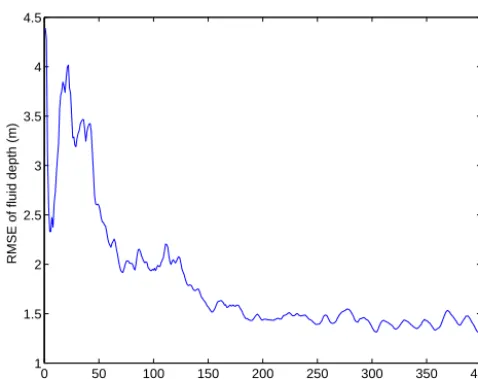
For the coarse grid simulations, the same value for water depth at each time step in the coarse grid was assigned to the four smaller cells that fall within each cell in the coarser grid to allow for direct comparison between the results of the coarse grid simulation and the regular mesh. To compare the coarse grid results to the results from the regular model mesh, the root-mean-square error (RMSE) of fluid depth for all grid cells within the lake was calculated at each time step. Addi-tionally, the percent difference in peak overtopping flow rate and total overtopping volume and the RMSE of the outflow hydrograph were calculated for the coarse grid simulation.
2.2 Boundary conditions: representing avalanche impact
mo-mentum transfer were tested to determine the sensitivity of the lake model to the boundary conditions. The variability in the results between the two boundary condition methods gives an approximation of the uncertainty associated with the avalanche impact and wave generation.
2.2.1 Avalanche source
The avalanche source boundary condition method represents the avalanche entering the lake by simulating water flow-ing from the lower glacier slopes into the lake. The den-sity of the avalanche material that is typical for this type of GLOF, a mixture of snow, rock, and ice, is nearly the den-sity of water (Schneider et al., 2014); therefore, water was used in place of the avalanche fluid, and the volume of the water that represents the avalanche was the same as the total avalanche volume. This is the same approach used by Worni et al. (2014) and Fah (2005). The two fluids (water and the avalanche material) have different viscosities, but the model was adjusted to account for the effects of the lower viscos-ity of water (less dissipation of energy as it flows towards the lake). The depths and velocities of the avalanche entering the lake from the RAMMS model lake were matched in the FLOW-3D model by varying the height at which the initial avalanche fluid volume was released above the lake and the initial depth of the avalanche fluid in the FLOW-3D model. The momentum transfer from the avalanche to the lake is what generates the displacement wave. Thus, the wave char-acteristics depend both on the mass (equivalent to depth) and velocity of the avalanche as it enters the lake. If the mass and momentum of the flow representing the avalanche impact-ing the lake are similar in the FLOW-3D avalanche source model and RAMMS, then the FLOW-3D simulations should realistically represent the wave generation. Reflected waves may be somewhat different due to the potential settling of the avalanche material that cannot be represented in the FLOW-3D model, but these differences are probably minimal be-cause the magnitude of the reflected wave is much less than the initial wave.
2.2.2 Mass–momentum source
The second boundary condition method for representing an avalanche impacting the lake was a mass–momentum source. For this method, hydrographs were constructed from the RAMMS avalanche simulations approximating the volumet-ric flow rate of the avalanche entering the lake by taking the depth and velocity from RAMMS at various points (approx-imately 10–15 points) along the edge of the lake for each time step. The average avalanche depth, velocity, and flow rate were calculated for each time step. These avalanche hy-drographs were slightly altered so that the total volume was equivalent to the avalanche volume, and the resulting ad-justed hydrographs were used as the inflow boundary condi-tion of the FLOW-3D model, representing the input of mass
and momentum that generates the impulse wave. This was done using the mass–momentum source function in FLOW-3D with the boundary condition defined by the hydrograph and cross-sectional area of the flow entering the lake. 2.3 Wave characteristics
There are five main phases of an avalanche-generated im-pulse wave in a glacial lake: (1) wave generation from the avalanche entering the lake, (2) propagation of the wave across the lake, (3) run-up on the damming moraine, (4) over-topping of the moraine, and (5) reflected wave(s) from the portion of the wave that does not overtop the moraine. The characterization of these phases of an avalanche-generated wave is important because empirical methods (e.g., Heller and Hager, 2010) have been developed to model wave gen-eration, but wave propagation often cannot be accurately de-scribed by simple empirical equations, especially for glacial lakes with varying bathymetry. Wave generation is dependent primarily on the avalanche characteristics and the lake depth at the point of impact, whereas wave propagation is depen-dent on initial wave characteristics, lake bathymetry, and the surrounding topography.
The empirical method of Heller and Hager (2010) for calculating characteristics of impulse waves is based on a database of field measurements and laboratory experiments. If the characteristics of the impulse wave in both the hydro-dynamic and empirical models are similar, then there is rea-son for confidence in the hydrodynamic model results. How-ever, the empirical method is only an approximation based on simplified representations of lake geometry and avalanche characteristics. The method has certain acceptable ranges of variables, such as relative slide density, volume, width, and Froude number, for which the empirical equations hold true. For Lake Palcacocha, all the variables fall within the ac-ceptable ranges except the relative slide width; therefore, the wave characteristics calculated according to this method can be reasonably relied upon to compare with the 3-D simula-tion results, but only to get an idea of the approximate wave dimensions.
2.4 Scenarios
Two sets of scenarios were simulated with the hydrody-namic model: avalanche scenarios and lake-lowering sce-narios. To assess the current GLOF hazard, simulations were first run with the current lake level (the baseline level). The baseline level was defined as the lake level con-trolled by the current outlet works, a tunnel that maintains a freeboard level of 8 m and a water surface elevation of 4562 m. Three avalanche scenarios were used to represent a range of potential avalanche sizes that might impact the lake: small (0.5×10⁶m3), medium (1×10⁶m3), and large (3×10⁶m3). The avalanche characteristics for each scenario are given in Somos-Valenzuela et al. (2016). Second, scenar-ios with different lake levels were simulated to study how lowering the lake surface might influence the overtopping wave volume and discharge. These scenarios included low-ering the lake level 15 and 30 m from the baseline lake level and were selected based on what has been proposed by local government technical specialists in Huaraz as plausible lake risk mitigation strategies.
Each lake level scenario (including the baseline) was sim-ulated for all three avalanche scenarios, forming a total of nine scenarios; the overtopping volume and outflow hydro-graph were computed for each scenario. Lake-lowering sce-narios were analyzed for reduction in peak overtopping flow rate and total discharge volume. Although the goal of this work is to examine lake hydrodynamics, the greater aim is to assess the potential for GLOFs to impact downstream popu-lations. Simulations of downstream inundation and flood in-tensities can facilitate analysis of lake-lowering schemes to reduce GLOF hazard levels. Somos-Valenzuela et al. (2016) evaluated how lake lowering may alter the GLOF impacts in Huaraz for the avalanche source scenarios and found that overtopping volumes of 20 000 m3or less would not result in significant flooding in Huaraz. Considering this, three clas-sifications were used to describe the overtopping results for
each scenario and their potential downstream impacts: (a) no discharge, (b) medium discharge≤20×103m3, and (c) high discharge > 20×103m3. Classification (a) implies that there should not be any downstream impacts. For scenarios result-ing in medium discharge, classification (b), the downstream impacts should be minimal; for scenarios resulting in high overtopping discharges, classification (c), there could be sig-nificant downstream impacts. However, these classifications should be considered in light of the significant uncertainty in the overtopping estimates. A comprehensive probabilistic hazard assessment and evaluation of mitigation alternatives is beyond the scope of this work, and these classifications of the magnitude of overtopping discharges are only intended to provide a useful tool that can be used in the decision-making process.
3 Results
For each scenario, FLOW-3D was used to model the avalanche-generated impulse wave, from the wave genera-tion to the overtopping phases. For each avalanche event, simulations were run using both boundary condition meth-ods (avalanche and mass–momentum sources), first for the baseline lake level and then for the two lake-lowering sce-narios.
3.1 Sensitivity analysis: turbulence model and grid size 3.1.1 Sensitivity to turbulence model
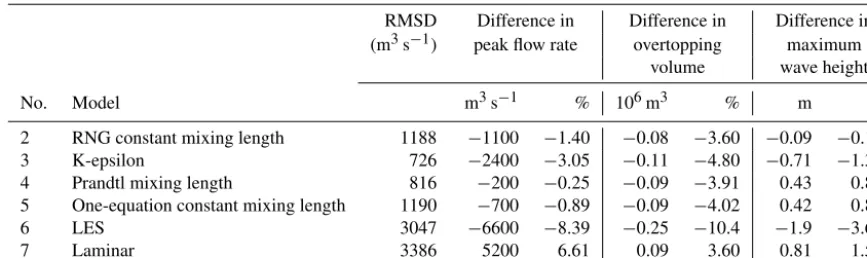
For the large size scenario with the avalanche-source bound-ary condition and current lake level, the results of using the various turbulence models were compared to the base-line model (1) (RNG dynamic mixing length). The RMSD (Fig. 3) shows the average difference in fluid depth between the baseline model and each of the other turbulence models. For all models, the highest RMSD values were for times up to 50 s when the water surface is most actively changing as the impulse wave is generated and begins to propagate across the lake. Models (6) (LES) and (7) (laminar) show the most de-viation from the baseline model with maximum RMSD val-ues around 2.5 m. The laminar model shows high deviations from the baseline model because it does not account for tur-bulence and should be the least dissipative of all the models. This is reflected in the peak flow rate, overtopping volume and maximum wave height (Table 1), which were all higher than the baseline model. The LES model appears to be overly dissipative, giving the lowest values for all parameters used for comparison between the models. It is difficult to say why this is the case, but it could be due to inhomogeneity in the flow or numerical errors due to the filter scale.
Table 1.Comparison of overtopping hydrograph characteristics among turbulence models.
RMSD Difference in Difference in Difference in (m3s−1) peak flow rate overtopping maximum
volume wave height
No. Model m3s−1 % 106m3 % m %
2 RNG constant mixing length 1188 −1100 −1.40 −0.08 −3.60 −0.09 −0.17
3 K-epsilon 726 −2400 −3.05 −0.11 −4.80 −0.71 −1.38
4 Prandtl mixing length 816 −200 −0.25 −0.09 −3.91 0.43 0.83
5 One-equation constant mixing length 1190 −700 −0.89 −0.09 −4.02 0.42 0.80
6 LES 3047 −6600 −8.39 −0.25 −10.4 −1.9 −3.64
7 Laminar 3386 5200 6.61 0.09 3.60 0.81 1.57
0 50 100 150 200
0 0.5 1 1.5 2 2.5 3
Time (s)
RMSD of fluid depth (m)
K−epsilon Laminar LES
Prandtl mixing length RNG constant mixing length 1−equation constant mixing length
Figure 3.Root-mean-square deviation (RMSD) of fluid depth from the baseline model results (RNG dynamically computed mixing length) for each turbulence model as a function of time.
differences in fluid depth between the models. All three mod-els had maximum RMSD values for fluid depth of around 1.8 m; the models approached a steady state (RMSD of ap-proximately 0.5 m) after 200 s when the initial wave over-topped the moraine. The highly variable lake bathymetry and fluid depths make defining an appropriate mixing length dif-ficult and introduce a source of uncertainty in the model; many of the turbulence models require the definition of a mixing length that ensures that the dissipation of energy is not underrepresented in the model. For this reason, model (1) appears to be the optimal choice in this case. However, the similarity in the results between the RANS eddy viscosity models (1)–(5) indicates that the uncertainty introduced by the constant mixing length models is relatively insignificant. The RMSD of the overtopping hydrograph flow rates for each of the turbulence models are given in Table 1 along with additional comparisons of the hydrographs, including the percent difference in peak flow rate and total overtopping volume. The largest differences in flow rate and overtopping
volume came from models (6) (LES) and (7) (laminar) with the laminar model producing higher flows and the LES model producing the lowest flow rates. The hydrographs from the other models resembled that of the baseline model. The per-cent differences in peak flow rate from the eddy viscosity models ranged from around 0.25 % for model (4) (Prandtl) to around 3 % for model (3) (k-epsilon). The differences in to-tal overtopping volume were a little higher, although all were less than 5 %, and the differences in maximum wave height were much less significant for all but model (6) (LES), with most models giving differences less than 2 %.
The laminar model (7) is the only model that gave higher flow rates and overtopping volumes than the baseline model, indicating that even if the turbulence model introduces un-certainty into the model results, the results of the baseline model are most likely conservative, giving possibly higher discharges. Considering all the other sources of uncertainty in the models of the avalanche and wave generation, the tur-bulence model is one of the less significant sources of uncer-tainty.
3.1.2 Sensitivity to grid size
0 50 100 150 200 250 300 350 400 1
1.5 2 2.5 3 3.5 4 4.5
Time (s)
RMSE of fluid depth (m)
Figure 4.RMSE of fluid depth for the coarse grid simulation as compared to the regular grid mesh using the baseline turbulence model.
at the same point in time, indicating that grid size could in-troduce much more error than the turbulence model.
The RMSE of overtopping discharge for the coarse grid simulation was approximately 3300 m3s−1. This amount of error is not insignificant; it is approximately 3 times the RMSD for the eddy viscosity turbulence models but less than the RMSD for the laminar flow model. The peak discharge from the coarse grid simulation was over 5 % higher than the peak discharge from the regular grid size model (a dif-ference of 4200 m3s−1). The total overtopping volume was slightly higher for the coarse grid simulation (a difference of 30 000 m3), but the difference was less than 1 %, so the coarse grid model seems to estimate the total overtopping volume well even if it does not get the wave dynamics and outflow hydrograph completely correct. Although the error resulting from using a coarser mesh was greater than the un-certainty from most of the turbulence models, the unun-certainty due to the grid size is still not a very large source of error. 3.2 Comparison of boundary conditions: avalanche
source vs. mass–momentum source
The inflow hydrographs of the two boundary condition meth-ods are shown in Fig. 5 along with the hydrograph from the RAMMS avalanche model (Somos-Valenzuela et al., 2016). For all three avalanche scenarios, the peak inflow for the avalanche source was significantly higher than for the mass– momentum source. The mass–momentum boundary condi-tion inflows were very close to those of the RAMMS model in each case because the boundary condition was defined to match the RAMMS avalanche hydrograph. The higher peak inflows for the avalanche boundary condition are probably because the lower viscosity of water relative to the avalanche material allows the fluid to flow and spread out more quickly;
to compensate for this, the avalanche boundary condition fluid release volume was concentrated over a smaller area so that the fluid depths would not be too low, but the result was higher inflow rates over a shorter period. The peak in-flow rates for the avalanche boundary condition ranged from nearly twice the peak flow rate of the RAMMS avalanche for the large scenario to over 5 times higher for the small scenario, but the inflows for the avalanche boundary condi-tion were of much shorter duracondi-tion. For the large scenario, peak overtopping discharge for the mass–momentum bound-ary condition (Table 2) was 14 % less than the discharge for the avalanche boundary condition (compared to a difference of about 50 % for the inflows). However, for the medium and small scenarios, the difference in peak overtopping discharge between the two boundary condition models was more pro-nounced. For the medium mass–momentum boundary con-dition, the overtopping discharge was 65 % less than the dis-charge from the medium avalanche boundary condition; this difference was only slightly lower than the difference in peak inflow (∼75 %). The overtopping discharge for the small mass–momentum boundary condition was almost 91 % less than the discharge for the small avalanche boundary condi-tion (with difference in peak inflow of around 80 %). While the difference in overtopping volumes for thelargeavalanche and mass–momentum boundary condition was only 9 %, the total overtopping volume for the small mass–momentum boundary condition was over an order of magnitude less than the overtopping volume resulting from the small avalanche boundary condition (Table 2).
Time (s)
0 10 20 30 40 50
Flow
rate
(m
s
)
3
-1
×105
0 0.5 1 1.5 2 2.5 3 3.5
4 Large avalanche scenario
Measured avalanche inflow (RAMMS model) Modeled inflow: mass-momentum source Modeled inflow: avalanche source
Time (s)
0 10 20 30 40 50
Flow
rate
(m
s
)
3
-1
×105
0 0.2 0.4 0.6 0.8 1 1.2 1.4 1.6 1.8
2 Medium avalanche scenario
Measured avalanche inflow (RAMMS model) Modeled inflow: mass-momentum source Modeled inflow: avalanche source
Time (s)
0 10 20 30 40 50
Flow
rate
(m
s
)
3
-1
×104
0 1 2 3 4 5 6 7 8 9
10 Small avalanche scenario
Measured avalanche inflow (RAMMS model) Modeled inflow: mass-momentum source Modeled inflow: avalanche source
Figure 5.Inflow hydrographs for the avalanche as it enters the lake for the avalanche source and mass–momentum source boundary conditions as compared to the hydrograph extracted from the RAMMS avalanche model.
Table 2.Overtopping characteristics of three simulated avalanche events of different size for the current lake level and lake-lowering scenarios (after Somos-Valenzuela et al., 2016).
Lake lowering Boundary condition Overtopping Avalanche size Large Medium Small Baseline (0 m lower) Avalanche Volume (106m3) 1.80 0.50 0.15 Peak discharge (m3s−1) 63 400 17 100 6410
Wave height (m) 21.7 12.0 7.1
Mass–momentum volume (106m3) 1.64 0.15 0.014 Peak discharge (m3s−1) 54 600 6000 592
Wave height (m) 15.9 – –
15 m lower Avalanche Volume (106m3) 1.60 0.20 0.02
Peak discharge (m3s−1) 60 200 6370 1080
Wave height (m) 38.4 27.5 25.1
Mass–momentum Volume (106m3) 0.83 0.034 0
Peak discharge (m3s−1) 25 700 1510 0
Wave height (m) 32.0 25.4 0
30 m lower Avalanche Volume (106m3) 1.30 0.05 0
Peak discharge (m3s−1) 48 500 1840 0
Wave height (m) 60.8 42.5 0
Mass–momentum Volume (106m3) 0.45 0 0
Peak discharge (m3s−1) 15 100 0 0
Distance from avalanche impact (m)
0 200 400 600 800 1000 1200 1400 1600
Elevation (m.s.l.)
4480 4500 4520 4540 4560 4580 4600 4620
Initial water surface elevation Lakebed profile
Maximum wave elevation: large avalanche
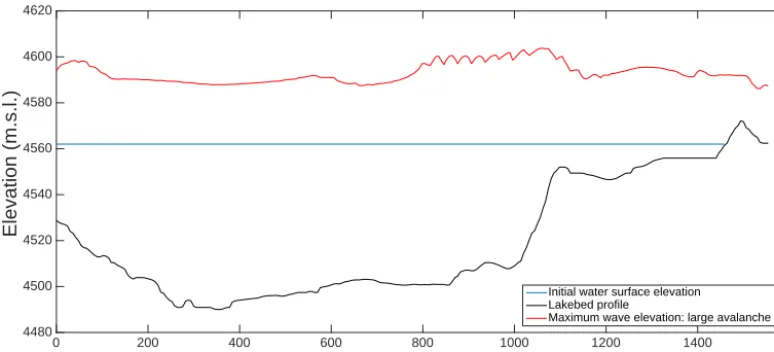
Figure 6.Profile of the maximum wave height as a function of distance along the lake for the large avalanche boundary condition.
from the sides of the lake in the avalanche model. However, due to the higher viscosity of the snow–rock–ice mixture of the avalanche, the inflow from the lateral moraines probably would happen more gradually so that the abrupt inflow from the sides would not cause such a significant peak in the in-flow hydrograph.
3.3 Wave characteristics
The impact of the avalanche with the lake generates a large displacement wave. As the wave propagates across the lake, it reaches a maximum height as it approaches the shallow part of the lake near the damming moraine (Fig. 6). The char-acteristics of the waves generated for each avalanche sce-nario are given in Table 3. The FLOW-3D wave heights were all larger than the empirically calculated wave heights (Heller and Hager, 2010); however, the waves were of a similar mag-nitude with both methods with a difference in maximum wave height between FLOW-3D and the empirical method of 14 % (5.8 m) for the large avalanche source. The FLOW-3D results showed attenuation of the wave as it propagated along the lake; this attenuation resulted in a reduction in the wave height of approximately 30 % before the wave began the run-up phase (Fig. 6).
Upon closer examination, the wave generated from the large avalanche source (Fig. 6) had two peaks that were of similar height. The first peak was near the avalanche impact, corresponding to the location of the wave represented by the empirical equations; the second peak, which was slightly higher, occurred as the wave began to run up on the shal-lower part of the lake. The wave characteristics calculated by the empirical method consider the wave generation pro-cess but do not account for the impact of run-up on the wave characteristics. Therefore, the peak wave height in the deeper portion of the lake is the closest point of comparison with the empirical equations. Figure 6 gives the wave height as a
function of distance along the lake (not as a function of time); there were some oscillations in the profile of the maximum wave height, most likely due to splashing from the run-up on the sides that was reflected off the lateral moraines and returned to the lake at irregular intervals.
3.4 Overtopping hydrographs and volumes
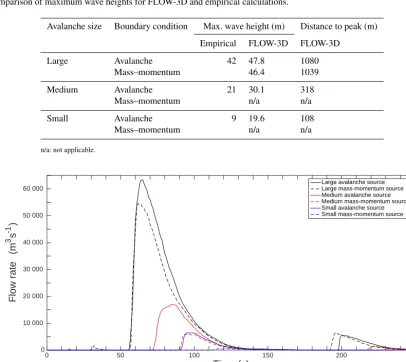
The run-up phase culminates with the moraine overtopping; the wave heights given in Table 2 correspond to the height above the moraine crest as the wave overtops the damming moraine. The volume of water that resulted from the over-topping of the moraine was significant; the total overover-topping discharge volume for each scenario is given in Table 2, and the overtopping hydrographs are shown in Fig. 7. The large avalanche source resulted in a peak overtopping discharge of approximately 63 000 m3s−1 that occurred around 60 s af-ter the start of the avalanche as well as a smaller peak of 6000 m3s−1 resulting from the overtopping of the reflected wave. The overtopping of the initial wave lasted about 100 s for the large avalanche source, 70 s for the medium avalanche source, and 50 s for the small avalanche source.
Table 3.Comparison of maximum wave heights for FLOW-3D and empirical calculations.
Avalanche size Boundary condition Max. wave height (m) Distance to peak (m) Empirical FLOW-3D FLOW-3D
Large Avalanche 42 47.8 1080
Mass–momentum 46.4 1039
Medium Avalanche 21 30.1 318
Mass–momentum n/a n/a
Small Avalanche 9 19.6 108
Mass–momentum n/a n/a
n/a: not applicable.
Time (s)
0 50 100 150 200 250
Flow
rate
(m
s
)
3
-1
0 10 000 20 000 30 000 40 000 50 000 60 000
Large avalanche source Large mass-momentum source Medium avalanche source Medium mass-momentum source Small avalanche source Small mass-momentum source
Figure 7.Overtopping wave discharge hydrographs for the three avalanche events and two types of boundary conditions with the lake at the baseline level.
overtopping volume between the small avalanche and mass– momentum boundary conditions was 91 %.
The overtopping volumes for all scenarios were less than the volume of avalanche material entering the lake. The over-topping volume for the large avalanche boundary condition was 60 % of the avalanche volume, and for the medium and small avalanche boundary conditions the overtopping volumes were 50 and 30 % of the avalanche volumes, re-spectively. The overtopping volume decreases relative to the avalanche volume as the avalanche size decreases, indicat-ing that the lake has more capacity to dissipate smaller avalanche-generated waves.
3.5 Lake-lowering scenarios
Two scenarios of lake lowering were simulated to evaluate the potential effect of lowering the lake level as a mitiga-tion strategy. Three avalanche sizes and both types of bound-ary conditions were simulated with each lake level, resulting in a total of 18 simulations. The overtopping volumes and
peak discharges were somewhat reduced by lowering the lake 15 m, while 30 m lowering resulted in even further reductions in overtopping discharges (Table 2). The hydrographs for the overtopping discharge are shown in Fig. 8.
Time (s)
0 50 100 150 200 250
Flow
rate
(m
s
)
3
-1
×104
0 0.5 1 1.5 2 2.5 3 3.5 4 4.5 5 5.5 6 6.5 7
(a)
Large avalanche scenarioLarge avalanche source, 0 m Large mass-momentum source, 0 m Large avalanche source, 15 m Large mass-momentum source, 15 m Large avalanche source, 30 m Large mass-momentum source, 30 m
Time (s)
0 50 100 150 200 250
Flow
rate
(m
s
)
3
-1
×104
0 0.2 0.4 0.6 0.8 1 1.2 1.4 1.6 1.8
(b)
Medium avalanche scenarioMedium avalanche source, 0 m Medium mass-momentum source, 0 m Medium avalanche source, 15 m Medium mass-momentum source, 15 m Medium avalanche source, 30 m Medium mass-momentum source, 30 m
Time (s)
0 50 100 150 200 250
Flow
rate
(m
s
)
3
-1
0 1000 2000 3000 4000 5000 6000 7000
(c)
Small avalanche scenarioSmall avalanche source, 0 m Small mass-momentum source, 0 m Small avalanche source, 15 m Small mass-momentum source, 15 m Small avalanche source, 30 m Small mass-momentum source, 30 m
Figure 8. Overtopping hydrographs for lake-lowering scenarios for (a) large avalanche scenario, (b) medium avalanche scenario, and(c)small avalanche scenario.
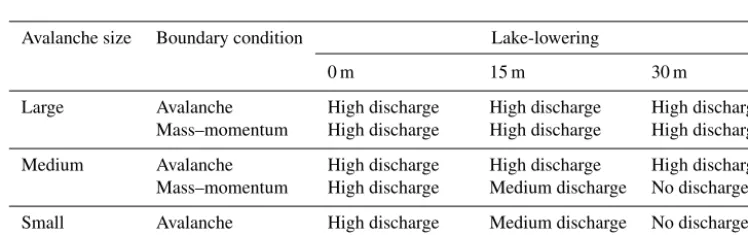
Table 4.Characterization of scenario according to the volume of overtopping discharge. Scenarios labeled as “High discharge” had overtop-ping volumes > 20×103m3. Scenarios labeled as “Medium discharge” had overtopping volumes≤20×103m3. Scenarios labeled as “No discharge” did not result in any overtopping.
Avalanche size Boundary condition Lake-lowering
0 m 15 m 30 m
Large Avalanche High discharge High discharge High discharge
Mass–momentum High discharge High discharge High discharge Medium Avalanche High discharge High discharge High discharge Mass–momentum High discharge Medium discharge No discharge Small Avalanche High discharge Medium discharge No discharge Mass–momentum Medium discharge No discharge No discharge
large mass–momentum boundary condition, with 30 m lake lowering. The categorization of each scenario according to the overtopping volume (Sect. 2.4) is given in Table 4.
The overtopping wave heights increased with lake lower-ing even though the total overtopplower-ing volumes and peak flow rates decreased. This may seem counterintuitive, but it can be explained by looking at how the lake dynamics may be expected to change with lake lowering. First, as the water surface level is lowered, the total volume stored in the lake decreases; thus the momentum transferred to the lake from the avalanches per unit volume should be higher. The to-tal volume in the lake decreases with lake lowering, so the additional momentum relative to the lake volume can pro-duce taller waves. Second, as the point of avalanche impact is at a lower elevation relative to the avalanche release area with lake lowering, there is more momentum in the avalanche fluid when it enters the lake. Although the increased over-topping wave heights for the lake lowering scenarios
indi-cate that the waves may be larger when the lake is lowered, the amount of overtopping still decreases with lake lowering. This is most likely due to the lower initial water surface el-evation; the lower free surface elevation results in a larger freeboard and means that more momentum is required for overtopping; although the momentum transfer per unit vol-ume to the lake from the avalanche is greater, more of this momentum is lost during the run-up and overtopping, and less water is actually able to pass over the crest of the termi-nal moraine.
4 Discussion
4.1 Boundary condition methods
complex nature of the interacting dynamic physical systems makes it difficult to develop a comprehensive and precise method for simulating avalanche-generated waves in glacial lakes. Recent advances in two-phase flow models such as r.avaflow (Pudasaini, 2012; Mergili et al., 2017) can facili-tate simulations of wave generation from avalanches enter-ing a lake; however, the use of depth-averaged equations still limits the ability to use this type of model to simulate all of the phases of an avalanche-generated wave from wave gener-ation to overtopping. Avalanches typically consist of a mix-ture of snow, ice, and rock, and the biggest limitation of the boundary conditions in this model is the representation of the avalanche fluid as water because the dissipation of en-ergy of the actual avalanche material is different from wa-ter. This limitation can be partially overcome by calibrating the model to replicate the depth and velocity characteristics of the avalanche as it enters the lake. This is done by ad-justing the avalanche release area in the avalanche boundary condition and the hydrograph and cross-sectional area of the inflow for the mass–momentum boundary condition. How-ever, it is impossible to completely replicate the avalanche characteristics in the lake hydrodynamic model, and there are significant differences in the inflow hydrographs of the FLOW-3D model and the RAMMS avalanche model (like the mass–momentum source) when the avalanche boundary condition is used. The discrepancies between the avalanche and mass–momentum boundary conditions are more pro-nounced for smaller avalanches, but there is no obvious so-lution to overcome this difficulty when using the avalanche boundary condition. To further advance the simulation of avalanche-generated waves, models are needed that can eas-ily and accurately represent two distinct fluids (in this case the mixture of snow, rock, and ice of the avalanche and the water in the lake) combined with non-hydrostatic free surface flows. Without two-phase models that can simulate free sur-face flows, it will not be easy to overcome the limitations and irregularities of the model that result from the representation of the avalanche fluid as water.
The avalanche boundary condition has much higher and possibly unrealistic peak inflow rates, but it gives a better physical representation of the actual geometry of the terrain as the avalanche enters the lake. The avalanche boundary condition is also able to simulate the effects of avalanche material entering the sides of lake, whereas the mass– momentum boundary condition only simulates flow enter-ing from the end of the lake. The mass–momentum boundary condition better matches the peak flow rates of the avalanche because that is how the method was designed; the flow rate of the avalanche inflow is a control parameter for the mass– momentum boundary condition. However, under this bound-ary condition, the avalanche material enters the lake hori-zontally rather than on the steep incline of the actual terrain above the lake. Therefore, this boundary condition likely un-derestimates the momentum transfer between the avalanche and the lake, as the avalanche can gain more momentum as it
enters the lake at a downward angle. Despite the limitations of each boundary condition method, they are representing a range of possible outcomes, and the results could be con-sidered as upper and lower bounds on the overtopping dis-charge from the lake model. Because we do not have any field measurements of the characteristics of avalanche-generated waves during GLOF events or the resulting discharge hydro-graphs, we do not possess the means of validating the model results presented in this paper or conclusively evaluating the boundary condition methods.
The avalanche simulation is the process in the GLOF chain of events that carries the greatest uncertainty because avalanche dynamics may be the least understood of the pro-cesses. The range of uncertainty in the avalanche condi-tions (depths, flow rates, and velocities) is possibly greater than the range of variability in the inflow hydrographs for the lake model. We have no estimates of the uncertainty in the avalanche model, but any uncertainties in the avalanche simulations are propagated into the lake model and subse-quent processes in the GLOF chain of events. Although there is significant variability between the avalanche and mass– momentum boundary condition results, the range of variabil-ity in the peak flow and shape of the avalanche hydrographs may be even greater than the variability in the discharge hy-drographs from the lake model.
4.2 Wave characteristics
FLOW-3D model can likely produce more realistic overtopping dis-charges than the empirical method. For the large avalanche scenario, both boundary conditions resulted in wave heights that were only 4.4–5.8 m higher than the empirically calcu-lated wave heights. However, it is worth noting that the maxi-mum wave height for the large avalanche boundary condition occurred at the beginning of the run-up phase in the shallow part of the lake, and the first wave peak in the deep portion of the lake was closer to the empirically predicted height. The large differences between the empirical and FLOW-3D wave heights for the medium and small scenarios may be due to the shortcomings of the avalanche boundary condition. Never-theless, the relatively close agreement between the empirical and hydrodynamic models for the large avalanche scenario indicates that it may be possible to use the empirical method as a calibration tool.
During the run-up phase of the wave propagation, two things happened simultaneously. The wave height increased due to the run-up in the shallow portion of the lake, but there was also some energy loss due to the sharp disconti-nuity in the lake bed geometry. Generally, one might expect the wave height to increase even more than what occurred in the FLOW-3D simulations; however, due to the lake bed geometry, there is more dissipation of energy when the wave reaches the shallow portion of the lake than would occur if there were a more gradual transition between the deep and shallow areas of the lake.
4.3 Model sensitivities and uncertainties
When model calibration and validation with field data is im-possible, it is important to understand the model sensitivity to input parameters. This sensitivity analysis may be used in lieu of validation in order to better understand the uncertain-ties of the model so that we do not represent more confidence in the model results than is justifiable given the uncertain-ties in the modeling process. The greatest uncertainty in the lake modeling arises from the wave generation and avalanche characteristics. Uncertainties due to the turbulence model and grid size are not negligible, but they are small compared to the magnitude of uncertainty from the wave generation.
The input parameter that seems to generate the least sen-sitivity is the turbulence model, with most variables used to evaluate the sensitivity varying less than 3 %. Although the results were somewhat more sensitive when the LES model and laminar flow model were used, this may be expected because neither model would be considered an appropriate choice for this application. We have insufficient informa-tion to correctly apply the LES model, and we know that the flow is not laminar, so neglecting turbulence altogether would underrepresent the dissipation of energy in the model. The RANS turbulence models all gave similar results. There-fore, the choice of turbulence model should likely have little impact on the results of the lake model, even when input pa-rameters such as the mixing length are unknown.
Nonethe-less, the turbulence models that use a dynamically computed mixing length are still probably the best choice because they eliminate the need for assumptions about the flow character-istics.
While the model sensitivity to grid size is greater than the sensitivity to the turbulence model, the variability in the anal-ysis parameters was still generally less than 5 %. In addition, the coarse grid simulation gave a larger overtopping volume and peak flow, so even though some error may be introduced by increasing the grid spacing, in this case it gave a more con-servative result. However, any conclusions made from these results should be done carefully. The analysis of the effect of grid size on model results presented in this paper is not com-prehensive, and it may be that further increasing the size of the grid cells could have an undesirable effect on the reliabil-ity of the model results. Nonetheless, the choice of grid size is likely to be a much less significant source of uncertainty than the boundary conditions.
One way to estimate the uncertainty in the wave genera-tion is by using more than one method to represent the im-pact of the avalanche with the lake (i.e., the two methods for modeling the boundary conditions). Without any in situ data from real events, the level of uncertainty cannot be estimated precisely; however, given the range of overtopping flows and volumes from the two boundary condition methods, the un-certainty is considerable. Although there is no way to vali-date the results to know which type of boundary condition is more representative of the actual conditions, it is possible that the avalanche boundary condition is overestimating the momentum transfer while the mass–momentum boundary condition is likely underestimating it. The avalanche bound-ary condition could represent an upper bound for the simula-tion results while the mass–momentum source may be closer to a lower bound.
The scenarios of avalanche size cover a range of possible avalanche volumes that could trigger GLOFs of significant size, and the analysis of the results from these scenarios may be considered as a measure of the sensitivity of the overtop-ping discharge to the input parameters related to avalanche characteristics. The avalanche characteristics carry their own uncertainties that are propagated into the lake model and subsequent downstream processes, and these uncertainties are probably much greater than the uncertainties associated with the turbulence model and grid size. Although we do not have enough information to quantify the uncertainty from the avalanche model, evaluating the potential effect of different sized avalanches on overtopping discharges can help us bet-ter understand the downstream sensitivity to the avalanche characteristics.
4.4 Implications of model results
termi-nal moraine due to overtopping flows. The avalanche is the portion of the GLOF process chain that is the least under-stood and most likely the greatest source of uncertainty in GLOF modeling and hazard mapping. Although the uncer-tainty resulting from the avalanche portion of the chain of events must be considered in the decision-making process, investigating the uncertainty in the avalanche characteristics is beyond the scope of this work. In a way, the avalanche scenarios are attempting to capture some of that uncertainty, but it does not represent all of the uncertainty associated with the avalanche model. This work explores the uncertain-ties that arise when representing the impact of the avalanche with the lake and the wave generation, but this is necessar-ily limited by the avalanche characteristics that were avail-able from the avalanche simulations. Until further advances are made in the field of avalanche simulations and we gain an improved understanding of avalanche dynamics for this type of event, it is impossible to incorporate all of the uncer-tainty of potential avalanches into analysis of the dynamics of avalanche-generated waves. All that we can do is assess the sensitivity of the lake model to different types of inputs to gain a qualitative understanding of how these uncertain-ties might impact the characteristics of avalanche-generated waves and the overtopping discharges. The potential erosion of the terminal moraine is also an important factor to con-sider when assessing the hazard level of any glacial lake with a moraine dam. For Lake Palcacocha, this was assessed by Somos-Valenzuela et al. (2016) through a separate hydro-morphodynamic model, and the conclusion was that, despite significant potential for erosion, the moraine is extremely un-likely to fail.
The results from the large avalanche simulations represent the worst-case scenario of an avalanche-induced GLOF from Lake Palcacocha if the moraine is as stable as it seems. Given the significant differences between the small and medium avalanche simulations, results from both boundary condition methods should be provided if these scenarios and their like-lihoods will be used in an economic or risk and vulnerability analysis of the mitigation alternatives. All the large avalanche scenarios and most of the medium avalanche scenarios re-sulted in significant overtopping, even with lake lowering. Thus, it is clear that steps to mitigate or reduce the hazard must be taken because even with the low end of the range of uncertainty in avalanche sizes, the resulting discharges could represent an unacceptable level of risk for the city of Huaraz, as was also indicated in Somos-Valenzuela et al. (2016). However, the classification of overtopping discharges by vol-ume used here (Table 4) is not fully indicative of the effect of lake lowering on hazard mitigation. The downstream im-pacts for each scenario should be considered when evaluat-ing lake-lowerevaluat-ing scenarios, but decision makers must also recognize the uncertainty contained in these GLOF hazard assessments. The potential for lake lowering works to pre-vent overtopping for the small and medium avalanche sce-narios is significant because small and medium avalanches
are believed to be much more likely than large avalanches (Huggel et al., 2004); therefore, the real impact of lake lower-ing may be more than is immediately apparent with these re-sults. However, from the modeling results alone it is not pos-sible to determine an optimum lake level. Further economic and vulnerability analyses are necessary to recommend an ideal mitigation alternative.
5 Conclusions
Three-dimensional non-hydrostatic models can be a use-ful tool to simulate avalanche-generated waves and im-prove our understanding of lake dynamics during GLOF events. The simulations of Lake Palcacocha show that waves of considerable magnitude can be produced. While sensitivity of the overtopping discharge to the turbulence model and grid size is minimal, the avalanche character-istics and the shape of the inflow hydrographs substan-tially influence the overtopping wave volumes. While large avalanches produce the largest overtopping discharges, even smaller avalanches could generate significant overtopping discharges. Based on the downstream inundation analysis in Somos-Valenzuela et al. (2016), even the small avalanche scenario could result in substantial inundation in the city. Somos-Valenzuela et al. (2016) only evaluate scenarios that use the avalanche source boundary condition, but the re-sults presented here indicate that the overtopping discharges with the mass–momentum source boundary condition may be lower than those evaluated for downstream impacts in Somos-Valenzuela et al. (2016). Based on this, it can be con-cluded that there is a considerable amount of uncertainty in the lake model due to the boundary condition method. How-ever, even considering this uncertainty, we can still conclude that overtopping discharges for the current lake level could be significant. Lowering the lake level may reduce the over-topping volume and discharge for a large avalanche, but it is not possible to eliminate the potential for overtopping. For small (0.5×10⁶m3)and medium (1×10⁶m3)avalanches, it may be possible for the wave to be contained in the lake if the water surface is lowered. However, given the range of uncertainty in the model results, it cannot be stated conclu-sively that lowering the lake level would prevent overtopping for smaller avalanches. Even though the precise reduction in hazard level due to lake lowering cannot be quantified using the given approach, it is reasonable to conclude that lowering the level of Lake Palcacocha can reduce the hazard levels in the city of Huaraz.