ARBTools: A tricubic spline interpolator for three-dimensional
scalar or vector fields.
Walker, Paul1,*, Krohn, Ulrich1, Carty, David2
1 Department of Physics, Durham University, South Road, Durham, DH1 3LE, United Kingdom.
2 Department of Chemistry, Durham University, South Road, Durham, DH1 3LE, United Kingdom
Abstract
ARBTools is a Python library containing a Lekien-Marsden type tricubic spline method for interpolating three-dimensional scalar or vector fields presented as a set of discrete data points on a regular cuboid grid. ARBTools was developed for simulations of magnetic molecular traps, in which the magnitude, gradient and vector components of a magnetic field are required. Numerical integrators for solving particle trajectories are included, but the core interpolator can be used for any scalar or vector field. The only additional system requirements are NumPy.
Keywords
ARBTools, Python, three-dimensional interpolation, spline, vector field, scalar field, smoothing
Introduction
1It is often necessary to smoothly interpolate vector or scalar fields known as a set of discrete 2
data points across a grid. For one- and two-dimensional problems cubic and bicubic spline 3
implementations exist (for example, in the SciPy interpolate library [1]), but 4
three-dimensional problems are more difficult. This software was developed for use in 5
modelling the three-dimensional motion of paramagnetic neutral particles through Zeeman 6
decelerators [2] and magnetic traps [3]. These fields are produced by combinations of 7
permanent magnetic and electromagnetic elements with generally no analytic solution. The 8
potentials are calculated, for example using finite element analysis methods, as a series of 9
data points on a grid, which must be interpolated to return the required values for an 10
arbitrary point within the region of interest. 11
The tricubic method described by Lekien and Marsden [4] implements cubic spline 12
interpolation in three dimensions, in an efficient and accurate way. The method was 13
originally motivated by studies of current flow in ocean dynamics [5]; high-frequency radar 14
data give a two-dimensional vector map of the surface of the ocean as a series of discrete 15
points, measured at regular intervals in time. The authors developed their method to 16
smoothly interpolate the time evolution of this velocity field, and note it can equivalently 17
operate on time-independent three-dimensional fields. 18
There are several commonly available implementations of this interpolator in a variety of 19
programming languages, but none were suitable for the specific requirements of our work. 20
ARBTools was written in Python [8], allowing easy modification of the software if needed. 21
Unlike many tools with complex software dependencies the only additional requirement for 22
ARBTools is NumPy [9]. The careful use of NumPy libraries has also allowed the package to 23
be efficient, and in tests it is only moderately slower than an equivalent C implementation. 24
The main difference in ARBTools, however, is the direct availability of the derivatives of an 25
interpolated scalar field, knowledge of these derivatives being a prerequisite for calculating 26
the force arising due to a potential gradient. (Unlike other interpolation methods in which 27
the gradients are recovered via finite-differences, in the tricubic scheme the approximating 28
polynomial function can be analytically differentiated). The software can also directly work 29
with a vector field; for example, in the context of molecular and atomic traps this is needed 30
when calculating the probabilities of non-adiabatic spin transitions [6], or simulating 31
laser-cooling interactions [7]. 32
Interpolation coefficients are calculated on-the-fly and subsequently reused where 33
required to reduce processor time. For arbitrary points inside the interpolation volume the 34
field magnitude, partial derivatives and vector components are readily accessible from a 35
single query. Separate query methods are included for dealing with interpolation of a single 36
point, or for multiple simultaneous coordinates. A fourth-order Runge-Kutta [10] algorithm 37
is implemented for numerically solving particle motion. 38
Although produced for the specific application of modelling low-field-seeking neutral 39
particles, this software has been developed to be more general. It can work directly with 40
either a scalar or vector field input, and is suitable for a variety of applications with any 41
field supplied across a regular, cuboid grid. 42
Implementation and architecture
43ARBTools is written in Python [8], with extensive use of NumPy [9]. ‘ARBInterp’ contains 44
the tricubic interpolator and query methods. Any source data presented across a regular 45
grid as either a scalar or vector field can be input into the interpolator, allowing the values 46
of the data to be calculated for arbitrary points within the set. For scalar data the 47
derivatives are directly accessible. Although designed for magnetic fields this software could 48
be used with a wide variety of systems, such as modelling heat flow, or in data processing to 49
smooth contour plots or heatmaps. Example magnetic fields, as both magnitudes and 50
vectors, are available to download along with scripts illustrating the use of the interpolator. 51
These example files also illustrate the expected input format of the data. 52
The ‘ARBTraj’ module contains functions to create a random sample of argon atoms 53
and solve its motion through a quadrupole field. By simply changing mass and magnetic 54
moment values this can be adapted for different atomic species, or a differently shaped 55
magnetic potential could be specified. The included Runge-Kutta integrator can be easily 56
modified to solve particle motion in alternative systems - for example, we have recently 57
discussed simulating the operation of an atomic tweezer apparatus with a colleague. 58
Installation
59To install on Linux run ‘sudo python setup.py install’. The interpolator is contained in a file 60
called ‘ARBInterp.py’ and the command ‘from ARBTools.ARBInterp import tricubic’ will 61
import the interpolation class. 62
Usage
63To instantiate the class, pass it a source field -e.g. ‘interp = tricubic(sourcefield)’ will 64
create an instance called ‘interp’. Input can be either a scalar field U(x,y,z) as an N x 4 65
(x,y,z,U) array or a vector field B(x,y,z) as an N x 6 (x, y, z, Bx, By, Bz) array. If an N x 4 66
field is passed, the interpolator will automatically default to return the magnitude and 67
gradient of the field. If an N x 6 field is passed it will accept an optional ‘mode’ keyword 68
argument to select one of three modes, (e.g. interp = tricubic(sourcefield, mode=‘kw’)): 69
• Norm: takes the norm of the vector field and return the magnitude and gradient (as 70
three partial derivatives) 71
• Vector: returns the interpolated vector components 72
• Both: takes vector norm, and returns the magnitude and norm of the vector plus the 73
vector components at the interpolation point 74
If no keyword is passed, the interpolator defaults to vector mode. Two query modes are 75
implemented: ‘sQuery’ interpolates a single point within the volume, accepting an input in 76
the form ([x, y, z]). ‘rQuery’ accepts a range of coordinates for simultaneous interpolation, 77
as an array ([x1, y1, z1]...[xn, yn, zn]). For multiple queries rQuery is much more efficient 78
than running sQuery in a loop. 79
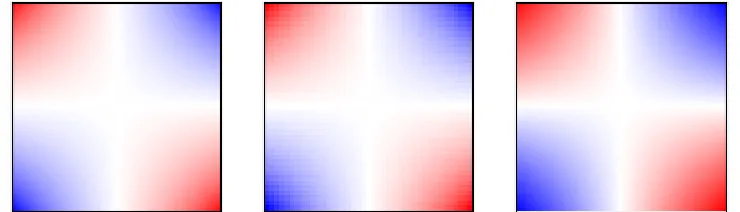
Figure 1. The magnitude of a quadrupole electric field, left, 400 x 400 pixel analytic
solution, centre, 40 x 40 pixel exported subset, right, 400 x 400 pixel interpolation of the subset.
Figure 1 shows an interpolation example. The quadrupole electric field produced by four 80
point charges was calculated as a grid of 4003data points; the left plot is a 2D slice through
81
the central plane. A less dense grid of 403points was then calculated, and the middle image
82
shows a plot through the centre. Lastly, the sparse grid was interpolated to reproduce the 83
4003 data, and is shown on the right.
84
Quality control
85ARBTools was written with Python 2.7.12 and NumPy 1.13.3 on Linux Mint 18.3, and has 86
been tested with Python 3.5.2 on the same platform. It has also been tested on Enthought 87
Canopy v2.1.9 on Microsoft Windows 7 and 10. 88
Example input fields and query scripts are available to download from the source 89
repository. Performance benchmarking on 64-bit Linux with an Intel Core i7 CPU shows 90
100 unique interpolations for a given data set take between 20 and 50 ms, depending on 91
which components are being returned. As expected, there is a linear relationship between 92
number of queries and run time. 93
The main constraint when using ARBTools is the amount of memory required to load 94
20 mm on a side with a grid spacing of 0.5 mm contains 413= 68921 grid points, which will 96
load in less than a second with negligible memory usage. The same data sampled at 97
0.25 mm intervals contains 531441 points, this may take several seconds to load and 98
consume≈500 MB memory. At 0.125 mm intervals we have 4173281 points, this may take 99
up to a minute to load and consume over 5 GB of memory. Once loaded, however, querying 100
these different datasets takes almost exactly the same amount of time. 101
The tricubic interpolation method values smoothness of the interpolated function and its 102
first derivatives over absolute accuracy [4]. In order to quantify the errors in this method 103
two types of model were considered; the quadrupole electric field produced by a series of 104
point charges, which can be solved analytically (figure 1), and a magnetic field produced by 105
a permanent magnet, calculated using finite-element analysis with the ‘FEMM’ [11] software 106
package (see figure 2). (Of course, if an analytic solution is available there is no need to 107
interpolate - this is simply a useful calibration tool!) 108
Figure 2. The magnitude of the magnetic field around a ring magnet, left, 400 x 400 pixel
finite-element analysis model, centre, 40 x 40 pixel exported subset, right, 400 x 400 pixel interpolation of the subset.
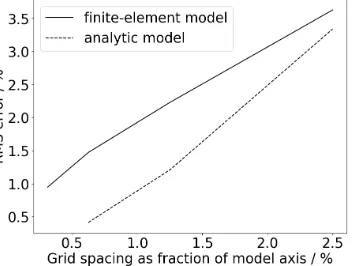
For both cases a high-resolution source dataset was created, and then a sparse subset of 109
this data was interpolated and compared with it. Figure 3 shows the root-mean-squared 110
errors between the interpolated and ‘true’ values of the calculated fields for a variety of grid 111
intervals. It can be seen that for a given level of accuracy the analytic solution can tolerate a 112
larger grid spacing - this is due to the high gradients at the interface between two materials 113
in finite-element (or boundary volume integral [12]) analysis. In general, consideration of 114
the nature of the data set being interpolated and its structure will inform the grid spacing 115
chosen, which is a compromise between inaccuracy and unwieldiness. These tests were 116
repeated with the interpolator in the ‘EQ Tools’ library; although it does not provide the 117
field derivatives, the magnitudes were found to be the same to within 1×10⁻⁶ %.
118
Figure 3. Root-mean-square error in interpolated data as compared to ‘true’ values from
either a finite-element analysis model or an analytic solution.
(2) Availability
119Operating system
120ARBTools was developed on Linux Mint 18.3, and has been tested on Windows 7 and 10. 121
Programming language
122ARBTools was developed in Python 2.7.12 and has been tested on 3.5.2. Any version of 123
Python from 2.7 upwards should be suitable. 124
Additional system requirements
125Several GB of RAM should be suitable for most applications. ARBTools has been used with 126
large datasets on the Durham university supercomputer. 127
Dependencies
128Written using NumPy 1.13.3. Earlier versions may work. 129
Software location:
130• Name: ARBTools 131
• Persistent identifier: https://doi.org/10.5281/zenodo.2548609 132
• Publisher: Paul A. Walker 133
• Version published: v1.3 134
• Repository: GitHub 135
• Persistent identifier: https://github.com/DurhamDecLab/ARBInterp 136
• Licence: GPL-3.0 137
• Date published: 15/02/2019 138
Language
139English 140
(3) Reuse potential
141The core of ARBTools is the tricubic interpolator, which can be used with any 142
suitably-formatted input field, for many possible tasks - for example, visualising the shape 143
of a three-dimensional potential or extracting coherent Lagrangian structures from a 144
time-dependent two-dimensional flow. The interpolator has been designed to be imported as 145
a library in Python, and the output from the evaluation methods can easily be passed into 146
third-party code, or output to file for use in non-Python systems. 147
As is, ARBTools can be used to model the trajectories of low-field-seeking argon atoms 148
in a magnetic field. Simply altering the mass and magnetic moment parameters would allow 149
other species to be modelled. If the functions defining the acceleration due to a potential are 150
replaced, trajectories in alternative systems could easily be modelled, for example, the 151
motion of charges in electric fields, or masses moving under gravity. 152
Support may be requested through the project GitHub page: 153
(https://github.com/DurhamDecLab/ARBInterp). The source code is available and may 154
be reused or modified at will subject to the details of the GPL-3.0 licence. 155
Acknowledgements
156Many thanks to Dr. Lewis McArd for his invaluable advice on this and other projects. 157
Funding statement
158This software was developed as part of research funded by EPSRC grant number 159
EP/N509462/1. 160
Competing interests
161“The authors declare that they have no competing interests.” 162
References
1631. ‘Interpolation (scipy.interpolate) - SciPy v0.19.0 Reference Guide’, (2017),SciPy.org . 164
Available at: https://docs.scipy.org/doc/scipy/reference/interpolate.html 165
2. McArd, L. M. (2017) ‘A Travelling Wave Zeeman Decelerator For Atoms and 166
Molecules’, PhD thesis, Durham University. 167
3. Walker, P. A. (2019) ‘MT-MOT: a Hybrid Magnetic Trap / Magneto-Optical Trap’, 168
MSci thesis, Durham University. 169
4. Lekien, F. and Marsden, J. (2005) ‘Tricubic interpolation in three dimensions’, 170
International Journal for Numerical Methods in Engineering, Vol. 63, No. 3, pp. 455–471 171
. DOI: 10.1002/nme.1296 172
5. Lekien, F., Coulliette, J. and Marsden, J. (2003) ‘Lagrangian Structures in Very 173
High-Frequency Radar Data and Optimal Pollution Timing’,AIP Conference 174
Proceedings 676, Vol. 162. DOI: 10.1063/1.1612209 175
6. Majorana, E. (1932) ‘Atomi orientati in campo magnetico variabile’,Nuovo Cimento, 176
Vol. 9, pp. 43–50. 177
7. Hanley, R. K., Huillery, P., Keegan, N. C., Bounds, A. D., Boddy, D., Faoro, R., and 178
Jones, M. P. A. (2018) ‘Quantitative simulation of a magneto- optical trap operating 179
near the photon recoil limit’,Journal of Modern Optics, Vol. 65, pp. 667-676, 180
DOI:10.1080/09500340.2017.1401679 181
8. van Rossum, G. (1995) Python tutorial, Technical Report CS-R9526, Centrum voor 182
Wiskunde en Informatica (CWI), Amsterdam 183
9. van der Walt, S., Colbert, S. C., and Varoquaux, G. (2011) ‘The NumPy array: a 184
structure for efficient numerical computation’,Computing in Science and Engineering, 185
Vol. 13, pp. 22-30, DOI:10.1109/MCSE.2011.37 186
10. ‘Runge-Kutta methods’, (2017)Wikipedia . Available at: 187
https://en.wikipedia.org/wiki/Runge-Kutta methods [Accessed April 2017]. 188
11. ‘Finite Element Method Magnetics’ (2019),Meeker, D.. Available at: 189
http://www.femm.info/wiki/HomePage 190
12. Elleaume, P., Chubar, O., Chavanne, J. (1997) ‘Computing 3D Magnetic Field from 191
Insertion Devices’,proc. of the PAC97 Conference, pp. 3509-3511. 192
13. Chilenski, M.A., Faust, I.C. and Walk, J.R. (2017) ‘eqtools: Modular, extensible, 193
open-source, cross-machine Python tools for working with magnetic equilibria’, 194
Computer Physics Communications, Vol. 210, pp. 155-162, 195
DOI:10.1016/j.cpc.2016.09.011. 196