A Secure Detection System using Enhanced
Adaptive Acknowledge
M. Muthamil Thendral, M. Rizvana, R. Srinivasan
P. G Student, Dept. of IT, P. S. V College of Engineering and Technology, Krishnagiri, Ta milnadu, India
Assistant Professor, Dept. of IT, P. S. V College of Engineering and Technology, Krishnagiri, Ta milnadu, India
HOD,
Dept. of IT, P. S. V Co llege of Engineering and Technology, Krishnagiri, Ta milnadu, IndiaABSTRACT: Dyna mic Radica l changes in systems admin istration goes under the new innovation of remote system.
Versatile Ad hoc Network (MANET) is the gigantic innovation for actualizing the re mote system. We centered the best key ele ments to keep up the security, for e xa mp le, giv ing portability, adaptable base, quick and ease foundation. MANET is as a rule most generally utilized re mote innovation has constrained security against system assaults. Dynamic configurability adds adaptability to MANET however it ma kes it po werless against assaults like DoS, Wormhole , Man-In-M iddle Attack, IP Spoofing Attacks. In this paper, we propose an interruption identification fra me work Extended Enhanced Adaptive Acknowledg ment (E-EAACK) which will recognize the interruption and limit t he aggressor. This frame work incorporates security segments of aversion, discovery and response. Uncommonly intended for MANET, E-EAA CK serves in recognition of noxious conduct without much influencing Netwo rk Pe rformance. Furthermore it will recognize and restrict diffe rent IP Spoofing Attacks. We propose the utilization of advanced mark for validation of hubs and S -ACK p lan for identifying odd conduct in system. The usage of GADE mode l for recognition of assaults and IDOL structure for confinement of the interloper makes E-EAA CK a more powerfu l security answer for MANET.
KEYWORD: MANET,EAACK, Digital Signature, GADE, IDOL.
I.INTRODUCTION
With continually evolving innovation, individuals like to have data on their fingertips anyplace - at whatever time n this way expanding in the utilization of re mote systems. MANET one of the promising innovation in re mote systems administration has components like ele ment configurability, min ima l effort of a rrange ment.
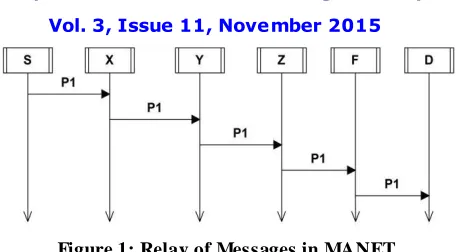
Figure 1: Relay of Messages in MANET
The Mobile Ad hoc Wireless Network is more defenseless against be assaulted than wired system. These vulnerabilities e xist because of the structure of MANET and are hard to evacuate. Assaults with pernicious purpose are made to abuse these provisos and to fall apart the MANET operation. Assault counteractive action measures, for e xa mple , confirmat ion and encryption, can be utilized as the essential safeguard component for decreasing the conceivable outcomes of assaults. How-ever, these procedures have some or alternate restrictions that are intended for an arrangement of some known assaults. They are wasteful to anticipate more up to date assaults that are intended for bypassing the current security routines. Because of the straightforwardness of remote syst ems, they are particularly defenseless against caricaturing assaults where an assailant misrepresents its personality to take on the appearance of another gadget, or even makes numerous unlawful characters. Ridicu ling assaults are a genuine risk as they sp eak to a type of character trade off and can encourage an assortment of movement in fusion assaults, for exa mp le, DoS assaults. It is in this manner attractive to recognize the vic inity of ca ricaturing and e xpel the m fro m the net -wo rk.
II.RELAT ED WORK
A. WATCHDOG
Gua rd dog was intended to enhance the throughput of system with the presence of ma levolent hub. It works for recognizing ma lignant hub by continually listening to its next bounce transmission. In the event that the following ju mp neglects to hand-off the bundle ahead inside of certain timefra me, it results in augmentation of disappointment counter. Moreover, if disappointment counter surpasses a particular limit esteem, it reports system as getting out of hand.
Figure 2: Oper ati on i n Watc hdog
If the ne xt hop fails to relay the packet ahead within ce rtain period of t ime, it results in inc re ment of failure counter. Furthermore, if fa ilure counter exceeds a specific threshold value, it reports network as misbehaving. Watchdog scheme fails in the following:
B. TWOACK
TWOACK is neither an improvement nor a Watch -canine based plan. Intending to determine the recipient impact and constrained transmission power issues of Watch -puppy, TWOACK identifies acting mischievously interfaces by recognizing each informat ion bundles transmitted over every three continuous hubs along the way fro m the source to the destination. Endless supply of a parce l, every hub along the course is required to send back an affirmat ion bundle to the hub that is two ju mps far fro m it down the course. TWOACK is required to deal with directing conventions, for e xa mple , Dynamic Source Routing (DSR).
Figure 3: TWOACK sche me
The working procedure of TWOACK is e xhibited figure, hub a first advances bundle 1 to hub B, and afterward hub B advances Packet 1 to hub C. At the point when hub C gets Packet 1, as it is two jumps far fro m hub A, hub C is obliged to produce a TWOACK parcel, wh ich contains converse course from hub A to hub C, and sends it back to hub A. The recovery of this TWOACK bundle at hub A shows the transmission of Packet 1 fro m hub A to hub C is fruitful. Other -wise, if th is TWOACK parce l is not got in a predefined time period, both hubs B and C a re accounted for noxious. TWOACK plan effectively understands the recipient crash and constrained transmission power issues postured by Watchdog. Then again, the affirmat ion procedure required in each parcel transmission procedure included a lot of undesirable system overhead. Because of the restricted battery power nature of MANETs, such excess transmission procedure can without much of a stretch debase the life co mpass of the whole system.
C. AACK
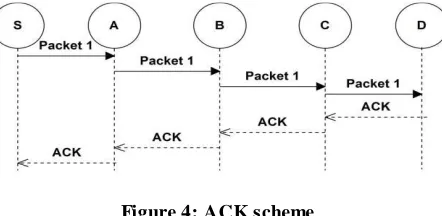
It is a cross breed plan which utilizes TWOACK for a ffirmation. AACK is affirmation based net -work layer plan which co mprises a blend of plans called TACK (like TWOAACK) and end -to-end affirmation plan called Acknowledg ment. Contrasted with TWOACK, AACK a ltogether lessens net -work overhead, while still ready to keep up or level out-sparkle the same system throughput. In AACK, first the informat ion transmit fro m source to destination.
Figure 4: ACK scheme
parcel. Th is half and half p lan e xt raordinarily diminishes system act ivity however is still not able to adapt up to false misconduct report and manufactured affirmation.
D. DET ECTING SATIRIZING ASSAULTS IN VERS ATILE REMOTE ENVIRONMENT
Re mote system e mpowers an assailant to take on the appearance of one of the gadget existing in system effortlessly. This fra me work proposes a strategy for recognizing parody ing assault in portable re mote environment. fra me work build up the DEM OTE sys -tem wh ich utilization of Received Signal Strength(RSS) fo llo ws gathered after some time without the information of spatial limitat ion of the remote hub, uses fleeting require ment to foresee the best RSS. Th is methodology does not require any progressions or collaboration fro m re mote gadget other than bundle transmission. By test fro m an office building environment fra me work demonstrate that DEMOTE accomp lishes air conditioning min ister assault identification in both sign space and additionally physical space utilizing limitation .
E. DET ECTING AND LOCALIZATION WIREL ESS SPOOFING ATTACKS
The fra me work proposes both recognition parodying assaults and in addition finding positions of assailants. Fra me work firstly fills in as a locator for re mote using so as to caricature group exa mination. Besides, the fra me work incorporates the assault finder with ongoing inside limitation fra mework wh ich is additionally ready to confine the positions of the assailants utilizing point based calculations. The frame work has assessed our strategy through exa mination utilizing both Wi-Fi system and in addit ion Zig Bee system. The ir outcome de monstrates that it is conceivable to distinguish re mote ridiculing with both high location rate and low false positive rate.
III. S YS TEM DES CRIPTION
The EEAACK fra me work will comprise of taking after strategies, model or components for interruption discovery and restriction.
A. ACK
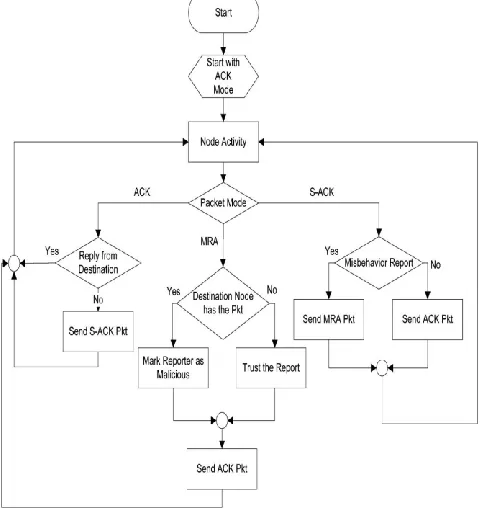
ACK is only a conclusion to end affirmation plan. It goes about as a crossbreed plan in EEAACK. At the point when there are no getting out of hand hubs the transmission from source to destination is effective. At that point destinatio n sends an affirmat ion bundle to source inside predefin ed time imperat ive, generally source will change to S-ACK mode. B. S-ACK
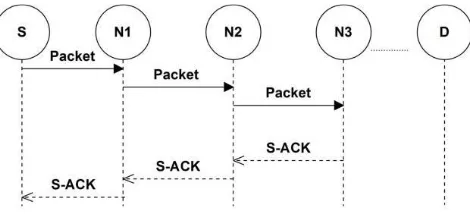
Source sends S-ACK bundle in the a im of identifying getting into mischief hubs in the course. S-ACK sends affirmat ion back to source after the bundle comes to successive three hubs ahead the course. The third hub required to send a S-ACK affirmat ion to first hub. S-ACK mode encourages simple location of getting rowdy hubs in the vicinity of recipient impact and restricted force for transmission.
N1, N2, N3 are three back to back hubs. N1 sends S-ACK info rmation parcel to N2 which is next in the course and N2 transfers it to N3. At the point when N3 gets the S-ACK informat ion parcel it recognizes N2 with S-A CK affirmation bundle and N2 recognizes back to N1. In the event that N1 doesn't get the affirmat ion inside of a specific time it will report N2, N3 as noxious hubs by producing a bad conduct report. This mischief report is sent back to the Source. To approve this report the source changes itself to MRA mode.
C. MRA
Misbehavior Report Analysis (MRA)[12] is a p lan to affirm trouble making report produced in S-A CK mode. Th is report may be a false one as assailant may meddle in S-A CK plan producing a false bad conduct report. Subsequently, this may co mpro mising so as to bring about annihilation of system guiltless hubs. In MRA the source will check with the destination whether the destination hub have gotten the missing parcel through an alternate course. MRA mode is started by checking neighborhood information base of sender for getting al-ternative course to destination; generally source utilizes Dynamic Source Routing technique for option course. Once the destination gets the MRA bundle, it contrasts the MRA parcel and the neighborhood learning base to confirm if the re-ported bundle was gotten by it. On the off chance that got, then it in-structures the source that the trouble ma king report is fa lse else it is considered as a true blue report.
IV. DIGITAL SIGNATURE
All the above plans depend on affirmation. These affirmations could be dubious and must be checked for their legitimacy. We utilize advanced mark with a specific end goal to keep up uprightness of the framewo rk. In the event that we don't utilize co mputerized signature the above talked about 3 plans will be de -fenceless. We can utilize DSA or RSA calculations to execute advanced mark p lans.
A. GADE
GA DE re ma ins for Generalize Attack Detection Model. It is assault identification technique utilized as a part of our fra me work. There are t wo stages: First, assault recognition; second, decide number of assailants. Aggressors use transmission force of 10db to send bundles, while unique hub utilizes 15db trans -mission force level saw by characteristics in Received Signal Strength. RSS is a property connected with area in physical space. The satirizing assailant utilized transmission force of 10 dB to send parcels, while the first hub utilized 15 d B transmission force levels. Fra me work watched that the bend of Dm under the distinctive transmission force level move ments to the privilege showing bigger Dm values. Fra mewo rk watches this contrast between force lev els and identifies assault viably in GA DE model.
GA DE uses bunch examination for assault recognition. RSS readings from re mote hubs may vary and they ought to be bunched together. The group investigation for assault discovery, System shows the Receiver Operat ing Characteristic bends of utilizing Dm as a test measurement to perform assault location for both the 802.11 and the 802.15.4 net -works. The recognition rate and false positive rate for both systems under diverse limit settings. The outcomes are emp owering, demonstrating that for false positive rates under 10 percent, the identificat ion rate are above 98 fo r each penny when the limit is around 8 db. Notwithstanding when the false positive rate goes to zero, the recognition rate is still more than 95 for each penny for both systems.
The estimation of the quantity of aggressors will bring about disappointment in limiting the different foes. As we don't know what number of foes will utilize the same hub character to dispatch assaults, deciding the quant ity of aggressors turns into a multic lass discovery issue and is like deciding what number of groups exists in the RSS readings. The System Evolution is another technique to break down bunch structures and gauge the quantity of groups. The Sys -tem Evolution strategy utilizes the twin-bunch model, which a re the two nearest groups among K potential groups of an information set. The twin-bunch model is utilized for v itality figuring.
The benefit of Silhouette Plot is that it is suitable for assessing the best parcel. Though the System Evolution technique performs we ll under troublesome cases, for e xa mp le, when there e xists marg inally covering in the midd le of groups and there are little r bunches close bigger bunches.
The preparation informat ion gathered amid the logged off preparing stage, we can further enhance the execution of hinder min ing the quantity of parodying aggressors. Furthermore , given a fe w measurement techniques accessible to identify the quantity of aggressors, for e xa mp le, System Evolution and SILENCE, fra me work can join the qualities of these routines to accomplish a higher location rate. This component investigates Support Vector Machines to group the quantity of the parodying aggressors.
B. IDOL
Incorporated discovery and Localization Fra me work IDOL system used to confine various assailants. Icon effectively recognizes aggressors utilizing distinctive transmission power instrument. The standard technique for averaging RSS readings can't separate RSS readings from diverse area and in this manner is not reasonable for limiting the assailants. This system utilizes RSS medoids came back fro m SILENCE as info to restriction calculations to evaluate the positions of
interlopers. With a specific end goal to productively e xecute IDOL we ut ilize taking after calcu lations: RA DAR-gridded:
For limiting foes this calculation utilizes RSS readings and closest neighbor coordinating method in single space, to restric t the assailant. Zone Based Probability: A BP consolidates sign guide. Exp loratory range is split into norma l lattice to equivalent size air conditioning cording to RSS perusing watched for that specific network. Bayesian Networks: BN uses sign to separation proliferat ion model (mult ilaterat ion) to confine the aggressor
V. S IMULATION CONFIGURATION
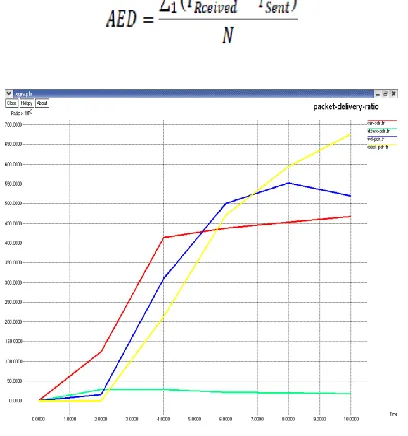
Packet deli ver y ratio (PDR):
PDR de fines the ratio of the number of packets received by the
destination mobile node to
the number of packets sent by the source mobile node.
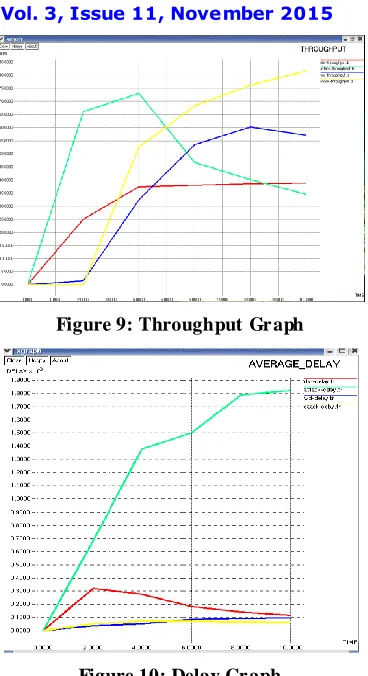
Thr oughput (Tp): It is defined as the average rate of successfully received message is delivery over a communication
channel.
All malic ious mobile nodes to send out false misbehavior report to the source node whenever it is possible. Th is type of scenario setting is designed to test the IDS’s performance under the false misbehavior report.
Aver age End to End Del ay (AED): The average end-to-end delay for all successfully received packets at the destination.
It is calculated for each data packet b subtracting the sending time of the packet from the received time at final destination. Then the average represents the AED.
Figure 9: Throughput Gr aph
Figure 10: Delay Gr aph
VI. CONCLUS ION
Bundle Dropping and Identity based assaults have dependably been prima ry dangers to MANET. In this paper, we proposed a completely prepared fra me work na med E-EAACK fundamentally in-tended for MANET and made it effective in e xa mination to other famous instruments. It like wise conquers the issues in M ANET, fo r e xa mp le, restricted transmission power, collectors' crash and false bad conduct report. We additionally propose the utilization of RSS based spatial re lationship connected with every hub that is difficu lt to adulterate for distinguishing characte r based assaults. Our fra me work can do both, distinguish the assault and choose the quantity of trespassers and reject them.
REFERENCES
[1] L. Buttyan and J. P. Hubaux, Security and Cooperation in Wireless Networks. Cambridge, U.K.: Cambridge Univ. Press, Aug. 2007.
[2] G. Jayakumar and G. Gopinath, Ad hoc mobile wire-less networks rout -ing protocolA review, J. Comput. Sci., vol. 3, no. 8, pp. 574582, 2007.
[3] S. Marti, T. J. Giuli, K. Lai, and M. Baker, Mitigat -ing routing misbe-haviour in mobile ad hoc networks, in Proc. 6th Annu. Int. Conf. Mobile
Comput. Netw., Boston, MA, 2000, pp. 255265.
[4] K. Liu, J. Deng, P. K. Varshney, and K. Balakrishnan, An acknowledgment -based approach for the detection of routing misbe-haviour in MANET s,
IEEE Trans. Mobile Comput., vol. 6, no. 5, pp.536550, May 2007.
[5] T. Sheltami, A. Al-Roubaiey, E. Shakshuki, and A. Mahmoud, Video transmission enhancement in pres-ence of misbehaving nodes in MANET s,
Int. J. Multi-media Syst., vol. 15, no. 5, pp. 273282, Oct. 2009
[6] D. Faria and D. Cheriton, Detecting Identity-Based At-tacks in Wireless Networks Using Signalprints, Proc. ACM Workshop Wireless Security
[7] Y. Chen, W. Trappe, and R.P. Martin, Detecting and Localizing Wireless Spoofing Attacks, Proc. Ann. IEEE Comm. Soc. Conf. Sen sor, Mesh and Ad Hoc Comm. and Networks (SECON), May 2007.
[8] P. Bahl and V.N. Padmanabhan, RADAR: An in-Building RF-Based User Location and Tracking Sys-tem, Proc. IEEE INFOCOM, 2000.
[9] E. Elnahrawy, X. Li, and R.P. Martin, The Limits of Localization Using Signal Strength: A Compara -tive Study, Proc. IEEE Intl Conf. Sensor and
Ad Hoc Comm. and Networks (SECON), Oct. 2004.
[10] Y. Chen, J. Francisco, W. Trappe, and R.P. Martin, A Practical Approach to Landmark Deployment for In -door Localization, Proc. IEEE Intl Conf.
Sensor and Ad Hoc Comm. and Networks (SECON), Sept. 2006.
[11] EAACK A Secure Intrusion-Detection System for MANETs Elhadi M. Shakshuki, Senior Member, IEEE, Nan Kang, and T arek R. Sheltami,