ABSTRACT
SHELLABARGER, RACHEL MARIE. Garbage or Godsend?: Contested Meanings Among Conservation and Humanitarian Groups on the United States Border. (Under the direction of Dr. M. Nils Peterson).
Conservation and human rights are threatened by direct and indirect effects of border enforcement practices on the Arizona-Sonora border. Increased border enforcement in urban areas pushed migrants into remote conservation areas, threatening both vulnerable borderland ecosystems and human migrants passing through them. This study examines responses to human and environmental impacts of border policies in the case study region of Altar Valley in southern Arizona, where migrant traffic increased greatly as a result of expanded border enforcement near urban centers. We use ethnographic methods to explore and understand the actions of land-management and humanitarian aid groups attempting to address
Garbage or Godsend?: Contested Meanings Among Conservation and Humanitarian Groups on the United States Border
by
Rachel Marie Shellabarger
A thesis submitted to the Graduate Faculty of North Carolina State University
in partial fulfillment of the requirements for the degree of
Master of Science
Natural Resources
Raleigh, North Carolina 2010
APPROVED BY:
_______________________________ ______________________________
Dr. M. Nils Peterson Dr. Erin Sills
Committee Chair
DEDICATION
BIOGRAPHY
Rachel was born in Blue Grass, IA, where she lived as a farm child until leaving to attend Wartburg College in Waverly, IA. There she acquired a B.S. in Biology with minors in Intercultural and Environmental Studies. Wherever she goes, she continues to find the phrase ―I‘m from Iowa‖ is adequate to explain almost any situation.
After graduating from Wartburg she spent a summer on the Arizona border, where the dynamic world of the borderlands captured her fascination. She then came to North Carolina to attend graduate school, and developed a plan of research which integrated her interests in conservation and human rights in an exploration of the borderlands. The merging of
ACKNOWLEDGMENTS
I am grateful to the people of the borderlands who facilitated this research and welcomed me into their communities. I would like to thank Nils Peterson for doing a wonderful job as my academic advisor, and for providing the funding to conduct this
TABLE OF CONTENTS
List of Tables vi
List of Figures vii
1. Introduction 1
Origin of the Research 1
Thesis Roadmap 2
Significance 2
Political Context 4
Study Area 8
2. Responses to Human and Environmental Distress in the Borderlands 13 Intersections of Human Rights and Conservation 13
Study Area 15
Methods 16
Explanation of Figure 19
Results 20
Federal conservation agency workers: Juggling multiple concerns 20 Federal conservation agency workers: Responses 24 Humanitarian aid volunteers: Addressing a unified concern 28 Humanitarian aid volunteers: Responses 32
Discussion 35
3. The Influence of Place Meanings in the Borderlands 41
Place and Natural Resources 41
Theoretical Framework 43
Study Area 44
Methods 45
Place Meanings in the Borderlands 49
Physical attributes 49
Social processes 53
Cultural meanings 62
Future of Place Meanings in the Borderlands 66
4. References 72
5. Appendices 78
Appendix 1: Example fire depicting escalation of fire costs due to extra security precautions along the international border 79 Appendix 2: Estimates of selected labor and equipment costs from
border-related activities 80
LIST OF TABLES
LIST OF FIGURES
Figure 1. Southern Arizona with Altar Valley 11
Figure 2. Study area map 12
Introduction
Origin of the Research
During the summer of 2007, I spent two months as a humanitarian aid volunteer with the group No More Deaths, which served as my introduction to border policy and its
ramifications. I was drawn to the desert because of the migrants and their distress, but as I spent more time hiking in the desert with humanitarian aid in hand, the ecological
degradation occurring in vulnerable ecosystems drew my interest. Local conservation groups and United Nations bodies alike have come to realize the interconnectedness of human rights and conservation, and it became apparent to me that the borderlands were an interconnected human rights and conservation disaster.
Given my previous experience in the Altar Valley, the large proportion of migrant traffic moving through the area, and the close proximity of unique ecosystems set aside as protected areas, I set out to design a research study that looked at the intersecting human rights and conservation crises in the Altar Valley area. Although I had background in the area as a No More Deaths volunteer first, I was trained as a natural resources student, and so I approached the issue accepting both concerns and being open to what both groups had to say.
While planning a study to investigate responses to conservation and human rights impacts in the area surrounding Altar Valley, my timing proved crucial. Several months before my research was to start, one of the land-management agencies targeted for my
of events for a study which was directed at understanding responses to conservation and human rights impacts on the border. The scope of the research evolved to include not just the specific responses to conservation and human rights issues (and their financial impacts on the groups), but also the interactions between the land-management and humanitarian groups. I thus set out to investigate the perceptions of and responses to the human and environmental distress occurring in the borderlands, in order to look for ways to improve upon the current situation through a better understanding of the context. This context included two groups who were engaged in a court trial against one another, contending over a littering citation.
Thesis Roadmap
This thesis begins with a basic introduction to the political changes along the United States‘ southwest border, particularly as they impact human rights and conservation
concerns. After this initial introduction, the thesis is formatted as two papers. The first paper is a descriptive piece to illustrate how land-management and humanitarian groups perceived and responded to conservation and human rights impacts of border policy along the border. The second paper looks at the situation in the Altar Valley through the lens of place, to understand the role that ideas of place had in the interactions between conservation and humanitarian groups.
Significance
between (see Audi & Brothers, 2009; Flynn & Simpson, 2009; "Malaysian plan to oust foreign workers," 2009). The United States itself is immersed in debate over immigration policies (see Colliver, 2009; Hayes, 2008; Preston, 2009), and this issue is uniquely reflected in Arizona‘s Altar Valley region. Since the mid-1990s increased border enforcement at urban population centers pushed undocumented migrants into this remote valley along the Arizona-Sonora (Mexico) border, creating converging conservation and human rights crises of degraded ecosystems and dying human migrants.
The crises came to a head when in February of 2008 a humanitarian aid volunteer was cited for littering by law enforcement officers on a wildlife refuge, after leaving jugs of water intended for migrants crossing through the refuge. The humanitarian left the water jug with the aim of preventing another migrant death along the border, while the law enforcement officer saw the water jug as contributing to the large amount of trash that human and drug smuggling operations have dumped on the refuge (No More Deaths, 2008; U.S. Fish and Wildlife Service, 2008).
Maintaining protected lands‘ viability in the Altar Valley is challenged by border traffic, from both migrants and border enforcement agents. At the same time, individuals are working with minimal resources to try and prevent human deaths in the desert. I investigate the perceptions of and responses to the human and environmental distress occurring in the borderlands in order to look for ways to improve upon the current situation through a better understanding of the context, using the Altar Valley as a case study.
Political Context
In late 1993, border control forces concentrated on reducing undocumented migration at urban points-of-entry. Starting with Operation Hold-the-Line in El Paso, TX, operations then spread to San Diego, CA, in 1994 with Operation Gatekeeper, to Nogales, AZ, in 1995 with Operation Safeguard, and to McAllen, TX, in 1997 with Operation Rio Grande
border towns of Nogales, AZ/MX and Sasabe, AZ/MX (Rubio-Goldsmith, McCormick, Martinez, & Duarte, 2006).
This Altar Valley region of southern Arizona holds several characteristics that make it particularly appealing to persons moving north. Altar Valley itself (Figure 1) is a section of generally flat land that is enticing to smugglers who need to move people quickly.
Alternatively, the nearby Baboquivari, Tumacácori, and Santa Rita mountains provide cover from border enforcement agents for smugglers who are willing to take on more physical risk by crossing through the mountains. Interstate 19 runs north-south from Nogales, with highways connecting to it from the valley to the west, and provides an ideal means of transporting migrants once they are across the border. Yet as migrants cross the border into these Arizona lands, they are moving through lands characterized by steep mountains and summer temperatures that frequently surpass 38° C (100° F). Traffic through these rough, remote areas means migrants are simultaneously more likely to meet injury or death, and less likely to find aid. It is widely accepted that deaths have increased in recent years as a result of enforcement policies and subsequent shifts in migration (Coalición de Derechos Humanos, 2006; Cornelius, 2001; Jimenez, 2009; Massey, Durand, & Malone, 2002; Nevins, 2002; Rubio-Goldsmith et al., 2006; United States General Accounting Office, 2006). As few as 3,861 and many as 5,607 migrant deaths, attributed largely to dehydration and exposure, have occurred along the entire border since enhanced enforcement at urban areas began in 1994; more than half of these deaths occurred along the Arizona state line (Jimenez, 2009). The Border Patrol‘s Tucson Sector, encompassing the middle and eastern portions of
from 1990 to 2003 (United States General Accounting Office, 2006). Within this sector Pima County, parts of which are included in the research study area, has recorded the
numbers of migrant deaths processed by the medical examiner: before 1990 it had processed 9 total deaths attributed to border-crossers, from 1990-1999 it processed an average of 14 per year, and from 2000-2005 an average of 160 migrant deaths were processed each year
(Rubio-Goldsmith et al., 2006). In addition, the medical examiner noted a statistically significant increase in deaths due to exposure and dehydration, whereas prior to the early 1990s vehicular deaths were most common for undocumented migrants.
goals as the others, but this time by operating desert camps from which volunteers hike migrant trails to provide water and other direct aid to migrants crossing the desert.
Study Area
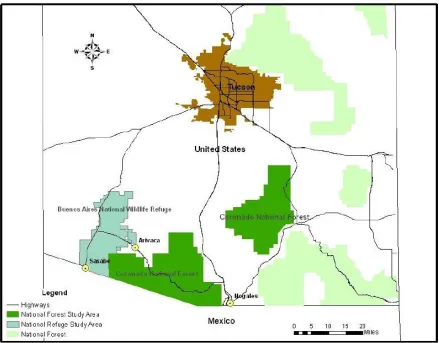
As seen in the study area map (Figure 2), which includes land nearby and west of Nogales, AZ, there are blocks of land managed by the U.S. Forest Service Nogales Ranger District of the Coronado National Forest (CNF) and by the Fish and Wildlife Service‘s Buenos Aires National Wildlife Refuge (BANWR). The humanitarian aid group No More Deaths, which was the third organization participating, works out of desert camps near the town of Arivaca. Personnel from the agencies—on-site and in nearby Tucson—as well as No More Deaths volunteers partnered in this study.
define the conditions under which Border Patrol may conduct enforcement operations on USDA and DOI lands along the international border (Schultz, 2008). Border Patrol officers continue to patrol Nogales Ranger District land, as this is the district of the Coronado National Forest receiving the greatest number of undocumented migrants.
BANWR is under half the size of the Nogales Ranger District of CNF, covering 48,000 hectares at the western edge of the study area, near Sasabe, AZ. The refuge was established over the site of the Buenos Aires Ranch in 1985 for the rehabilitation of a local endangered species called the Masked Bobwhite Quail (Colinus virginianus ridgwayi). The Fish and Wildlife Service, administered under DOI, is also subject to the previously
mentioned National Memorandum of Understanding signed in 2006, which means Border Patrol conducts operations on the refuge. Refuge land includes approximately 7 kilometers of international boundary with Mexico, but in October of 2006 virtually all the land along the border, reaching approximately 1.5 kilometers inward, was closed to the public. The refuge manager cited violence against migrants and law enforcement officers, from both border bandits and smugglers, in the closure of these 1415 hectares of land. In light of the high level of border activity, the land around Sasabe was targeted to receive 11 kilometers of border fence in line with the Secure Fence Act of 2006. In 2007, the Department of Homeland Security negotiated a land swap with the refuge and acquired land along the border, enough to complete the fence surrounding Sasabe and abutting the southern edge of the refuge.
The humanitarian aid group involved in this study was No More Deaths/No Más
Muertes, which operates out of a base camp near the unincorporated town of Arivaca, AZ,
land, 30 minutes from Arivaca while driving along bending, rural Arizona road. No More Deaths‘ camp near Arivaca is situated at the intersection of BANWR and CNF lands.
Volunteers are able to access migrant trails both on and near agency lands, thereby providing aid to persons travelling through and beyond both protected areas. The group was
established in 2004 in response to ―a morally intolerable situation,‖ and works towards its mission ―to end death and suffering on the U.S.-Mexico border through civil initiative: the conviction that people of conscience must work openly and in community to uphold
Responses to Human and Environmental Distress in the Borderlands
Intersections of Human Rights and Conservation
Ecosystem function and human rights are frequently dependent on one another (Sachs, 1995; United Nations Environment Programme, 2004), so understanding their interaction is vital for effective natural resource management (Brennan, 1998; Brockington, Igoe, & Schmidt-Soltau, 2006). For instance, basic human rights to life are threatened when ecosystem services preventing flooding are lost. On the other hand when rights to due process or peaceful assembly are not upheld, persons are not able to oppose measures that could cause environmental harm, such as exploitative resource extraction (Sachs, 1995). The role of natural resources as motivators or financers of war, and the existence of
environmental refugees who flee natural disasters or polluted environments, illustrate the sometimes devastating link between natural resources and human rights (Bates, 2002; Le Billon, 2001).
When human rights and conservation goals are pitted against each other, human rights often take precedence over environmental conservation, resulting in greater pressure on already degraded natural resources (Liu et al., 2007). On the other hand, when
& Redford, 2009; Brockington & Igoe, 2006; Brockington et al., 2006; Curran et al., 2009; Dowie, 2005; Redford & Sanderson, 2006).
Tension between conservation and human rights concerns exists in the remote areas of the United States‘ (U.S.) southwest border, from undocumented migrant and border enforcement traffic (Coalición de Derechos Humanos, 2006; Ellis, 2006; Schultz, 2008; Terrell, 2006). Since 1994 federal actions to control migration across the Mexico-U.S. border have concentrated resources at points-of-entry near population centers (Andreas, 1998-1999; Office of Homeland Security, 2002). Declining numbers of undocumented persons apprehended at these locales was initially interpreted as a sign of successful deterrence (Andreas, 1998-1999), but a northern pull for labor simply diverted border-crossers away from traditional points-of-entry along the border and spurred increased traffic through less-inhabited areas of the borderlands, such as the lands between Nogales, AZ/MX and Sasabe, AZ/MX (Cornelius, 2001; Nevins, 2002; Rubio-Goldsmith et al., 2006). From 1994-2009, an estimated 3,861-5,607 migrant deaths took place along the U.S.-Mexico border, the majority taking place in the Arizona borderlands (Jimenez, 2009). In addition to the migrant deaths, ecological degradation also occurred in vulnerable borderland ecosystems protected by federal parks, refuges, and forests.
land-management and humanitarian aid groups make it a good location for studying the
intersection of conservation and human rights, an understanding which is vital for effective natural resource management (Brennan, 1998; Brockington et al., 2006).
Study Area
The Altar Valley region of Arizona includes an 80-kilometer section of the 3,200-kilometer U.S.-Mexico border that has seen a marked increase in undocumented migrants, and in response it has seen an increase in federal border enforcement operations. This area includes lands managed by the US Forest Service Nogales Ranger District of the Coronado National Forest (CNF), the Fish and Wildlife Service‘s Buenos Aires National Wildlife Refuge (BANWR), and the desert camps of the humanitarian aid group No More Deaths. Personnel from both the agencies, both on-site and in nearby Tucson, and volunteers from No More Deaths partnered in this study. The three groups involved were asked to participate in this research because they were placed close enough geographically so that they all witnessed similar trends in border activity, and their affiliation as natural resource professionals or humanitarian volunteers in this area meant they had the most direct experience with interacting conservation and human rights concerns in the case study area.
with Mexico, but in October of 2006 virtually all the land along the border, reaching approximately 1.5 kilometers inward, was closed to the public due to the threat of violence from both border bandits and smugglers. The border fence abuts the southern edge of the refuge. No More Deaths runs a desert camp near Arivaca, AZ, which is situated at the intersection of BANWR and CNF lands. Around 10 to 20 volunteers typically inhabit the camp, which sends out groups of hikers twice a day to leave water along migrant trails and provide first aid to any migrants in distress. Volunteers are able to access migrant trails both on and near agency lands, thereby providing aid to persons travelling through and beyond both protected areas.
Methods
and July 2008. The proximity of the three groups also allowed for intermittent travel among all three sites.
We reduced bias by using triangulation of document review, interviews, and participant observation (Silverman, 2001). Using three methods of data collection helps to reveal multiple facets of the people and circumstances under study, creating a more complex, and thus more revealing, depiction of the social context (Fossey, Harvey, McDermott, & Davidson, 2002). Document review was carried out before, during, and after fieldwork, extending into 2009 in order to follow the littering court trials. Reports and press releases from the three groups, as well as literature from similar human rights and conservation groups in the area, were gathered. Local news stories, government reports, and university research were assembled to create a better picture of community responses to migration. Field notes taken during volunteer work with each of the three community groups provided data on the conservation- or human rights-related behaviors that took place.
themes that emerged during the interview. The researcher used an interview guide
(Appendix 3), but allowed informants to guide and direct the flow of conversation. In this way, the informant‘s view of the situation emerged throughout the interview (McCracken, 1988). During and after interviews, participants were allowed to review individual interview notes and asked to confirm themes, as a means of ensuring the quality of the data
(Hammersley & Atkinson, 1995; Lincoln & Guba, 1985; McCracken, 1988). Informants were asked to confirm all quoted statements.
Data for this paper was analyzed using a grounded approach, which allowed themes to emerge from interview and field notes through constant review and comparison of data (Draucker, Martsolf, Ross, & Rusk, 2007; Fossey et al., 2002; Peterson et al., 1994).
Continuously interrogating the data throughout fieldwork allowed us to recognize and pursue emerging themes among informants (Lincoln & Guba, 1985). As themes emerged
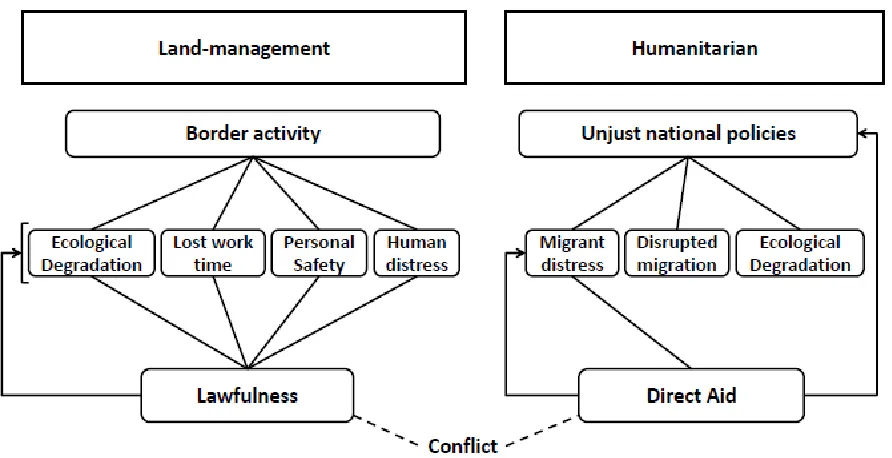
throughout data collection they were shared with community partners, who could confirm or elaborate on them and suggest further avenues for research. After fieldwork the full set of data was again analyzed and coded. To extract themes from the data, interview and observation notes were systematically coded by identifying and grouping similar pieces of data in a hierarchical fashion. With the entirety of the data arranged in these hierarchical coding schemes, the perceptions and motivations that framed participants‘ behaviors in the borderlands began to emerge (Figure 3).
While analyzing the themes presented by the coded data, informant variation was also taken into account. Informants had differing degrees of access or experience with the
immersion were key informants. In the analysis process two types of themes reflected heavily on the conclusions: those that were repeated among key informants, and those that were illuminated by data from multiple sources (interviews, observation, and documents). Themes that emerged as prominent given the multiple data sources and the variation among informants form the foundation of this work.
We utilize a naturalistic approach to report results (Lincoln & Guba, 1985). This approach reflects our purpose: to understand and explore the meanings and processes as informants lived them. The naturalistic approach aims not to generalize over multiple meanings with numerical representations, but to recognize and explore the multiple realities that inevitably arise from social circumstances (Guba & Lincoln, 2005; Lincoln & Guba, 1985). An analysis built from numerous informant quotes allows the multiple realities to be represented directly, as rich descriptions which together form a detailed picture of the
borderlands. This approach also allows the reader to assess the coherency and consistency of the research and its conclusions. When quoted, informants are referenced using a
pseudonym, followed by ―LM‖ to identify them as land-management personnel or ―H‖ to identify them as humanitarian volunteers.
Explanation of Figure
Figure 3 illustrates the major themes that emerged from data analysis, which
illustrates, the different conceptions of problems led to different responses, which ultimately conflicted.
Figure 3. Major themes from data analysis
Results
Federal conservation agency workers: Juggling multiple concerns
footprints, saying ―BP use large heavy rubber tires to drag the roads, then they park on the side of the road, often right by an entrance or turn, and this creates a bald spot. It begins to look like a parking spot, and then everyday users use it to park because they think it‘s supposed to be there—it turns into a parking lot.‖ Land-management personnel said that smugglers often cut fences when they intersected migrant trails, which lead to erosion problems when animals grazed outside of their designated areas. Informants also discussed the large amounts of trash piled up in the borderlands, and Leslee (LM) was visibly disturbed as she explained, ―There's a possibility for wildlife to ingest things they shouldn't, and they can die from that. When two [Student Conservation Association volunteers] were cleaning up trash, they commonly found lizards or rodents drowned in bottles. Cattle on nearby ranches have died from swallowing plastic bags.‖ In addition to erosion and trash, agency personnel often pointed out an increase in the frequency of human-caused fires, which they attributed to the increase in migrant traffic in the area. ―Before the immigration problem human-caused fires were rare, now they are prevalent‖ (Aaren-LM). This was particularly problematic because of the ability for wildfires to spread quickly during the dry summer months in Arizona. Informants associated the changing patterns of fires with the changing patterns of human traffic. ―The last two years we‘ve had one mountain fire each year, that‘s more than the average. This may become the average because the fence is pushing more traffic into the mountains‖ (Tom-LM).
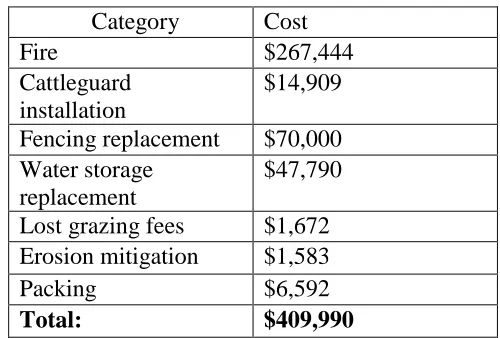
to help Border Patrol meet their tactical needs—we‘re hoping to concentrate things near the border and reduce the impact, freeing our Law Enforcement to focus on the ‗other‘ segments of ‗Prohibited Acts‘ on [National Forest] lands.‖ They saw law enforcement officers as ―spending too much time on immigration issues,‖ and one officer suggested that as much as 95% of his time was spent on immigration-related work in a given day (Field Notes). Law enforcement officers were also involved in searching for migrants in distress, a task which is the responsibility of the BP unit BORSTAR. Outside of law enforcement, other personnel described being asked to complete various tasks necessary for border enforcement. Some personnel mentioned having ―packed‖ materials for BP. This entailed personnel spending a full day bringing supplies into remote areas of the borderlands, where vehicles were unable to venture, so that BP agents could carry out border enforcement operations in these areas. In addition, extra security precautions were instituted for land-management practices along the border. These safety precautions mostly took place in what were considered ‗high-risk zones‘, areas with higher prevalence of drug smugglers and bandits. Personnel largely avoided venturing into these areas alone or at night, and firefighters were prohibited from suppressing fires that broke out in these zones at night (see Appendix 1 for an example of the impact of delaying fire response).
bodies do we have to find before there‘s a better way for them to get here?‖ (Field Notes). The deaths seemed to be so prevalent that informants began to expect them. As Lee (LM) said, ―I‘m surprised I haven‘t found a dead body yet. So many people have, there are so many bodies out there.‖ When a land-management informant learned that the researcher had also worked with No More Deaths, he asked ―How many bodies have you found?‖ and reacted with surprise when she responded with ―none‖ (Field Notes). For land-management informants, discussion of migrant deaths was often considered alongside the ecological degradation in the borderlands. ―The tragic human aspect of the immigrant issue is that persons looking for work or a better life can actually lose their lives in that quest. The trashing of the refuge, the impact on habitat quality and our time and finances is an aggravating problem for the refuge and its staff. But there is a sad and human side to this problem‖ (Leslee-LM).
Land-management personnel‘s concern for migrants was tempered by their concerns for the safety of themselves, their families, and their belongings. Land-management
much—two guys were waiting at my kids‘ bus-stop for a ride back to Mexico one day. It affects everyone‘s lives directly, everyday. It‘s a different life than I grew up with. Used to be quiet, rural, communities trusted one another, now we have to lock everything‖ (Aaren). Another informant stated, ―We saw drug runners several times at the house. They didn't ask for water, but went to the spigot outside the fence… got their water and left within a few seconds. They had obviously been there before, knew where the water was and did not want to be seen. They headed south after getting water. They may have been ‗regular‘ illegals, but I don't think so. Their behavior was so different and sometimes I saw a burlap sling, for hauling drugs‖ (Lee). Aaren (LM) explained, ―We're safety-minded because there‘s so much extreme violence and crime associated with traffic. [The manager] often compares the extra precautions here to those in grizzly country—just some things you don‘t do.‖
Federal conservation agency workers: Responses
Land-management informants‘ actions were influenced by professional duties, personal ethical obligations, and perceived safety concerns. As a part of their professional responsibilities, personnel attempted to mitigate ecological damage (See Appendix 2 for informant estimates of mitigation costs). Dell (LM) described a fight to contain an invasive species outbreak. ―Buffel grass is a huge threat… However, three small spots have started up on the refuge, one right along a [undocumented alien] trail. The refuge has successfully eradicated the buffel grass on these sites but the fear is that new sites will be established from grass seeds coming in on the soles of their shoes, which is a source we have no way to
widespread problems like erosion, they focused on repairing fences that were cut frequently by migrants. As Jack (LM) said, ―The refuge could handle a 2-man fence crew, would be busy all the time.‖ They also installed cattle guards where gates were frequently left open. Personnel described attempts to work with Border Patrol agents in order to limit their ecological impacts, and supported community efforts at trash clean-up.
Most informants expressed some sort of ethical obligation to respond to the migrant deaths and distress occurring on agency lands, but were often unsure how to follow through on this, given their professional responsibilities safety concerns. ―I think we have some responsibility… I think we have to address it, we don‘t like to, but have to face the fact of what these people are dealing with‖ (Tom-LM). When a humanitarian aid volunteer was cited for littering after leaving gallons of water for migrants on refuge land, a number of personnel found themselves on both sides of the issue. ―I flipflop on supporting giving water or not—it‘s harsh out there. I‘ve felt the impacts of the heat in my situations, can only imagine what it‘s like for them. Personally, I feel that if we can help get water, like with Humane Borders stations, that‘s good… It‘s not just an issue with leaving water, though, but also leaving big bags of food, and we can hardly keep up with the trash‖ (Cody-LM). Some land-management informants stated that directly aiding migrants in the desert was a
groups. On the other hand, I feel their efforts encourage more people to cross. So, I tolerate their work, but don't support it‖ (Runar). Informants also pointed out that current work by humanitarians put the very volunteers at risk. Referencing stories of violence from
smugglers, informants stated that the risk to humanitarian volunteers was too high.
As land-management informants responded to a range of impacts along the border, an emphasis on lawfulness emerged as a means of resolving multiple problems. For
Lawfulness was a common theme among land-management informants who
suggested broad solutions to problems in the borderlands. Referencing the migrant presence in the borderlands, land-management informants would often make a statement similar to, ―I don‘t put someone down for trying to better themselves, but there‘s got to be a legal way to do it‖ (Jack-LM, emphasis added). Even informants who criticized border policies or regulations described solutions to the current problems in the borderlands in terms of legal solutions such as guest-worker programs. ―Make it feasible for workers to come here, and then those crossing the border elsewhere will actually be criminals‖ (Runar-LM). They supported abstract ideas of new immigration laws because they offered long-term resolution to their problems. Informants also supported existing immigration laws by turning migrants over to Border Patrol. Adhering to these existing immigration laws removed undocumented migrants from the desert and thereby addressed the ecological degradation, migrant deaths, and personnel safety concerns. The emphasis on laws and their enforcement provided theoretical and sometimes practical resolution to the problems land-management personnel wanted to fix.
the border. …The people responsible for making decisions relative to border issues, must be better informed, along with the people who vote for them‖ (David-LM). Lee (LM)
suggested that ―People don‘t realize the magnitude of what‘s happening here, they can‘t accept the reality of finding bodies or having your house broken into repeatedly or the massive trash and the innumerable trails.‖ Charlie (LM) also saw this separation: ―It‘s hard for people who do not reside down here to understand the situation… People who don‘t work down here don‘t understand it, and we— Forest Service, Border Patrol— are directed by people who don‘t understand.‖
Land-management personnel were mostly unsure as to how people away from the border could be better informed. One informant described how he tried to inform every volunteer he met about the distress in the borderlands. He would then ask the volunteers to tell everyone at home about the problems, so that the news could spread. Personnel said they gave interviews to journalists, and took politicians on guided tours that briefly touched on the problems of the border (Field Notes). They gave educational presentations for schools that included more information about the border, for better or for worse, as Cody (LM) noted. ―Now school and other groups all want to know about border issues, less about natural resources issues.‖ All these endeavors constitute means of informing others about the distress associated with the current method of border enforcement.
Humanitarian aid volunteers: Addressing a unified concern
Many volunteers echoed a feeling of commitment to the migrants because they blamed U.S. policy for the migrants‘ suffering. They volunteered as a way of ―acting on their
responsibility‖ to the migrants, which stemmed from their roles as U.S. residents or fellow humans. ―People in the US benefit from the policies that perpetuate violence in Central and South America and help drive the migrant experience. People in the US benefit from the work of migrants on a daily basis. I know that that is an issue of contention but let's just take it as true. If we benefit from a system of violence we have a responsibility to understand and prevent that violence on moral grounds if nothing else‖ (Cole-H). Hallie (H) made a similar statement, ―The problem is caused by the U.S. government, and it's not separate from the economy. The economy benefits from cheap, undocumented labor. The money put into border enforcement could be put elsewhere, into Latin America or Central America, for instance, and the problem wouldn't exist…‖
Humanitarians‘ perspectives reflected statements made by No More Deaths publicly, which described migrants as ―Driven by economic inequality, thwarted by ill-conceived US border policy‖ (No More Deaths website), for instance. Informants expressed frustration that the government did not appear to be taking responsibility for the consequences of border enforcement. ―If I hurt you through my actions, directly or indirectly, I have a responsibility to make sure you are OK. We teach this idea to all of our children at a very early age. Why is it different in the global community? What is so special about countries and institutions, corporate or otherwise, that they are held to a different standard?‖ (Cole-H).
volunteers, Cole (H) explained, ―By forcing migrants into more remote and rugged areas U.S. policy has had an effect on these ecosystems. We should not confuse this issue by saying that migrants are responsible for this reality. What we are talking about is a system of policies that have led to increased human impact on sensitive areas." Hallie put the policy perspective in different terms, saying ―The government is using this desert as a natural deterrent to migrants, based on its remoteness, its harshness. This is an issue of environmental justice‖ (Hallie-H).
Informants frequently expressed anger or frustration at the total environmental impact on the borderlands, which many viewed as a policy problem. ―If the U.S. government were serious about the environment, they would address the root causes of immigration,
militarization, and I don't see that happening. I don't see them standing up to the walls being built through the desert, to the policies that cause migration‖ (Edward-H). Edward
Humanitarian aid volunteers‘ efforts to address the migrants‘ distress were rooted in their egalitarian ideals. Slogans such as "No Human Is Illegal/¡Ningún Ser Humano es
Ilegal!" and its variations were seen on shirts, posters or buttons around the camp,
emphasizing the equality of migrants. The Truman Capote quote prominently placed on a trailer at the desert camp, ―Love, having no geography, knows no boundaries,‖ also illustrated volunteers‘ ideas of equality among all persons. Volunteers emphasized this perspective through statements such as ―Everything boils down to equality‖ (Shayna-H) and ―No matter of particular characteristics, people deserve respect, medical treatment,
opportunities, family, a chance to succeed‖ (Annina-H). Language was also used to
communicate the equality among persons, and among volunteers, migrants were referred to as ‗friend‘, ‗amigo/a‘, ‗migrant‘, or ‗compañero/a‘, which were viewed as better terms than the public‘s frequently used descriptors of ‗illegal‘ or ‗alien‘. This egalitarian perspective formed the foundation for their work on the border. As Hallie (H) stated, ―The desert of Arizona is how I define who I am, where my home is. It's wrong to let people die in my home, regardless of who they are or why they're here.‖
Although No More Deaths clearly prioritized equality and a duty to change the social context, they were also aware of ecological degradation from both migrants and enforcement practices and concerned about its ramifications in the desert. Annina pointed out that ―…the wall is a huge symbol of antagonism towards migrants, and a practical inhibitor of migration and disrupter of wildlife systems in the area.‖ Informants were concerned about the
advocates, saying ―there's a deep respect for the environment, and most humanitarians
understand that.‖ Sol (H) also described a resonance between humanitarian and conservation goals. ―The sacredness of life is not just human life—it's all of creation. Rescuing life in the desert does not mean just migrant life, it's all life in the desert.‖ Volunteers explained that their work increased their appreciation for their ecological surroundings. ―People love being out at camp because they love the desert. Maybe they first come out because they're
concerned for migrants, then they fall in love with the desert‖ (Annina-H). Sol stated that ―Many volunteers here have a heart for the environment. We throw them into this context, and it's hard for them to decipher since migrants are causing environmental damage. A lot of trash is on the trails, it occurs in dump sites, and it's real. It's hard for volunteers with
commitments to the environment to live with this. It's a personal commitment for me, so I have a hard time with it‖ (Sol-H).
Humanitarian aid volunteers: Responses
Since No More Deaths volunteers felt that unjust policies were the cause of human and ecological distress, their actions were undertaken with the purpose of ultimately
the desire ―to work ourselves out of business‖ (Field Notes). Informants described their work as a response to government deficiency, as Sol (H) stated, ―We are doing humanitarian work on the border that should be done by government agencies. They should be giving water, food and medical treatment to migrants. We'll be happy to turn this work over to them when they respond as they should.‖
As volunteers responded to a humanitarian problem they felt was caused by their government, they also challenged laws and standards of behavior that they saw as
uncompassionate towards the migrants they viewed as equals. This was seen when No More Deaths adopted the slogan ―Humanitarian Aid Is Never A Crime‖ after the arrest of
haven't had a clean drink of water in days. If they find drinking water, it's a godsend, not trash.‖
While No More Deaths volunteers addressed the humanitarian problem, they also described some desire to mitigate ecological damage. Since volunteers viewed the ecological damage as policy-driven, much of the desire to mitigate the ecological damage was
verbalized in terms of stopping the policies that rerouted migrants into remote areas. Shayna (H) simply stated, ―In the larger picture, if we can get just immigration reform passed we won't have people moving through the desert, leaving trash, etc.‖ A similar sentiment was expressed by Hallie (H), who said ―The environmental impact of the whole border deal would end if NMD is able to end the issue.‖ Environmentally-conscious measures also took place among volunteers, who picked up trash and recyclable plastic jugs as they hiked migrant trails. They also collected usable clothing and backpacks from rest and layover sites along migrant trails, to be washed and donated to shelters in Tucson.
a villager goes in to save it. As days go by, babies continue to be seen in the river, with more coming each day. The community organizes a monitoring system to detect and remove any babies in the river. As more babies show up in the river, this system gets more complex. Finally, someone decides to go upriver, find out why the babies are being put in the river, and stop this from happening. The parable-teller explained that No More Deaths constituted the villagers going into the river to save the babies, because this was the most urgent need. He then asked the visiting students to be the villagers who go upriver and stop the forces sending the babies into the river. After the story, Sol (H) described the worth of educating others through this type of direct action, saying ―That may be our greatest contribution to the larger issue of immigration reform - making others aware of the suffering and death on the border.‖ Beyond educating about the problems occurring in the borderlands, volunteers emphasized educating people about their cause. ―There's a need for more education on the economic context of migration, understanding and acknowledging that the wall doesn't separate us from the decisions we make that affect people all over the world‖ (Annina-H).
Discussion
various approaches, but no clear path, to address the interacting concerns of ecological degradation, lost work time, human suffering, and safety. No More Deaths volunteers faced less of an internal struggle in their conceptions of and responses to the problem, as they clearly described opposition to unjust policies that they felt contributed to distress along the border. Volunteers tied the human and ecological distress in the borderlands to globalization and free trade markets which they felt drew labor into the U.S. from the South. Their
thoughts resonated with Massey et al.‘s (2002) study of Mexican immigration, which criticized the juxtaposition of increasing economic, communication, social, and cultural ties with Mexico alongside increasingly stricter border policies as ―fundamental contradictions.‖
In 2009, after a series of media events criticizing the refuge and a civil disobedience event, No More Deaths appeared to embrace the idea of collaborating with land-management personnel towards shared goals. No More Deaths submitted a proposed memorandum of understanding with specific attempts at compromise—such as agreeing to pick up twice the amount of food and water containers that they left on trails—to Fish and Wildlife Service officials. This follows in line with suggestions that interactions between conservation and human rights concerns with unique perspectives must rely upon dialogue and negotiation, rather than laying out an edict to one another (Agrawal & Redford, 2009; Curran et al., 2009), which is what initially occurred among groups in the borderlands. Focusing dialogue on clear deliverables such as picking up twice the amount of containers left along trails, rather than on broad goals or criticisms, is also a positive step in interactions between conservation and human rights concerns (Redford & Sanderson, 2006). Land-management officials did not accept the agreement proposed by No More Deaths, but the humanitarian aid volunteers‘ attempt at negotiation suggests potential for future dialogue and compromise in the borderlands.
land-management personnel. On the refuge in this study, the humanitarian group Humane Borders had previously been given special-use permits to place three semi-permanent water stations along high-traffic migrant trails in the desert, avoiding the concern over trash from water jugs. More solutions like this, which utilize creativity and cooperation on the part of both groups, could create better relationships in the borderlands which properly address both humanitarian and conservation concerns directly.
Beyond their immediate goals to reduce ecological degradation or human suffering in the borderlands, there is potential to collaborate and influence more lasting change. Both groups expressed the desire to link those who demand border enforcement to its social and ecological impacts, and to some degree, the conflicts over littering in the borderlands produced this result. As high-profile conflicts between two emotional concerns
(conservation and human rights), the littering citations garnered national interest in border policies and their impacts (see Gandossy, 2009; Powers, 2009; "Water in the desert," 2009). Since the attention brought by the littering citations fulfilled the desire to increase national awareness, a feedback loop may actually reinforce the actions that led to the littering citations. As groups with limited resources, however, they could benefit by seeking new alternatives to achieve their shared goal of stirring up national interest, outside of courtroom and media battles for supremacy (Gregory & Keeney, 1994; Keeney, 1996). Cultivating concern for distress in the borderlands among residents across the U.S., by efforts other than littering citations, could be a fruitful means for all groups concerned.
resistance must be broad and expand across space in order to enact change. Political action leading to change requires ―an active civil society engaged in real participatory democracy‖ (Cox, 2004, p. 201), which cannot be isolated to particular places or organizational cultures (Harvey, 1989). At the national level, informants expressed a desire to see policies which did not result in environmental and human distress in the borderlands. This could result from an informed national dialogue on border enforcement. This sort of dialogue must include a range of perspectives, not just the fear of what will happen if the border is not secured (Ivie, 2004), and conflict should be expected and accepted as a means of reaching legitimate policy decisions (Mouffe, 2000; Peterson, Peterson, & Peterson, 2005). In the age of the wars on terror and drugs, both of which are played out on the southern U.S. border, debate and dissent from what is purported as national security is often squashed in light of the perceived crisis. Yet, it is exactly at times of crisis when diverse and dissenting voices must be heard, so that those in power do not abuse their position (Ivie, 2004). Border enforcement in the U.S. is one such circumstance. The voices of those along the border, who may or may not dissent from prevailing thought, must be allowed to inform a national dialogue given their specific knowledge of distress the borderlands. In this way, decisions regarding the current state of border security and provisions for future changes can more fully reflect the reality of the border, including conservation and human rights concerns.
Given today‘s global interconnectedness, it's likely that human rights and
The Influence of Place Meanings in the Borderlands
“Well, you have to respect that tree or hill or whatever it is you’re with. Take a horned toad
for example. If you think you’re better than a horned toad, you’ll never hear its voice—even
if you sit there in the sun forever.”
-Byrd Baylor, Altar Valley area author, The Other Way to Listen
Place and Natural Resources
Place meanings are often at the heart of natural resource politics, and help to explain why natural resource conflicts can become heated and emotional (Bott, Cantrill, & Myers, 2003; Cheng, Kruger, & Daniels, 2003). Attachments to place can help create community support for conserving natural resources that define place, since attachment to particular resources can motivate persons to preserve their quality. At the same time, if a particular place and its characteristics are imbued with memories, values, and social contracts, altering that place through a change in land use can become a challenge to the feelings associated with it (Said, 2000). Place attachments can therefore make natural resource decisions complex, because plans to change resources to which people ascribe meaning may be met with especially strong opposition. Understanding place meanings is therefore a necessity for effective negotiation of natural resource conflicts (Bott et al., 2003; Cheng et al., 2003).
Places have been altered significantly along the United States‘ (U.S.) southwest border, due to border enforcement practices first implemented in 1994. To reduce
borderlands concentrated enforcement efforts such as patrol agents, fences, and surveillance technology at population centers (e.g., Tijuana-San Diego and Ciudad Juarez-El Paso). The increased pressure on cities coupled with economic opportunities to the north funneled migrants into remote regions of the borderlands with less border enforcement (Andreas, 1998-1999; Cornelius, 2001; Massey et al., 2002; Nevins, 2002). This funnel effect contributed to an estimated 3,861-5,607 migrant deaths along the U.S.-Mexico border, the majority taking place in the Arizona borderlands (Jimenez, 2009). In addition to the migrant deaths, ecological degradation has occurred in vulnerable borderland ecosystems protected by federal parks, refuges, and forests.
Place-changing events led to a high-profile conflict in the Altar Valley region of southern Arizona. In February of 2008 law enforcement officers on Buenos Aires National Wildlife Refuge, which lies along the U.S.-Mexico border, first cited a humanitarian aid volunteer with littering after he left jugs of water along migrant trails with the aim of preventing migrant deaths. In the year and a half following the first citation, 14 more volunteers were cited with littering for the same action. In the subsequent court trials and press discourse, the conflict was branded as an issue of human rights versus conservation. This paper goes beyond the specific concerns of human rights or conservation, and suggests the groups involved were spending significant time and money on a battle that arose from distinct place meanings. We analyze the perceptions and behaviors of land-management agencies and a humanitarian aid group in the Altar Valley using three fundamental
Theoretical Framework
Place is broadly defined as physical space in which people invest meaning (Low & Altman, 1992; Williams & Stewart, 1998). This emotional attachment to a space is not limited to local residents, but involves a broad range of groups who have an interest in the place (Cheng et al., 2003; Yung, Freimund, & Belsky, 2003). Understanding place meanings allows insight into the strong attachments that people form with physical spaces, and gives perspective on their actions surrounding that space (Williams, Patterson, & Roggenbuck, 1992). Place meanings stem from multiple interacting factors, and must be understood in light of these influences (Agnew, 1987; Gustafson, 2001).
arise in different places, and determine the appropriate behaviors in a place. Cheng et al. (2003) give the example of a dinosaur skeleton to illustrate this point: “an artificial dinosaur skeleton in a municipal park invites people to play on it; the same skeleton in a museum of natural history invites people to learn about prehistoric life‖ (p. 90).
Study Area
The Altar Valley region of Arizona includes an 80-kilometer section of the 3,200-kilometer U.S.-Mexico border that has seen a marked increase in undocumented migrants, and in response it has seen an increase in federal border enforcement operations. This area includes lands managed by the US Forest Service Nogales Ranger District of the Coronado National Forest (CNF), the Fish and Wildlife Service‘s Buenos Aires National Wildlife Refuge (BANWR), and the desert camps of the humanitarian aid group No More Deaths. Personnel from both the agencies, both on-site and in nearby Tucson, and volunteers from No More Deaths partnered in this study. The three groups involved were asked to participate in this research because they were placed close enough geographically so that they all witnessed similar trends in border activity, and their affiliation as natural resource professionals or humanitarian volunteers in this area meant they had the most direct experience with interacting conservation and human rights concerns in the case study area.
the study area, near Sasabe, AZ. Refuge land includes 7.2 kilometers of international border with Mexico, but in October of 2006 virtually all the land along the border, reaching
approximately 1.5 kilometers inward, was closed to the public due to the threat of violence from both border bandits and smugglers. The border fence abuts the southern edge of the refuge. No More Deaths runs a desert camp near Arivaca, AZ, which is situated at the intersection of BANWR and CNF lands. A range of 10-20 volunteers at a time inhabit the camp, which sends out groups of hikers twice a day to leave water along migrant trails and provide first aid to any migrants in distress. Volunteers are able to access migrant trails both on and near agency lands, thereby providing aid to persons travelling through and beyond both protected areas.
Methods
We used an ethnographic approach (Hammersley & Atkinson, 1995; Mason, 2002) to understand place meanings among conservation and humanitarian groups in the study area. Although immigration is shaped by national and global forces, migration is situated in a spatial and temporal place in the borderlands, one which ethnography is well-suited to explore (Englund, 2002; Gille & Ó Riain, 2002; Massey, 1995). Ethnography allows
and volunteered with each of the three community groups. She volunteered with CNF for four weeks in May and June 2008, and with BANWR for the month of July 2008. The researcher volunteered with No More Deaths from June to August during summer 2007, and for three weeks total in June and July 2008. The proximity of the three groups also allowed for intermittent travel among all three sites.
We reduced bias by using triangulation of document review, interviews, and
participant observation (Silverman, 2001). Using three methods of data collection helps to reveal multiple facets of the people and circumstances under study, creating a more complex, and thus more revealing, depiction of the social context (Fossey et al., 2002). Document review was carried out before, during, and after fieldwork, extending into 2009 in order to follow the littering court trials. Reports and press releases from the three groups, as well as literature from similar human rights and conservation groups in the area, were gathered. Local news stories, government reports, and university research were assembled to create a better picture of community responses to migration. Field notes taken during volunteer work with each of the three community groups provided data on the conservation- or human rights-related behaviors that took place.
community. Within each of the three groups interviews were conducted with 9 individual informants. Interviews lasted from 30 minutes to 3 1/2 hours. Informal conversations and interactions with all 27 informants after the interviews were used to clarify data and evaluate themes that emerged during the interview. The researcher used an interview guide
(Appendix 3), but allowed informants to guide and direct the flow of conversation. In this way, the informant‘s view of the situation emerged throughout the interview (McCracken, 1988). During and after interviews, participants were allowed to review individual interview notes and asked to confirm themes, as a means of ensuring the quality of the data
(Hammersley & Atkinson, 1995; Lincoln & Guba, 1985; McCracken, 1988). Informants were asked to confirm all quoted statements.
While analyzing the themes presented by the coded data, informant variation was also taken into account. Informants had differing degrees of access or experience with the
interplay of conservation and human rights in the borderlands, and those with the most immersion were key informants. In the analysis process two types of themes reflected heavily on the conclusions: those that were repeated among key informants, and those that were illuminated by data from multiple sources (interviews, observation, and documents). Themes that emerged as prominent given the multiple data sources and the variation among informants form the foundation of this work.
We utilize a naturalistic approach to report results (Lincoln & Guba, 1985). This approach reflects our purpose: to understand and explore the meanings and processes as informants lived them. The naturalistic approach aims not to generalize over multiple meanings with numerical representations, but to recognize and explore the multiple realities that inevitably arise from social circumstances (Guba & Lincoln, 2005; Lincoln & Guba, 1985). An analysis built from numerous informant quotes allows the multiple realities to be represented directly, as rich descriptions which together form a detailed picture of the
borderlands. This approach also allows the reader to assess the coherency and consistency of the research and its conclusions. When quoted, informants are referenced using a
Place Meanings in the Borderlands Physical attributes
When land-management informants spoke about physical attributes in the borderlands, they often described ecological attributes which were being damaged or threatened by border activity. In their daily work, land-management informants saw ecological components of the borderlands harmed by border activity. Of the factors they mentioned, their concerns over erosion best represented informants‘ worries over a range of damage in the borderlands. Land-management personnel expressed concern over erosion from migrant trails as they cut across open desert grassland and alongside dry riverbeds. Dell (LM) stated, ―Human activity in these riparian areas threaten the animals as well as the vegetation. In some circumstances, people travelling through drainages dominated with seed bearing leguminous shrubs represent a threat to the endangered Masked Bobwhite Quail which depend on these plants for food, cover and nesting‖ (Dell-LM).
Informants in both agencies cited the GIS study conducted by a BANWR biologist that determined 113 hectares of refuge land (of 48,000 hectares total land) was denuded due to off-system paths. Another informant said migrant trails grew ―from cattle trails to super-highways‖ (Field Notes). Erosion concerns also stemmed from what was viewed as a common side effect of migrant traffic: cattle fences being cut to facilitate human migrant movement. This allowed the abundant open range cattle in southern Arizona to roam and graze in areas they were restricted from, including refuge and forest lands.
side of the road, often right by an entrance or turn, and this creates a bald spot. It begins to look like a parking spot, and then everyday users use it to park because they think it‘s
supposed to be there—it turns into a parking lot.‖ Informants described another problem with erosion when enforcement agents created new vehicle trails or roads for their patrols, which recreational users then used. ―Roads have become more pronounced. Some are entirely new, as in created through enforcement or smuggling efforts. Others are old roads that used to be lightly-used, but are now heavily-used‖ (Aaren-LM).
In addition to the impacts of erosion on desert lands, personnel connected an increase in wildfires to migrant cooking, warming, distress, or distraction fires that got out of hand. Informants did not have historical data to support this assertion, since it was considered politically taboo to state in the fire report that a fire was started by migrants (Field Notes). Yet statements like Aaren‘s (LM), that ―Before the immigration problem human-caused fires were rare, now they are prevalent‖ were common in both agencies. At BANWR the
Natural resource professionals tried to address some of the damage to physical
attributes along the border directly. To mitigate one piece of unauthorized ATV trail heading up a small hill, four personnel spent three hours of a morning placing waterbars of logs and rebar across a trail that posed a serious erosion threat. Personnel said they lacked the resources to do this every place that needed it, citing the prohibitive time investment (Field Notes). Personnel spent time fixing fences cut by smugglers, and as one informant put it, ―The refuge could handle a 2-man fence crew, would be busy all the time‖ (Jack-LM). Fire management personnel stated that a portion of their resources was necessary to address the fires from migrants, with one informant estimating that 20% of program costs went to tackle migrant-related fires. (See Appendix 2 for informant estimates of costs to mitigate damage from border activity.) They were largely unable to stem the flow of migrant traffic that they saw as creating ecological damage, but personnel attempted to influence the actions of people they could control, as in working with Border Patrol agents to make their operations more ecologically friendly.
When humanitarian volunteers spoke about physical attributes of the borderlands, they described a system of interconnected physical components that they felt was disrupted by immigration policies which restricted human movement. Cole (H) described this mindset, saying, ―By forcing migrants into more remote and rugged areas US policy has had an effect on these ecosystems. We should not confuse this issue by saying that migrants are
corporations clear cutting and strip mining their home countries. It is all policy driven. Population mobility has been a critical part of the human experience for thousands of years. Instead of engaging this mobility in a positive and formative way US policy has criminalized this part of the human experience.‖ Another informant pointed to the border wall
specifically, suggesting ―…the wall is a huge symbol of antagonism towards migrants, and a practical inhibitor of migration and disrupter of wildlife systems in the area… the well-being of humans and of wildlife and ecosystems is so intertwined, and humans are a part of these systems‖ (Annina-H). They framed their policy criticisms using environmental terminology, as well. Hallie (H) stated, ―The government is using this desert as a natural deterrent to migrants, based on its remoteness, its harshness. This is an issue of environmental justice.‖ Humanitarian aid volunteers expressed concern for the damage occurring to a broad range of physical attributes in the borderlands. Sol (H) stated, ―The sacredness of life is not just human life—it's all of creation. Rescuing life in the desert does not mean just migrant life, it's all life in the desert.‖
Volunteers exhibited a range of opinions regarding how to address the disrupted physical attributes in the borderlands. Most volunteers believed that No More Deaths‘ humanitarian aid and advocacy work would eventually lead to a solution for both
regarding immediate measures to support physical attributes in the borderlands. Some saw a direct response to the ecological distress as a positive step, but not as No More Deaths‘ primary goal. ―Personally, though I'm definitely concerned about environmental issues, I see a sacrifice of environmental concerns for [No More Death]'s work. We drive SUVs, trucks, and migrant packs create a lot of trash. The amount we pick up is nothing compared to what we put out. However, there's a steel wall in the desert—that's a bigger environmental deal‖ (Hallie-H). As Marilyn (H) stated, ―It's outside the scope of [No More Death]'s objective. If it can play a part of the work that's great, because it is important. … [No More Deaths] is at least not contributing to the problem with what we leave, but perhaps we're also not
alleviating it. People pick up water bottles as they hike, and groups do pick up trash at rest areas.‖ Others believed that immediate changes were appropriate. ―It is missing in the discourse of [No More Deaths]—to look at environmental factors in immigration causes, also in how we operate in delivering water, patrolling, etc. I see it in informal discourse between particular individuals, particularly the younger individuals. Never see it in an official context …‖ (Atticus-H). Though informants had varying opinions on the role of environmentally-friendly actions in their humanitarian work, they accepted efforts to include such actions. The desert camp brought the materials it used to town for recycling, and collected usable clothing and backpacks from along the trails to be washed and sent to shelters in Tucson.
Social processes
defensive action. The illegal activity taking place in remote areas of the borderlands created what land-management personnel saw as a security threat. At BANWR in 2005 law
enforcement documented the following on the refuge, all related to border crossing activity: 4 homicides, 5 rapes, 5 vehicles stolen (4 government, 1 personal). Though migrant traffic in 2008 did not reflect the intensity of 2005, informants were aware of past events and wary of interactions with migrants. Some told stories of their own homes being broken into by migrants in search of food, water, or money, several informants having to stop and count the number of times their homes had been broken into by undocumented persons (Field Notes). Other informants explained how people would stop at their homes for food, water, or other needs. ―We saw drug runners several times at the house. They didn't ask for water, but went to the spigot outside the fence… got their water and left within a few seconds. They had obviously been there before, knew where the water was and did not want to be seen. They headed south after getting water. They may have been ‗regular‘ illegals, but I don't think so. Their behavior was so different and sometimes I saw a burlap sling, for hauling drugs‖ (Lee-LM).
Much of the concern that land-management informants expressed was based on ambiguous identities, making many people unable to differentiate between who was
that ―[We‘re] mostly concerned with the safety issue: who is an endangered person vs. who is a drug trafficker. You never know‖ (Aaren-LM). David (LM) described the uncertainty that came with their work, ―Forest Service employees working in remote areas must have the situational awareness of their surroundings and be on the lookout for something that‘s just slightly off, and even when things look right they might not be right. There are a lot of unknowns. It‘s a complex issue.‖ At the same time, a number of personnel expressed concern over wearing their uniforms when working in remote areas, suggesting that smugglers might confuse their government uniforms with border enforcement agents and provoke conflict over a misunderstood identity. This was especially a concern for Forest Service informants, whose dark green uniforms look very similar to the green uniforms of Border Patrol agents.