HIGHLIGHTED ARTICLE
| INVESTIGATION
Multiple Barriers to the Evolution of Alternative
Gene Orders in a Positive-Strand RNA Virus
Anouk Willemsen,*,1Mark P. Zwart,*,2Nicolas Tromas,*,3Eszter Majer,* José-Antonio Daròs,*
and Santiago F. Elena*,†
*Instituto de Biología Molecular y Celular de Plantas, Consejo Superior de Investigaciones Científicas–Universidad Politécnica de Valencia, 46022 València, Spain, and†Santa Fe Institute, New Mexico 87501 ORCID ID: 0000-0002-8511-3244 (A.W.)
ABSTRACTThe order in which genes are organized within a genome is generally not conserved between distantly related species. However, within virus orders and families, strong conservation of gene order is observed. The factors that constrain or promote gene-order diversity are largely unknown, although the regulation of gene expression is one important constraint for viruses. Here we investigate why gene order is conserved for a positive-strand RNA virus encoding a single polyprotein in the context of its authentic multicellular host. Initially, we identified the most plausible trajectory by which alternative gene orders could evolve. Subsequently, we studied the accessibility of key steps along this evolutionary trajectory by constructing two virus intermediates: (1) duplication of a gene followed by (2) loss of the ancestral gene. We identifiedfive barriers to the evolution of alternative gene orders. First, the number of viable positions for reordering is limited. Second, the within-hostfitness of viruses with gene duplications is low compared to the wild-type virus. Third, after duplication, the ancestral gene copy is always maintained and never the duplicated one. Fourth, viruses with an alternative gene order have even lowerfitness than viruses with gene duplications. Fifth, after more than half a year of evolution in isolation, viruses with an alternative gene order are still vastly inferior to the wild-type virus. Our results show that all steps along plausible evolutionary trajectories to alternative gene orders are highly unlikely. Hence, the inaccessibility of these trajectories probably contributes to the conservation of gene order in present-day viruses.
KEYWORDSgene order; genome evolution; virus evolution; experimental evolution
T
HE organization of genes within a genome can vary greatly between phylogenetically distant species. Several com-parative studies of bacterial, archaeal, and eukaryotic ge-nomes have concluded that, in general, gene order is not conserved (Himmelreichet al. 1997; Kolstø 1997; Koonin and Galperin 1997; Siefert et al. 1997; Watanabe et al. 1997; Dandekaret al.1998; Rocha 2008). In stark contrast, gene order within virus orders and families is often conserved.Viral genomes tend to be smaller, with minimal intergenic sequences and in some cases overlapping genes (Lynch 2006; Belshaw et al.2007; Koonin 2009). The reasons why a particular gene order supports the required patterns of virus gene expression and virus replication have in many cases also been elucidated. For example, different expression levels for viral gene products can arise through the generation of sub-genomic RNAs (de Haanet al.2003), frameshifts (Chunget al. 2008), stuttering of the RNA polymerase in intergenic regions (Wertzet al.1998), having multiple genome segments with different regulatory elements (Sullivan and Ahlquist 1997), or varying the frequency of different genome segments (Sicard et al.2013). Altering gene order in viral genomes therefore can be associated with greatfitness costs (Novellaet al.2004; Springman et al.2005), and rearrangement of essential genes is not always reversible (Wertzet al.1998). Nevertheless, it is not always ob-vious why gene order has been so well conserved in viruses.
Phylogenetic approaches have helped to unveil interesting patterns in gene-order evolution. An intriguing example
Copyright © 2016 by the Genetics Society of America doi: 10.1534/genetics.115.185017
Manuscript received November 19, 2015; accepted for publication February 7, 2016; published Early Online February 10, 2016.
Supplemental material is available online atwww.genetics.org/lookup/suppl/doi:10. 1534/genetics.115.185017/-/DC1.
1Corresponding author: Instituto de Biología Molecular y Celular de Plantas, Consejo
Superior de Investigaciones Científicas–Universidad Politécnica de Valencia, Campus UPV, CPI 8E, Laboratory 2.0.4, Ingeniero Fausto Elio s/n, 46022 València, Spain. E-mail: [email protected]
2Present address: Institute of Theoretical Physics, University of Cologne, Zülpicher
Strasse 77, D-50937 Köln, Germany.
3Present address: Department of Biological Sciences, University of Montreal, Pavillon
is the endornaviruses found in plants, fungi, and protists (Valverdeet al.1990; Wakarchuk and Hamilton 1990; Fukuhara et al.2006), which have acquired domains with similar func-tions from these different hosts (Songet al.2013). Despite their distinct origins, these domains have a strict functional order within theEndornavirusgenus (Roossincket al.2011; Songet al.2013), even though they highly vary as to pres-ence or abspres-ence. Whereas phylogenetic approaches can identify patterns in gene-order evolution, experimental evolution potentially could shed light on the short-term dynamics and underlying mechanisms. The evolution of gene order has been explored experimentally for phage T7 (Springman et al.2005) andVesicular stomatitis virus (VSV) (Peskoet al.2015).
T7 has a double-stranded DNA genome of40 kb. The T7 genome contains three promoters for theEscherichia coliRNA polymerase, and host-mediated transcription draws thefirst part of the T7 genome into the cell. Once the T7 RNA poly-merase protein in this early region is expressed, it initiates transcription for the rest of the genome from its associated promoters, internalizing the remaining part of the T7 genome and achieving a high level of transcription of the late genes. The artificial repositioning of the T7 RNA polymerase down-stream of its normal location resulted in a delay of the phage life cycle and had severe impacts on viralfitness (Endyet al. 2000; Springmanet al.2005). Subsequent experimental evo-lution led to only a modest recovery infitness (Springmanet al. 2005). In one evolved line, the RNA polymerase was restored to the wild-type position, but at the same time, other genes in T7 genome were relocated, and a full regain offitness was not observed. This study demonstrates that gene order is impor-tant forfitness and that the wild-type levels offitness are not rapidly re-evolved after reorganizing the genome.
VSV is a nonsegmented negative-strand RNA virus with a genome size of 11.2 kb that encodesfive proteins. Tran-scription of VSV is regulated by a single promoter located at the 39end of the genome. Stuttering of the VSV RNA poly-merase causes greater messenger RNA (mRNA) production in upstream genes, which is a strategy to regulate gene ex-pression. Gene order in VSV was altered by moving the nu-cleocapsid (N) gene, located at the 39 end, sequentially downstream in the genome (Wertzet al.1998). This led to a stepwise decrease inNmRNA production and protein ex-pression (Wertz et al.1998). The initial fitness of the VSV variants was low (Novellaet al.2004), butfitness gains were observed in evolutionary time, andfitness improved the most for the variant with the lowest initial fitness (Peskoet al. 2015). Nevertheless, the variant with the wild-type gene order still grew better than the other variants.
T7 and VSV are different in nature, gene content, and structure, and both use different replication strategies. De-spite these differences, gene order is important for the regu-lation of gene expression in both viruses. Moreover, the different constraints on gene-order evolution observed in these two studies raise the question of their general applica-bility. Do most viruses and viral genome architectures suffer
from the major constraints, as has been observed for T7? What about viruses that do not use promoters for the transcription of mRNA, such as the positive-strand RNA viruses? Many emerging viruses with large societal impacts, as well as viral model systems with great relevance to fundamental re-search, are positive-strand RNA viruses, making it relevant to address these questions.
The positive-strand RNA viruses represent the largest group of viruses (Franckiet al.1991) and are classified into three tribes: picorna-, alpha-, andflavi-like (Koonin and Dolja 1993; Fauquetet al.2005). These viruses are characterized by conserved gene clusters and especially the helicase-polymerase arrangement, where the helicase gene is typ-ically located upstream of the polymerase gene (Koonin and Dolja 1993). In particular, the picorna-like tribe is iden-tified by the partial conservation of core genes that consist of the RNA-dependent RNA polymerase (RdRp), a chymotrypsin-like protease (3CPro), a superfamily 3 helicase (S3H), and a genome-linked protein (VPg) (Koonin and Dolja 1993; Fauquet et al.2005; Kooninet al.2008). Moreover, core genes tend to form ordered arrays, whereas noncore genes are responsible for genome reorganization and recombination between dis-tant groups of viruses from all three tribes (Koonin and Dolja 1993; Fauquetet al.2005).
To study the evolution of alternative gene orders in pos-itive-strand RNA viruses in the context of a real multicellular-host infection, we used the picorna-like Tobacco etch virus (TEV; genusPotyvirus, family Potyviridae). TEV has a 9.5 kb genome that codes for a single polyprotein that is further processed into 11 mature peptides (Figure 1A). Because it is composed of positive-strand RNA, the TEV genome can be immediately translated on entering a cell. Unlike the bacte-riophage T7 and VSV, replication of TEV is not regulated by a promoter but by the VPg protein linked to the 59end of the genome, which helps to initiate RNA replication (Puustinen and Mäkinen 2004). Then the viral NIa-Pro protease is re-sponsible for processing the polyprotein at most of its pro-teolytic cleavage sites (Revers and García 2015), except for the processing of the first two proteins, P1 serine protease and HC-Pro cysteine protease, which are self-cleaving. There-fore, the rate of synthesis of the mature proteins depends on three factors: the amount of positive-strand RNA accessible to ribosomes, the rate and effectiveness of translation into the polyprotein, and the efficiency of its proteolysis by the viral proteases. Within the Potyviridae family, gene order has been strictly conserved, including theBymovirusgenus, which has evolved a segmented bipartite genome (Revers and García 2015).
cannot replicate on their own (Li and Carrington 1995). In a previous study, we considered whether virus infectivity was maintained when theNIbgene was relocated to all possible intergenic positions in the TEV genome without maintaining the original NIbcopy (Majer et al.2014). Only two of nine viruses with reordered genomes were viable: the genotypes with NIb relocated to the first two intergenic positions (Figure 1B). A variant withNIbrelocated to the third inter-genic position was not infectious in wild-type plants, while it could cause infection in transgenic plants expressing NIb in trans, albeit at a lower frequency (Majeret al.2014). Moreover, in these cases, we always found an exact dele-tion of theNIbgene, and therefore, we do not consider this a viable virus for reordering.
In this study, we used experimental evolution to better understand the dynamics of genome architecture evolution and gene-order conservation. Why has gene order been con-served within positive-strand RNA virus orders and families? Are there accessible evolutionary trajectories to alternative orders, or is a lack of accessible trajectories an important impediment in present-day viruses? Here we use the two viable reordered TEV variants to address these issues. Wefirst explore whether there are accessible evolutionary trajectories that re-sult in these two viable reordered viruses. To consider whether such natural trajectories exist, genomes containing duplications
of the NIb gene were generated, tested for viability, and evolved in plants. We consistently found that theNIbgene at the alternative position was rapidly lost owing to the occurrence of large genomic deletions. Finally, we explored the evolutionary potential of viruses with reordered genomes by evolving viruses with a singleNIbgene in an alternative position. We then measured virus accumulation andfitness and used next-generation sequencing to identify genomic changes. Although we found evidence for adaptation of these reordered viruses in terms of increasing virus accumulation, they were still less fit than the wild-type virus. This study therefore revealed multiple barriers to the evolution of alter-native gene orders.
Materials and Methods
Viral constructs, virus stocks, and plant infections
TEV-NIb1-DNIb9, TEV-NIb2-DNIb9, TEV-NIb1-NIb9, and TEV-NIb2-NIb9were generated from complementary DNA (cDNA) clones constructed using plasmid pGTEVa, which consists of a TEV infectious cDNA (accession no. DQ986288, including two silent mutations, G273A and A1119G)flanked by Cauli-flower mosaic virus(CaMV) 35S promoter and terminator in a binary vector derived from pCLEAN-G181 (Tholeet al.2007). Figure 1 Schematic representations of the differentTobacco etch virusgenotypes used in this study. The wild-type TEV (A) codes for 11 mature peptides, including P3N-PIPO embedded within the P3 protein at a +1 frameshift. Relevant names of the proteins products are indicated in the gray dashed boxes. For more information on the features and proposed functions of the pro-teins, consult Revers and García (2015). For constructing the viral genotypes with the NIb replicase in an alternative position, a copy of NIb was moved to the first and second positions within the TEV genome, removingNIbfrom its original position (B). For constructing the viral genotypes with a duplication of NIb, a second copy of NIb
Clones were constructed using standard molecular biology techniques, including PCR amplification of cDNAs with the high-fidelity Phusion DNA Polymerase (Thermo Scientific), DNA digestion withEco31I (Thermo Scientific) for assembly of DNA fragments (Engler et al.2009), DNA ligation with T4 DNA Ligase (Thermo Scientific), and transformation of E. coli DH5a by electroporation. Sanger sequencing
con-firmed the sequences of the resulting plasmids. The ances-tral and resulting binary plasmids were transformed in Agrobacterium tumefaciens C58C1 harboring helper plasmid pCLEAN-S48 (Thole et al.2007). Nicotiana tabacum L cv. Xanthi (NN) plants were agroinoculated withA. tumefaciens cultures (Bedoya and Daròs 2010), and symptomatic tissue was collected 7 days postinoculation (dpi). To generate large virus stocks, the collected tissue was homogenized, ground intofine powder using liquid nitrogen and a mortar, and resuspended 1:1 in phosphate buffer (50 mM KH2PO4, pH 7.0, and 3% polyethylene glycol 6000). The third true leaf of 4-week-oldN. tabacumplants was mechanically inoculated with 50ml of the TEV genotypes.N. tabacumplants were kept in a BSL-2 greenhouse at 24°with 16 hr of light. All systemi-cally infected tissues were harvested 7 dpi and stored at280°. For the serial passage experiments, 500 mg of homoge-nized stock tissue was ground intofine powder and diluted in 500ml of phosphate buffer. From this mixture, 20ml was then mechanically inoculated on the third true leaf using carborundum. Depending on the virus variant and the pas-sage duration, seven or five independent replicates were used. At the end of the designated passage duration (3 or 9 weeks), all leaves above the inoculated leaf were collected and stored at 280°. For subsequent passages, the frozen tissue was homogenized, and a sample of the homogenized tissue was ground and resuspended with an equal amount of phosphate buffer (Zwartet al.2014). Then 20ml was rub-inoculated on the third true leaf. All the experiments involving plant infections have been performed following the Spanish National Guidelines for Plant Research.
Reverse transcription polymerase chain reaction (RT-PCR)
To determine whether deletions had occurred at theNIblocus, RNA was extracted from 100 mg of homogenized infected tissue using the InviTrap Spin Plant RNA Mini Kit (Stratec Molecular). Reverse transcription (RT) was performed using M-MuLV Reverse Transcriptase (Thermo Scientific) and the reverse primer 59-CGCACTACATAGGAGAATTAG-39 located in the 39UTR of the TEV genome. PCR was then performed with Taq DNA Polymerase (Roche) and primersflanking the NIbgene inserted at thefirst and second positions—forward 59-GCAATCAAGCATTCTACTTC-39and reverse 59-CCTGAT ATGTTTCCTGATAAC-39—as well as primers flanking the NIbgene at the original position—forward 59-TCATTACAAA CAAGCACTTG-39 and reverse 59-GCAAACTGCTCATGTG TGG-39. PCR products were electrophoresed using 1% aga-rose gel. Based on the amplicon size and the genome size of the ancestral viruses, genome size was estimated for the
corresponding evolved viruses, assuming that deletions occurred only within the amplified region.
Accumulation and within-host competitive
fitness assays
Prior to performing assays, the viral copy numbers per 100 mg of tissue of the ancestral virus stocks and all evolved lineages were determined for subsequent assays. The InviTrap Spin Plant RNA Mini Kit (Stratec Molecular) was used to isolate the total RNA of 100 mg of homogenized infected tissue. Real-time quantitative RT-PCR (RT-qPCR) was then performed using the One-Step SYBR PrimeScript RT-PCR Kit II (Takara) in accordance with the manufacturer’s instructions in a StepOnePlus Real-Time PCR System (Applied Biosystems). Specific primers for theCP(coat protein) gene were used— forward 59-TTGGTCTTGATGGCAACGTG-39 and reverse 59-TGTGCCGTTCAGTGTCTTCCT-39. StepOne Software v.2.2.2 (Applied Biosystems) was used to analyze the data. The con-centration of genome equivalents per 100 mg of tissue was then normalized to that of the sample with the lowest concen-tration using phosphate buffer.
For the accumulation assays, 4-week-oldN. tabacumplants were inoculated with 50ml of these dilutions of ground tis-sue. For each ancestral and evolved lineage, three indepen-dent plant replicates were used. Plant height was measured (data not shown) and leaf tissue was harvested 7 dpi. Virus accumulation then was determined by means of RT-qPCR for theCPgene for TEV, TEV-NIb1-DNIb9, TEV-NIb2-DNIb9, TEV-NIb1-NIb9, TEV-NIb2-NIb9, and the evolved lineages of these viruses.
To measure within-host competitivefitness, we used TEV carrying an enhanced greenfluorescent protein (TEV-eGFP) (Bedoya and Daròs 2010) as a common competitor. TEV-eGFP has proven to be stable for up to 6 weeks (using 1-and 3-week serial passages) in N. tabacum (Zwart et al. 2014) and is therefore not subjected to eGFP loss in our 1-week-long competition experiments. All ancestral and evolved viral lineages were again normalized to the sample with the lowest concentration, and 1:1 mixtures of TEV-NIb1 -NIb9 and TEV-NIb2-NIb9 genome equivalents were made with TEV-eGFP. For both TEV-NIb1-DNIb9 and TEV-NIb2 -DNIb9, the ratio was 10 genome equivalents set to 1 of TEV-eGFP. The mixture was mechanically inoculated on N. tabacumplants using three independent plant replicates per viral lineage. The plant leaves were collected at 7 dpi and stored at280°. RNA was extracted from 100 mg of homog-enized tissue as described earlier. RT-qPCR for theCPgene was used to determine total viral accumulation, and indepen-dent RT-qPCR reactions also were performed for the eGFP sequence using specific primers—forward 59-CGACAACCAC TACCTGAGCA-39 and reverse 59-GAACTCCAGCAGGAC CATGT-39. The ratioRof the evolved and ancestral lineages to TEV-eGFP is thenR¼ ðnCP2 neGFPÞ=neGFP, wherenCPand neGFP are the RT-qPCR measured copy numbers ofCP and eGFP, respectively. Then we can estimate the within-host competitivefitness asW¼ t ffiffiffiffiffiffiffiffiffiffiffiffiRt=R0
p
the start of the experiment, andRtis the ratio aftertdays of competition (Carrascoet al.2007).
Sanger sequencing
To determine the exact positions of the deletions detected by RT-PCR in the evolved TEV-NIb1-NIb9and TEV-NIb2-NIb9 line-ages, the genomes were partly sequenced by Sanger’s method. RT was performed using AccuScript Hi-Fi (Agilent Technolo-gies) reverse transcriptase and the reverse primer 59-TT GCACCTTGTGTGACCAC-39located in theP3 gene of the TEV genome. PCR was then performed with Phusion DNA Polymerase (Thermo Scientific) and primers flanking the deletions ofNIbat thefirst and second positions—forward 59-GCAATCAAGCATTCTACTTC-39 and reverse 59-CCTGATAT GTTTCCTGATAAC-39. Sanger sequencing was performed at GenoScreen (Lille, France, www.genoscreen.com) with an ABI3730XL DNA analyzer. Six sequencing reactions were done per lineage using the same two outer primers as used for PCR amplification plus four inner primers—forward 59 -CAATTGTTCGCAAGTGTGC-39 and 59-ACACGTACTGGCTGT CAGCG-39and reverse 59-GCTCTTCTTGCTAATGAT-39and 59-ATGGTATGAAGAATGCCTC-39. Sequences were assembled using Geneious v.8.0.3 (www.geneious.com), and the start and end positions of the deletions were determined. Based on the original TEV-NIb1-NIb9and TEV-NIb2-NIb9reference sequences, new reference sequences were constructed for each of the evolved lineages.
Illumina next-generation sequencing (NGS), variants, and SNP calling
For Illumina NGS of the evolved and ancestral lineages, the viral genomes were amplified by RT-PCR using AccuScript Hi-Fi Reverse Transcriptase (Agilent Technologies) and Phusion DNA Polymerase (Thermo Scientific), with six in-dependent replicates that were pooled. TEV-NIb1-DNIb9 and TEV-NIb2-DNIb9 were amplified using three primer sets (set 1: 59-GCAATCAAGCATTCTACTTCTATTGCAGC-39 and 59-CCTGATATGTTTCCTGATAAC-39; set 2: 59-ACACG TACTGGCTGTCAGCG-39 and 59-CATCAATGTCAATGGT TACAC-39; set 3: 59-CCCGTGAAACTCAAGATAG-39and 59-CGCACTACATAGGAGAATTAG-39). TEV-NIb1-NIb9and TEV-NIb2-NIb9were amplified using three different primer sets (set 1: 59-GCAATCAAGCATTCTACTTCTATTGCAGC-39 and 59-TATGGAAGTCCTGTGGATTTTCCAGATCC-39; set 2: 59-TTGACGCTGAGCGGAGTGATGG-39 and 59-AATGCTT CCAGAATATGCC-39; set 3: 59-TCATTACAAACAAGCACT TG-39and 59-CGCACTACATAGGAGAATTAG-39). Equimolar mixtures of the three PCR products were made. We did not have any Illumina data for the TEV-NIb1-NIb93WL1 (3-week passages, lineage 1) because this sample was lost during the preprocessing steps for sequencing. Sequencing was per-formed at GenoScreen. Illumina HiSeq2500 2 3 100-bp paired-end libraries with dual-index adaptors were prepared along with an internal PhiX control. Libraries were prepared using the Nextera XT DNA Library Preparation Kit (Illumina). Sequencing quality control was performed by GenoScreen
based on PhiX error rate and Q30 values. Read artifactfi lter-ing and quality trimmlter-ing (39minimum Q28 and minimum read length of 50 bp) were done using FASTX-Toolkit v.0.0.14 (http://hannonlab.cshl.edu/fastx_toolkit/index. html). Dereplication of the reads and 59quality trimming re-quiring a minimum of Q28 were done using PRINSEQ-lite v.0.20.4 (Schmieder and Edwards 2011). Reads containing undefined nucleotides (N) were discarded. As an initial map-ping step, the evolved sequences were mapped using Bowtie v.2.2.4 (Langmead and Salzberg 2012) against their corre-sponding ancestral sequence: TEV (GenBank accession num-ber DQ986288, including two silent mutations: G273A and A1119G), TEV-NIb1-DNIb9 (GenBank accession number KT203714), TEV-NIb2-DNIb9(GenBank accession number KT203715), TEV-NIb1-NIb9ancestral (GenBank accession number KT203712), TEV-NIb2-NIb9 ancestral (GenBank accession number KT203713), and against the evolved TEV-NIb1-NIb9and TEV-NIb2-NIb9references including the corre-sponding deletions. Subsequently, mutations were detected using SAMtools’mpileup (Liet al.2009) in the evolved lineages compared with their ancestral lineages. We were only interested in mutations at a frequency of .10%. Therefore, we present frequencies as reported by SAMtools, which has a low sensitivity for detecting low-frequency variants (Spenceret al.2014).
After the initial premapping step, error correction was done using Polisher v2.0.8 (available for academic use from the Joint Genome Institute), and consensus sequences were
de-fined for every lineage. Subsequently, the cleaned reads were remapped using Bowtie v.2.2.4 against the corresponding consensus sequence for every lineage. The remapping was efficient, with about 84–89% and 89–92% of the paired reads mapping exactly one time for the TEV-NIb1-DNIb9and TEV-NIb2-DNIb9lineages, respectively. For the TEV-NIb1-NIb9and TEV-NIb2-NIb9lineages, this was 86–89% and 85–89%, re-spectively. For each new consensus, SNPs within each virus population were identified using SAMtools’ mpileup and VarScan v.2.3.7 (Koboldtet al.2012). For SNP calling, max-imum coverage was set to 40,000, and SNPs with a fre-quency of,1% were discarded.
Data availability
The sequences of the ancestral viral stocks were submitted to GenBank (GenBank accession numbers KT203711— KT203715). Supplemental Material, Figure S1 and Figure S2 show the distribution of the SNP frequencies in the evolved virus lineages.Table S1shows the results of a non-linear regression analysis of the viral genome sizes over time.
Table S2shows the high-frequency mutations of the evolved
TEV-NIb1-NIb9and TEV-NIb2-NIb9lineages compared with their ancestral sequence.Table S3shows the within-population sequence variation of the evolved and ancestral TEV-NIb1-NIb9 lineages after the remapping step. Table S4 shows the within-population sequence variation of the evolved and ancestral TEV-NIb2-NIb9lineages after the remapping step.
Table S5shows the high-frequency mutations of the evolved
with their ancestral sequence.Table S6shows the within-population sequence variation of the evolved and ancestral TEV-NIb1-DNIb9lineages after the remapping step.Table S7 shows the within-population sequence variation of the evolved and ancestral TEV-NIb2-DNIb9lineages after the remapping step.
Results
Study framework: plausible evolutionary trajectories to alternative gene orders
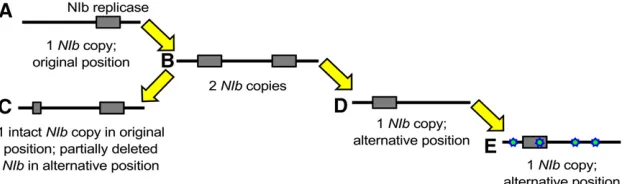
For the rearrangement of genes in a viral genome, many potential evolutionary trajectories can be envisioned. Here we use“plausible”to denote trajectories that could be tra-versed by the virus in terms of consistently maintaining rep-lication (i.e., virological perspective), whereas we use the term “accessible” to denote trajectories that could be tra-versed if the fitness and stability of intermediate steps are considered (i.e., evolutionary perspective). In the potyvirus model we are considering, a number of constraints conspire to effectively limit the number of plausible trajectories to one. First, we are considering repositioning of the essential NIb replicase, which must be present in every cell that will con-tribute to infection and between-host transmission. When plants are inoculated with multiple potyvirus genotypes, the observed rate of cellular co-infection is typically very low, with the main exception being early infection prior to systemic movement (Dietrich and Maiss 2003; Zwartet al. 2011; Tromaset al.2014a; Gutiérrezet al.2015). It is there-fore not surprising that while TEV missing theNIbgene (TEV-DNIb) can autonomously infect plants expressing NIb (Li and Carrington 1995), it cannot co-infect wild-type tobacco plants when co-inoculated with a wild-type virus (Tromas et al. 2014b). Since each intermediate along a reordering trajectory must be capable of autonomous replication, a plau-sible trajectory for an essential gene—such asNIb—will nec-essarily involve a gene-duplication event. Second, although higher gene expression as a consequence of gene duplication may have benefits, the increase in genome size and the pos-sible disruption of the expression of other genes could signif-icantly reduce viral fitness. Therefore, the most plausible trajectory to a new gene order is gene duplication, followed by deletion of the ancestral copy (Figure 2). A complication in this process is that variants with a deletion of the new gene copy may very well be favored owing to thefine-tuning of polyprotein processing and expression levels at this position.
A deletion of the new gene copy would, however, be a cul-de-sac along this evolutionary trajectory (Figure 2, variantc). Alternatively, viruses with only the new copy may be fixed (Figure 2, variantd), successively followed by the evolutionary
fine-tuning (e.g., adaptive mutations) of the relocated gene (Figure 2, variante).
Given that biological constraints strongly suggest that an evolutionary trajectory through gene duplication is the most plausible route to gene reordering, we decided to study this route in detail for the repositioning ofNIbin the TEV genome. To get a complete picture of the likelihood that a new gene order can evolve by means of this route, we decided to con-sider the followingfive key steps: (1) thefitness of viruses with gene duplications, rendering an indication of how long such variants can persist, (2) the evolutionary potential of viruses with gene duplications, focusing on the stability of the new gene copy because this will show whether the viruses can act as a bridge to the evolution of a new gene order, (3) thefitness of viruses with a singleNIbcopy in an alternative position to determine the likely fate of such viruses in the background of their direct ancestor, the corresponding doubleNIbgenotype, and (4) the evolutionary potential of viruses with a singleNIb copy in an alternative position because should such a virus occur and have lowfitness, we can infer whether—following a period of reproductive isolation—it could eventually be com-petitive with wild-type viruses.
From the outset, however, we are faced with a barrier to the evolution of alternative gene orders for TEV: there are only two alternative positions to place theNIbreplicase for which viruses appear to be viable (Majeret al.2014): (1) before the P1serine protease gene and (2) betweenP1and theHC-Pro cysteine protease genes (Figure 1B). A first barrier to the evolution of alternative gene order is therefore the number of potentially viable intergenic sites, which is limited to only two of nine for TEV. Recombination events leading to the movement of a gene, as well as conservation of the reading frame and polyprotein processing, will be rare, and in ad-dition, all other things being equal, seven of nine of these events will lead down trajectories that are ultimately cul-de-sacs. The number of viable alternative positions, and therefore the effective supply offirst-step recombinants lead-ing to alternative gene order, is almost 10-fold smaller than that suggested by the mutational supply alone.
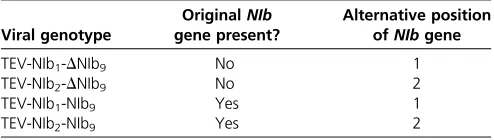
We therefore focus on those evolutionary pathways to reach the two viable alternative gene orders, and conse-quently, four different TEV genotypes were constructed. Figure 2 Plausible evolutionary trajectory for reorder-ing of an essential gene in a potyvirus genome. First, the essential gene must be duplicated (varianta/
TheNIbgene was inserted at thefirst and second positions in the TEV genome while preservingNIbat the original position (Figure 1C). Henceforth, we refer to these viruses with a duplication of NIb as TEV-NIb1-NIb9 and TEV-NIb2-NIb9 (see Table 1), with subscripts denoting the intergenic posi-tions ofNIb. Note that NIb9is referring toNIbat its original position. We also generated viruses in whichNIbwas moved to alternative positions and the original gene was deleted (Figure 1B). We refer to these viruses with a singleNIbcopy at alternative positions as TEV-NIb1-DNIb9 and TEV-NIb2 -DNIb9 (Table 1). For all viruses generated, the termini of the relocated NIb were adjusted such that this protein is properly translated and sites for cleavage from the viral poly-protein are provided (Figure 1), similar to the original pro-teolytic cleavage sites at the corresponding positions. For these four key intermediate viruses along an evolutionary trajectory to altered gene order, we could then measure vir-ulence, viral accumulation, and competitivefitness and study their evolutionary potential.
Viruses with a duplication of NIb have reducedfitness
and accumulation
TEV-NIb1-NIb9and TEV-NIb2-NIb9were reconstituted from infectious clones and inoculated inN. tabacumL. cv. Xanthi-nc (NN) plants. The collected tissue from these plants served as the starting material for all succeeding experi-ments. Subsequently, we measured within-host competitive
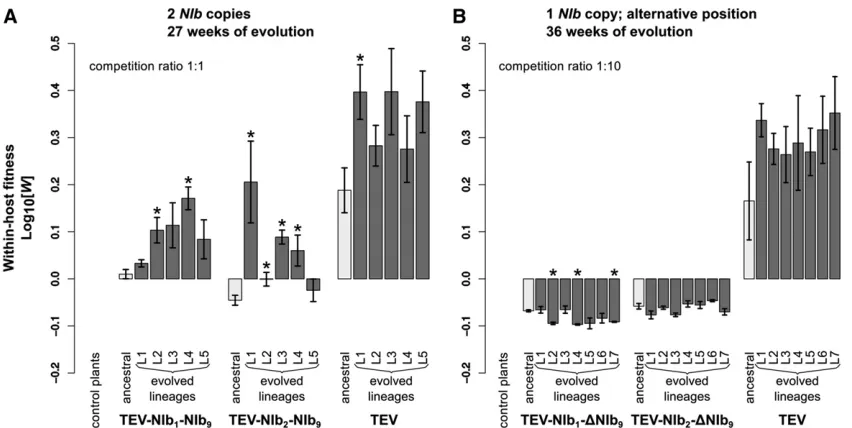
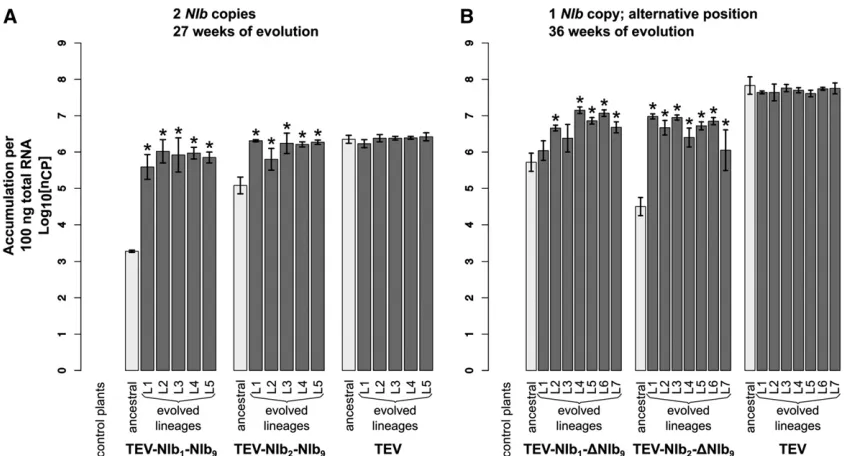
fitness (W) by individually competing the two viruses with NIbduplications against the wild-type virus carrying a GFP marker (TEV-eGFP) and viral accumulation by measuring the number of virions (genome equivalents) present in the host plant in the absence of a competing virus. After nor-malizing the number of virions for each viral genotype to the same concentration, both competition and accumulation experiments were performed for a total duration of 1 week. For both ancestral viruses TEV-NIb1-NIb9 and TEV-NIb2 -NIb9, we observed statistically significant decreases— compared to the ancestral wild-type virus—in competitive
fitness (Figure 3A; TEV-NIb1-NIb9:t4=26.379,P =0.003; TEV-NIb2-NIb9:t4=28.348,P= 0.001) and accumulation (Figure 4A; TEV-NIb1-NIb9:t4=245.097,P,0.001; TEV-NIb2-NIb9: t4 = 28.650, P , 0.001). The magnitude of change in competitive fitness for both genotypes is similar (0.6), but the magnitude of change in accumulation is much larger for TEV-NIb2-NIb9(0.054) than for TEV-NIb1 -NIb9(0.001). Compare the light gray bars labeled“ancestral” in panel A of both Figure 3 and Figure 4 to see how the duplicated viruses performed compared to the wild-type vi-rus. Because of the increase in genome size, we were not surprised that duplication ofNIbleads to a virus with reduc-tions in thesefitness components. Nevertheless, this observa-tion has an important implicaobserva-tion; thefirst step that must be taken along the plausible evolutionary route we have sug-gested is already unlikely. Viruses withNIbduplications can-not be maintained in virus populations for long periods of time. These viruses therefore must establish a bridgehead
in viral populations by means of genetic drift, from whence they can continue along the evolutionary trajectory to alternative gene order. Consequently, the low fitness of viruses withNIb duplications constitutes a second barrier to reordering.
An evolutionary cul-de-sac: after duplication, NIb is pervasively deleted from an alternative position
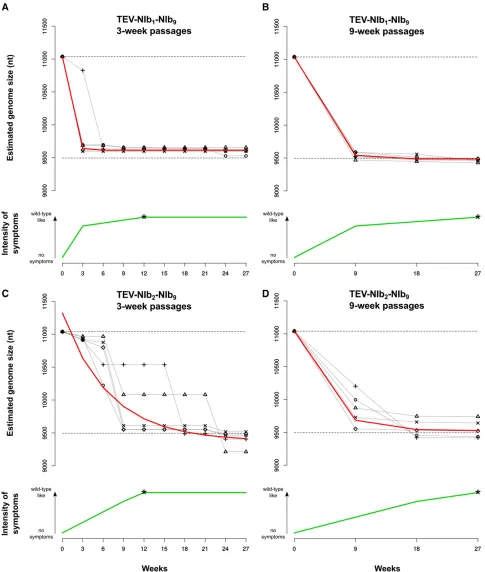
The next key stage in the evolution of alternative gene order is to determine the evolutionary potential of viruses with gene duplications TEV-NIb1-NIb9and TEV-NIb2-NIb9. The geno-types containing twoNIbcopies (Figure 1C) were therefore evolved in N. tabacumplants for a total of 27 weeks using both nine 3-week passages and three 9-week passages. Our choice for passage duration was based on a previous study in which we showed that selection appears to act more strongly for longer-duration passages, while nonfunctional sequences are more stable during shorter passages (Zwartet al.2014). Hence, these conditions may fulfill requirements for further evolution of duplicated viruses by (1) retaining the dupli-cated gene copy while (2) still allowing for selection—and not mainly genetic drift—to act on these virus populations. At the start of the evolution experiment, the TEV-NIb1-NIb9and TEV-NIb2-NIb9viruses had reduced infectivity and showed little or no symptoms, consisting of fewer than seven sparse small chlorotic spots per leaf. These symptoms are much weaker than typical symptoms observed for wild-type TEV, which consist of vein clearing, mosaic mottling, chlorosis, and stunting of the leaves together with reduced plant growth (Velasquez et al. 2014; Revers and García 2015). However, during the evolution experiment, these symptoms changed to wild-type-like symp-toms, indicated by the green lines in Figure 5. In thefirst 3- and 9-week passages, the reduced symptoms turned into mild wild-type-like symptoms for the TEV-NIb1-NIb9lineages (Figure 5). For the TEV-NIb2-NIb9lineages, mild wild-type-like symptoms appeared later: for the 3-week lineages in passage 3 (9 weeks on thex-axis in Figure 5) and for the 9-week lineages in passage 2 (18 weeks on thex-axis in Figure 5). At the end of the evolution experiment (27 weeks), all lineages of both viruses showed wild-type-like symptoms in tobacco plants.
Through RT-PCR, deletions were detected in the second alternative copy of NIb but never in the original one. Ge-nome size for all the evolved lineages was estimated at every passage (black symbols and continuous lines in Figure 5). As deletions occur, the viral genome reduces in size to one that is similar to that of wild-type TEV. An exponential decay model [SðtÞ ¼Sð0Þ þa expð2btÞ] was fitted to the estimated ge-nome sizeSover timetfor every lineage (red line in Figure 5 Table 1 TEV genotypes constructed for this study
Viral genotype
OriginalNIb
gene present?
Alternative position ofNIbgene
TEV-NIb1-DNIb9 No 1
TEV-NIb2-DNIb9 No 2
TEV-NIb1-NIb9 Yes 1
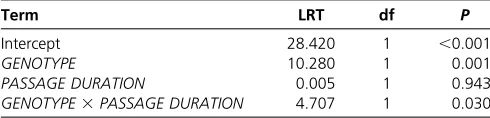
andTable S1), and the rates of size changebwere compared by means of a generalized linear model (GLM) using a gamma probability distribution. Whereas PASSAGE DURA-TIONdid not have a significant effect on genome size, both virusGENOTYPEand the interactionGENOTYPE3PASSAGE DURATION were significant (Table 2). The alternative NIb copy was deleted more quickly in the TEV-NIb1-NIb9lineages than in the TEV-NIb2-NIb9 lineages (Figure 5; compare A and B to C and D), whereas the interaction term suggests that the effect of genotype is particularly strong for the 3-week passages (Table 2). Additionally, in the TEV-NIb2 -NIb9lineages, there appears to be more variation in the time points at which the second NIb copy was deleted in the evolution experiment (Figure 5, C and D). The alternative NIbcopy from TEV-NIb2-NIb9is therefore more stable, sug-gesting that the second position in the TEV genome is a more accessible trajectory for duplication of a gene and sub-sequent reorganization within the genome. The decrease in genome size also appears to correlate with the appearance of stronger symptoms (Figure 5). At the end of the evolution experiment, all lineages had a genome size that was very similar to that of the wild-type virus. All TEV-NIb1-NIb9 3-week lineages and four of five 9-week lineages even evolved to a genome size smaller than the wild-type virus by deleting a part of the 59UTR. For TEV-NIb2-NIb9, four of
five 3-week lineages and three of five 9-week lineages evolved to a smaller genome size by deleting part of the HC-Procysteine protease.
For all the evolved lineages, we then measured within-host competitivefitness and accumulation (Figure 3A and Figure 4A).
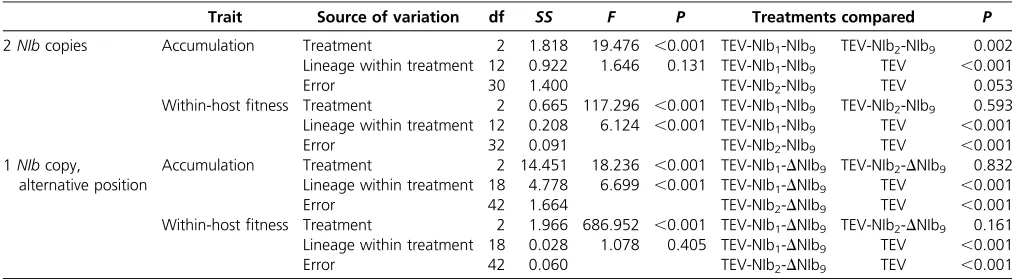
Compare bars labeled“ancestral”and“evolved lineages”in Figure 3A. When pairwise comparisons were made be-tween the ancestral virus and the evolved lineages (t-test with Holm-Bonferroni correction), significant increases in within-host competitivefitness were found for two offive TEV-NIb1-NIb9lineages and for four offive TEV-NIb2-NIb9 lineages (Figure 3A and Table 3). However,fitness never reached the fitness of the wild-type virus, and therefore, we didfind a significant effect of treatment [ANOVA with post hocTukey honestly significant difference (HSD)] com-paring the evolved TEV-NIb1-NIb9and TEV-NIb2-NIb9 line-ages to the evolved TEV lineline-ages (Table 4). Now compare bars labeled “ancestral”and“evolved lineages”in Figure 4A. Whereas no significant increases in accumulation were found comparing the ancestral virus and the evolved lineages of the wild-type TEV, we didfind significant increases in viral accumulation for all the evolved lineages of both TEV-NIb1 -NIb9and TEV-NIb2-NIb9. And these lineages reached similar accumulation levels as the evolved wild-type lineages. How-ever, we didfind a significant effect of treatment on accumu-lation comparing the evolved lineages of the viral genotypes owing to the differences between the evolved TEV-NIb1-NIb9 and the wild-type TEV lineages (Table 4).
The evolution of viruses with twoNIbcopies results in an increase infitness related to the reduction in genome size. However, we consistently observed the deletion ofNIbat an alternative position, leading back to the ancestral wild-type virus, and we never observed the deletion ofNIbat its ances-tral position. This evolutionary cul-de-sac therefore repre-sents a third barrier to reordering.
Whole-genome sequences of evolved lineages of viruses with a NIb duplication
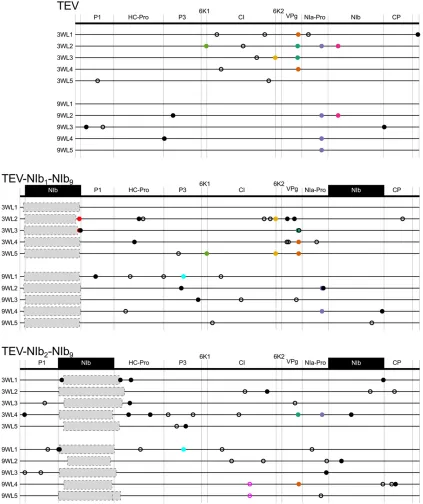
All evolved and ancestral lineages described in this study have been fully sequenced using the Illumina technology. The sequences of the ancestral lineages were used as an initial reference for the evolved lineages. Furthermore, for the genotypes that originally had twoNIb copies, parts of the genome were sequenced by Sanger to determine the exact deletion sites, which have been detected previously by RT-PCR (Figure 5). Most deletion variants were used to construct new reference sequences for each of the evolved TEV-NIb1-NIb9and TEV-NIb2-NIb9lineages. After the ini-tial mapping step, mutations were detected in the evolved lineages compared to their corresponding ancestor.
At the sequence level, the main changes in TEV-NIb1-NIb9 and TEV-NIb2-NIb9were large genomic deletions in the sec-ond NIbcopy. In other words, for both viruses, we consis-tently observed pseudogenization of the duplicated NIb copy, in accordance with RT-PCR results. In TEV-NIb1-NIb9, none of these deletions included the N-terminus of P1, while for nine of ten lineages these deletions included the 39end of the 59UTR (Figure 6). Only in half of the TEV-NIb1-NIb9 lineages is the reading frame maintained after pseudogeniza-tion. Because the deletion occurs at the start of the genome, it is not necessary to maintain the reading frame as long as the original second methionine in P1 is preserved. In TEV-NIb2 -NIb9, none of the deletions included the C-terminus of P1, but for seven of ten lineages the deletions included the N-terminal region of the HC-Pro cysteine protease (Figure 6), similar to results obtained by previous studies (Dolja et al. 1993;
within each lineage. SNPs were detected at a frequency as low as 1%. In the evolved TEV-NIb1-NIb9lineages, a total of 301 SNPs were detected, with a median of 36 (27–45) per lineage. In the evolved TEV-NIb2-NIb9lineages, a total of 220 SNPs were detected, with a median of 23.5 (4–44) per line-age. In both virus genotypes, most of the SNPs were present at low frequency, with a higher percentage of synonymous (TEV-NIb1-NIb9, 66.4%; TEV-NIb2-NIb9, 64.5%)vs. nonsy-nonymous changes (Figure S1). However, the difference in the distribution of synonymous vs. nonsynonymous SNP frequency was not significant (Kolmogorov-Smirnov test; TEV-NIb1-NIb9:D= 0.146,P= 0.073; TEV-NIb2-NIb9:D= 0.144,P= 0.217). For more details on the frequency of the SNPs within every lineage, seeTable S3andTable S4.
The results from the whole-genome data are congruent with the RT-PCR results and phenotypic assays: the main change in the evolved lineages of the viruses withNIbduplications is the deletion of the second copy, which turns into a virus that is in all respects similar to the ancestral wild-type virus. Although there are some convergent single-nucleotide mutations, these occur only in a small fraction of lineages and, moreover, are often shared between the TEV, TEV-NIb1-NIb9, and TEV-NIb2 -NIb9lineages. These mutations therefore appear to represent general adaptations, without a strong link to the transient presence of the secondNIbcopy.
Viruses with NIb moved to an alternative position have
further reductions infitness and viral accumulation
The viruses for which NIb was moved to an alternative position without conserving the original NIb copy, TEV-NIb1-DNIb9and TEV-NIb2-DNIb9, were reconstituted from infectious clones. Subsequently, we measured their within-host competitivefitness and viral accumulation. Compare bars la-beled“ancestral”in both Figure 3B and Figure 4B. For both TEV-NIb1-DNIb9and TEV-NIb2-DNIb9, we observed significant decreases—compared to the wild-type virus—in competitive
fitness (Figure 3B; TEV-NIb1-DNIb9:t4=24.897,P= 0.008; TEV-NIb2-DNIb9:t4=24.692,P= 0.009) and accumulation (Figure 4B; TEV-NIb1-DNIb9: t4 = 210.463, P , 0.001; TEV-NIb2-DNIb9: t4 = 216.453, P , 0.001). Deletion of the originalNIbcopy therefore leads to further reductions in viral fitness, suggesting that TEV-NIb1-DNIb9and TEV-NIb2-DNIb9will be rapidly outcompeted by both their direct ancestors (TEV-NIb1-NIb9and TEV-NIb2-NIb9, respectively) and viruses with deletions in the new copy of NIb (fitness similar to wild-type virus). Therefore, we are confronted with a fourth evolutionary barrier: viruses with a single copy ofNIb in an alternative position cannot outcompete the duplicated
virus, meaning that they must be maintained, or probably
fixed, by genetic drift to have the opportunity to undergo fur-ther evolution.
Limited short-term evolutionary potential of viruses with NIb moved to an alternative position
In the evolutionary trajectory we have postulated, thefinal step is the evolution of a virus withNIbonly in an alternative position. If these viruses managed to occur through a series of chance events and could exist in isolation from their ancestral viruses for a period of time, what would their evolutionary fate be? Could these viral populations readily converge on a
fitness peak that allowed them to be comparable or superior to the ancestral TEV?
To address these questions, TEV-NIb1-DNIb9and TEV-NIb2 -DNIb9were evolved in tobacco plants for a total of 36 weeks using four 9-week serial passages. We did not perform 3-week passages because we expected these genomes to be stable and therefore considered only a condition with maximal selection and minimal drift by intermittent bottlenecks. Both reordered viruses have very low infectivity, and serial passage was com-pleted successfully for only seven of ten lineages. For both TEV-NIb1-DNIb9and TEV-NIb2-DNIb9, tobacco plants had very weak or no symptoms of infection, and these symptoms did not become more severe over time. Therefore, infection had to be confirmed by RT-PCR. Two different regions of the reordered genomes were amplified using primersflanking the region of the newNIbposition as well as primersflanking the original position of the removed NIb. No evidence was found of any insertions or deletions within these amplified sites, indicating that reordered viruses were stable over time and that there was no presence of wild-type-like viruses.
For all the evolved lineages, we measured within-host competitive fitness and accumulation (Figure 3B and Figure 4B). Compare bars labeled“ancestral”and“evolved lineages” in Figure 3B. Pairwise comparisons between the ancestral and evolved lineages showed there were no significant increases in within-host competitivefitness (Figure 3B and Table 3), while in three offive TEV-NIb1-DNIb9lineages we even found signif-icant decreases. Now compare bars labeled “ancestral” and
“evolved lineages” in Figure 4B. Accumulation levels of the wild-type virus did not change significantly compared to the ancestral TEV, while for five of seven of the evolved TEV-NIb1-DNIb9lineages and all the TEV-NIb2-DNIb9lineages, ac-cumulation increased significantly (Figure 4B and Table 3). However, these accumulation levels never reached the same levels as the wild-type virus. Comparing only the evolved line-ages, there was a significant effect of treatment (ANOVA with post hocTukey HSD; Table 4) on viral accumulation and within-host competitivefitness, indicating that the wild-type TEV out-performs the two reordered viruses for bothfitness components.
Whole-genome sequences of evolved lineages of viruses with a single NIb copy at an alternative position
We found evidence of adaptive convergent evolution com-paring the evolved and ancestral lineages containing one Table 2 GLM analysis of the genome size data
Term LRT df P
Intercept 28.420 1 ,0.001
GENOTYPE 10.280 1 0.001
PASSAGE DURATION 0.005 1 0.943
reorderedNIbcopy (Figure 7,Table S5,Table S6, andTable S7). Mutations in the TEV-NIb1-DNIb9lineages were found in (1) the reorderedNIbgene at thefirst position (U428C), (2) in P1 around the proteolytic cleavage site of NIb and P1 (U1688C, U1697C, and U1697A), and (3) in NIa-Pro (U8210C and A8347G). Mutation U1688C modifies the start codon ofP1(M563T). This is explained by the intro-duction of an additional start codon at thefirst position of the reordered genome that makes the original methionine redundant. Mutations in the TEV-NIb2-DNIb9lineages were found (1) in the reorderedNIbgene at the second position (G1066A, G1090A, G1264A, and U1346C), (2) in HC-Pro (G3213U, A3632G, and U3803C), (3) inP3(A4016G), and (4) inNIa-Pro(U8285C and A8350G). The former mutation inNIa-Pro(U8285C) also was found in one lineage of TEV-NIb1-DNIb9, and the latter mutation (A8350G) also was found in the evolved lineages of TEV-NIb1-DNIb9and the wild-type TEV. Not a single mutation was detected inVPg, which is putatively involved in translation and replication.
For more information of the mutations found in both geno-types, seeTable S5.
As for the within-population variation, in the evolved TEV-NIb1-DNIb9lineages, we detected 137 SNPs, with a median of 22 (7–37) per lineage. In the evolved TEV-NIb2-DNIb9 lineages, 155 SNPs were detected, with a median of 22 (18–48) per lineage. In both virus genotypes, most of the SNPs were low-frequency SNPs, with a higher percentage of synonymous changes (58.4%) in the TEV-NIb1-DNIb9 line-ages, while in the TEV-NIb2-DNIb9lineages, the percentage of nonsynonymous changes was higher (63.9%) (seeFigure S2). However, no significant difference was found in the distri-bution of synonymousvs.nonsynonymous SNP frequencies (Kolmogorov-Smirnov test; TEV-NIb1-DNIb9: D = 0.203, P = 0.078; TEV-NIb2-DNIb9: D = 0.152, P= 0.318). For more information on the frequency of the SNPs within each lineage, seeTable S6andTable S7.
The mutations appeared to be contingent on the ancestral genotype; most of the convergent mutations that were found Table 3 Two-samplet-test (4 df) with Holm-Bonferroni correction comparing ancestral against evolved lineages
Accumulation Within-hostfitness
Genotype Lineage t P t P
2NIbcopies TEV-NIb1-NIb9 9WL1 211.744 ,0.001a 23.101 0.036
9WL2 214.697 ,0.001a 25.610 0.005a
9WL3 29.690 0.001a 23.663 0.022
9WL4 227.962 ,0.001a 210.713 ,0.001a
9WL5 229.966 ,0.001a 22.991 0.040
TEV-NIb2-NIb9 9WL1 29.305 0.001a 24.849 0.003a
9WL2 23.284 0.030a 24.358 0.012a
9WL3 25.600 0.005a 212.814 ,0.001a
9WL4 28.222 0.001a 25.348 0.006a
9WL5 28.832 0.001a 21.405 0.233
TEV 9WL1 1.3475 0.249 24.836 0.008a
9WL2 20.2692 0.801 22.549 0.063
9WL3 20.4693 0.663 23.542 0.024
9WL4 20.5268 0.626 21.782 0.149
9WL5 20.7859 0.476 24.028 0.016
1NIbcopy, alternative position TEV-NIb1-DNIb9 9WL1 21.521 0.203 20.395 0.713
9WL2 26.133 0.004a 15.041 ,0.001a
9WL3 22.534 0.064 20.515 0.634
9WL4 29.322 0.001a 19.454 ,0.001a
9WL5 27.363 0.002a 3.986 0.016
9WL6 28.738 0.001a 2.652 0.057
9WL7 25.670 0.005a 17.220 ,0.001a
TEV-NIb2-DNIb9 9WL1 216.224 ,0.001a 3.139 0.035
9WL2 211.531 ,0.001a 0.805 0.466
9WL3 216.134 ,0.001a 4.564 0.010
9WL4 29.068 0.001a 20.989 0.379
9WL5 213.961 ,0.001a 20.502 0.642
9WL6 214.943 ,0.001a 23.544 0.024
9WL7 24.320 0.012a 2.374 0.077
TEV 9WL1 1.377 0.241 23.311 0.030
9WL2 0.986 0.380 22.152 0.098
9WL3 0.476 0.659 21.674 0.170
9WL4 0.908 0.415 21.642 0.176
9WL5 1.464 0.217 21.867 0.135
9WL6 0.621 0.569 22.388 0.075
9WL7 0.497 0.646 22.865 0.046
in the lineages of one reordered genotype were not found in the other genotype. All convergent mutations found were nonsynonymous. Note that the convergent mutations are present at different frequencies and that none of these con-vergent mutations were fixed in all the replicate lineages (Table S5).
For TEV-NIb1-DNIb9and TEV-NIb2-DNIb9, we therefore see markedly different patterns of genome evolution than for TEV-NIb1-NIb9 and TEV-NIb2-NIb9. In agreement with RT-PCR results, TEV-NIb1-DNIb9and TEV-NIb2-DNIb9show no signs of major genomic rearrangements, such as the large deletions seen in TEV-NIb1-NIb9and TEV-NIb2-NIb9. Given the strong selection, which undoubtedly would occur for a variant with wild-type gene order, these results suggest that the mutation supply and nonviability of viruses withoutNIb are major limiting factors. This result provides support for our conjecture that gene-order evolution involving essential genes must occur through gene duplications in potyviruses. However, the observed convergent single-nucleotide muta-tions are congruent with the observed improvement in virus accumulation, suggesting that selection is acting on these virus populations.
Studying the evolutionary potential of the reordered viruses TEV-NIb1-DNIb9 and TEV-NIb2-DNIb9, although demonstrating clear signatures of adaptive evolution, therefore also shows further barriers to the evolution of alternative gene orders. First, increased accumulation and sequence-level convergent evolution illustrate that adaptive evolution occurred, meaning that the reordered viruses, despite initially having low levels of accumulation, are still somewhat evolvable and show marked improve-ment in keyfitness components. Conversely, accumulation was still significantly lower than that of the wild-type virus. Furthermore, within-host competitive fitness remained similar to that of the ancestral TEV-NIb1-DNIb9 or TEV-NIb2-DNIb9or, strikingly, even decreased in some lineages. These observations suggest that even after 36 weeks of evolution under conditions that optimize selec-tion, these reordered viruses remain grossly inferior com-petitors to the wild-type virus. Therefore, even if a virus population should overcome all four of these barriers, a
final evolutionary barrier to the reordering of potyvirus genomes remains.
Discussion
In this study, we have explored whether the most plausible evolutionary trajectory for the rearrangement of gene order in a positive-strand RNA potyvirus is accessible. Overall, we have identifiedfive barriers to the evolution of viruses with the essentialNIbreplicase gene moved to an alternative position. First, only two of nine viruses withNIbmoved to an alterna-tive position are viable. Second, thefitness of viruses withNIb duplications was low, meaning that such viruses would be quickly displaced from populations if they arose (Figure 8 shows a summary of fitness data). Third, for viruses with gene duplications, the newNIbcopy was lost in all lineages, whereas the original copy was maintained. This propensity represents a second cul-de-sac because loss of the newNIb copy entails a trajectory that leads back to the ancestral gene order. Fourth, viruses with only a singleNIbcopy at an alter-native position had low fitness and accumulation, notably lower than viruses with duplications (Figure 8). Therefore, to reach a virus with a singleNIbcopy in an alternative posi-tion, two rare recombination events must occur within a small time window because the intermediate step is unstable. Moreover, the low-fitness recombinants would need to be maintained orfixed by genetic drift because they would be outcompeted otherwise. Fifth, even if this unlikely sequence of events occurs and the resulting virus becomes reproduc-tively isolated, after more than half a year of evolution under optimal conditions, this virus still would not stand a chance in head-to-head competition with its ancestor (Figure 8). We therefore conclude that—under the conditions we have considered—the evolution of alternative gene orders for TEV is highly unlikely because the evolutionary trajectory to alternative gene order we have studied is not accessible. These results suggest that one reason gene order has been conserved in potyviruses is therefore the lack of accessible trajectories to alternative gene orders.
The observation that the evolved virus lineages with an alternative gene order have improved accumulation while Table 4 Nested ANOVAs on accumulation and within-hostfitness of evolved lineages with apost hocTukey HSD test
Trait Source of variation df SS F P Treatments compared P
2NIbcopies Accumulation Treatment 2 1.818 19.476 ,0.001 TEV-NIb1-NIb9 TEV-NIb2-NIb9 0.002
Lineage within treatment 12 0.922 1.646 0.131 TEV-NIb1-NIb9 TEV ,0.001
Error 30 1.400 TEV-NIb2-NIb9 TEV 0.053
Within-hostfitness Treatment 2 0.665 117.296 ,0.001 TEV-NIb1-NIb9 TEV-NIb2-NIb9 0.593
Lineage within treatment 12 0.208 6.124 ,0.001 TEV-NIb1-NIb9 TEV ,0.001
Error 32 0.091 TEV-NIb2-NIb9 TEV ,0.001
1NIbcopy, alternative position
Accumulation Treatment 2 14.451 18.236 ,0.001 TEV-NIb1-DNIb9 TEV-NIb2-DNIb9 0.832
Lineage within treatment 18 4.778 6.699 ,0.001 TEV-NIb1-DNIb9 TEV ,0.001
Error 42 1.664 TEV-NIb2-DNIb9 TEV ,0.001
Within-hostfitness Treatment 2 1.966 686.952 ,0.001 TEV-NIb1-DNIb9 TEV-NIb2-DNIb9 0.161
Lineage within treatment 18 0.028 1.078 0.405 TEV-NIb1-DNIb9 TEV ,0.001
having unchanged or deteriorated within-hostfitness is note-worthy. Our serial passage experiment was conducted in single-host plants, and we would therefore expect within-host competitive fitness to improve. In other words, the virus variant that is present at highest frequency in thefinal pop-ulation has the highest probability of carrying over to the next round of infection, irrespective of the level of accumulation.
low-level infections therefore may not improve performance in direct competition and may even lower it as a result of antago-nistic pleiotropy, given that accumulation and competitivefi t-ness do not correlate for TEV (Zwart et al.2014). Since the common competitor used in thefitness assays is a strain derived from TEV, high-level infections will occur in these assays. For these reasons, fitness improvements in TEV-NIb1-DNIb9 and TEV-NIb2-DNIb9lineages may very well not be conspicuous in direct competitions with the ancestral TEV and can only be de-tected systemically by measuring virus accumulation.
Thefirst step in our proposed model, gene duplication, is a rare event in the recent history of RNA viruses (Simon-Loriere and Holmes 2013). The few cases describing gene duplica-tion in RNA viruses seem to occur through either homologous or nonhomologous recombination (Forss and Schaller 1982; Tristemet al.1990; Boykoet al.1992; Walkeret al.1992; Wang and Walker 1993; Karasevet al.1995; LaPierreet al.
1999; Penget al.2001; Valliet al.2007; Simon-Loriere and Holmes 2013). In our experiments, the gene duplications are engineered artificially, while loss of the duplicated gene gen-erates shorter genomes that are efficiently selected for, prob-ably by means of slippage of the RdRp. We also observed deletions in the N-terminal region of the HC-Pro cysteine protease because there is no selection to maintain the intact HC-Pro. However, these specific deletions probably would not perform well in nature because the resulting truncated protein would preclude aphid-mediated transmission.
replicase gene are located at the N-terminus, before and be-tween theP1andHC-Progenes. Within the Potyviridae family, bothP1and the multifunctionalHC-Prohave the lowest se-quence conservation (Adamset al.2005; Revers and García
2015). P1is not an essential gene (Verchot and Carrington 1995a), but the cleavage that separatesP1andHC-Prois re-quired (Verchot and Carrington 1995b). The introduction of NIbbefore or betweenP1andHC-Procould result in a delay in Figure 8 Within-host competitive fi t-ness of all trajectories explored. For all the trajectories proposed (x-axis), thefi t-ness (Wat they-axis) was plotted. The viruses with the NIb gene moved to intergenic positions 3–8 and 10 are non-viable genotypes (upper panel;W,0). The trajectories of viruses with NIb
this separation or even makeP1inactive, which, in turn, would result in a low accumulation of the virus (Verchot and Carrington 1995a). We do observe that the viral genomes with an alternative gene order have low accumulation levels, but the accumulation levels are able to improve over time with the same gene order. This suggests that the adaptive mutations alone are responsible for the increase in accumulation levels. Nevertheless, these adaptive mutations could not compensate for the rearrangements done because within-host competitive
fitness remains low throughout evolutionary time.
It can be postulated that the early expression of theNIb gene would have advantages for viral replication. However, the position of NIb in potyviruses’polyprotein seems to be optimized for its interaction with VPg for initiation of repli-cation. Furthermore, it is thought that the interaction with both VPg and NIa-Pro targets NIb to the membranous struc-tures where viral RNA replication takes place (Dufresneet al. 2008). Thus, the movement of NIb away from these interact-ing proteins might result in a delay in the interaction, repli-cation, and gene expression. This is a difficult, maybe even impossible, burden to overcome for a virus.
The relocation ofNIbin our model system did lead to the evolution of adaptive or compensatory mutations that allowed for an increase in viral accumulation. Interestingly, convergent mutations occur in both the relocatedNIband two regions that are responsible for proteolytic activity: the C-terminal region of HC-Proand the main viral proteaseNIa-Pro. When relocating the NIb replicase to the first position in the genome, and thereby introducing a second methionine codon before NIb in the viral genome, we observe a mutation that changes the original methionine (in P1) to a threonine. Therefore, a re-version ofNIbto its original position is not a subsequent step we would expect to see in this viral genotype.
Comparing our study to the experimental evolution done on the repositioning of the T7 RNA polymerase (Springmanet al. 2005), similar results were obtained despite T7 having a dif-ferent genome composition, architecture, and replication and gene expression strategies. In T7 studies,fitness is measured as the rate of population growth, which is comparable to our accumulation measurements. As in our study, the fitness of the rearranged phages improved but never reached the wild-type level. Additionally, as in our study, the reordered T7 ge-nomes are stable over a long period of time. Concerning these similarities, the lack of accessible evolutionary trajectories to alternative gene orders cannot be entirely explained by the most obvious impediment: that potyviruses with reordered genomes most likely would be nonviable owing to improper autocatalytic processing of the polyprotein. In our study, ex-perimental evolution of the reordered viruses illustrates other important barriers to gene order evolution.
In VSV, the evolution of alternative gene orders is more plausible than for TEV because the movement of theNgene does not affect viability of the virus (Wertzet al.1998). The evolvability of variants of VSV with theNin alternative posi-tions was higher in a cell line from an alternative host (Pesko et al.2015). Our results for the evolution of TEV-NIb1-DNIb9
and TEV-NIb2-DNIb9 are comparable, although we consid-ered evolution in a permissive host and, as such, expected to see little adaptation of the ancestral TEV. Pesko et al. (2015) did not consider the evolutionary trajectory leading up to the formation of a virus with a rearranged genome. However, at least in the cell-culture environment where MOI can be high for VSV, this may not be as big an impedi-ment as for TEV. A computational study suggests that point mutations in VSV intergenic regions preceded or coevolved withfixation of the wild-type gene order, resulting in a sub-optimal genome organization (Lim and Yin 2009).
For our experiments, we have considered only one present-day potyvirus as well as variants with rearranged gene orders derived from it. Whether our results will extend to other pre-sent-day potyviruses is a valid question, but it is equally im-portant to consider that these results may have only a limited bearing on the potential for gene-order evolution in ancestral potyviruses. As a result of epistasis, adaptive evolution can limit accessible evolutionary trajectories (Salverdaet al.2011), while purifying selection can result in entrenchment (Shah et al.2015). It is therefore plausible that evolutionary trajec-tories to alternative gene orders may have been more accessi-ble to ancestral viruses. We therefore do not rule out that other factors may have been important in conserving potyvirus gene order, in particular, at early time points in their evolution.
What conditions could make the evolutionary trajectory we have studied accessible for present-day viruses or could open up alternative evolutionary trajectories? We have explored evolv-ability of a single potyvirus genotype at different points along the trajectory to alternative gene orders. It is possible that certain genotypes could be less constrained, although given the low fitness of the intermediates considered and the in-stability of the newNIbcopy, this potentiating variation prob-ably would have to preexist prior to the first recombination step leading to gene duplication. Prime candidates for muta-tions that may mitigate such constraints are the convergent mutations found in the evolved lineages of TEV-NIb1-DNIb9 and TEV-NIb2-DNIb9. An alternative host species in which high MOI occurs also could open up new evolutionary trajectories by allowing complementation between viral genomes, thereby widening the set of plausible trajectories beyond only those involving gene duplication. We think that it is unlikely that such hosts exist, however, given that (1) in general, MOI esti-mates for plant RNA viruses tend to be low (Zwartet al.2013), and (2) alternative hosts would tend to be semipermissive, and we therefore would intuitively expect lower infection levels and MOI in such a host. We think that the most promising avenue for further research on alternative gene orders is to consider the impact of potentiating mutations.
Acknowledgments
We thank Francisca de la Iglesia and Paula Agudo for excellent technical assistance. This work was supported by the John Templeton Foundation (grant 22371), by the European Commission 7th Framework Program EvoEvo Project (grant ICT610427), and by the Spanish Ministerio de Economía y Competitividad (MINECO) (grants BFU2012-30805 to S.F.E. and BIO2011-26741 and BIO2014-54269-R to J.A.D). A.W. was supported by a John Templeton Foun-dation grant and the EvoEvo Project. M.P.Z. was supported by a Juan de la Cierva postdoctoral contract from MINECO. E.M. was the recipient of a predoctoral fellowship (AP2012-3751) from the Spanish Ministerio de Educación, Cultura y Deporte. The opinions expressed in this publication are those of the authors and do not necessarily reflect the views of the John Templeton Foundation. The authors declare that they have no competing interests.
Author contributions: A.W., M.P.Z., and S.F.E. designed the study. A.W., M.P.Z., and N.T. performed the experiments. E.M. and J.A.D. prepared the viral constructs. A.W., M.P.Z., and S.F.E. analyzed the data and wrote the manuscript. All authors read and approved thefinal manuscript.
Literature Cited
Adams, M. J., J. F. Antoniw, and C. M. Fauquet, 2005 Molecular criteria for genus and species discrimination within the family Potyviridae. Arch. Virol. 150: 459–479.
Atreya, C. D., P. L. Atreya, D. W. Thornbury, and T. P. Pirone, 1992 Site-directed mutations in the potyvirus HC-Pro gene affect helper component activity, virus accumulation, and symptom expression in infected tobacco plants. Virology 191: 106–111.
Bedoya, L. C., and J.-A. Daròs, 2010 Stability ofTobacco etch virus
infectious clones in plasmid vectors. Virus Res. 149: 234–240. Belshaw, R., O. G. Pybus, and A. Rambaut, 2007 The evolution of
genome compression and genomic novelty in RNA viruses. Genome Res. 17: 1496–1504.
Boyko, V. P., A. V. Karasev, A. A. Agranovsky, E. V. Koonin, and V. V. Dolja, 1992 Coat protein gene duplication in a filamentous RNA virus of plants. Proc. Natl. Acad. Sci. USA 89: 9156– 9160.
Carrasco, P., J.-A. Daròs, P. Agudelo-Romero, and S. F. Elena, 2007 A real-time RT-PCR assay for quantifying the fitness of tobacco etch virus in competition experiments. J. Virol. Methods 139: 181–188.
Chung, B. Y., W. A. Miller, J. F. Atkins, and A. E. Firth, 2008 An overlapping essential gene in the Potyviridae. Proc. Natl. Acad. Sci. USA 105: 5897–5902.
Cronin, S., J. Verchot, R. Haldeman-Cahill, M. C. Schaad, and J. C. Carrington, 1995 Long-distance movement factor: a transport function of the potyvirus helper component proteinase. Plant Cell 7: 549–559.
Dandekar, T., B. Snel, M. Huynen, and P. Bork, 1998 Conservation of gene order: a fingerprint of proteins that physically interact. Trends Biochem. Sci. 23: 324–328.
de Haan, C. A. M., L. van Genne, J. N. Stoop, H. Volders, and P. J. M. Rottier, 2003 Coronaviruses as vectors: position de-pendence of foreign gene expression. J. Virol. 77: 11312– 11323.
Dietrich, C., and E. Maiss, 2003 Fluorescent labelling reveals spa-tial separation of potyvirus populations in mixed infected Nico-tiana benthamianaplants. J. Gen. Virol. 84: 2871–2876. Dolja, V. V., K. L. Herndon, T. P. Pirone, and J. C. Carrington,
1993 Spontaneous mutagenesis of a plant potyvirus genome after insertion of a foreign gene. J. Virol. 67: 5968–5975. Dufresne, P. J., K. Thivierge, S. Cotton, C. Beauchemin, C. Ideet al.,
2008 Heat shock 70 protein interaction with Turnip mosaic
virus RNA-dependent RNA polymerase within virus-induced
membrane vesicles. Virology 374: 217–227.
Endy, D., L. You, J. Yin, and I. J. Molineux, 2000 Computation, prediction, and experimental tests offitness for bacteriophage T7 mutants with permuted genomes. Proc. Natl. Acad. Sci. USA 97: 5375–5380.
Engler, C., R. Gruetzner, R. Kandzia, and S. Marillonnet, 2009 Golden gate shuffling: a one-pot DNA shuffling method based on type IIs restriction enzymes. PLoS One 4: e5553. Fauquet, C. M., M. A. Mayo, J. Maniloff, U. Desselberger, and L. A.
Ball, 2005 Virus Taxonomy: Eighth Report of the International Committee on Taxonomy of Viruses. Elsevier Academic Press, San Diego.
Forss, S., and H. Schaller, 1982 A tandem repeat gene in a picor-navirus. Nucleic Acids Res. 10: 6441–6450.
Francki, R. I. B., C. M. Fauquet, D. L. Knudson, and F. Brown, 1991 Classification and nomenclature of viruses: fifth report of the International Committee on Taxonomy of Viruses. Arch. Virol. 17: 1–405.
Fukuhara, T., R. Koga, N. Aoki, C. Yuki, N. Yamamoto et al., 2006 The wide distribution of endornaviruses, large double-stranded RNA replicons with plasmid-like properties. Arch. Virol. 151: 995–1002.
Gutiérrez, S., E. Pirolles, M. Yvon, V. Baecker, Y. Michalakiset al., 2015 The multiplicity of cellular infection changes depending on the route of cell infection in a plant virus. J. Virol. 89: 9665– 9675.
Himmelreich, R., H. Plagens, H. Hilbert, B. Reiner, and R. Herrmann, 1997 Comparative analysis of the genomes of the bacteria My-coplasma pneumoniaeandMycoplasma genitalium. Nucleic Acids Res. 25: 701–712.
Karasev, A. V., V. P. Boyko, S. Gowda, O. V. Nikolaeva, M. E. Hilf
et al., 1995 Complete sequence of the citrus tristeza virus RNA genome. Virology 208: 511–520.
Koboldt, D. C., Q. Zhang, D. E. Larson, D. Shen, M. D. McLellan
et al., 2012 VarScan 2: somatic mutation and copy number alteration discovery in cancer by exome sequencing. Genome Res. 22: 568–576.
Kolstø, A. B., 1997 Dynamic bacterial genome organization. Mol. Microbiol. 24: 241–248.
Koonin, E. V., 2009 Evolution of genome architecture. Int. J. Bio-chem. Cell Biol. 41: 298–306.
Koonin, E. V., and V. V. Dolja, 1993 Evolution and taxonomy of positive-strand RNA viruses: implications of comparative analy-sis of amino acid sequences. Crit. Rev. Biochem. Mol. Biol. 28: 375–430.
Koonin, E. V., and M. Y. Galperin, 1997 Prokaryotic genomes: the emerging paradigm of genome-based microbiology. Curr. Opin. Genet. Dev. 7: 757–763.
Koonin, E. V., Y. I. Wolf, K. Nagasaki, and V. V. Dolja, 2008 The Big Bang of picorna-like virus evolution antedates the radia-tion of eukaryotic supergroups. Nat. Rev. Microbiol. 6: 925– 939.
Langmead, B., and S. L. Salzberg, 2012 Fast gapped-read align-ment with Bowtie 2. Nat. Methods 9: 357–359.