Innovative technologies in the structural design of FBRs
Tai A S A Y A M A 1), Kazuyuki TSUKIMORI ~), and Masaki MORISHITA 1) 1) Japan Nuclear Cycle Development Institute
ABSTRACT
For the development of fast breeder reactors, cost reduction, both construction and running costs, is strongly needed. This must be achieved simultaneously with improving the reliability of the plant. This paper surveyed various innovative technologies that have possibility to contribute to this goal within the areas of structural integrity assessment. The areas surveyed were not restricted to the areas that are covered by the existing design codes but included wider areas: Those were postulated conditions for design (postulated loading condition, etc), materials, design evaluation, preservice inspection, operation, inservice inspection, and maintenance. Improvement of design evaluation methods was discussed in detail, and as a typical example of the innovative technologies, the merit of inelastic analysis in the design of reactor vessel and piping of a large-scale sodium cooled reactor being studied was quantitatively assessed. Finally, direction of the development of a structural integrity assessment code was discussed, and a new concept of a design code system for fast breeder reactors, which fully utilizes the promising technologies, was proposed.
INTRODUCTION
In Japan, since the prototype fast breeder reactor Monju was constructed, studies have been continued to design the next large-scale reactor. This reactor must be even more cost-effective compared to the future light water reactors. One of the powerful ways to achieve this goal is to improve the design codes upon which structural integrity is evaluated. So far, the demonstration fast breeder reactor design standard (DDS) [ 1 ] has been developed by improving the elevated temperature structural design guide (ETSDG) that was used for the design of Monju. The improvements made in the DDS were mainly on design evaluation methods, and the scope of the DDS and the ETSDG was basically the same as the ASME Boiler and Pressure Vessel Code Section III Subsection NH [2], and covers elevated temperatures. For lower temperatures, a Japanese government notification (MITI Notification No.501) is applied and the scope of it is similar to ASME Section III.
Considering technological progresses with regard to the structural integrity assessment since those codes were initially developed, fully improving the existing codes and developing a system of codes and standards based on a new concept that covers the progresses is a strategy that we must pursue to achieve the goal of cost-reduction of future fast breeder reactors. Therefore, this paper firstly surveys innovative technologies that are not employed in the existing cods and have possibility to contribute to cost-reduction without decreasing reliability. The survey was done not only in the area where the existing codes covered but also in other areas such as postulating design events or loads, materials, operation, inspection and maintenance, with emphasis on design evaluation. One of the technologies, inelastic analysis, is examined in detail and the benefit on the design of a reactor vessel and a piping system is shown. Finally, this paper proposed a new concept of structural integrity code for the design of fast breeder reactors.
INNOVATIVE T E C H N O L O G I E S Principle of survey
Technologies that have possibility to contribute to the reduction of construction and maintenance, and to the improvement of plant reliability were widely surveyed. Because longer design life reduces power generating cost, technologies that contribute to make design life longer were also surveyed. Areas surveyed were postulated conditions for design (postulated events, number of events), materials, design evaluation, pre-service inspection, operation, inservice inspection and maintenance. Although parts of those areas are covered by the existing Japanese codes, many items are not mentioned in the codes, and are either dealt with according to practice or not taken into account in design process at all. Result of Survey
From the many items identified as promising as a result of the survey, those considered to have significant effects on cost reduction and the improvement of plant reliability are discussed below.
1) Material
The most promising is to modify 12Cr steel, which have been used in fossil power plants, for fast breeder reactors. The
SMiRT 16, Washington DC, August 2001 Paper # 1173
high thermal conductivity and low thermal expansion rate of this material makes thermal stress significantly lower than other steels such as austenitic stainless steels. The points in development are: 1) Selection of chemical composition so that the creep properties at 823K, the expected temperature in the operation of fast breeder reactors, be the maximum, and 2) the improvement of weldability. The other promising item in the area of material is the fimher improvement of the 316FR [3]. The further increase in creep-fatigue strength is expected by reducing the carbon content of 316FR from 0.01% to 0.001-0.006%, which is possible within the range of normal productivity. Finally, surface treatment such as shot peening is promising for the improvement of fatigue strength.
2) Design evaluation
In this category, items not covered in the existing codes and standards were also discussed. Significant improvement can be expected by examining the postulated conditions for design. Those include the way of classification of components, failure modes, the definition of failure, and the estimation methods of thermal stress. Those items have not been discussed extensively from the standpoint of cost reduction, because improvements of structural integrity assessment tended to be concentrated on the methods of strength evaluation such as creep-fatigue evaluation.
For the classification of components, the existing practice is to make similar classification as light water reactors; the direction of improvement in fast breeder reactors is to make a classification procedure that is directly based on risk technologies, and determine requirements such as a way of stress analysis, necessary accuracy of construction, inspection and so on. The re-evaluation of failure modes can contribute to the improvement of the reliability of the plant, by eliminating unexpected failure modes at particular components, such as the high cycle fatigue failure of the thermocouple of the secondary coolant system of Monju. The definition of failure makes it possible to improve the reliability and at the same time to reduce construction cost. For components classified important from risk, crack initiation should be prevented, while for less important components, a limited depth of crack should be prevented, assuming the applicability of inservice inspection. This precise def'mition of failure was not possible when the existing codes were initially developed because of the lack of evaluation methods. However, recent development in fracture mechanics and inspection techniques makes this innovative design more realistic. Design evaluation methods that have been continuously been improved is still the core of the structural integrity assessment and discussed in detail in the next chapter..
Another important point in design is how to assess design margin. The existing practice requires margins for every factor that is accounted for in structural integrity assessment. For example, in creep-fatigue analysis, there is conservatism in the postulation of loads (postulated events and its repeated cycles), calculation of thermal history (temperature history), calculation of stress in components, materials properties used in calculating fatigue and creep damage, and creep-fatigue failure criteria. This may lead to excessive conservative design. To reduce this conservatism to an appropriate level, a new method that is based on reliability design can be employed. This method first determines reliability that is required for a particular component, using, for example, risk technologies. Margins for each factor are determined so that the reliability satisfies the required value. The point to be noted is, in the new method, not only above factors but also other factors that were addressed separately in the existing method, such as the effect of inservice inspection and maintenance on structural integrity are also taken into account in the stage of component design. That is, all the factors that can affect structural integrity are addressed simultaneously in component design. This makes a new design concept, for example, a choice between smaller design margin with inservice inspection and larger design margin without inservice inspection. The choice can be made on an economical basis.
3) Fabrication and preservice inspection
For fabrication, determining reasonable standards for the accuracy of fabrication, installation, welding procedure can lead to cost reduction through the reduction of processes required for construction. For example, only gas tungsten arc welding (GTAW) was allowed for class 1 components. This is because of reliability, but GTAW needs longer duration than other types of welding. Improving the quality of submerged arc welding (SMAW), for example, can reduce time necessary to finish welding. In this case, a corresponding creep-fatigue evaluation method is also to be developed.
4) Inservice inspection and maintenance
As stated previously, conventional design practice do not take into account of the effect of inspection (preservice and inservice inspection) on structural integrity in the stage of component design. The basic requirements for inservice inspection of Monju are determined mainly based on the experience of light water reactors. However, one of the characteristics of liquid metal fast breeder reactors is that leak before break (LBB) can be assumed. This means the necessity of volumetric inspection is less than light water reactors. Because of this merit, with developing a method to evaluate the contribution of inservice inspection to the structural integrity, it would be possible to count on inservice inspection as a tool to insure structural reliability. This allows us to design a component with higher stresses compared to
the case without inservice inspection. Risk technologies might be a powerful tool to make such an inspection plan. DESIGN ANALYSIS AND EVALUATION
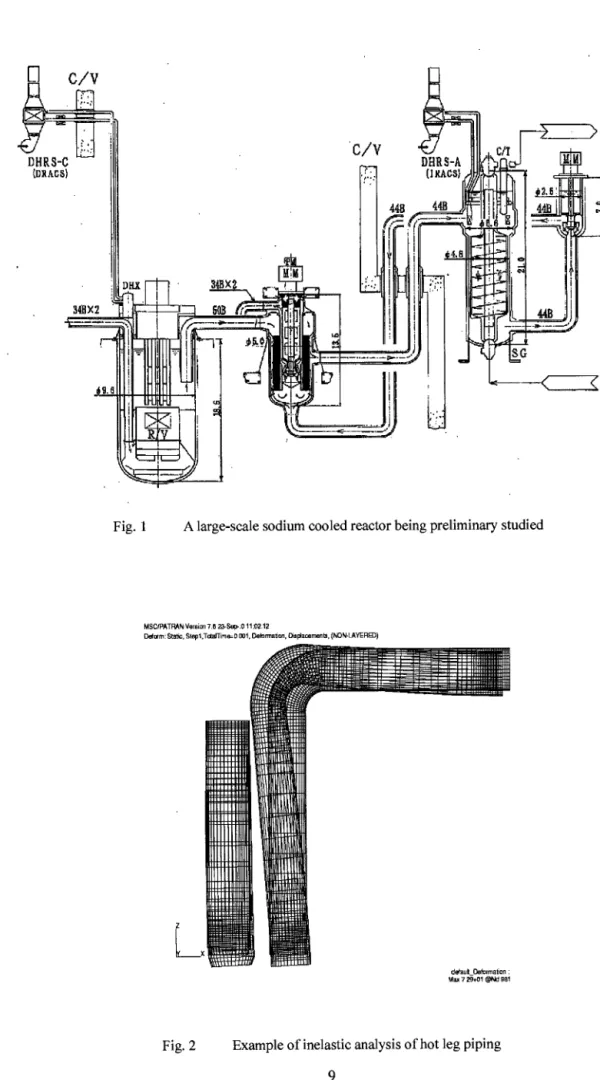
Because design analysis and evaluation is a core of structural integrity assessment, a detailed discussion is made in this chapter. The scope of the discussions in this chapter is limited to the design evaluation methods described in the conventional design standard such as the DDS. A sodium-cooled fast breeder reactor currently in the stage of design study was chosen as a model for analysis. Figure 1 shows the illustration of the plant. A reactor vessel and the primary coolant circuit were evaluated. Relatively high creep-fatigue damage was predicted by elastic analysis in some parts of those components. Table 1 summarizes the technical issues regarding structural integrity assessment that contribute to make this plant design even more cost-reduced.
Improvement of design analysis method
The current design standard for fast breeder reactors in Japan is the DDS (for the contents of the DDS, see reference [3]). Improvements needed on the DDS to realize the design study were suggested. These suggestions were classified into "short-term improvements", "mid-term improvements" and "long-term improvements", according to the amount and duration of necessary research and development.
1) Short-term improvements ('~ 3years)
• Adoption of inelastic analysis: By fully using inelastic analysis to assess strain range and creep behavior, eliminate excessive conservatism.
• Improvement of treating strain rate effect: In calculating fatigue damage, use a single fatigue curve corresponding to the strain rate of 0.1%/s; for slower strain rate, calculate creep strain separately.
• Revision of strain limit: Revise the strain limit from 1 and 2% for membrane strain and membrane plus bending strain to 2 and 4% respectively.
• Creep-fatigue evaluation of welded joint: Develop a creep-fatigue evaluation method for welded joints for an inelastic analysis result; multiply creep damage by 5 and 2 for 316FR and 12Cr steel, respectively
2) Mid-term improvements (~5years)
• Damage tolerance design: By defining the definition of failure precisely, allow limited depth of crack
• Abolition of strain limit: Because the strain limit is made from a functional basis, totally abolish this limit (Acceptance of strain must be decided on a functional basis by designers)
• Improvement of assessment of prevention of buckling: Develop an evaluation method based on inelastic analysis
3) Long-term improvements
• Improvement of damage tolerance design • Introduction ofprobabilistic evaluation
• Rationalization of material strength criteria based on long-term test data The items described above are summarized in Table 2.
Effect of inelastic analysis
One of the most important items for improvement is the use of inelastic analysis for providing a strain range and creep behavior. To show that inelastic analysis is a promising tool to validate a design that was not even allowed if elastic analysis was used, a series of analyses were performed.
1) Condition of analysis
316FR was used for the top entry design and 12Cr steel was used for the side entry design. Loading conditions were assumed as follows:
Service temperature: 550C Hold period per cycle: 1000h
Cycles: 300cycles
Weight: Earthquake: Thermal transient:
1750t for vessel
Neglected because it is small(seismic isolation is adopted)
Movement of sodium surface and thermal stratification were considered
Short-term improvements and mid-term improvements were applied to these designs. Items suggested for future improvement of the design method were:
• Inelastic analysis
• Strain rate effect in fatigue design diagram • Reduction of strain limit
• Damage tolerance design(mid-term improvement)
2) Result of analysis
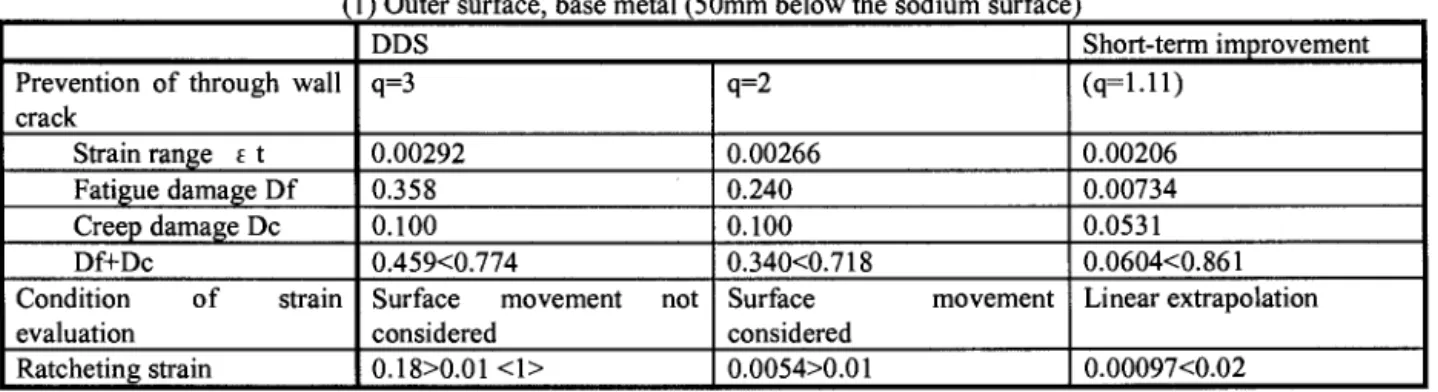
Table 3 summarizes the results of analysis for outer surfaces. The estimated creep-fatigue damage calculated following the DDS was below the critical value for base metal. For welded joints, creep-fatigue damage became larger than the critical value, because of the fatigue strength reduction factor for welded joints.
If we apply inelastic analysis ("short-term improvement"), the estimated strain range become smaller than the existing method, due to more accurate estimation of strain range and creep behavior. Moreover, the estimated fatigue damage became smaller due to the use of a fatigue curve corresponding to a higher strain rate of 0.1%/s. Therefore, the estimated creep-fatigue damage became smaller than the critical value and a reactor vessel could be made by welded plates. The "mid-term improvement" allows us to use damage tolerance design, which leads to further allowable strains and stresses.
For the limit of strain, thermal ratchet at the sodium surface level was assessed. The existing method gave an estimated strain of more than 0.5% and this lead to a strain beyond the allowable limit. The "short-term improvement" or "mid-term improvement" decreased the estimated strain by applying inelastic analysis and by expanding or abolishing the strain limit itself.
These assessments show that the existing method did not allow welded structure, but that the improved methods permitted it with margins. This makes it possible to remove the thermal liner at the inside of the reactor vessel and the use of welded structure instead of forged rings.
For piping, a detailed inelastic analysis was performed using a shell model. 12Cr steel was used for piping. Figure 2 shows an example of deformation of the piping when temperature is raised from 200 to 550C. Because yield strength of 12Cr steel is high, shakedown occurs in the second cycle, and the history of cyclic creep strain becomes identical to that of monotonic stress relaxation. Therefore, no ratchet strain was predicted. Moreover, the maximum creep strain was 0.4% at the surface of the elbow and 0.3% at the pipe end. This yields only small creep strain and the possibility of creep buckling is negligible. Comparing those results and inelastic analyses, we confirmed the effectiveness of the improved methods. D I R E C T I O N O F F U T U R E CODE
Overall
This chapter summarizes a new concept of structural integrity assessment method based on the discussions made in the previous two chapters. The main points with regard to the concept are as follows"
The method must give designers effective tools to resolve problems in making component design improved or innovative.
The method must allow designers to determine reliability that must be achieved for each component and must give methods to design accordingly.
The method must take into account of all the factors that can affect structural integrity, that is, postulated conditions for design, materials, design evaluation, preservice inspection, operation, inservice inspection, and maintenance.
The method must allow designers to use as many technologies as possible as design tools.
The method must allow designers to pursue as many possible design options as possible, so that they can choose the cost-minimum option among those that meet the reliability criteria.
Methodology
indicated by discrete points. The other candidate is to use safety factors that are closely related to failure probability.
A new structure of standards is also necessary to realize those methods. An example is a code system that consists of a supreme code and partial codes. The supreme code calculated failure probabilities and the partial codes provide necessary conditions regarding various factors such as material properties, design evaluation, fabrication, operation and maintenance.
The new system of standards must make it easer for users to adopt newly developed technologies that can contribute to cost reduction and the improvement of reliability.
CONCLUSIONS
(1) Innovative technologies that are considered to contribute to reduce construction and maintenance cost of a large-scale sodium cooled fast breeder reactor were widely surveyed. Among those were adoption of new materials such as 12Cr steel and inelastic analysis.
(2) The merit of using full inelastic analysis was shown using a reactor vessel and coolant piping of a large-scale sodium cooled fast breeder reactor now being preliminary studied.
(3) A new concept for structural integrity assessment code was suggested. It includes a new methodology that takes account of all the factors that can affect structural integrity in the stage of component design through calculation of reliability, and a new system that consists of a "supreme code" and "partial codes".
A C K N O W L E D G E M E N T
The authors are grateful to Mr. Tomomi Otani and Mr. Yoshiro Kamishima for performing finite element analyses and useful discussions.
R E F E R E N C E S
[1]
[2]
[3]
Kawasaki, N., Takakura, K., Ohtani, T., Hayashi, M., and Yamada, Y., Recent Design Improvements of Elevated Temperature Structural Design Guide for DFBR in Japan, Transactions of the 15th International Conference on Structural Mechanics in Reactor Technology, Volume IV (1999) 161.
ASME Boiler and Pressure Vessel Code, Section III, Subsection NH (1998)
0
O
0
0
c',l
6
"~
~
_~.
~
~~~
~~
,
"~
~
~
~
,
,
]~
~
~
.~
..
~~
~
°°
=~
<,
0
0
,~
,.4
~
"
°!
°~
!
°
°~.,~
!
!
0
o~
0
"i
6
o~-~
0
0
0
°~.,~
~_~
i
~
0
• ~
,,.~i
~
°~
0
6
~,
°
Table 3 Result of integrity assessment of reactor vessel
(1) Outer surface, base metal (50mm below the sodium surface)
Prevention of through wall crack
Strain range e t Fatigue damage Df Creep dama~;e De Df+Dc
Condition of strain
evaluation Ratcheting strain
q: elastic follow-up parameter DDS q=3
0.00292 0.358 0.100 0.459<0.774
Surface movement
considered 0.18>0.01 <1>
< 1 >" Does not meet the criteria
not q=2
0.00266 0.240 0.100 0.340<0.718 Surface considered 0.0054>0.01
movement
Short-term improvement ( q - l . l l )
0.00206 0.00734 0.0531 0.0604<0.861 Linear extrapolation
0.00097<0.02
Prevention of through wall crack
Strain range e t Fatigue damage Df Creep damage Dc Df+Dc
Condition of strain
evaluation Ratchetin~; strain
q: elastic follow-up parameter < 1 >" Does not meet the criteria
;) Outer surface, welded )oint (50mm below the sodium surface) DDS
q=3 q=2
Short-term improvement ( q = l . l l )
0.00292 0.00266 0.00206
1.079 0.744 0.0238
0.111 0.104 0.265
0.849<0.859 0.289<0.901
1.190 <1>
Surface movement
considered 0.18>0.005 <1>
Surface considered
movement
0.0054>0.005 <1>
not Linear extrapolation
m
c/v
iklt
DHR$-C(D~ACS)
•
. 3~X2 i ' " .-r
~~-i
6~,6 :. !_
_
Fig. 1
!
i
c / v
I
i I
i
I
! I
DHRS-A
(XRACS)
SG
i X
A large-scale sodium cooled reactor being preliminary studied
MSCIPATRAN Version 7.8 23-Sep-:O 11:02:12
Deform: Static, Stepl,Taal'l'ime= 0 001. Daformation, Displacerrmnta, (NON-LAYERED)
detau t Delmmation •
Max 7 ~,Ol @Nd gSl