Efficient Hybrid Algorithm for High Utility
Itemset Mining
Rahul Chavan, Chirantan Dhumal, Shivani Sawwalakhe, Shivani Patki, Sandeep M. Chitalkar
B. E Students, Department of Computer Engineering, Sinhgad Institute of Technology and Science, Narhe,
Pune, India
Professor, Department of Computer Engineering, Sinhgad Institute of Technology and Science, Narhe, Pune, India
ABSTRACT: Data mining is a computerized process of finding for models available in large data sets that involve processes at the intersection of the database system. The renowned problem of data mining is the extraction of high utility element sets (HUI) or, more formally, the extraction of public services (UI). The issue of HUI (set of elements of high utility) is mainly the introduction to the set of frequent elements. Frequent pattern mining is a widespread problem in data mining, which involves searching for frequent patterns in transaction databases. Solve the problem of the set of high utility elements (HUI) with some particular data and the state of the art of the algorithms. To store the HUI (set of high utility elements) many popular algorithms have been proposed for this problem, such as "Apriori", FP growth, etc., but now the most popular TKO algorithms (extraction of utility element sets) K in one phase) and TKU (extraction of elements sets Top-K Utility) here TKO is Top K in one phase and TKU is Top K in utility. In this paper, address previous issues by proposing a new frame work for k upper HUI where k is the desired number of HUI to extract. Extraction of high utility element sets is a common term. But we are using it while shopping online, etc. It is part of the business analysis. The main area of application is the analysis of the market basket, where when the customer buys the item he can buy another to maximize the benefit both the customer and supplier profit.
KEYWORDS: Utility mining, high utility item set, top k Pattern mining, top k high item set mining.
I.INTRODUCTION
1.1 Aim & Objective:-
1. The Execution time of Top K in One Phases is less than other Algorithms such as the Top K in Utility Phases. 2. The Result of TKO is less but result not Accurate.
3. The execution time of TKU algorithm is more but result is correct. It is very challenging issue how hybrid algorithm (TKO WITH TKU) is efficient than TKU algorithm. The time factor is very important in that.
II. RELATEDWORK
1. “Efficient tree structures for high-utility pattern mining in incremental databases:- ”. As of late, high utility example (HUP) mining is a standout amongst the most vital research issues in information mining because of its capacity to consider the non-paired recurrence estimations of things in exchanges and distinctive benefit esteems for each thing. Then again, incremental and intuitive information mining give the capacity to utilize past information structures and mining results with a specific end goal to decrease pointless counts when a database is refreshed, or when the base edge is changed. In this paper, we propose three novel tree structures to effectively perform incremental and intelligent HUP mining. The main tree structure, Incremental HUP Lexicographic Tree (IHUPL-Tree), is organized by a thing's lexicographic request. It can catch the incremental information with no rebuilding task. The second tree structure is the IHUP Transaction Frequency Tree (IHUPTF-Tree), which acquires a minimal size by organizing things as indicated by their exchange recurrence (slipping request). To diminish the mining time, the third tree, IHUP-Transaction-Weighted Utilization Tree (IHUPTWU-Tree) is planned in view of the TWU estimation of things in plunging request. Broad execution examinations demonstrate that our tree structures are extremely effective and adaptable for incremental and intelligent HUP mining.
2. “Mining high-utility item sets” Conventional affiliation run mining calculations just create a substantial number of exceedingly visit rules, yet these standards don't give helpful responses to what the high utility tenets are. We build up an original thought of best K objective-coordinated information mining, which centers around mining the best K high utility shut examples that specifically bolster a given business objective. To affiliation mining, we add the idea of utility to catch very attractive factual examples and present a level-wise thing set mining calculation. With both positive and negative utilities, the counter monotone pruning system in Apriori calculation never again holds. Accordingly, we build up another pruning methodology in view of utilities that permit pruning of low utility thing sets to be finished by methods for a weaker however hostile to monotonic condition. Our test results demonstrate that our calculation does not require a client determined least utility and thus is viable practically speaking
3. “Mining top-k frequent closed patterns without minimum support” In this paper, we propose another mining errand: mining top-k visit shut examples of length no not exactly min_/spl lscr/, where k is the coveted number of regular shut examples to be mined, and min_/spl lscr/is the negligible length of each example. An effective calculation, called TFP, is produced for mining such examples without least help. Two strategies, shut hub tally and relative total are proposed to viably raise bolster limit and prune tree both amid and after the development of FP-tree. Amid the mining procedure, a novel best down and base up joined FP-tree mining system is produced to accelerate bolster raising and shut incessant example finding. What's more, a quick hash-based shut example confirmation conspire has been utilized to check proficiently if a potential shut example is extremely shut. Our execution consider demonstrates that much of the time, TFP beats CLOSET and CHARM, two effective successive shut example mining calculations, notwithstanding when both are running with the best tuned min-bolster. Moreover, the technique can be reached out to create affiliation controls and to consolidate client determined requirements.
4. Mining frequent patterns without candidate Generation” Mining successive examples in exchange databases,
additionally long examples. In this investigation, we propose a novel continuous example tree (FP-tree) structure, which is an expanded pre xtree structure for putting away packed, critical data about regular examples, and build up an e customer FP-tree based mining technique, FP-development, for mining the total arrangement of successive examples by design part development. Exigency of mining is accomplished with three systems: (1) a huge database is compacted into a very consolidated, considerably littler information structure, which maintains a strategic distance from exorbitant, rehashed database examines, (2) our FP-tree-based mining receives an example section development technique to evade the expensive age of an expansive number of hopeful sets, and (3) a parceling based, isolate and-overcome strategy is utilized to break down the mining assignment into an arrangement of littler errands for mining con require designs in restrictive databases, which drastically diminishes the pursuit space. Our execution think about demonstrates that the FP-development technique is old and adaptable for mining both long and short regular examples, and is around a request of greatness speedier than the Apriori calculation and furthermore quicker than some as of late detailed new successive example mining strategies
5. Novel Concise Representations of High Utility Item
sets Using Generator Patterns” Mining unremitting cases in return databases, times Series databases, and various diverse sorts of databases have been inspected unmistakably in data mining research. A substantial segment of the past examinations get an Apriori-like candidate set age and-test approach. Regardless, candidate set age is as yet extravagant, especially when there existproli c outlines and moreover long cases. In this examination, we propose a novel consistent case tree (FP-tree) structure, which is a widened pre xtree structure for securing pressed, basic information about ceaseless cases, and develop an e client FP-tree based mining methodology, FP-advancement, for mining the whole course of action of relentless cases by configuration area improvement. Exigency of mining is refined with three frameworks: (1) a broad database is pressed into an exceedingly combined, altogether more diminutive data structure, which avoids over the top, reiterated database checks, (2) our FP-tree-based mining grasps an illustration piece advancement procedure to keep up a key separation from the costly age of a considerable number of candidate sets, and (3) an allotting based, parcel and-vanquish method is used to decay the mining errand into a plan of more diminutive assignments for mining con require outlines in prohibitive databases, which definitely diminishes the chase space. Our execution consider shows that the FP-improvement strategy is out of date and adaptable for mining both long and short progressive cases, and is around a demand of degree snappier than the Apriori count and besides speedier than some starting late uncovered new ceaseless case mining systems..
6. “Mining Top-K Sequential Rules”[6] Mining
consecutive decides requires determining parameters that are regularly hard to set (the negligible certainty and insignificant help). Contingent upon the decision of these parameters, current calculations can turn out to be moderate and create a to a great degree vast measure of results or produce excessively few outcomes, excluding significant data. This is a major issue in light of the fact that practically speaking clients have constrained assets for dissecting the outcomes and consequently are frequently just keen on finding a specific measure of results, and tweaking the parameters can be exceptionally tedious. In this paper, we address this issue by proposing TopSeqRules, an effective calculation for mining the best k consecutive principles from succession databases, where k is the quantity of consecutive guidelines to be found and is set by the client. Exploratory outcomes on genuine datasets demonstrate that the calculation has great execution and adaptability
7.“Direct Discovery of High Utility Itemsets without
keep up one of a kind utility information in the mining system by a novel data structure. Such a data structure enables us to figure a tight set out toward serious pruning and to direct perceive high utility itemsets in a compelling and versatile way. We furthermore enhance the capability inside and out by displaying recursive irrelevant thing isolating with small data, and a lookahead framework with thick data. Wide tests on insufficient and thick, designed and certifiable data prescribe that our count defeats the front line figurings in excess of one demand of enormity
8.“Mining High Utility Itemsets in Big Data" lately,
broad examinations have been led on high utility itemsets (HUI) mining with wide applications. Notwithstanding, the majority of them accept that information are put away in unified databases with a solitary machine playing out the mining undertakings. Thusly, existing calculations can't be connected to the huge information situations, where information are frequently circulated and too vast to be managed by a solitary machine. To address this issue, we propose another system for mining high utility itemsets in enormous information. A novel calculation named PHUI-Growth (Parallel mining High Utility Itemsets by design PHUI-Growth) is proposed for parallel mining HUIs on Hadoop stage, which acquires a few decent properties of Hadoop, including simple arrangement, blame recuperation, low correspondence overheads and high versatility. In addition, it receives the MapReduce design to segment the entire mining errands into littler free subtasks and utilizations Hadoop circulated record framework to oversee appropriated information with the goal that it permits to parallel find HUIs from conveyed information over numerous ware PCs in a dependable, adaptation to non-critical failure way. Trial results on both manufactured and genuine datasets demonstrate that PHUI-Growth has elite on vast scale datasets and beats cutting edge non-parallel kind of HUI mining calculations.
9.“Isolated items discarding strategy for discovering high
utility item sets”[9] Conventional strategies for the affiliation working of the mining and think about the presence of a thing in an exchange, regardless of whether it is obtained, as a twofold factor. Be that as it may, clients may buy more than one of a similar thing, and the unit cost may change among things. Utility mining, a summed up type of the offer mining model, endeavors to conquer this issue. Since the Apriori pruning methodology can't recognize high utility thing sets, building up a productive calculation is vital for utility mining. This investigation proposes the Isolated Items Discarding Strategy (IIDS), which can be connected to any current level-wise utility mining technique to diminish applicants and to enhance execution. The most productive known models for share mining are ShFSM and DCG, which work satisfactorily for utility mining too. By applying IIDS to ShFSM and DCG, the two techniques FUM and DCG+ were actualized, individually. For both manufactured and genuine datasets, exploratory outcomes uncover that the execution of FUM and DCG+ is more proficient than that of ShFSM and DCG, separately. Accordingly, IIDS is a compelling procedure for utility mining.
10. “ExMiner: An effective calculation for mining top-k
III. PROPOSEDSYSTEM
In the proposed framework, Mining is Major task in any Application and performances of mining with different Algorithms such one Phase and different phases. To Get High Utility item Set TKO and TKU with Parallel Mining. Two types of production calculations called TKU (extraction of sets of utility elements Top-K) and TKO (sets of themes of extraction Top-K are proposed in one phase) to extract these series of elements without the need to establish a utility minimum. But the TKO algorithm has the main disadvantage of not mainly accumulating the result of TKO given the value of the garbage in the set high utility items. The result of the TKU algorithm is increased but the execution time is high, so the alternative solution is to find the efficient algorithm in the proposed combination of the TKO and TKU algorithm system. It can be said that the result of TKO Top K in one phase is given at the entrance of TKU Top K in the utility result of TKO and TKU is increased and the execution time is low. In the proposed system, a new algorithm is generated for combining the name TKO and TKU as TKOWITHTKU or TKMHUI Top k Main set of utility elements. Mainly Generating New Algorithms which combine the one Phases with utility Phases to make efficient Algorithms
Advantages are:
1. Hybrid Algorithms is Proposed for mining complete set of top k HUIs 2. Min utility Set value is not fixed.
3. The proposed algorithm has less search space so it needs less memory 4. It scans the database only once
5. It is easy to implement
6. Its performance is good in dense databases
Module:
Module 1 - Administrator (Admin)
The administrator reserve database of the transactions made by customers. On the daily market basis analysis, each day a new product is let go, so that the administrator would add the product or items, and update the new product view the stock details.
Module 2 - User (Customer)
Customer can purchase the number of items. All the purchased items history is stored in the transaction database.
Module 3 - Construction of Up Tree
In Up Tree Dynamic Table is generated by algorithms. Mainly the Up growth is considerable to get the PHUI item set.
Module 4 TKO and TKU Algorithms
In Combination of TKO and TKU algorithms first the TKO (Top k in one phase) algorithms is called and then output of TKO is given as the input of TKU (Top k in utility phases) then the actual result is TKU Result.
Fig 1. System overview IV. RESULT
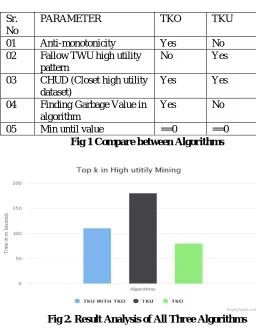
As a result, Top K Algorithm is applied in different data sets, such as data sets, such as mushrooms, chess and accidents with different k, respectively. In this graph TKUWITHTKO is the best performance among HUI top-k mining algorithms, in this TKO chart with TKU Spend 120 almost time-based for seconds to complete the mining process while REPT and TKU last longer than 160 seconds and TKO 70 seconds. In comparison, the TKO and TKU algorithms of the table are compared with various parameters, such as TWU and CHUD, and the Garbage Find values.
0 Sr.
No
PARAMETER TKO TKU
01 Anti-monotonicity Yes No 02 Fallow TWU high utility
pattern
No Yes
03 CHUD (Closet high utility dataset)
Yes Yes
04 Finding Garbage Value in algorithm
Yes No
05 Min until value ==0 ==0
Fig 1 Compare between Algorithms
Fig 2. Result Analysis of All Three Algorithms V.CONCLUSION
In this paper, we looked at the question of the best sets of high-use mining mines, where k is the coveted number of highly useful sets of things to extract. The most competent combination of TKO WITH TKU of the TKO and TKU calculations is proposed to extract such sets of objects without establishing utility limits. Instead TKO is the first single phase algorithm developed for top-k HUI mining called PHUI (high potential set of utility elements) and PHUI is given to TKU in the utility phases. Empirical evaluations on different types of real and synthetic data sets display the proposed algorithms have good scalability in large data sets and the performance of the proposed algorithms are close to the optimal case of the state of the combination of both phases in an algorithm.
.
REFERENCES
[1] C. Ahmed, S. Tanbeer, B. Jeong, and Y. Lee, “Efficient tree structures for high-utility pattern mining in incremental databases,” IEEE Trans. Knowl. Data Eng., vol. 21, no. 12, pp. 1708–1721, Dec. 2009.
[2] R. Chan, Q. Yang, and Y. Shen, “Mining high-utility itemsets,” in Proc. IEEE Int. Conf. Data Mining, 2003, pp. 19–26.
[3] J. Han, J. Wang, Y. Lu, and P. Tzvetkov, “Mining top-k frequent closed patterns without minimum support,” in Proc. IEEE Int. Conf. Data Mining, 2002, pp. 211–218.
[4] J. Han, J. Pei, and Y. Yin, “Mining frequent patterns without candidate generation,” in Proc. ACM SIGMOD Int. Conf. Manag. Data, 2000, pp. 1– 12.
[5] P. Fournier-Viger, C. Wu, and V. S. Tseng, “Novel concise representations of high utility itemsets using generator patterns,” in Proc. Int. Conf. Adv. Data Mining Appl. Lecture Notes Comput. Sci., 2014, vol. 8933, pp. 30–43.
[6] P. Fournier-Viger and V. S. Tseng, “Mining top-k sequential rules,” in Proc. Int. Conf. Adv. Data Mining Appl., 2011, pp. 180–194.
0 [8] Y. Lin, C. Wu, and V. S. Tseng, “Mining high utility itemsets in big data,” in Proc. Int. Conf. Pacific-Asia Conf. Knowl. Discovery Data Mining,
2015, pp. 649–661.
[9] Y. Li, J. Yeh, and C. Chang, “Isolated items discarding strategy for discovering high-utility itemsets,” Data Knowl. Eng., vol. 64, no. 1, pp. 198–217, 2008.