Non Linear Heat Transfer Analysis of IC
Engine Cylinder Block Using Finite Element
Method
Salman k1, Mr. Akhil Vinod V 2
P.G. Student, Department of Mechanical Engineering, Malabar College of Engineering, Thrissur, Kerala, India1
Associate Professor, Department of Mechanical Engineering, Malabar College of Engineering, Thrissur, Kerala, India2
ABSTRACT In internal combustion engines cylinder part is the heart of the engine and this cylinder block forms the walls of a combustion chamber where air fuel mixture burns. Due to this continues combustion process the cylinder walls subjected combustion zone and heat transfer takes place through the cylinder material. If the heat is not dissipated properly then it causes to development of detonation and it finally decreases the working efficiency of the engine, hence the heat removal rate from the cylinder is one of the important and interesting task. Mostly the heat transfer rate through the material is depends on the thermal conductivity of the material. Hence in this paper an attempt has been made to find out the thermal analysis of cylinder block with fins for different materials by using ANSYS, and the results has been analysed to find out the best material that gives the better heat transfer rate and consists of light weight and a possible replacement for the present one
KEYWORDS: cylinder block, aluminium alloy , Heat transfer rates, I. INTRODUCTION
have a huge potential to deal with the challenges of the future. Despite the green hype, internal-combustion engines will keep powering vehicles for the foreseeable future. Aim of this project is to make a comparative study of internal combustion engine having made of different metal composition under steady state condition and forced condition and to check the heat transfer rate of the internal combustion engine and to find out the material having maximum heat transfer rate. For this experiment 3 different internal combustion engine is is modeled using a CATIA V5 software, part modeling and surface modeling workbenches are used for the modeling of internal combustion engine. Analysis of internal combustion is done using Ansys 15 Workbench under different condition and graphs are plotted in order to determine faster heat removal . Transient thermal workbench is used for the analysis. By this project it is trying to prove that the possible replacement of traditional materials such as cast iron with aluminium alloys .
The main objective of this project is to find out a internal combustion engine with maximum heat transfer rate. internal combustion engines are a part of our daily life an attempt to improve the material used in its construction to enhance the heat transfer rate to avoid detonation and increase its working efficiency three models of internal combustion engines are modeled and are analysed under steady state and forced condition to determine the best one For this experiment of internal combustion engine with different geometry, the 3D model of the internal combustion engine is to be made with the software Catia V5 and the thermal analysis of the same model is done in Ansys 15 Transient thermal workbench.
II. RELATEDWORK
Presently cast iron is used in engine block construction. the heat removal rate from the cylinder is one of the important and interesting task. Mostly the heat transfer rate through the material is depends on the thermal conductivity of the material. Hence in this paper an attempt has been made to find out the thermal analysis of cylinder block with fins for different materials by using ANSYS, and the results has been analyzed to find out the best material that gives the better heat transfer rate and consists of light weight and a possible replacement for the present one .This work can be extended to areas where there is a need for high efficient internal combustion engine with higher heat transfer rate. Many future works are also possible in this work such as by making changes in the material composition , making changes in fins attached over the tubes to check the heat transfer rate. Few desirable properties of engine block material;
● It possesses tremendously elevated temperature stability. ● High thermal conductivity
● Low cost of material compared to traditional metallic materials ● It has excellent corrosion resistance.
III.MODELLING AND MATERIAL SELECTION
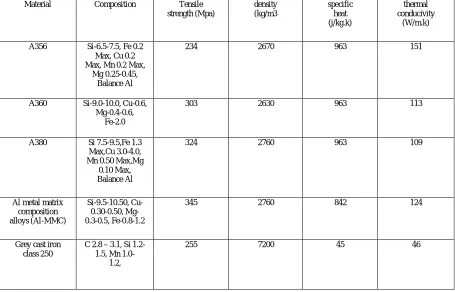
The internal combustion is formed by taking a dimensions from official site. The whole model is created in CATIA V5.five different materials (Aluminum alloy (A356,A360,A380,ALMMC,GCI) are also chosen to enhance the material properties
.
Material Composition Tensile strength (Mpa)
density (kg/m3
specific heat (j/kg.k)
thermal conducivity
(W/m.k)
A356 Si-6.5-7.5, Fe 0.2 Max, Cu 0.2 Max, Mn 0.2 Max,
Mg 0.25-0.45, Balance Al
234 2670 963 151
A360 Si-9.0-10.0, Cu-0.6, Mg-0.4-0.6,
Fe-2.0
303 2630 963 113
A380 Si 7.5-9.5,Fe 1.3 Max,Cu 3.0-4.0, Mn 0.50 Max,Mg
0.10 Max, Balance Al
324 2760 963 109
Al metal matrix composition alloys (Al-MMC)
Si-9.5-10.50, Cu-0.30-0.50, Mg- 0.3-0.5, Fe-0.8-1.2
345 2760 842 124
Grey cast iron class 250
C 2.8 – 3.1, Si 1.2-1.5, Mn 1.0-
1.2,
255 7200 45 46
Table 1 : Properties of materials used in analysis
IV.GEOMETRICAL MODELLING
V.
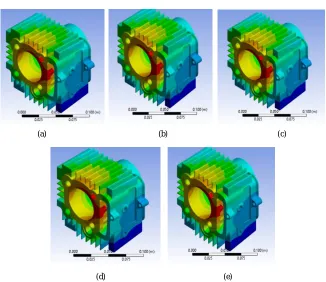
Fig. 2. Meshed model (a) supra 110(b)grevees 1520(c)greeves 3250
V. EXPERIMENTAL RESULTS
(a) (b) (c) (b)
(a) (b) (c)
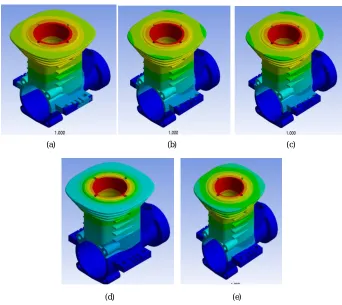
Fig. 4 temperature analysis Greeves 1520 (a) A319 (b) A356 (c) A360 (d) A380 (e)ALMMC (a) (b) (c)
(d) (e)
Fig. 4 temperature analysis Greeves 3520 (a) A319 (b) A356 (c) A360 (d) A380 (e)ALMMC
118000 120000 122000 124000 126000
128000
MAX HEAT FLUX
MAX HEAT
FLUX 108000
110000 112000 114000
116000
MAX HEAT FLUX
MAX HEAT FLUX
109000 110000 111000 112000 113000 114000 115000
116000
MAX HEAT FLUX
MAX HEAT FLUX
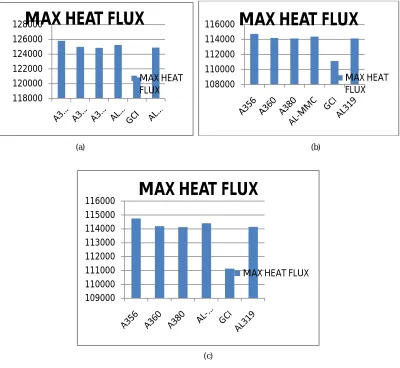
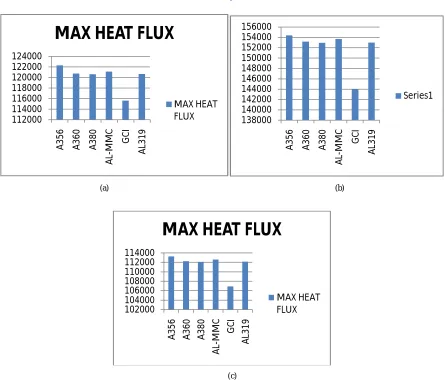
Fig. 5 heat flux graph under forced condition (a) supra 110 (b) Greeves 1520 (c) Greeves 3520
First the internal combustion engine is analysed using different aluminium alloy, grey cast iron under different condition. The below graphical representations and tables show the variation in heat transfer rates and heat flux. The heat flux transfer rates are analyzed and from graphical representation /m2K. graphs are plotted for heat flux and temperature maximum for the two condition one is steady state and air is forced over the surface body W/m2K.. under forced condition additional convective heat transfer occur over the fins as the as air is moving at speed of 45km/hr ( most economical speed cited by automobile makers) the graphs clearly shows that aluminium alloys has greater advantage over the cast iron variant in terms of heat removal from the internal combustion engines . in the graphs plotted A356 has slight advantage over other alloys in terms of heat transfer rate
VI. CONCLUSION
The performance of the internal combustion engine made A356 has a slight improvement in the performance of the internal combustion engine over other aluminium alloy . internal combustion engine made by aluminium alloys are a
112000 114000 116000 118000 120000 122000 124000 A 3 56 A 3 60 A 3 80 A L-M M C G C I A L3 1 9
MAX HEAT FLUX
MAX HEAT
FLUX 138000140000
142000 144000 146000 148000 150000 152000 154000 156000 A 3 56 A 3 60 A 3 80 A L-M M C G C I A L3 19 Series1 102000 104000 106000 108000 110000 112000 114000 A 3 5 6 A 3 6 0 A 3 8 0 A L-M M C G C I A L3 1 9
MAX HEAT FLUX
MAX HEAT FLUX
(a) (b)
transfer of the three internal combustion engine. The thermal analysis results give the idea about the heat transfer rate through the solid material when different materials are used . all the materials used for the analysis shows a promising alternative for the selected engines in thermal point of view . Thermal analysis results proved that A356 is better replacement for conventional materials used in ic engine cylinder block .after conducting the first analysis engine1 shows low heat flux value comparing with other two engines. Transient analysis output shows a more realistic values for heat flux and temperature distribution from the analysis following points are obtained
A356 is a better replacement for A319
TRANSIENT HEAT Conduction analysis shows more accurate than steady state analysisREFERENCES
[1] G. Babu, M. Lavakumar,Heat Transfer Analysis and Optimization of Engine Cylinder Fins of Varying Geometry and Material, Journal of Mechanical and Civil Engineering (IOSR-JMCE, Volume 7, Issue 4 (Jul. - Aug. 2013), PP 24-29
[2] P. Sai Chaitanya, B. Suneela Rani, K. Vijaya Kumar, Thermal Analysis of Engine Cylinder Fin by Varying Its Geometry and Material,, Journal of Mechanical and Civil Engineering, Volume 11, Issue 6 Ver. I (Nov- Dec. 2014), PP 37-44
[3] Angus, H. T. Cast Iron: Physical and Engineering Properties. BCIRA, 1960, pp. 126-134
[4] M. Azadi, M. Shariyat, Nonlinear transient transfinite element thermal analysis of thick-walled FGM cylinders with temperature-dependent material properties, Meccanica, Vol. 45, No. 3, 2010, pp. 305-318.
[5] Thornhill D. and May A., An Experimental Investigation into the Cooling of Finned Metal Cylinders in a free Air Stream, SAE Paper 1999-01-3307 (1999)
[6] Biermann E. and Pinkel B., Heat Transfer from Finned Metal Cylinders in an Air Stream, NACA Report No. 488 (1935)
[7] Zakirhusen, Memon K. and Sundararajan T., Indian Institute of Technology Madras, V. Lakshminarasimhan, Y.R. Babu and Vinay Harne, TVS Motor Company Limited, Simulation and Experimental Evaluation of Air Cooling for Motorcycle Engine, 2006-32-0099 / 20066599 (2006)