FLEXED TAIL I N THE MOUSE, MUS MUSCULUS HARRISON R. HUNT, RUSSELL MIXTER, AND DOROTHY PERMAR
Michigan State College,' East Lansing, Michigan
Received January 11, 1933
In January 1927 the writer found two albino males with markedly flexed tails. These tails were rigid a t the bends, so it was evident that vertebral fusions, or a t least some anatomical peculiarity other than muscular con- traction, was the cause. The mutation was found in a stock which had descended from animals supplied by Dr.
W.
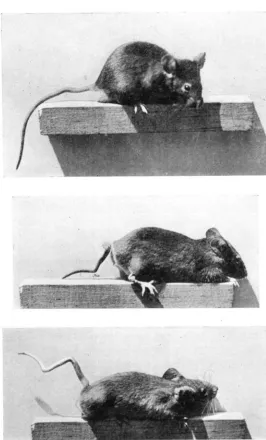
E. CASTLE of HARVARD UNI- VERSITY. The abnormal males were mated immediately with normal albino females, and a flexed tailed stock was started from the flexed animals of the Fz generation. The same mutation, or at least something resembling it in appearance, has been found in the colony several times since the original discovery.Subsequent experience has shown that the character flexed tail is highly variable (figures 1 and 2). As a rule there are one or more permanent angles in the tail, though sometimes as many as five. They may be acute, obtuse, or right angles, and are most frequent in the proximal half of the tail, though a t times one occurs near the tip. Rarely the tail turns sharply cephalad over the rump, then bends abruptly backward. This was the case in one of the two original mutant males, though, curiously enough, his numerous descendants rarely show this particular form of flexure. Curves of varying extent are sometimes found instead of the sharp angular bends, and spirals are fairly frequent. The latter are usually, but not always, near the base of the tail. They range from very tight close twists to widely open forms, and their direction is either clockwise or counterclockwise. In addition to being flexed, the tail is sometimes conspicuously shortened. The tail is usually very stiff where angles, curves, or spirals occur, and attempts to straighten it are likely to result in a break a t that point. Some- times there is no visible flexure, but palpation reveals rigid areas of varying extent. These stiff segments in straight tails may be so limited in length, and approach the normal so closely in flexibility, that considerable experi- ence is required to decide whether or not the animal should be classified as flexed. Thus flexed tails range from extremely contorted or shortened forms to normality, and individuals show a variety of combinations of the char- acteristics mentioned.
Flexed tailed animals would certainly be handicapped under natural Mr. MIXTER secured the data on inbreeding. Miss PERMAR'S contribution is noted in the text. Mr. HUNT planned and executed all the remaining experiments, and prepared the manu- script.
336 H. R. HUNT, R. MIXTER, AND D. PERMAR
REAR ?Inn
FLEXED TAIL I N THE MOUSE 337
conditions. The shredded paper bedding must be torn into short lengths, otherwise the hooked appendage of some of the mice gets hopelessly tan-
I
FIGURE 2.-Flexed tailed mice. The middle photograph shows marked shortening of the tail and a tendency to form a spiral at its base.
338 H. R. HUNT, R. MIXTER, AND D. PERMAR
Several other abnormalities appeared among the flexed tailed animals. They were obviously anemic a t birth. The blood was studied and the re- sults of this investigation will appear in a later paper. The right, left, or both eyes were closed in some cases. This frequently occurred among several young from the same mating, though the exact nature of the defect and its mode of inheritance were not investigated. Some flexed tailed mice showed a dorsal enlargement of the head in front of the ears, suggesting hydrocephaly.2 The desirability of concentrating our efforts upon the study of the complex phenomena of flexed excluded the analysis of these other traits. The eye defect particularly merits further study.
REVIEW O F LITERATURE
Several investigators have observed flexions in the mouse’s tail resem- bling, or identical with, our mutation. PLATE (1910) studied such a charac- ter, and found it to be hereditary. BLANK (1916, 1917) investigated the embryological development and morphology of bent tail in the mouse. His material consisted of
45
mutant mice from PLATE’S breed, together with 6 embryos from the uterus of a female. He found that a flexure was due to a lateral fusion between two adjacent vertebrae, which thrust the vertebral epiphyses with their growth zones, the intervertebral disc, and the vestige of the notochord toward the opposite side of the tail. The presence of a flexure demonstrated the existence of a fusion, but there might be a verte- bral union without a flexure. BLANK believed that the inheritance of bent tail did not follow Mendel’s Law, but his published quantitative data, as far as they go, support our contention that flexed tail is a simple Mendelian recessive character.DOBROVOLSKAIA-ZAVADSKA~A has reported variations in the tail of the mouse which were encountered in experiments designed to produce changes in the germ-plasm by means of X-rays. Two types were obtained: a waltzing mouse whose trait proved to be recessive, and a dominant short tailed type which continually mutated, producing tailless, filiform tailed, kinky or bent tailed, helicoid, e t cetera, variants.
DANFORTH (1930) observed kinky tails in a strain of mice having heredi- tary duplication of posterior parts (extra pair of hind legs, two rectums, two urethrae, two bladders, four kidneys, four gonads, four pubic bones, doubled intestine, bifurcated spinal cord, et cetera). A genetic explanation for this kinky tail was not offered.
MISS PERMAR’S EXPERIMENTS
Miss DOROTHY PERMAR (1928) began a study of the mode of inheritance of flexed tail during the fall of 1927 in the zoological laboratory a t MICHI-
2 Since the completion of this manuscript, F. H. CLARK at HARVARD has reported on the in-
FLEXED TAIL I N THE MOUSE 339
GAN STATE COLLEGE. Crosses were made between flexed animals to deter- mine whether the trait breeds true. Flexed and normal mice also were mated, and the resulting F1 generation bred F2’s.
Fourteen pairs of flexed animals produced 127 young, all of which were flexed tailed. I n two additional matings one parent was stiff tailed and the other flexed; all 10 young from these two crosses were flexed. Thus the flexed tailed character bred true, like a simple Mendelian recessive, and stiff tailed animals (those in which the tail was rigid in one or more places but did not show an angular bend) bred like the flexed animals.
Thirteen crosses were made between flexed tailed and normals. I n five of these crosses the male was the flexed parent and the female was normal. Eight reciprocal crosses also were bred. All the 142 F1 generation young had normal tails. Thus it appeared that the flexed character was recessive to normality.
Thirty matings between F1 parents produced an F2population of 1,065. I n most of these crosses both parents had been bred by the same pair of
Pi's, and frequently both the Fl’s of a pair came from the same litter. Nine hundred thirty-six of the Fz’s were normal tailed and 129 were flexed, a ratio of 7.26 normals to 1.00 flexed. The flexedxflexed and the flexed Xnormal matings gave results which were in perfect agreement with the hypothesis that flexed tail is a simple Mendelian recessive character, but the F2 distribution was decidedly inconsistent with this view. No other satisfactory genetic explanation was found, so that Miss PERMAR’S work failed to reveal the mode of inheritance of the flexed tailed mutation.
It was obvious that a fresh start was necessary. Certain facts discovered during Miss PERMAR’S work suggested why her F2 ratio deviated so mark- edly from 3 : 1. A flexed tail is rigid at and near the bends and sometimes the flexure is absent but the rigidity remains. Thus unless the tail were pal- pated i t might pass for normal. Furthermore, stiffened but flexureless tails occasionally have such exceedingly short rigid segments that a hasty examination might lead one to classify them as normal. The writer has found cases in which short rigid segments can be made pliable by gently bending them two or three times between the thumb and finger. Thus the flexed character grades into normality so perfectly that great care must
a h a y s be used in differentiating between a non-flexed but stiff tail, and
340 H. R. IITNT, R. MIXTER, AND D. PERMAR
A second complicating factor was the anemia of the newborn flexed. It was discovered late in Miss PERMAR’S work that there were anemic and normal blooded mice in the Fz litters. Mice are hairless a t birth, the only color they show being the red which is due to the blood. Anemics are easily recognized by a dilution of the red color. The flexure in the tail of the mutant type can usually be observed at birth, and the newborn ani- mals with flexed tails are anemic as a rule. It was conceivable that the anemia of the flexed tailed animals was so deleterious that their death rate during the first three or four weeks was much greater than the rate for their normal siblings. I n an F2 generation this differential death rate would give a marked excess of normals at the time of the final count, which was almost always between the twenty-first and twenty-eighth day after birth. This was the kind of result secured by Miss PERMAR. That hereditary anemia in mice can be a lethal agent was shown by Miss D E
ABERLE
(1927) who found that mice homozygous for the dominant white factor possess 25 percent as much hemoglobin and 14 percent as many red cells as normal mice, and that these anemics die within ten days after birth. Such con- siderations suggested that the flexed character could be the expression of a single recessive Mendelian factor, but that the deficiency of flexed animals in the Fz generation might be due to classifying a few flexed mice as normals and to a higher death rate among the flexed. The writer, there- fore, undertook a more critical and extensive reinvestigation of the ques- tion (HUNT 1932).FLEXED XFLEXED MATINGS
One of the most important things to discover about a mutation is whether i t breeds true. Mr:RussELL MIXTER attempted to isolate various grades of tail flexure in strains that would propagate true to form. The details of this experiment will be discussed later in the paper. Suffice i t to say at this point that seven grades were recognized, and that a line of in- breeding was started for each. I n every generation animals were mated which showed the original grade used when the line was started. The in- breeding experiment revealed, also, whether flexed X flexed crosses pro- duced anything but flexed progeny. Forty-nine such matings yielded 688 young, of which 584 were living three to four weeks later.
FLEXED TAIL I N THE MOUSE
r)
N
3
Q\
W v)
N
W m
N
N
10
3
d+
d+
h
10
2
0
G 2
X
2
ri E;
r)
cu
3
Q\
N
m
0
r- N
h W N
N
v)
2
h 3
3
v1 Y
e
342 H. R. HUNT, R. MIXTER, AND D. PERMAR
anemics on the day of birth. All the remaining 40 young were anemic, but 17 were short tailed, 16 were doubtfully flexed, 5 were apparently straight tailed, and 2 were recorded as straight tailed.
It has been mentioned that the tail may be straight and yet have stiff segments. Thus the form a t birth, at which time a stiff region would be difficult or impossible to identify, is presumably not a very reliable indica- tion as to whether the animal is genetically flexed. The condition of the tail can be more accurately determined at twenty-one to twenty-eight days, when the final counts and classifications of the young were made. At this time 537 had flexed tails of approximately normal length. The sexes approached a 1 : 1 ratio. There were, in addition, 32 females and 9 males with short flexed tails, 1 female with a short tail, and 2 females and 3
males with normal tails. Thus the flexedxflexed crosses bred 578 flexed animals (99.0 percent) and 6 non-flexed. Practically speaking flexed breeds true, but even such a small proportion of exceptions as 1 percent should not be ignored, so Mr. MIXTER applied the breeding test to these excep- tional animals.
Two of the normal males ( 3 1 2 5 and 3131) produced by the flexed Xflexed crosses were mated with flexed females. The parents of these males had relatively slight flexures (grades 1 and 2). Both were anemic at birth. Male 125 mated with flexed females 123 and 124 yielded 20 off- spring, all flexed a t birth. Of these 20, only one survived to twenty-one days, and a t that time i t was found to be flexed. Male 131 paired with flexed female 132 yielded 11 young which were flexed at birth. The four alive at twenty-one days were highly flexed.
The writer has discovered several normal tailed animals in the stock cages where the flexed strain is maintained. Presumably the parents of such animals were both flexed, for we are careful to exclude foreign stock. Five such mice were found in October 1929, 2 males and 3 females. One of these males was mated with the 3 females, producing 10 normal and 17 flexed offspring. Each female bore both types of young. If the male and the 3 females be regarded as heterozygotes carrying one gene for normal tail and one for flexed, then not many more than
7
(instead of 17) of the young should have been flexed tailed. The result is explicable, however, if we assume that the grade of flexure is determined by modifying factors. I n that case the normal tailed parents would be homozygous flexed, but the modifying factors would completely suppress the development of a flexure. Segregation of these modifiers would permit the flexure to appear on some of the progeny.FLEXED TAIL I N THE MOUSE 343
The second normal male which was found in the flexed stock cages was mated with 2 flexed females; 17 flexed offspring were bred.
It is regrettable that only 2 of the 6 non-flexed young recorded in table 1 could be tested genetically. The exceptional normal progeny of flexed
Xflexed crosses merit further study. Nevertheless Mr. MIXTER’S crosses, described above, strongly favor the view that such normal young are homozygous flexed animals in which flexure, or the equivalent stiffness of the tail without flexure, is suppressed by modifying factors, or by environ- mental agents, or by both. The same causes which inhibit flexure may be, a t least in part, responsible for the great variability in bent tails. It should be remembered in this connection that some stiff tailed animals, as has already been mentioned, approach the normal condition so closely that it is difficult to classify them. The normal offspring from flexed Xflexed matings may reasonably be regarded as completing the full range of varia- tion for homozygous flexed tailed mice. This range extends, therefore, from marked kinking and extensive rigidity to a completely normal somatic condition.
When Mr. MIXTER’S data on the offspring of flexedxflexed crosses are combined with Miss PERMAR’S, we find that such crosses bred 715 flexed and 6 non-flexed progeny. The conclusion may be drawn that the flexed tailed character breeds true as a rule, and that the few exceptional cases are conformable with the view that there is a single gene for flexed.
Mention has been made of eight crosses of short tailed flexedxshort tailed flexed. These are recorded in table 1. The tail of the short tailed mouse is less than half the length of the body. Is this short tailed condition inherited and is it caused by a gene or genes other than that for flexed?
344 H. R. HUNT, R. MTXTER, AND D. PERMAR
mice. On the other hand when a long tailed animal carrying some of the short genes happens to mate with another long tailed individual carrying different shortening genes, a few of the progeny will be shorts. The data, however, are not sufficient to establish the mode of inheritance of the short tailed condition. Further investigation is needed. Among other things variation in the length of flexed tails should be studied to determine whether Mr. MIXTER’S definition of the short tail is purely arbitrary. Also, if short tail is not due to the gene for flexed, short tailed non-flexed strains should be built up for genetic experimentation.
FLEXED XNORMAL MATINGS (pl’s)
If there were a single gene for the flexed character, it remained to be seen whether it was dominant or recessive to the normal straight and pliable condition of the tail. So flexed males were bred with normal females. Thirty-nine such crosses were made, and 53 litters containing 302 animals at the time of the final counting (21 to 28 days) were produced. Of these, 299 (162 males and 137 females) had normal straight tails, while 3 mice (1 male and 2 females) possessed flexed tails. These 3 flexed animals were the progeny of one female (HY15); the remaining 38 females bred normal young only.
Female HY15 produced 14 young, 1 2 of which survived to the time of the final count. The distribution at birth was as follows: 3 flexed anemics, 1 doubtfully flexed anemic, 8 normally red straight tailed, and 2 anemic straight tailed. The final count of her litters after weaning was
7
normal tailed males, 2 normal tailed females, 1 flexed tailed male, and 2 flexed tailed females, or a ratio of 9 normals:3 flexed. The fact that only 1 of the 39 normal females gave birth to flexed young marks her as unusual. There was something in her germ-plasm that was absent in the other mated females. She was undoubtedly heterozygous, carrying the recessive gene for flexed and its normal dominant allelomorph. The probability that this view is correct is supported by the fact that flexure has cropped out several times in different strains of our mouse colony.Miss DOROTHY PERMAR’S thirteen matings of flexed with normal tailed animals gave 142 offspring, all of them with normal tails. Adding Miss PERMAR’S data to those I secured from the 38 normal females gives a total of 432 normal tailed Fl progeny from the PI flexedxnormal crosses. Thus flexed is recessive to the normal condition.
THE BACKCROSS (F~XFLEXED)
346 H. R. HUNT, R. MIXTER, AND D. PERMAR
produced 112 litters comprising 863 young, of which 795 survived to the age of 21 to 28 days, when they were counted. The reciprocal cross involved
5
matings which bred 19 litters. Combining the data for the two types of crosses, the distribution of the young at birth was as follows: 344 anemic flexed tailed; 3 normally red flexed tailed (a type of considerable signifi- cance which will be discussed later) ; 78 anemic normal tailed; 499 nor- mally red normal tailed; 28 anemics and 11 normally reds whose tails were of intermediate or doubtful character.Mention may be made at this point of the frequency of anemia among these newborn mice, though we will return to the subject later. Of the 963 young, 450, or 46.73 f 1.09 percent, were anemics. If anemia were a simple Mendelian recessive we would expect about 50 percent of the backcross generation to be anemic. The actual percentage deviates from 50 percent by 3.27
5
1.09 percent, which is on the borderline of statistical signifi- cance.There were 386 of the newborn which were recognizably flexed tailed, intermediate, or doubtfully flexed. This was 40.08
k
1.07 percent of the whole. The appearance of a tail at birth, however, is an unreliable index to its real nature. One must wait until the skeletal elements are more fully formed before passing judgment, for, as has been pointed out, the tail of a partly grown mouse may be straight but as stiff in places as tails which show flexures. Also, a flexed tail may approach so closely to the normal structure that its nature is indicated in the mature mouse only by a very slight bend, or by a very short stiff segment, or both. Thus a more reliable classification of the tails can be made when the animals are three or four weeks old.The final count was when the young were 2 1 to 28 days of age. The nature of the tail is usually evident at that time. There were 333 clearly flexed (155 males, 178 females), 26 of intermediate or doubtful nature (13 males, 13 females), and 519 normal tailed (272 males and 247 females). The very slightly flexed (intermediate) and doubtful cases have been combined with the obviously flexed throughout the paper in computing the percentages of flexed animals. The flexed condition grades into nor- mality, SO it seems reasonable to classify the few doubtful cases as extreme variants of flexed. The percentage of flexed animals at the final count was 40.89 & 1.12 percent. This is not substantially different from the propor- tion of flexed animals a t birth, but perhaps the close agreement is merely a coincidence. A considerable number of young flexed animals may have died before the final count, the percentage being maintained by the later discovery of a sufficient number of stiff but straight tailed animals to hold up the percentage.
FLEXED TAIL I N THE MOUSE 347
character is semi-lethal, so that the death rate for young flexed tailed animals would be higher than for their normal siblings. If there were a re- cessive flexed gene, then we would find that the percentages of flexed animals in the backcross and the Fz generations would be less than the expected 50 percent and 25 percent. Such a differential death rate could operate before birth, after birth, or during both periods. The disturbing effect of postnatal deaths can be eliminated by using only those litters which contained the same number of young at the final counting as at birth-the undepleted litters. The effect of a differential prenatal death rate on the norma1:flexed ratio could be measured by determining the number of zygotes formed, then using only the litters which had been un- depleted by death within the uterus. This would have involved counting the corpora lutea in the pregnant females. Since this involves a time-con- suming and somewhat difficult technique we did not attempt it. How- ever, the disturbance caused by a prenatal differential death rate can probably be reduced by using only the large postnatally undepleted litters, and this we did, as will appear shortly.
There were 44 matings, producing 75 undepleted litters with a total of 539 young. As stated previously an undepleted litter was one in which no deaths occurred between birth and the final counting of the litter when it was three to four weeks old. The distribution of the young in these lit- ters is shown in table 2. If, as previously done, we class the 14 intermediate or doubtful cases with the flexed category, the percentage of the latter rises to 43.97
5
1.44 percent. Thus postnatal deaths decreased the per- centage of flexed animals by about 3 percent.The postnatal death rate among flexed animals in the 131 unselected litters was apparently rather high. 43.97 percent of the young in the un- depleted litters were flexed tailed. This percentage is based upon 539 animals and is therefore quite reliable. There were 963 on the day of birth in the unselected litters. If none of these young had died, there should have been about 423 flexed animals a t the final count when they were 3 or 4 weeks old (963X.4397). There were, however, 359 flexed young at this time, indicating that around 64 such animals must have died. This is a death rate of about 15.13 percent. Using these data, the computed death rate among the straight tailed young of the unselected litters was 3.89 percent. Thus deaths among the flexed were nearly four. times as fre- quent as among normals, proving our contention that there is a differential death rate in mixed litters. This matter will be considered again in con- nection with the Fz generation.
348 H. R. HUNT, R. MIXTER, AND D. PERMAR
such litters from 28 matings (table 2). These litters were probably fairly highly selected for a low prenatal death rate. The fact that they suffered from no postnatal deaths whatever suggests that they were relatively free from hereditary weaknesses, and that the mothers were in good health during gestation as well as when nursing. Such conditions should have re- duced the prenatal deaths. Also, selecting litters of average size (7) and larger undoubtedly eliminated some in which a considerable proportion of the fetuses died.
If using these large undepleted litters eliminated all prenatal deaths, and if there is a single recessive flexed gene present in all the Fl’s, then these backcross litters should have contained approximately 50 percent of mutant animals. It is unlikely that there were no prenatal deaths, but they were probably few, and in this case nearly half the young should be flexed if there is a recessive gene for flexure. A hypothetical example will illustrate the point.
Suppose 2,000 zygotes are formed, half of them heterozygous for flexed and half homozygous. Assume that the prenatal death rate is low, say
5 percent. There will be 100 deaths. If, as in the first two or three weeks after birth, about four times as many flexed as normal zygotes die, then approximately 80 of these dead fetuses will be flexed and 20 normal. Thus a t birth the litters will contain 920 flexed and 980 normals, and the per- centage of the former will be 48.42 percent.
Let us now turn to the facts. The 43 undepleted litters containing
7
or more each produced 383 animals, of which 176 were flexed, 198 normals, and 9 had tails which were intermediate or of doubtful nature. If we in- clude the 9 intermediate or doubtful cases with the flexed, the percentage of these in the backcross litters becomes 48.30k1.72 percent. This is in close agreement with what one might expect with a low prenatal death rate, considerably higher among the flexed than the normals, if there is a recessive gene for flexed.The above is 7.41 52.05 percent higher than the frequency of flexed (40.895 1.12 percent) in the unselected litters. This difference is 3.6 the size of its probable error and is therefore statistically significant.
FLEXED TAIL IN THE MOUSE 349
GENETIC CONSTITUTION OF THE STRAIGHT TAILED PROGENY OF
THE F1XPLEXED CROSSES
If there is a recessive gene for flexed, then the normal young produced by the FIXflexed crosses should be heterozygous for flexed, and should therefore breed like Fl’s. The constitution of these normal tailed mice can be tested by crossing them with flexed animals. If F be the symbol for the normal gene, and
f
for the flexed, then the following describes the process :P1 generation: FF Xff F1 generation: all Ff Backcross : Ff X
ff
Progeny of the backcross : Ff (normal)
+
ff (flexed).If the Ff, normal tailed, offspring of the backcross were mated, they should give practically the same results as though the Fl’s were sub- stituted for them. Such an experiment was carried out by crossing 76 nor- mal tailed female offspring of the FIXflexed matings with flexed males. The results are summarized in table 3, where comparisons are made with the FIXflexed matings. Seventy-nine litters were secured. As a rule only one litter was bred by each female. The primary object of the experiment was at first to determine whether any of these somatically straight tailed females were homozygous for the flexed factor. Therefore, as soon as a female was found to produce both normal and flexed young she was no longer used.
TABLE 3
Comparisons between the progeny of the F1 Xflexed crosses and the progeny of the crosses (straight tailed female offspring of FIXfEexed) Xflexed.
PROQENY OF: PERCENTAQE OF:
FIXFLEXED (NORMAL TAILED FEMALE OPF- BPRINQ OF FIXFLEXED) x
FLEXED
Flexed tailed young at birth
Flexed tailed young at the final counts Flexed tailed young in undepleted litters Flexed tailed young in undepleted litters where
the litters contained 7 or more young Anemic young at birth
Anemic young at birth in litters of 7 or more
40.08 k 1.07 44.07 k 1.54 (472 young) 40.89 1 .12 39.07 t 1 .67 (389 young) 43.97 rt 1 . 4 4 43.01 k 2.45 (186 young) 4 8. 30 ,l . 72 4 7. 06 k4. 08 (68 young) 4 6. 73 k 1.09 44.91 k 1.58 (452 young)
animals 47.21 k 1.29 45.88 k 2.41 (194 young)
350 H. R. HUNT, R. MIXTER, AND D. PERMAR
mated with flexed males produced 472 young, of which 44.07 percent were recognized as flexed a t birth. The corresponding figure for the progeny of FIXflexed experiments was 40.08 percent. When the final counts were made at 21 to 28 days, 39.07 percent of the 389 young from the normal tailed females were found to be flexed as compared with 40.89 percent for the backcross progeny. Undepleted litters (those in which there were no deaths between birth and the final count) yielded about 43 percent of flexed animals in both experiments. Undepleted litters of
7
or more young contained 48.30 percent of flexed animals in the backcross experiment, and 47.06 percent in the other. The frequency of anemia also was about the same in the two series. The percentage of flexed animals in the progeny of the FIXflexed matings is not significantly different in any of the six com- parisons from the percentage of flexed among the offspring of the normal females produced by the FIXflexed pairs. This is obvious when one in- spects the differences and probable errors in table 3.The normal tailed daughters of FIXflexed crosses therefore breed like F, animals, and this is exactly the result to be expected if there is a reces- sive flexed gene. The data of table 3 therefore furnish one more link in the chain of evidence that flexed is a simple recessive Mendelian character. Mention has been made of the fact that the original purpose of this ex- periment was to determine whether somatically normal tailed animals might not be homozygous for flexed. Environmental factors in embryonic development might, conceivably, prevent permanent fusions between caudal vertebrae. If such an event occurred fairly frequently, the result would be a deficiency of flexed animals such as was found in the backcross litters. Since flexedxflexed matings yield almost nothing but flexed young, a homozygous flexed female whose tail appeared normal might be expected to produce none but flexed tailed offspring when mated with a flexed male. As a matter of fact only one of these 72 females that gave birth to litters had only flexed young; all the remaining 71 produced both flexed and nor- mals. The exceptional female gave birth to 6 flexed animals in one litter, 3 of which survived. She had two small litters later, but all these infants were born dead. This female may have been heterozygous for flexed rather than homozygous, for the production of 6 flexed young when a heterozy- gote is bred with a flexed mate should occur about once in 64 times. Somatically normal but genetically homozygous flexed mice can not be numerous enough to account for all the shortage of flexed animals in our experiments.
THE Fz GENERATION
FLEXED TAIL I N THE MOUSE 35 1
mechanism of inheritance. As Miss PERMAR’S work progressed several sources of error became evident which, i t was thought, might account for the marked deviation from a 3.00: 1.00 ratio. For example, it is probable that some straight tailed animals having stiff caudal segments were er- roneously classified as normals. The practice of palpating the tail to locate stiffened sections began after the investigation was well advanced. Also, i t was not realized at the outset that extreme variants of the flexed can scarcely be distinguished from normal tailed mice. This fact, too, was brought out when we began to palpate carefully all apparently normal tails in generations that produced both flexed and normal animals. So the writer repeated the experiment, starting from the beginning with fresh pairs of
Pi's.
Three flexed tailed males were mated with normal females from our laboratory stocks. Each male was confined in a cage with 6 females, so that there were 18 PI crosses in all. The Fl generation has already been discussed. The distribution of the Fz young is shown in table 4. Forty-four F1 matings bred 206 Fz litters containing 1478 young on the day of birth. The condition of the tail in some of these new-born mice was, as in the previous experiments, difficult to determine, so that a considerable number were classified as “intermediate or doubtful.” Whether the animal was nor- mal blooded or anemic was likewise problematical in over 2 percent of the cases. If the intermediate or doubtful cases are combined with those that were certainly flexed, there were 289 flexed and 1189 normal tailed, a ratio of 4.11 normals:1.00 flexed, or 19.55f70 percent flexed. Three hundred and ten of the new-born mice were certainly anemic and 1136 clearly normal blooded, as judged by the redness of the mouse. Thus there were 3.66 normally red animals: 1.00 anemic, or 21.44 .73 percent of the young, exclusive of the doubtful cases, were anemics.
The discussion of the backcross experiments brought out the fact that the classification of tails soon after birth can not be very reliable because the only criterion for flexure at that time is external appearance. The dis- tribution of F2’s at the final count (when the mice were 21 to 28 days of age) is shown in table 4. We assume that the intermediate or doubtful cases were usually extreme variants of flexed in the direction of normality. Combining them with the flexed, there are 213 flexed and 1104 normal tailed animals, which make a ratio of 5.18 normals: 1.00 flexed, and 16.17 f . 6 8 percent of flexed tailed mice. This is a wide departure from the 25 percent for a Mendelian character in an F2 generation, so i t is necessary to determine whether here also a higher death rate among the flexed than for the normals may have caused a deficiency of flexed.
352 H. R. HUNT, R. MIXTER, AND D. PERMAR
,a
e
6 na
U
0
w
P
B G
g s
b B
FLEXED TAIL IN THE MOUSE 353 birth and the final counting a t three to four weeks of age. Thirty-nine FI matings produced 114 Fz undepleted litters containing 795 animals. Of these, 127 were certainly flexed and 15 intermediate or doubtful, making 142 to be reckoned as flexed if we follow the plan of regarding as flexed all animals that are not clearly normal tailed. There were 653 normal mice, which gave an Fz ratio of 4.60 normals: 1.00 flexed, or 17.86
f
.92 percent of flexed tailed mice in the undepleted Fz generation. This was an increase of 1.69 percent over the percentage of flexed for the entireFZ
generation (depleted plus undepleted litters), but the increase was not statistically significant, though it is important to note that when all possible disturbing effects of a differential postnatal death rate were removed, the percentage of Fz flexed animals moved toward 25 percent.The attempt was then made to eliminate not only the postnatal, but a t least part of the prenatal deaths as well. It will be recalled that the same object was sought in analyzing the backcross generation. Table 4 gives the types of young in undepleted litters which contained
7
or more animals each. There were 34 such F, matings which bred 73 Fz litters containing a total of 595 young. There were 102 clearly flexed tailed, and 9 inter- mediate or doubtful animals, making a total of 111 which we reckon as flexed, while the normal tailed numbered 484. The Fz ratio for these ani- mals was 4.36 normals: 1 .00 flexed. The percentage of flexed animals roseto 18.66 1.28 percent over
the 16.175.68 percent of flexed animals for the whole unselected
FZ
population. This difference was only 1.9 times its probable error. Even though eliminating all of the postnatal and part of the prenatal deaths did not cause a statistically significant increase in the percentage of flexed animals, yet there was an increase of noteworthy size, and to this extent the facts lend support to the view that a differential death rate is one of the causes for the frequency of flexed animals being considerably below 25 percent.
The probable effects of the differential death rate are shown by the fol- lowing computations. There were 17.86 percent of flexed animals in the undepleted
FZ
litters a t the final count. It is possible that if all the 1478FZ
young, that is all the mice born in the Fz generation, had survived to the age a t which the animals were finally counted (3 to 4 weeks), about the same percentage of flexed mice would have been found among them. I n other words there would have been approximately 264 (1478x
.1786) flexed tailed individuals. There were actually only 213, so that something like 51 flexed animals (264-213) probably died. This was a death rate of 19.32 percent for the young flexed animals. If there were 264 flexed young among the newborn, then there were 1214 normal tailed animals a t that time. This number had fallen to 1104 when the young were 21 to 28 days354 H. R. HUNT, R. MIXTER, AND D. PERMAR
old, a decrease by death of 110 animals, or a death rate of 9.06 percent. Thus it appears plausible that the mortality rate was about twice as great among the animals with the defective tails as among the normals.
Possibly the undepleted litters were selected to some extent for a low percentage of flexed animals. If flexed animals have a higher death rate than normals, then there is more likelihood of deaths occurring in litters having a relatively large number of flexed animals than in litters having fewer flexed. Thus it may be that if no deaths had occurred among our whole
Fz
population, we would have found considerably more than 17.86 percent of flexed mice a t the final count.The data suggest modifying factors. When death rates were materially reduced the percentage of flexed animals in the
Fz
generation fell below 25 percent by 6.34 percent, while in the backcross generation (table 3) the percentage of flexed was only 1.70 percent less than the expected 50 percent, and among the progeny of matings between flexed males and normal tailed daughters of the FIXflexed cross the percentage of flexed was only 2.94 percent less than 50 percent. The hypothesis of modifying factors fits the facts fairly well. The Fz flexed animals all had 2 flexed grandparents and 4 flexed great-grandparents. The progeny of the F1 Xflexed crosses had a flexed parent, 3 flexed grandparents, and 6 flexed great-grandparents. The young of the matings between flexed males and normal daughters of the FIXflexed crosses each had one flexed parent,3 flexed grandparents, and 6 flexed great-grandparents. A greater concen- tration of flexed tailed germ-plasm is thus associated with a closer ap- proximation to the percentages one should get if flexed is a simple reces- sive. This fact supports our theory that flexed is such a character, but that other genes, which are few or absent in decidedly flexed animals, may modify the character, or even suppress it altogether if enough of them are present. The conception of modifying factors finds further support in the fact that flexed is a highly variable trait which ranges all the way from very extreme forms to normality itself.
FLEXED TAIL IN THE MOUSE 355
the males were decidedly in the minority among the flexed animals bred by three of the four crosses mentioned above, so there are grounds for SUS- pecting that there is some factor (or factors) among flexed mice that modifies the sex ratio and that such an influence is not found among nor- mal animals. Perhaps flexed males have a higher death rate than flexed females.
INHERITANCE O F T H E GRADE O F F L E X U R E
The fact has been emphasized that the flexed character is highly varia- ble. There are spirals, tails with one or more angles of varying magnitude, straight tails with stiff segments, and finally occasional individuals that appear normal. Variability is of the continuous type. It was shown earlier in the paper that abnormal shortness of the tail in flexed mice is probably inherited. If this modification is determined by genes other than the flexed gene, the suspicion is aroused that perhaps all variations in flexure are more or less hereditary. This possibility was tested experimentally.
Before such a study could be undertaken i t was necessary to devise a system for classifying the degrees of flexure. Since variability is strictly continuous and sharp natural boundaries between different grades do not exist, the system was necessarily somewhat arbitrary. Three fundamental characteristics could be used: (1) length, (2) the percentage of the length which was rigid, and ( 3 ) the number and magnitude of the angles. The short tailed condition has been shown to be probably hereditary, so it need not be considered further. The system of grading adopted was based on the number and size of the angles, and upon stiffness where angularity was absent or slight. Other, perhaps equally valid, criteria could have been used.
The scheme for defining the different grades was as follows:
Grade 1. No, or almost no, visible flexure. Stiffness might easily be de- tected in the tail when it was bent a little and passed between the thumb and index finger, or the stiffness might be slight. Doubtful cases were in- cluded in this group, that is those in which flexure, or stiffness, (or both) was so slight that i t was difficult to classify them with certainty either as normal or flexed animals.
Grade 2. Characterized by one slight but well defined flexure in the tail.
Grade 3 . Two or more slight flexures.
(A “slight” flexure was arbitrarily defined as one a t which the distal segment was deflected by 30” or less from the axis of the adjoining proxi- mal segment. If this angle was greater than 30” the flexure was “pro- nounced”.)
356 H. R. HUNT, R. MIXTER, AND D. PERMAR
Grade
5.
Two or more pronounced flexures.Grade 6. The flexure assumed the form of a spiral-a “corkscrew tail.” If the type or degree of flexure is inherited, that is, if there are factors other than the flexed gene itself which determine the form of the tail, then one might expect the following: (1) The flexed animals in the Fz generation from a P1 cross of flexedxnormal might have tails resembling that of the flexed Pl ancestor; and the same thing could be true of the flexed individ- uals produced by a cross between Fl’s and a flexed, providing the flexed parent and grandparent were of the same, or nearly the same, grade of flexure. It is conceivable, of course, that in such experiments genes from the normal Pl’s might neutralize the effects of specific modifiers from the flexed ancestry. (2) If close inbreeding were carried on within each of the grades of flexure defined above, strains should be secured which would breed approximately true for the grade in question. ( 3 ) Finally, there should be a positive correlation between the grades of parents and off- spring.
Each of these three tests for modifiers was applied. The Fz flexed ani- mals derived from the PI crosses flexed $ Xnormal 9 were graded by the system for tail classification just outlined. There were 207 Fz flexed mjce which descended from three mutant P1 males, all of grade
5.
The distribu- tion of these flexed Fz’s was as follows :GRADE OF FLEXURE 1 2 3 4 5 6
-
Number of Fz flexed mice 34 37 29 55 41 11
The above data seem to indicate that the degree of flexure is inherited, for the mode was at grade
4,
and the second largest class was grade 5, while the flexed grandfathers were of grade 5. Such a conclusion is not to be drawn, however, without further investigation, for as will be shown shortly by the results of breeding mutants with one another, the modal grade among the offspring was5,
whether the parents showed a high or a low grade of flexion. Thus Pl parents of grades 2 or 3 might have had FZ descendants whose mode was at4
or 5. An explanation will be offered later for this peculiarity in the inheritance of flexed tail.FLEXED TAIL IN THE MOUSE 357
TABLE 5
~~
FLEXED KALE ANCE8TOR8 GRADES OF BACKCROGB FLEXED OFFSPRINQ MEAN
1 2 3 4 5 6 GRADES OF FATHER QRANDFATHER OFPBPRINQ
NUMBER8 OF OFPBPRING
~
6 6 (grade 3) 9 8 7 2 0 3 0 8 3.95
5 5 (grade4+) 1 3 3.25
1 1 (grade 5 ) 2 1 3 5 8 3.84
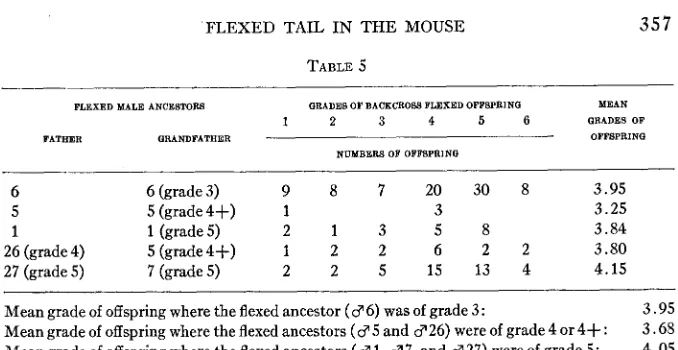
26 (grade 4) 5(grade4+) 1 2 2 6 2 2 3.80 27 (grade 5 ) 7 (grade 5 ) 2 2 5 1 5 1 3 4 4.15
Mean grade of offspring where t h e flexed ancestor ( 3 6) was of grade 3: 3.95 3.68 4.05 Mean grade of offspring where the flexed ancestors ( 3 5 and $26) were of grade 4 or 4+:
Mean grade of off spring where the flexed ancestors ( 3 1, 3 7, and 3 27) were of grade 5 :
It is obvious that table 5 furnishes no satisfactory evidence that the grade of flexure is influenced by genes, though the normal blood in these flexed animals may have prevented such factors from manifesting them- selves.
Close inbreeding was finally used to determine whether the grade of flexure was inherited. Mr. RUSSELL MIXTER collected all the data in this part of the investigation. His inbreeding experiments began late in June 1929, and continued until July 1930. If genetic factors determine the extent of flexion, then by mating animals of about the samegrade, select- ing siblings of this grade from among their progeny and mating them together, and continuing this process for several generations, one should be able, in some lines a t least, to evolve a strain of flexed mice which varies within relatively narrow limits around the grade selected in each genera- tion. This would be due, of course, to increasing homozygosity.
Mr. MIXTER started this experiment with 32 females, representing all the grades of flexure which have been described, each female being mated with a male of her own kind. Table 6 shows the numbers of animals,
TABLE 6
Numbers of individuals mated i n successive generations of the inbreeding experiment.
QRADES OF INDIVIDUAL¶ MATED
~ _ _ _ -
QENERATIONB -_____
6 SHORT TAILED
1 2 3 4 5
358 H. R. HUNT, R. MIXTER, AND D. PERMAR
of the same grade. The matings for grades 3,
4,
5 , 6, and the short tailed type each consisted, likewise, of 5 females and 1 male. Two grade 2 females were bred with a single male of that type. Thus there were 32 crosses in the first generation. It has been emphasized that the classification of the grades of flexure is arbitrary, that these grades are not separated from one another by natural gaps, but that variability is continuous. Perhaps the short tailed type shows fewer intergrades than any of the others. Mr. MIXTER defines it as having a tail which is less than half as long as the body.The mating cages of the inbreeding experiment were inspected twice a week to discover pregnant females, which were isolated. The litters were observed every three days to make note of deaths. The young animals were weaned and usually classified when 21 to 25 days old, and one or two drawings of each tail were recorded. From among the offspring, mice of the same grade of flexure as the parents were chosen to breed a new generation. The members of the first generation were selected from our stock cages, and were but remotely, if a t all, related, but in later genera- tions the matings were always between siblings.
Mr. MIXTER was unable to develop pure lines of flexed animals because breeding practically ceased in all seven lines in the second or third genera- tion. Several difficulties were encountered. Sometimes he obtained males whose tail structure made them eligible for breeding, but no sisters of the same grade were born, and vice versa. Our laboratory stock of flexed ani- mals seemed, on the whole, to propagate less rapidly than normal mice, so only what appeared to be healthy animals were selected for inbreeding, and for this reason fewer matings than possible were made. The experi- ment automatically terminated at the third generation, for the third gen- eration animals practically ceased breeding. Whether this was due to in- creasing sterility, to miscarriages, or to the females’ inability to bear young as a consequence of malformations of the pelvic girdle, we do not know. The harmful effects of this limited course of inbreeding, combined with the inferior reproductivity of the flexed stock, are probably sufficient to account for this result. The inbreeding must have been an important factor in suppressing reproduction, for only one of the 32 females of the first generation was sterile.
FLEXED TAIL I N THE MOUSE 359
mal is mated with a normal one, the Fz flexed descendants might con- ceivably receive modifying genes not only from the flexed P1 ancestor, but from the normal one also. The genes from the latter might partly or completely neutralize the effects of modifiers from the flexed PI, so that the resemblance between the P1 and Fz flexed mice would be very much reduced. The same criticism would apply to a lesser extent if a correlation be sought between the flexed animals of a backcross generation (pro- duced by F, Xflexed matings) and their flexed ancestors.
Table
7
is a summary of Mr. MIXTER’S inbreeding work. The left half of the table shows the results of mating the first generation animals, which were selected from the stock cages. The right half records the con- sequences of inbreeding the second generation. Table7
reveals some very interesting facts. No grade of flexure bred true; in fact if the offspring of the first and second generation crosses are combined, i t is found that in four of the seven types of matings (grades 1,2,
4, and 5) the progeny in- cluded all grades of tail flexure. Five hundred and sixteen animals con- stituted the second and third generations, and of these, 248 (48.1 percent) were classified in grade5.
This conspicuous placement of the mode at 5 was found among the offspring of all the types of crosses where the num- bers were fairly large. The heaping up of nearly half the young in one grade suggests that it may have included more genotypes than any of the others, and that more than one grade might well have been created from grade 5. The relatively high percentage of short tailed progeny from crosses of short tailed animals is conspicuous. The short tailed crosses listed in table7
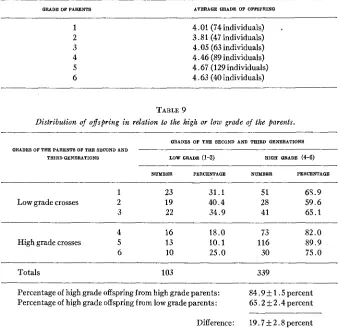
produced 58 young, 23 of which were short tailed (39.7 percent). Among the 458 young bred by all the other crosses, only 16 (3.5 percent) were short tailed, and 1 2 of these were the offspring of the grade 5 cross. As has been previously stated, the evidence indicates that the short tailed con- dition is inherited.Tables 8 and 9, particularly the latter, indicate that hereditary factors are involved in determining the extent of flexure. Table 8 shows the mean grades of the inbred flexed offspring produced by different grades of parents, the short tailed parents and their progeny being excluded. Parents of grade 1 bred 74 individuals having an average grade of 4.01. The rating of the offspring rose slightly and irregularly as the level of the parents increased to 6.
More striking evidence of factors modifying the degree of flexure is found in table 9, where parents and offspring are classified as (‘low grade” (grades 1-3) and ‘(high grade” (grades 4-6). 84.9
A
1.5 percent of the off- spring of “high grade” parents were themselves “high grade,” while only 65.2 _+ 2.4 percent of the young of (‘low grade” parents were “high grade.”FLEXED TAIL I N THE MOUSE 361 progeny than did “low grade” parents, and this difference can scarcely have been due to random sampling, for it was seven times as large as its probable error. Thus i t is evident that though the more extreme degrees of flexure did not breed true, yet they produced a higher percentage of markedly flexed off spring than the less pronouncedly flexed parents.
TABLE 8
Average grades of the inbred fEexed tailed ofspring of the second and third generations produted by the diferent grades of fiarents. The short tailed parents and ofspring are excluded.
GRADE OF PARENTS AVERAGE QRADE OF OFFSPRINQ
1 4.01 (74 individuals) I
2 3.81 (47 individuals)
3 4.05 (63 individuals)
4 4.46 (89 individuals)
5 4.67 (129 individuals)
6 4.63 (40 individuals)
TABLE 9
Distribution of ojspring in relation to the high or low grade of the parents.
GRADES OF TEE SECOND AND TAIRD QENERATIONS GRADES OF THE PARENTS OF THE SECOND AND -
THIRD GENERATIONS LOW GRADE (1-3) HIQE GRADE (4-6)
NUMBER PERCENTAGE NUMBER PERCENTAGE
~
1 23 31.1 51 63.9
Low grade crosses 2 19 40.4 28 59.6
3 22 34.9 41 65.1
4 16 18.0 73 82.0
High grade crosses 5 13 10.1 116 89.9
6 10 25.0 30 75.0
Totals 103 339
Percentage of high grade offspring from high grade parents: Percentage of high grade offspring from low grade parents:
-~
84.9 1 . 5 percent 65.2 ?c 2.4percent
Difference: 19.7 L- 2.8 percent
362 H. R. HUNT, R. MIXTER, AND D. PERMAR
pairs by two grades (2 and 4; 3 and 5 ) . Whenever the two parents were of different grades, the average of their ratings was used in table 10. This accounts for the parental grades 13, 23, 33, 43, and 53. Seventy-nine (16 percent) of the young were the progeny of such crosses. The coefficient of correlation between parents and offspring was +.243 5.029, a rather low, but nevertheless statistically significant correlation.
TABLE 10
Correlation betieleen the grades of fexure of parents and ojspring.
GRADES OF FLEXURE OF OFFf3PRINQ
1 2 3 4 5 6
6 2 8 4 15 11
S+
5 3 3 12 28 97 17
41 1 1 2 10 21 8
GRADE8 4 6 2 10 19 30 6
OF FLEXURE 33 2 1
1 2 12 9 30
21 1 1 2
2 2 4 4 2 9 1
1; 1 1 3 9 15
1 10 6 7 5 27 4
OF PARENT8 3
n=487; r =
+
.243 k .029; ratio= 8.4.The mean was calculated for the parents of each grade of offspring. These six averages when plotted were found to be approximately linear, so that the coefficient of correlation may properly be used to measure the resemblance between parents and offspring. However, only about 6 percent (the square of the coefficient of correlation,
.z2
X 100) of the variability among the offspring can be definitely attributed to the parents. This coefficient of correlation should not be regarded as an exact measure of hereditary influences modifying the expression of flexure, for another system of classifying the tails (by the number of fused vertebrae, for ex- ample) might have given a considerably different value for r. Assuming that the stiffened condition of the tail is due to the fusion of vertebrae, i t is reasonable to suppose that movements of the fetus and uterus would a t critical periods in the development of the character modify the angle of flexure or break up incipient adhesions between the vertebrae. Events fol- lowing birth might have similar results. Thus the form of a flexed tail is probably the resultant both of hereditary and environmental influences.LINKAGE RELATIONS O F T H E F L E X E D G E N E
FLEXED TAIL I N THE MOUSE 363
acters. The backcross generation was available for this study. TWO types of backcrosses were made: first, the flexed albino male X the Fl colored fe- male (produced by the Pl cross flexed albino male Xnormal tailed colored female), and second, the reciprocal of the above cross. The progeny of the cross flexed albino male X F1 colored female were as follows:
Flexed albinos: 108 Flexed colored : 106
Intermediate or Intermediate or
doubtful tailed, doubtful tailed,
9 albinos :
Total counted as Total counted as
flexed albinos : 117 flexed colored : 115
Normal tailed Normal tailed
albinos: 172 colored :
177
The “intermediate or doubtful tailed” were, as has been mentioned, those cases where the presence of a very slight flexure or an indistinct stiffness in the tail justified the view that they could not be normals. We have assumed that such mice were extreme variants in the flexed distribu- tion.
The analysis of the data is complicated by the differential death rates which seemed to be higher among the flexed than the normals in these mixed litters, and by such extreme variability of the flexed that some of them looked like normals. So for clarity i t may be well to set down the genetic formulae.
-
9 colored:
-
F = gene for normal tail.
C =gene for color.
f = gene for flexed tail. c = gene for albinism.
PI zygotes: ffcc male X FFCC female PI gametes: f c FC
F1 females: f c . F C
F1 ova :fc+FC+fC+Fc
When such F1 females are mated with flexed albino males, the backcross progeny should be,
f f c c -I FfCC
+
ffCC+
Ffcc(flexed albinos) (normal tailed (flexed colored; (normal tailed al-
3 64 H. R. HUNT, R. MIXTER, AND D. PERMAR
part of the prenatal deaths had been eliminated, 48.3 percent of the young were flexed.
The crossover percentage may be computed in various ways. What per- centage of the F1 flexed bearing germ cells were of the crossover type VC)? The death rate among the ffcc young was probably about the same as among the crossover class, ffCc. The percentage of flexed albino young
(ffcc) which were overlaps (that is, seemed to be normal tailed albinos,
(Ffcc) was probably about equal to the percentage of flexed colored young
(ffCc) which likewise were overlaps (looking like the normal tailed colored,
FfCc). Thus the agencies which decreased the ffcc class undoubtedly oper-
ated with the same intensity on the f f C c crossover group, so that the per- centage of flexed backcross young which had colored hair was probably about the'same as the percentage of flexed bearing F1 germ cells which carried the color factor. Thus computed, the percentage of crossing over was 49.57+2.21 percent, which does not differ significantly from the 50 percent to be expected if no linkage exists.
I n similar fashion one may determine what percentage of the FI germ cells that carried the gene F for normal tail, also bore the factor for al- binism c. This becomes a matter of determining what percentage of the normal tailed young were albinos (Ffcc). As just pointed out, each of the two normal tailed classes no doubt contained a few flexed overlaps, but i t has also been shown that they were probably not numerous in either
1 7 2 172
+
177 case. The crossover percentage for the F bearing ova would be:X 100 =49.28
+
1.81 percent.If we use all four classes of backcross young to compute the percentage of crossing over by the conventional method, we get 49.40 f 1.40 percent.
A limited amount of data (83 animals) was secured from the reciprocal cross, F1 male (produced by the PI cross flexed albino malexnormal tailed colored female) Xflexed albino female. All four classes were used to compute the crossover percentage, which was found to be 51.81 percent. Thus albinism and the flexed gene are not located on the same chromo- some, which means, also, that flexed is not linked with the genes known to be linked with, or allelomorphic to, albinism (full color, chinchilla, extreme dilution, dark-eye, pink-eye, non-shaker, shaker).
Inspection of the data presented in the tables shows that the flexed char- acter is not sex-linked.
SUMMARY
FLEXED TAIL I N THE MOUSE 365
2. The character is highly variable, some tails being extremely bent in one or more places, while a few homozygous flexed animals can be dis- tinguished from normals only by breeding tests.
3. The progeny of flexedxflexed crosses are nearly all flexed, the few exceptions being animals whose tails are normal but which are probably all homozygous flexed. There is evidence that the flexed character may be suppressed by other factors.
4. Short tail is an hereditary variation, found in the flexed popula- tion, which is probably due to several genes.
5 . The flexed tailed character is recessive.
6. The percentage of flexed young produced by the backcross
(F1
Xflexed) approaches 50 percent when the postnatal and part of the pre- natal deaths are eliminated from the data.7.
The normal tailed female offspring of FIXflexed matings have the same genetic constitution as Fl’s.8. The percentage of flexed animals in the Fz generation is in agree- ment with the views that flexed is a recessive character which can be sup- pressed by modifying genes, and that the death rate for flexed mice is higher than for normals.
9. The coefficient of correlation between the grades of flexure in flexed parents and their offspring is +.243+.029, indicating that the grade of flexure is to some extent inherited.
10. The flexed gene is not linked with albinism, and i t is not sex-linked.
.
LITERATURE CITED
DE ABERLE, S. B., 1927 A study of the hereditary anaemia of mice. Amer. J. Anat. 40: 219-249 BLANK, E., 1916-1917 Die Knickschwanze der Mause. Arch. EntwMech. Org. 42: 333-406. DANFORTH, C. H., 1930 Developmental anomalies in a special strain of mice. Amer. J. Anat. 45:
DOBROVOLsKAia-ZAVADSKAiA, N., 1927a Sur la mortification spontanee de la queue chez la souris nouveau-nCe et sur I’existence d’un caractire (facteur) hCrCditaire “non viable.” C. R. Soc. Biol. 97: 114-116.
1927b Brachyurie, accompagnCe de coudures et “structure gCnCtique” de la queue chez la souris. Also, Une nouvelle mutation “bout flexible” de la queue chez la souris. C. R.
Soc. Biol. 97: 1583-1587.
1928a L’irradiation des testicules et I’hCrCditC chez la souris. Arch. Biol. Paris 38: 457-501. 192813 Nouvelles mutations du type helicoide de la queue chez la souris. C. R. Soc. Biol. 98:
192& Sur une souche de souris, prtsentant une mutabilitC insolite de la queue. AcadCmie
1928d Contribution a 1’Ctude de la structure gtndtique d’un organe. C. R. Soc. Biol. 99:
1929 The problem of species in view of the origin of some new forms in mice. Biol. Rev. 4. 275-287.
1304-1306.
des Sciences, October: 615-617.
366 H. R. HUNT, R. MIXTER, AND D. PERMAR
DOBROVOLSKAiA-ZAVADSKA!A, N. and KOBOZIEFF, N., 1927a Sur la reproduction des souris
anoures. C. R. Soc. Biol. 97: 116118.
Biol. 97: 114G1142:
les mutations qui en rtsultent. C. R. Soc. Biol. 98: 1301-1303.
C. R. Soc. Biol. 104: 969-971.
19271, Sur une nouvelle mutation de la queue, “queue filiforme,” chez la souris. C. R. Soc.
1928 Suspension du dtveloppement embryonnaire d’une vertsbre dans la queue de souris c t
1930 “CBne-filament” et “pendeloque,” deux mutations opposCes de la queue chez la souris
HUNT, H. R., 1932 The flexed tailed mouse. Proc. Sixth Int. Congress Genetics 2: 91-93.
HUNT, H. R. and PERMAR, D., 1928 Flexed tail, a mutation in the house mouse. Anat. Rec. 41: