The Curriculum of the Private Architectural
Education between Theory and Application
Mohammed Zakaria Ghareeb1
Lecturer, Department of Architecture, High institute of Engineering and Technology in Kafr El-Sheikh1
ABSTRACT: architectural education, in general, aims at preparing an architect who can compete regionally and internationally. Responsibility increases for the graduates of universities and institutes of the private architectural education in the national competition with the graduates of the governmental education, consequently that leads to transforming the negative and positive points of the governmental architectural education, in addition to the experiment that needs to concert effort to improve and develop the current track, not only its continuity. But the architecture graduate in Egypt generally suffers from severance between the information that he\she has learned during the study period and what he\she needs to learn in practical life. Also, the society suffers from the great percentage of the graduates from the architectural engineering departments in the public and private faculties of engineering who are not qualified to work efficiently, especially in the field of architectural work. That requires to reach the method of how to make the architectural education in Egypt meet the present and future needs of the society and to respond to them creatively to contribute in regaining the position of the Egyptian architect on the map of the regional and international creativeness. There is no alternative for a real renaissance in Egypt without being concerned with the distinct education and serious scientific research as they are considered the gate through which developed countries.
KEYWORDS:Government Architectural Education - Private Architectural Education - Practical Reality
I. INTRODUCTION
II. II.RELATEDWORK
Several previous studies concerning the topic of this research were reviewed according to the aim of its performance. Some of the important studies are:
Salama's study (2006AD)
This study aimed at studying the method of developing the engineering plans and curricula to qualify the human engineering cadres and the problems that hinder and how to find practical solutions that can be put through those plans and programs. Some of the most important results that the study reached are:
Many plans don't fit the labor market.
The current results don't lead to creating the scientific and engineering creativity by the learners.
Mohammed's Study (2004AD):
This study aimed at putting the applied basics to evaluate the programs of architectural education in the private universities and institutes and designing an architectural program with the credit hour system for specializations required for the labor market.
El-Basiouny' study (2007AD):
This study dealt with the origination of the governmental and private engineering education, discussing the recommendations of the Quality Accreditation Committee, reviewing the modern styles for learning and comparing between the programs of the Egyptian, Arabic and international universities. Through a questionnaire for the students, the research tried to reach the characteristics that should be provided in the students of the private architecture education.
Hassan's Study (2008AD):
The research reviewed the concept of the architectural educational and the problems of the designing studio, then a comparison between Al-Azhar University, Misr International University and El-Mansura University in terms of physical and human inputs and its relationship with the recommendations of the International Architects Union and the UNESCO.
Gendy's Study (2006AD):
The research centered on the benefit from the technological possibilities to build a scientific architectural content and on studying the identity of the architectural education, the methods of the traditional architectural curricula.
It is concluded from all above that the previous studies were concerned with the subject of the current research, either directly or indirectly, which supports its convincing importance. However, the previous studies did not explain obvious axes that fulfill the basic aspects of the topic for reasons concerned with the generality of the topic discussed. So, the input of this study formed a theoretical framework to deal with quantitative and qualitative discussions by comparing the public and private institutions of the architectural education to formulate an architectural output in consistence with the requirements of the labor market.
III.THEPROBLEMOFTHERESEARCH
architectural education? What are the criteria required to be provided in the architectural curriculum that should be taught to the students of architecture?
So, the problem of the research is represented in identifying how the institutions of the private education follow a clear teaching methodology that helps in building the student's true architectural thought which is consistent with the global updates and with the requirements of the labor market.
IV.THEIMPORTANCEOFTHERESEARCH
The importance of the research lies in its identifying the shortcomings of this experiment and in identifying the necessary procedures to raise the quality of the private architectural graduates according to the theoretical and analytical outputs of the study to reach some recommendations that can contribute in developing the educational process of the architectural field in Egypt.
V. THEOBJECTIVESOFTHERESEARCH
Studying the programs and curricula in a certain number of the institutions of private education compared to the architectural education in certain governmental faculties to identify the status of what the students of the private education in Egypt learn in quantity and quality. That is to identify the pros and cons of that curriculum to develop and to make graduates more capable to interact with the updates in this era and the requirements of the labor market.
VI.THEMETHEDOLOGYOFTHERESEARCH
The research adopted the comparative descriptive analytical curriculum by certifying two methods. First, the theoretical aspect to be a theoretical background of the study by presenting an abstract of the origination of the governmental and private high and architectural education then reviewing a comparative study between the traditional and the modern concept of the educational curricula according to their nature, fields and the method of teaching as they are considered the basic for evaluation and estimation of a group of the required criteria for the process of architectural education. The Second aspect is a comparative analysis between some institutions of the governmental and private education and performing a questionnaire for the employers and the graduates of the private architectural education.
VII. HIGHEDUCATIONINEGYPT
The importance of high education begins in its outputs, not only according to the quantity but also the quality of those outputs as they serve like qualified human capital and researches that serve the society which has led to the importance of considering the quality of its outputs that reflect the quality of the educational process [2], the Ministry of High Education was established according to the republican decision no. 1665 of the year 1961. [3]
As a result of the expansion of High Education, the numbers of the accepted students increased which added up to the burdens especially as the financial resources are limited and especially with the technology development which created a huge gap between the educational systems between developed and undeveloped countries. Yet, the Higher Education Ministry carried out its functionand responsibility and had to provide the necessary financial resource and to carry out those responsibilities. Also, the high education was affected by other community variables such as globalization and the policy of privatization that occurred with its application, several opinions called for the privatization of the university education and the state’s abandonment of financing it. From here on, high education was divided into governmental universities and high institutes and private universities and high institutes.
Governmental Universities and High Institutes:
universities followed from 1972 to 1994. The number of the governmental faculties of engineering and their branches has reached 32 faculties and the number of architecture departments in them has reached 18 departments. Concerning the high institutes, the law no. 49 of the year 1963 was issued and according to the rulings of that law, high industrial and agricultural institutes were established, followed by the establishment of the technological institutes till 1995, their number has reached four institutes, two of which include the departments of architectural engineering. [4]
Private Universities and High Institutes:
Private universities were established a long time ago in 1919 when the American University in Cairo was established followed by the International French University (Senghor) in Alexandria. Due to the increasing acceptance in education, the state thought about opening other branches for the academic education through the private universities and high institutes. On issuing the law no. 101 of the year 1992AD, the establishment of private universities was allowed, when the first four universities of them were established in 1996 till the number of the private faculties of engineering in the private universities reached 13 faculties. However, the date of establishing the private institutes goes back to 1934 with the establishment of the High Institute of Social Service in Alexandria, and then the establishment of different institutes followed including the engineering institutes, and law no. 52 of the year 1970, concerning the regulation of the private high institutes, was issued. [4]
VIII. ARCHITECTUREEDUCATION
Architectural education is a branch of science branches which is required for the society development so that its graduates can design and establish buildings provided with the conditions of utilization, durability, beauty and economy and meet the recipient's needs.
Identifying the educational architectural curricula in the governmental and private education and the factors influencing them, is considered one of the most important steps to identify the policies of the architectural education. To build the architectural thought in an integrated manner, theory should be connected to the reality; the architectural theory does not separate from the design process or from the executive process under the frame of actual understanding of the social, economic, environmental and civilized aspects. That is obvious in the average percentages of the science groups in the departments of architecture in Egypt [5]. Figure 1.
Figure 1 The average percentages of the science groups in the departments of architecture in Egypt
In addition, the separation between the curricula through the academic year weakens the intellectual progression on the horizontal level in one academic year or on the vertical level through the different academic years, resulting in a division between the educational process and the professional practice. (6)
44%
8% 3% 15%
13%
15% 2%
Drawing and design sciences
History and theories of architecture
reserches and reports
Basic Standards for Study Plans in Architectural Education(7):
The architectural education refers to its independency from the remaining engineering sciences and the types of fine arts because it deals with the human and practical sciences. It is worthy to make it an independent faculty having several and specialized departments, branches and sections and to have clear criteria and characteristics that can qualify specialists accurately and in integration with the remaining specializations.
Architectural education in its importance represents the interaction feed between the cultural, historical, economic, political and environmental effects of the society among the melting-pot of the renewable scientific international developments.
It is known that, to regulate the architectural education quality, the main dimensions of the education process should be studied, they are the inputs and outputs and the labor market. That means, to adjust the relationship between the main elements represented in the students, the teaching staff, the assistant cadres, the academic plans and the teaching and training utilities, in addition to the existence of a monitoring body that provide those elements to know some criteria of controlling the quality of education in the field of architectural engineering. Therefore the study needs to review some of the main criteria, the most important of which are:
The moral and cultural criteria:
The architectural work is connected with the individuals' identity, habits and traditions. Construction has mutual relationships with social, economic and political life and the architect affects and is influenced by them; he is the person who translates the human existence in making civilization and culture. It is necessary to stimulate important aspects in the educational topics and to have a general orientation in the architectural education as following:
Inserting theoretical topics with applied content about the details of national construction to insure that the student learns national, cultural and constructional basics through some sequential topics which are appropriate for the years of study
Inserting topics concerning the human and cultural aspects aiming at showing the difference between conveyance, creativity, adaptation, copying, mixing .
Originating the identity in the general constructional program and highlighting the importance of the kinds of national construction heritage, confirming the importance of the existence of distinguished character which is considered an accumulative extension of cultural and environmental inputs over times.
Environmental criteria:
They are the criteria related to the specialized concept of the environment and its connection with the constructional fields. because the environment is an important concept in the building natural materials, so the concept of environment should be generalized for the topics of architectural engineering.
The national and international scientific criteria (8):
They are determinants concerned with the evaluation of the level of performance and achieving the aims by developing the architectural education in the world by professional scientific and independent institutions that set standards of evaluating the architectural programs and by the qualified graduates of those programs. Among the most famous of those institutions are:
National architecture accrediting board (NAAB):
That board was established in 1940, the last edition of its conditions was in 2005about the necessity of studying the academic plan in five years by distributing its topics for specialized subjects represent the core of the plan with a percentage of no more than 60% of the total:
EcoleSuperiour des Beaux Arts:
The German school "The Bauhaus":
The Bauhaus linked the architectural education to the technical specialization. The school considered architecture the adjusting between planning, construction and internal design. Studying architecture in this school continues for four years at least, concentrating on technical, constructional, environmental and human sciences. The curriculum components are distributed on the basics of 55% for the main subjects and the remaining for the other subjects provided that the student has a professional training for at least one year.
Royal Institute of British Architects (RIBA):
This institute was established in 1834; the studying system is that the architectural education is performed on two stages to receive the architecture sciences. After that, the graduate has a full year in professional training to come back to study for two years to get the bachelor degree in architecture. The programs of architectural education subordinated to the Royal Institute of British Architects (RIBA) .
General international standards of the faculties and departments of Architecture
These standards are represented in the recommendations of the United Nations and the International Union of Architects (IUA) by calling for developing the architectural education through the published program in the report of the Union's president and the UNESCO from Barcelona, Spain in 1996.
A part of that report includes the general standards of the faculties and departments of architecture, as in the following text:
The architectural educational institutions must be based on achieving the self assessment system.
There should be an appropriate relationship between the numbers of students and the numbers of the teaching staff and to set a standard of the students' selection of the architectural studying with asserting their basic capabilities to insure that they are going to continue efficiently in the architectural education.
Encouraging the continuous cooperation between the professional architects and the educational institutions. The scientific research in architecture and construction depends on that it is a basic activity for the professor of
the departments of architectural
The students' graduation projects should represent a blend in which the students shows his skills and capabilities in understanding the knowledge he has learned though his studying.
Training inside drawing and design studios should represent the core of the architectural educational process and to occupy half of the educational program.
Developing and raising the status of the architectural education by asserting the importance of providing modern educational means depending on the available technical communications and electronic websites that can generalize knowledge and expand its benefit
IX.THEANALYTICALSTUDY
The Comparative Analysis Between The Institutions of Private Architecture Education:
Table 1. The academic curricula of architecture engineering department\ Cairo university(9), Alexandria [10], Asyut [11]
University Architectural Engineering Cairo University Architectural Engineering Alexandria University Architectural Engineering Asyut University
Accredited Hours\week Accredited Hours\week Accredited Hours\week
Subjects Architectural design and
architecture theories 19 19 16 27 81 15 20 20 29 84 20 20 20 20 80
Drawings and executive designs - - 12 6 18 - - 10 6 16 - - 12 8 20
Construction and building
technology 7 7 - - 14 6 6 - - 12 6 6 - - 12
Constructional studies - 7 12 12 31 - 6 16 12 34 - 6 6 20 32
Civil and constructional subjects 11 6 4 - 21 8 6 4 - 18 10 10 7 - 27
Technical and artistic subjects 8 16 - - 24 8 18 4 - 30 20 14 11 8 53
Optional subjects - - 16 15 31 - 4 14 14 32 4 4 4 4 16
Total hours: 220 hour\week Total hours: 226 hour\week Total hours: 240 hour\week
1st grade architecture 2nd grade architecture 3rd grade architecture 4th grade architecture Total
It is noticed from the results of table 1 from figure 1 that the total accredited hours\week of the groups of subjects are the following: Concerning the subjects of designing, Architecture in Alexandria University was the highest (84hours\week), both the Cairo and Asyut Universities approached that number but the High Institute in Kafr El-Sheikh came at the last rank (51hours\week). Subjects of executive designs was the highest in the Asyut University (20hours\week), the remaining departments approached that number. Architecture departments in the MIU and the 6th October University were the lowest at 9 and 10 hours\week. The 6th October University was the highest at 30hours/week. For the Civil Subjects, the Asyut University and the Kafr El-Sheikh Institute were the highest at 25-27 hours\week, while the 6th October University was the lowest at13hours\week and the remaining are approximate. In the technical and specialized subjects, the Architecture department in Asyut was the highest at 53hours\week, while the Architecture department in the Cairo University was the lowest at 24 hours\week. Concerning the optional subjects, the Architecture department in Alexandria was the highest at 32 hours\week, while the Misr International University was the lowest at 6 hours\week. Consequently, this study also shows that there is a noticeable variance between the governmental and private departments of architecture in the number of hours specified for the main subject for the benefit of the governmental departments.
Table 2: The academic curricula of architecture engineering department, the 6th October University [12], the Misr International University [13], the Engineering Institute in Kafr El-Sheikh [14]
University
Architectural Engineering
6th October University
Architectural Engineering Architectural Engineering
Engineering Institute in Kafr El-Sheikh
Accredited Hours\week Accredited Hours\week Accredited Hours\week
Subjects Architectural design and
architecture theories 20 20 14 24 78 13 13 16 11 53 17 10 6 18 51
Drawings and executive designs - - 10 - 10 - - 6 3 9 - - 12 6 18
Construction and building
technology 10 10 10 - 30 9 - - - 12 8 4 - - 12
Constructional studies - 10 17 8 35 - 2 13 6 21 - 8 4 5 17
Civil and constructional subjects 7 6 - - 13 7 9 - - 16 15 10 - - 25
Technical and artistic subjects 16 8 11 13 48 12 15 2 6 35 13 19 10 5 47
Optional subjects - - 7 11 19 - - - 6 6 8 8 4 6 26
Total hours: 233 hour\week Total hours: 152 hour\week Total hours: 196 hour\week
6thOctober University was the highest.MisrInternational University., the remaining departments approached that number. Architecture departments in the MIU and the 6th October University were the lowest at 9 and 10 hours\week. The 6th October University was the highest at 30hours/week. For the Civil Subjects, Kafr El-Sheikh Institute were the highest at 25-27 hours\week, while the 6th October University was the lowest at13hours\week and the remaining are approximate. The Misr International University was the lowest at 6 hours\week. Consequently, this study also shows that there is a noticeable variance between the governmental and private departments of architecture in the number of hours specified for the main subject for the benefit of the governmental departments.
Figure 2: Total of accredited hours\week between governmental and privatearchitecture departments
It is concluded from figure (2) that the average of the number of accredited hours in the governmental departments of architecture was the highest at 228 hour\week – for the four years after the preparation year), whereas in the private departments of architecture it was 193 hour\week – for the four years after the preparation year). That points out there is a difference reflecting negatively on the architecture student in the private education.
Field Studies of questionnaires (graduates of the private architectural education and employers):
The variance of age was considered between the generations of employers to identify the different visions in activity (Contracting Company, Real-estate office, individual), distributed on different areas. There are 18 forms which are retrieved from 30 forms. In this part, we are going to review some of the results of the questionnaire which are considered descriptive data. So, it was necessary to use the analytical descriptive style for the responses in addition to displaying the graph if necessary.
Answers to the questions from the first to the third showed that 33% out of 18 responses work at engineering offices, 44% at contracting companies, 6% in real estate marketing, 17% at an office for computer courses. Most forms were answered by the responsible managers of architectural and civil engineers.
Answers to the questions from the fourth to the fifth showed that only 33% out of the sample of the study for whom graduates of the private education work, 16% in design, 16% in executive drawings, 16% in supervision and 50% site engineers.
Answers to the sixth question about the assessment of the graduates, 50% answered with ‘Pass’, 17% answered with ‘Good’, 5% answered with ‘Excellent’ and 33 % answered with ‘Weak’. That indicates that the graduate h still not gained the trust of the employers in a satisfying way. (Figure 3), this comparative result is asserted in answering the seventh question as 22% answered that the graduate of the architectural private education is higher in his status than his colleagues who are graduated
Figure 3: Evaluation of graduates of privatearchitectural education
from the governmental architectural education. However, 50% think that(Figure 4). their status is approximate and 28% think that their status is lower.
Figure 4: Comparison of graduatesof private education Percentageof graduates of public education
It is noticed that the answers to the eighth question which is “Which fields are weak?”, the highest percentage was 45% for execution works, followed by 28%, computer skills with 17% and tenders and bids at 5%. This indicates that although the most available work field is the execution field, it was the weakest. (Figure 5).
0% 10% 20% 30% 40% 50%
Higher equal
Lower
0% 10% 20% 30% 40% 50%
Excellent Good
Figure (5) The assessment of the graduates of private architectural education in some work Fields
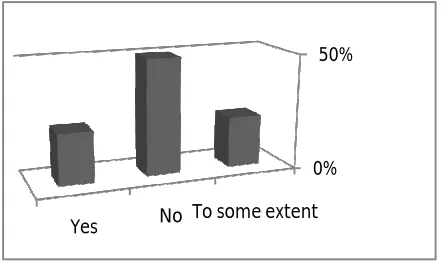
Concerning the answers to the ninth question about evaluating what is the educated versus in relation to the practical reality, the highest was 50% "to some extent", 28% with "No" and 22% with "Yes" (Figure 6). That is compliant with the previous answers about the existence of insufficiency in the private architecture system.
Figure (6) The assessment of the curricula ofprivate education according to the practicalreality
Answers to the tenth question with the suggestions of employers to take care of the following subjects: the skills of dealing with others, practical training, computer skills, reality design, constructional requirements, finishing and architecture aesthetics.
The special sample of the study: the graduates of private education:
The sample included the graduates of the private education; the 6th October University, the Misr International University, the High Institute of Engineering and Technology in Kafr El-Sheikh, including 33 forms representing the retrieved number out of 45 forms. Some of the results of the questionnaire are going to be reviewed. Those results are considered descriptive data. So, the analytical descriptive style was used for responses plus displaying charts if necessary to increase clarification.
Concerning the opportunity of getting work after graduation, the graduates' highest responses to the second question were "No" at 58 % and "Yes" at 42%. For the answer of the third question, 35% of those who work, got that work within a year, 28% got the job after one year, 21% after two years, and 16% after more than two years, shown in fig 7.
0% 50%
To some extent No
Yes 0 20 40
60 28
17 45
Figure 7: The extent of the of his study exercises compatibility with practical reality
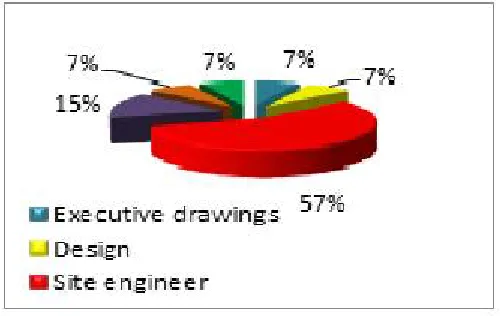
As Fig .8, answers to the fourth and fifth questions showed that the highest percentage of those who work is 57% and work in the field of implementation, 21% work at engineering offices, 07% work individually. The answer of the fifth question showed the nature of their work, 07% answered: work at designing, another 07% in the field of supervision, 07 % in the perspectives, 15 % work in teaching in the private institutes (two teaching assistants), Figure 8, but 43% said that they were site engineers.
Figure 8: The specialization in which the graduate his profession
Figure 9: The most misrelated subjects to reality
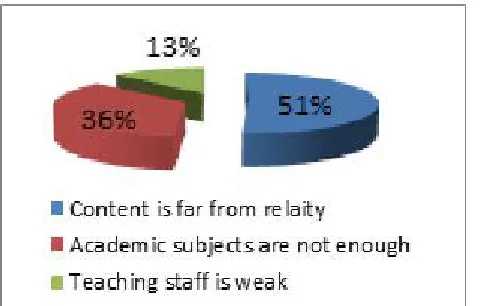
The results of answering the eighth question showed that the reason of insufficiency in the subjects is that 51%: the content of those subjects is irrelevant to the reality, while 36 % think that they are not enough and 13 % answered because of the weak teaching staff. Figure (10).
Figure 10: The reason of the weak the practical compliance with the practical reality
The students in the preliminary engineering grade answered the ninth question and the greatest percentage of 55% thought of replacing them with architectural and specialized subjects, while 33 % thought of replacing them with a practical training year and 12 % answered by remaining them as they are.
In answering the tenth question about comparing between the scientific information of the graduates of the governmental and private education, 58 % answered there are no essential differences, 27 % answered the governmental graduate has more information while 15 % thought the private graduate has higher information.
X. RESULTS
General results of the study:
There are differences between the traditional and modern concepts of educational curricula and their nature and methods of teaching.
The systematic separation between the years of study weakens the intellectual sequence Ask the student.
The subordination of architectural education to engineering education does not give sections of architecture the freedom to develop curricula
A graduate of architecture suffers from a schism between what he receives during his studies and what he needs to be practical.
The subordination of architectural education to Western thought does not validate the Egyptian identity on architectural production.
the results of the analytical study:
There is a quantitative variance between the groups of the main subjects such as the group of architectural design, (reaching 63 hours) for the benefit of the governmental faculties, in the executive group, there is a quantitative difference for the benefit of the governmental faculties reaches 17 hours. However, there is a quantitative difference in the constructional subjects reaches (24 hours), also there is a quantitative difference in the civil subjects for the benefit of the governmental faculties reaches 12 hours, but there is a quantitative difference in the specialized subjects for the benefit of the private faculties reaches 23 hours, in the optional subjects for the benefit of the governmental faculties reaches 28 hours. Therefore, the total quantitative differences for the benefit of the governmental selected faculties to the private selected faculties of 103 hours which affects negatively on the students and graduates of the private architectural education.
The employers' assessment of the graduate of the private architectural education is that he approaches "Pass", however he didn't get their required trust like the graduate of the governmental education. That explains the quantitative and qualitative evaluation of the subjects as they are not relevant enough to the practical reality as referred to in the answer of the ninth question.
The most works that shows the weakness of the subjects that the graduates learned are in the following arrangement: execution works, design, specialized computer programming skill, bids and tenders.
Employers suggested the following topics: practical training, computer skills, realistic design, Building Laws, finishes, aesthetics of architecture)
The results of the answers point out that despite of taking care to the architectural design in the curricula with more than 50 %, the work field in design doesn’t exceed 10%. The available work is still execution because it got the greatest percentage but in curricula it is not enough taken care with. That is considered insufficiency that should be treated.
Results showed that most of the educated subjects, which were irrelevant to the practical reality, was the cultural subjects educated in the preliminary engineering grade. Those answers are compliant with those of experts who call for replacing the cultural subjects with architectural ones.
Most graduates of private education see that there are no significant differences between the subjects they studied and their colleagues in government education.
Graduates and employers agreed to take care of the following subjects: modern internal and external finishing, designing real sites and preferred to be residential, feasibility study and site management, specialized computer courses, real estate marketing and field training.
XI.RECOMMENDATIONS
Greater focus on the practical and field aspects of the students
To continuously evaluate and update curricula and programs in a manner consistent with the requirements of the times.
The authors of the curriculum should consider an explanation for the conflicting theories resulting from intellectual duplication.
To obligate the private universities to activate the necessary flexibility to develop the academic specializations and programs away from routine obstacles that face the governmental universities.
The aim is to form a body for architectural education composed of architects, academics and student representatives, who will have to coordinate between universities and architectural schools to find out the educational situation, and prepare an annual report with a vision or realistic solutions to the problems.
It is necessary to separate the property from the education for fear of intervention of private university owners in the educational process.
Working to close the gap between the study and the labor market by creating training initiatives aimed at benefiting the student by combining the student's learning abilities with practical experience and then carefully monitoring the gap. The development authority proposes solutions according to real studies and statistics.
To consider the student as a partner in the educational process and not just a recipient, and to be keen to hold dialogue sessions with students to explore their views and aspirations to improve their educational reality, and then seriously consider their perceptions.
REFERENCES
1. High education in Egypt, Cooperation and Development Organization in the economic Field and the World Bank , pp.10.,2010 2. B.H.Kamel,Education and Future, 1997.
3. Supreme Council of the Universities, the law of organizing universities and its stages of development,2006 4. M.M.El-Basiony, Private Architectural Education under the global updates, Ph.D, Cairo University, 2007.
5. A.M.Salama, Education and Architectural education\Developing the curricula and the educational process, Master Thesis, Al-Azhar University,2007
6. A.ElBaky, Continuous Education in Architecture, whose responsibility? Building World magazine, Edn. 84,pp 15,1987. 7. A.M.Yasar, Developing the architectural education for the holiday period,Damascus University , 2007.
8. A.M.Afify, The Architectural education in Palestinem, Master Thesis, ElNagah University, 2012. 9. The internal Executive legislation, Faculty of Engineering, Cairo University, 2003.
10. The internal Executive legislation, Faculty of Engineering, Alexandria University, 1997. 11. Student Guide, Faculty of Engineering, Bachelor stage, Asuit University, 2010. 12. Study Program, Faculty of Engineering, University, 2006.

![Table 1. The academic curricula of architecture engineering department\ Cairo university(9), Alexandria [10], Asyut [11]](https://thumb-us.123doks.com/thumbv2/123dok_us/1565075.1192344/7.595.43.555.573.750/table-academic-curricula-architecture-engineering-department-university-alexandria.webp)