HARDWARE CONTROLLER IMPLEMENTATION OF CANDU NUCLEAR POWER
PLANT SHUTDOWN SYSTEM
Polad Zahedi
Department of Electrical and Computer Engineering University of Western Ontario
ABSTRACT
Implementation of logic functions associated with the shutdown systems of CANDU nuclear power plants is the focus of this project. The experimental aspects of this work includes development of control program embedded in shutdown systems of CANDU based NPPs.
This method enables the shutdown systems to operate separated and independent from each other and from process systems as a main regulatory requirement for safety systems.
Physical test environment is designed to simulate the measurements of in-core flux detector (ICFD) and ion chamber (I/C) signals.
The functionality and timeline of trip mechanism is tested in this method and compared against regulatory requirements.
The programmable logic and process controller used in this experimentation provides Triple Modular Redundant (TMR) architecture. For this purpose, a voting mechanism is used upon execution of control program on each independent channel.
The control system is capable of transient and steady-state error detection through triple redundant design on the control system.
Various plant conditions and scenarios are experimented against the logic design using a broad range of parameter specification in order to evaluate the designed control system.
The main purpose of the experimental project is to analyze the respond characteristics and reliability of shutdown systems implemented in hardware controller and comparison against current implementations and regulation requirements.
METHODOLOGY
Tricon Shutdown system will control the reactor parameters and protect the simulated plant from accidents. An Update Information System processes the data from Tricon control and protection systems utilizing high-speed triple redundant Data Interface. Its triple redundancy ensures that data can be voted within the system.
The Fault Indicator System monitors the parameters in various conditions in the plant, such as temperatures, flows, and pressures, to detect if they are below or above a certain set point. If an acceptable range is violated, the Tricon system sends a signal to the control algorithm to take the required action. The Tricon system also sends a signal to the Fault indicator.
The digital shutdown system consists of three data channels, all participating in the computation as well as final voting method. The Tricon system receives analog and digital inputs from the sensors of water pressure, level, and temperature in the reactor's core.
In the case of this experimentation a physical testbench is created to simulate the information received from the sensors in the actual nuclear power plants. The results are calculated and written to three digital output channels, which are connected to physical testbench simulating pumps and valves.
2
The logic implemented in the hardware controller is driven from Shutdown System #1 (SDS1) for CANDU nuclear power plants. The details of the logic and its implementation will follow in this paper.
CANDU SHUTDOWN SYSTEM 1 (SDS1)
Shutdown System 1 (SDS1) is an independent, fully-capable, passive shutdown system. It is designed such that if a component of the shutdown system fails, the rest of the system is either capable of performing its function, or is automatically activated to shutdown the reactor. [1] The independency of SDS1 with other safety critical logics in the CANDU nuclear power plant such as SDS2 and the control system is a regulation requirement. For this reason, the hardware controller chosen for the implementation performs completely independent data processing on each channel to satisfy this regulation requirement.
The set of parameters simulated by the physical testbench are designed to represent the shutdown parameters used in CANDU6 nuclear power plants. The physical test bench is illustrated in the following section of this paper.
The trip parameters simulated by the physical testbench are as follows:
1. High Neutron Power
2. High Rate of Rise of Neutron Power 3. High Coolant Pressure
4. Low Coolant Pressure 5. High Building Pressure 6. Low Steam Generator Level 7. Low Pressurizer Level 8. High Moderator Temperature 9. Low Coolant Flow
10. Low Steam Generator Pressure [2]
Once the collected values for the above trip parameters are collected by the hardware controller, the controller compares the values to the set points predefined on its controller logic for any specific power level and produces the appropriate decision. In turn, the decision is transferred to the SDS1 shutdown instruments.
The original logic defined for SDS1 is compatible with that of the hardware controller in that they both use a Two-Out-of-Three logic. There are three different trip channels, D, E and F used in SDS1.
Every channel has completely independent and physically separated power supplies, trip parameter sensors and instrumentation trip logic. [3] These separated channels are simulated as separated power supplies connected to the controller via the physical testbench. Three analog input channels of the hardware controller are used to receive data from all the channels.
The Two-Out-of-Three logic implies that if any two of the there channels satisfy the trip conditions the system will send signal to shutoff rods to be dropped. This voting mechanism is implemented within the hardware controller to be used upon processing of data in its three independent execution units.
The shutdown command is produced as a simple digital output occupying one of the digital output channels of the hardware controller.
In the real implementation of the SDS 1, the digital output produced by the hardware controller would be sent to shutoff rods to be dropped into moderator.
The Two-Out-of-Three logic, not only allows for comparison of the signals for more accurate decisions, it also provides the facility for one channel to be tested online without reactor trip. This capability has also been integrated into the hardware controller used in this project.
Any processing unit on the hardware controller can be replaced, repaired or tested online. This means any processor module can be removed from the controller while data acquisition is in process and the other two processors will take over and continue with the processing without any disturbance detected in the data execution process.
In order to realistically simulate the execution of the reactor trip, the time intervals specified for CANDU 6 nuclear power plants are used in the logic implementation. After 2 seconds from the generation of the shutdown command to the rods, the rods are assumed to be fully inserted into the moderator and the predefined trip parameters associated with the shutdown condition overrides the analog inputs from the test bench to the shutdown logic.
TRICON HARDWARE CONTROLLER
Tricon Programmable Logic Controller (PLC) is used for the control and shutdown applications in several industries including nuclear power plants. The Tricon controller provides Triple Modular Redundant (TMR) architecture which makes this PLC very compatible with the shutdown system implemented in CANDU Nuclear Power plants.
Upon the execution of control program, a voting mechanism is used between all independent channels. The control system is capable of transient and steady-state error detection through triple redundant design on the control system. [4] The Tricon PLC is used for this experimentation due to its similarities in control logic with that of SDS1 of CANDU NPPs. The Tricon PLC is connected to three analog input devices representing the three channels, D, E and F, for the SDS1. The analog input devices are connected to the testbench simulating the plant sensors and transmitters. The details of operation of the physical testbench are studied in the following section. The current signals received by the analog input devices are transmitted to the analog input modules on the Tricon PLC where the signals are converted and fed to the processor units.
The following figure presents the structure of the analog input module used in this experimentation:
4
The simulated D, E and F channel signals are received by three independent processor units to satisfy the triple redundancy required by the SDS 1 logic. The Tricon PLC used the same Two-Out-of-Three voting method upon the execution of the data in each of the processing units. The matching voting method introduces an automatic compatibility between the SDS 1 trip logic and Tricon voting strategy.
The following figure illustrates the logic and methodology used in the processing of Tricon hardware controller:
Triple Modular Redundant Logic in Tricon Processors
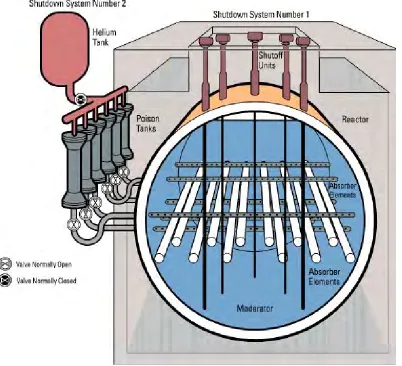
Finally, the digital signal produced as a result of the voting mechanism is sent out of the Tricon PLC in a redundant manner. This is also in compliance with the SDS1 trip logic. In reality the trip command would be transferred to the shutoff rods on top of the reactor to be dropped into the moderator.
The following figure shows the position of these rods relative to the reactor and SDS2:
6 PHYSICAL TESTBENCH
In order to simulate the signals received from the transmitter of the nuclear power plant, the physical testbench has been designed to generate such signals in a realistic manner. The signals generated in the physical testbench are calibrated to be in the range of 4mA-20mA to comply with specifications of actual signals generated by the sensors and transmitters used in CANDU nuclear power plants.
The following figure presents the electrical design of the testbench built for this purpose:
Electrical Design of the physical testbench
There are three sets of signal terminals representing the three channels of the SDS 1 logic. Each set of channels include ten terminals representing the ten trip parameters associated with SDS 1 logic. Using this testbench the Tricon PLC is interfaced with the same signal configuration and specifications that are presented by CANDU 6 nuclear power plants.
The signals generated by the physical testbench are fed to the Tricon analog input modules. The data received by the modules are processed in a triple redundant manner and the decision made is reflected graphically by the Human Machine Interface (HMI). The process is explained in the following figure:
Hardware Controller Data Process Procedure
CONCLUSION
Due to the similarities in the logic design and voting mechanisms, the shutdown system #1 of CANDU 6 nuclear power plant could be realistically implemented in the chosen hardware controller. In addition, physical testbench was used to generate simulated input signals to the hardware controller. This testbench was designed to simulate the actual signal specifications of the power plant sensors and transmitters.
In order to further increase the validity of the evaluation the input signals are overwritten by the predefined shutdown characteristics once the shutdown command is generated. The delay for the trip parameters to be affected by the trip command is set to realistically match that of CANDU 6 specifications. The hardware controller used for this experimentation appropriately suited the purpose and produced an accurately simulated shutdown system.
8 REFERENCES
[1] Rouben, B. (2002). Introduction to Reactor Physics, Reactor Core Physics Branch Atomic Energy of Canada Ltd., ON, Canada, 23-45
[2] Glockler, O, (2002). Testing the dynamics of shutdown systems instrumentation in reactor trip measurements, Station Performance Monitoring Section, Technical Services Department Inspection Services Division, Ontario Power Generation Nuclear, ON, Canada
[3] Canadian Nuclear Safety Commission (2006). Trip Parameter Acceptance Criteria for the Safety Analysis of CANDU Nuclear Power Plants, Office of Communications and Regulatory Affairs, Canadian Nuclear Safety Commission, ON, Canada
[4] Invensys Systems, Inc. (2004), Planning and Installation for Tricon v9 Systems, Triconex Corporate, Irvine, CA