Robust and Efficient Multipath Intertest
Forwarding For NDN- Based MANETS
Kavana. S1, Prof. Vanitha T N2, Dr K.S Jagadeesh Gowda3
B.E. Student, Department of Computer Science & Engineering, Sri Krishna institute of technology, Bangalore,
Karnataka, India1
Assistant Professor, Department of Computer Science & Engineering, Sri Krishna institute of technology, Bangalore,
Karnataka, India2
Professor and Head, Department of Computer Science & Engineering, Sri Krishna Institute of Technology, Bangalore,
Karnataka, India3
ABSTRACT: Named data organizing (NDN) worldview tackles different issues of current TCP/IP based Internet and considers as a decent possibility for future Internet design. It has a basic correspondence system in light of named substance rather than their physical areas. In NDN-based versatile specially appointed systems (MANETs), the taking part hubs have restricted assets. Intrigue message flooding is a key research issue around there. Because of Interest message flooding, the member hubs regularly partake in the sending procedure and bite the dust prior due to constrained outstanding vitality. In this investigation, by use the advantages of NDN worldview, we have proposed another plan, named hearty and productive multipath Interest sending (REMIF) for NDN-based MANETs. Execution of the proposed REMIF plot is researched by utilizing ndnSIM. The outcomes demonstrate that proposed conspire performs better as far as substance download time and the aggregate number of Interest messages infused in the system.
KEYWORDS:Named data organizing (NDN), MANET, TCP/TP.
I. INTRODUCTION
Nowadays, advancements in technologies, especially in wireless devices are bringing a great revolution to our society. By using these devices, Internet traffic has been increased exponentially since the last decade. Due to the rapid growth in the usage of multimedia content, current TCP/IP based Internet architecture is not suitable for the future application requirements perspective. It is hard to pre-allocate the network resources by using TCP/IP based Internet paradigm. Hence, there is a demand of a new Internet architecture that can deals with these issues.
Fig. 1 NDN Interest packet forwarding mechanism
Fig. 1 demonstrates the ordinary Interest message sending process in NDN. At the point when a NDN hub gets an Interest message, it first checks its CS information structure for the accessibility of information. In the event that Data message is discovered, it advances the information to the requester hub. Something else, the NDN hub additionally checks its PIT information structure for any relating section. In the event that a section is discovered, it implies some different node(s) officially asked for the comparable information. The NDN hub refreshes the present PIT information structure (i.e., include the face data) and disposes of the Interest message transmission. Then again, it additionally checks its FIB information structure. On the off chance that the sending face data is accessible, the NDN hub includes the comparing passage in PIT information structure and further advances the Interest message. Lie information structure is populated by utilizing a directing convention like the correspondence held in TCP/IP based engineering. Be that as it may, in information conveyance case, Data messages just take after the PIT information structure passages, which are beforehand put away on the transfer hubs.
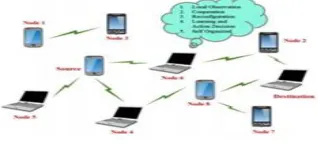
Fig. 2 Mobile ad hoc networks
The work in this paper is divided in two stages. 1) Text- Detection 2) Inpainting. Text detection is done by applying morphological open-close and close-open filters and combines the images. Thereafter, gradient is applied to detect the edges followed by thresholding and morphological dilation, erosion operation. Then, connected component labelling is performed to label each object separately. Finally, the set of selection criteria is applied to filter out non text regions. After text detection, text inpainting is accomplished by using exemplar based Inpainting algorithm. Paper is organized as follows. Section II describes automatic text detection using morphological operations, connected component analysis and set of selection or rejection criteria. The flow diagram represents the step of the algorithm. After detection of text, how text region is filled using an Inpainting technique that is given in Section III. Section IV presents experimental results showing results of images tested.
II. EXISTING SYSTEM
provider center point. Interminable supply of the Interest package, hand-upside down point 2 checks its CS for the openness of a Data parcel.
III. PROPOSEDSYSTEM
In this paper, we have proposed another plan, named vigorous and effective multipath Interest sending (REMIF) for NDNbased MANETs. In which, the Interest message sending component thinks about the rest of the vitality of the hubs. In addition, REMIF plot likewise mitigates the superfluous message broadcasting by utilizing the controlled flooding component. Propose conspire uses the regular NDN messages (i.e. Intrigue message and Data message) in its correspondence procedure. Not at all like others, It doesn't uses any expansion information structures (i.e. cradles, tables) or control messages. In addition, in this plan, each NDN hub has just two sorts of information structures, named content store (CS) and pending Interest table (PIT) (like regular NDN). In any case, proposed plot does not use the FIB information structure. The reason is that, propose conspire depends on responsive approach. In which, if a NDN hub needs a few Data messages, it basically sends the Interest messages towards the supplier hub. Keeping in mind the end goal to populate the FIB information structure, we require an additional convention that occasionally refreshes the FIB information structure. This marvel causes an extra overhead in the system and hard to keep up particularly in asset obliged condition
IV. LITERARYSURVERY
The paper[1] depicts the get-together to oppose the web impasse, and proposes a way virtualization may be utilized to beat it. At the same time, thought of plan and verbal experience among fussbudgets and pluralists are investigated. The present Internet is at an impasse in light of the way that new models can't be sent, or even sufficiently studied. By a wide edge an extensive segment of Internet look at is either exploratory or incremental, While both research are essential, they are not attractive to address fringes and noteworthy difficulties. We should need to give fundamental access to virtual demonstrating grounds, there will be renaissance to incrementally deployable course of action, Also to raise the sights of research gathering. The time has come to plainly confront it and whipping it.
This paper depicts that IoT is broadly perceived as key empowering driver in natural checking frameworks, its innate abilities to give detecting and incitation functionalities on dispersed premise. In the meantime larger part of IoT applications are Information driven by outline. A natural observing framework can be effortlessly set up by letting at least one gathering stations to buy in the occasions or detected esteems, produced by IoT hubs scattered in situation of intrigue. All examined arrangements falls inside two primary methodologies: pull-based and push-based. It rose that all ICN designs can execute the two plans. For the most part one of them locally upheld while other one is actualized by presenting fitting augmentations. Future research exercises will concern plan of logical models of recognized methodologies, by considering portability conditions.
This paper[3] Depicts the Interdependent power mastermind disruptor (IPND) change issue to perceive essential center points in dependent power arrange whose removals maximally annihilate its abilities due to glitch of centers and falling dissatisfactions of related correspondence compose. A wide examination not simply demonstrate feasibility of approach on facilitate with different topologies and interdependencies, yet moreover include some fundamental recognitions to sharpen power of dependent frameworks in future.
This paper[8] delineates frameworks can be generally insinuated as multilayer frameworks. Makers review and discuss an extensive parcel of pertinent tackles the point. By then they tie together the written work by introducing a general framework for multilayer frameworks. Such packaging work address different documentations of frameworks by exhibiting all out constraints on general model. Multilayer frameworks got a lot of thought starting late and creating gathering of research has been totally investigated.
frameworks of frameworks) by basically introducing consolidated necessities on the general model. Scholars also review attempts to entirety up single-layer investigative and estimations, for instance, center degree, gathering coefficient, aggregate structure, related fragments, dynamic and spreading shapes. , this work hopes to be only an introduction regarding the matter.
The paper depicts[12] Triangles are fundamental for bona fide casual associations, lying at the center of the gathering coefficient and of the transitivity extent. Regardless, straight-forward and even unpleasant checking counts can be direct, attempting to execute or inaccurate what should be known as a 3-way database join. In this paper two figurings, the Eigen-triangle for checking the total number of triangles in a diagram, and the Eigen triangles that contain a pined for center. This is a critical discernment opening the best approach to monstrous contraption of quickly available, exceedingly adjusted Eigen regard estimations and use. These counts are fast and in addition, the more prominent
V. SYSTEMDESIGN
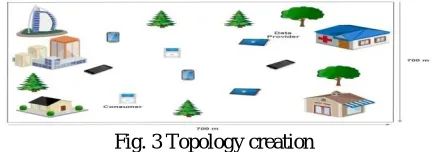
The ndnSIM test system is uniquely intended for the NDNbased wired systems. In any case, in this investigation, it is additionally improved to give the help to multihop correspondence in remote impromptu systems. We consider the 700m×700m reproduction topology that is comprises of 50 NDN hubs as appeared in Fig. 3. In which, the NDN hubs can arbitrarily move starting with one place then onto the next by utilizing Random walk versatility show. Every hub has based innovation and Nakagami demonstrate is utilized as a channel blurring model. Every hub has starting vitality set to 100 joules.
The vitality devoured in transmission, gathering and sit without moving statesand populated by utilizing a managing convention At first one substance is put away on every supplier hub. Each substance bargain with 4000 Data messages. The span of every datum message is 1040 bytes. As of now, we think about five customer/supplier combines in our recreation. Customer NDN hub can downloads its required substance from any supplier hub. CS measure is set to 10000 Data messages. Leave duplicate all over the place (LCE) and Least as of late utilized (LRU) are consider as a storing and swap approaches for the administration of the CS information structure, individually. We consider the accompanying two measurements for the assessment reason.
Fig. 3 Topology creation
Content Download Time (CDT): It is characterized as the normal time devoured by the shopper hub keeping in mind
the end goal to recover every one of the Data messages of a substance.
Add up to Number of Interests (TNI): It is characterized as the aggregate number of Interest messages including retransmitted Interest messages send by the shopper and transfer hubs to get the required Data messages of a substance.
VI. IMPLEMENTATION
NETWORK MODEL: Create topology of a wireless ad hoc networks by a graph G(V;E) where V and E are the set of
FIND POSSIBLE PATH: The possible pth between a source and destination node are found using DJIKISTHRA’s algorithm. The sender can select a path and send message to destination.
MESSAGE SENDING WITH CACHING: When sender or neighbour sends message, a copy of message is saved in
cache. This message is used for retransmission purpose, if ack not received from receiver.
MESSAGE RETRANSMISSION: The node waits for ACK from receiver or neighbour. If ACK is not received within
timeout period, the message will be retransmitted. This process is done until ACK is received from receiver.
MESSAGE RECEIVER: Receiver sends ACK from every received message. If receiver doesn’t send ack, message is retransmitted from neighbour until ACK is received.
VII. EXPERIMENTALRESULTS
We conduct the several experiments to evaluate the perfor-mance of the proposed as well as the compared protocols by considering the impact of the node density, node speed, and the number of consumer/provider pairs. The following sections explain and analyze in detail the results obtained from these experiments. 1) Node Density: In the first round of experiments, we investigate the performance of the proposed LOMCF protocol and other protocols by varying the number of nodes in the net-work.
VIII. CONCLUSION
A novel scheme, named REMIF is proposed for NDN-based MANETs. Proposed scheme increases the network efficiency by reducing the flooding of Interest messages in the network. Moreover, it considers the residual energy of participating NDN nodes and makes its Interest message forwarding mechanism according to the node’s energy status. Simulation results shows that proposed REMIF schemes outperforms as compared to E-CHANET scheme in terms of content download
REFERENCES
[1] S. Eum, K. Nakauchi, Y. Shoji, N. Nishinaga and M. Murata, ”CATT: Cache aware target identification for ICN,” in IEEE Communications
Magazine, vol. 50, no. 12, pp. 60-67, 2012. doi: 10.1109 /MCOM. 2012.6384452
[2] B. Ahlgren, C. Dannewitz, C. Imbrenda, D. Kutscher, and B. Ohlman, ”A survey of information-centric networking.” Communications
Magazine, vol. 50, no. 7, pp. 26-36, 2012.
[3] M. Brunner, H. Abramowicz, N. Niebert, and L. M. Correia, ”4ward: a european perspective towards the future internet.” IEICE transactions
on communications, vol. 93, no. 3, pp. 442-445, 2010.
[4] COMET, ”Content mediator architecture for content-aware networks.” http://www.comet-project.org.
[5] L. Zhang, A. Afanasyev, J. Burke, V. Jacobson, P. Crowley, C. Papadopoulos, L. Wang, and B. Zhang, ”Named data networking.” ACM
SIGCOMM Computer Communication Review, vol. 44, no. 3, pp. 66-73, 2014.
[6] PURSUIT, ”Pursuing a pub/sub Internet.” http://www.fp7-pursuit.eu.
[7] V. Jacobson, D. K. Smetters, J. D. Thornton, M. F. Plass, N. H. Briggs, and R. L. Braynard, ”Networking named content.” In Proceedings of
the 5th international conference on Emerging networking experiments and technologies, ACM, 2009, pp. 1-12.
[8] CONVERGENCE, ”Host centric to content-centric.” http://www.ictconvergence.eu.
[9] COAST, ”Content aware searching retrieval and streaming.” http://www.coast-fp7.eu.
[10] The CBMEN project. http://www.darpa.mil/program/content-basedmobile-edge-networking.
[11] The UMOBILE project. http://umobile-project.eu. [12] ENCODERS. http://encoders.csl.sri.com [13] The BONVOYAGE project.
http://bonvoyage2020.eu. [14] M. Amadeo, C. Campolo, A. Molinaro, and G. Ruggeri, ”Content-centric wireless networking: A survey.”
Computer Networks, vol. 72, pp.1-13, 2014.