Biometric Based Electronic Voting System
Using Aadhar
Geethamani R
1, Nithya V
2, Nivetha B
2, Pratheebamary R
2, Rajakumari Agnes A
2Assistant Professor, Department of Electrical & Electronics Engineering, Sri Krishna College of Engineering and
Technology, Kuniyamuthur, TamilNadu, India1
U.G. Student, Department of Electrical & Electronics Engineering, Sri Krishna College of Engineering and
Technology, Kuniyamuthur, TamilNadu, India2
ABSTRACT: There is lot of methods to avoid fraudulence in voting systems, but we are not able to eradicate it completely. This project will give solutions for the above mentioned problem. This project is to develop a secure Electronic voting machine using Finger print identification method, for finger print accessing we use Aadhar card database. Today we all have AADHAR CARD so the Government has all the data base of us including finger print and retina. Fingerprint is one of the unique identities of a human being which is being used in the aadhar system. By using arduino software we capture the finger print of every individual. At the time of voting in the elections, the authentication can be done using Aadhar Card Id and Finger Vein Sensing, which enables the electronic ballot reset for allowing voters to cast their votes. Fingerprint biometric is the most widely deployed publicized biometrics for identification. This is largely due to its easy and cost effective integration in existing and upcoming technologies. The integration of biometric with electronic voting machine undoubtedly requires less manpower, save much time of voters and personnel eliminate rigging, ensure accuracy, transparency and fast results in election. This project shows how this problem can be solved with the help of combination of biometric finger print scanner and micro controller. The framework for electronic voting machine based on biometric verification is proposed and implemented. The proposed framework ensures secured identification and authentication processes for the voters and candidates through the use of fingerprint biometrics.
KEYWORDS: Electronic voting machine, Finger print, Aadhar Card, Biometric, Rigging
I. INTRODUCTION
Voter identification is required during two phases of the electoral process: first for voter registration in order to establish the right to vote and afterwards, at voting time, to allow a citizen to exercise their right to vote by verifying if the person satisfies all the requirements needed to vote (authentication). Security is a heart of e-voting process. Therefore the necessity of designing a secure e-voting system is very important. Usually, mechanisms that ensure the security and privacy of an election can be time consuming, expensive for election administrators, and inconvenient for voters. There are different levels of e-voting security. Therefore serious measures must be taken to keep it out of public domain. Also, security must be applied to hide votes from publicity. There is no measurement for acceptable security level, because the level depends on type of the information. An acceptable security level is always a compromise between usability and strength of security method. Finger print devices for voting machines is enforced during this project. The information read is passed to the controlling unit for the verification. The controller reads DATA from the reader and compares this data with the already existing data. If the data matches with the already stored information, the person is allowed to poll his vote. If not, a message is displayed on LCD and therefore the person isn't allowed to poll his vote. The polling mechanism carries out manually using the switches. LCD is employed to display the related messages.
The development of fingerprint scanners that serve to quickly identify individuals and assign access privileges. Finger printing recognition, the electronic methods of recording and recognizing an individual finger print, advanced substantially. Today, identification can be achieved in a few seconds with reasonable accuracy. As a result, the use of Automated Fingerprint Identification Systems (AFIS) that record, store, search, match and identify finger prints is rapidly expanding. AFIS can be integrated with a microcontroller and other peripherals to form an embedded system which is a comprehensive electronic voting machine with fingerprint print identification system.
“Aadhar based Electronic Voting Machine using Arduino” by R.Murali Prasad et al [1] (2016) in which they have
performed an online electoral system for Indian election is proposed for the first time. The voting system is managed in a easier way as all the users should login by Aadhar card number and password and click on his/her favorable candidates to cast the vote. This features a larger security in the sense that voter high security password is confirmed before the vote is accepted in the main database of ECI. The extra feature of the model is that the voter will ensure if his/her vote has gone to correct candidate/party. The votes are going to be done automatically, therefore saving an enormous time and facultative ECI to announce the result at intervals a very short period. The result obtained was that the EVM system has to be further studied and innovated to reach all level of community, so that the voter confidence will increase and election officials will make more involvement in purchasing the innovated EVM‟s for conduct smooth, secure, tamper resistant Elections.This concludes that the Aadhar based EVM will be useful :
To avoid Rigging
To avoid time consumption
To keep the voter‟s information more secured.
“Bio-metric Electronic Voting System for Election Process” by RathnaPrabha.S et al [2] (2016) in which they came up
Use AADHAR card database. At the time of voting in the elections, the e-voting process authentication can be done using finger vein sensing, which enables the electronic ballot reset for allowing voters to cast their votes. Also the voted data and voters details can be sent to the nearby Database Administration unit in a timely manner using Zigbee System with cryptography technique. Thus AADHAR based Electronic voting systems have many advantages over the traditional way of voting. Some of these advantages are lesser cost, faster tabulation of results, improved accessibility, greater accuracy, and lower risk of human and mechanical errors. It is very difficult to design ideal e-voting system which can allow security and privacy on the high level with no compromise. Future enhancements focused to design a system which can be easy to use and will provide security and privacy of votes on acceptable level by concentrating the authentication and processing section.
II. EXPERIMENTAL SETUP
Fig 3.1 BLOCK DIAGRAM
The experimental setup consists of the following sections
Power supply section
Microcontroller section
RFID section
Finger print section
Relay coil section
The power supply section connects with the every other section of the setup. Step down transformer reduces the supply voltage level which is then regulated using voltage regulators bypassing the bridge rectifier for AC to DC conversion. The output of the voltage regulator has some ripple contents which is then filtered using capacitors. The microcontroller section consists of two controllers namely Arduino and ATMEL 89s52. The Arduino board is used finger print processing while ATMEL is being used for RFID and LCD display purpose. These controllers works with 5V supply obtained from the power supply section.
RFID is the physical identification for the voters which acts as a prototype for the Aadhar card. On reading the RFID number it is passed to ATMEL which on further verification provides authentication for the user to vote. Once the authentication is succeeded, the finger print of the voter is sensed using R-305 finger print sensor. The sensed data is compared with stored database in MAX-232 which serves as a prototype for the live Aadhar Biometric Database. The relay coil has the control over the entire section which is
III. WORKING
1. Biometric Based Electronic Voting System using Aadhar starts with the physical authentication of the voters which is the RFID tag.
2. Once the RFID id matches with the stored database, voters are then asked to place the finger for scanning. 3. The finger print is then sensed using R-305 finger print sensor which is in serial communication with Arduino. 4. The sensed biometric is compared with the already stored database in MAX-232.
5. The authentication is provided on successful matching of data and the voters are allowed to cast their vote. 6. The stored database consists of two thumb prints either of which can be used for the authentication. The polls are stored for further result publication.
The most known disadvantage of the existing system is Rigging of votes and to overcome it we have used biometric which will not allow the duplicate users to vote in absence of the card holder for which the relay coil trips out with a buzzer indication and also a message is displayed using the LCD. Even if the card holder tries to recast his vote he will indicated with a buzzer stating that „Already Polled‟ in the LCD. The other case of Rigging is duplicating the card itself which is also indicated using the buzzer and a message. Finally, the stored polls can be displayed with no delay in time, which is also a disadvantage of the existing voting system
IV. EXPERIMENTAL RESULTS
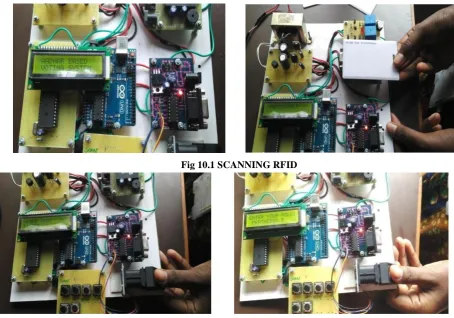
The RFID tag is scanned and the voter is allowed to vote using finger print.
Fig 10.1 SCANNING RFID
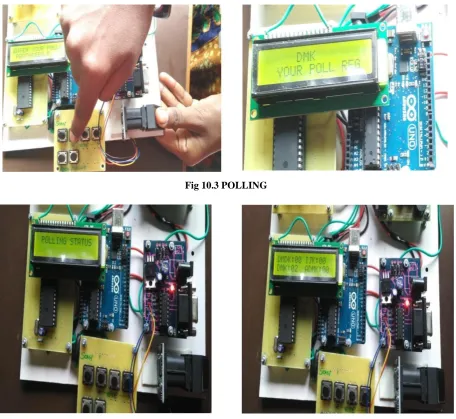
Fig 10.3 POLLING
Fig 10.4 DISPLAY OF RESULT
V. CONCLUSION
REFERENCES
[1]“Aadhar based Electronic Voting Machine using Arduino” by R.Murali Prasad , Polaiah Bojja, Madhu Nakirekanti in International Journal of Computer Applications on July 2016.
[2]“Bio-metric Electronic Voting System for Election Process” by RathnaPrabha.S, Trini Xavier.X, Deepika.V , Iswarya.C in International Journal Of Innovative Research In Electrical, Electronics, Instrumentation And Control Engineering on January 2016.
[3]“Aadhar Based Electronic Voting System And Providing Authentication” by D.Krishna , T.Hemalatha, G.Dhana Mani Shankar, K.Bala Krishna, V.Bala Subhramanyam in International Journal of Engineering Science & Advanced Technology on March 2016.
[4]“Biometric Secured Voting Machine to Avoid Bogus Voting Based on Aadhar Card” by Umang Shah, Trupt Shah, Marteen Kansagara, Saagar Daxini in International Journal of Innovative Research in Computer and Communication Engineering a Vol. 3, Issue 3, March 2015.
[5]“Design A Secure Electronic Voting System Using Fingerprint Technique” by Sanjay Kumar, Manpreet Singh in IJCSI International Journal of Computer Science Issues, Vol. 10, Issue 4, No 1, July 2013.