International Journal of Innovative Research in Science, Engineering and Technology
An ISO 3297: 2007 Certified Organization Volume 6, Special Issue 5, March 2017
National Conference on Advanced Computing, Communication and Electrical Systems - (NCACCES'17)
24th - 25th March 2017
Organized by
C. H. Mohammed Koya
KMEA Engineering College, Kerala- 683561, India
A Survey on Super-Resolution Techniques
Aparna K V1, Lisha P P2
M.Tech Student (Image Processing), Department of Computer Engineering, Model Engineering College,
Thrikkakara, Kochi, India 1
Assistant Professor, Department of Computer Engineering, Model Engineering College, Thrikkakara, Kochi, India 2
ABSTRACT: Information revealed by Low Resolution (LR) images is so limited that the accuracy of the resulting recognition is very low. Thus the Low Resolution (LR) problem forms one of the most challenging issues in recognition. Recently, super-resolution techniques have been employed to address the Low Resolution (LR) problems of imaging system. Super-Resolution techniques estimate a high resolution image from one or more low resolution images. Super Resolution (SR) is an under-determined problem, especially when only one Low Resolution (LR) image is available for a scene- a problem known as single image super-resolution (SISR). We present a learning-based single image super-resolution method to obtain a High Resolution (HR) image from a single given low resolution LR image. Our method not only tests and trains faster, it also requires a smaller number of training samples while achieving competitive reconstruction accuracy compared to other learning based methods. We met these objectives by posing the HR reconstruction problem as an estimation of a function to predict the pixels of an HR patch using its corresponding LR pixels and their spatial neighborhood. These goals were achieved by careful selection of input and output patch sizes, use of Dimensionality Reduction Methods as a pre-processing step, and use of learning based single image super-resolution.
KEYWORDS:Super-Resolution, Interpolation Based, Reconstruction Based, Example Based, Neural Networks.
I. INTRODUCTION
The main objective of super-resolution (SR) imaging is to reconstruct a higher-resolution image based on a set of LR images, that is acquired from the same scene and denoted as low-resolution images (LR images), to overcome the limitation and/or ill-posed conditions of the image acquisition process for facilitating better visualization and scene recognition. Image super-resolution refers to image processing algorithms and mainly on face recognition algorithms that produce high quality, high resolution (HR) images from a single or set of low quality, low resolution (LR) images. Naturally there is always demand of a better quality HR image. The level of image detail is crucial for the performance of several computer vision algorithms for better performance and analysis.
atmosphere cause additive noise in image. So, super resolution is the process of recovering the missing high frequency details and removing the degradation that arise during the image acquisition process. Multi frame image Super Resolution (SR) is used to refer to the image processing done to obtain a High Resolution (HR) image from multiple Low Resolution (LR) images. SR techniques are applied on multiple LR image captured from the same scene (Multiple images of the same scene) in order to increase spatial resolution for a new image of that same scene. That is, LR images are subsampled (aliased) with sub pixel precision. If the LR images are shifted by integer units, then each image contains the same information, and then there is no new information that can be used to reconstruct a High resolution image. If the Low resolution images have different sub pixel shifts from each other and if aliasing is present, then each image cannot be obtained from the others. In this method, the new information contained in each LR image is used to obtain a HR image. To obtain different looks at the same scene, some relative scene motions must exist from frame to frame via multiple scenes of the same image or video sequences. Multiple scenes can be obtained from one camera with several captures or from multiple cameras located in different positions, it will give the different looks of the same scene. Frames also can be obtained of one scene but from a video sequence.
Super resolution is the process of generate or obtaining a High-Resolution (HR) form a single Low-Resolution (LR) image or a sequence of LR images taken at different viewpoints. Its aim produces the HR image and overcome the limitations of image capturing device. HR image not only for better visual appearance but also for the valuable in several applications of the computer vision areas such as satellite imaging, medical image processing, target recognition, video applications, automatic image mosaicking, fingerprint and face image enhancement. Another important application in surveillance where synthetic zooming of region of interest (ROI). For surveillance or forensic purposes, a digital video recorder (DVR) is currently replacing the CCTV system, and it is usually needed to zooming objects in the scene such as the criminals face or the license plate. The SR technique is also useful in medical imaging such as computed tomography (CT) and magnetic resonance imaging (MRI) since the multiple images is possible to acquire while the quality of resolution is limited.
Paper is organized as follows. Section II describes some related work. Section III describes the taxonomy of super-resolution techniques. Finally, Section IV presents conclusion.
II.RELATEDWORK
Detailed study of existing techniques in Super-Resolution was done with the help of different literatures available in journals and books. A Proliferation of literature is available in Super- resolution. Here highlight some of the key contributions. Super-resolution (SR) can be achieved using a single image or multiple images (image sets). In single image the input is single LR image. But in the case of multiple we take the different images of same scene it will give different looks of same scene. Based on the taxonomy of super-resolution technique based on the transformation domain super-resolution techniques are classified as two 1)spatial domain and 2)frequency domain. In spatial domain it is the normal image space. We perform operations directly on pixels. In frequency domain apply transforms (Fourier transform) convert it as frequency components and perform mathematical operations on this frequency components and again transform it into spatial domain for display purpose. Glasner et. al [1] combined the above two methods so as to obtain super - resolution from a single image. These single-frame super-resolution methods are also called Example based super-resolution described by Freeman et al. in [2] which states that to generate an up scaled image with desired number of pixels.
The main aim of this paper is to check the performance of single-image and multiple image learning based super-resolution method [3] and compare it with the existing methods. Our aim is to achieve the good performance of the super-resolution algorithms by reducing the computational time and cost of the system and getting a good quality image. In order to do so we are extending previous method which was described in [4]. Also it has to be checked that the artifacts are reduced while a super resolved image is reconstructed. We call image super-resolution as image up scaling, image zooming, image magnification, image up sampling etc. Li et al in [5] proposed a non-iterative adaptive interpolation scheme for natural image sources. Sun et al in [6] proposed a Bayesian approach to image super-resolution. Primal sketch priors are constructed and used to enhance the quality of the reconstructed high resolution image. Chang et al [7] have generated a high resolution image from a single low resolution image, with the help of a single or multiple training images from scenes of the same or different types. Various methods are used to recover or obtain a high resolution (HR) image from one or more low resolution (LR) images.
from an image. Total variation regularization methods leads to reduction in the artifacts while maintaining the sharp edges and textures. In this method, Learning based method using single image is combined with Intermediate Dictionary Learning in order to get an improved image quality. It is different from in the fact that in this case a single image is used for learning. Thus, a large database of images is not needed for checking co-occurence between the image patches so there is no problem of data redundancy as only high resolution patches constitute its database.
III. SUPER-RESOLUTION TECHNIQUES
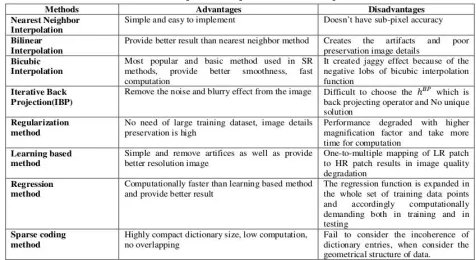
SISR techniques can be broadly classified into interpolation-based, reconstruction-based, and learning-based techniques. Interpolation-based methods such as bicubic interpolation remain the bulwark of digital zoom in consumer software and devices, but produce blurring or ringing artifacts. Reconstruction-based techniques produce water-color like artifacts. SISR performance has been achieved using learning-based, reconstruction based and interpolation based techniques, comparing with other methods learning based method give high quality image as output. In learning-based SR methods, a mapping from LR patches to their corresponding HR patches is learnt using set of LR-HR patch pairs. Most of them are memory and computation intensive due to formation of an HR patch database or searching LR-HR patch pairs within the same image. Direct nonlinear regression mapping between LR and LR-HR patches gives good results with memory and time efficiency.
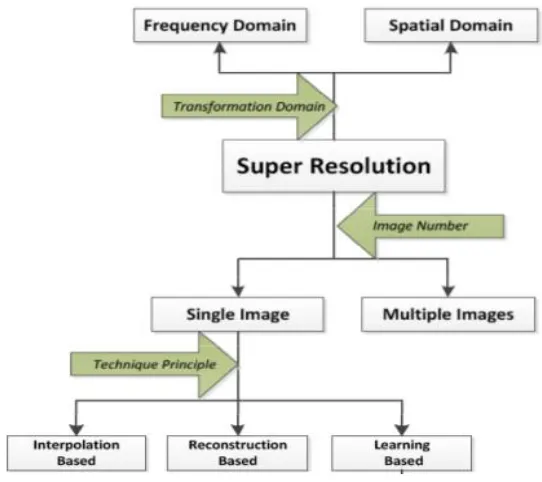
According to technique principle and input and output data form, current super resolution algorithms can be divided into various types. The division standards also include transformation domain, the number of input image, color space and so on.
Frequency domain and spatial domain are divided from the perspective of signal transformation domain. Based on input number of image, we can obtain single image based super resolution and multiple images based super resolution. According to technique principle, super resolution can be divided into three types, namely, interpolation based, reconstruction based and learning based. And among existing super resolution methods, reconstruction based method and learning based method are the most popular ones. Most multiple images based super resolution algorithms are reconstruction based methods. These algorithms assume that there is a target high resolution image and the low resolution observations have some relative geometric displacements from the target high resolution image. They usually exploit these differences between low resolution observations and the targeted high resolution image, and hence are referred to as reconstruction based super resolution algorithms.
Super-Resolution techniques are mainly classified as
A. INTERPOLATION BASED SUPER-RESOLUTION:
This method try to recover missing information from neighboring pixels. It is quite straightforward but the quality is not tolerate when the scaling factor is getting larger. Interpolation is a method of constructing new set of data points within the range of a discrete set of known data points. Disadvantage is produce blurring or ringing artifacts. Mainly used Interpolation based techniques are
a.Bilinear Interpolation:
Bilinear interpolation is an extension of normal mathematical linear interpolation for interpolating functions of two variables (e.g.,x and y) on a rectilinear 2D grid. The main idea is to perform linear interpolation first in one direction(row), and then again in the other direction (coloumn). Bilinear interpolation is performed by finding linear interpolation between adjacent pixels. This can be done by finding the average gray value between two pixels and use that as the pixel value between those two. We can do this for the rows first, and then we take that result and expand the coloumns in the same way.
b
.
Bicubic Interpolation:
This is the Godzilla of pixel interpolation algorithms. It gives absolutely good results with negligible artifacts. But it requires an extreme number of complex calculations and it is very hard to understand. Bicubic Interpolation takes a weighted average of the 16 pixels to calculate its final interpolated value. Bicubic gives sharper images than other two methods. This techniques take more computational time. When time is not an issue then this technique give the best result among all other techniques.
c.Nearest Neighbour
:
Fig 1: Taxonomy of Super-Resolution Techniques
B. RECONSTRUCTION BASED SUPER-RESOLUTION:
This method assumes that the observed LR image could be represented as a degraded HR image. The degradation model consists of down-sampling, blurring, and some additional noise. The given prior knowledge can be adopted to improve the edge strength and to relax the aliasing artifacts in the reconstructed HR image. The amount of missing information is proportional to the scaling factor. Thus it is hard to reconstruct a plentiful image detail by the LR image itself when dealing with large scaling factors. Dis-advantage: It produce water-color like artifacts. Reconstruction based techniques are mainly divided as
a. Iterative Back Projection
:
In IBP approach HR image is estimated by back projecting the difference between the simulated LR image and captured Low-resolution on interpolated image. This iterative process of SR does iterations until the minimization of the cost function is achieved. In this approach, High-resolution image is estimated by back propagating the error (difference) between simulated LR image via imaging blur and the observed LR image. And this process is iteratively repeated to minimize the error.
b. Regularization Methods
:
The basic idea of regularized SR approach is to incorporate some prior knowledge about the desired HR image to constrain the solution space. Propose an algorithm using two complementary regularization terms: steering kernel regression total variation (SKRT) and a non-local total variation (NLTV). Total regularization term is used to guide iterative back-projection process and minimize the SR reconstruction error.
C.
EXAMPLE-BASED SUPER-RESOLUTION:
Patch recurrence is the appearance of the same local structures at different locations in the same image due to relative homogeneity of patches of the same object and similarity between many objects. This allows learning of a mapping from downscaled patches to original patches with the hope that it will generalize to unseen patches that need to be upscaled. Techniques that utilize the correspondence between a set of pairs of LR and HR patches are also known as example- based super-resolution.
When the example LR-HR patch pairs are sampled from an image (and its downscaled version) whose upscaled version is sought, the technique is called internal example-based SISR. When the example pairs are sampled from a separate set of images (and their downscaled versions) than the image whose upscaled version is sought, then it is termed external example-based SISR. Example-based Super- Resolution techniques are mainly divided as
a. Regression Based SR techniques
:
feature space. However, the speed of searching the nearest cluster for the desired mapping function is still the trouble of the system. This problem is getting critical when the number of mapping function is increased.
b. Sparse Coding SR techniques
:
Dictionaries are crusial in sparse coding based algorithms for image SR.Sparse coding is a typical unsupervised learning method to study the relationship between the patches of high and low resolution images. Built a compact dictionary for sparse reconstruction. Solving the sparse representation is still a time consuming process.
c. Learning based SR techniques
:
Learning based approaches restore the detail by using trained dataset. The co-occurrence LR-HR patches involved in the dataset would be helpful to learn the correlation between LR and HR patches and then construct a LR to HR dictionary. Learning based SR techniques are divided in to three: Supervised Learning , Unsupervised Learning, reinforcement Learning
.
Fig 2: Classification of Super-Resolution Techniques
IV. CONCLUSION
Information revealed by LR images is so limited that the accuracy of the resulting recognition is very low. Thus the LR problem forms one of the most challenging issues in recognition. Super-Resolution techniques have been employed to address the LR problem of imaging system. It can generate an HR image from either a sequence of LR images or a sin- gle frame LR image. Producing High-Resolution image from a Low-Resolution image to enhance the information revealed by image and increases the accuracy of the resulting Recognition. Super-resolution techniques can be used to address the LR problems of imaging system. We use Dimensionality Reduction Techniques to enhance the estimation optimization energy on perceptually salient features such as edges. We also tapped into the ability of learning based single image super-resolution techniques to hierarchically learn refinements of a nonlinear function to model the mapping from LR to HR patches.
REFERENCES
[1] Fast Learning-Based Single Image Super-Resolution, Neeraj Kumar and Amit Sethi, IEEE Transactions on Multimedia IEEE 2016
[2] D. Glasner, S. Bagon, and M. Irani, Super-resolution from a single image, in Computer Vision, 2009 IEEE 12th International Conference
on, 29 2009-oct. 2 2009,pp. 349 356.
[3] A. Lukin , A. S. Krylov and A. Nasanov, Image Interpolation by Super- resolution [2006] International conference Graphicon, Novosibirsk
Akademgorodok, Russia.
[4] S. Dai, M. Han, W. Xu, Y. Wu, and Y. Gong, Softedge smoothness prior for alpha channel super resolution (2007) IEEE Computer
Vision and Pattern Recognition, pp. 1-8.
[5] W. T. Freeman, T. R. Jones, and E. C. Paztor, Example based super- resolution (2002) IEEE Computer Graphics and Applications, Vol. 22, No. 2, pp. 56-65.
[6] J. Sun , N. N. Zheng, H. Tao and H. Y. Shum, Image Hallucination with primal sketch priors (2003) IEEE Computer society Conference
on Computer Vision and Pattern Recognition, Vol. 2, pp. 729- 736.
[7] X. Li and M. T. Orchard, New edge-directed interpolation (201) IEEE Transactions on Image Processing, Vol. 10, No. 10, pp.
1521-1527.
[8] H. Chang, D. Y. Yeung and Y. Xiong, Super-resolution through neighbor embedding (2004) IEEE Computer society Conference on
Computer Vision and Pattern Recognition, Vol.1, pp. 275-282.
[9] P. Purkait and B. Chanda, Fuzzy- Rule based Approach for Single Frame Super Resolution (2013) In Proceedings of the IEEE
International Conference on Fuzzy Systems (Fuzz-IEEE 13).
[10] Michael. K. Ng, H. Shen, E. Y. Lam, L. Zhang, A Total Variation Regularization based Super- resolution Reconstruction Algorithm for Digital
Video (2007) EURASIP Journal on Advances in Signal Processing, Volume 2007, Article ID 74584,2007.
[11] H. Pandey, P. Swadas, M. Joshi, A Survey of Techniques and Challenges in mage Super-resolution Reconstruction (2013), International
Journal of Computer Science and Mobile Computing, Vol. 2, Issue. 4, pp. 317 -325.
[12] Dr. M. Senthil Murugan "Comparative Study on Super Resolution Image Reconstruction Techniques" Professor and Head,