W. L. WACHTER
Lafayetle College, Easlon, Pennsylvania
Received July 6, 1926
TABLE OF CONTENTS
P A G E
INTRODUCTION . . . The relation of brown to black-eyed
The relation of dilution to black-eye The relation of dilution to piebald. .
LITERATURE CITED. . .
The relation of brown to piebald. . . . . . 110
INTRODUCTION
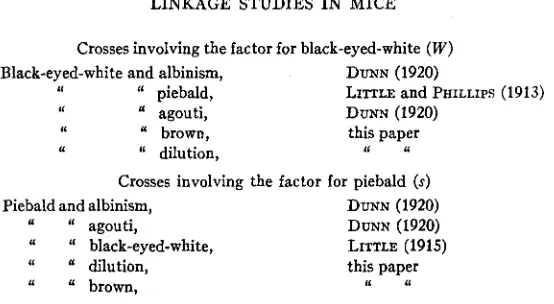
Since WRIGHT'S (1917) review of the inheritance of color in mammals, investigation of the genetics of the house mouse has shown independent inheritance of all known genetic factors except two, those for albinism and pink-eye, which are linked. At the time of WRIGHT'S review there were yet no data concerning the inter-relationships of the genes for dilution, brown, black-eyed-white spotting, and piebald spotting. A record of work done with these four factors may be found in the following publica- tions:
Crosses involving the factor for brown ( b )
Brown and albinism,* agouti,
11 11
" " dilution, " piebald,
" black-eyed-white,
LITTLE and PHILLIPS (1913)
11 I 1 11 11 '1 11 11 11
this paper
11 11
Crosses involving the factor for dilution ( d )
Dilution and albinism,* LITTLE and PHILLIPS (1913)
'1 '1
U 11 11 ' I
'1 '1 11 "
agouti,
" " brown,
" " piebald, this paper '1 " " black-eyed-white,
The data given in this paper were obtained from work done a t the BUSSEY INSTITUTION,
* Albinism and pink-eye are located in the same chromosome so that genes which segregate
HARVARD UNIVERSITY.
independently of one will also segregate independently of the other.
LINKAGE STUDIES I N MICE 109
roTAL
356 160 516
321 373 694
677 533 1,210 Crosses involving the factor for black-eyed-white (W)
Black-eyed-white and albinism, DUNN (1920)
I1 piebald, LITTLE and PHILLIPS (1913)
11 DUNN (1920)
U agouti,
" brown, this paper " dilution,
Crosses involving the factor for piebald (s)
11
11 I1 U
Piebald and albinism, DUNN (1920)
U agouti, DUNN (1920)
" " black-eyed-white, LITTLE (1915) " dilution, this paper
U U brown, I1 U
CROSS-
OVERS
-- 188
89
277
132 192 324
320 281 601 THE RELATION OF BROWN TO BLACK-EYED-WHITE
The factor for brown pigmentation ( b ) is recessive to that for black ( B ) .
It has been shown to segregate independently of the factors for agouti, dilution, pink-eye, and albinism (LITTLE and PHILLIPS, 1913). The present paper considers two other relationships, that of brown to black-eyed-white, and of brown to piebald.
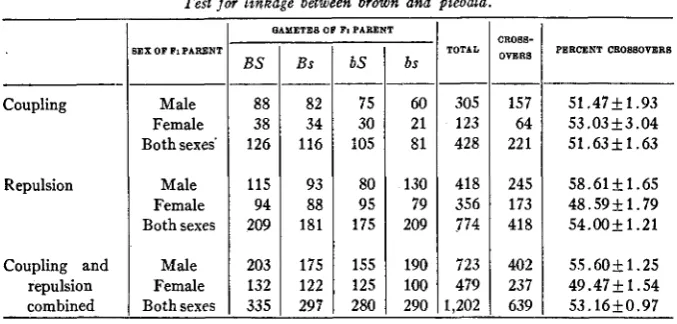
In the brown Xblack-eyed-white matings, data were obtained a s recorded in table 1. I n the coupling series, the F1 males and females of the
TABLE 1
Tests for linkaxe between brown and black-eyed-whilc.
Coupling
Repulsion
Coupling and repulsion combined
I I QAMETES OF FI PARENT
-
SEX O F PI PARENT B W
Male 70
Female 43
Both sexes 113
Male 68
Female 70
Both sexes 138
Male 138
Female 113
Both sexes 251
-- Bw
107 53 160
65 103 168
172 156 328
bW
61 18 79
67 89 156
128 107 235
-- bw
118 46 164
121 111 232
239 157 396
-
PERCENT CROSSOVER8
52.80+ 1.79 55.62k2.67 53.68k1.48
41.12k1.88 51.47 k 1.75 46.68+ 1.28
48.74k 1.30 52.72k 1.40 49.66 +O. 97
genetic formula
Bb Ww
were obtained from the cross, brown-eyed-white(bbWwss)
X black piebald (non-black-eyed-white) of the genetic formulaBBwwss.
The factor s, the recessive allelomorph of the factor for self (S) is common to all animals in the experiments involving the black-eyed- white factor, and may be omitted from the formulae.These Fl's were mated to the double recessives, brown piebalds, producing the four types of F1 gametes
B W ,
B w ,
bw,bW,
as shown bythe character of the young produced (See table 1).
On the hypothesis that B and W are independent in their inheritance, equal numbers are to be expected in all four classes, and this expectation is approximately realized although there is regularly a deficiency of black- eyed-whites (combinations containing W ) . This deficiency occurs consistently in all these experiments, but since black-eyed-whites occur both in the crossover (BW and bw) and in the non-crossover
(Bw
and bW)classes, the deficiency does not affect the crossover value to any extent. The total number of young raised in the coupling series was 516 of which 277 or 53.68 1.48 percent were crossovers. Since the crossovers deviate from the 50 percent value expected on random assortment by less than three times the probable error, there is apparently no linkage.
I n the repulsion series, black-eyed-whites (BBWw) were mated to brown piebalds (bbww) and Fl’s (BbWw) of both sexes were crossed back to the double recessive. Here again, of the four possible combinations of F1 gametes from the doubly heterozygous parent, those containing the black-eyed-white factor are deficient. The crossover frequency in this case was 46.68f1.28 percent. The expected 50 percent of crossovers is not realized, but the deviation is only 3.32 percent which is less than three times the probable error.
A total of 1,210 animals was raised in the whole experiment. Of these, 601 were crossovers constituting a crossover percentage of 49.66 t 0 . 9 7 . The deviation from 50 percent is less than the probable error and conse- quently not significant.
THE RELATION O F BROWN TO PIEBALD
Piebald and black-eyed-white, the two principal spotting factors in mice, were first shown to be independent by LITTLE (1915). The piebald character is distinguished from the black-eyed-white in having a greater pigmented area. High-grade piebalds, obtained by the selective elimination of the darkening modifying factors, may resemble black-eyed-whites, but under normal conditions a black-eyed-white of the genetical constitution
Wwss may be readily identified. It is when the gene for self ( S ) , the
dominant allelomorph of piebald (s), is present that the pigmented area is extended so that a black-eyed-white, resembles a piebald. The piebald factor is also inherited independently of the factor for pink-eye (DUNN
1920) and consequently of albinism which is linked with the gene for pink-eye. Tests for linkage between the genes for piebald and agouti have given negative results (DUNN 1920, and WACHTER 1921).
LINKAGE STUDIES IN MICE 111
BS
88
38 126
115 94 209
203 132 335
brown piebald. The four types of gametes shown to have been formed and their respective frequencies are recorded in table 2. The crossover gametes of the type Bs and bS produced 221 young or 51.63
k
1.63 percent of the total 428 young obtained. The deviation of 1.63 percent from the 50Bs
--
82 34 116
93
88
181
175 122 297
percent expected just equals the probable error.
TABLE 2
Test for linkage between brown and
Coupling
Repulsion
Coupling and repulsion combined
EX OF Fi PARENT
Male Female
Both sexes’
Male Female Both sexes
Male Female Both sexes
QAYITEB O F PI PARENT
bS
75 30 105
80
95 175
155 125 280
bs
60
21 81
130 79 209
190
100
290
piebald.
-
TOTAL
305
123 428
418 356 774
723 479 1,202
L_
-
CROBB-
OVERS
157 64 22 1
245 173 418
402 237 639
-
PERCENT CR0880VERS
51.47 k 1.93
53.03 k 3 . 0 4
51.63f 1.63
5 8 . 6 1 k 1 . 6 5 4 8 . 5 9 k 1.79 5 4 . 0 0 k 1 . 2 1
5.5.60k 1.25
49.47 k 1.54
5 3 . 1 6 k 0 . 9 7
I n the repulsion series, Fl’s were taken from the crosses between brown selfs (bbSS) and black piebalds (BBss), and they gave in backcrosses a total of 774 young. Of these 418 resulted from the union of crossover gametes of the types BS and bs with the double recessive gametes. These types of zygotes, constituting 54.00 percent of the number recorded, show no deficiencies of crossovers such as would be expected if linkage occurred. The combined data give a total of 1,202 young of which 53.1650.97 percent are crossovers. The excess of crossovers is slightly more than three times the probable error, but undoubtedly has no statistical significance.
THE RELATION OF DILUTION TO BLACK-EYED-WHITE
Previous genetic tests for the factor for dilution have shown no linkage with any other factor. LITTLE and PHILLIPS (1913) have obtained data showing dilution to be inherited independently of the genes for albinism and pink-eye, agouti, and brown. Indirect observations would indicate that dilution, black-eyed-white, and piebald are independent factors, and the following data from direct sources confirm this view.
I n the tests involving the genes for dilution and black-eyed-white, considerable difficulty was experienced in breeding the homozygous dilute animals. This strain did not show the usual vigor found in other
varieties of BUSSEY stock. Where the dilute animal was a female the number of litters was reduced. Within the litter was also found a great degree of differential mortality, for many of the animals did not reach maturity, the survival value of the double recessives, dilute piebalds, being the lowest of the dilute classes. This element does not alter the value of the results of the experiment, however, for the young could always be classified before they were weaned, a t which time the depletion of the litter was most evident.
This particular kind of deficiency was different from that of the previous crosses involving the black-eyed-white factor. Those data showed that the proportion of black-eyed-whites to non-black-eyed-whites was 604 to 961, giving a large deficiency of black-eyed-whites. This deviation from the 1 : 1 ratio is so great that some factor other than that of chance alone must be operative. I n these dilute X black-eyed-white crosses, however, the deficiency is not at all evident until the young are three or four weeks old, for the numbers of dilute and intense colored animals are 310 and 326 respectively, approximating the 1 : 1 ratio.
The deficiency of black-eyed-whites is undoubtedly due to the modify- ing factors previously mentioned, and the presence in some of the stock of the factor for self in a heterozygous condition, which may mask the presence of the black-eyed-white factor, for earlier work has not shown any inviability of the black-eyed-white factor when heterozygous.
Because of the difficulty of raising the dilute piebald animals, dilute black-eyed-whites (ddWw) were mated to intense colored piebalds (DDww).
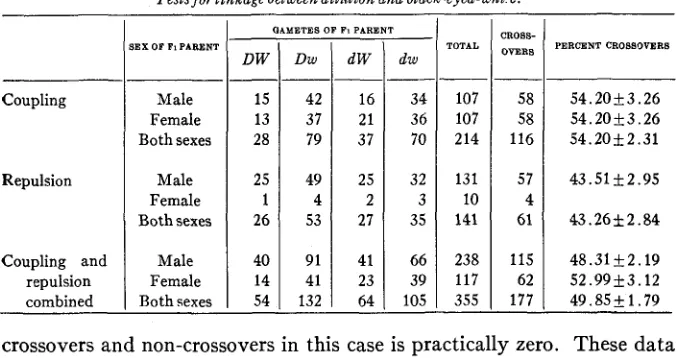
The black-eyed-white intense colored young (DdWw) obtained in the F1 generation were then mated to double recessives. The progeny of these matings included 214 individuals, of which the two crossover classes, dilute piebalds and intense black-eyed-whites, numbered 116 animals. This gives a crossover percentage of 54.20+2.31. The deviation from the expected 50 percent is 4.20 percent, a value slightly less than twice the probable error.
LINKAGE STUDIES I N MICE 113
Dw
42 37 79
49
53
91 41 132
The total results of this test included 355 animals raised in the back- cross generation in both the coupling and repulsion series. Of these 177 or 49.84 f 1.79 percent were crossovers. The deviation from equality of
TABLE 3
Tests for linkage between dilution and black-eyed-whi‘e.
dW
16 21 37
25
4 2
27
41 23 64
___-
Coupling
Repulsion
Coupling and repulsion combined
E X OF F I PARENT
Male Female Both sexes
Male Female Both sexes
Male Female Both sexes
-
DW
15 13 28
25
1
26
40 14 54
-
dw
34 36 70
32 3 35
66 39 105
-
TOTAL
107 107 214
131 10 141
238
117
355
-
CROSS-
OVERS
58 58 116
57 4 61
115 62 177
-
PERCENT CROSSOVERS
5 4 . 2 0 5 3 . 2 6 5 4 . 2 0 5 3 . 2 6 5 4 . 2 0 k 2 . 3 1
43.51 k 2.95
43.26 f 2.84
48.31 5 2 . 1 9 5 2 . 9 9 k 3 . 1 2 49.85 1.79
crossovers and non-crossovers in this case is practically zero. These data are shown in table 3.
THE RELATION O F DILUTION TO PIEBALD
The observations of LITTLE and PHILLIPS (1913) did not consider the possibility of linkage between the genes for dilution and piebald. I n the present work a few data were obtained from matings involving these two factors. I n the coupling series, both males and females heterozygous for dilution and piebald were obtained from matings of dilute piebald (ddss)
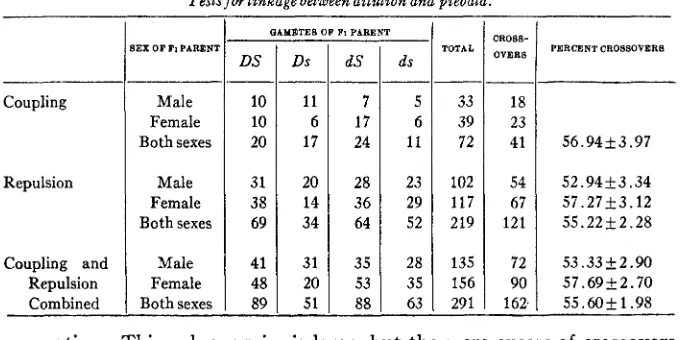
and intense colored selfs (DDSS). I n the backcross generation 72 young were recorded of which 41 or 56.94 percent were crossovers. I n the re- pulsion series Fl’s from dilute selfs (ddSS) Xintense colored piebalds
(DDss) produced 219 young in the backcross generation. Of these 121
o r 52.22k2.28 percent were crossovers. I n both series the crossover frequencies were high, although within the limits of the probable error which is rather large due to the small numbers involved. Such high frequencies of crossover values are indicative of independent assortment and the tests were accordingly discontinued.
Of the four types of gametes expected from the F1 animals in these tests, those carrying the gene for piebald are slightly deficient. There were 177 selfs and only 114 piebalds. This deficiency is similar to that of the black-eyed-whites in that the probability of obtaining a like distribution
CROSS- OVERS
as a result of chance alone is extremely small. I n the conbined data a s shown in table 4 this deficiency is distributed between the crossovers and non-crossovers.' Combining the coupling and repulsion series, the cross- over percentage is 55.60k1.98, based on 291 animals in the backcross
TABLE 4
Tests for linkage between dilution and piebald.
PERCENT CROSSOVERS
Ds
11 6 17
20 14 34
-
DS d S ds
---
7 5
17 6
24 11
28 23
36 29
64 52
10 10 20
31 38 69 Coupling
Repulsion
Coupling and Repulsion Combined
____-
Male Female Both sexes
Male Female Both sexes
Male Female Both sexes
TOTAL
18 23 41
54 67 121
72
90 162. 33 39
72
102 117 219
135 156 291
56.94k3.97
52.94k3.34 57.27k3.12 55.22rt2.28
53.33k2.90 57.69k2.70
5 5 . 6 0 + 1.98
generation. This value, again, is large, but the mere excess of crossovers denotes independence in inheritance of the two genes, and as the devia- tion from 50 percent is less than three times the probable error, i t has n o statistical significance.
CONCLUSION
These data show (1) that the factors for brown and black-eyed-white are independent, (2) that brown segregates independently of the factor for piebald spotting, (3) that the factor for dilution is not linked with that for black-eyed-white nor (4) with the factor for piebald. These four factors are mutually independent, and segregate from all the other factors constituting the hereditary complex of the house mouse after the fashion of independent Mendelian inheritance.
LITERATURE CITED
DUNN, L. C., 1920 Independent genes in mice. Genetics 5: 344-361.
LITTLE, C. C., 1913 Experimental studies of the inheritance of color in mice. 102 pp. 5 pis.
Carnegie Inst. Washington Publ. 179.
Amer. Nat. 49: 727-740.
mice. Amer. Nat. 47: 760-762.
1915 The inheritance of black-eyed-white spotting in mice.
LITTLE, C. C., and PHILLIPS, J. C., 1913 A cross involving four pairs of Mendelian characters i n
WACHTER, W. L., 1921 Data concerning linkage in mice. Amer. Nat. 55: 412-420.