ABSTRACT
SREENIVASA, ABHISHEK B. I/O Coordination for Co-Running Scientific Applications to Improve Parallel I/O Performance. (Under the direction of Xiaosong Ma.)
Despite advancements in the I/O subsystem, there is an ever increasing performance
gap between computation and I/O in high-performance computing (HPC) systems
mak-ing I/O highly bottleneck prone. Although applications have dedicated access to compute
nodes, the file system is typically shared by all applications running on the system.
With-out coordination, applications interfere with each other while accessing the file system,
resulting in significantly degraded application and file system performance.
In our work, we focus on improving the I/O performance of scientific applications
that perform checkpoint I/O by reducing I/O contention between co-existing jobs. We
approach this by proposing two different mechanisms—backoff and locking—that allow
I/O coordination between applications that contend for file system resources. The aim
of I/O coordination is to prevent multiple applications from performing checkpoint I/O
simultaneously. The benefits of coordination are better files system throughput and
application performance. Withbackoff, each application writes a small amount of dummy data to the file system before starting a checkpoint operation. Based on the perceived
throughput of this probing operation, the application decides to either back off and probe
again, or perform the checkpoint operation. Withlocking, each application acquires a lock from a centralized server before performing the checkpoint operation. The centralized
server services applications in FIFO order, allowing only one application to acquire the
lock at any given time.
We evaluate our proposed approaches with pseudo applications generated with the
the baseline system (without any I/O coordination scheme), backoff, and locking. Our
experiments showed an average of 19.22% and 81.38% reduction in I/O completion time
with backoff and locking, respectively, over base case with a system running 10 jobs
simultaneously. We noticed a significant reduction in makespan time of the application
set with our proposed mechanisms. The percentage variance in checkpoint duration
reduces with locking. Backoff, however, shows an increased percentage variance than
c
Copyright 2012 by Abhishek B. Sreenivasa
I/O Coordination for Co-Running Scientific Applications to Improve Parallel I/O Performance
by
Abhishek B. Sreenivasa
A thesis submitted to the Graduate Faculty of North Carolina State University
in partial fulfillment of the requirements for the Degree of
Master of Science
Computer Science
Raleigh, North Carolina
2012
APPROVED BY:
Frank Mueller Rudra Dutta
Zhe Zhang Xiaosong Ma
DEDICATION
BIOGRAPHY
Abhishek B. Sreenivasa was born in Bangalore, India on February 15th, 1985. He received
Bachelor of Engineering degree in Electronics and Communication in June 2007 from
R.V. College of Engineering. After graduating, he worked as a software development
engineer at Cisco Systems, Bangalore. He began his Master of Science in Computer
Science at North Carolina State University in August 2009. After graduation, he will
ACKNOWLEDGEMENTS
I’m very thankful for my advisor, Dr. Xiaosong Ma, for guiding me in my graduate
studies for the past two years. It’s not often that one gets an advisor who can motivate, be
inspirational, show confidence in your work, allow you to work on cutting-edge technology,
and be cool. I’m grateful for her for being all that.
I’d like to thank Dr. Zhe Zhang for being my mentor and guiding me through my
research work. I would also to thank the committee members, Dr. Frank Mueller and
Dr. Rudra Dutta, for their guidance. Our work would not have been possible without
NCSU’s ARC cluster. I’d like to thank Dr. Frank Mueller again for setting up this
system.
It’s been a pleasure working with PALM research group for the last two years. I’m
thankful for interesting interesting discussions and help that I’ve received over these
years.
I had the opportunity of working with some of the great minds at Oak Ridge National
Laboratory. I’d like to thank Galen Shipman for giving me an opportunity to intern in
Technology Integration group. I’d like to express my gratitude to Kenneth Matney, Sr.
and Scott Klasky for guiding me.
Last but not the least, I’d like to thank all friends, roommates, and family, especially
TABLE OF CONTENTS
List of Tables . . . vi
List of Figures . . . vii
Chapter 1 Introduction . . . 1
1.1 Research Overview . . . 4
1.2 Thesis Outline . . . 5
Chapter 2 Background . . . 6
2.1 IOR Benchmark . . . 6
2.2 PMPI . . . 7
Chapter 3 I/O Coordination Mechanisms . . . 9
3.1 Backoff . . . 9
3.1.1 Design . . . 10
3.1.2 Implementation . . . 14
3.1.3 APIs . . . 15
3.2 Locking . . . 16
3.2.1 Design . . . 16
3.2.2 Implementation . . . 20
3.2.3 APIs . . . 22
Chapter 4 Experimental Evaluation. . . 23
4.1 Experimental Setup . . . 23
4.1.1 ARC Cluster . . . 23
4.1.2 Scripts . . . 24
4.2 Results . . . 25
Chapter 5 Related Work . . . 35
Chapter 6 Conclusion . . . 38
LIST OF TABLES
Table 1.1 Variation in checkpoint I/O completion time of S3D . . . 3
LIST OF FIGURES
Figure 2.1 Extending MPI using PMPI . . . 7
Figure 3.1 Probing on parallel file system . . . 13
Figure 3.2 MPI prober . . . 14
Figure 3.3 Lock state in locking server . . . 17
Figure 3.4 Timing diagram of interaction between applications and locking server . . . 19
Figure 3.5 Locking with and without order preservation on parallel file system 20 Figure 3.6 Overview of acquire lock() API . . . 21
Figure 3.7 Overview of release lock() API . . . 21
Figure 4.1 Timeline graph of identical workloads without I/O coordination . 26 Figure 4.2 Timeline graph of identical workloads with backoff . . . 27
Figure 4.3 Timeline graph of identical workloads with locking . . . 28
Figure 4.4 Timeline graph of mixed workloads without I/O coordination . . . 29
Figure 4.5 Timeline graph of mixed workloads with backoff . . . 30
Figure 4.6 Timeline graph of mixed workloads with locking . . . 31
Figure 4.7 Application set makespan time versus number of co-running appli-cations . . . 31
Figure 4.8 Per-application I/O completion time versus number of co-running applications . . . 32
Chapter 1
Introduction
High-performance computing (HPC) systems are used to solve a variety of scientific
problems. They comprise of hundreds to thousands of compute nodes, fast interconnects,
one (or few) file system(s), and specialized software.
The computational performance of high-performance computing (HPC) systems has
increased tremendously over the years with the current state-of-the-art systems reaching
several petaflops [9]. Among other things, the scalability of compute nodes, with
top-of-the-line systems comprising of several thousand nodes, is responsible for the increase in
computational power. Despite advances in I/O subsystem, the growth of compute power
has outpaced that of the I/O throughput, making I/O increasingly bottleneck prone [23].
In this work, we focus on reducing the I/O resource contention between parallel
applications that execute simultaneously. Note that most scientific applications do not
scale up to utilize all the compute nodes available on a system for a number of reasons.
Applications are tuned to strike the right balance between the size of the data set involved
in simulation and the number of compute nodes. Increasing the number of compute nodes
the application as it may increase the communication and I/O overhead. With imbalance
in performance of components in HPC system, applications are configured to utilize only
a part of the compute nodes available on the system. To improve the utilization of the
system’s compute resources, more than one application, each having exclusive access to
a set of compute nodes allocated to it is allowed to run on the system simultaneously.
Compute resource managers and schedulers are responsible for scheduling applications. A
variety of scheduling algorithms are available [18] that improve compute node utilization.
HPC systems are typically equipped with one (or few) shared file system(s). Unlike
compute nodes that are exclusive to a single application, file system is shared by all
applications running on a cluster or supercomputer. In addition, file system also
han-dles requests from interactive commands from the user. Jaguar [12], the leadership-class
supercomputer managed by Oak Ridge National Laboratory, TN, comprises of 18,688
nodes and uses a Lustre file system called Spider. The scale of applications running on
Jaguar is such that typically, several dozen applications run simultaneously, and all
appli-cations share the Spider file system. This facility manages several other supercomputers.
In order to prevent islands of data spread across several file systems, all systems mount
Spider [33].
Scientific applications comprise of several iterations of compute and checkpoint phases.
In a checkpoint phase, the state of the simulation is written to the file system. These
checkpoint files are used for restarting the simulation from a given state, analyzing
inter-mediate data from a running scientific simulation, or stitching the data to form a movie
to analyze the objects of simulation over a period of time. In this work, we use the terms
scientific application and checkpoint-based application interchangeably. Unless otherwise
specified, I/O or I/O operation refers to checkpoint I/O operation. Examples of scientific
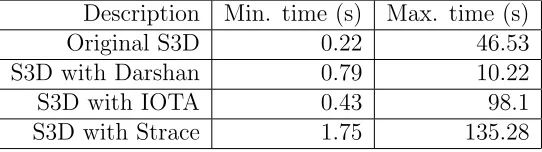
Table 1.1: Variation in checkpoint I/O completion time of S3D
Description Min. time (s) Max. time (s)
Original S3D 0.22 46.53
S3D with Darshan 0.79 10.22
S3D with IOTA 0.43 98.1
S3D with Strace 1.75 135.28
Ocean Program, S3D, Community Climate Simulation Model, etc.
With a shared file system and more than one application allowed to run on the system,
the I/O phases of applications may overlap. The consequences of overlapped I/O are
multi-fold. Firstly, simultaneous I/O requests from several applications result in increased
disk seeks, so the peak I/O throughput of file system is not achieved. Secondly, the caches
close to the file system will be shared by several applications, forcing smaller data transfer
into the caches. Finally, I/O completion rate reduces as I/O cycles are split between
applications resulting in increased idle time on compute nodes. All these contribute
to increased and highly varying application runtime. From an economic perspective,
increased application time results in increased costs as applications are billed on the
number of CPU-hours of compute nodes they utilize. So checkpoint operation is becoming
an expensive operation [27], forcing application developers to reduce the frequency of such
operations.
During a study of performance of I/O tracing tools that we conducted on Jaguar,
we noticed huge variance in I/O performance when the same application was run several
times. We used S3D [29] application configured to perform a collective checkpoint write of
2.02GB. Table 1.1 shows minimum and maximum time to finish the checkpoint I/O under
running on the system and their checkpoint I/O pattern. Generally, applications running
during off-peak hours, when there are fewer job running simultaneously, have high I/O
throughput.
1.1
Research Overview
To address the I/O contention and performance problem discussed earlier, we present
two I/O coordination mechanisms. In the first mechanism called backoff, an application
writes a small amount of dummy data into the file system to determine its throughput
just before performing a checkpoint operation. If the perceived throughput is less than
a specified threshold, the application backs off for a random duration of time before it
starts with probing all over again. If the perceived bandwidth is above the specified
threshold, the application proceeds with checkpoint I/O operation. In order to prevent
starvation, applications are allowed to perform checkpoint I/O operation when it reaches
a certain number of unsuccessful probings.
The second I/O coordination mechanism is called locking. In this approach, only one
application is allowed to perform checkpoint I/O at a time. This is enforced by requiring
each application to request a lock to use the file system before performing checkpoint
I/O. A central locking server is used to manage such a resource lock. The applications
communicate with this server to acquire and release a lock. Fairness is ensured and
starvation is avoided by serving the applications in FIFO order.
As a proof of concept, we use the NFS file system [14] in our experimental evaluation.
However, we propose ways to handle parallel file systems with multiple file servers for
both the mechanisms.
• We confirm the need for I/O coordination in checkpoint-based applications, with
large-scale experiments on a leadership-class supercomputer.
• We propose two I/O coordination mechanisms and present their design and
imple-mentation.
• We perform preliminary evaluation of our proposal with pseudo-applications based
on I/O benchmarks.
1.2
Thesis Outline
The rest of the thesis work is organized as follows. In chapter 2 we present background
information. Chapter 3 covers design and implementation of probing and locking
mecha-nisms. In chapter 4, we evaluate our work through experimentation. Chapter 5 presents
an overview of related research. Finally, we provide our conclusion along with future
Chapter 2
Background
2.1
IOR Benchmark
Interleaved or Random (IOR) is a benchmark used for analyzing I/O performance of
parallel applications [3]. It allows users to perform I/O at various levels of abstraction,
namely POSIX, MPI I/O, HDF5, and parallel netCDF.
IOR supports both read and write operations. With write operation, IOR can be
configured to check the integrity of the written data. When supported by the I/O
ab-straction, collective operation can be configured for both read and write.
A diverse set of workloads, such as file-per-process POSIX I/O, single task POSIX
I/O, file-per-process MPI I/O, collective MPI I/O, etc., can be generated using
config-urable parameters [32]. These parameters can be specified in a script file or as command
line parameters to IOR command.
Because of its versatility, we chose IOR benchmark to generate different workloads
with checkpoint operation. We created a script to automatically create IOR
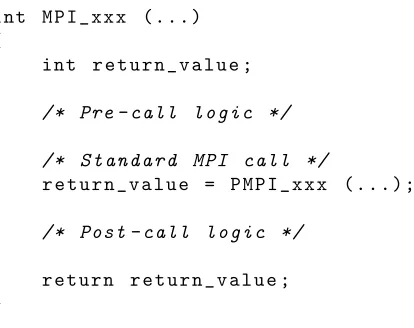
int M P I _ x x x ( . . . ) {
int r e t u r n _ v a l u e ;
/* Pre - c a l l l o g i c */ /* S t a n d a r d MPI c a l l */
r e t u r n _ v a l u e = P M P I _ x x x ( . . . ) ;
/* Post - c a l l l o g i c */
r e t u r n r e t u r n _ v a l u e ; }
Figure 2.1: Extending MPI using PMPI
obtain detailed information about the various phases of the workload, we instrumented
the IOR code to generate additional information in its report. This is discussed in detail
in section 4.1.2.
2.2
PMPI
PMPI is the profiling layer of MPI that allows profiling, tracing, and extending the
functionality of MPI calls [5]. With this interface, MPI calls can be intercepted and their
logic can be modified by wrapping standard MPI calls between user-defined code. This
is supported in C, C++, and Fortran.
An implementation of MPI that supports PMPI, such as Open MPI, provides the
MPI APIs as weak links. This allows users to define MPI functions without link-time
conflicts. The standard implementation of MPI can then be called using PMPI prefix
instead of MPI prefix. Figure 2.1 illustrates how a standard MPI call is extended using
PMPI.
in which the MPI APIs are used [7]. So PMPI can be extended for all languages by just
providing profiling wrappers in C.
In this work, we use PMPI layer to setup TCP connection between the client processes
and the locking server during MPI initialization (M P I Init). At the termination of the application, we tear down the TCP connection (M P I F inalize). In future we plan to use PMPI to embed backoff and locking calls inside MPI I/O calls and free the user from
Chapter 3
I/O Coordination Mechanisms
3.1
Backoff
To address the performance issues arising from lack of I/O coordination, we propose
backoff. It is an I/O coordination mechanism in which an application probes the file
system throughput with a small dummy data write and decides whether to back off and
probe again, or proceed with checkpoint I/O. It is a self-regulation mechanism since
it’s the applications that decide whether to back off rather than a central server
decid-ing as in lockdecid-ing. Since probdecid-ing is closely associated with backoff, we use these terms
interchangeably to refer to these mechanisms.
Without any form of coordination among applications, their checkpoint I/O phases
may overlap resulting in degradation in performance of the file system and the I/O
completion rate. It is also possible for other forms of file system activities, such as heavy
interactive commands, to overlap with checkpoint I/O. By backing off when file system
activity is high, the applications are idle for a while. However, this ensures that file
The inspiration for our proposed backoff scheme is drawn from binary exponential
backoff and truncated binary exponential backoff [10] schemes in computer networking.
In networking, the shared resource is the network medium. A node that wants to transmit
data senses the channel before transmitting. If the medium is being used, the node backs
off for a duration that is a multiple of a fixed time and a random value between 0 and
2x−1, where x is incremented by 1 after every unsuccessful transmission attempt. The truncated binary exponential backoff places a ceiling on the value of x.
3.1.1
Design
Algorithm 1Backoff pesudocode
1: iter ←0
2: exp←ST ART IN G EXP ON EN T 3: while true do
4: iter ←iter+ 1
5: beginT ime ← getTime()
6: writeDummyDataToFile(DAT A SIZE)
7: endT ime← getTime()
8: time← endT ime−beginT ime 9: rate← DAT A SIZE/time
10: if (rate≥T HRESHOLD)or (iter =M AX COU N T) then
11: break
12: end if
13: sleepT ime ←random() mod BASEexp
14: sleep(sleepT ime×BACKOF F T IM E CON ST +F IXED SLEEP T IM E)
15: exp←exp+ 1
16: end while
Algorithm 1 shows the basic principle behind backoff mechanism. In lines 5–9, the
file system is probed by writing dummy data of a configurable size to a file. Lines 10–12
or back off and repeat the probing. We use only write in probing as checkpoint I/O is
predominantly a write operation.
There are a number of parameters that can be tuned to vary the performance of
the prober. They are STARTING EXPONENT, DATA SIZE, THRESHOLD, MAX
-COUNT, BASE, and FIXED SLEEP TIME.
Determining File System Activity
The file system throughput is determined by determining the time it takes to complete
writeDummyDataToFile(). The writeDummyDataToFile() takes write size as a
parame-ter. Each time this function is invoked, a new file is created, DATA SIZE bytes of dummy
data is written to the disk, the buffers are flushed, and the file is closed.
DATA SIZE is an important parameter that we determine heuristically. In order to
reduce the overhead of probing on the file system, the DATA SIZE must be as small as
possible. However, a small data size is susceptible to caching effects resulting in both
false positives and false negatives. So it is critical to choose the right data size.
The THRESHOLD constant is the parameter that decides whether an application
should repeat probing or continue with checkpoint I/O. The maximum throughput for
a given DATA SIZE can be determined by timing the writeDummyDataToFile() during
off-peak hours when the file system activity is low. The THRESHOLD is set to 80–90%
of this maximum throughput. A leeway of 10–20% is provided to account for inaccuracies
in throughput performance measurement and to filter out small file system activities from
Backoff Parameters
The MAX COUNT parameter allows applications to break out the loop after a number
of consecutive probings and back offs. Without this option, the applications could starve
if they happen to probe at a time when file system is busy or if the throughput of the
file system decreases. Again, the value of this parameter is set heuristically.
The duration of back off is controlled by STARTING EXPONENT, BASE, FIXED
-SLEEPING TIME parameters. The actual back off time is determined by the sum of
sleepTime and FIXED SLEEP TIME, where sleepTime is a random variable with
uni-form distribution taking values between 0 and BASEexp −1.
Design on Parallel File System
Parallel file systems are used in HPC systems to achieve high performance by striping the
data across multiple file servers. Commonly used parallel file systems in HPC systems
are Lustre [4], GPFS [30], PVFS [15], etc.
Although our work is a proof of concept focusing on single file server on NFSv3 [14],
we explain how backoff and locking mechanisms can be extended to parallel file systems
with multiple file servers.
A file that is created on a parallel file system is striped across multiple file servers. File
systems provide APIs to get or set the file servers across which a file is striped. In order
to probe the correct file servers, the prober needs the list of of file servers across which a
checkpoint file is striped. This requires prober APIs to be called after the checkpoint file
is opened or created and accept file handle as a parameter. Each file server associated
with the checkpoint file is probed by writing to a file with dummy data striped across
Figure 3.1: Probing on parallel file system
probes again. If not, the application performs the checkpoint operation.
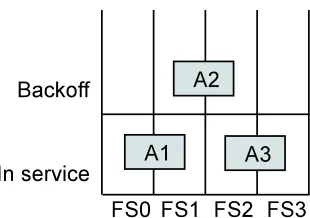
Figure 3.1 illustrates probing with three applications (A1, A2, and A3) and four file
servers (FS0, FS1, FS2, and FS3). In service area refers to the applications that are performing checkpoint I/O on the file servers. Backoff area refers to applications that have backed off after unsuccessful probing. Let us assume that A1, A2, and A3 have
overlapping I/O phases in time and are striped across two file servers each as show in in
the figure. Let checkpoint I/O of A1 begin before A2 and A2 begin before A3. A1 probes
FS0 and FS1 and proceeds with checkpoint as there is no other application performing
I/O on these servers. A2 probes FS1 and FS2, does not pass the threshold in FS1 and
backs off. A3 also performs the checkpoint operation as FS2 and FS3 are not serving
other applications. We notice out-of-order checkpoint I/O operation with applications
A2 and A3.
MAX COUNT prevents applications from starving by setting a ceiling on number
unsuccessful probings. Once the application reaches this limit, it is allowed to perform
checkpoint operation.
Since the granularity of back off applies to the entire file, the application can not write
data into file servers that pass the threshold if the overall proving fails. This could lead
/*
* C a l l e d by MPI a p p l i c a t i o n s b e f o r e d o i n g c h e c k p o i n t I / O */
v o i d M P I _ p r o b e r () {
if ( r a n k == 0) { p r o b e r (); }
M P I _ B a r r i e r ( M P I _ C O M M _ W O R L D ); }
Figure 3.2: MPI prober
benefit if it is allowed to write checkpoint data into file servers that pass the threshold as
I/O is considered complete only when checkpoint data is written to file servers that do
not pass the threshold. The file system performance may degrade due to underutilization,
but we believe performance benefits from probing will overcome this.
3.1.2
Implementation
Our backoff API library is implemented in C and is dependent on MPI library. Figure
3.2 shows how the prober that is described in algorithm 1 is extended for MPI-based
applications. Only a single MPI task is required to perform probing. In the figure, it is
rank 0. The rest of the MPI tasks synchronize with rank 0 using a barrier.
The success of this mechanism is dependent on the accuracy of determining the file
system throughput. Since each file system type behaves differently, certain file system
specific changes are made to the prober peseudocode to improve its accuracy.
Priming
We noticed the distribution of maximum throughput of file system during off-peak hours
throughput of the second call is usually higher. This affected the accuracy since prober
calls that immediately followed another I/O call showed higher throughput than the ones
that didn’t. In order to reduce this type of inaccuracy, we introduced priming where a
small amount of data is written just before calling writeDummyDataToFile(). From
trial and error method of experimentation, we found 256KB of priming data is sufficient
to fully throttle the writeDummyDataToFile() to maximum throughput in a quiet file
system.
Min. Prober
In section 3.1.1, we described the impact of DATA SIZE on probing accuracy. With
small DATA SIZE, the accuracy of probing is susceptible to caching effects. During
experimentation, we observed that accuracy can be increased significantly by probing
several times with small DATA SIZE and reporting the smallest throughput value. A
small delay is also introduced between successive probings to spread them apart.
3.1.3
APIs
3.2
Locking
Locking is an I/O coordination mechanism in which the file system is treated as a
lock-able resource for checkpoint operations. Applications request a centralized server, called
locking server, to acquire the lock, perform the checkpoint operation, and release the
lock by sending a message back to the locking server. The single, central locking server
handles the requests from applications and manages the lock.
In order to improve the performance of applications and the file system, locking
mechanism allows only one application to acquire the lock at a time. The locking server
maintains a queue and serves application in FCFS order. Any application that wishes
to acquire the lock is blocked until all applications ahead of it in the queue have been
served.
3.2.1
Design
Message Types
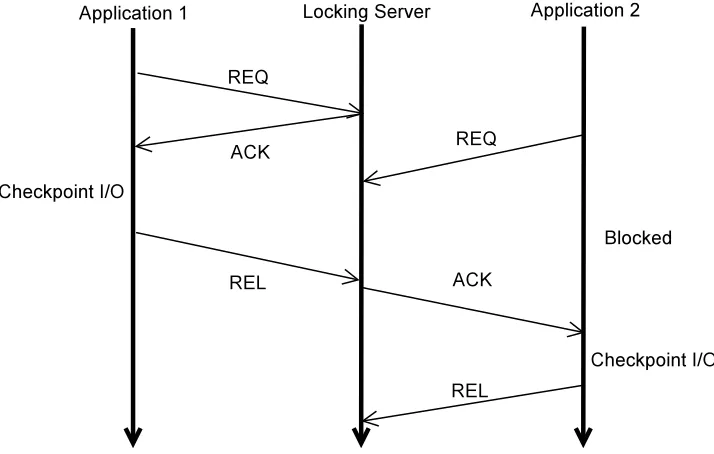
Compute nodes and the locking server exchange three types of messages over the TCP
stream:
• REQ: Lock request messages are sent by compute nodes to the locking server to
indicate that the application is ready to perform checkpoint I/O.
• ACK: The acknowledgement is sent from the locking server to indicate that the
application has acquired the lock and can proceed with checkpoint operation. The
application is blocked until the receipt of this message.
• REL: When an application acquires the lock and finishes the checkpoint operation,
Figure 3.3: Lock state in locking server
Locking Server
The locking server is a multi-threaded server that handles several asynchronous requests
from applications. For each application, it maintains a separate thread that listens to
incoming messages. When a message arrives, it is registered as an event and enqueued
in an event queue which is common to all the applications. A separate thread dequeues
the event queue and handles the message from the applications.
The locking server maintains another queue, called service queue, which is used to
the serve the applications in FCFS order. Applications whose lock request arrives when
another application has acquired the lock are enqueued in this queue. When the
appli-cation owning the lock releases it, the first element in the service queue is dequeued and
the lock is owned by the application associated with that element.
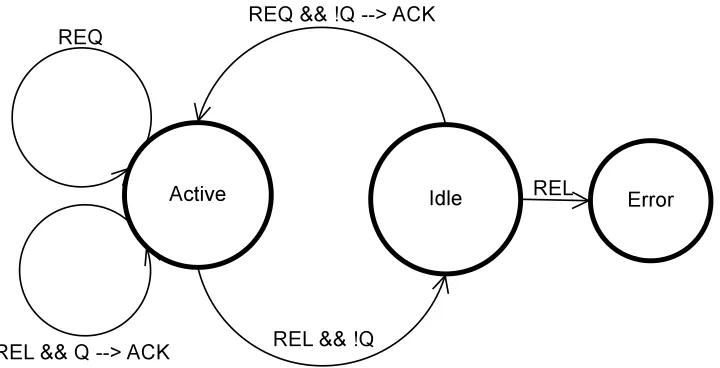
Figure 3.3 illustrates that state diagram of the lock in the locking server. A lock in in
idle state when it is not acquired by any application and active state when it is acquired.
way. The state transition occurs on REQ and REL events. The variable Q indicates the
state of the service queue. Q evaluates to false if there are no elements in the queue,
otherwise true. An ACK during the transition indicates that an ACK message is sent to
the compute node during transition.
On a supercomputer the size of Jaguar with over 200,000 cores, there are not more
than a few dozen applications running on the system simultaneously. Our locking server,
despite being implemented in an interpreted language like Python, did not show any
scalability issues when over a dozen applications were running simultaneously. So we
believe scalability would not be a challenge on large-scale systems.
Application
The application is responsible for requesting and releasing the lock, i.e., sending REQ
and REL messages. A single task from the application sends the request and the rest of
the tasks are blocked by barrier synchronization until the node that sent the REQ gets
an ACK message from the locking server.
Interaction Between Locking Server and Applications
Figure 3.4 illustrates the interactions between locking server and the applications.
Ap-plication 1 acquires the lock before performing checkpoint I/O operation and the server
receives another request from application 2. Application 2 waits for application 1 to
fin-ish the checkpoint operation and release the lock. Once the lock is released, the locking
Figure 3.4: Timing diagram of interaction between applications and locking server
Design on Parallel File System
When multiple file servers are involved, each file server is treated as a lockable resource.
An application is allowed to perform checkpoint operation only if all the file servers across
which the checkpoint file is striped are unlocked. The application locks all the relevant
file servers before performing the checkpoint I/O.
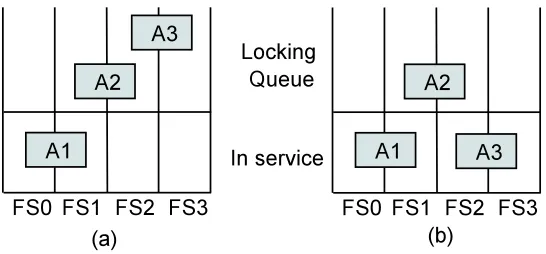
We present two locking mechanisms for parallel file systems: locking with and without
order preservation. In lockint with order preservation, an application can not perform
checkpoint I/O when the file server across which the checkpoint file is striped is not
locked and there are applications ahead of it in the locking queue. In figure 3.5, let
us assume that A1 requests lock before A2 and A2 requests before A3. Figure 3.5 (a) illustrates locking with order preservation where A3 can not proceed with checkpoint I/O
although FS2 and FS3 are unlocked as A2 is ahead of A3 in FS2 queue. This could lead
Figure 3.5: Locking with and without order preservation on parallel file system
without order preservation as illustrated in figure 3.5 (b). In this case, A3 is allowed to acquire locks on FS2 and FS3 before A2 does. A2 could starve if requests similar to A1
and A3 keep arriving. To prevent starvation, we set an upper limit on blocking duration.
Applications that are blocked for this duration are allowed to perform checkpoint I/O.
3.2.2
Implementation
In our implementation, login node serves as the locking server. A server daemon is
launched on the login node to listen to applications on a specific port. The port number
and IP address of the locking server is provided to the applications during compilation.
Locking Server
The server is implemented using Python. It is a multi-threaded service with one thread for
each application for listening to messages and an additional thread to manage the lock.
The event queue and service queue are Queue objects from Python’s Queue module.
Objects from this module are thread safe [8]. Hence, explicit synchronization is not
necessary.
v o i d a c q u i r e _ l o c k () {
if ( r a n k == 0) { s e n d _ R E Q (); w a i t _ A C K (); }
M P I _ B a r r i e r ( M P I _ C O M M _ W O R L D );
}
Figure 3.6: Overview of acquire lock() API
v o i d r e l e a s e _ l o c k () {
M P I _ B a r r i e r ( M P I _ C O M M _ W O R L D ); if ( r a n k == 0) {
s e n d _ R E L (); }
}
Figure 3.7: Overview of release lock() API
event queue. It is possible for network latency and server’s thread scheduling to alter the
order of requests that originate close to each other in time.
Application
Just before a performing a checkpoint operation, the application requests a lock by
sending REQ message to the server. This is done by calling the acquire lock() API.
After performing the checkpoint operation, the application calls release lock() API. An
3.2.3
APIs
• void acquire lock(): Call this function just before a checkpint I/O operation.
This function should be visible to all the tasks during execution.
• void acquire lock(): Call this function just after the checkpint I/O operation. This function should be visible to all the tasks during execution.
For our proof of concept work, we backoff/block at the MPI COMM WORLD
com-municator or application-level granularity. In future, we plan to make backoff and locking
APIs available at MPI communicator-level granularity.
The APIs described here and in section 3.1.3 require manual invocation in the
appli-cation code. Going forward, we plan to embed the backoff and locking logic in MPI-IO
and high-level I/O libraries. Commonly used high-level libraries in scientific applications
such as ADIOS[25], HDF-5[2], and NetCDF[6] make it easy to identify checkpoint I/O
from other forms of I/O in scientific applications. This would allow embedding of I/O
Chapter 4
Experimental Evaluation
4.1
Experimental Setup
4.1.1
ARC Cluster
Our experiments were conducted on North Carolina State University’s A Root Cluster
(ARC) [1]. The cluster comprises of 108 compute nodes, a login node, and a head node.
Each node is a dual socket board hosting two 8-core, 64-bit AMD Opetron 6128 processors
for a total of 16 cores per node. All nodes have 32GB RAM. The system has a total of
1728 cores and 3456GB of memory. All nodes are equipped with Mellanox ConnectX-2
VPI InfiniBand Adapter Card and 1GE ethernet ports. The head node acts as the NFS
server comprising of 12TB HDDs.
The cluster is setup with Rocks Cluster Distribution v5.3. The operating system
is CentOS 5.7 running Linux kernel version 2.6.32. The cluster uses Open MPI v1.5.4
implementation of MPI. Jobs are submitted to the system using Torque/Maui using PBS
4.1.2
Scripts
FCFS-based Backfilling Scheduler
Without administrative access to Torque/Maui, it is difficult to have tight control over the
order in which jobs are executed, especially when jobs are submitted by other users too.
In order to overcome this difficulty, we developed a script that implements FCFS-based
backfilling scheduler described in [26].
In order to run the experiments, a set of N nodes are requested from the system
through Torque/Maui. Once the requested resources are available, our script takes control
of the N nodes, treating them as a single HPC system with N nodes. All jobs from our
experiments are then managed and executed by the script in FCFS order. To improve
system utilization, backfilling is allowed. The jobs are submitted to our custom scheduler
by listing them in a file along with their start time relative to the start time of the
scheduler script and the job’s PBS script file.
Our scheduler script collects information about a job from the job’s PBS file. This
includes the number of nodes requested and the wall time of the script. The scheduler
script is also capable of terminating a job if it exceeds the wall clock time. The scheduler
script also gathers statistical information about the jobs and the system.
Timeline Visualization
To clearly understand the behavior of applications with and without I/O coordination
mechanisms, it was necessary to visualize the different phases on a timeline. To generate
such a visualization, we instrument IOR to log the beginning and duration of each phase
of the application into a file. Each application generates a few kilobytes of data from these
instrumentation neither impacts the performance of the application nor the accuracy of
the measurements. Once the events are recorded, we process them offline using Python
scripts to generate the timeline graphs of the application.
Job Configuration Generator
In order to test the performance of I/O coordination mechanisms, we had to generate
configurations for IOR to represent different workloads. To ensure a fair degree of
ran-domness in choosing the workloads, we developed a script that generates workloads with
their parameters treated a random variables.
The parameters of the application that are treated as random variables are compute
time, checkpoint I/O size, number of checkpoint operations, number of cores, and
ap-plication launch time relative the start of execution of custom scheduler. All random
variables conform to uniform distribution. We have control over the minimum and
max-imum value of the random variable. The random variables are time variant, i.e., they do
not necessarily take the same values on different executions of the job generation script.
4.2
Results
Identical Workload
In this experiment, we run two instances of the same application and analyze their
interaction with and without I/O coordination mechanisms. When the two identical
applications are launched simultaneously, their I/O phases coincide resulting in maximum
I/O performance degradation.
is quite common. From our observation of jobs submitted on ORNL’s Jaguar
super-computer, several instances of the same application operating on different data sets are
submitted together and the scheduler runs them simultaneously.
The two jobs that run simultaneously are configured with the same parameters. The
jobs request 16 MPI tasks each. Each application has a compute phase of 90s followed by
1024MB write in I/O phase per iteration. There is an explicit synchronization between
MPI tasks after each I/O. The real world applications may or may not have explicit
synchronization, but scientific applications are tightly coupled and make use of MPI
commands that implicitly synchronize tasks. There are three iterations in each job.
0
50
100
150
200
250
300
350
400
450
Time in s
1
2
Application ID
18.99 21.30 19.65
19.45 20.18 19.34
Compute
I/O
Figure 4.1: Timeline graph of identical workloads without I/O coordination
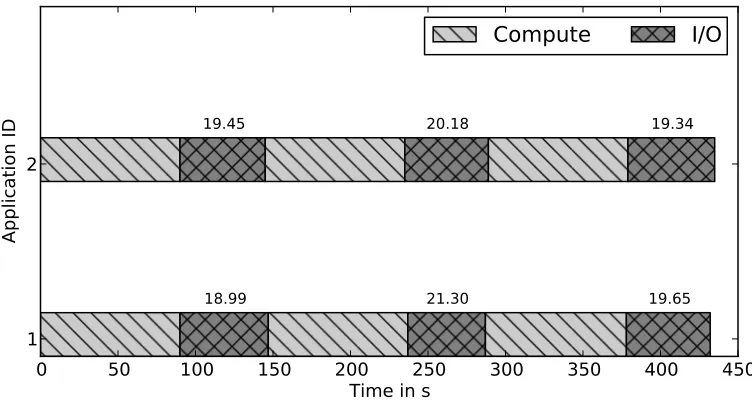
Figure 4.1 shows the different phases of the applications on a timeline graph without
I/O coordination. Both applications 1 and 2 have identical configurations, but operate
achieved for any checkpoint operation is 21.30MBps.
0
50
100
150
200
250
300
350
400
450
Time in s
1
2
Application ID
23.37 91.20 90.21
28.09 78.01 91.48
Compute
I/O
Backoff
Figure 4.2: Timeline graph of identical workloads with backoff
Figure 4.2 is the timeline graph with backoff. The peak throughput achieved using
backoff is 91.48MBps seen in the last iteration of application 2. The first iteration in both
the applications have overlapping I/O resulting is low throughput. As discussed earlier,
prober is susceptible to multi-layered caches resulting in false negatives. The prober
successfully detects the overlap in 2nd iteration and backs off resulting in a higher peak
application throughput. There is no overlap in iteration 3, and the overhead of backoff
can be observed.
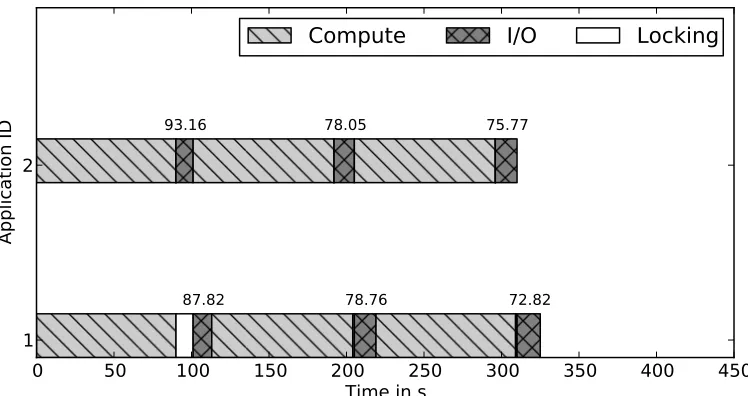
Figure 4.3 is the timeline graph with locking. As a result of locking, there is no
overlap between I/O phases of applications. In 1st iteration of application 1, we notice
that application waits for a considerable time to acquire the lock. Once the I/O phases
0
50
100
150
200
250
300
350
400
450
Time in s
1
2
Application ID
87.82 78.76 72.82
93.16 78.05 75.77
Compute
I/O
Locking
Figure 4.3: Timeline graph of identical workloads with locking
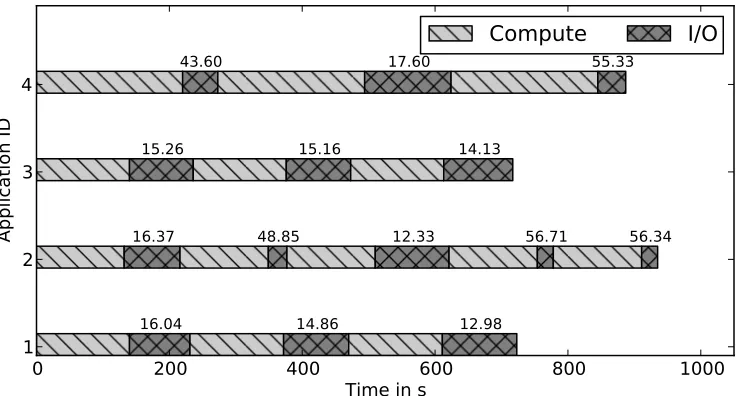
Table 4.1: IOR configuration of applications
Job ID Number of iterations I/O size (MB) Compute time (s)
1 3 1392 140
2 5 1312 132
3 3 1392 140
4 3 2192 220
The total I/O time, including I/O coordination overhead if any, from both the
appli-cations is 325.95s, 178.87s, and 92.16s for base, backoff, and locking, respectively. Backoff
and locking have 45.12% and 71.72% improvement over the base case, respectively.
Mixed Workload
In this experiment, we gather results from a mix of different workloads. We run 4
0
200
400
600
800
1000
Time in s
1
2
3
4
Application ID
16.04 14.86 12.98
16.37 48.85 12.33 56.71 56.34
15.26 15.16 14.13
43.60 17.60
Compute
55.33I/O
Figure 4.4: Timeline graph of mixed workloads without I/O coordination
were generated randomly using the job generator script described in section 4.1.2. The
configuration of the jobs are tabulated in table 4.1
In figure 4.4, we notice the timeline graph of the 4 applications without I/O
coordi-nation. The number over the I/O phase indicates the I/O throughput of the checkpoint
operation in MBps. From this figure it is clear that when I/O phases coincide, the
ap-plications’ throughput decreases. The I/O throughput reaches the maximum value when
I/O phases do not overlap. This can be observed in 4th and 5th iterations of application
2.
Figure 4.5 shows the timeline graph for backoff. In the figure, each uncolored block
indicates backoff. Multiple successive uncolored blocks indicate that application had
backed off and probed again. In the figure, we notice a total of 21 probings. Since each
probing generates 9MB of dummy data, a total of 189MB of data was generated from all
0
200
400
600
800
1000
Time in s
1
2
3
4
Application ID
49.71 52.87 18.50
46.90 56.11 55.37 12.76 56.14
54.73 56.96 50.00
56.74
Compute
12.79I/O
Backoff
57.14Figure 4.5: Timeline graph of mixed workloads with backoff
4 overlap with 3rd checkpoint operation application 1. This is a false negative resulting
from caching effects.
Figure 4.6 shows the timeline graph with locking. The uncolored blocks indicate the
period during which the application is blocked. It can be noticed that all the iterations
run at maximum throughput.
We also calculate the CPU core-hours saved from I/O coordination schemes with
respect to the base case. Backoff resulted in savings of 0.82 CPU core-hours and locking
resulted in 2.39 CPU core-hours.
The average I/O (which includes I/O coordination overhead) completion time is
275.50s, 228.98s, and 140.96s for base, backoff, and locking respectively. This shows
16.88% and 48.83% improvement in I/O completion time with backoff and locking over
the base case.
0
200
400
600
800
1000
Time in s
1
2
3
4
Application ID
55.39 53.79 53.70
55.60 56.20 55.79 53.41 54.78
57.10 56.08 56.21
56.63
Compute
55.67I/O
55.69Locking
Figure 4.6: Timeline graph of mixed workloads with locking
2
6
10
Number of co-running applications
0
100
200
300
400
500
600
700
800
Total application set makespan (s)
Base
Backoff
Locking
2
6
10
Number of co-running applications
0
50
100
150
200
250
300
350
Per-application total I/O time (s)
Base
Backoff
Locking
Figure 4.8: Per-application I/O completion time versus number of co-running applica-tions
co-running jobs and analyze their performance. The job configuration generator is used
to create jobs with random configurations. The total computation time of the experiment
is set to take a uniformly distributed value between 7 and 9 minutes. The number of
iterations is uniformly distributed between 4 and 10. Each application writes an average
of 2.4GB between the iterations. We conduct the experiment 3 times with a different job
configuration in each experiment.
In figure 4.7, we notice an increase in average application set makespan as the number
of co-running applications in the system increase. This is a result of increased I/O
con-tention between applications. In figure 4.8, we observe the time spent by an application
in performing checkpoint operation spread across all the iterations. With 2 co-running
applications, we notice that backoff mechanism takes longer than the base case. This is
2 6 10 Number of co-running applications 0
10 20 30 40 50 60 70 80
Standard deviation of checkpoint duration (%)
Base
Backoff
Locking
Figure 4.9: Standard deviation of application checkpoint duration versus number of co-running applications
jobs running simultaneously. In all other cases, the performance of locking and backoff is
better than the base case. With a loaded system comprising of 10 simultaneous jobs, we
notice 19.22% and 81.38% reduction in application I/O time with backoff and locking,
respectively.
Figure 4.9 shows the percentage standard deviation of checkpoint operations,
ob-tained by averaging the percentage standard deviation of checkpoint duration across all
checkpoint iterations of each application within a group. With 2 co-running jobs, the
variance is less compared to 6 and 10 co-running jobs for all three cases as there are fewer
overlaps in I/O phases. The variance of 10 co-running jobs is less than 6 co-running jobs
as the increased load causes most of the iterations to suffer from overlapped I/O resulting
in a uniformly poor performance. Backoff mechanism exhibits the highest variance as
Overhead and Side Effects of I/O Coordination
In this section, we experimentally determine the overhead of backoff and locking. In
backoff mechanism, the overhead is a result of writing the dummy data to probe the file
system. This also includes data written to file system for priming and the sleep calls
between probings in Min. Prober. The side effect of backoff is writing dummy files to the
file system being probed. In locking, the overhead is dependent on messages exchanged
between the application and the locking server, and the response time of the server.
There is no side effect with locking.
We collect the desired metrics by running backoff and locking instrumented
appli-cation on a quiet system. The appliappli-cation is configured to run 3 iterations. The time
between compute and I/O phase gives the average overhead with I/O coordination.
With backoff, for the configuration used in all our experiments, the average overhead
per iteration is 4.03s. Each probing also creates 3 dummy files of 3MB each and a 500K
Chapter 5
Related Work
With I/O being a bottleneck, several techniques have been proposed to improve the
performance of I/O. I/O subsystem itself includes several subcomponents such as client,
server, networking elements, and storage disks, and papers focus on one or more of these
components.
The server-side I/O coordination work presented in [34] is closely related to our work.
Their work groups the requests from an application that arrive within a time window
and services them together by order of application ID. By grouping the requests from
applications together, the disk seeks are reduced and the I/O completion rate increases.
The size of the window plays a critical role in deciding which type of I/O pattern benefits
from this approach. With small time window, checkpoint operations that output large
amount data with multiple synchronous I/O requests will be spread across different time
windows. So the file server will interleave the I/O service with requests from other
appli-cations that originate in these time windows. Setting the time window high would turn
this into a priority queue, favoring applications with low job ID. Checkpoint operations
we focus on improving checkpoint operation which is significant than other forms of I/O
in scientific applications.
Other server-side I/O performance improvement techniques aim to improve
perfor-mance at file system server. Data sieving [17] is one such technique where non contiguous
data segments are accessed as contiguous data segments by including holes that do not
belong to the requested I/O. Two-phase I/O [13] is another technique that aims to
im-prove I/O performance in parallel I/O systems by accessing data from the disks into
intermediate nodes and then distributing the data to the required nodes based on
re-quest mapping. Disk-directed I/O [22] is a combination of several techniques, including
data sieving and two-phase I/O. The information from a collective I/O is used to access
the disks in a optimal way to improve the performance. Server-directed I/O [31] is an
ex-tension of disk-directed I/O that provides high-level interface such as multi-dimensional
data sets. These applications aim at improving I/O in general, but our work is focused
on checkpoint I/O operations.
The work presented in [24] also acknowledges the problem of variability and not
realizing peak I/O performance in HPC systems. Their efforts focus on monitoring the file
server performance and balancing the load by distributing the workload to underutilized
file servers. They also focus on staggering metadata requests to improve metadata access
performance. The load balancing technique described here could complement our I/O
coordination mechanisms to further improve the performance by reducing backoff and
locking time.
Log-based file systems presented in [11] and [28] improves the performance of
check-point operations. However, this improvement in write performance comes at the cost of
reduced read performance.
applica-tions. The work presented in [16] describes a technique to provide statistical guarantee to
applications that have time-critical needs such as online transactions. These techniques
are not applicable to scientific applications as they are not time critical. A technique
for proportionally allocating file system resources for applications is presented in [19].
This work also probes the shared resource, but uses this information to regulate the
I/O requests. [20] presents multi-dimensional parameters, such as latency, space, etc.,
for providing differentiated service for applications, but it is not suitable for scientific
applications. [21] presents a feedback-based approach for providing QoS to applications
by regulating the service to applications when there is more than one application
per-forming I/O. [36] introduces a delay-based approach for ensuring QoS in applications.
[37] presents a mechanism for guaranteeing minimum QoS for when there is contention
for I/O from several applications. Performance improvement and predictability for
ap-plications that share file system is discussed in [35], but they still service requests in
an interleaved manner in checkpoint operations. All these techniques try to regulate
I/O to allow several applications to perform I/O operations simultaneously. Scientific
applications that perform checkpoint I/O do not benefit from it as they mostly address
Chapter 6
Conclusion
A common trend in the development of HPC systems over the years has been the
in-creasing gap in computational and I/O performance. With thousands of cores available
in today’s high-end HPC systems, it is possible to run large-scale applications.
How-ever, with I/O being a bottleneck, application developers are forced to reconsider the
scalability of their applications.
The architecture of today’s HPC systems is aimed at providing dedicated computing
resources to facilitate tightly-coupled scientific applications. However, all applications
share the same file system. Without I/O coordination between applications, the
appli-cation and file system performance takes a hit as a result of increased disk seeks, shared
buffers on file servers, and low I/O completion rate.
In this paper, we present two I/O coordination mechanisms to improve the
perfor-mance of applications. In backoff, the application writes a dummy data to a file to
determine the write throughput. If the file system is busy, the application backs off and
probes again, otherwise performs a checkpoint operation. In locking, the applications
The application is blocked until the lock is acquired.
Our results show 19.22% and 81.38% improvement in average I/O completion time
with backoff and locking, respectively with 10 simultaneously running applications. The
percentage variance of checkpoint duration decreases with locking compared to the base
case, but the value for backoff increases due to the randomized backoff time after an
unsuccessful probing. The makespan time of the application set is lower than base case
in both our mechanisms when there are reasonable number of jobs running on the system.
The overhead of these mechanisms is found to be negligible compared to the size of the
checkpoint operation.
Future Work
The success of locking is dependent on instrumenting all applications running on the HPC
system with calls from locking API. Despite this, it is possible for heavy interactive user
commands to interfere with checkpoint phase of applications. In backoff, applications
can detect high I/O activity in the file system even when it originates from interactive
commands or from applications that have not instrumented probing. A possible research
direction is to stack backoff on top of locking where the central server has the additional
responsibility of probing the file system before letting an application acquire a lock.
In the backoff mechanism, we use dummy data to probe the file system. This
in-troduces additional load to the system. In future, we plan to use part of applications’
REFERENCES
[1] ARC cluster. http://moss.csc.ncsu.edu/˜mueller/cluster/arc/.
[2] HDF5. http://www.hdfgroup.org/HDF5/.
[3] IOR HPC benchmark. http://sourceforge.net/projects/ior-sio/.
[4] Lustre. http://www.lustre.org/.
[5] MPI profiling layer. http://www.mpi-forum.org/docs/mpi-20-html/node233.htm.
[6] NetCDF. http://www.unidata.ucar.edu/software/netcdf/.
[7] Open MPI profiling layer. http://www.open-mpi.org/faq/?category=perftools.
[8] Queue a synchronized queue class. http://docs.python.org/library/queue.html.
[9] TOP500 supercomputing sites. http://www.top500.org/.
[10] IEEE Standards Association et al. IEEE 802.3 LAN/MAN CSMA/CD Access Method. 2008.
[11] J. Bent, G. Gibson, G. Grider, B. McClelland, P. Nowoczynski, J. Nunez, M. Polte, and M. Wingate. PLFS: a checkpoint filesystem for parallel applications. In Pro-ceedings of the Conference on High Performance Computing Networking, Storage and Analysis, page 21, 2009.
[12] A.S. Bland, R.A. Kendall, D.B. Kothe, J.H. Rogers, and G.M. Shipman. Jaguar: The worlds most powerful computer. Memory (TB), 300(62):362, 2009.
[13] R. Bordawekar, J.M. del Rosario, and A. Choudhary. Design and evaluation of primitives for parallel I/O. In Proceedings of the 1993 ACM/IEEE conference on Supercomputing, page 452461, 1993.
[14] B. Callaghan, B. Pawlowski, and P. Staubach. RFC 1813: NFS version 3 protocol specification, june 1995. See also RFC1094 [Sun89]. Status: Informational.
[15] P.H. Carns, W.B. Ligon III, R.B. Ross, and R. Thakur. PVFS: a parallel file system for linux clusters. In Proceedings of the 4th annual Linux Showcase & Conference-Volume 4, page 2828, 2000.
[17] A. Choudhary, R. Bordawekar, M. Harry, and R. Krishnaiyer. PASSION: parallel and scalable software for input-output. 1994.
[18] Y. Etsion and D. Tsafrir. A short survey of commercial cluster batch schedulers. School of Computer Science and Engineering, the Hebrew University, Jerusalem, Israel, Reporte tcnico, 13:2005, 2005.
[19] A. Gulati, I. Ahmad, and C.A. Waldspurger. PARDA: proportional allocation of resources for distributed storage access. InProccedings of the 7th conference on File and storage technologies, page 8598, 2009.
[20] L. Huang, G. Peng, and T. Chiueh. Multi-dimensional storage virtualization. In ACM SIGMETRICS Performance Evaluation Review, volume 32, page 1424, 2004. [21] M. Karlsson, C. Karamanolis, and X. Zhu. Triage: Performance differentiation for storage systems using adaptive control. ACM Transactions on Storage (TOS), 1(4):457480, 2005.
[22] D. Kotz. Disk-directed I/O for MIMD multiprocessors. ACM Transactions on Computer Systems (TOCS), 15(1):4174, 1997.
[23] S. Lang, P. Carns, R. Latham, R. Ross, K. Harms, and W. Allcock. I/O performance challenges at leadership scale. InProceedings of the Conference on High Performance Computing Networking, Storage and Analysis, page 40, 2009.
[24] Jay Lofstead, Fang Zheng, Qing Liu, Scott Klasky, Ron Oldfield, Todd Kordenbrock, Karsten Schwan, and Matthew Wolf. Managing variability in the IO performance of petascale storage systems. pages 1–12. IEEE, November 2010.
[25] J.F. Lofstead, S. Klasky, K. Schwan, N. Podhorszki, and C. Jin. Flexible io and in-tegration for scientific codes through the adaptable io system (adios). InProceedings of the 6th international workshop on Challenges of large applications in distributed environments, page 1524, 2008.
[26] A.W. Mu’alem and D.G. Feitelson. Utilization, predictability, workloads, and user runtime estimates in scheduling the IBM SP2 with backfilling. Parallel and Dis-tributed Systems, IEEE Transactions on, 12(6):529543, 2001.
[28] M. Polte, J. Simsa, W. Tantisiriroj, G. Gibson, S. Dayal, M. Chainani, and D.K. Uppugandla. Fast log-based concurrent writing of checkpoints. In Petascale Data Storage Workshop, 2008. PDSW’08. 3rd, page 14, 2008.
[29] R. Sankaran, E.R. Hawkes, J.H. Chen, T. Lu, and C.K. Law. Direct numerical sim-ulations of turbulent lean premixed combustion. In Journal of Physics: conference series, volume 46, page 38, 2006.
[30] F. Schmuck and R. Haskin. GPFS: a shared-disk file system for large computing clusters. In Proceedings of the First USENIX Conference on File and Storage Tech-nologies, page 231244, 2002.
[31] K.E. Seamons, Y. Chen, P. Jones, J. Jozwiak, and M. Winslett. Server-directed collective I/O in panda. In Supercomputing, 1995. Proceedings of the IEEE/ACM SC95 Conference, page 5757, 1995.
[32] H. Shan and J. Shalf. Using ior to analyze the i/o performance for hpc platforms. 2007.
[33] G. Shipman, D. Dillow, S. Oral, and F. Wang. The spider center wide file sys-tem: From concept to reality. InProceedings, Cray User Group (CUG) Conference, Atlanta, GA, 2009.
[34] H. Song, Y. Yin, X.H. Sun, R. Thakur, and S. Lang. Server-Side I/O coordination for parallel file systems. 2011.
[35] M. Wachs, M. Abd-El-Malek, E. Thereska, and G.R. Ganger. Argon: performance insulation for shared storage servers. In Proceedings of the 5th USENIX conference on File and Storage Technologies, page 55, 2007.
[36] Y. Wang and A. Merchant. Proportional-share scheduling for distributed storage systems. In Proceedings of the 5th USENIX Conference on File and Storage Tech-nologies, page 4760, 2007.