Experimental Study on Modified Bituminous
Mix Using Waste High Density Polyethylene
And Crumb Rubber
Vishal Rasal1, L Nokfho K2, P.M.Wale3, Mrunalini Kasar4, Anjali Thorat5, Raunak Solanki6,
Ishan Dharmadhikari7
U.G. Student, Dept. of Civil Engineering, Sinhgad Institute of Technology and Science, Maharashtra, India1
U.G. Student, Dept. of Civil Engineering, Sinhgad Institute of Technology and Science, Maharashtra, India2
Asst. Professor, Dept. of Civil Engineering, Sinhgad Institute of Technology and Science, Maharashtra, India3
U.G. Student, Dept. of Civil Engineering, Sinhgad Institute of Technology and Science, Maharashtra, India4
U.G. Student, Dept. of Civil Engineering, Sinhgad Institute of Technology and Science, Maharashtra, India5
U.G. Student, Dept. of Civil Engineering, Sinhgad Institute of Technology and Science, Maharashtra, India6
U.G. Student, Dept. of Civil Engineering, Sinhgad Institute of Technology and Science, Maharashtra, India7
ABSTRACT:This paper represents an effort taken to produce modified bituminous mix and coated aggregates. Aggre gates were coated with 6%, 8%, 10% of high density polyethylene and 8%, 10%, 12% of crumb rubber were mixed in b itumen. Different moulds were prepared with different combinations and compared with conventional bitumen mixes by conducting marshall stability test to check its strength, flow value, stability value. Optimum percentage of crumb ru bber was found to be 8%. Then crumb rubber percentage is kept constant and HDPE percentage is varied as 6%, 8%, 1 0% Highest stability is achieved for all mix with 8% CRMB combination with 10% of HDPE giving more satisfied res ults comparing to conventional bitumen.
KEYWORDS:Bitumen, CRMB, Crumb rubber, HDPE.
I. INTRODUCTION
This paper represents an effort taken to produce modified bituminous mix and coated aggregates. Aggregates were coated with 6%, 8%, 10% of high density polyethylene and 8%, 10%, 12% of crumb rubber were mixed in bitumen. Different moulds were prepared with different combinations and compared with conventional bitumen mixes by conducting marshall; stability test to check its strength, flow value, stability value. Optimum percentage of crumb rubber was found to be 8%. Then crumb rubber percentage is kept constant and HDPE percentage is varied as 6%, 8%, 10%. Highest stability is achieved for all mix with 8% CRMB combination with 10% of HDPE giving more satisfied results comparing to conventional bitumen.
HDPE polyethylene modified provides better engineering properties.[2] In the paper “Utilisation of waste plastic as a strength modifier in surface course of flexible and rigid pavements” by Afroz sultana , SK and Ks Prasad used waste plastic as a strength modifier and found that there is increase in softening point and decrease in penetration and ductility value indicate hardness of bitumen.[3]
III. OBJECTIVESOFPROJECT
1.) To investigate properties of Rubber/ Aggregate.
2.) Experimental assessment on strength of flexible pavement & modified bitumen pavement.
3.) Comparison between test results of conventional & modified bitumen pavement.
4.) To identify the best mechanism of adding the polyethylene (dry or wet process) in aggregate.
5.) Environment-There is huge problem of disposal waste tyre by using this waste tyre we protect the environment. 6.) Strength- By replacing rubber in bitumen it increasing its strength which gives better strength as compare to normal
road.
7.) Economy- As compare to waste rubber bitumen is costlier by replacing this waste tyre in bitumen we can reduces the cost, hence economy can be achieved.
IV. EXPERIMENTALMATERIALSUSED
A. Bitumen
The grade of bitumen used for this research work VG30. It was sourced from hot mix plant from Yerawada in Pune.
B. Crumb Rubber
For this research work crumb rubber of 1 to 2 mm size is obtained by shredding waste tyres of automobile from Prabhat Tyres, Kothrud.
C. Course Aggregate
The coarse aggregate used for this research work was 6mm, 10mm, 12mm size. It was sourced from stone crusher from Hot Mix Plant Yerawada in Pune.
D. Fine Aggregate
The fine aggregates used for this work was from Hot Mix Plant Yerwada in Pune.
E. High Density Polyethylene
High density polyethylene used in this project is obtained from waste Tupperware bottles, HDPE sheets etc.
V. DENSEBITUMINIOUSMIXPROPORTIONS
The aggregate and bitumen required for the study was provided by Pune Municipal Corporation Hot Mix plant, Yerawada. The following mix formula was used for DBM mix preparation.
Table 1: Dense Bitumen Macadam mix Formula
Table 1 shows dense bitumen macadam mix proportions which are used for preparation of specimens. 20mm aggregate, 10mm aggregate, 06mm aggregate, crush sand, filler materials are used in mix proportions.
VI. METHODOLOGY
1. Selection of Materials.
2. Basic Tests performed on bitumen and aggregate. 3. Prepare DBM mix design for VG30 grade of bitumen. 4. Prepare conventional bitumen sample.
5. Testing of conventional concrete specimen. 6. Result of conventional bitumen.
7. Preparation of modified bitumen using 8%,10%,12% CRMB & 6%,8%,&10% of HDPE 8. These modified bituminous mix moulds are tested by conducting Marshall stability 9. Result for modified bituminous mix.
10. Comparison between conventional bitumen and modified bitumen
VII. EXPERIMENTALINVESIGATION
A. Penetration Test: - Penetration Test apparatus was used to determine penetration value of bitumen. Penetration val ue is distance penetrated by standard needle in bitumen in specified time under specified load and temperature. Pen etration value is measured in tenth of millimetre.
B. Softening Test:- This test is done to determine the softening point of asphaltic bitumen and fluxed native asphalt, road tar, coal tar pitch and blown type bitumen as per IS: 1205 – 1978. The principle behind this test is that softeni ng point is the temperature at which the substance attains a particular degree of softening under specified condition of the test.
C. Marshall Stability test: - The Marshall Stability and flow test gives the performance prediction measure for the Mar shall Mix design method. The stability portion of the test measures the maximum load supported by the test specim
Bitumen VG-30 grade
4.3% by weight 52 gm
4.5% by weight 54 gm
4.7% by weight 57 gm
20 mm aggregate 42% by weight 504 gm
10 mm aggregate 0.8% by weight 96 gm
06 mm aggregate 0.8% by weight 96 gm
Crush Sand 40% by weight 480 gm
mixing tools. Then mixture is placed in heated Marshall Mould with a collar and base. A filter paper is placed under the sample and on top of the sample. Then mould is placed in Marshall Compactor.
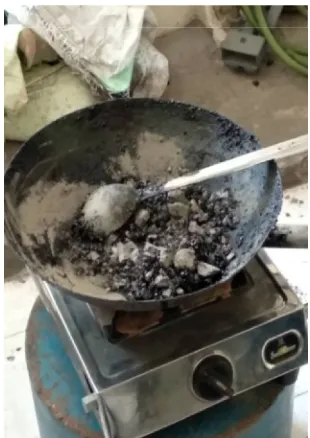
Fig 1: Mixing of Coated Aggregate and CRMB
For obtaining required temperature aggregates were heated in pan. And heated modified bitumen with crumb rubber was mixed after obtaining desired temperature. Then mixture is placed in heated Marshall Mould with collar and base.
E. Compaction of
samples-After preparing batch of the DBM mix sample, it requires to be compacted before testing. Compaction is done with Automatic Marshal Compactor machine present at the lab at Pune Municipal Corporation, Hot Mix Plant, Yerawada. Sample prepared in the mould were compacted in the compaction machine for 75 blows each side. Filter papers were added to the both sides of the mould. The moulds were kept for 24 hours before testing. After compaction of sample, After 24 hour’s moulds are kept in temperature controlled water bath at 600C for 30 minutes. These moulds are loaded in Marshall Stability test apparatus.
Fig 2 Automatic Marshall Compactor
Automatic Marshall Compactor is used for compaction of moulds. Sample prepared in the mould were compacted in the compaction machine for 75 blows on each side.
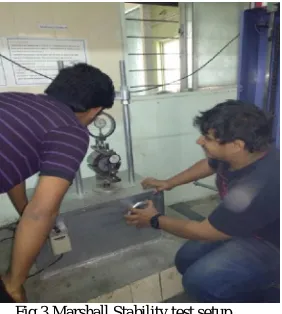
Fig 3 Marshall Stability test setup
VIII. RESULT
Sr no Test Result on Conventional
Bitumen Result on 10% CRMB References
1 Softening Point (oC) 49.40 59.7 IS:1205-1978
2 Penetration at 25oC 100 gm
53 41.72 IS:1205-1978
3 Specific Gravity 1.01 - IS:1205-1978
4 Flash Point (oC) 262 - IS:1205-1978
5 Ductility (Cm) 100 - IS:1205-1978
Table 2 Test Results On Conventional Bitumen and CRMB-
Table 2 clearly shows that softening point is increased from 49.40 0C to 59.7 0C and penetration value is decreased from 53 oC to 41.76 oC.
Bitumen content Division Stability (Kg) Average Value Flow (mm)
4.3 270 1179 4.5
245 1070 1055.6 4
210 917.49 3.5
4.5 285 1245 4
220 961.18 1077.63 4.5
235 1026.72 4
4.7 195 851.96 4.5
230 1004.57 830.02 5
145 633.504 5
Table 3 Marshall Stability test result on conventional mixes
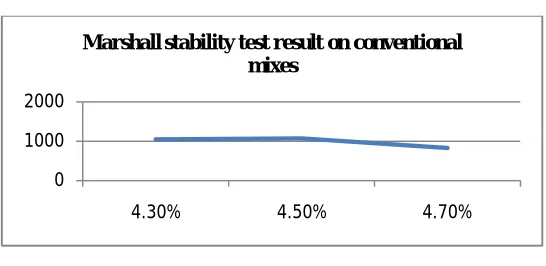
Table 3 Shows Marshal stability result on conventional bituminous mix- 1) Maximum stability (kg) = 1077.63kg, at binder content = 4.5% 2) Minimum flow value (mm) = 4mm, at binder content = 4.3%
Fig 4 Marshall Stability test results on conventional mixes 0
1000 2000
4.30% 4.50% 4.70%
Crump Rubber % Division Stability(Kg) Average Flow(mm)
8% 275 1201.47 3.5
240 1048.56 1043.22 4
270 1179.63 4
10% 280 1223.3 3.5
265 1157.7 1194.13 4.5
275 1201.4 4
12% 265 1157.7 4.5
250 1092.2 1048 4
230 1004.8 7
Table 4: Marshall Stability Test Results on CRMB Mixes
Table 4 Shows crumb rubber percentage is varied as 8%, 10% and 12%. at binder content of 4.5%. Maximum results are obtained at 10% crumb rubber modified bituminous mix and flow values are also in specified limit
CRMB+HDPE Division Stability
(kg) Average (kg) Flow (mm) 10%CRMB+ 6%HDPE Coated Aggregate
260 1135.94
1128.66
3
245 1070.40 3.5
270 1179.63 4
10%CRMB+ 8%HDPE Coated
Aggregate
280 1223.32
1209.76
4.5
265 1157.785 4
285 1248.16 3.5
10%CRMB+ 10%HDPE Coated
Aggregate
270 1179.63
1172.35
4
260 1135.94 3.5
275 1201.47 4
Table 5: Test results on CRMB & High Density Polyethylene
From above table Marshal Stability results are on Crumb Rubber + HDPE Coated Aggregate
(Optimum binder content is 4.5%)
1) Maximum stability (kg) = 1209.76kg, at 8% HDPE and 10% CRMB.
Fig 5- Marshall Stability Test Result on CRMB and HDPE coated aggregate
Summary of Results-
1. Marshal stability result on conventional bituminous mix-
1) Maximum stability (kg) = 1077.63kg, at binder content = 4.5% 2) Minimum flow value (mm) = 4mm, at binder content = 4.3% 2. Marshal stability results on Crumb Rubber + HDPE Coated Aggregate
(Optimum binder content is 4.5%)
1) Maximum stability (kg) = 1209.76kg, at 8% HDPE and 10% CRMB. 2) Minimum flow value (mm) = 3mm, at 6%HDPE and 10% CRMB 3. Marshal stability results on CRMB mix –
1) Maximum stability (kg) = 1194.13kg, at binder content 4.5% and crumb rubber 10% of binder 2) Minimum flow value (mm) = 3mm, at 4.5% binder content and crumb rubber 10% of binder
VIII. CONCLUSION
Penetration values and softening points of plain bitumen can be improved by modifying it with addition of crump rubber. Optimum binder content for conventional bitumen was found to be 4.5% .Optimum value of crumb rubber in CRMB was found to be 10%. Dry Process (polymer coating of aggregates) is more useful as compared to Wet Process (adding polymer in the binder) for manufacturing modified mixtures, as it can accommodate higher amount of waste plastic as modifier and results more stable mixtures. In addition with 10% crumb rubber optimum content of HDPE was found to be 8%. Using waste rubber and plastic reduces threat to environment and also improve the road quality.
REFERENCES
[1] Mrs.Vidula Swami1 , Abhijeet Jirge2 , Karan patil2 , Suhas patil2 , Sushil patil2 ,Karan salokhe2, “Use of waste plastic in construction of bituminous road" International Journal of Engineering Science and Technology, Vol. 4, pp.2351-2355 05 May 2012
[2] Rokade S Use of Waste Plastic and Waste Rubber Tyres in Flexible Highway Pavements 2012 International Conference on Future Environment and Energy IPCBEE vol.28, 2012
[3] Afroz Sultana.SK, K.S.B. Prasad/ International Journal of Engineering Research and Applications (IJERA) ISSN: 2248-9622 www.ijera.com Vol. 2, Issue 4,pp-1185-1191, July-August 2012,
[4] Divya Bhavana Tadepalli Srikanth Kandula , Sai Vivek Reddy .K & Sadgun Kumar. A "Experimental Investigation on Bituminous Mixing Using Waste HDPE" International Journal of Innovative Research in Science, Engineering and Technology, Vol. 5, Issue 4, April 2016 pp-5469-5476 [5] Vasudevan, R., Utilization of waste plastics for flexible pavement, Indian High Ways (Indian RoadCongress), Vol. 34, No.7. (July 2006). [6] Sandhya dixit “Studies on the improvement of characteristics of bitumen with use of waste plastic” International Journal of Emerging Technology and Advanced Engineering (ISSN 2250-2459, ISO 9001:2008 Certified Journal, Volume 3, Issue 3, March 2013).
[7] Yadav Kajal, Sangita and Chandra A, Identification, Characterization and Quantification of Elastomeric/Plastomeric Waste for Sustainable Waste Minimization American Journal of Environmental Sciences 1 (3) pp-202-205
1080 1100 1120 1140 1160 1180 1200 1220
6% 8% 10%
[8] Miss. Apurva J Chavan, “Use of plastic waste in flexible pavements” International Journal of Application Innovation in Engineering and Management (IJAIEM) as Volume 2, Issue 4, April 2013. ISSN 2319 - 4847
[9] S.K.Palit, K. Sudhakar Reddy and B. B. Pandey “Laboratory Evaluation Of Crumb Rubber Modified Asphalt Mixes”in Journal of materials in civil engineering,ASCE/January/February 2004.DOI:10.1061/(ASCE)0899-1561(2004)