Selection of Hydraulic Press on the Basis of
Fuzzy Multi Objective Optimization Ratio
Analysis (MOORA) Method
Sumit S. Patil1, Ayyankali Muthuraja2
M. Tech Design, Dept. of Mechanical Engineering, Sandip University SCOE, Nashik, Maharashtra, India1
Associate Professor, Dept. of Mechanical Engineering, Sandip University, SCOE, Nashik, Maharashtra, India2
ABSTRACT: In the present work, to meet the challenges of global competitiveness, manufacturing organizations area unit currently facing the issues of choosing applicable producing ways, product and process designs, manufacturing processes and technologies, and machinery and equipment. The selection selections become a lot of complicated because the call manufacturers within the producing atmosphere need to assess a good vary of alternatives supported a collection of conflicting criteria. To aid these choice processes, varied multi-objective higher cognitive process (MODM) ways area unit currently offered. application of multi-objective optimization on the basis of ratio analysis (MOORA) method is applied for solving multiple criteria (objective) optimization problem in Hydraulic press. Vertical and horizontal hydraulic press machine for squeezing and flaring process which include selection on the basis of linguistic variable triangular fuzzy logic number criteria in hydraulic press are considered in this paper. In all these cases, the results obtained using the MOORA method trying to match with those derived by the previous researchers which prove the applicability, potentiality, and flexibility of this method while solving this problems in present day manufacturing environment.
KEYWORDS: MODM, MOORA, Hydraulic Press, Linguistic Variable, Triangular Fuzzy Number.
I. INTRODUCTION
The fuzzy MOORA technique was introduced by Brauers and Zavadskas [4]. when the matter happens on the positioning, different call manufacturers with varied interests and values ,make decision-making method far more tough. Multi-objective optimisation within the method of at the same time optimizing two or a lot of conflicting alternatives subjective to sure constraints. Such techniques, therefore appear to be associate applicable tool for ranking or choosing the simplest different from a collection of obtainable choices [1].
Multi-objective optimisation on the premise of magnitude relation analysis (MOORA) is that the recent and noval tool fictional and used within the several scientific comes. In alternative facet, in each call setting their square measure huge data and undetermined scenario that have an effect on call method and plainly its outcomes. therefore to improve the choice preciseness and to beat unclearness in uncertain setting, the fuzzy theory and fresh linguistic fuzzy approaches try and get a lot of reliable solutions [3]
within the mechanical press, there square measure two totally different operations needed the separate machine in order that the vertical and horizontal machine during this case the victimisation this multi-criteria higher cognitive process MOORA technique is however useful victimisation fuzzy criteria is given during this paper.[5].and the techniques for the hydraulic press.
II. MOORA METHOD
constraints. The MOORA methodology, initial introduced by Brauers [1] is such a multi objective optimisation technique which will be with success applied to unravel varied kinds of advanced deciding issues within the producing atmosphere. The MOORA methodology starts with a choice matrix showing the performance of different alternatives with reference to various objectives.[2],[4].
The fuzzy MOORA procedure for ranking of best knowledge flow practicing for hydraulic press is given below
Step 1: construct the fuzzy decision matrices.
The fuzzy decision matrices are constructed by respondents using the appropriate linguistic variables for the alternative with respect to criteria.
=
⋯ ⋮ ⋱ ⋮
⋯
=[ ]
Where is the performance rating of decision makers who are responsible for assessing m alternatives ( , = 1, … … ), with respect to the importance of each of the criteria ( , = 1, … … ). A fuzzy rating of all decision makers is the given by triangular numbers ( = , , )
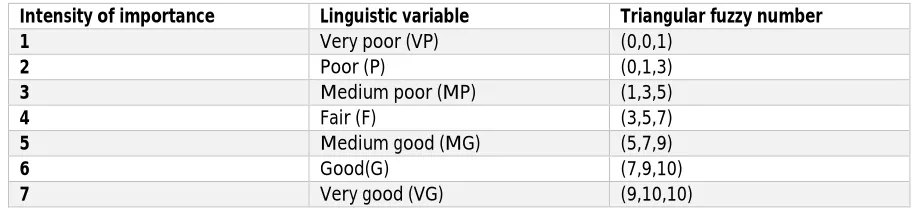
The scale for alternative rating is given in Table 1.
Table 1 The fuzzy linguistic scale for alternatives
Intensity of importance Linguistic variable Triangular fuzzy number
1 Very poor (VP) (0,0,1)
2 Poor (P) (0,1,3)
3 Medium poor (MP) (1,3,5)
4 Fair (F) (3,5,7)
5 Medium good (MG) (5,7,9)
6 Good(G) (7,9,10)
7 Very good (VG) (9,10,10)
In this table 1 we have considered some linguistic variables with the help of this linguistic variables we are study the triangular fuzzy number.
Table 2 Decision Matrix
Criteria Vertical Hydraulic Press Horizontal Hydraulic Press
Criteria 1 G F
Criteria 2 G MG
Criteria 3 F P
Criteria 4 G G
Criteria 5 VG G
Criteria 6 G MG
Criteria 7 G MG
Criteria 8 VG MG
Criteria 9 G MG
In the table 2 shows the decision number for the vertical hydraulic press and horizontal hydraulic press from this we considered the 10 criteria’s.
Step 2:Aggregate rating for each alternative expressed in triangular fuzzy numbers.
Assuming that a decision group has number of decision makers. The aggregated fuzzy ratings ( ) of each criterion with respect to alternatives are calculated as
= ………. ………(1)
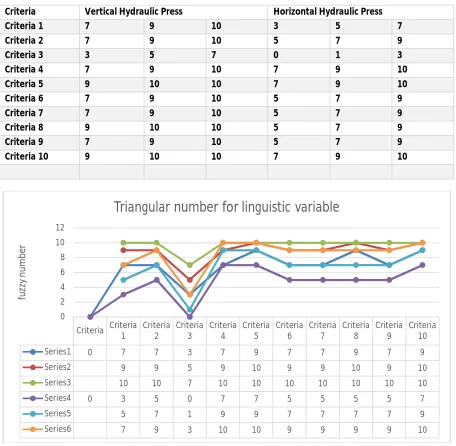
Table 3 Triangular number for respective linguistic variable.
Criteria Criteria 1 Criteria 2 Criteria 3 Criteria 4 Criteria 5 Criteria 6 Criteria 7 Criteria 8 Criteria 9 Criteria 10
Series1 0 7 7 3 7 9 7 7 9 7 9
Series2 9 9 5 9 10 9 9 10 9 10
Series3 10 10 7 10 10 10 10 10 10 10
Series4 0 3 5 0 7 7 5 5 5 5 7
Series5 5 7 1 9 9 7 7 7 7 9
Series6 7 9 3 10 10 9 9 9 9 10
0 2 4 6 8 10 12 fu zz y n u m b er
Triangular number for linguistic variable
Criteria Vertical Hydraulic Press Horizontal Hydraulic Press
Criteria 1 7 9 10 3 5 7
Criteria 2 7 9 10 5 7 9
Criteria 3 3 5 7 0 1 3
Criteria 4 7 9 10 7 9 10
Criteria 5 9 10 10 7 9 10
Criteria 6 7 9 10 5 7 9
Criteria 7 7 9 10 5 7 9
Criteria 8 9 10 10 5 7 9
Criteria 9 7 9 10 5 7 9
For this squeezing and flaring operation considered the 10 different criteria for the vertical and horizontal hydraulic press for that triangular fuzzy number consideration shown in the table and graph.
Step 3:Normalize the fuzzy-decision Matrix.
The decision matrix is normalized to remove sample-to-sample variability by transforming the various criteria scales into a comparable scale.MOORA refers to a magnitude relation system during which every response of an alternate on associate objective is compared to the divisor, that is representative for all alternatives regarding that objective. The normalized fuzzy-decision matrix denoted by is shown as following formula.
= ( , , ), = 1,2, … , ; = 1,2, … ,
Here, the linear scale transformation can be used to transform the various criteria scales into a comparable scale. Therefore, we can obtain the normalized fuzzy decision matrix .
Where,
∗ = / [( ) + ( ) + ( ) ]………..(2)
∗ = / [( ) + ( ) + ( ) ]………(3)
∗ = / [( ) + ( ) + ( ) ]……….(4)
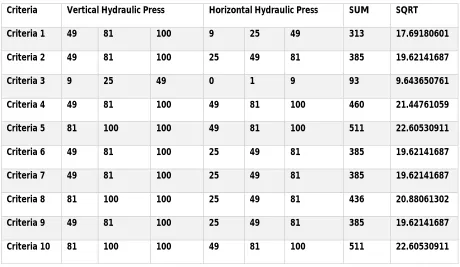
Table 4 Determine the SQRT for triangular number of each criteria
Criteria Vertical Hydraulic Press Horizontal Hydraulic Press SUM SQRT
Criteria 1 49 81 100 9 25 49 313 17.69180601
Criteria 2 49 81 100 25 49 81 385 19.62141687
Criteria 3 9 25 49 0 1 9 93 9.643650761
Criteria 4 49 81 100 49 81 100 460 21.44761059
Criteria 5 81 100 100 49 81 100 511 22.60530911
Criteria 6 49 81 100 25 49 81 385 19.62141687
Criteria 7 49 81 100 25 49 81 385 19.62141687
Criteria 8 81 100 100 25 49 81 436 20.88061302
Criteria 9 49 81 100 25 49 81 385 19.62141687
We can calculate the SQRT of this triangular number and we are also calculate the sum .calculating things shown in graph and the table.
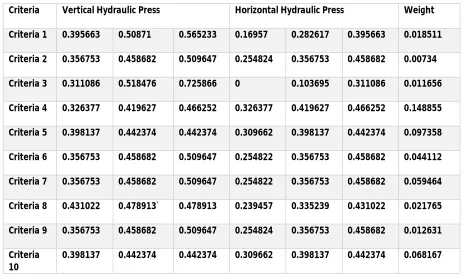
Table 5 Normalised fuzzy decision matrix.
Criteria Vertical Hydraulic Press Horizontal Hydraulic Press Weight
Criteria 1 0.395663 0.50871 0.565233 0.16957 0.282617 0.395663 0.018511
Criteria 2 0.356753 0.458682 0.509647 0.254824 0.356753 0.458682 0.00734
Criteria 3 0.311086 0.518476 0.725866 0 0.103695 0.311086 0.011656
Criteria 4 0.326377 0.419627 0.466252 0.326377 0.419627 0.466252 0.148855
Criteria 5 0.398137 0.442374 0.442374 0.309662 0.398137 0.442374 0.097358
Criteria 6 0.356753 0.458682 0.509647 0.254822 0.356753 0.458682 0.044112
Criteria 7 0.356753 0.458682 0.509647 0.254822 0.356753 0.458682 0.059464
Criteria 8 0.431022 0.478913` 0.478913 0.239457 0.335239 0.431022 0.021765
Criteria 9 0.356753 0.458682 0.509647 0.254824 0.356753 0.458682 0.012631
Criteria 10
0.398137 0.442374 0.442374 0.309662 0.398137 0.442374 0.068167
Criteria 1
Criteria 2
Criteria 3
Criteria 4
Criteria 5
Criteria 6
Criteria 7
Criteria 8
Criteria 9
Criteria 10
Vertical Hydraulic Press 49 49 9 49 81 49 49 81 49 81
81 81 25 81 100 81 81 100 81 100
100 100 49 100 100 100 100 100 100 100
Horizontal Hydraulic Press 9 25 0 49 49 25 25 25 25 49
25 49 1 81 81 49 49 49 49 81
49 81 9 100 100 81 81 81 81 100
SUM 313 385 93 460 511 385 385 436 385 511
SQRT 17.6918019.621419.64365021.4476122.6053019.6214119.6214120.8806119.6214122.60530
0 100 200 300 400 500 600
We are calculate the horizontal hydraulic press and vertical hydraulic press calculate the normalised fuzzy decision matrix. With the help of the AHP method and some TOPSIS study we calculate the weight. Which is shown in table and graph
Step 4: weighted normalized decision matrix.
The weighted normalized fuzzy decision matrix is obtained as following matrix = [ , , ], = 1,2, … … . , ; = 1,2, … … . . ,
Where,
[ = ∗ ⊗
] ……….(5)
[ = ∗ ⊗ ]………..(6)
[ = ∗ ⊗ ]………...(7)
Criteria 1 Criteria 2 Criteria 3 Criteria 4 Criteria 5 Criteria 6 Criteria 7 Criteria 8 Criteria 9 Criteria 10 Weight 0.018511 0.00734 0.011656 0.148855 0.097358 0.044112 0.059464 0.021765 0.012631 0.068167
0.395663 0.458682 0.311086 0.466252 0.442374 0.458682 0.458682 0.431022 0.458682 0.442374 0.282617 0.356753 0.103695 0.419627 0.398137 0.356753 0.356753 0.335239 0.356753 0.398137 Horizontal Hydraulic Press 0.16957 0.254824 0 0.326377 0.309662 0.254822 0.254822 0.239457 0.254824 0.309662 0.565233 0.509647 0.725866 0.466252 0.442374 0.509647 0.509647 0.478913 0.509647 0.442374 0.50871 0.458682 0.518476 0.419627 0.442374 0.458682 0.458682 0 0.458682 0.442374 Vertical Hydraulic Press 0.395663 0.356753 0.311086 0.326377 0.398137 0.356753 0.356753 0.431022 0.356753 0.398137
0 0.5 1 1.5 2 2.5 3
Table 6 weighted normalized fuzzy decision matrix
Criteria Vertical Hydraulic Press Horizontal Hydraulic Press
Criteria
1 0.007324 0.009417 0.010463 0.003139 0.005231 0.007324
Criteria
2 0.002618 0.003367 0.003741 0.00187 0.002618 0.003367
Criteria
3 0.003626 0.006043 0.008461 0 0.001209 0.003626
Criteria
4 0.048583 0.062464 0.069404 0.048583 0.062464 0.069404
Criteria
5 0.038762 0.043069 0.043069 0.030148 0.038762 0.043069
Criteria
6 0.015737 0.020234 0.022482 0.011241 0.015737 0.020234
Criteria
7 0.021214 0.027275 0.030306 0.015153 0.021214 0.027275
Criteria
8 0.009381 0.010423 0.010423 0.005212 0.007296 0.009381
Criteria
9 0.004506 0.005794 0.006438 0.003219 0.004506 0.005794
Criteria
10 0.02714 0.030156 0.030156 0.021109 0.02714 0.030156
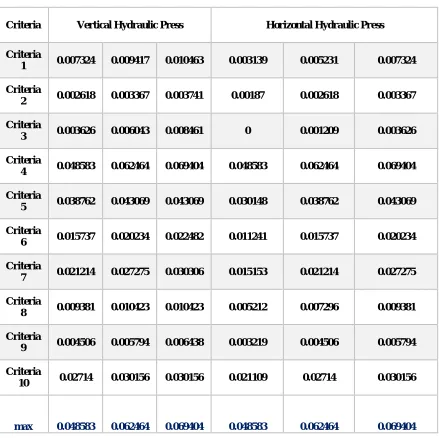
We studied the weighted normalised fuzzy decision matrix for the vertical and horizontal hydraulic press for the squeezing and flaring operations from that calculate the maximum value shown in the table as well as graph.
Step 5:The normalized performance are added for beneficial criteria and subtracted for non-beneficial criteria, computed as follows:
=∑ − ∑ ……….(8) Here,
∑ , benefit criteria for 1……
∑ , non-benefit criteria for + 1,……, , maximum number of criteria to be done ( − ), minimum number of criteria to be done
Step 6: The fuzzy reference point
Next, the reference point theory chooses for maximization a reference point, which has as ordinate the highest co-ordinate per objective of all alternatives. The reference point approach chooses for maximization a reference point, which has as co-ordinates the highest co-ordinate per objective of all the alternatives[3]. (.For example, where we have consider three alternatives. The alternatives are described as follows: A (10;100), B (100;20) , C (50;50). In this case the maximal objective reference point maximum result in (100;100).
Criteri a Criteri a 1 Criteri a 2 Criteri a 3 Criteri a 4 Criteri a 5 Criteri a 6 Criteri a 7 Criteri a 8 Criteri a 9 Criteri a 10 max Series1 0 0.0073 0.0026 0.0036 0.0485 0.0387 0.0157 0.0212 0.0093 0.0045 0.0271 0.0485 Series2 0.0094 0.0033 0.0060 0.0624 0.0430 0.0202 0.0272 0.0104 0.0057 0.0301 0.0624 Series3 0.0104 0.0037 0.0084 0.0694 0.0430 0.0224 0.0303 0.0104 0.0064 0.0301 0.0694 Series4 0 0.0031 0.0018 0 0.0485 0.0301 0.0112 0.0151 0.0052 0.0032 0.0211 0.0485 Series5 0.0052 0.0026 0.0012 0.0624 0.0387 0.0157 0.0212 0.0073 0.0045 0.0271 0.0624 Series6 0.0073 0.0033 0.0036 0.0694 0.0430 0.0202 0.0272 0.0093 0.0057 0.0301 0.0694
0 0.01 0.02 0.03 0.04 0.05 0.06 0.07 0.08 h yd ra u lic p re ss s e ri es
For beneficial criteria,
= (max ∗ max ∗ , max ∗) , where ≤ ………(9) For Non-beneficial criteria
= (min ∗ min ∗ , min ∗)
, where > ………(10) ∀ = 1,2, … … … … . , ; = 1,2, … … … . ,
The deviation between the standardized evaluation value and the reference point can be defined as, = min (max | − ∗|)
………(11)
Table 8: deviation between the standardized evaluation value and reference point
Criteria Vertical Hydraulic Press Horizontal Hydraulic Press
Criteria 1 0.041259 0.053047 0.058941 0.045444 0.057232 0.06208
Criteria 2 0.045964 0.059097 0.065663 0.046712 0.059845 0.066038
Criteria 3 0.044957 0.056421 0.060944 0.048583 0.061255 0.065778
Criteria 4 0 0 0 0 0 0
Criteria 5 0.009821 0.019395 0.026335 0.018435 0.023702 0.026335
Criteria 6 0.032846 0.04223 0.046922 0.037342 0.046726 0.049171
Criteria 7 0.027369 0.035189 0.039098 0.03343 0.04125 0.042129
Criteria 8 0.039202 0.05204 0.058981 0.043371 0.055168 0.060023
Criteria 9 0.044077 0.05667 0.062967 0.045364 0.057957 0.06361
Criteria 10 0.021442 0.032308 0.039249 0.027474 0.035324 0.039249
Considering the maximum reference point and the beneficial and non beneficial criteria’s for this two different hydraulic press we are shown in the graph and summation for the press in the table.
Step 7: Defuzzify the fuzzy decision matrix.
There are four defuzzification methods commonly used : (i) centered method (or centre of area -COA) ; (ii) the mean of maximum (MOM) ; (iii) the cut method ;(iv) the signed distance method. The fuzzy values of weighted normalized fuzzy decision matrix converted into crisp values using the BNP values. The equation gives the defuzzified value of fuzzy number.
=[ ]+ ,∀ , ………(12)
0 0.05 0.1 0.15 0.2 0.25 0.3 0.35 0.4 0.45 0.5
se
ri
es
criteria
Series1
Series2
Series3
Series4
Series5
Table 9 Defuzzify fuzzy decision matrix
Vertical Hydraulic Press Horizontal Hydraulic Press
0.306937 0.406397 0.4591 0.346155 0.438459 0.474413
0.390811 0.419676
From this above table the summation for hydraulic press horizontal and vertical that diffuzify the fuzzy decision using the BNP crisp formula from that calculate the ratio value.
Step 8 : select the best alternative solution
According to the criteria the best solution for the squeezing and flaring operation in the hydraulic press is shown Table 10 Best solution
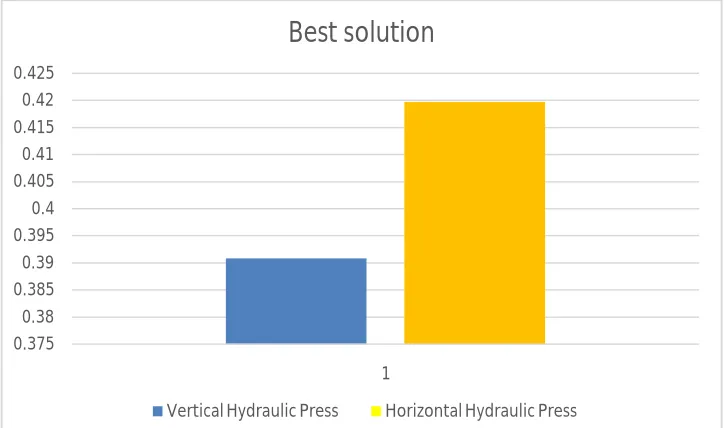
Using the BNP formula we are calculated the ratio value for the horizontal and vertical hydraulic press and shown in the graph for the best alternative solution.
III. ADVANTAGES OF MOORA METHOD OVER THE OTHER MULTI OBJECTIVE METHODS
1.The MOORA method handles both beneficial and non-beneficial criteria and employs separate the mathematical process in the contrast to other methods. For Example, SAW method does not treat the beneficial and non-beneficial criteria separate and during the normalization process the non-beneficial criteria are transformed into the beneficial criteria.
2.The procedure of MOORA method produces the overall performance of alternatives with respect to various criteria. So, these benefits build the MOORA methodology simple to use and versatile. The MOORA method reflects the subjective part of selection procedure by integrating the criteria of weight to the computational procedure.
3.The mathematical background of MOORA method is not complex so it is easily understandable. The step of computational procedure does not require the software package, namely they are performed by MS Excel programme. 4.The necessary time for making the final selection is not too long. There is no limit about the number of criteria and the alternatives of the problems. Adding of any further parameter doesn’t have an effect on the process procedure.
0.375 0.38 0.385 0.39 0.395 0.4 0.405 0.41 0.415 0.42 0.425
1
Best solution
IV. RESULT
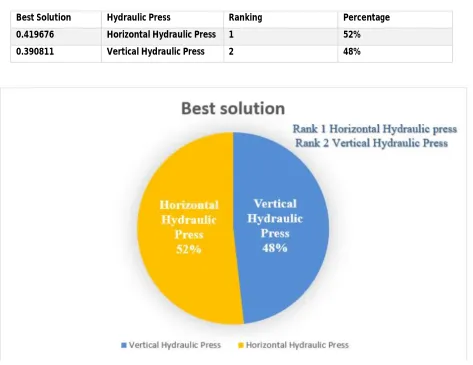
Here, in this research we are considering the linguistic criteria for the triangular fuzzy number for comparing the which machine is more suitable for squeezing, flaring operation and for that we considered the ten criteria’s from that criteria. MOORA method is very easy and simple for implementation than other like MODM, GRAmethods. MOORA method is very stable method for decision making problems. We got the result the Horizontal hydraulic machine is most suitable machine for the squeezing and flaring operations than vertical hydraulic press machine. And we also got rank of this machine.
Table 11 Result
Best Solution Hydraulic Press Ranking Percentage
0.419676 Horizontal Hydraulic Press 1 52%
0.390811 Vertical Hydraulic Press 2 48%
V. CONCLUSION
In this paper, the selection of hydraulic press using MOORA method is presented. We considered the linguistic criteria using triangular fuzzy number for the selection for squeezing and flaring of the hydraulic press.in all this criteria , it is observed that the top ranked alternative tried to match with those derived past research MOORA is basically simple ratio analysis it involved less amount of calculation which may quite useful for the decision maker who may not have strong mathematical background the MOORA method consider there attribute according to importance and can provide better accurate evaluation of the alternatives. this method is computationally very simple, robust and comprehensible which also consider the qualitative and quantitative attributes while offer more criteria and logical selection approach but it is not convenient for large qualitative attributes. Application of this method in a wide range of selection of problem in real time manufacturing environment.in our case for criteria of linguistic variable triangular fuzzy number helps to decision for the squeezing and flaring operations which is most suitable machine and it gives the result ,horizontal machine is most suitable machine.
VI. ACKNOWLEDGEMENT
The work was supported by Samarth Engineers and designers and industrial guide Mr.NikhilBhamre sir. Research department of Sandip University. Sincere appreciation is due to technical staff in Department of mechanical engineering in Sandip University, Nashik. I would like to thanks to Dr. Ayyankalai Muthuraja and Department of Mechanical Engineering,Sandip university Nashik, for their constant support and cooperationto carry out this task.
REFERENCES
1. Brauers WKM,Optimization methods for a stakeholder society. A revolution in economic thinking by multiobjective optimization. Kluwer Academic Publishers, Boston,2004
2. Brauers WKM, Zavadskas EK, Peldschus F, Turskis Z,Multiobjective decision-making for road design. Transport 23:183–193,2008
3. Brauers WKM, Zavadskas EK, Robustness of the multiobjective MOORA method with a test for the facilities sector. Technological and Economic Development of Economy: Baltic J on Sustainability 15:352–375,2009
4. Brauers WKM, Zavadskas EK,The MOORA method and its application to privatization in a transition economy. Control Cybern 35:445–469,2006 5. Brauers WKM ,Multi-objective contractor’s ranking by applying the MOORA method. J of Business Economics and Management 4:245–255,2008 6. Brauers WKM, Zavadskas EK, Peldschus F, TurskisZ , Multi-objective optimization of road design alternatives with an application of the MOORA method, Proc of the 25th Int Sym on Automation and Robotics in Construction, Lithuania, 541–548,2008
7. Kalibatas D, Turskis Z, Multicriteria evaluation of inner climate by using MOORA method. Inf Tech and Con 37:79–83,2008 8. LootsmaFA ,Multi-criteria decision analysis via ratio and difference judgement. Springer, London,1999
9. Bhangale PP, Agrawal VP, Saha SK, Attribute based specification, comparison and selection of a robot. Mech Mach Theory 39:1345–1366,2004
10. Rao RV (2007) Decision making in the manufacturing environment using graph theory and fuzzy multiple attribute decision making methods. Springer, London
11. Karsak EE, Kuzgunkaya O, A fuzzy multiple objective programming approach for the selection of a flexible manufacturing system. Int J Prod Eco 79:101– 111,2002
12. Rao RV, ParnichkunM , Flexible manufacturing system selection using a combinatorial mathematics-based decisionmaking method. Int J Prod Res 47:6981–6998,2008
13. Sun S , Assessing computer numerical control machines using data envelopment analysis. Int J Prod Res 40:2011– 2039,2002
14. Yurdakul M, Cogun, Development of a multi-attribute selection procedure for non traditional machining processes. Proc IMechE, J of EnggManuf 217:993–1009,2003
15. Das Chakladar N, Chakraborty S, A combined TOPSISAHP method based approach for non-traditional machining processes selection. Proc IMechE, J of EnggManuf 222:1613–1623,2008
16. Daschakladar N, Das R, Chakraborty S, A digraph-based expert system for non-traditional machining processes selection. Int J Adv Manuf Tech 43:226– 237,2009
17. Byun HS, Lee KS,A decision support system for the selection of a rapid prototyping process using the modified TOPSIS method. Int J Adv Manuf Tech 26:1338–1347,2004
18. Rao RV, Patel BK ,Decision making in the manufacturing environment using an improved PROMETHEE method. Int J Prod Res 48:4665–4682,2009 19. Pandey PC, Kengpol A Selection of an automated inspection system using multi-attribute decision analysis. Int J Prod Econ 39:289–298,1995
20. Ginevičius R, PodvezkoV , Multi-criteria graphical analytical evaluation of the financial state of construction enterprises. Baltic J on Sustainability 14:452– 461,2008