GENETICS | INVESTIGATION
Complementation of Yeast Genes with Human
Genes as an Experimental Platform for Functional
Testing of Human Genetic Variants
Akil Hamza,* Erik Tammpere,* Megan Kofoed,* Christelle Keong,* Jennifer Chiang,†Guri Giaever,†
Corey Nislow,†and Philip Hieter*,1
*Michael Smith Laboratories, University of British Columbia, Vancouver, British Columbia, Canada V6T 1Z4, and†Department of Pharmaceutical Sciences, University of British Columbia, Vancouver, British Columbia, Canada V6T 1Z3
ABSTRACTWhile the pace of discovery of human genetic variants in tumors, patients, and diverse populations has rapidly accelerated, deciphering their functional consequence has become rate-limiting. Using cross-species complementation, model organisms like the budding yeast,Saccharomyces cerevisiae, can be utilized tofill this gap and serve as a platform for testing human genetic variants. To this end, we performed two parallel screens, a one-to-one complementation screen for essential yeast genes implicated in chromo-some instability and a pool-to-pool screen that queried all possible essential yeast genes for rescue of lethality by all possible human homologs. Our work identified 65 human cDNAs that can replace the null allele of essential yeast genes, including the nonorthologous pair yRFT1/hSEC61A1. We chose four human cDNAs (hLIG1, hSSRP1, hPPP1CA, and hPPP1CC) for which their yeast gene counterparts function in chromosome stability and assayed in yeast 35 tumor-specific missense mutations for growth defects and sensitivity to DNA-damaging agents. This resulted in a set of human–yeast gene complementation pairs that allow human genetic variants to be readily characterized in yeast, and a prioritized list of somatic mutations that could contribute to chromosome instability in human tumors. These data establish the utility of this cross-species experimental approach.
KEYWORDShuman–yeast cross-species complementation; chromosome instability; tumor-specific missense mutations; human genetic variants; model organisms and human disease
D
IFFERENTIATING passenger from driver mutations in tumor cell genomes and linking somatic variants to cancer phenotypes are major challenges. A hallmark of cancer is chromosome instability (CIN), which is an important pre-disposing factor in the progression and heterogeneity of tumors because it increases the likelihood of loss of tumor-suppressor genes and mutation/amplifi cation/rearrange-ment of oncogenes (Lengauer et al. 1997; Charames and Bapat 2003; Schvartzmanet al.2010; Hanahan and Wein-berg 2011). The budding yeast,Saccharomyces cerevisiae, has been used to define cellular pathways and catalog a compre-hensive list of yeast genes required for the maintenance ofchromosome stability (Yuenet al.2007; Stirlinget al.2011). The yeast CIN gene list facilitates identification of candidate human CIN genes whose somatic variants may contribute to chromosome instability and tumorigenesis (Barber et al. 2008). Budding yeast can be exploited to screen these hu-man genetic variants for prioritizing and directing func-tional studies in mammalian models (reviewed in Dunham and Fowler 2013).
There are several approaches for studying human genetic variants in yeast. Based on sequence conservation, human variants can be tested by introducing homologous mutations in the yeast ortholog. However, such sequence-based efforts restrict the number of variants that can be studied, and inferences based on this approach can be misleading as function can be maintained despite sequence divergence. For example, the impact of a nonsynonymous substitution in the context of the yeast protein may not accurately predict the same effect in the context of the human protein (Marini et al.2010). A more desirable approach is functionally testing Copyright © 2015 by the Genetics Society of America
doi: 10.1534/genetics.115.181099
Manuscript received July 26, 2015; accepted for publication September 1, 2015; published Early Online September 9, 2015.
Available freely online through the author-supported open access option.
Supporting information is available online at www.genetics.org/lookup/suppl/ doi:10.1534/genetics.115.181099/-/DC1.
variants directly in the context of the human protein se-quence by utilizing cross-species complementation to “ hu-manize” the yeast strain. This refers to the ability of a human gene (or set of genes) to complement the loss-of-function phenotype of its yeast ortholog (or set of orthologs). Cross-species complementation has previously been used in yeast to isolate human orthologs, elucidate human gene func-tion, and characterize gene variants (reviewed in Osborn and Miller 2007; Dunham and Fowler 2013). Expression of hu-man cDNAs in wild-type yeast cells has also been used as means to study genetic variants and characterize protein domains (Katoet al.2003; Tarnowskiet al.2012).
While cross-species complementation can be scored by any measurable phenotype, the most straight-forward phe-notype to assay and quantify is the rescue of growth defects. Complementation of essential yeast genes by candidate hu-man gene orthologs can be tested by the ability of a huhu-man cDNA to rescue lethality caused by (i) a null allele (deletion in a haploid strain), (ii) a conditional allele under restrictive conditions (e.g., temperature-sensitive strain), or (iii) down-regulation by a repressible promoter (e.g., Tet system) (Kachroo et al.2015). Nonessential yeast gene mutants can be assayed when they present a phenotype (e.g., drug sensitivity) or the nonessential yeast gene can be converted to an essential gene by disrupting a synthetic lethal partner (Greeneet al.1999). Hundreds of studies testing individual genes have revealed
.200 successful human–yeast complementation pairs (Dunham and Fowler 2013). Two studies systematically tested for human–yeast complementation pairs. One screened for res-cue of lethality caused by inducible loss-of-function of 25 essential yeast genes (repressible promoter) following trans-formation of a human cDNA library (i.e., pool-to-one screens) and identified six essential genes that were rescued by a hu-man ortholog (Zhanget al.2003). More recently, 176/414 essential yeast genes (as null and/or Ts mutations and/or using a repressible promoter) were found to be replaceable by their 1:1 human ortholog (i.e., one-to-one screens) (Kachroo et al.2015).
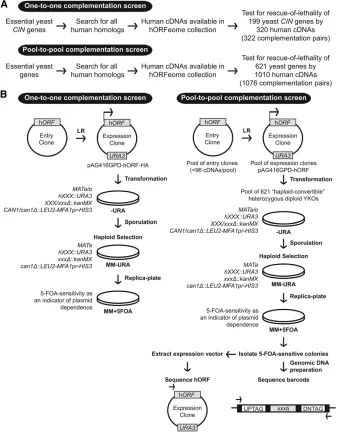
We report the screening of 621 essential yeast gene null mutants for complementation by all potential human homo-logs in two parallel screens (“one-to-one”screens for 199 essential CIN genes corresponding to 322 candidate comple-mentation pairs, and a“pool-to-pool”screen for all possible essential yeast genes). In addition, we demonstrate the fea-sibility of using yeast to test human gene variants by extend-ing cross-species complementation to 35 tumor-specific mutations in genes functioning in chromosome stability.
Materials and Methods
Generating expression vectors for the complementation screens
One-to-one screen: Human cDNAs in Gateway-compatible entry clones were obtained from hORFeome V8.1 (Yanget al. 2011) and shuttled into yeast destination vectors (Alberti
et al.2007) using LR clonase II (Invitrogen) to generate ex-pression clones. The destination vector used was pAG416GPD-ccdB-HA (URA3, CEN, constitutiveGPDpromoter, C-terminal HA tag) with a stop codon contributed by the vector back-bone resulting in a 55-amino-acid C-terminal extension. The identity of the human cDNA was confirmed by sequencing the expression vector using a common primer that hybridizes to the vector backbone (CAGGAAACAGCTATGAC).
Pool-to-pool screen: The same experimental outline was followed as the one-to-one screen with the following mod-ifications and additional steps. Human cDNAs were randomly grouped into 13 pools with each pool comprising up to 96 unique entry clones. Each of the 13 pools of entry clones were shuttled en masse into a yeast destination vector to generate 13 pools of expression vectors (Arnoldo et al. 2014). The destination vector used was pAG416GPD-ccdB (URA3, CEN, constitutiveGPDpromoter) with a stop codon contributed by the vector backbone resulting in a 50-amino-acid C-terminal extension. To ensure sufficient coverage of each expression vector within a pool, the bulk LR reaction was repeated three times to obtain a minimum of 10,000 transformants for 100-fold coverage (96 entry clones3100).
Yeast strains and media used in complementation screens
One-to-one screen:Generated expression vectors were trans-formed into the corresponding haploid-convertible heterozy-gous diploid knockout yeast strain (Pan et al. 2004) and transformants were selected on2Ura media. Transformants were then inoculated in liquid sporulation media (1% w/v potassium acetate, 0.005% w/v zinc acetate, and 0.3 mM histidine) (Panet al.2007) to a cell density of1–2 OD600
at 25°with shaking for 5 days and sporulation efficiency was assessed using microscopy. Following sporulation, 50 ml of cells were resuspended in 1 ml water of which 100ml was plated on the haploid selection media MM2Ura (2Leu2His
2Arg2Ura +canavanine +G418) (Panet al.2007) and in-cubated at 30°. To confirm that the generated yeast essential haploid knockout is dependent on the expression vector, cells were then replica plated on MM +5-FOA (0.1%) (2Leu2His
2Arg +canavanine +G418 +5-FOA) and incubated at 30°.
equal representation of yeast strains across all pools. To en-sure sufficient coverage of each yeast strain/vector combina-tion in sufficient numbers, the transformation was repeated a second time for each pool to obtain a minimum of 6 million transformants for 100-fold coverage (621 yeast strains 3 96 expression vectors 3100). Transformed diploid colo-nies were then scraped, pooled, and inoculated in 13 sepa-rate 50 ml sporulation cultures as described. Sporulated cultures were then pelleted, resuspended in water, and plated on MM 2Ura for haploid selection, after which the haploid-converted cells were scraped, pooled, and re-plated again on MM 2Ura to obtain single colonies, which were confirmed by replica plating to MM +5-FOA. For each pool, 20–50 5-FOA-sensitive colonies were isolated. To deter-mine the identity of the yeast strain, genomic DNA was prep-ped and the yeast barcode was amplified using the U1/D1 primers to allow sequencing of the UPTAG/DNTAG using the kanB or kanC primers (Giaeveret al.2002). To determine the identity of the rescuing human cDNA, expression vectors were isolated and sequenced using a common primer that hybridizes to the vector backbone (CAGGAAACAGCTATGAC). Each potential hit (a rescued yeast colony) was reconfirmed by retransformation of the extracted plasmid into the corre-sponding heterozygous diploid as described for the one-to-one screen. To confirm the nonorthologous hits, both extracted pAG416GPD-hSEC61A1 and newly generated pAG416GPD-hSEC61A1-HA expression vectors along with pAG416GPD-hRFT1-HA and GAL-inducible ySEC61 from the FLEX array (Huet al.2007) were separately transformed into theRFT1/
rft1Dheterozygous diploid yeast strain and the experiment was carried out as described for the one-to-one screen.
Generating lists and analysis for the complementation screens
A comprehensive list of essential yeast CIN genes was obtained from Stirlinget al.(2011), while a list of essential yeast genes was obtained from the Yeast Deletion Project (Giaeveret al. 2002). A list of human genes was generated from two sour-ces: Yeastmine (Balakrishnanet al.2012) and Ensembl Bio-Mart (Kinsellaet al.2011) databases. Gene Ontology (GO) processes and other features used to analyze the complemen-tation set were obtained from Yeastmine and each feature was represented as a proportion of the total number of genes input for each gene set. Significance for each feature was calculated using the hypergeometric distribution and sub-jected to the Bonferroni correction to obtain the adjusted P-value (critical value: 0.05; number of tests: 24 for features analyzed in Figure 3, A–F). Sequence identity (%) in relation to the yeast gene was calculated for all possible human–yeast gene pairs using the Ensembl BioMart database. Significance between the % sequence identity of complementation pairs and % sequence identity of all human–yeast pairs included in this study was calculated using a Mann–Whitney test. For some manually curated orthologs and others generated from Yeastmine, sequence identity was determined using NWalign (Y. Zhang,http://zhanglab.ccmb.med.umich.edu/NW-align).
Generating variants and yeast strains for growth curves
Expression vectors and yeast strain construction: As de-scribed, hLIG1, hSSRP1, hPPP1CA, and hPPP1CCin entry clones were shuttled into the yeast destination vectors pAG416GPD-ccdB-HA (URA3) and pAG415GPD-ccdB-HA (LEU2) to gener-ate expression clones (Supporting Information, Table S1). Missense mutations were introduced in vector pAG415GPD-hORF-HA (LEU2) using the QuikChange Site-Directed Muta-genesis Kit (Agilent), and verified by Sanger sequencing. To generate the yeast haploid knockout strains, tetrads were dis-sected following transformation of the expression vector pAG416GPD-hORF-HA (URA3) to the corresponding hetero-zygous diploid deletion strain and then haploids were main-tained on 2Ura media (Table S1). To generate the strains used for growth curve analysis, expression clones containing wild-type and mutant human cDNA on pAG415GPD-hORF-HA (LEU2) were first transformed into both the generated haploid knockouts (covered by wild-type human cDNA marked byURA3) and wild-type strain (BY4742) (Brachmann et al.1998) and maintained on2Ura2Leu or2Leu media, respectively. For the plasmid shuffle, strains were then plated on2Leu +Ura +5-FOA media and individual colonies were picked and thereafter maintained on2Leu media. To confirm that theURA3-marked plasmid was lost, strains were streaked on2Ura media to observe lack of growth.
Growth curves: Unless otherwise indicated, all growth con-ditions were carried out in2Leu media at 30°. Strains were inoculated overnight, diluted to a cell density of 0.1 OD600,
and then grown to mid-log phase. Strains were then diluted to OD600= 0.1 in 200ml2Leu media with no drug, 0.01% MMS,
or 100 mM HU in 96-well plates. OD600readings were
mea-sured every 30 min over a period of 48 hr in a TECAN M200 plate reader. Prior to each reading, plates were shaken for 10 min. Each strain was tested in three to four replicates per plate per condition and area under the curve (AUC) value was calculated for each replicate independently. For growth curves in2Leu and2Leu +100 mM HU, AUC values were calculated from 0–24 hr corresponding to when most strains reached saturation. For growth curves in 2Leu +0.01% MMS, AUC values were calculated from 0 to 48 hr. For each mutant, strain
fitness was defined as the AUC of the mutant curves relative to the AUC of the wild-type allele grown on the same plate in the same media condition. Significant differences in growth in the
“no drug”condition was determined against the wild-type al-lele in the same condition, while significant differences in growth in the “drug”condition was determined against the same allele in the no drug condition using a Student’st-test. Sets of all individual growth curves are shown inFigure S1,
Figure S2,Figure S3, andFigure S4.
Data availability
Results
Systematic identification of human–yeast cross-species complementation pairs
A comprehensive list of yeast CIN genes revealed that many essential genes are mutable to a CIN phenotype (323 CIN genes/1100 essential genes, or 29%) (Stirling et al. 2011). To establish an experimental platform for testing tu-mor-specific somatic mutations in candidate human CIN genes, we tested all possible yeast CIN gene null mutants for complementation by all potential human homologs in a series of one-to-one screens. While one-to-one screening reduces the number of false negatives that can arise as an artifact of the skewed representation associated with pooled screening, it does not allow identification of unexpected or nonorthologous complementation pairs. Therefore, we set up a pool-to-pool screen to test all possible essential (CIN and non-CIN) yeast genes for complementation by all
sequence-related human homologs that are available as full-length cDNA clones. For the purposes of this study, we use“ homo-log”as an umbrella term that encompasses orthologs (genes derived from speciation and that typically perform equivalent functions) and paralogs (genes related by duplication and that generally perform biologically distinct yet mechanisti-cally related functions) (reviewed in Koonin 2005).
To set up both screens (Figure 1), we used Gateway clon-ing to enable the systematic shuttlclon-ing of DNA fragments be-tween cloning vectors (Hartleyet al.2000). Briefly, a human cDNA of interestflanked by recombination sites on an entry clone can be transferred to Gateway-compatible destination vectors in a single-step reaction to create yeast expression vectors. We used the human ORFeome V8.1, which is a Gate-way-compatible clone library of sequence-confirmed human cDNAs (Yanget al.2011) as the source of human ORFs. We also used the Gateway-compatible library of yeast expression vectors, which offers a selection of promoters (constitutive
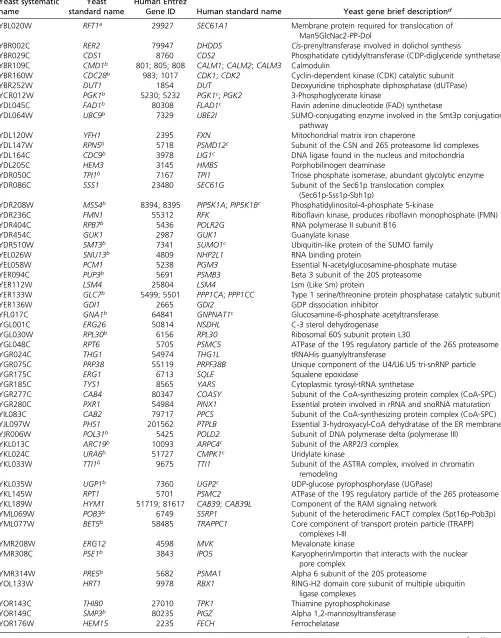
Table 1 Human cDNAs that complement essential yeast deletion mutants
Yeast systematic name
Yeast standard name
Human Entrez
Gene ID Human standard name Yeast gene brief descriptiond
YBL020W RFT1a 29927 SEC61A1 Membrane protein required for translocation of Man5GlcNac2-PP-Dol
YBR002C RER2 79947 DHDDS Cis-prenyltransferase involved in dolichol synthesis
YBR029C CDS1 8760 CDS2 Phosphatidate cytidylyltransferase (CDP-diglyceride synthetase) YBR109C CMD1b 801; 805; 808 CALM1;CALM2;CALM3 Calmodulin
YBR160W CDC28b 983; 1017 CDK1;CDK2 Cyclin-dependent kinase (CDK) catalytic subunit YBR252W DUT1 1854 DUT Deoxyuridine triphosphate diphosphatase (dUTPase) YCR012W PGK1b 5230; 5232 PGK1c;PGK2 3-Phosphoglycerate kinase
YDL045C FAD1b 80308 FLAD1c Flavin adenine dinucleotide (FAD) synthetase
YDL064W UBC9b 7329 UBE2I SUMO-conjugating enzyme involved in the Smt3p conjugation pathway
YDL120W YFH1 2395 FXN Mitochondrial matrix iron chaperone
YDL147W RPN5b 5718 PSMD12c Subunit of the CSN and 26S proteasome lid complexes YDL164C CDC9b 3978 LIG1c DNA ligase found in the nucleus and mitochondria
YDL205C HEM3 3145 HMBS Porphobilinogen deaminase
YDR050C TPI1b 7167 TPI1 Triose phosphate isomerase, abundant glycolytic enzyme YDR086C SSS1 23480 SEC61G Subunit of the Sec61p translocation complex
(Sec61p-Sss1p-Sbh1p)
YDR208W MSS4b 8394; 8395 PIP5K1A;PIP5K1Bc Phosphatidylinositol-4-phosphate 5-kinase
YDR236C FMN1 55312 RFK Riboflavin kinase, produces riboflavin monophosphate (FMN) YDR404C RPB7b 5436 POLR2G RNA polymerase II subunit B16
YDR454C GUK1 2987 GUK1 Guanylate kinase
YDR510W SMT3b 7341 SUMO1c Ubiquitin-like protein of the SUMO family
YEL026W SNU13b 4809 NHP2L1 RNA binding protein
YEL058W PCM1 5238 PGM3 Essential N-acetylglucosamine-phosphate mutase YER094C PUP3b 5691 PSMB3 Beta 3 subunit of the 20S proteasome
YER112W LSM4 25804 LSM4 Lsm (Like Sm) protein
YER133W GLC7b 5499; 5501 PPP1CA;PPP1CC Type 1 serine/threonine protein phosphatase catalytic subunit
YER136W GDI1 2665 GDI2 GDP dissociation inhibitor
YFL017C GNA1b 64841 GNPNAT1c Glucosamine-6-phosphate acetyltransferase
YGL001C ERG26 50814 NSDHL C-3 sterol dehydrogenase
YGL030W RPL30b 6156 RPL30 Ribosomal 60S subunit protein L30
YGL048C RPT6 5705 PSMC5 ATPase of the 19S regulatory particle of the 26S proteasome YGR024C THG1 54974 THG1L tRNAHis guanylyltransferase
YGR075C PRP38 55119 PRPF38B Unique component of the U4/U6.U5 tri-snRNP particle
YGR175C ERG1 6713 SQLE Squalene epoxidase
YGR185C TYS1 8565 YARS Cytoplasmic tyrosyl-tRNA synthetase
YGR277C CAB4 80347 COASY Subunit of the CoA-synthesizing protein complex (CoA-SPC) YGR280C PXR1 54984 PINX1 Essential protein involved in rRNA and snoRNA maturation YIL083C CAB2 79717 PPCS Subunit of the CoA-synthesizing protein complex (CoA-SPC) YJL097W PHS1 201562 PTPLB Essential 3-hydroxyacyl-CoA dehydratase of the ER membrane YJR006W POL31b 5425 POLD2 Subunit of DNA polymerase delta (polymerase III)
YKL013C ARC19b 10093 ARPC4c Subunit of the ARP2/3 complex
YKL024C URA6b 51727 CMPK1c Uridylate kinase
YKL033W TTI1b 9675 TTI1 Subunit of the ASTRA complex, involved in chromatin remodeling
YKL035W UGP1b 7360 UGP2c UDP-glucose pyrophosphorylase (UGPase)
YKL145W RPT1 5701 PSMC2 ATPase of the 19S regulatory particle of the 26S proteasome YKL189W HYM1 51719; 81617 CAB39;CAB39L Component of the RAM signaling network
YML069W POB3b 6749 SSRP1 Subunit of the heterodimeric FACT complex (Spt16p-Pob3p) YML077W BET5b 58485 TRAPPC1 Core component of transport protein particle (TRAPP)
complexes I-III
YMR208W ERG12 4598 MVK Mevalonate kinase
YMR308C PSE1b 3843 IPO5 Karyopherin/importin that interacts with the nuclear pore complex
YMR314W PRE5b 5682 PSMA1 Alpha 6 subunit of the 20S proteasome
YOL133W HRT1 9978 RBX1 RING-H2 domain core subunit of multiple ubiquitin ligase complexes
YOR143C THI80 27010 TPK1 Thiamine pyrophosphokinase
YOR149C SMP3b 80235 PIGZ Alpha 1,2-mannosyltransferase
YOR176W HEM15 2235 FECH Ferrochelatase
GPD vs.inducible GAL), plasmid copy number (2mvs.CEN backbone), N- or C-terminal tags, and auxotrophic markers (Albertiet al.2007). To express human cDNAs in yeast, we selected a centromere-based backbone and a constitutive promoter to reduce plasmid copy-number variation and min-imize potential toxicity that can arise from overexpression of human cDNAs in yeast (Tugendreichet al.2001). To test for complementation of essential gene null mutations, we assayed for rescue of lethality of the haploid yeast gene de-letion following sporulation of the “haploid-convertible” heterozygous diploids (Panet al.2004).
To design and execute the complementation assay, we compiled all sequence homologs of essential yeast genes generated from multiple sources using the Yeastmine data-base (Balakrishnan et al.2012), Ensembl BioMart database (Kinsellaet al.2011) and to a lesser extent through manual curation. Each candidate complementation pair (human cDNA and cognate yeast gene) was included in our screens based on the availability and quality control of both the hu-man cDNA in the hORFeome collection and the correspond-ing yeast strain in the heterozygous collection. In an effort to be as comprehensive as possible, our screens tested all pos-sible complementation pairs even when the least diverged candidate ortholog was not available in the hORFeome col-lection. For instance, yCDC42is a rho-like GTPase required for the establishment of cell polarity (Johnson 1999). The list of homologs for yCDC42 included genes such as hCDC42, hRHOJ, hRHOV, hRHOU, and other related members of the RHO family of small GTPases. Of these homologs, the least diverged ortholog, hCDC42 (80% sequence identity, previ-ously shown to complement the yeast deletion mutant (Kachroo et al. 2015), was not available in the human ORFeome V8.1 collection and therefore not tested in this study. We did test hRHOJ(60% sequence identity) and de-termined that it does not complement the null allele of yCDC42. In total, we tested 199 essential CIN deletion mutants for rescue of lethality by 320 human cDNAs one-by-one (322 candidate complementation pairs) and 621 essential gene deletion mutants for rescue of lethality by 1010 human cDNAs pool-to-pool (1076 candidate complementation pairs) (Figure 1A,Table S2andTable S3). Our screens identified 65 human cDNAs that complement the null allele of 58 es-sential yeast genes, including a complementation pair of
nonorthologous proteins (yeast Rft1 and human Sec61A1) (Table 1). When compared to a curated list of complementa-tion pairs available from theSaccharomycesGenome Database (SGD) that includes the recent results of Kachrooet al.(2015)
(http://downloads.yeastgenome.org/curation/literature/
functional_complementation.tab (June 2015) and other
published reports, our work identified 20 novel complemen-tation pairs in which the human cDNA rescues lethality of the yeast null allele (Table S4).
Assessing features of essential yeast genes that predict replaceability
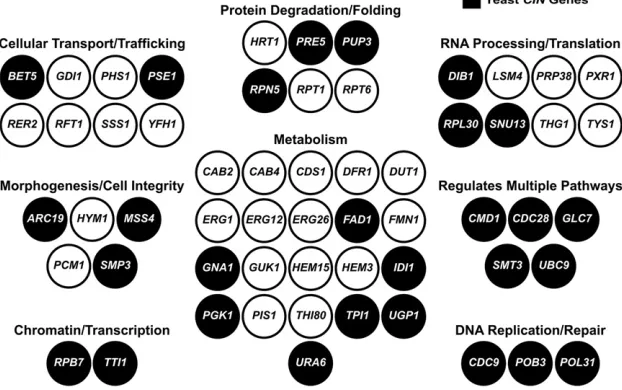
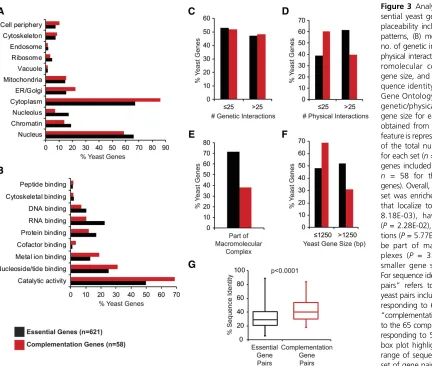
We used Yeastmine to assess GO terms and looked for features that predict replaceability of essential yeast genes. Our yeast complementation set (n= 58) is composed predominantly of metabolic genes (Figure 2), a feature also observed in a recent large-scale complementation study (Kachrooet al.2015). In general, the complemented yeast genes encode proteins that localize to the cytoplasm and associated organelles rather than the nucleus or other nuclear-associated regions (Figure 3A). When grouped by molecular function, the complemen-tation set is enriched for proteins that display catalytic activ-ity and other enzymatic features such as nucleotide, metal ion, and cofactor binding (Figure 3B).
Even though the complemented yeast genes display no difference in the number of genetic interactions (Figure 3C), there is a marked difference in the number of physical inter-actions in this set: replaceable yeast proteins tend to have fewer physical interactions (Figure 3D) and are less likely to be part of macromolecular complexes (Figure 3E). We further show that replaceable yeast genes tend to be short (Figure 3F), corroborating the observation of Kachrooet al. (2015).
Complementation pairs tend to have higher than average sequence identity/similarity, but sequence identity alone is a poor predictor of replaceability as evidenced by the obser-vations that high sequence similarity does not guarantee replaceability and complementation pairs can have low se-quence similarity (Figure 3G). We assessed whether replace-ability by one human homolog predicts the same outcome for additional human homologs. In one case, we found that the glycolytic enzyme yPGK1can be replaced by either hPGK1 (66% sequence identity) or hPGK2(63% sequence identity),
Table 1,continued
Yeast systematic name
Yeast standard name
Human Entrez
Gene ID Human standard name Yeast gene brief descriptiond
YOR236W DFR1 1719 DHFR Dihydrofolate reductase involved in tetrahydrofolate biosynthesis
YPL117C IDI1b 3422 IDI1c Isopentenyl diphosphate:dimethylallyl diphosphate isomerase YPR082C DIB1b 10907 TXNL4Ac 17-kDa component of the U4/U6aU5 tri-snRNP
YPR113W PIS1 10423 CDIPT Phosphatidylinositol synthase
aComplementation by nonorthologous gene. bYeast CIN gene.
human proteins that share 87% sequence identity and cata-lyze the same reaction but are differentially expressed (McCarrey and Thomas 1987). In the only other example, the phosphatase yGLC7 can be replaced by the isozymes hPPP1CA (84% sequence identity) and hPPP1CC (84% se-quence identity), human proteins that are 91% identical and part of the highly conserved PP1 subfamily of protein phosphatases (Ceulemans and Bollen 2004). In contrast, some yeast genes such as yDIB1, yIDI1, and ySMT3are only replaceable by one of multiple human homologs, whereas others like yCMD1, yMSS4, and yCDC28are replaceable by several (but not all) human homologs. For these cases and the previously mentioned yCDC42, we observed that replace-able human proteins share higher sequence identity with the yeast protein than the nonreplaceable ones (Table S5), sug-gesting that the least diverged homologs were the most likely to complement. The only contradiction of this observation is hSEC61A1, which can replace the nonorthologous yRFT1and rescue lethality ofrft1D.Sec61forms an ER membrane chan-nel and is required for cotranslational and post-translational translocation of proteins into the ER (Osborneet al.2005), whileRft1also functions at the ER membrane and is impli-cated in the translocation of lipid-linked oligosaccharides into the ER (Heleniuset al.2002). We further demonstrated that hRFT1cannot complement yRFT1(also shown by Kachroo et al. 2015), and that overexpression of the yeast ortholog of hSEC61A1, ySEC61, also fails to rescue lethality ofrft1D (Figure 4). The fact that hSEC61A1also fails to complement ySEC61 (Table S2) highlights the unexpected and complex manner in which the human protein acts to functionally sub-stitute for the nonorthologous yeast protein. Overall, our observations and those of Kachrooet al.(2015) suggest that complementation cannot be predicted by sequence similarity.
Characterizing tumor-specific variants using cross-species complementation
Human–yeast complementation enables direct testing of human gene variants for function. Genetic variants can be
screened rapidly and are characterized in the context of the human protein. For example, complementation of yeast
cys4Dby its human orthologCBS gene enabled the testing of 84 variants from patients with homocystinuria for func-tionality and cofactor dependence (Mayfield et al. 2012). One resource from our human–yeast complementation screen is a list of human genes whose variants can be char-acterized in a yeast deletion strain. We focused on testing tumor-specific mutations found in human orthologs of yeast CIN genes. Our complementation set (Table 1) includes 28 essential yeast CIN genes rescued by 34 candidate human CIN genes. We observe that the replaceable yeast CIN genes function across diverse biological processes, including those pathways predicted to protect genome integrity (e.g., DNA replication/repair and chromatin-related processes) and more peripheral pathways (e.g., metabolism and cellular
traf-ficking) (Figure 2).
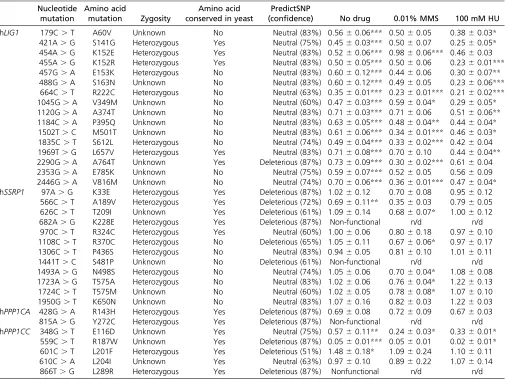
We selected three yeast CIN genes corresponding to four complementation pairs (yCDC9:hLIG1, yPOB3:hSSRP1, yGLC7:hPPP1CA, and yGLC7:hPPP1CC) and assessed the im-pact of single amino acid substitutions in the human protein. Briefly, yCDC9encodes DNA ligase, an essential enzyme that joins Okazaki fragments during DNA replication and also functions in DNA repair pathways (Lindahl and Barnes 1992); yPOB3is a subunit of the heterodimeric FACT com-plex (yPOB3-ySPT16) that functions in nucleosome reorgani-zation to facilitate transcription and replication processes (Formosa 2008); yGLC7is the catalytic subunit of protein phosphatase which, depending on its bound regulatory sub-unit, regulates numerous cellular processes (Cannon 2010). We selected one cancer type (colorectal cancer) and screened all reported missense mutations compiled in two databases: Catalogue of Somatic Mutations in Cancer (COSMIC) (Forbes et al.2015) and cBIOPORTAL for Cancer Genomics (Cerami et al.2012; Gaoet al.2013). In total, 35 single amino acid substitutions were constructed corresponding to 16 in hLIG1, 12 in hSSRP1, 2 in hPPP1CA, and 5 in hPPP1CC. As a control, we expressed each human gene variant in a wild-type yeast
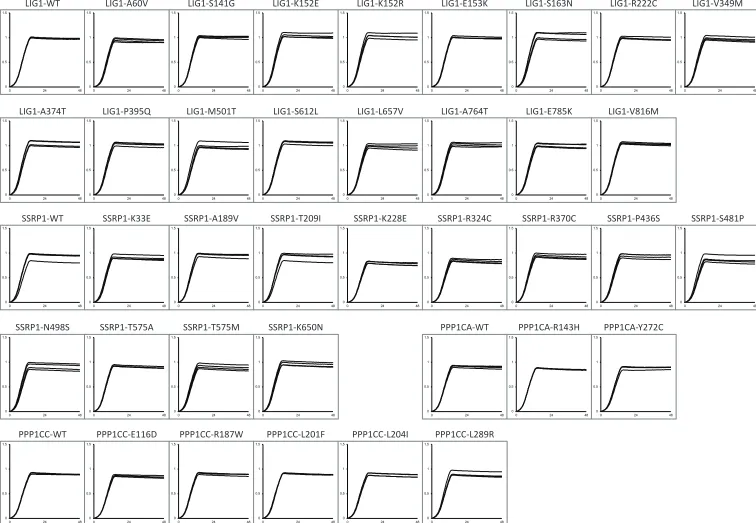
strain and compared the growth of these yeast strains to the growth of the same yeast strain expressing the wild-type hu-man allele. This step is required to identify any mutants whose ectopic expression may impact the growth phenotype of the yeast strain either by causing toxicity to the yeast cell or increasing the growth rate. Of the 35 mutants analyzed, the K228E mutation in hSSRP1is the only amino acid substitu-tion whose ectopic expression decreasedfitness of wild-type yeast (Table S6,Figure S1).
We used a plasmid shuffle strategy to introduce the human gene variants in the corresponding yeast gene deletion mutants. Haploid yeast gene knockout strains carrying the rescuing human cDNA on a URA3-marked plasmid were transformed with wild-type or mutated human cDNA on a LEU2-marked plasmid and plated on media containing 5-FOA (Figure 5), which selects for cells that have lost theURA3plasmid. Growth on 5-FOA plates indicates that the mutant human cDNA is able to complement the essential gene. Lack of growth on 5-FOA indicates that the mutation in the human cDNA results in a non-functional protein. We observed that 4 of the 35 mutant alleles [2 in hSSRP1(K228E, S481P), 1 in hPPP1CA(Y272C), and 1 in hPPP1CC (L289R)] are nonfunctional (Table 2). Although hSSRP1-K228E was found to be detrimental in the context of
the human gene, the same substitution in the conserved site of the yeast protein (yPob3-K271E) is tolerated (VanDemarket al. 2006). This corroborates previous observations that amino acid substitutions in the context of the yeast gene (or other ortho-logs) do not necessarily have the same effect in the context of the human gene (Mariniet al.2010), emphasizing the impor-tance of characterizing human variants in their native gene context. To determine the accuracy of our experimental read-out, we surveyed the literature and found the conserved Y272 and L289 in PP1 phosphatases are essential for substrate bind-ing (Egloffet al.1995, 1997; Zhanget al.1996).
The remaining 31 mutant alleles were assessed for their ability to rescue growth of the null mutant (Table 2,Figure S2,
Figure S3, andFigure S4). We observed that 19 of the 31
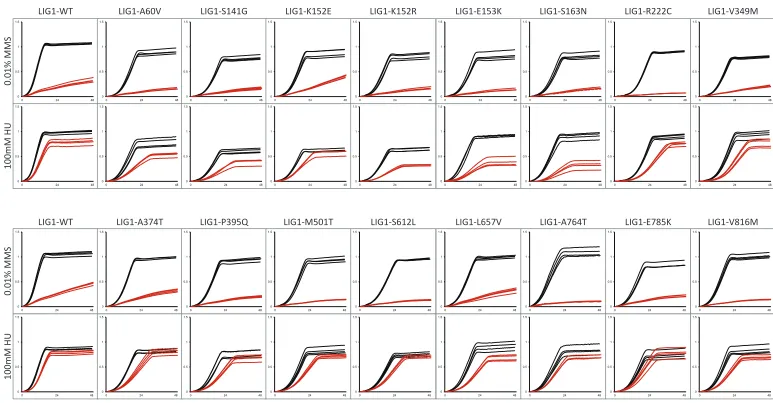
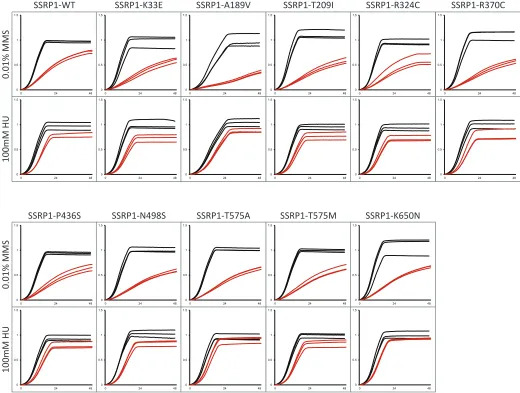
mutations cause a significant decrease in strainfitness rela-tive to the wild-type allele, while 1 mutant allele (hPPP1CC -L201F) grows considerably better than the corresponding wild-type allele. Notably, 16 of the 19 “slow growers” are substitutions in hLIG1, with the mutations dispersed through-out the protein. Given that mutants with defects in chromo-some stability are often sensitive to DNA-damaging agents, we assayed our 31 mutants for growth in the presence of methyl methane sulfonate (MMS) and hydroxyurea (HU).
Figure 3 Analyzing features of es-sential yeast genes that predict re-placeability including (A) localization patterns, (B) molecular function, (C) no. of genetic interactions, (D) no. of physical interactions, (E) part of mac-romolecular complexes, (F) yeast gene size, and (G) human–yeast se-quence identity. Localization data, Gene Ontology (GO) terms, no. of genetic/physical interactions, and gene size for each yeast gene were obtained from Yeastmine and each feature is represented as a proportion of the total number of genes input for each set (n= 621 for all essential genes included in both screens and n = 58 for the complementation genes). Overall, the complementation set was enriched for yeast proteins that localize to the cytoplasm (P = 8.18E-03), have catalytic activity (P= 2.28E-02), less physical interac-tions (P= 5.77E-03), are less likely to be part of macromolecular com-plexes (P = 3.36E-07), and have smaller gene size (P= 9.16E-03). For sequence identity,“essential gene pairs” refers to the 1076 human–
MMS is an alkylating agent (Beranek 1990) while HU slows DNA replication by decreasing the rate of dNTP synthesis (Kocet al.2004), and haploid viable mutant alleles of yeast
CDC9,POB3, andGLC7have been shown to cause sensitivity to sublethal doses of MMS and/or HU (Prakash and Prakash 1977; Schlesinger and Formosa 2000; Bazzi et al. 2010). Twelve mutant alleles cause sensitivity to MMS, while two cause increased resistance to MMS. The majority of the mutants sensitive to HU are in hLIG1 (12/14), which is expected given the major role of that protein in DNA replica-tion. To assess whether computational predictions match em-pirical results, we used PredictSNP (a consensus classifier grouping six computational tools) (Bendlet al.2014) to pre-dict the effects of the mutations on protein function. Our results demonstrate that predicted effects do not always match observed results. While some substitutions predicted to be neutral with high confidence displayed detrimental growth phenotypes (e.g., hPPP1CC-E116D), others predicted to be deleterious with high confidence exhibited no growth defects (e.g., hSSRP1-R370C). Moreover, amino acid conser-vation alone or in combination with computational predic-tions did not accurately predict observable phenotypes. For instance, an amino acid that is conserved between yeast and human proteins might be expected to be important for pro-tein function. However, even a substitution predicted to be deleterious by computational tools may not result in any growth phenotypes (e.g., hSSRP1-T209I). Overall, these results underscore the requirement for direct functional test-ing of variants in their native gene context.
Discussion
The work presented in this study extends the growing list of human–yeast complementation pairs that will serve as an important resource for model organism and human biology. Many factors impact replaceability of yeast genes by human genes. Different types of yeast strains permit different com-plementation readouts; therefore, choosing the appropriate yeast strain depends on what is required for downstream applications. We restricted our complementation assays to testing rescue of lethality of the haploid yeast gene knockout
because rescue of a yeast conditional allele or downregulated yeast gene can represent partial or indirect complementation. This is evident in the results of Kachrooet al.(2015), which indicate that,60% (32/56) of the 69 human orthologs iden-tified by rescue of temperature-sensitive alleles are able to rescue the null allele. Similarly, 60% (24/39) of the 44 human orthologs identified by rescue of downregulated yeast genes are able to rescue the null allele. If the main objective is to use yeast as a platform to characterize the functional con-sequence of human gene variants, we believe that comple-mentation of the null allele is more desirable mainly for two reasons. First, expressing human cDNAs in a yeast deletion mutant diminishes the possibility of misleading phenotypic readouts by eliminating unwanted side effects of the residual yeast protein that is present in partial loss-of-function alleles. Second, the use of null alleles distinguishes those human proteins that are truly substituting for the essential function of the yeast protein from those human proteins that are sup-pressing a growth phenotype by a secondary mechanism that may or may not relate to the conserved function. Other fac-tors that impact replaceability include the conditions used to express the human cDNA in yeast to account for dosage, toxicity, or timing of expression. Examples of what can be manipulated include picking a suitable promoter (endoge-nous yeast promoter vs.constitutivevs.inducible), integra-tion of human cDNA vs. episomal vector-based expression, and inclusion of epitope tags. For instance, in this study we used yeast expression vectors that introduce short C-terminal extensions, which can interfere with replaceability by some human proteins (Kachrooet al.2015). In general, there are no sets of conditions that satisfy the replaceability require-ments of all candidate complementation pairs, as each human– yeast gene pair is unique. Even when no complementation is observed, partial fusions to create chimeric human–yeast
Figure 5 Plasmid shuffle used to generate strains expressing human cDNAs with missense mutations. Yeast haploid knockout strains covered by wild-type human cDNAs onURA3-marked vectors were transformed with the followingLEU2-marked vectors (empty, wild-type human cDNA, and human cDNA with missense mutation) and maintained on 2Ura
2Leu media. Strains were plated on2Leu +5-FOA media to generate haploid yeast knockouts covered byLEU2-marked vectors. Strains were confirmed to have lost theURA3-marked plasmid by streaking on2Ura media to observe no growth. In the presented example, hSsrp1-K33E is able to complementpob3D, but S481P results in a nonfunctional hSsrp1 protein.
proteins may allow complementation and provide a useful resource for specific applications (Zhou and Reed 1998).
The experimental design of systematic complementation assays impacts the scope of the results. Testing complemen-tation pairs one-by-one reduces the number of false negatives inherent in pooled screening. This was observed in our study: our one-to-one screen identified 34 complementation pairs corresponding to 28 yeast strains, while our pool-to-pool screen identified 12 of these complementation pairs corre-sponding to 12 yeast strains, resulting in a 35% recovery rate from the pooled screen (Table 1). This modest recovery rate may be due to several factors: (i) even with 100-fold cover-age, shorter cDNAs are shuttled more efficiently from entry clones to destination vectors in Gateway’s LR reaction, result-ing in a potentially skewed representation of some expres-sion vectors within a pool; (ii) competitive outgrowth can result in a skewed representation of yeast strains pre- and
post-transformation; (iii) even with 100-fold coverage, pool-to-pool transformation reduces the chances of a particular human cDNA complementing the matched yeast strain, espe-cially given the possibility of skewed representation of expres-sion vectors and yeast strains; (iv) toxicity from some human cDNAs can skew representation of yeast strains within a pool; (v) sporulation efficiencies of different yeast strains skew hap-loid selection; and (vi) sequence coverage of rescued haphap-loids will impact the scope of the results. Nevertheless, the advan-tage of pooled screening is the potential for identification of nonorthologous complementation pairs, as demonstrated in this study. With the development of better screening methods and updated collections, the potential for discovery of additional nonorthologous complementation pairs will aid in deciphering biological mechanisms that would otherwise be overlooked.
We demonstrated a robust approach to determining the functional consequence of human gene variants in yeast.
Table 2 Tumor-specific variants constructed and analyzed in a yeast deletion background
Nucleotide mutation
Amino acid
mutation Zygosity
Amino acid conserved in yeast
PredictSNP
(confidence) No drug 0.01% MMS 100 mM HU
hLIG1 179C.T A60V Unknown No Neutral (83%) 0.5660.06*** 0.5060.05 0.3860.03*
421A.G S141G Heterozygous Yes Neutral (75%) 0.4560.03*** 0.5060.07 0.2560.05*
454A.G K152E Heterozygous Yes Neutral (83%) 0.5260.06*** 0.9860.06*** 0.4660.03 455A.G K152R Heterozygous Yes Neutral (83%) 0.5060.05*** 0.5060.06 0.2360.01***
457G.A E153K Heterozygous No Neutral (83%) 0.6060.12*** 0.4460.06 0.3060.07**
488G.A S163N Unknown No Neutral (83%) 0.6060.12*** 0.4960.05 0.2360.06***
664C.T R222C Heterozygous No Neutral (63%) 0.3560.01*** 0.2360.01*** 0.2160.02***
1045G.A V349M Unknown No Neutral (60%) 0.4760.03*** 0.5960.04* 0.2960.05*
1120G.A A374T Unknown No Neutral (83%) 0.7160.03*** 0.7160.06 0.5160.06**
1184C.A P395Q Unknown No Neutral (83%) 0.6360.05*** 0.4860.04** 0.4460.04*
1502T.C M501T Unknown No Neutral (83%) 0.6160.06*** 0.3460.01*** 0.4660.03*
1835C.T S612L Heterozygous No Neutral (74%) 0.4960.04*** 0.3360.02*** 0.4260.04 1969T.G L657V Heterozygous Yes Neutral (83%) 0.7160.08*** 0.7060.10 0.4460.04**
2290G.A A764T Unknown Yes Deleterious (87%) 0.7360.09*** 0.3060.02*** 0.6160.04 2353G.A E785K Unknown No Neutral (75%) 0.5960.07*** 0.5260.05 0.5660.09 2446G.A V816M Unknown No Neutral (74%) 0.7060.06*** 0.3660.01*** 0.4760.04*
hSSRP1 97A.G K33E Heterozygous Yes Deleterious (87%) 1.0260.12 0.7060.08 0.9560.12 566C.T A189V Heterozygous Yes Deleterious (72%) 0.6960.11** 0.3560.03 0.7960.05 626C.T T209I Unknown Yes Deleterious (61%) 1.0960.14 0.6860.07* 1.0060.12 682A.G K228E Heterozygous Yes Deleterious (87%) Non-functional n/d n/d 970C.T R324C Heterozygous Yes Neutral (60%) 1.0060.06 0.8060.18 0.9760.10 1108C.T R370C Heterozygous No Deleterious (65%) 1.0560.11 0.6760.06* 0.9760.17 1306C.T P436S Heterozygous No Neutral (83%) 0.9460.05 0.8160.10 1.0160.11 1441T.C S481P Unknown No Deleterious (61%) Non-functional n/d n/d 1493A.G N498S Heterozygous No Neutral (74%) 1.0560.06 0.7060.04* 1.0860.08 1723A.G T575A Heterozygous No Neutral (83%) 1.0260.06 0.7660.04* 1.2260.13 1724C.T T575M Unknown No Neutral (60%) 1.0260.05 0.7860.08* 1.0760.10 1950G.T K650N Unknown No Neutral (83%) 1.0760.16 0.8260.03 1.2260.03 hPPP1CA 428G.A R143H Heterozygous Yes Deleterious (87%) 0.6960.08 0.7260.09 0.6760.03
815A.G Y272C Heterozygous Yes Deleterious (87%) Non-functional n/d n/d hPPP1CC 348G.T E116D Unknown Yes Neutral (75%) 0.5760.11** 0.2460.03* 0.3360.01*
559C.T R187W Unknown Yes Deleterious (87%) 0.0560.01*** 0.0560.01 0.0260.01*
601C.T L201F Heterozygous Yes Deleterious (51%) 1.4860.18* 1.0960.24 1.1060.11 610C.A L204I Unknown Yes Neutral (63%) 0.9760.10 0.8960.22 1.0760.14 866T.G L289R Heterozygous Yes Deleterious (87%) Nonfunctional n/d n/d
Strainfitness for each allele is expressed as a ratio relative to the yeast strain expressing the wild-type allele grown in the same plate in the same media condition. For“no drug”condition, significance was calculated compared to the wild-type allele grown in the same plate to assess impact of missense mutation on strainfitness. For“drug”
condition, significance was calculated compared to the same allele in the no drug condition grown in the same plate to assess impact of drug on strainfitness. Alleles were defined as nonfunctional based on inability to complement the corresponding deletion mutant yeast strain. Strainfitness values that were not determined are indicated (n/d).
Because the functional effects of missense mutations are difficult to predict, a quick yet systematic approach to screen and prioritize human gene variants for subsequent testing in mammalian models is of great value. As we have picked mutants of genes implicated in chromosome stability, mutant alleles that result in a nonfunctional protein, or reduction of function as displayed by decreased strainfitness, or increased sensitivity to DNA-damaging agents, are candidate mutations that might contribute to chromosome instability in tumor cells. While we have focused on screening somatic mutations found in tumors, this approach is also applicable to rare-disease variants that are being discovered at an unprece-dented rate through next-generation sequencing (Hieter and Boycott 2014). Of course, there are limitations to com-plementation in model organisms, including representation of multicellular and developmental pathways that are absent in single-celled yeast. Nevertheless, advances in sequencing technologies have led to the discovery of an overwhelming number of human genetic variants whose empirical assess-ment of their biological effects would be impractical without the support of model organisms.
Acknowledgments
We thank Peter Stirling and Nigel O’Neil for helpful discus-sion and critical reading of the manuscript. This work was supported by grants to P.H. from the Canadian Institutes of Health Research (CIHR) (MOP 38096) and the National Institutes of Health (R01CA158162). A.H. is supported by doctoral awards from CIHR and the University of British Columbia. C.N. and G.G. are funded by the US Department of Agriculture and the Canada Foundation for Innovation. P.H. is a senior fellow in the Genetic Networks program at the Canadian Institute for Advanced Research.
Literature Cited
Alberti, S., A. D. Gitler, and S. Lindquist, 2007 A suite of Gateway cloning vectors for high-throughput genetic analysis in Saccharo-myces cerevisiae. Yeast 24: 913–919.
Arnoldo, A., S. Kittanakom, L. E. Heisler, A. B. Mak, A. I. Shukalyuk
et al., 2014 A genome scale overexpression screen to reveal drug activity in human cells. Genome Med. 6: 32.
Balakrishnan, R., J. Park, K. Karra, B. C. Hitz, G. Binkley et al., 2012 YeastMine–an integrated data warehouse for Saccharo-myces cerevisiae data as a multipurpose tool-kit. Database (Oxford) 2012: bar062.
Barber, T. D., K. McManus, K. W. Yuen, M. Reis, G. Parmigianiet al., 2008 Chromatid cohesion defects may underlie chromosome instability in human colorectal cancers. Proc. Natl. Acad. Sci. USA 105: 3443–3448.
Bazzi, M., D. Mantiero, C. Trovesi, G. Lucchini, and M. P. Longhese, 2010 Dephosphorylation of gamma H2A by Glc7/protein phosphatase 1 promotes recovery from inhibition of DNA repli-cation. Mol. Cell. Biol. 30: 131–145.
Bendl, J., J. Stourac, O. Salanda, A. Pavelka, E. D. Wiebenet al., 2014 PredictSNP: robust and accurate consensus classifier for prediction of disease-related mutations. PLOS Comput. Biol. 10: e1003440.
Beranek, D. T., 1990 Distribution of methyl and ethyl adducts following alkylation with monofunctional alkylating agents. Mu-tat. Res. 231: 11–30.
Brachmann, C. B., A. Davies, G. J. Cost, E. Caputo, J. Li et al., 1998 Designer deletion strains derived from Saccharomyces cerevisiae S288C: a useful set of strains and plasmids for PCR-mediated gene disruption and other applications. Yeast 14: 115–132.
Cannon, J. F., 2010 Function of protein phosphatase-1, Glc7, in Saccharomyces cerevisiae. Adv. Appl. Microbiol. 73: 27–59. Cerami, E., J. Gao, U. Dogrusoz, B. E. Gross, S. O. Sumeret al.,
2012 The cBio cancer genomics portal: an open platform for exploring multidimensional cancer genomics data. Cancer Dis-cov. 2: 401–404.
Ceulemans, H., and M. Bollen, 2004 Functional diversity of pro-tein phosphatase-1, a cellular economizer and reset button. Physiol. Rev. 84: 1–39.
Charames, G. S., and B. Bapat, 2003 Genomic instability and can-cer. Curr. Mol. Med. 3: 589–596.
Dunham, M. J., and D. M. Fowler, 2013 Contemporary, yeast-based approaches to understanding human genetic variation. Curr. Opin. Genet. Dev. 23: 658–664.
Egloff, M. P., P. T. Cohen, P. Reinemer, and D. Barford, 1995 Crystal structure of the catalytic subunit of human pro-tein phosphatase 1 and its complex with tungstate. J. Mol. Biol. 254: 942–959.
Egloff, M. P., D. F. Johnson, G. Moorhead, P. T. Cohen, P. Cohen
et al., 1997 Structural basis for the recognition of regulatory subunits by the catalytic subunit of protein phosphatase 1. EMBO J. 16: 1876–1887.
Forbes, S. A., D. Beare, P. Gunasekaran, K. Leung, N. Bindalet al., 2015 COSMIC: exploring the world’s knowledge of somatic mutations in human cancer. Nucleic Acids Res. 43: D805–D811. Formosa, T., 2008 FACT and the reorganized nucleosome. Mol.
Biosyst. 4: 1085–1093.
Gao, J., B. A. Aksoy, U. Dogrusoz, G. Dresdner, B. Gross et al., 2013 Integrative analysis of complex cancer genomics and clinical profiles using the cBioPortal. Sci. Signal. 6: pl1. Giaever, G., A. M. Chu, L. Ni, C. Connelly, L. Riles et al.,
2002 Functional profiling of the Saccharomyces cerevisiae genome. Nature 418: 387–391.
Greene, A. L., J. R. Snipe, D. A. Gordenin, and M. A. Resnick, 1999 Functional analysis of human FEN1 in Saccharomyces cerevisiae and its role in genome stability. Hum. Mol. Genet. 8: 2263–2273.
Hanahan, D., and R. A. Weinberg, 2011 Hallmarks of cancer: the next generation. Cell 144: 646–674.
Hartley, J. L., G. F. Temple, and M. A. Brasch, 2000 DNA cloning using in vitro site-specific recombination. Genome Res. 10: 1788–1795.
Helenius, J., D. T. Ng, C. L. Marolda, P. Walter, M. A. Valvanoet al., 2002 Translocation of lipid-linked oligosaccharides across the ER membrane requires Rft1 protein. Nature 415: 447–450. Hieter, P., and K. M. Boycott, 2014 Understanding rare disease
pathogenesis: a grand challenge for model organisms. Genetics 198: 443–445.
Hu, Y., A. Rolfs, B. Bhullar, T. V. Murthy, C. Zhu et al., 2007 Approaching a complete repository of sequence-verified protein-encoding clones for Saccharomyces cerevisiae. Genome Res. 17: 536–543.
Johnson, D. I., 1999 Cdc42: An essential Rho-type GTPase con-trolling eukaryotic cell polarity. Microbiol. Mol. Biol. Rev. 63: 54–105.
Kato, S., S. Y. Han, W. Liu, K. Otsuka, H. Shibata et al., 2003 Understanding the function-structure and function-mu-tation relationships of p53 tumor suppressor protein by high-resolution missense mutation analysis. Proc. Natl. Acad. Sci. USA 100: 8424–8429.
Kinsella, R. J., A. Kahari, S. Haider, J. Zamora, G. Proctoret al., 2011 Ensembl BioMarts: a hub for data retrieval across taxonomic space. Database (Oxford) 2011: bar030. Koc, A., L. J. Wheeler, C. K. Mathews, and G. F. Merrill,
2004 Hydroxyurea arrests DNA replication by a mechanism that preserves basal dNTP pools. J. Biol. Chem. 279: 223–230. Koonin, E. V., 2005 Orthologs, paralogs, and evolutionary
ge-nomics. Annu. Rev. Genet. 39: 309–338.
Lengauer, C., K. W. Kinzler, and B. Vogelstein, 1997 Genetic in-stability in colorectal cancers. Nature 386: 623–627.
Lindahl, T., and D. E. Barnes, 1992 Mammalian DNA ligases. Annu. Rev. Biochem. 61: 251–281.
Marini, N. J., P. D. Thomas, and J. Rine, 2010 The use of orthol-ogous sequences to predict the impact of amino acid substitu-tions on protein function. PLoS Genet. 6: e1000968.
Mayfield, J. A., M. W. Davies, D. Dimster-Denk, N. Pleskac, S. Mc-Carthyet al., 2012 Surrogate genetics and metabolic profiling for characterization of human disease alleles. Genetics 190: 1309–1323.
McCarrey, J. R., and K. Thomas, 1987 Human testis-specific PGK gene lacks introns and possesses characteristics of a processed gene. Nature 326: 501–505.
Osborn, M. J., and J. R. Miller, 2007 Rescuing yeast mutants with human genes. Brief. Funct. Genomics Proteomics 6: 104–111. Osborne, A. R., T. A. Rapoport, and B. van den Berg, 2005 Protein
translocation by the Sec61/SecY channel. Annu. Rev. Cell Dev. Biol. 21: 529–550.
Pan, X., D. S. Yuan, D. Xiang, X. Wang, S. Sookhai-Mahadeoet al., 2004 A robust toolkit for functional profiling of the yeast ge-nome. Mol. Cell 16: 487–496.
Pan, X., D. S. Yuan, S. L. Ooi, X. Wang, S. Sookhai-Mahadeoet al., 2007 dSLAM analysis of genome-wide genetic interactions in Saccharomyces cerevisiae. Methods 41: 206–221.
Prakash, L., and S. Prakash, 1977 Isolation and characterization of MMS-sensitive mutants of Saccharomyces cerevisiae. Genet-ics 86: 33–55.
Schlesinger, M. B., and T. Formosa, 2000 POB3 is required for both transcription and replication in the yeast Saccharomyces cerevisiae. Genetics 155: 1593–1606.
Schvartzman, J. M., R. Sotillo, and R. Benezra, 2010 Mitotic chro-mosomal instability and cancer: mouse modelling of the human disease. Nat. Rev. Cancer 10: 102–115.
Stirling, P. C., M. S. Bloom, T. Solanki-Patil, S. Smith, P. Sipahima-laniet al., 2011 The complete spectrum of yeast chromosome instability genes identifies candidate CIN cancer genes and func-tional roles for ASTRA complex components. PLoS Genet. 7: e1002057.
Tarnowski, L. J., P. Kowalec, M. Milewski, M. Jurek, D. Plochocka
et al., 2012 Nuclear import and export signals of human cohe-sins SA1/STAG1 and SA2/STAG2 expressed in Saccharomyces cerevisiae. PLoS One 7: e38740.
Tugendreich, S., E. Perkins, J. Couto, P. Barthmaier, D. Sunet al., 2001 A streamlined process to phenotypically profile heterol-ogous cDNAs in parallel using yeast cell-based assays. Genome Res. 11: 1899–1912.
VanDemark, A. P., M. Blanksma, E. Ferris, A. Heroux, C. P. Hill
et al., 2006 The structure of the yFACT Pob3-M domain, its interaction with the DNA replication factor RPA, and a potential role in nucleosome deposition. Mol. Cell 22: 363–374. Yang, X., J. S. Boehm, X. Yang, K. Salehi-Ashtiani, T. Hao et al.,
2011 A public genome-scale lentiviral expression library of human ORFs. Nat. Methods 8: 659–661.
Yuen, K. W., C. D. Warren, O. Chen, T. Kwok, P. Hieter et al., 2007 Systematic genome instability screens in yeast and their potential relevance to cancer. Proc. Natl. Acad. Sci. USA 104: 3925–3930.
Zhang, L., Z. Zhang, F. Long, and E. Y. Lee, 1996 Tyrosine-272 is involved in the inhibition of protein phosphatase-1 by multiple toxins. Biochemistry 35: 1606–1611.
Zhang, N., M. Osborn, P. Gitsham, K. Yen, J. R. Miller et al., 2003 Using yeast to place human genes in functional catego-ries. Gene 303: 121–129.
Zhou, Z., and R. Reed, 1998 Human homologs of yeast prp16 and prp17 reveal conservation of the mechanism for catalytic step II of pre-mRNA splicing. EMBO J. 17: 2095–2106.
GENETICS
Supporting Information
www.genetics.org/lookup/suppl/doi:10.1534/genetics.115.181099/-/DC1
Complementation of Yeast Genes with Human
Genes as an Experimental Platform for Functional
Testing of Human Genetic Variants
Akil Hamza, Erik Tammpere, Megan Kofoed, Christelle Keong, Jennifer Chiang, Guri Giaever, Corey Nislow, and Philip Hieter
LIG1-WT LIG1-A60V LIG1-S141G LIG1-K152E LIG1-K152R LIG1-E153K LIG1-S163N LIG1-R222C LIG1-V349M
LIG1-A374T LIG1-P395Q LIG1-M501T LIG1-S612L LIG1-L657V LIG1-A764T LIG1-E785K LIG1-V816M
0 0.5 1 1.5
0 24 48 0
0.5 1 1.5
0 24 48 0
0.5 1 1.5
0 24 48 0
0.5 1 1.5
0 24 48 0
0.5 1 1.5
0 24 48 0
0.5 1 1.5
0 24 48 0
0.5 1 1.5
0 24 48 0
0.5 1 1.5
0 24 48 0
0.5 1 1.5
0 24 48
0 0.5 1 1.5
0 24 48 0
0.5 1 1.5
0 24 48 0
0.5 1 1.5
0 24 48 0
0.5 1 1.5
0 24 48 0
0.5 1 1.5
0 24 48 0
0.5 1 1.5
0 24 48 0
0.5 1 1.5
0 24 48 0
0.5 1 1.5
0 24 48
SSRP1-WT SSRP1-K33E SSRP1-A189V SSRP1-T209I SSRP1-K228E SSRP1-R324C SSRP1-R370C SSRP1-P436S SSRP1-S481P
SSRP1-N498S SSRP1-T575A SSRP1-T575M SSRP1-K650N PPP1CA-WT PPP1CA-R143H PPP1CA-Y272C
PPP1CC-WT PPP1CC-E116D PPP1CC-R187W PPP1CC-L201F PPP1CC-L204I PPP1CC-L289R
0 0.5 1 1.5
0 24 48 0
0.5 1 1.5
0 24 48 0
0.5 1 1.5
0 24 48 0
0.5 1 1.5
0 24 48 0
0.5 1 1.5
0 24 48 0
0.5 1 1.5
0 24 48 0
0.5 1 1.5
0 24 48 0
0.5 1 1.5
0 24 48 0
0.5 1 1.5
0 24 48
0 0.5 1 1.5
0 24 48 0
0.5 1 1.5
0 24 48 0
0.5 1 1.5
0 24 48 0
0.5 1 1.5
0 24 48 0
0.5 1 1.5
0 24 48 0
0.5 1 1.5
0 24 48 0
0.5 1 1.5
0 24 48
0 0.5 1 1.5
0 24 48 0
0.5 1 1.5
0 24 48 0
0.5 1 1.5
0 24 48 0
0.5 1 1.5
0 24 48 0
0.5 1 1.5
0 24 48 0
0.5 1 1.5
0 24 48
Figure S1. Growth curve replicates of wild-type yeast (BY4742) expressing indicated human cDNAs in –Leu media at 30°C. X-axis represents time in hours,
LIG1-WT LIG1-A60V LIG1-S141G LIG1-K152E LIG1-K152R LIG1-E153K LIG1-S163N LIG1-R222C LIG1-V349M
LIG1-A374T LIG1-P395Q LIG1-M501T LIG1-S612L LIG1-L657V LIG1-A764T LIG1-E785K LIG1-V816M
0.01% MMS 100mM HU 0.01% MMS 100mM HU LIG1-WT 0 0.5 1 1.5
0 24 48 0
0.5 1 1.5
0 24 48 0
0.5 1 1.5
0 24 48 0
0.5 1 1.5
0 24 48 0
0.5 1 1.5
0 24 48 0
0.5 1 1.5
0 24 48 0
0.5 1 1.5
0 24 48 0
0.5 1 1.5
0 24 48 0
0.5 1 1.5
0 24 48
0 0.5 1 1.5
0 24 48 0
0.5 1 1.5
0 24 48 0
0.5 1 1.5
0 24 48 0
0.5 1 1.5
0 24 48 0
0.5 1 1.5
0 24 48 0
0.5 1 1.5
0 24 48 0
0.5 1 1.5
0 24 48 0
0.5 1 1.5
0 24 48 0
0.5 1 1.5
0 24 48
0 0.5 1 1.5
0 24 48 0
0.5 1 1.5
0 24 48 0
0.5 1 1.5
0 24 48 0
0.5 1 1.5
0 24 48 0
0.5 1 1.5
0 24 48 0
0.5 1 1.5
0 24 48 0
0.5 1 1.5
0 24 48 0
0.5 1 1.5
0 24 48 0
0.5 1 1.5
0 24 48
0 0.5 1 1.5
0 24 48 0
0.5 1 1.5
0 24 48 0
0.5 1 1.5
0 24 48 0
0.5 1 1.5
0 24 48 0
0.5 1 1.5
0 24 48 0
0.5 1 1.5
0 24 48 0
0.5 1 1.5
0 24 48 0
0.5 1 1.5
0 24 48 0
0.5 1 1.5
0 24 48
SSRP1-WT SSRP1-K33E SSRP1-A189V SSRP1-T209I SSRP1-R324C SSRP1-R370C
SSRP1-P436S SSRP1-N498S SSRP1-T575A SSRP1-T575M SSRP1-K650N
0.01% MMS
100mM HU
0.01% MMS
100mM HU
0 0.5 1 1.5
0 24 48 0
0.5 1 1.5
0 24 48 0
0.5 1 1.5
0 24 48 0
0.5 1 1.5
0 24 48 0
0.5 1 1.5
0 24 48 0
0.5 1 1.5
0 24 48
0 0.5 1 1.5
0 24 48 0
0.5 1 1.5
0 24 48 0
0.5 1 1.5
0 24 48 0
0.5 1 1.5
0 24 48 0
0.5 1 1.5
0 24 48
0 0.5 1 1.5
0 24 48 0
0.5 1 1.5
0 24 48 0
0.5 1 1.5
0 24 48 0
0.5 1 1.5
0 24 48 0
0.5 1 1.5
0 24 48 0
0.5 1 1.5
0 24 48
0 0.5 1 1.5
0 24 48 0
0.5 1 1.5
0 24 48 0
0.5 1 1.5
0 24 48 0
0.5 1 1.5
0 24 48 0
0.5 1 1.5
0 24 48
PPP1CA-WT PPP1CA-R143H PPP1CC-WT PPP1CC-E116D PPP1CC-R187W PPP1CC-L201F PPP1CC-L204I
0.01% MMS
100mM HU
0 0.5 1 1.5
0 24 48
0 0.5 1 1.5
0 24 48
0 0.5 1 1.5
0 24 48
0 0.5 1 1.5
0 24 48
0 0.5 1 1.5
0 24 48
0 0.5 1 1.5
0 24 48
0 0.5 1 1.5
0 24 48
0 0.5 1 1.5
0 24 48
0 0.5 1 1.5
0 24 48
0 0.5 1 1.5
0 24 48
0 0.5 1 1.5
0 24 48
0 0.5 1 1.5
0 24 48
0 0.5 1 1.5
0 24 48
0 0.5 1 1.5
0 24 48