International Journal of Innovative Research in Science, Engineering and Technology
An ISO 3297: 2007 Certified Organization Volume 5, Special Issue 11, May 2016
International Conference on Innovations in Engineering and Technology (ICIET'16)
6th & 7th April 2016
Organized by
K.L.N. College of Engineering and Technology, Madurai, Tamil Nadu, India
Caution System for Live Video Streaming
K.Palani Raj*, S.Vishaal**, B.M.Nagarajan ***.
Department of Computer Science Engineering, K.L.N. College of Engineering, Pottapalayam, Sivagangai India Department of Computer Science Engineering, K.L.N. College of Engineering, Pottapalayam, Sivagangai India Assistant Professor, Department of Computer Science Engineering, K.L.N. College of Engineering, Pottapalayam,
Sivagangai India
ABSTRACT: Background Subtraction Technique of segmentation are simple and the segmented output using these technique gives the best results. This paper presents an automatic segmentation method based on background segmentation done on Captured images received from footage. BS imaging is widely used in image-guided interventions, but suffers from poor quality. SVM is used inorder to optimize the detection mechanism Here we present two techniques, namely thresholding,k-means clustering to optimize image quality.
KEYWORDS: Background Subtraction, segmentation, thresholding, k-means clustering.
I. INTRODUCTION
Image segmentation is the process of partitioning an image into disjoint homogeneous regions so that all pixels in a region are similar with respect to some characteristics such as color, intensity, or texture, while adjacent regions are significantly different with respect to the same characteristics. Segmentation is one of the essential low-level vision operations with a fundamental role in the final result of higher-level operations such as object recognition and tracking, image retrieval, face detection, etc. Clearly, color images contain much more information than gray-level ones, which can be used to improve the quality of segmentation. Although this improvement is obtained at the expense of computational complexity, it is no longer a major problem with the recent increase in processing power. Accordingly, in this paper, we consider color image segmentation problem.In recent years, considerable efforts have been made in surveillance system which gives monitoring and security platform for these images. Segmentation is a process of dividing an image into regions having similar properties such as gray level, color, texture, brightness, contrast etc. The techniques available for segmentation of images can be broadly classified into two classes: (I) based on RGB level – the methods used here are (a)Background Subtraction based on removal of unwanted image patterns (b)Support Vector machine for rank representation for detecting moving objects.
II.SYSTEM OVERVIEW
III.RELATEDWORK
A Gaussian filter is a filter whose impulse response is a Gaussian function. Gaussian filters have the properties of having no overshoot to a step function input while minimizing the rise and fall time. This behavior is closely connected to the fact that the Gaussian filter has the minimum possible group delay. It is considered the ideal time domain filter, just as the sinc is the ideal frequency domain filter.
IV.PROPOSED ALGORITHM
4.1. Thresholding
The simplest method of image segmentation is called the thresholding method. This method is based on a clip-level (or a threshold value) to turn a gray-scale image into a binary image. Recently, methods have been developed for thresholding computed tomography (CT) images. The key idea is that the thresholds are derived from the radiographs instead of the (reconstructed) image.
Categorizing thresholding Methods
Histogram shape-based methods, where, for example, the peaks, valleys and curvatures of the smoothed histogram are analyzed
Clustering-based methods, where the gray-level samples are clustered in two parts as background and foreground (object), or alternately are modeled as a mixture of two Gaussians
Entropy based methods result in algorithms that use the entropy of the foreground and background regions, the cross-entropy between the original and binarized image, etc.
Object Attribute-based methods search a measure of similarity between the gray-level and the binarized images, such as fuzzy shape similarity, edge coincidence, etc. arg min
Spatial methods [that] use higher-order probability distribution and/or correlation between pixels
Local methods adapt the threshold value on each pixel to the local image characteristics. Multiband thresholding
Color images can also be thresholded. One approach is to designate a separate threshold for each of the RGB components of the image and then combine them with an AND operation. This reflects the way the camera works and how the data is stored in the computer, but it does not correspond to the way that people recognize color. Therefore, the HSL and HSV color models are more often used. It is also possible to use the CMYK color model. 4.2. K-means clustering
K-means clustering is a method of vector quantization, originally from signal processing, that is popular for cluster analysis in data mining. K-means clustering aims to partition observations into k clusters in which each observation belongs to the cluster with the nearest mean, serving as a prototype of the cluster. This results in a partitioning of the data space into Verona cells.
The problem is computationally difficult (NP-hard) however, there are efficient heuristic algorithms that are commonly employed and converge quickly to a local optimum. These are similar to the expectation maximization algorithm for mixtures of Gaussian distributions via an iterative refinement approach employed by both algorithms. Additionally, they both use cluster centers to model the data; however, k-means clustering tends to find clusters of comparable spatial extent, while the expectation-maximization mechanism allows clusters to have different shapes. Description
Given a set of observations (x1, x2, …, xn), where each observation is a d-dimensional real vector, k-means
clustering aims to partition the n observations into k sets (k ≤ n)S = {S1, S2, …, Sk} so as to minimize the within-cluster
where μi is the mean of points in Si.
The K-means algorithm is an iterative technique that is used to partition an image into K clusters. The basic algorithm is:
1. Pick K cluster centers, either randomly or based on some heuristic
2. Assign each pixel in the image to the cluster that minimizes the distance between the pixel and the cluster center
3. Re-compute the cluster centers by averaging all of the pixels in the cluster 4. Repeat steps 2 and 3 until convergence is attained (i.e. no pixels change clusters)
In this case, distance is the squared or absolute difference between a pixel and a cluster centre. The difference is typically based on pixel colour, intensity, texture and location, or a weighted combination of these factors. K can be selected manually, randomly, or by a heuristic. This algorithm is guaranteed to converge, but it may not return the optimal solution. The quality of the solution depends on the initial set of clusters and the value of K.
Demonstration of the standard algorithm
1) K initial "means" (in this case=3) are randomly generated within the data domain (shown in colour).
2) K clusters are created by associating every observation with the nearest mean. The partitions here represent the Voronoi diagram generated by the means.
3) The centroid of each of the k clusters becomes the new mean.
4) Steps 2 and 3 are repeated until convergence has been reached.
As it is a heuristic algorithm, there is no guarantee that it will converge to the global optimum, and the result may depend on the initial clusters. As the algorithm is usually very fast, it is common to run it multiple times with different starting conditions. However, in the worst case, k-means can be very slow to converge: in particular it has been shown that there exists certain point sets, even in 2 dimensions, on which k-means takes exponential time, to converge. These point sets do not seem to arise in practice: this is corroborated by the fact that the smoothed running time of k-means is polynomial.
4.3. Background Subtraction (BS) Algorithm
s repetitive behavior. In some cases, distance of the moving object also forms a basis for it to be considered a background, e.g. if in a scene one person is close to the camera while there is a person far away in background, in this case the nearby person is considered as foreground while the person far away is ignored due to its small size and the lack of information that it provides. Identifying moving objects from a video sequence is a fundamental and critical task in many computer-vision applications. A common approach is to perform background subtraction, which identifies moving objects from the portion of video frame
BS Introduction
Background subtraction is a class of techniques for segmenting out objects of interest in a scene for applications such as surveillance. There are many challenges in developing a good background subtraction algorithm. First, it must be robust against changes in illumination. Second, it should avoid detecting non-stationary background objects and shadows cast by moving objects. A good background model should also react quickly to changes in background and adapt itself to accommodate changes occurring in the background such as moving of a stationary chair from one place to another. It should also have a good foreground detection rate and the processing time for background subtraction should be real-time.
Filtering and Smoothing BS Algorithms
BS technique usually works on the following method for implication Low Rank modelling
Matrix completion problem is to recover a low-rank matrix from a subset of its entries. The main solution strategy for this problem has been based on nuclear-norm minimization which requires computing singular value decompositions – a task that is increasingly costly as matrix sizes and ranks increase. To improve the capacity of solving large-scale problems, we propose a low-rank factorization model and construct nonlinear successive over-relaxation (SOR) algorithm that only requires solving a linear least squares problem per iteration. Convergence of this nonlinear SOR algorithm is analyzed.
V.RESULTS AND DISCUSSION
5.1 Magnitude operator
It is used to find out the maximum pixel size of image and also it modifies or change input image according to the format of Gaussian post filter.
5.2 Gaussian filter
SIMULATION RESULTS
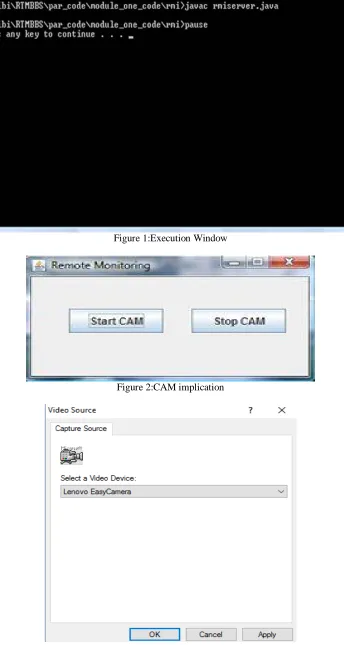
Figure 1:Execution Window
Figure 2:CAM implication
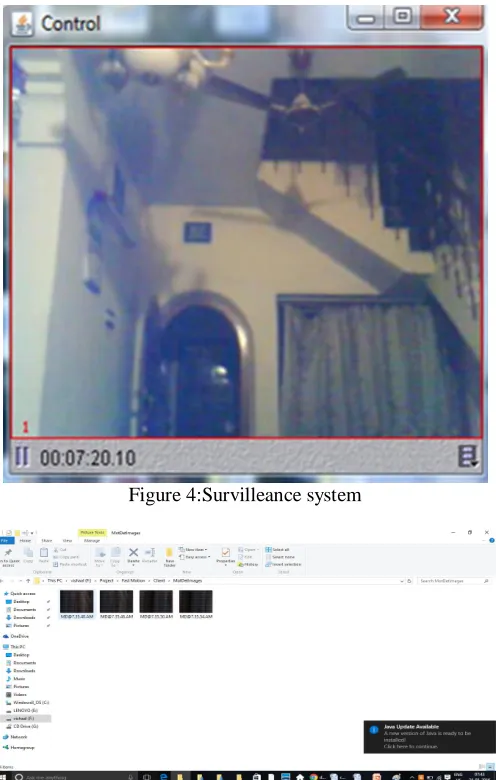
Figure 4:Survilleance system
Figure 5: Moving Object Detection and Capturing
VI. CONCLUSION
In this paper, we propose a novel framework named DECOLOR to segment moving objects from image sequences. It avoids complicated motion computation by formulating the problem as outlier detection and makes use of the low-rank modeling to deal with complex background. We established the link between DECOLOR and PCP. Compared with PCP, DECOLOR uses the non convex penalty and MRFs for outlier detection, which is more greedy to detect outlier regions that are relatively dense and contiguous. Despite its satisfactory performance in our experiments, DECOLOR also has some disadvantages. Since DECOLOR minimizes a non convex energy via alternating optimization, it converges to a local optimum with results depending on initialization of ^ S, while PCP always minimizes its energy globally. In all our experiments, we simply start from ^ S ¼ 0. Also, we have tested other random initialization of ^ S and it generally converges to a satisfactory result.
REFERENCES
[1] Giyoung Lee, Rammohan Mallipeddi, Gil-Jin Jang, "A Genetic Algorithm-Based Moving Object Detection Real-time Traffic Surveillance",Vol. 22, pp.1619-1622, 2015.
[2] B. Elqursh, and A. Elgammal, "Online Moving Camera Background Subtraction" Proc. 12th European Conf.Computer Vision (ECCV), 2012
[3] B. Han, D. Comaniciu, Y. Zhu, and L.S. Davis, “Sequential Kernel Density Approximation and Its Application to Real-Time Visual Tracking,” IEEE Trans. Pattern Analysis and Machine Intelligence, vol. 30, no. 7, pp. 1186-1197,July 2008.
[4] Z. Zivkovic and F. van der Heijden, “Efficient Adaptive Density Estimation Per Image Pixel for Task of Background Subtraction,” Pattern Recognition Letters, vol. 27, no. 7, pp. 773-780, 2006.
[5] D.S. Lee, “Effective Gaussian Mixture Learning for Video Background Subtraction,” IEEE Trans. Pattern Analysis and Machine Intelligence, vol. 27, no. 5, pp. 827-832, May 2005.
[6] B. Han, D. Comaniciu, and L. Davis, “Sequential Kernel Density Approximation through Mode Propagation: Applications to Background Modelling,” Proc. Asian Conf. Computer Vision, 2004.
[7] P. Viola and M. Jones, “Rapid Object Detection Using a Boosted Cascade of Simple Features,” Proc. IEEE Conf. Computer Vision and Pattern Recognition, pp. 511-518, 2001.