Secured and Efficient Ant Based Zone Routing
Protocol in MANET
Kanishka Raheja1, Rasveen2
Research Scholar, Department of Computer Engineering, BRCM Engineering College, Bahal (Bhiwani),
Haryana, India1
Assistant Professor, Department of ECE , Dronacharya Group of institutions, Greater Noida, U.P, India2
ABSTRACT: Because of the limitation on available resources and the dynamic topology Quality of Service support in routing for Mobile Ad hoc Networks (MANETs) is a challenging process. The main purpose of QoS routing is to find a feasible path that has sufficient resources to satisfy the constraints. A routing model can be chosen as proactive or reactive. Both purely proactive and reactive routing model proved to be in efficient as purely proactive protocol are not optimal for rapidly changing topologies and purely reactive protocols are often inappropriate for relatively static networks. In addition, reactive protocols also suffer with additional delay for real-time traffic. In order to achieve the routing efficiency, Swarm based Hybrid Routing Protocol (SHRP) was proposed, which uses the Ant Colony Optimization (ACO) technique on ZRP. Zone Routing Protocol (ZRP) is one of the hybrid routing protocols in MANETs, which is vulnerable to a number of security threats that come from internal malicious nodes which have authorization credentials to participate in the network. Malicious nodes deliberately drop routing and data packets and disrupt the correct operation of the routing protocol. To overcome this problem, a Secured ZRP (SZRP) based on efficient key management, secure neighbour discovery, secure routing packets, detection of malicious nodes, and preventing these nodes from destroying the network was proposed. We enhanced SHRP and applied the concept of key management on the SHRP called as Secured and Efficient Ant Based Routing Prottocol.The proposed work need to support four metrics, Throughput, End to End Delay, Routing Overhead, and PDR. To evaluate the performance of this protocol, we carried out series of simulation with NS 2 simulator. The simulation results are compared with the SHRP. Through simulation results; it has been showed that A&KZRP fabricates better performance than SHRP.
KEYWORDS:SHRP, A&KZRP, MANET, ZRP.
I. INTRODUCTION
Quality of Service (QoS) is defined as a set of service requirements that require to be met by the network while transporting the data packets from source to destination. The network is expected to guarantee a set of performance metrics like average end to end delay, throughput, packet delivery ratio, routing overhead. Ant Colony Optimization (ACO) [3] is a heuristic approach for solving hard combinatorial optimization problems. It was first proposed by M.Dorigo, and had been successfully used to solve Traveling Salesman Problem. Since then, ACO was applied to network’s routing. The basic idea behind ACO algorithms [4] for routing is the use of mobile agents, called ants. These ants are generated by nodes in the network, with the task to sample a path between the node and an assigned destination. An ant going from source node to destination node collects information about the quality of the path (e.g. round trip time, number of hops, hop delay, available bandwidth, node energy etc.) using pheromone variables, and uses this on its way back from destination to update the routing information at the intermediate nodes. [1] The pheromone information is used for the routing of both ants and data packets.
The goal of security in MANETs is to provide security services to defend against all the kinds of threat. Major
requirements in securing ad hoc wireless networks, are authentication, authorization, privacy/ confidentiality, availability, data integrity and non-repudiation. [5] There can be lot of attacks which interrupt the normal operation of the network .This includes Wormhole attack, Black hole attack, Byzantine attack, Information disclosure. So to provide security in network key management is used.Rest of the paper is organized as follows. In section two, background work is included related to routing.ZRP, Ant based QOS routing and Key management process is briefly reviewed. In section three proposed work Ant and Key based ZRP called as A&KZRP (an enhanced version of Swarm based hybrid routing protocol (SHRP).In section four the simulation part is dealt along with the result analysis. In section five, the proposed work is summarized.
II. BACKGROUND AND RELATED WORK
A. ROUTING IN MANET:
The various design choices which are available for routing protocol of MANET. These techniques includes: (a) flat vs. protocol (b) proactive vs. reactive (c) link state vs. distance vector (d) source routing vs. hop-by-hop routing (e) single path vs. multipath routing.
(a) The flat networks eliminate the possible traffic “bottlenecks” and reduce congestion. But in the hierarchical networks nodes are divided into groups. For example CGSR and HSR.HSR is based on link state routing whereas CGSR is based on distance vector routing.[1][6]
(b) In proactive protocol every node maintains network topology information in the form of tables by exchanging the information. Here, the concept of flooding is used, by flooding the routing information in the whole network. Whenever a node has a packet to send it runs an appropriate path finding algorithm on the topology information it maintains. The Destination Sequenced Distance vector (DSDV) routing protocol, Wireless Routing Protocol (WRP) are some examples of this category of protocols. Reactive protocols do not maintain the network topology information. Whenever the path is required only then discovers it by using connection establishment process. Third category, Hybrid protocols combines the advantages of both the protocols. Main example of this type of category is ZRP. [7]
(c) In Link state routing, nodes are connected in the form of graph which shows the connectivity of the network. Then each node calculates the next best logical path from it to every destination. Example of this type of routing is OLSR. But in Distance vector routing each node shares its routing table with its neighbors such as DSDV [8].This type of protocols are simple and efficient in small networks.
(e) Single path algorithms, at any time they use only one path between source and destination. But some algorithms create multiple paths at path setup time and use best of these until it fails , after which they switch to the second best and so on (e.g., AODV-BR).
B. HYBRID ROUTING AND ZRP:
Hybrid routing protocols combines the advantages of both routing protocols Proactive and Reactive as Proactive protocols has the advantage of not having delay and reactive protocols having the disadvantage of delay because of the on demand routing. So the combination of both theses protocols produces hybrid protocols of which the best example is ZRP.
The Zone Routing Protocol (ZRP) is a hybrid routing protocol, where the network is divided into routing zones according to the distances between nodes and the routing zone defines a range (in hops) that each node is required to maintain network connectivity proactively. The proactive part of the protocol is restricted to a small neighborhood of a node and the reactive part is used for routing across the network. In this proactive routing approach-Intra Zone Routing Protocol (IARP) is used inside routing zones and reactive routing approach-Inter Zone Routing Protocol (IERP) is used between routing zones. Therefore, for nodes within the routing zone, routes are immediately available. For nodes that lie outside the routing zone, routes are determined on-demand (i.e. reactively), and it can use any on-demand routing protocol to determine a route to the required destination. Route creation is done using a query-reply mechanism. The destination in turn sends back a reply message via the reverse path and creates the route. [9]
Another Hybrid routing protocol (HRP) which is similar to ZRP and has HRP has intelligence to preempt from proactive to reactive, and vice versa for every 12 hours. During day time movement is high and no movement during night time. All nodes run reactive during day time and proactive in the night time. Based on the movement it selects the appropriate routing protocol, for no movement DSDV is used and for high movement DSR reactive protocol is used. The main disadvantage is the increased complexity of the routing algorithm.[1]
One more routing protocol which is named as the Link Quality-based Hybrid Routing (LQHR) takes account of link quality such as SNR between adjacent nodes and the link utilization level of each node. When a source makes a communication request, it finds a route to the destination node on the basis of the link quality. [1]
Dynamic Hybrid Multi Routing Protocol (DHMRP) [10] is proposed to overcome re-discovered route path to be reply path in traditional routing protocol. The protocol utilizes the reply path based on the hybrid clustering hierarchical establishment of multi routing path to gain an automatic monitoring and repairing broken links in ad hoc networks.
C. SWARM-BASED HYBRID ROUTING PROTOCOL:
The SHRP algorithm is a hybrid routing approach which effectively combines the best features of both proactive and reactive routing protocols. It also utilizes the self-organizing, foraging and stochastic nature of ACO algorithms which exhibit interesting properties desirable for MANET routing. ACO creates artificial ants with some special features such as pheromone values and memory and uses them for route exploration. ACO could maintain feedback information based on pheromone values to find optimal solutions and is having faster convergence. [1]
III SECURED AND EFFICIENT ANT BASED ROUTING PROTOCOL:
The proposed Secured and Efficient Ant based Routing Algorithm is an enhancement of existing SHRP which is a Hybrid routing protocol and combines the best features of Proactive and Reactive Routing. In addition of this it also utilizes the self-organising and foraging behavior of ACO algorithms.ACO creates artificial ants with special features like pheromone values and memory and which can be used for route exploration. These values are used to find the optimal solutions.
A. ZONE-BASED ROUTING:
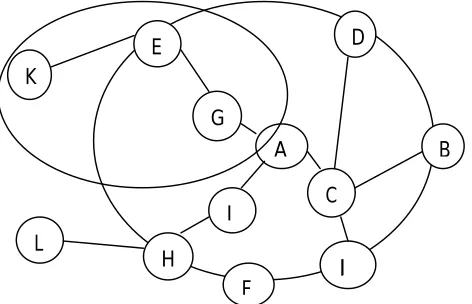
Whole network is divided into routing zones which are dynamic in nature means zones are not fixed and can change due to rapidly changing topology in MANET. The concept employed in this protocol is to use proactive scheme with in a limited zone in the r-hop neighborhood of every node(r is the radius of zone) with to use a unique key identifier in the control packet. For outside zone communication reactive routing is used. Whatever is the value of r is to be chosen it has considerable effect on the routing performance. Too low value chosen for r results in the highly reactive procedure and too high value results in highly reactive procedure. Ant IntEr-zone Routing Protocol (AntIERP) is used as reactive routing. Zones could vary in size and it is the subset of a network, within which all nodes are reachable within less than or equal to zone radius hops. Nodes can be categorized as interior and peripheral nodes. Boundary nodes are at a distance from the central node. All other nodes less than the radius are interior nodes.
In Fig.3.1, if r=2 nodes B, D, E, H, F, and J are boundary nodes, and nodes C, G, I are interior nodes. All other nodes which are outside the zone are exterior nodes. Each node maintains its routing table about the routes to all nodes within its routing zone by exchanging periodic route update packets.
Figure 3.1 Routing zone for node A and E with r=2.
.
This approach uses ants’ pheromone substances for the interzone routing for exploring the path the AntInterzone pheromone table (AntInterPT) is considered as the routing table. AntInterPT stores the path to a node beyond its zone and is setup on demand as routes outside a zone is required. The peripheral nodes of the zone are used to find routes between zones. Whereas the proactive routing use a key management technique.Because the existing protocol can be vulnerable to a number of security threats that come from internal malicious nodes which have authorization credentials to participate in the network. Malicious nodes deliberately drop routing and data packets and disrupt the correct operation of the routing protocol. To overcome this problem a key management process is used to send the data within its zone.
D
B
J C
F H
I A E
G
II Route Discovery:
This section explains route discovery within a zone and between the zones. The network can be represented as a graph G = (V, E). V is denoted as the set of vertices (nodes) and E is the set of edges (links).Each link eij (link between I and j) is associated with four variables DAij, TAij, HAij, RAij which represent the pheromone concentration on each link such as Delay, Routing overhead etc. The pheromone concentration Aij is increased with a constant ratio ΔA as more
number of ants traverse through the link between node i and j. Similarly it is decreased based on the evaporation coefficient e when no ants are following that path .The formulas for pheromone value increment and decrement are given in (1) and (2)
Aij=Aij-ΔA (1)
Aij=(1-e)Aij e € [0,1] (2) a) Ant IntrA-zone Route Discovery:
Firstly it will be checked whether the destination lies within a zone or outside a zone. If the destination lies inside the zone a key management process is used to send the packet to its destination. A key authentication process will be carried out. A unique identifier number of destination is added to the packet for authentication. When the key is authenticated at any destination, data will be transferred otherwise keep searching till last node. When the path is found, the reply can be sent to the destination through the same path.
b) Ant IntEr-zone Route Discovery:
When any node wants to send data in its zone it can send proactively by using key management technique, but if the destination does not lies inside the zone then source node suppose A in the Fig. 3.1 bordercasts (uses unicast routing to deliver packets directly to border nodes).This is done by periodically sending out the forward Ants to trace the path (ex_FANTS) to the peripheral nodes. FANTs try to identify any node which is not previously visited by any other FANT; otherwise they find the next hop based on the pheromone concentration. This exploration strategy guarantees that no link is missed and thereby no good path is missed. Once a forward ant reaches a destination, a corresponding backward ant (BANT) is sent back along the path discovered and it has been entered in AntInterPT.
Source Address
Destination address
Sequence no Type Zone radius Path
Data Structure of an artificial ant
In the above table Source and Destination address fields are used to store the source and destination node information. The sequence no field is used to store the unique ID labeled on each ant for identification and to avoid duplicates. Type field specifies the type of ant generated which are in_FANT(0), ex_FANT(1), BANT(2), NANT(3), EANT(4).Zone radius is kept blank in case of ex_FANT. The last field represents the path sequence which contains the intermediate nodes between the source and destination. In Fig. 3.1 node A bordercasts ex_FANTs to nodes B, D, E, H, F, and J. The peripheral node D finds destination node K located within its routing zone, it sends a BANT packet back to the source node A indicating the path and its associated attributes; otherwise the node D rebordercasts the ex_FANT to its peripheral nodes. This process continues until the destination node is located
During ex_FANT propagation, every node that forwards the ex_FANT appends its address to it. This information is used for delivering the BANT back to the source. The path-finding process may result in multiple BANT packets reaching the source, in which case the source node can choose the best part among them based on pheromone values implemented for each QoS metrics.
inserts a record in its AntInterPT table for the destination and the path obtained from the backward ant. The source then sends the packet along the path to the destination. [1]
III Route Maintenance: When an intermediate node detects a broken link in a path, it performs a local path reconfiguration in which the broken link is bypassed by means of a short alternate path connecting the ends of the broken link. An NANT (notification ANT) is then sent to the sender to inform about the change in path. All nodes on the path that the NANT visits will update their AntInterPT to remove any invalid routes. This results in a sub-optimal path between source and destination, but achieves quick reconfiguration in case of link failures. To obtain the optimal path, the sender reinitiates the global path-finding process after a number of local reconfigurations. If no alternate path can be found, then the EANT (error ant) is sent to source node which in turn reinitiates the global path-finding process.
Algorithm: 1. For i=1:N
2. Loc(i,1)=random(maxx,maxy) 3. Loc(i,2)=random(maxx,maxy) 4. Z(i)=random(number_of_zones) 5. End
6. S=source node 7. D=destination node 8. If zone(S)!=zone(D)
9. Use ACO to route the packet from S to D 10. Else
11. Add key in data packet S
12. Route data from S to D using ZRP 13. If key authenticated at D
14. Transfer the data 15. Else
16. Discard the data 17. End if
18. End if
This algorithm uses the key authentication and ant based routing to route the data from source to destination node.
IV. SIMULATON AND RESULT ANALYSIS:
To evaluate the performance of proposed strategy series of simulation were carried out using NS 2.33.
A. SIMULATION CONFIGURATIONS
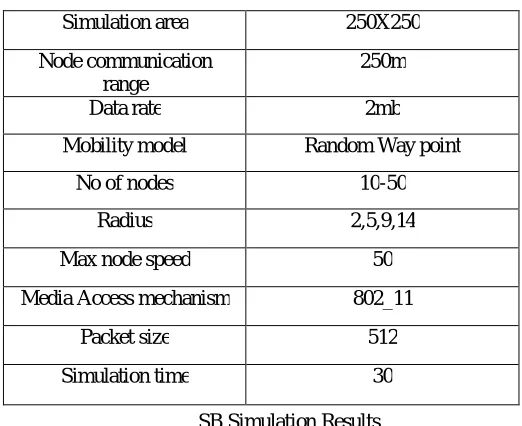
Table 4.1 Simulation Configurations
SB Simulation Results
We carried out four different series of simulation by varying the number of radius and the number of nodes. Average end to end Delay, Throughput, Packet Delivery Ratio and routing overhead. Average End-to-End delay that reflects the total time needed to successfully deliver a packet by a source node till it is received by the corresponding destination node. This metric is crucial in terms of QoS to real-time applications such as video and audio streaming. Packet delivery ratio is the fraction of packets sent by a source node to that received by the corresponding destination node. Number of packets received in the destination is to be calculated and taken as throughput. Routing overhead was the ratio of routing packets transmitted to the total data packets delivered. The routing packets include control packets used for route discovery, route maintenance, and pheromone updates. Results in 2 types, first, when radius of zone varies while the number of nodes keeping same and is set to 50.Second is when the number of nodes varies while keeping the radius of zone to 9. Each carries four series of simulations. Figure 4.1 represents the graph of Throughput.
Figure 4.1: zone radius vs. Throughput
0 200000 400000 600000 800000 1000000
2 5 9 14
T
h
ro
u
gh
p
u
t
(
kb
p
s)
Radius of zone
Zone radius vs Throughput
SHRP
A&K ZRP Simulation area 250X250
Node communication range
250m
Data rate 2mb
Mobility model Random Way point
No of nodes 10-50
Radius 2,5,9,14
Max node speed 50
Media Access mechanism 802_11
Packet size 512
Above graph shows the effect of Throughput by varying the zone’s radius and it shows that Throughput increases with the zones radius. There is steep hike in the throughput when the zone radius varies from 2 to 5.After that it slightly decreases from 5 to 9 and then remains same for zone radius 9 and 14.While in the case of SHRP graph shows that throughout the throughput increases when the zone radius increases. But if SHRP and A&K ZRP are compared then A&K ZRP gives overall performance much better than that of SHRP in terms of throughput.Next performance metrics which needs to be considered is Average End to End delay. For this we represented it graphically by plotting a graph which compares the average end to end delay of the SHRP and A&K ZRP when the radius of the zone is varied. Figure 4.2 shows the graph of end to end delay.
Figure 4.2: Zone radius vs. delay
Above graph shows the effect of increasing the zone radius on End to End Delay. End to End delay decreases as the zone radius increases in SHRP as well as in A&K ZRP. Graph shows this delay is less in A&K ZRP as comparison to SHRP. As the radius increases from 9 to 14 the result for End to End delay shows no change.
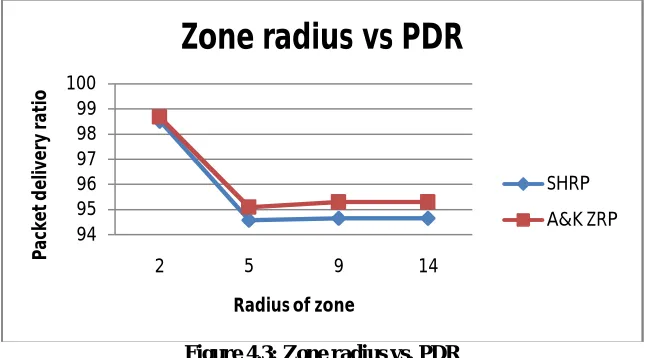
Figure 4.3: Zone radius vs. PDR
Packet Delivery ratio is ratio is the fraction of packets sent by a source node to that received by the corresponding destination node. It can be measured as the above metrics were measured. Actually the results are to be extracted from
SHRP A&K ZRP 0.5
0.7 0.9
2 5
9 14
En
d
t
o
E
n
d
D
e
la
y
(m
s)
Radius of zone
Zone radius vs. Delay
94 95 96 97 98 99 100
2 5 9 14
P
ac
ke
t
d
e
liv
e
ry
r
at
io
Radius of zone
Zone radius vs PDR
SHRP
the trace file by applying the AWK scripts on it. We calculated the simulation results for PDR by varying the zone radius which is shown in Figure 4.3. As the zone radius varies from 2 to 5 there is hard decrease of PDR and then it slightly went increasing till the radius 9 and then remains same for 14.This is the same case for SHRP.If the overall performance is considered then A&K ZRP shows the improved PDR.
Next performance metrics which is to be considered is the Routing overhead which the SHRP did not show any effect on it and we tried to improve this metric. Routing overhead was the ratio of routing packets transmitted to the total data packets delivered. Figure 20 shows the effect of increasing the zone radius on Routing overhead.
Figure 4.4: Zone radius vs. Routing overhead
As can be seen from the graph, when the zone radius is increasing the Routing Overhead is also increasing and remains same for radius 9 and 14.But if we consider about the A&K ZRP it decreases from 2 to 5 zone radius, then increases from 5 to 9 and remains same for 9 and 14.This is the scenario of the SHRP and A&K ZRP protocol while varying the zone radius.
These simulations were carried out with radius being varying and no of nodes were kept same. Next series of simulation when radius of zone was kept same (e g. 9) and nodes being varying (10-50).
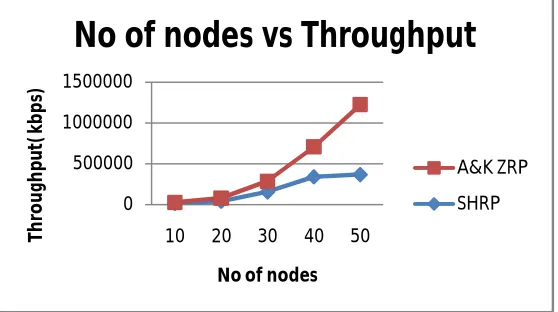
Figure 4.5 shows the result of Throughput with nodes. Graph shows that in both the protocols existing as well as the proposed with the increase of radius throughput increases and among both the protocols A&KZRP shows better performance in terms of Throughput.
Figure 4.5: No of nodes vs. Throughput
0 500000 1000000 1500000
10 20 30 40 50
Th
ro
u
gh
p
u
t(
k
b
p
s)
No of nodes
No of nodes vs Throughput
A&K ZRP
SHRP 0
0.05 0.1 0.15 0.2
2 5 9 14
R
o
u
ti
n
g
O
ve
rh
e
ad
Radius of zone
Zone radius vs Routing overhead
SHRP
Next performance metric need to be evaluated is PDR. Figure 4.6 shows the effect of increasing the number of nodes on PDR.
Figure 4.6: No of nodes vs. PDR
As the number of nodes of nodes increases PDR decreases as we move from 10 to 20 and then to 30.But then it decreases from 30 to 40 and then to 50 in case of both the protocols. Overall a&KZRP performs quite better than SHRP except in the case ehen nodes are 40.Figure 4.7 shows the performance of Average e to e delay with varying number of nodes.
Figure 4.7: Average e to e delay
Above graph shows, as the no. of nodes are increased once the delay s increased from the nodes 10 to 20 and after that it kept on decreasing. A&KZRP performs much better reduced delay than SHRP.
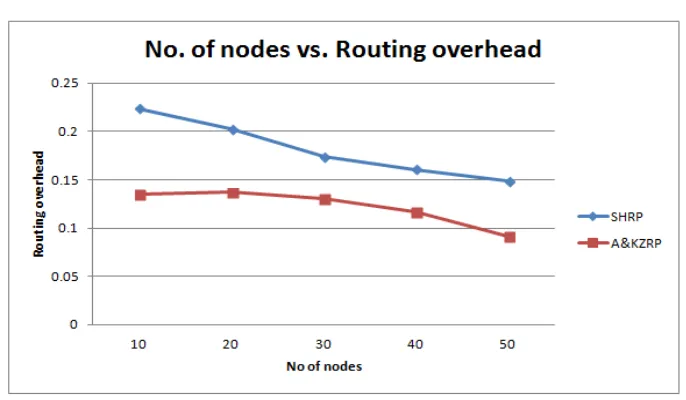
Figure 4.9 shows the results of how Routing overhead varies with No. of nodes. SHRP shows Routing overhead decreases as the nodes increases. A&KZRP shows that it firstly increases then decreases. Overall A&KZRP performs better than SHRP.
SHRP 90
95 100
10 20
30 40
50
P
ck
e
t
D
e
iv
e
ry
R
at
io
No of nodes
Figure 4.9 No. of nodes vs. Routing overhead
V. CONCLUSION & FUTURE WORK
The paper proposes a secure ZRP based routing in the MANET with less overhead. The secure ZRP uses the ant based secure routing within the zone while the key authentication process is used in the routing within zone. The comparison of the enhanced Secured and Efficient ZRP is done with the existing SHRP by using the scenarios having different zone radius through the parameters e2edelay, PDR and the routing overhead. The better performance is analyzed in terms of delay, PDR as well as the routing overhead. In future the protocol can be extended to use other existing swarm intelligence based techniques for routing.
REFERENCES
[1] S.K.Nivetha, R.Asokan and N.Senthilkumaran. “A Swarm-based Hybrid Routing Protocol to Support Multiple Quality of Service (QoS) Metrics in Mobile Ad Hoc Networks”. 4th ICCCNT 2013. IEEE – 31661
[2] http://en.wikipedia.org
[3] Prince Samar, Marc R. Pearlman, and Zygmunt J. Haas, “ Independent Zone Routing: An Adaptive Hybrid Routing Framework for Ad Hoc Wireless Networks”, IEEE/ACM Transactions on Networking, Vol. 12, No. 4, 2004
[4] Z.Liu , M. Z. Kwiatkowska and C. Constantinou , “A biologically inspired QoS routing algorithm for ad hoc networks”, International Journal of Wireless and Mobile Computing, 2006.
[5] Dilli Ravilla,Dr Chandra Shekar Reddy Putta ,(2013,July 4 - 6, ) “Performance of Secured Zone Routing Protocol due to the Effect of Malicious Nodes in MANETs” 4th ICCCNT - 2013 ,IEEE
[6] Z.Baoxian , T. M. Hussain, “QoS routing for wireless ad hoc networks: Problems, algorithms, and protocols”, IEEE Comm. Magazine , 43(10): 110-117, 2005
[7] Z.J. Haas, “A new routing protocol for the reconfigurable wireless networks”, In Proc. of the IEEE Int. Conf. on Universal Personal Communications, 1997.
[8] C. Perkins and P. Bhagwat, “Highly dynamic destination-sequenced distance-vector routing (DSDV) for mobile computers”, Conference on Communications Architectures, Protocols and Applications, 1994.
[9] Panda, I. (2012). “A survey on routing protocols of manets by using qos metrics”. International journal of advanced Research in computer science and software engineering, volume2.
[10] Chaorong Peng and Chang Wen Chen, “Dynamic Hybrid Multi Routing Protocol for Ad Hoc Wireless Network”, Procedings of IEEE Communications Society, 1-4244-0626-9: 809-816 , 2006
[11] M. Dorigo, M. Birattari, and T. Stutzle, “Ant colony optimization”, Computational Intelligence Magazine, IEEE, vol. 1, no. 4, pp. 28 – 39,nov. 2006
[13] D. Rupérez Cañas, A. L. Sandoval Orozco, L. J. García Villalba, and P.-S. Hong, “Hybrid ACO Routing Protocol for Mobile Ad Hoc Networks”, International Journal of Distributed Sensor Networks, Article ID 265485, 7 pages, 2013.
[14] Kaur, S., & Kaur, (2013) S. Analysis Of Zone Routing Protocol In Manet. International Journal of Research In Engineering And Technology. [15] Haas, Zygmunt J., Pearlman, Marc R., Samar, P.: Interzone Routing Protocol (IERP), June 2001, IETF Internet Draft,
draft-ietf-manet-ierp-01.txt
[16] F. Glover, G. Kochenberger (Eds.), Handbook of Metaheuristics, Kluwer Academic Publishers, Norwell,MA, 2002.