Performance Optimization of Air
Conditioning System of ATM Room Using
PCM as TES
Ajinkya Deshpande 1, Rohan Jadhav 1,Vikrant Kale 1, Milind Nerpagar1, Sachin Bansode 2, Nilesh Patil2
U.G. Student, Department of Mechanical Engineering, NBN SSOE, Ambegaon, Pune, Maharashtra, India1 Assistant Professor, Department of Mechanical Engineering, NBN SSOE, Ambegaon, Pune, Maharashtra, India2
ABSTRACT: Fossil fuels are used to produced energy. But these fossil fuels are present in limited amount under the earth’s crest. So scientist from all over the world are trying to find new and renewable energy sources. One of the option is to develop energy storage devices like thermal energy storage system which has the potential to attain energy savings, which in turn reduce the environment impact related to energy use. In this report performance optimization of air conditioning system of ATM room is carried out by making its actual prototype. The electrical consumption of air condition system is reduced by using phase change materials(PCMs). The performance of conventional air conditioning system is improved by using PCM having melting point temperature of 220C. The results obtained through calculation are validated through experimentation.
KEYWORDS: Air Conditioning System, Phase Change Material, Thermal Energy Storage, Latent Heat
I. INTRODUCTION
Today, our country is facing one of the major problems which is high prices of fuel with the increasing demand. The pollutants coming from the combustion of these fuels are increasing the temperature of earth rapidly which caused the invention of air conditioning system to reduce the temperature of air inside a system.This led to increase in demand for air conditioning greatly during the last decade. Large demands of electric power and limited reserves of fossil fuels have led to surge of interest with efficient energy application.Electrical energy consumption varies significantly during the day and night according to the demand by industrial, commercial and residential activities. In hot and cold climate countries, the major part of the load variation is due to air conditioning and domestic space heating respectively. This variation leads to utilization of energy in different amount at different time due to which price of electricity changes according to use. Better power generation/ distribution management and significant economic benefit can be achieved if some of the peak load could be shifted to the off peak load period that can be achieved by thermal energy storage for heating and cooling in various application. [2]
Thermal energy storage (TES) is the temporary storage of high or low temperature energy for later use. It bridges the time gap between energy requirements and energy use. Among the various heat storage techniques of interest, latent heat storage is particularly attractive due to its ability to provide a high storage density at nearly isothermal conditions. Phase-change thermal energy storage systems offer other advantages, such as a small temperature difference between storage and retrieval cycles, small unit sizes and low weight per unit storage capacity. One of prospective techniques of storing thermal energy is the application of phase change materials (PCMs).[2]
material melts, it absorbs a large amount of heat from the environment. PCMs recharge as ambient temperatures fluctuate, making them ideal for a variety of everyday applications that require temperature control. Figure (1) shows the classification of phase change material.[3]
Figure(1):Classificationof PhaseChangeMaterial Objectives:
i. To reduce electrical consumption of AC system. ii. To reduce maintenance cost.
iii. To overcome the draw backs of conventional air conditioning system. iv. To increase life period and efficiency of air conditioning system.
II. LITERATURE SURVEY
The research paper named, “Design and Fabrication of cold Storage Plant Using Phase Change Material (PCM)”,
by J. Kannakumar, proposed the use of a passive system integrated into the walls of the cold storage facility to limit the rise in temperature due to power loss [1]. The research paper named, “Cooling of Room with Ceiling Fan Using Phase Change Materials”, by M. Joseph Stalin proposed themounting of PCM along with ceiling fan impart air conditioning effect[2]. The research paper named “Application of Phase Change Materials (PCMs) in Maintaining Comfort Temperature inside an Automobile”, by A. Jamekhorshid, presents the modelling results of an innovative system for the temperature control in the interior compartment of a stationary automobile facing the solar energy from the sun[5].The research paper named, “Study of a floor supply air conditioning system using granular phase change material to augment building mass thermal storage Heat response in small scale experiments”, by K. Nagano, S. Takeda, T. Mochida, K. Shimakura, T. Nakamura, proposed a new floor supply air conditioning system, using phase change material to augment building mass thermal storage[7].
III.WORKING PRINCIPLE OF PCM
The process of changing state from one form to another form is called as phase change. Any material exhibits four phases which are solid, liquid, gas and plasma. There are four phase change process by which material changes its state which are i) solid-liquid ii) liquid-gas iii) liquid-solid and iv) solid-gas. Each process requires use of thermal energy to change the phase. Thermal energy available can utilized by four ways which ae 1) sensible heat utilization 2) latent heat utilization 3) utilization of reversible chemical heat and 4) utilization of heat of dilution. While changing the phase material either absorbs the thermal energy or releases, this released or absorbed thermal heat is called as latent heat. Generally, phase change material with higher latent heat utilization with phase change process from liquid to solid or solid to liquid is used as it is easy to manufacture for heat storage.
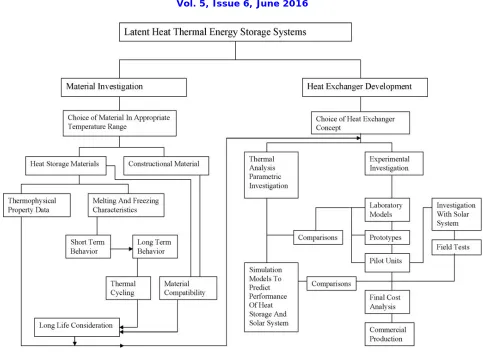
Fig (2):Latent heat thermal energy storage system (process block diagram)
Figure (3) shows the process of phase change process of PCM from solid to liquid and vice versa schematically. During melting process of phase change material, the temperature of phase change material as well as surrounding system remains nearly constant causing less use of energy. Also at crystallization temperature the change in temperature of surrounding and phase change material us negligible.
IV.METHODOLOGY
The decision to use the two systems which are conventional and modified was taken to compare the efficiency of two systems. The conventional system served as standard for comparison of modified system. Both systems were subjected to same conditions during the experimentation. Both systems were in their basic form without any modification. The outputs of the two systems were measured and compare.
In TES generally two modes occur i.e. charging mode, discharging mode and standby mode. The release of heat is called as charging mode while absorption of energy is called as discharge mode.
1. Charging Mode:
The charge mode is started by circulation of cold air from air conditioner. This mode terminates upon complete solidification of PCM. In this method, phase change material emits the heat to room due to which load on the compressor of air conditioner increase and it provides more cooling effect till the desired temperature is achieved. This procedure is continued till PCM reaches a desired freezing temperature.
2. Discharging Mode:
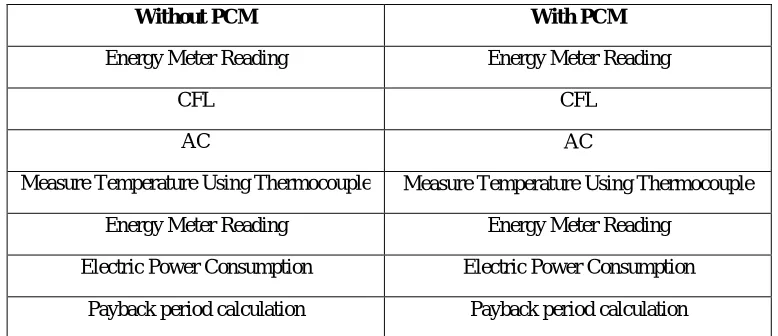
The discharging mode starts when compressor shuts off. This mode terminates upon complete melting of PCM. During the discharging process room temperature starts increasing due to shut downed compressor. At this point phase material absorbs the heat entered in space. The PCM slowly gets heated, sensibly at first, until it reaches its melting point temperature. As the discharging proceeds PCM melts at constant temperature & provides cooling effect. After complete melting is achieved, temperatures of the PCM and air at the different locations are recorded. Table 1 shows the entire experimentation procedure stepwise
Table 1. Experimentation Methodology
Without PCM With PCM
Energy Meter Reading Energy Meter Reading
CFL CFL
AC AC
Measure Temperature Using Thermocouple Measure Temperature Using Thermocouple
Energy Meter Reading Energy Meter Reading
Electric Power Consumption Electric Power Consumption
Payback period calculation Payback period calculation
During above experimentation following parameters will be checked 1.Temperature measurement.
Components:
1. plywood:
Plywood is a sheet material manufactured from thin layers or "plies" of wood that are glued together with adjacent layers having their wood grain rotated up to 90 degrees to one another. It is an engineered wood from the family of manufactured boards which includes medium-density fibreboard (MDF) and particle board (chipboard).Figure (4) shows plywood used in this experiment using which a room of 5ft x 5ft x 4ft is made.
Size= 8*4Meter, Thickness= 12mm
Figure (4):Plywood
2. Air conditioner:
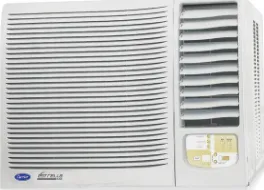
Air conditioning is the process of altering the properties of air (primarily temperature and humidity) to more comfortable conditions, typically with the aim of distributing the conditioned air to an occupied space such as a building or a vehicle to improve thermal comfort and indoor air quality. In common use, an air conditioner is a device that lowers the air temp. The cooling is achieved through a refrigeration cycle, but sometimes evaporation or free cooling is used. Air conditioning systems can also be made based on desiccants.Figure (5) shows the air conditioner of 1.5TR used in this experiment.
Figure (5):Air conditioner
3. CFL bulb:
Figure (6):CFL bulb
4. Phase Change Material (PCM):
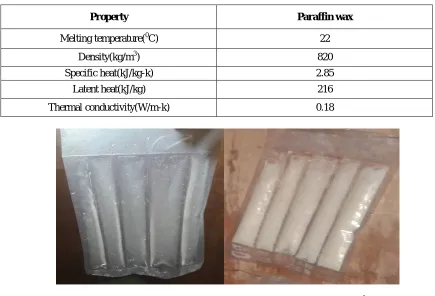
A phase-change material (PCM) is a substance with a high heat of fusion which, melting and solidifying at a certain temperature, is capable of storing and releasing large amounts of energy. Heat is absorbed or released when the material changes from solid to liquid and vice versa; thus, PCMs are classified as latent heat storage (LHS) units.PCMs latent heat storage can be achieved through liquid–solid, solid–liquid, solid–gas and liquid–gas phase change.Figure (7) shows the PCM at room temperature while Figure (8) shows the completely solidified PCM at 220C.
Table 2. Physical properties of PCM
Property Paraffin wax
Melting temperature(0C) 22
Density(kg/m3) 820
Specific heat(kJ/kg-k) 2.85
Latent heat(kJ/kg) 216
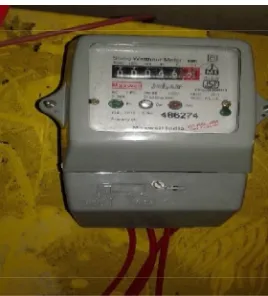
device. Electric utilities use electric meters installed at customers premises to measure electric energy delivered to their customers for billing purposes. They are typically calibrated in billing units, the most common one being the kilowatt hour [kWh]. They are usually read once each billing period.
Figure (9): Energy Meter
6. Thermocouples:
Figure (11) shows the thermocouple used in this experiment. A thermocouple is a device consisting of two dissimilar conductors or semiconductors that contact each other at one or more points. A thermocouple produces a voltage when the temperature of one of the contact points differs from the temperature of another, in a process known as the thermoelectric effect. Thermocouples are widely used type of temperature sensors for measurement of temperature. Fig (10) shows the schematic representation of working of thermocouple.
Figure (10):Working Principle Figure (11): Thermocouple of Thermocouple
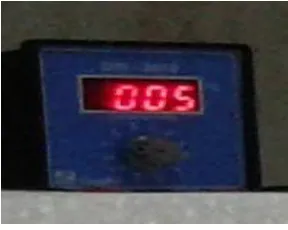
7. Digital Temperature Indicator:
Figure (12): Digital 12 Node Temperature Indicator
V. DESIGN OF SYSTEM
1 Conventional Air conditioning system:
Figure (13) shows the conventional ATM room with air conditioning system without PCM. The ATM room is manufactured at experimentation location. Thermocouples were fixed at various points inside the tank to measure temperature. This system represents as standard for comparison of performance of modified system. Both systems were tested under same conditions.[1]
2 System with PCM:
Figure (14) shows the modified ATM room with air conditioning system with PCM. The basic parts of the modified system remain the same as that of the conventional system. Modification includes PCM filled plastic packs which were fitted inside the room on the walls.[1]
4.2 Tests Result:
To check whether the both system systems has same performance or not we had taken the readings of temperature in 10 min and 30 second cycles and plotted into graphs as Temperature vs Time. During this testing, we kept the air conditioner ON for 1Hr. for pre-charging. Then readings were taken. 10min and 10s cycle consists of opening and closing the door. After pre-charging we open the door for 10sec to allow the heat transfer from atm. to inner atmosphere. After 10s, door is closed and temperature readings were taken for that time. After that door was kept closed for 10 min so that inner space gets cooled and temperature reading were taken after 10 min. Figure (15) shows graph plotted between temperature fluctuations and time obtained from the results of experiments.
Figure (15): Test on conventional system w\o PCM Figure (16). Test on modified system with PCM
After all readings were taken, then all pcm packs were installed and air conditioner was kept for pre-charging so that pcm in pcm packs gets solid. After solidification of all packs readings were taken similarly as that of above and graph is plotted.Figure (16) shows graph plotted between temperature fluctuations and time obtained from the results of experiments.
Figure(17): Electrical consumption of system without and with PCM
Figure (17) shows graph plotted between energy consumption and time obtained from the results of experiments. We can observe that energy saving is 1.83KW between conventional and modified system. It means that the system with phase change material is 38% more efficient than system without phase change material.
18 18.519 19.520 20.521 21.522 22.523 23.524 24.525 25.526 26.527 27.528 28.529 29.530 30.531 31.532 1 0 s 1 0 m in 1 0 s 1 0 m in 1 0 s 1 0 m in 1 0 s 1 0 m in 1 0 s 1 0 m in T e m p e ra tu re ( 0C )
Conventional System
T1 T2 T3 T4 T5 T6 14 14.515 15.516 16.517 17.518 18.519 19.520 20.521 21.522 22.523 23.524 24.525 25.526 26.527 27.528 28.529 29.530 30.531 1 0 s 1 0 m in 1 0 s 1 0 m in 1 0 s 1 0 m in 1 0 s 1 0 m in 1 0 s 1 0 m in T e m p e ra tu re ( 0C )Modified System
T1 T2 T3 T4 T5 T6 0 1 2 3 4 10 20 30 40 05 60 70 80 90
1 0 0 1 1 0 1 2 0 1 3 0 1 4 0 1 5 0 E n e rgy C o n su m e d (K W ) Time(min)
Energy Consumption Comparison
VII. CONCLUSION
From the above experimental results, it can be concluded that with the use of PCM in conventional air conditioning system leads to improvement in the performance over conventional system. This increase in the performance of system is due to:
1. Storage of heat in latent form reducing temperature of water. Reduction in room temperature improves efficiency. Hence, improvement in overall efficiency. PCM is selected in such a way that melting point of the material is well below the highest temperature achieved by the system when system is without PCM.
2. Rapid transfer of heat to and from PCM is necessary during heating and cooling processes for complete phase change for maximizing performance improvement. Use of plastic bags with less thickness help for this due to less thermal resistance value. Use of less thickness plastic packs reduces overall cost.
REFERENCES
1. J. Kannakumar, P. Mallikarjuna Reddy, “Design and Fabrication of Cold Storage Plant Using Phase Change Material (PCM)”, Vol. 2. Issue 9,
International Journal of Innovative Research in Science, Engineering & Technology, September 2013, page 3.
2. M. Joseph Stalin, P. Barath, “Cooling of Room with Ceiling Fan Using PCM”, Vol 3, Proceedings of World Congress on Engineering, 2013,
Page 2-4.
3. M. Ravi Kumar, Dr. Srinivasan, “Phase Change Material used as Thermal Energy Storage for Cooling of Building”, Journal of Theoretical and Applied Information Technology, 2008, Page 1-2.
4. P. Dolado, A. Lázaro, B. Zalba, J.M. Marín, “Numerical Simulation of the Thermal Behavior of an Energy Storage Unit with Phase Change Materials for Air Conditioning Applications Between 17ºc and 40ºc”, Plan Nacional de Investigación Científica, Desarrollo e Innovación Tecnológica 2000–2003, Page 1-3.
5. Jamekhorshid, “Application of Phase Change Materials in Maintaining Comfort Temperature Inside an Automobile”, Vol 6, World Academy of
Science, Engineering & Technology, 2012, Page 5-6.
6. Bouchra Abouelkhayrat, Hamid Hamza, Jawad Lahjomri, Abdelaziz Oubarra, “Optimum Distribution of Two Different PCM Between Components of Roof Air-Conditioned Room to Reduce Annual Energy Consumption”, Issue 5, Scientific Research, 2013, Page 7.