Abstract
WOOD, LISA MARIE. On the Solvable Length of Associative Algebras, Matrix Groups, and Lie Algebras. (Under the direction of Ernest Stitzinger.)
Let A be an algebraic system with product a*b between elements a and b in A. It
is of interest to compare the solvable length t with other invariants, for instance size,
order, or dimension of A. Thus we ask, for a given t what is the smallest n such that there
is an A of length t and invariant n. It is this problem that we consider for associative
algebras, matrix groups, and Lie algebras. We consider A in each case to be subsets of
(strictly) upper triangular n by n matrices. Then the invariant is n. We do these for the
associative (Lie) algebras of all strictly upper triangular n by n matrices and for the full n
by n upper triangular unipotent groups. The answer for n is the same in all cases. Then
we restrict the problem to a fixed number of generators. In particular, using only 3
generators and we get the same results for matrix groups and Lie algebras as for the
earlier problem. For associative algebras with 1 generator we also get the same result as
the general associative algebra case. Finally we consider Lie algebras with 2 generators
and here n is larger than in the general case. We also consider the problem of finding the
DEDICATION
BIOGRAPHY
I was born in Buffalo, New York on October 3, 1977. I received my BA in Mathematics and Computer Science Summa Cum Laude at the State University of New York College at Geneseo in 1999. After graduation, I moved down to a warmer place Cary, North Carolina, where I took a job as a Software Engineer at IBM. In 2000, I started part-time graduate school at North Carolina State University and received my MS in Computational Mathematics in May of 2003. After completion of my PhD in Applied Mathematics, I will continue to work with IBM and plan to teach a class per semester at a local college.
ACKNOWLEDGEMENTS
First, I wish to thank my advisor, Dr. Ernie Stitzinger, for his patience dealing with a part-time student and his guidance and support throughout my four years at North Carolina State University. In addition, I wish to thank Drs. Lada, Martin, and Misra for serving on the advisory committee. I also wish to thank my sponsor, IBM, and my managers for the time off to attend classes.
TABLE OF CONTENTS
LIST OF TABLES... vi
CHAPTER 1: Introduction ... 1
CHAPTER 2: Associative Algebra General Case ... 6
CHAPTER 3: Associative Algebras with One Generator ... 9
CHAPTER 4: Matrix Group General Case... 14
CHAPTER 5: Matrix Groups with 3 Generators... 15
CHAPTER 6: Lie Algebra General Case ... 20
CHAPTER 7: Lie Algebras with 3 Generators... 22
CHAPTER 8: Lie Algebras with 2 Generators... 33
REFERENCES ... 45
LIST OF TABLES
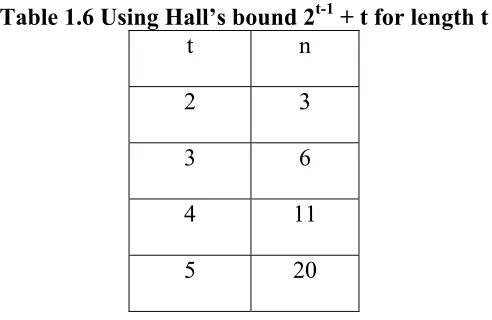
Table 1.6 Using Hall’s bound 2t-1 + t for length t ... 4
Table 2.2: Associative algebra general case results... 7
Table 3.6: Associative algebra results with one generator ... 12
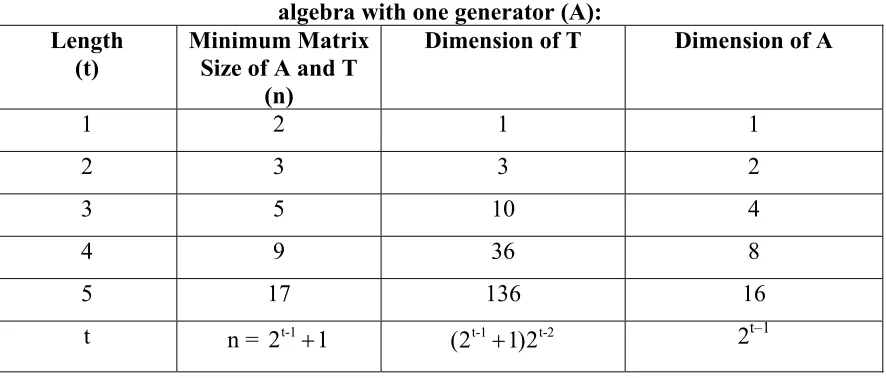
Table 3.7: Comparison chart of associative algebras general case (T) and associative algebra with one generator (A): ... 13
Table 5.5: Matrix Group results with three generators ... 19
Table 7.7: Lie Algebra results with three generators... 27
Table 7.12: Lie algebra results including dimension with three generators ... 31
CHAPTER 1: Introduction
Let A be an algebraic system with product a*b between elements a and b in A. Define A1 = A*A and Ak+1 = Ak*Ak. A is called solvable of length t if there exists a t such that At = 0 and At-1 is nonzero. It is of interest to compare the solvable length t with other invariants, for instance size, order, or dimension of A. Thus we ask, for a given t what is the smallest n such that there is an A of length t and invariant n. It is this problem that we consider for associative algebras, matrix groups, and Lie algebras. We consider A in each case to be subsets of (strictly) upper triangular n by n matrices. Then the invariant is n. We do these for the associative (Lie) algebras of all strictly upper
triangular n by n matrices and for the full n by n upper triangular unipotent groups. The answer for n is the same in all cases. Then we restrict the problem to a fixed number of generators. In particular, using only 3 generators and we get the same results for matrix groups and Lie algebras as for the earlier problem. For associative algebras with 1 generator we also get the same result as the general associative algebra case. Finally we consider Lie algebras with 2 generators and here n is larger than in the general case. We also consider the problem of finding the dimension in the associative algebra, the general, and 3 generator Lie algebra cases. We begin with further discussion of the problem and it’s history.
He then made a start on his famous question with finding the order of G to be |G| > p3(t-1) with solvable length t, but stated that it seems probable that for greater values of t the actual lower limit for the order exceeds p3(t-1) and in [2] he improves this order to |G| > p(t+1)(t+2)/2. Continuing with Burnside’s question, early results in group theory are shown in a classic 1933 paper by Philip Hall [6]. Hall found the derived length of p-groups to be bounded between p2 +t-1t-1 < |G| < 2(t-2)*(2 -1)t-1
p .
In [7] Itˆo refined the upper bound of Hall’s and found the order of |G| < p3*2t-1.
Recently in [4], Evans-Riley, Newman & Schneider showed that for every integer t > 3 and every prime p > 5 there is a group with solvable length t and order p2 -2t , |G| < 2 -2t
p ,
and Schneider in [9] found that |G| > p2 +3t-10t-1 and Mann in [8] showed |G| > 2 +2t-4t-1 p with solvable length t. Schneider’s result is better for larger t and Mann’s is better for smaller t.
There are many recent results in groups and we would like to see what is true in Lie algebras. There are many similarities between groups and Lie algebras, in particular between groups of order pn where p is prime, and nilpotent Lie algebras of dimension n. Both have a derived series and a lower central series which end at the identity. Also, in both cases, the derived series is contained in the lower central series (Lw ⊆
w
2
L ). The following examples help to explain the derived series and central series, where we let L be a Lie algebra. Let L2 = [L, L], L3 = [L, L2] … Ln+1 = [L, Ln]. L is called a nilpotent if there exists an n such that Ln = 0. L has class n if Ln+1 = 0 and Ln
Example 1.1
L = (x, y, z) where [x, y] = z and [x, z] = [y, z] = 0. L2 = (z) and L3 = 0 leaving L to have a class of 2. □
Example 1.2
Let M = 5x5 strictly upper triangular matrix
0 * * * * 0 0 * * * M 0 0 0 * * 0 0 0 0 * 0 0 0 0 0
=
then 2
0 0 * * * 0 0 0 * * M = 0 0 0 0 * 0 0 0 0 0 0 0 0 0 0
and 3
0 0 0 * * 0 0 0 0 * M 0 0 0 0 0 0 0 0 0 0 0 0 0 0 0
=
and 4
0 0 0 0 * 0 0 0 0 0 M 0 0 0 0 0 0 0 0 0 0 0 0 0 0 0
=
and M5 = 0.
Leaving M to have a class of 4. □
Define L1 = [L, L], L2 = [L1, L1], … Ln+1 = [Ln, Ln]. L is solvable if there exists a t such that Lt = 0. L has derived length t if Lt = 0 and Lt–1≠0.
Example 1.3
Using example 1.1 above we find L1 = (z) = L2 and L2 = 0. L has a length of 2. □
Example 1.4
Using example 1.2 we find that 1
2
0 0 * * * 0 0 0 * * M = 0 0 0 0 * =M
0 0 0 0 0 0 0 0 0 0
and 2
4
0 0 0 0 * 0 0 0 0 0 M 0 0 0 0 0 M
0 0 0 0 0 0 0 0 0 0
= = and
M3 = 0. M has a length of 3. □
Example 1.5
A is abelian and A1 = A2 = 0. A has a length of 1 and a class of 1. □
There are some more similarities between groups and Lie algebras. The center of a group G is Z(G) = {x\ xy = yx ∀y ∈ G}, and the center of a Lie algebra L is Z(L) = {x\ [x, y] = 0 ∀y ∈ L}. For groups we use the computation of <x, y> = xyx-1y-1 and for Lie algebra we use the commutator multiplication where [A, B] = AB - BA. In the case of strictly upper triangular nxn matrices we have Z(L) = {E1,n}. Burnsides theorem applied to groups and Lie algebras would result with: if G (or L) is abelian, then G1 = e (L1 = 0), and if |G| = p2 (dimension of L = 2), then G1=e (L1 = 0). So if G (or L) is to have length 2 then |G| ≥ 3 (dimension of L ≥ 3). (Such an L is L = <x, y, z> where [x, y] = z and [x, z] =[y, z] =0. Then L1 = <z> and L2 = 0 leaving the length of L to be 2). In [6] it is shown that for G to have length t and |G| = pn, then n ≥ 2t-1 + t -1 leaving the following table:
Table 1.6 Using Hall’s bound 2t-1 + t for length t t n
2 3 3 6 4 11 5 20
We will apply the ideas of the group results and investigate the bounds using strictly upper n x n triangular matrices in the case of associative algebras, matrix groups, and Lie algebras. The aim is to find the smallest n for each derived length in these cases.
In a related direction, we would like to find the least size n of the nxn matrices which have a derived length t. For a given n, we use n-1 generators. These generator elements come from diagonal d1, the diagonal directly above the main diagonal. For derived length t we find n = 2t-1+1. We consider the case of having less than n-1
generators. If we fix the number of generators, it is conceivable that for a given t the size of n might need to increase. I have considered the following cases: 1 and n-1 generators for associative algebras; 3 and n-1 generators for matrix groups; 3 and n-1 generators for Lie algebras.
CHAPTER 2: Associative Algebra General Case
We are looking at the strictly upper triangular nxn matrices, N. The derived series of N is defined as N1 = N*N and Nk+1 = Nk*Nk that we find using associative
multiplication. Evidently, Nt–1 is generated by the set of all products of 2t–1 generator elements from N. These generator elements will be chosen from diagonal d1, the
diagonal directly above the main diagonal. Letting Ei,j be the usual matrix unit with 1 in the (i,j) position and 0 elsewhere, the generators are E12, E23, …,En–1,n. The N* are the matrices we find starting with the first diagonal, d1. Hence, for N to have length t, N must have 2t–1 generator elements whose product is non–zero while each product of 2t elements is zero.
To make this clearer let T be the associative algebra of all strictly upper triangular nxn matrices. Also let d1 represent the diagonal directly above the main diagonal, dj represents the diagonal j steps above the main diagonal, and dj’ represent the basis elements of the diagonal j steps above the main diagonal. Clearly, T = d1 ⊕ d2
⊕…⊕dn–1. Using matrix units, it is clear that the derived series is T1 = d2 ⊕ d3 ⊕…⊕dn–1
T2 = d22 ⊕ d5 ⊕…⊕dn–1
M
Tk = d2k ⊕ d2k+1 ⊕…⊕dn–1
Notice that Tt–1 ≠0 if and only if 2t–1 ≤ n–1 or n ≥ 2t–1+1 (diagonal d2t-1has to exist). If
T is n(n-1)
2 . Since we are dealing with strictly upper triangular matrices we compute this dimension by starting with the size of the nxn matrix, n , minus the number of elements 2
on the main diagonal, n, and then since we are only dealing with the upper half of the
matrix we divide that number by 2. Therefore, we have
2
n -n n(n-1)
2 = 2 . Letting n = 2 t–
1+1, we find the dimension of T is (2t-1 1)2t-1 (2t-1 1)2t-2
2
+ = +
. These results can be
incorporated into Lemma 2.1.
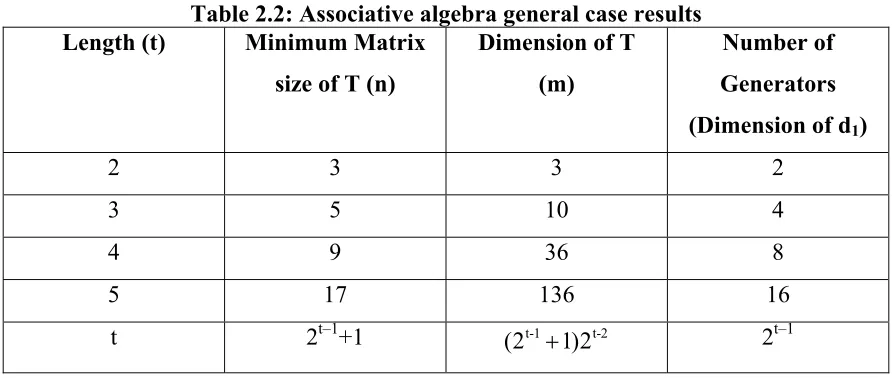
Lemma 2.1 For T to have length t, the smallest matrix size is n = 2t–1+1. In this construction the dimension of T = (2t-1+1)2t-2, and T has 2t–1 generators. We obtain the table:
Table 2.2: Associative algebra general case results Length (t) Minimum Matrix
size of T (n)
Dimension of T (m)
Number of Generators (Dimension of d1)
2 3 3 2 3 5 10 4 4 9 36 8 5 17 136 16
t 2t–1+1 (2t-1+1)2t-2 2t–1
Lemma 2.3 The minimum dimension for a nilpotent associative algebra to have derived
length t is less than or equal to(2t-1+1)2t-2.
We can do much better than that. The problems that arise are: 1.) Reduce the upper bound found in Lemma 2.1.
2.) For a fixed number of generators and a fixed length, find a good upper bound for the dimension.
3.) Consider question 2 in the context of a subalgebra of T and find the minimum size of the matrices.
CHAPTER 3: Associative Algebras with One Generator
In the beginning problem, we started with a basis of the first diagonal as the generators and there were 2t–1 generators. Now we look at the case were the generator is a combination of the basis for the first diagonal, F12 = E12 + E23 + … + En–1,n. Using associative matrix multiplication with strictly upper triangular nxn matrices, we find the derived series of the matrix and answer the three main questions at the end of Chapter 2. Set F1,j+1 = E1,j+1 + E2,j+2 + … + En–j,n where F1,j+1 is the sum of the elementary matrices whose non–zero entries are on the diagonal dj. To make this clear we start with an example.
Example 3.1
Let n = 5 and A be the subalgebra of T generated by the basis of d1. We have the 5x5 matrix starting with F12 = E12 + E23 + E34 + E45
F12 =
0 1 0 0 0 0 0 1 0 0 0 0 0 1 0 0 0 0 0 1 0 0 0 0 0
Now we compute the derived series of the matrix. The elements on d2 are F12 * F12 = (E12 + E23 + E34 + E45) * (E12 + E23 + E34 + E45) = F13 = E13 + E24 + E35. Then the elements on d4, F13 * F13 = F15 = E15. Note we also compute the elements of d4 by multiplying F12* F14. Now we compute the rest of the products. We compute elements of d3 by
multiplying elements of d1 by the elements of d2, F12 * F13 = F14 = E14 + E25. All other products between the other F’s are 0. Now we have the derived series where A = <F12>
dimension m = 4. This is the least possible dimension a nilpotent algebra of length 3 can have since such an algebra must have a product of 4 elements that are not 0. □
Example 3.2
Let n = 9 and A be the subalgebra of T generated by F12.
We have the 9x9 matrix starting with F12 = E12 + E23 + E34 + E45 + E56 + E67 + E78 + E89.
F12 =
0 1 0 0 0 0 0 0 0 0 0 1 0 0 0 0 0 0 0 0 0 1 0 0 0 0 0 0 0 0 0 1 0 0 0 0 0 0 0 0 0 1 0 0 0 0 0 0 0 0 0 1 0 0 0 0 0 0 0 0 0 1 0 0 0 0 0 0 0 0 0 1 0 0 0 0 0 0 0 0 0
In the general case we claim that F1,s+1∈ ds and that F1,p+1 * F1,q+1 = F1,p+q+1. The first of these is by definition and for the second we note that
Ei,i+p * Ej,j+q =
i i+p+q,
0 if i+p j E if i+p = j ≠
Of course F1,s+1∈ ds, where s = p+q. Hence F1,p+1 * F1,q+1 = (E1,p+1 + E2,p+2 + …. + En–p,n) * (E1,q+1 + E2,q+2 + …. + En–q,n) = E1,p+q+1 + E2,p+q+2 +… + En–(p+q),n = F1,p+q+1 = F1,s+1 ∈ dp+q = ds. Therefore, F12, F13, …,F1,n–1 are a basis for A and the dimension of A = n–1. Also
A = <F12> ⊕ <F13> ⊕…⊕ <F1,n> A1 = <F13> ⊕ <F14> ⊕…⊕ <F1,n> A2 = <F15> ⊕ <F16> ⊕…⊕ <F1,n>
M
Ak = <F1,2k+1> ⊕ <F1, 2k+2> ⊕…⊕ <F1,n>
Theorem 3.3 Let A be the subalgebra of the algebra T of strictly upper triangular nxn matrices that is generated by F12. Then the dimension of A is n–1.
Theorem 3.4 There is a subalgebra A of T having length t and dimension 2t–1 if A has the size n = 2t–1 + 1. A is generated by one element, F12. This result is the best possible in that there is not a subalgebra of smaller dimension that has length t.
From Theorem 3.4 we get this Corollary:
Proof. Let A be a subalgebra of T generated by one element, F12, where T has a size n. As usual F1,p+1 * F1,q+1 = F1,p+q+1 = F1,s+1 ∈ ds if p+q+1 ≤ n and it is 0 otherwise. Hence A = <F12> ⊕ <F13> ⊕…⊕ <F1,n> and dimension of A = n–1. Furthermore,
A1 = <F13> ⊕ <F14> ⊕…⊕ <F1,n> A2 = <F15> ⊕ <F16> ⊕…⊕ <F1,n>
M
Ak = <F1,2k+1 > ⊕ <F1,2k+2 >⊕…⊕ <F1,n>
Hence At–1 ≠ 0 if and only if 2t–1 ≤ n–1 or n ≥ 2t–1+1 (if diagonal d2t-1 exists). If n ≥
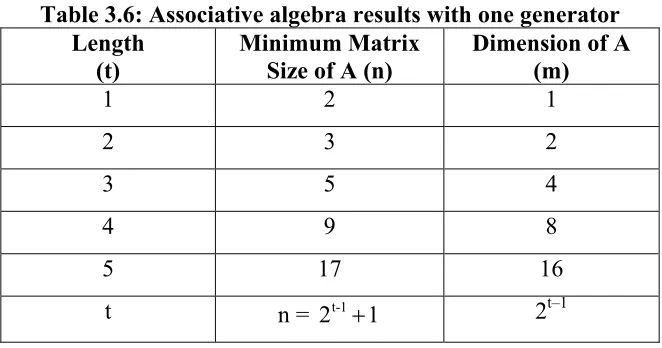
2t–1+1 and n < 2t+1 then A has length t. If n = 2t–1+1, then n is the least possible n for A to have derived length t. Now we know that the dimension of A is n–1, therefore when we want the smallest n of length t we let n = 2t–1+1 and the dimension of A is 2t–1. □
Table 3.6: Associative algebra results with one generator Length
(t) Minimum Matrix Size of A (n) Dimension of A (m)
1 2 1 2 3 2 3 5 4 4 9 8 5 17 16
t n = 2t-1+1 2t–1
when we start with the n-1 elementary matrices directly above the main diagonal as generators (Lemma 2.1).
Table 3.7: Comparison chart of associative algebras general case (T) and associative algebra with one generator (A):
Length (t)
Minimum Matrix Size of A and T
(n)
Dimension of T Dimension of A
1 2 1 1
2 3 3 2
3 5 10 4
4 9 36 8
5 17 136 16
CHAPTER 4: Matrix Group General Case
We now consider the matrix group versions of the associative algebra results. In this investigation, we work exclusively with subgroups M of the group of unipotent nxn upper triangular matrices, U. Then U = I ⊕ d1 ⊕ d2 ⊕…⊕dn–1, where the sum is a vector space direct sum and the di are the upper diagonals of U as in the last section. We will consider the problem: For a given length, find the minimum n necessary.
Again using matrix units we compute the derived length where [A,B] = ABA-1B-1 is the commutator. Then U1 = <[A,B]; A,B ∈U> and Ud = <[A,B]; A,B ∈Ud-1>. Then U 1 = I ⊕ d2 ⊕ d3 ⊕…⊕dn–1
U 2 = I ⊕ d22 ⊕ d5 ⊕…⊕dn–1
M
U k = I ⊕ d2k ⊕ d2k+1 ⊕…⊕dn–1
Notice that U t–1 ≠0 if and only if 2t–1 ≤ n–1 or n ≥ 2t–1+1 (diagonal d2t-1has to exist).
The least n for U to have length t, is n = 2t–1+1 and the dimension of U = (2t-1+1)2t-2, just
as in the associative case. Hence I + E12, I + E23, …,I + En–1,n are generators of U, hence U has 2t–1 generators.
CHAPTER 5: Matrix Groups with 3 Generators
Now we consider a subgroup of U where there are three generators: F12, F23, and F34. These generators are combinations of the elements on the first diagonal added to the identity matrix. We use the following terms:
Fij = I + j+3k n i+3k,j+3k
k 0
E
≤ =
∑
where i = 1,2,3 and j > i.Using multiplication with unipotent strictly upper triangular nxn matrices, we can find the derived length of the group. To make this clear we start with an example.
Example 5.1
Let n = 9 and let F12, F23, and F34 be generators of M in T. Thus M ⊇ {F12, F23, F34} where F12 = I + E12 + E45 + E78, F23 = I + E23 + E56 + E89, and F34 = I + E34 + E67.
F12 =
1 1 0 0 0 0 0 0 0 0 1 0 0 0 0 0 0 0 0 0 1 0 0 0 0 0 0 0 0 0 1 1 0 0 0 0 0 0 0 0 1 0 0 0 0 0 0 0 0 0 1 0 0 0 0 0 0 0 0 0 1 1 0 0 0 0 0 0 0 0 1 0 0 0 0 0 0 0 0 0 1
F23 =
1 0 0 0 0 0 0 0 0 0 1 1 0 0 0 0 0 0 0 0 1 0 0 0 0 0 0 0 0 0 1 0 0 0 0 0 0 0 0 0 1 1 0 0 0 0 0 0 0 0 1 0 0 0 0 0 0 0 0 0 1 0 0 0 0 0 0 0 0 0 1 1 0 0 0 0 0 0 0 0 1
F34 =
1 0 0 0 0 0 0 0 0 0 1 0 0 0 0 0 0 0 0 0 1 1 0 0 0 0 0 0 0 0 1 0 0 0 0 0 0 0 0 0 1 0 0 0 0 0 0 0 0 0 1 1 0 0 0 0 0 0 0 0 1 0 0 0 0 0 0 0 0 0 1 0 0 0 0 0 0 0 0 0 1
Now we compute the derived length of the group. Compute the derived series starting with M to get M1 by the following multiplications:
[F12,F23] = (F12 * F23)*( F12–1 * F23–1) =
[(I + E12 + E45 + E78) * (I + E23 + E56 + E89)] * [(I – E12 – E45 – E78) * (I – E23 – E56 – E89)]= (I+E23+E56+E89+E12+E13+E45+E46+E78+E79)*(I-E23-E56-E89-E12+E13-E45+E46-E78+E79) =
I + E13 + E46 + E79 = F13 [F12,F34,] = (F12 * F34) * (F12–1 * F34–1) =
(I + E12 + E45 + E78 + E34 + E67) * (I – E12 – E45 – E78 – E34– E67) = I - E35 - E68 = (F35)-1
[F23,F34] = (F23 * F34) * (F23–1 * F34–1) =
[(I + E23 + E56 + E89) * (I + E34 + E67)] * [(I – E23 – E56 – E89) * (I – E34 – E67)] =
(I + E34 + E67 + E23 + E24 + E56 + E57 + E89) * (I – E34 – E67 – E23 + E24 – E56 + E57 – E89) = I + E24 + E57 = F24
M1 ⊇ {F13, F24, F35} and we continue to find M2 ⊇ {F15, F26, F37} where F15 = I + E15 + E48, F26 = I + E26 + E59, and F37 = I + E37; and M3 ⊇{ F19} where F19 = I + E19; and M4 = 0 since M ⊆ U and U4 = 0. Hence M has length 4. □
Lemma 5.2 The multiplication of [Fi,p+i,Fj,p+j] where i, j = 1,2,3 and i≠j and p is not congruent to 0 mod 3 yields three possible results:
Case 1: I if j is not congruent to p+i mod 3 and i is not congruent to p+j mod 3 Case 2: Fi,2p+i if j≡p+i mod 3 and i is not congruent to p+j mod 3
Case 3: (Fj,2p+j)-1 if i ≡ p+j mod 3 and j is not congruent to p+i mod 3
Proof. We will be computing [Fi,p+i,Fj,p+j] where i=1,2; j = 2,3; i<j and we assume that p is not congruent to 0 mod 3. It will be useful to let Ha,b = Fa,b – I. Then
[Fi,p+i,Fj,p+j] =
[(I + Hi,p+i) * (I + Hj,p+j)] * [(I - Hi,p+i) * (I - Hj,p+j)] =
[Hi,2p+iδ (p+i-j mod 3,0)] * (-Hj,p+j) + [Hi,2p+iδ (p+i-j mod 3,0)] * (-Hi,p+i) + [Hi,2p+iδ (p+i-j mod 3,0)] * [Hi,2p+iδ(p+i-j mod 3,0)]. We go through each of these multiplications: I * I = I
I * (-Hj,p+j) = -Hj,p+j this will cancel with its positive opposite I * (-Hi,p+i) = -Hi,p+i this will cancel with its positive opposite I * Hi,2p+iδ (p+i-j mod 3,0) = Hi,2p+iδ(p+i-j mod 3,0)
Hj,p+j * I = Hj,p+j this will cancel with its negative opposite Hj,p+j * (-Hj,p+j) = 0 since p+j is not congruent to j mod 3 Hj,p+j * (-Hi,p+i) = -Hj,2p+j δ(p+j - i mod 3,0)
Hj,p+j * [Hi,2p+i δ (p+i-j mod 3,0)] = 0, for if not, p+j ≡ i mod 3 and p+i ≡ j mod 3 Æ p ≡i - j mod 3 and p≡-i + j mod 3 Æ p ≡i - j mod 3 and -p ≡i – j mod 3 Æ p≡-p mod 3 Æ
2p≡0 mod 3
which is a contradiction to our original assumption. Hi,p+i * I = Hi,p+i this will cancel with its negative opposite Hi,p+i * (-Hj,p+j) = -Hi,2p+i δ (p+i - j mod 3,0)
Hi,p+i * (-Hi,p+i) = 0 since p+i is not congruent to i mod 3
Hi,p+i * [Hi,2p+iδ (p+i-j mod 3,0)] = 0, since if p+i ≡i mod 3 then p ≡ 0 mod 3 which is a contradiction to our original assumption.
Hi,2p+iδ (p+i-j mod 3,0) * I = Hi,2p+iδ(p+i-j mod 3,0)
but p is not congruent to 0 mod 3 and p+i-j≡0 mod 3 which is impossible. [Hi,2p+iδ (p+i-j mod 3,0)] * (-Hi,p+i) = 0, since if 2p+i ≡i mod 3 then 2p≡0 mod 3 which
is a contradiction to our original assumption.
[Hi,2p+iδ (p+i-j mod 3,0)] * [Hi,2p+iδ(p+i-j mod 3,0)] = 0, since if 2p+i≡i mod 3 then p ≡0 mod 3 which is a contradiction to our original assumption.
Leaving: I + 2Hi,2p+iδ(p+i-j mod 3,0) - Hj,2p+jδ (p+j-i mod 3,0) - Hi,2p+iδ(p+i-j mod 3,0) = I + Hi,2p+i δ (p+i - j mod 3,0) - Hj,2p+j δ (p+j - i mod 3,0) =
Case 1: I if j is not congruent to p+i mod 3 and i is not congruent to p+j mod 3 Case 2: I + Hi,2p+i = Fi,2p+i if j ≡p+i mod 3 and i is not congruent to p+j mod 3
Case 3: I – Hj,2p+j = (Fj,2p+j)-1 if i ≡ p+j mod 3 and j is not congruent to p+i mod 3
Note that i ≡ p+j mod 3 and j ≡p+i mod 3 cannot hold simultaneously, if they did then p+j ≡ i mod 3 and p+i ≡ j mod 3 Æ
p ≡i - j mod 3 and p≡-i + j mod 3 Æ p ≡i - j mod 3 and -p ≡i – j mod 3 Æ p≡-p mod 3 Æ
2p≡0 mod 3
which is a contradiction to our original assumption. □
Lemma 5.3 F1,2k+1, F2,2k+2, F3,2k+3 ∈ Mk.
Proof. Base case: Let k = 1. We start with F12, F23, F34 ∈M. We find with the following multiplications of [F1,2, F2,3], [F1,2 F3,4], and [F2,3, F3,4] and with lemma 5.2 we get F1,3, (F3,5)-1, and F2,4 respectively, where F1,3, F2,4, F3,5 are elements of M1.
To show that when k = r+1 that F1,2r+1+1, F2, 2r+1+2, F3, 2r+1+3 ∈ Mr+1, we start with Mr+1 = [Mr,Mr] where F1, 2r+1, F2, 2r +2, F3, 2r +3 ∈ Mr. We do the calculations
[F1, 2r +1, F2, 2r +2] [F1, 2r +1, F3, 2r +3] [F2, 2r +2, F3, 2r +3]
using lemma 5.2 to get F1, 2*2r +1, (F3, 2*2r +3)-1, and F2, 2*2r +2, giving us F1, 2r+1 +1, F3, 2r+1 +3, and F2, 2r+1 +2 ∈ Mr+1. □
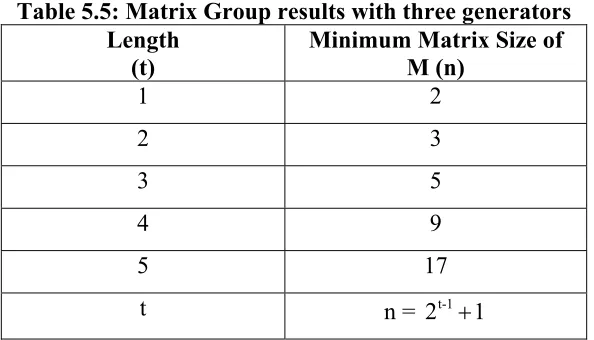
Theorem 5.4 M has length t if M has the matrix size n = 2t–1 + 1. M is generated by three elements; F12, F23, F34. This result is the best possible.
Proof. Let M be the matrix group of the nxn unipotent strictly upper triangular matrices U generated by the three elements, F12, F23, and F34. M has a size n and is a unipotent strictly upper triangular matrix group. If n ≥ 2t–1+1 then Mt–1 ≠ 0 (because F1,2t–1+1 is the smallest element of Mt–1). If n ≥ 2t–1+1 and n < 2t+1, then M has length t. If n=2t–1+1, then n is the least possible n for M to have derived length t. This number matches the least possible n for U to have derived length t. Hence using three or more generators, n = 2t–1+1 is the smallest n for a unipotent group to have derived length t. □
Table 5.5: Matrix Group results with three generators Length
(t)
Minimum Matrix Size of M (n)
1 2 2 3 3 5 4 9 5 17
CHAPTER 6: Lie Algebra General Case
We now consider the Lie algebra versions of the associative algebra results. We have four problems to consider:
1.) Find a good upper bound for the dimension of nilpotent Lie algebras with derived length t. In other words, for a given t, find as small an m as possible such that there is an algebra of dimension, m, with derived length, t.
2.) Answer the same question when restricted to a fixed number of generators. 3.) Answer the same question when the Lie algebras are subalgebras of strictly
upper triangular matrices of size n (denoted again by T). Here the multiplication is commutator multiplication.
4.) For a given length, find the minimum n necessary.
In this investigation, we work exclusively with subalgebras of T. As before T = d1 ⊕
d2 ⊕…⊕dn–1 where the di are the upper diagonals of T. Again using matrix units, we compute the derived series of T:
T1 = d2 ⊕ d3 ⊕…⊕dn–1 T2 = d22 ⊕ d5 ⊕…⊕dn–1
M
Tk = d2k ⊕ d2k+1 ⊕…⊕dn–1
Notice that Tt–1 ≠0 if and only if 2t–1 ≤ n–1 or n ≥ 2t–1+1 (diagonal d2t-1has to exist).
CHAPTER 7: Lie Algebras with 3 Generators
In lemma 6.1 there are 2t–1 generators. Now we look at the case where there are three generators: F12, F23, and F34. These generators are combinations of the elements on the first diagonal. We define:
Fij = j+3k n i+3k,j+3k k 0 E ≤ =
∑
where i = 1,2,3 and j > i.Let L be generated by F12, F23, and F34.
Using commutator multiplication, we find the derived series of the algebra. To make this clear we start with an example.
Example 7.1
Let n = 9 and let F12, F23, and F34 be generators of L in T. Let dj’ = L ∩dj. d1’ = <F12, F23, F34> where F12 = E12 + E45 + E78, F23 = E23 + E56 + E89; and F34 = E34 + E67.
F12 =
0 1 0 0 0 0 0 0 0 0 0 0 0 0 0 0 0 0 0 0 0 0 0 0 0 0 0 0 0 0 0 1 0 0 0 0 0 0 0 0 0 0 0 0 0 0 0 0 0 0 0 0 0 0 0 0 0 0 0 0 0 1 0 0 0 0 0 0 0 0 0 0 0 0 0 0 0 0 0 0 0
F23 =
0 0 0 0 0 0 0 0 0 0 0 1 0 0 0 0 0 0 0 0 0 0 0 0 0 0 0 0 0 0 0 0 0 0 0 0 0 0 0 0 0 1 0 0 0 0 0 0 0 0 0 0 0 0 0 0 0 0 0 0 0 0 0 0 0 0 0 0 0 0 0 1 0 0 0 0 0 0 0 0 0
F34 =
0 0 0 0 0 0 0 0 0 0 0 0 0 0 0 0 0 0 0 0 0 1 0 0 0 0 0 0 0 0 0 0 0 0 0 0 0 0 0 0 0 0 0 0 0 0 0 0 0 0 0 1 0 0 0 0 0 0 0 0 0 0 0 0 0 0 0 0 0 0 0 0 0 0 0 0 0 0 0 0 0
Now we obtain the derived series of the algebra. We start by finding the elements of d2’. [F12,F23] = (F12 * F23) – (F23 * F12) =
[(E12 + E45 + E78) * (E23 + E56 + E89)] – [(E23 + E56 + E89)* (E12 + E45 + E78)] = E13 + E46 + E79 = F13 ∈ L1
[F23,F34] = (F23 * F34) – (F34 * F23) =
[(E23 + E56 + E89) * (E34 + E67)] – [(E34 + E67) * (E23 + E56 + E89)] = E24 + E57 = F24 ∈ L1
Resulting with d2’ = <F13, F24, F35>. Then use these elements to find F15, F26, F37 ∈ L2 where d4’ = <F15, F26, F37> and F15 = E15 + E48, F26 = E26 + E59, and F37 = E37. Then use these elements to find F19 ∈ L3 where d8’ = < F19> and F19 = E19. Clearly L4 = [L3, L3] = 0 and L has derived length 4. We have computed the linearly independent elements d1’, d2’, d4’, and d8’. We find the other diagonals, starting with d3’:
[F12,F13] = (F12 * F13) – (F13 * F12) =
[(E12 + E45 + E78) * (E13 + E46 + E79)] – [(E13 + E46 + E79) * (E12 + E45 + E78)] = 0
[F12,F24] = (F12 * F24) – (F24 * F12) =
[(E12 + E45 + E78) * (E24 + E57)] – [(E24 + E57) * (E12 + E45 + E78)] = E14 + E47 – E25 – E58 = F14 – F25
[F12,F35] = (F12 * F35) – (F35 * F12) =
[(E12 + E45 + E78) * (E35 + E68)] – [(E35 + E68) * (E12 + E45 + E78)] = 0
[F23,F13] = (F23 * F13) – (F13 * F23)=
[(E23 + E56 + E89) * (E13 + E46 + E79)] – [(E13 + E46 + E79) * (E23 + E56 + E89)] = 0
[F23,F24] = (F23 * F24) – (F24 * F23) =
[F23,F35] = (F23 * F35) – (F35 * F23) =
[(E23 + E56 + E89) * (E35 + E68 )] – [(E35 + E68) * (E23 + E56 + E89)] = E25 + E58 – E36 – E69 = F25 – F36
[F34,F13] = (F34 * F13) – (F13 * F34) =
[(E34 + E67) * (E13 + E46 + E79)] – [(E13 + E46 + E79) * (E34 + E67)] = E36 + E69 – E14 – E47 = F36 – F14
[F34,F24] = (F34 * F24) – (F24 * F34) =
[(E34 + E67) * (E24 + E57)] – [(E24 + E57) * (E34 + E67)] = 0
[F34,F35] = (F34 * F35) – (F35 * F34) =
[(E34 + E67) * (E35 + E68) – [(E35 + E68) * (E34 + E67)] = 0
leaving d3’ = <[d1’,d2’]> = < F14 – F25, F25 – F36, F36 – F14> where F14 – F25 = E14 + E47 – E25 – E58, F25 – F36 = E25 + E58 – E36 – E69, and F36 – F14 = E36 + E69 – E14 – E47. Notice that F36 – F14 = – (F25 – F36) – (F14 – F25), therefore, d3’ = < F14 – F25, F25 – F36>.
length 4 and d1’ ⊕ d2’ ⊕…⊕ d8’ contains a basis for L, as demonstrated, and L has dimension 3+3+2+3+3+2+2+1 = 19. □
With Lie Algebras we are dealing with commutator multiplication where [Fi,p+i,Fj,q+j] = Fi,p+i * Fj,q+j – Fj,q+j * Fi,p+i. Let s = p+q.
Recall that:
Fi,p+i * Fj,q+j = Fi,p+q+i = Fi,s+i where i = 1,2,and 3, if i+p is congruent to j mod 3 0 , if i+p is not congruent to j mod 3 and
Fj,q+j * Fi,p+i = Fj,q+p+j = Fj,s+j where j = 1,2,and 3, if q+j is congruent to i mod 3 0 , if q+j is not congruent to i mod 3
Let M1 represent Fi,p+i * Fj,q+j and let M2 represent Fj,q+j * Fi,p+i. In order for M1≠ 0, p+i is congruent to j mod 3 or 3 divides p+i–j. In order for M2≠ 0, q+j is congruent to i mod 3 or 3 divides q+j–i.
Lemma 7.2 If both M1≠ 0 and M2≠ 0 then s is a multiple of 3 where ds is the diagonal s steps above the main diagonal.
Proof. If both M1 ≠ 0 and M2 ≠ 0 then 3 divides p+i–j and q+j–i. Since q = s–p, q+j–i = s–p+j–i = s–(p+i–j). Hence, s is a multiple of 3. □
Lemma 7.3 If s is a multiple of 3 then either both M1≠ 0 and M2≠ 0 or both M1 = 0 and M2 = 0.
divides s, this shows that 3 divides q+j–i which is a contradiction. Similarly, we get the same results if we start with M2≠ 0 and M1 = 0. □
Corollary 7.4 If s is not a multiple of 3, then one of the following holds where M1 represent (Fi,p+i * Fj,q+j) and M2 represent (Fj,q+j * Fi,p+i): M1≠ 0 & M2 = 0, M1 = 0 & M2≠0, or M1 = 0 & M2 = 0.
Lemma 7.5 F1,2s+1, F2,2s+2, F3,2s+3 ∈ Ls (provided the second subscript ≤ n).
Note that d2s’ = < F1,2s+1, F2,2s+2, F3,2s+3>, therefore, we know that the diagonal we are dealing with is never a multiple of 3.
Proof. Base Case: Let s = 1. We start with L, where d1’ = <F12, F23, F34> and F12 = E12 + E45 + …+ E3k+1,3k+2, F23 = E23 + E56 + …+ E3k+2,3k+3, and F34 = E34 + E67 + …+ E3k+3,3k+4 where k starts at zero, and the terms are within the matrix size.
Then
[F12,F23] = (F12 * F23) – (F23 * F12) = F13 [F12,F34] = (F12 * F34) – (F34 * F12) = –F35 [F23,F34] = (F23 * F34) – (F34 * F23) = F24
Hence d2’ = <F13, F24, F35> and F1,21+1, F2,21+2, F3,21+3 ∈ L1.
Induction Hypothesis: let s = k where F1,2k+1, F2,2k+2, F3,2k+3 ∈ Lk. We show that F1,2k+1+1, F2,2k+1+2, F3,2k+1+3 ∈ Lk+1. We compute
[F1,2k+1, F2,2k+2], [F1,2k+1, F3,2k+3], and [F2,2k+2, F3,2k+3].
if 2k+j is congruent to i mod 3, but at no time will these results both be nonzero (corollary 7.4). One of them will be non-zero since either i-j is congruent to 2k mod 3 or j-i is congruent to 2k mod 3.
Thus either (Fi,2k+i * Fj,2k+j) = Fi, 2k+2k+i = Fi, 2k+1+i or (Fj,2k+j * Fi,2k+i ) = Fj, 2k+2k+j = Fj, 2k+1+j. Therefore d2(k+1)’ = <F1,2k+1+1, F2,2k+1+2, F3,2k+1+3> and F1,2k+1+1, F2,2k+1+2, F3,2k+1+3∈Lk+1. □
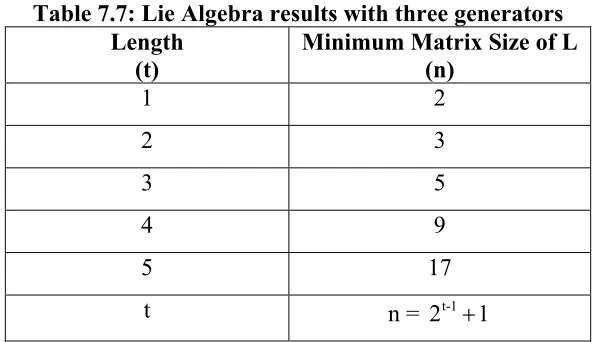
Theorem 7.6 L has length t if L has the matrix size n = 2t–1 + 1. L is generated by three elements; F12, F23, F34. This result is the best possible for three generators.
Proof. Let L be the Lie subalgebra of the nxn strictly upper triangular matrices T
generated by three elements, F12, F23, F34. If n ≥ 2t–1+1 then Lt–1 ≠ 0 (because F1,2t–1+1 is in Lt–1). If n ≥ 2t–1+1 and n < 2t+1 then L has length t. If n = 2t–1+1, then n is the least possible n for L to have derived length t. This number matches the least possible n for T to have derived length t and thus L⊆T. Hence for any number of generators ≥ 3, n = 2t– 1+1 is the smallest n to obtain derived length t.
Table 7.7: Lie Algebra results with three generators Length
(t)
Minimum Matrix Size of L (n)
1 2 2 3 3 5 4 9 5 17
t n = 2t-1+1
Lemma 7.8 L = d1’ ⊕ d2’ ⊕…⊕dn–1’ where di’ = L ∩di. The dimension of ds’ = 3 if s is not congruent to 0 mod 3 and s≠n–2 or n–1. The dimension of ds’ = 2 if s is congruent to 0 mod 3 and s ≠n–2 or n–1. The dimension of dn–2’ = 2 and dimension of dn–1’ = 1. Proof. We will first look at the dimension of ds’ where s is not congruent to 0 mod 3, hence s is not a multiple of 3. ds’ is computed from [dp’,dq’] where s = p+q, and we calculate ds’ with [Fi,p+i,Fj,q+j] = (Fi,p+i * Fj,q+j) – (Fj,q+j * Fi,p+i) = Fi,p+q+i = Fi,s+i or –Fj,p+q+j = Fi,s+i where i=1, 2, and 3, and ds’ = <F1,s+1, F2,s+2, F3,s+3>. Therefore, the dimension of ds’ is 3 when s is not congruent to 0 mod 3 and s≠n–2 or n–1.
Now we look at the dimension of ds’ where s is congruent to 0 mod 3, hence s is a multiple of 3. We compute ds’ with the calculation [Fi,p+i,Fj,q+j] = (Fi,p+i * Fj,q+j) – (Fj,q+j * Fi,p+i) = (Fi,p+q+i – Fj,p+q+j) = (Fi,s+i – Fj,s+j)δp+i,j. If i = 1, p = 1, j = 2, q = s-1 this equals F1,s+1 – F2,s+2. If i = 2, p = 1, j = 3, q = s-1 this equals F2,s+2 – F3,s+3. If i = 1, p =2, j = 3, q = s-2 this equals F1,s+1 – F3,s+3. Where ds’ = <F1,s+1 – F2,s+2, F2,s+2 – F3,s+3, F1,s+1 – F3,s+3>. Only two of these are linearly independent hence ds’ = <F1,s+1 – F2,s+2, F2,s+2 – F3,s+3> and the dimension of ds’= 2 when s is congruent to 0 mod 3 and s ≠n–2 or n–1.
The case of dn–2’ and dn–1’ are easily checked to be dn–2’ = <F1,n–1, F2,n> where F1,n–1 = E1,n–1 and F2,n = E2,n and dn–1’ = <F1,n> where F1,n = E1,n remembering that in the last diagonal there is only one element in the matrix and in the second to last diagonal there are 2 elements in the matrix. Hence, the results hold. □
Lemma 7.9 The dimension of L =
(k-1)*8+3 if n=3k (k-1)*8+6 if n=3k+1 (k-1)*8+9 if n=3k+2
know the matrix size is a multiple of 3 and that there are n–1 diagonals above the main diagonal, breaking down to k–1 sets of consecutive diagonals that have dimension 8 = (3+3+2), dn–2’ with dimension 2, and dn–1’ with dimension 1. Making the total dimension of L = (k–1)*8+3. In the case where n = 3k+1 break down to k–1 sets of diagonals that have dimension 8, dn–3’ where n–3 is not a multiple of 3 because 3k+1–3 mod 3 is not 0 leaving dn–3’ with dimension 3, dn–2’ with dimension 2, and dn–1’ with dimension 1. Making the total dimension of L = (k–1)*8+6. The last case where n = 3k+2 breaks down to k–1 sets of diagonals that have dimension 8, dn–4’ where n–4 is not a multiple of 3 because 3k+2–4 mod 3 is not 0 leaves dn–4’ with dimension 3, dn–3’ where n–3 is not a multiple of 3 because 3k+2–3 mod 3 is not 0 leaves dn–3’ with dimension 3, dn–2’ with dimension 2, and dn–1’ with dimension 1. Making the total dimension of L= (k–1)*8+9.□
We can use the 9x9 Lie Algebra, Example 7.1, to check this lemma. In the 9x9 example we showed that the dimension of L = 3+3+2+3+3+2+2+1 = 19. Using lemma 7.9 when n = 9 we see we have the case n = 3k where k = 3 and find the dimension to be the same as in our example (k-1) * 8 + 3 = (3–1) * 8 + 3 = 19.
We now find the dimension of L in Theorem 7.6. Recall that for a given length t, Theorem 7.6 gives that the minimum matrix size needed for L to have length t is n =
t-1
2 +1.
Proposition 7.10 If t is even, then n = 3k (n≡0 mod 3), and if t is odd then n = 3k+2 (n≡2 mod 3).
Proof. Induct on d.
If t = 3 then matrix size is 2t-1+1 = 5 where k = 1 and we use n = 3k+2. Note that 5 mod
3 = 2. We see that 2t-1+2+ ≡1 3*2t-1+2 +1t-1 ≡2t-1+1 mod 3. Hence all even (odd) t have
their corresponding n’s congruent mod 3. □
Proposition 7.10 is easier to understand by looking at some examples. For the even case we start with t = 2. Then 22-1+2+1 ≡ 3*22-1+2 +12-1 ≡ 22-1+1 mod 3 = 3 mod
3 = 0. To check this we take t = 4, where 2t-1+1= 9 and 9 mod 3 is 0. Notice that when t
= 2 and n = 3, n≡0 mod 3; and when t = 4 and n = 9, n≡0 mod 3 showing that the even t have an n≡0 mod 3. We can also show an odd example where we start with t = 3. Then
3-1+2
2 + ≡1 3*23-1+2 +13-1 ≡ 23-1+1 mod 3 = 5 mod 3 = 2. To check this we take t = 5,
where 2t-1+1 = 17 and 17 mod 3 is 2. Notice that when t = 3 and n = 5, n≡2 mod 3; and
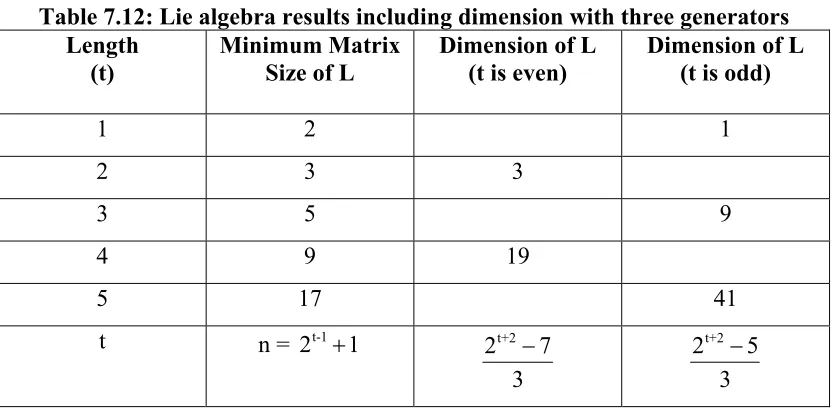
when t = 5 and n = 17, n≡2 mod 3 showing that the odd t have an n≡2 mod 3. Theorem 7.11 There is a three generator Lie Algebra (L) of derived length t and
dimension 2t+2 7 3
−
if t is even and 2t+2 5 3
−
if t is odd. These algebras are subalgebras of
T of matrix size 2t-1+1.
Proof. For any t, n = 2t-1+1 is the smallest matrix size which will support algebras L of
length t as seen earlier. If t is even, n≡0 mod 3 and n = 3k and the dimension of L is 8(k–1) + 3. Using both n =2t-1+1 and n = 3k we get the dimension of L is 8(k–1) + 3 =
8(n
3–1) + 3 =
t-1
2 1
8( 1) 3
3 + − + = t+2 2 7 3 −
. If t is odd, n≡2 mod 3 and n = 3k + 2 and the
dimension of L is 8(k–1) + 9. Using both n =2t-1+1 and n = 3k + 2 we get the dimension
of L = 8(k–1) + 9 =8(n 2 1) 9 3
−
− + =
t-1
2 1 2
8( 1) 9
Table 7.12: Lie algebra results including dimension with three generators Length
(t)
Minimum Matrix Size of L
Dimension of L (t is even)
Dimension of L (t is odd)
1 2 1 2 3 3 3 5 9 4 9 19 5 17 41
t n = 2t-1+1 2t+2 7
3
− 2t+2 5
3 −
Table 7.13: Comparison chart with strictly upper triangular matrices general case (T), Lie algebra with three generators (L), and associative algebra with one
generator (A) Length (t) Minimum Matrix Size(T,A,L) Dimension of T Dimension of L Dimension of A
1 2 1 1 1 2 3 3 3 2 3 5 10 9 4 4 9 36 19 8 5 17 136 41 16
t n = 2t-1+1 (2t-1+1)2t-2
t even
t+2 2 7 3 − t odd t+2 2 5 3 − t-1 2
CHAPTER 8: Lie Algebras with 2 Generators
For a given t, we have found the smallest n such that there is a 3 generated subalgebra of the strictly upper triangular nxn matrices which has derived length t. We now consider the same problem for the 2 generated subalgebras.
We start by finding a lower bound for n.
Theorem 8.1 If n ≤ 52t
8 then T does not have a 2 generated subalgebra with derived length t.
Proof. Let L be a 2 generated subalgebra of T. Let L = <A, B>. In order for the derived length of L to be t, Lt = 0 and Lt–1 ≠0.
When t = 2 we find that n ≤ 522 5
8 = 2, leaving n < 3. When n = 2 we have L t–1 =
L1 = <[A, B]> = L 2 = 0. Hence, T does not have a 2 generated subalgebra with derived
length t = 2 when n ≤ 52t
8 .
When t = 3 we find that n ≤ 5. When L = <A, B>, L2 = [A, B] + L3. Then: Lt–1 = L2 = [L1, L1] = [L2, L2] =
[[A, B] + L3, [A, B] + L3] = [L3, [A, B] + L3] =
[L3, L2] ⊆ L5 = 0 since n ≤ 5.
Hence T does not have a 2 generated subalgebra with derived length t = 3 when n ≤
t
Using induction, we assume Lt–1⊆ t-3
5 * 2
L and compute Lt = [Lt–1, Lt–1]
⊆[ t-3
5 * 2
L , t-3
5 * 2
L ] ⊆ t-3
2(5 * 2 )
L = t-2
5 * 2
L . Now Lt–1⊆ t-3
5 * 2
L for all t. If n ≤ 52t
8 , then
t-3 5 * 2
L = 0 leaving Lt–1 = 0. Hence, T does not have a 2 generated subalgebra of derived
length t when n ≤ 52t
8 . Therefore, in order for a 2 generated subalgebra to have derived
length t, n > 52t
8 , leaving us with a lower bound on n. □
Let L be a Lie algebra generated by x and y and let z∈L such that z can be expressed as a product of the generators. Of all expressions of z as a product of generators, let w(z) be the number of generators in the shortest such expression of z. Then w(z) will be called the width of z.
Let F be a free Lie algebra generated by a and b. Let F ⊃F1⊃F2 ⊃ … be the derived series of F. The terms [a, b], [[a, b], a], [[a, b], b] are all in F1 with [a, b] having the shortest width, w([a, b]) = 2. The pairwise products of these elements are in F2 with the shortest width of any term being 5. These products are [[a, b], [[a, b], a]]; [[a, b], [[a, b], b]]; and [[[a, b], a], [[a, b], b]]. The products of these elements have widths 10, 11 and 11 and are the shortest elements in F3. Taking products again, we obtain products of width 21, 21, and 22. The new products are in F4 and the shortest width is 21 = 21 * 24–4. The shortest width in F5 is at least 42 = 21 * 25–4 which would be obtained by multiplying two elements of width 21 from F4. This process continues and we find that the shortest width in Fs is at least 21 * 2s–4.
Since any 2 generated Lie algebra L is the homomorphic image of F, the shortest width element in Ln is at least as wide as the shortest width element in Fn. The approach we take is that for each derived length t, we construct a 2 generated Lie algebra of strictly upper triangular matrices that meets the bound. The generator matrices A and B will be sums of Ei,i+1 of the appropriate size with each Ei,i+1 appearing in A or B but not both A and B. We let A ∈T1,n(α1,α2,...αn-1) and B ∈T1,n(β1,β2,...βn-1) where αi and βj are regarded as variables, and T1,n denotes the nxn matrices with non-zero elements only on the first diagonal along the main diagonal.
The following examples consider the cases for small values of t. Computations have been aided by the use of Maple (see Appendix A). As usual, t will be the solvable length, L is a subalgebra of T = Tn where n is the size of the matrices and j stands for the width of the smallest non-zero term in Lt-1. We always need n = j + 1.
Example 8.3
Let t = 2. Using s = 1 in Theorem 8.2 we find that j = 2 and n ≥3. Let A and B be matrices of size n = 3 with non-zero entries only on the super diagonal and zero’s elsewhere. Clearly for j = 2 we use [A, B] or [B, A]. Let c2(x, y) = [y, x] and consider c2(A, B) = [B, A] where
A = 1 2 0 α 0 0 0 α
0 0 0
and B = 1 2 0 β 0 0 0 β
0 0 0
.
Expanding using Maple, we find c2(A, B)1,3 = β1 α2 – α1 β2. Let m2=β1α2 and let β1=α2=1 and α1=β2=0, we find [c2(A, B)]1,3 = 1. Hence, for n = 3 the Lie algebra
possible result. That is, n = 3 is the smallest size matrix that contains a two generated Lie algebra of solvable length 2.
Note: that the number of alphas, 1, in m2 equals the number of A’s in c2(A, B) and the number of betas, 1, in m2 equals the number of B’s in c2(A, B). □
Example 8.4
Let t = 3. Using s = 2 in Theorem 8.2 we find that j = 5 and n ≥6. Let A and B be matrices of size n = 6. Let c5(x, y) = [[[y, x], x], [y, x]] and consider c5(A, B) = [[[B, A], A], [B, A]] where A and B have non-zero entries only on the super diagonal and zero’s elsewhere and the elements of this diagonal for A are α1, … α5 and for B are β1 … β5.
Expanding using Maple, we find c5(A, B)1,6 = 3α3β1α2β4α5 – 2α3β1α2α4β5 – 4α3α1β2β4α5 + 3α3α1β2α4β5 + α1α2β3β4α5 – α1α2β3α4β5 – β1α2α5β3α4 + α1β2α5β3α4. Let m5=α1α2β3β4α5 and let α1 = α2 = β3 = β4 = α5=1 and the remaining α’s and β’s be zero, we find [c5(A, B)]1,6 = 1. Hence, for n = 6 the Lie algebra generated by A and B has t = 3. From the result on free Lie algebras, n = 6 is the best possible result. That is, n = 6 is the smallest size matrix that contains a two generated Lie algebra of solvable length 3. Note: that the number of alphas, 3, in m5 equals the number of A’s in c5(A, B) and the number of betas, 2, in m5 equals the number of B’s in c5(A, B). □
For the next case we also will use c5'(x, y) = [[[y, x], y], [y, x]] and consider c5'(A, B) = [[[B, A], B], [B, A]] where A and B have non-zero entries only on the super
diagonal and zero’s elsewhere and the elements of this diagonal for A are α1, … α5 and for B are β1 … β5.
m5'=β1β2α3α4β5 and let β1 =β2=α3=α4=β5=1 and the remaining α’s and β’s be zero, we find [c5'(A, B)]1,6 = 1.
Note: that the number of alphas, 2, in m5' equals the number of A’s in c5'(A, B) and the number of betas, 3, in m5' equals the number of B’s in c5'(A, B).
Example 8.5
Let t = 4. Using s = 3 in Theorem 8.2 we find that j = 10 and n ≥11. Let A and B be matrices of size n = 11. Let c10(x, y) = [c5'(x, y), c5(x, y)] = [[[[y, x], y], [y, x]], [[[y, x], x], [y, x]]] and consider c10(A, B) = [c5'(A, B), c5(A, B)] = [[[[B, A], B], [B, A]], [[[B, A], A], [B, A]]] where A and B have non-zero entries only on the super diagonal and zero’s elsewhere and the elements of this diagonal for A are α1, … α10 and for B are β1 … β10.
Expanding using Maple, we find [c10(A,B)]1,11 contains β1β2α3α4β5α6α7β8β9α10 and many other terms, all different from this one. Let m10=β1β2α3α4β5α6α7β8β9α10 and let β1=β2=α3=α4=β5=α6=α7=β8=β9=α10=1 and the remaining α’s and β’s be zero, we find [c10(A,B)]1,11 = 1. Hence, for n = 11 the Lie algebra generated by A and B has t = 4. From the result on free Lie algebras, n = 11 is the best possible result. That is, n = 11 is the smallest size matrix that contains a two generated Lie algebra of solvable length 4. Note: that the number of alphas, 5, in m10 equals the number of A’s in c10(A, B) and the number of betas, 5, in m10 equals the number of B’s in c10(A, B). □
Example 8.6
Let t = 5. Using s = 4 in Theorem 8.2 we find that j = 21 and n ≥22. Let A and B be matrices of size n = 22 with non-zero entries only on the supper diagonal and zero’s elsewhere. Let
term2(x, y) = [[[[y, x], x], y], [y, x]] term3(x, y) = [[[[y, x], y], y], [y, x]] and
c21(x, y) = [[term1(x, y), c5(x, y)],c10(x, y)] c21' (x, y) = [term2(x, y), c5(x, y)],c10(x, y)] c21'' (x, y) = [term3(x, y), c5(x, y)],c10(x, y)]
and consider c21(A, B)=[[term1(A,B), c5(A,B)],c10(A, B)] =
[[[[[[B, A], A], A], [B, A] ], [[[B, A], A], [B, A]]], [[[[B, A], B], [B, A]], [[[B, A], A], [B, A]]]].
We first look at term1(A,B) = [[[[B, A], A], A], [B, A]] where A and B are 7x7 matrices of
the usual super diagonal form, we expand using Maple and we find [term1(A,B)]1,7 contains α1α2α3β4β5α6 and many other terms, all different from this one. We consider c5(A,B) = [[[B, A], A], [B, A]] where A and B are 6x6 matrices of the usual super
diagonal form, we expand using Maple and we find [c5(A,B)]1,6 contains α1α2β3β4α5 and many other terms, all different from this one (see example 8.4). We consider
c10(A,B)=[[[[B, A], B], [B, A]], [[[B, A], A], [B, A]]] where A and B are 11x11 matrices of the usual super diagonal form, we expand using Maple and we find [c10(A,B)]1,11 contains β1β2α3α4β5α6α7β8β9α10 and many other terms, all different from this one (see example 8.5).
To build A and B of size 22, we are guided by the above discussion. In the upper 7x7 block we put the A and B dictated from calculation using term 1; that is, we let α1=α2=α3=β4=β5=α6=1 and the rest of the super diagonal terms be 0. For the next 5
rest are 0. For the last part we use the calculations from c10 and add 11 to the subscripts giving β12=β13=α14=α15=β16=α17=α18=β19=β20=α21=1 and the rest are 0. Substituting A and B into term1(x,y), c5(x,y) and c10(x,y) yields ± 1 in postions (1,7), (7,12), and (12,22) in the respective matrices. Then c21(A,B) has ±1 (actually -1) in the (1,22) position and zeros elsewhere. This can also be described as in the next paragraph.
To build the matrices of size 22, term1(A,B) has α1α2α3β4β5α6 in the (1,7) position, c5(A,B) has α7α8β9β10α11 in the (7,12) position, and c10(A,B) has
β12β13α14α15β16α17α18β19β20α21 in the (12,22) position. The large A and B matrices have
been built in 3 steps. In the first 6 supper diagonal positions we put the α’s and β’s found in term1(A,B). In the next 5 positions we put the term found in c5(A,B) where the
subscripts have been increased by 6. In the last 10 positions we use the term found in c10(A,B) with the subscripts increased by 11. Then [c21(A,B)]1,22 has the product of these terms as one of many summands. Let
m21=α1α2α3β4β5α6α7α8β9β10α11β12β13α14α15β16α17α18β19β20α21 and let these values for α’s and β’s be 1 and the remaining α’s and β’s be zero, we find [c21(A,B)]1,22 = -1. Hence, for n = 22 the Lie algebra generated by A and B has t = 5. From the result on free Lie algebras, n = 22 is the best possible result. That is, n = 22 is the smallest size matrix that contains a two generated Lie algebra of solvable length 5.
Note: that the number of alphas, 12, in m21 equals the number of A’s in c21(A, B) and the number of betas, 9, in m21 equals the number of B’s in c21(A, B).
10, thus the number of A’s in c21(A,B), c21'(A,B), and c21''(A,B) is congruent to 0, 1, and 2 mod 3 respectively. □
Theorem 8.7 T has a 2 generated subalgebra of derived length t if n = [21*2t-5] + 1 and n is the smallest possible size for T.
Proof. The cases t ≤5 has been shown in the previous examples. Theorem 8.2 shows that for any t the shortest width of an element in Fs is [21*2s-4]. For such an element to be non-zero n ≥[21*2s-4] + 1. Since s = t-1, n ≥ [21*2t-5] + 1 is the smallest possible n. It remains to show that we can find an example that shows that n = [21*2t-5] + 1.
To construct these examples we need some preliminary lemmas. Let A and B be enlarged (2n-1 x 2n-1) matrices each of which is the sum of elementary matrices Ei,i+1 such that each Ei,i+1 is a summand in A or B but not both. Let mn-1 denote an element in the free Lie Algebra on two generators, α and β, such that mn-1 is a single term with n-1 factors. We compute the cn-1(A,B) elements using [A,B] = AB-BA and when expanded, each associative product consists of n-1 terms of the Ei,i+1. In order for one of these products to be E1,n, the terms must be E1,2 E2,3…En-1,n and similarly for –E1,n. Any terms containing Ei,i+1 where i ≥n will not contribute to the scalar in the (1,n) position.
The following descriptions of A and B are needed for the next two lemmas: Let A1 and B1 be the upper nxn blocks of matrix A and B respectively, and let A2 and B2 be the lower nxn blocks of matrix A and B respectively.
Note: A and B are (2n-1 x 2n-1) size matrices, so the blocks of A1 and A2 overlap in row n and column n. For example, if we look at the case where n = 2 we have
Lemma 8.8 cn-1(A,B) has the same element in the (1,n) position as does cn-1(A1,B1). Lemma 8.9 cn-1(A,B) has the same element in the (n, 2n-1) position as does cn-1(A2,B2).
Suppose that cn-1(A,B) has A as a factor r times. In order that the coefficient of E1,n is not 0 when we expand cn-1(A,B) the Ei,i+1, i<n must be distributed such that r come from A and the remainder from B. If r ≠| { Ei,i+1 / Ei,i+1 from A, i<n}| then the coefficient of E1,n is 0 in the cn-1(A,B). In our example 8.3 we had the matrix calculation of [B,A] where A and B had size n=3, and the c2(A,B) yielding E1,3 was m2 = β1α2 where the number of α’s equaled the number of A’s in the calculation and the number of β’s equaled the number of B’s in the calculation. In particular, if mn-1' and mn-1'' have a different number of α’s as factors, then the coefficient of E1,n must be 0 in one of them (at least). Similar remarks hold for the coefficient of En,2n-1.
Lemma 8.10 If E1,n has a non-zero coefficient in cn-1(A,B), then |{Ei,i+1 / i<n, Ei,i+1 in A}|
= the number of times α is a factor of mn-1.
Similar if E1,n has a non-zero coefficient in cn-1(A,B), then |{Ei,i+1 / i<n, Ei,i+1 in B}| = the number of times β is a factor of mn-1.
Lemma 8.11 If En,2n-1 has a non-zero coefficient in cn-1(A,B), then |{Ei,i+1 / i<n, Ei,i+1 in
A}| = the number of times α is a factor of mn-1.
Similar if En,2n-1 has a non-zero coefficient in cn-1(A,B), then |{Ei,i+1 / i<n, Ei,i+1 in B}| = the number of times β is a factor of mn-1.
Lemma 8.12 If E1,n has a non-zero coefficient in cn-1(A,B) then E1,n has a zero coefficient
in cn-1' (A,B) if the number of times α is a factor of mn-1 and mn-1' are different. The same remark holds for En,2n-1.
c21(A, B) = [[term1, c5(A, B)],c10(A, B)] =
[[[[[[B, A], A], A], [B, A] ], [[[B, A], A], [B, A]]], [[[[B, A], B], [B, A]], [[[B, A], A], [B, A]]]]
c21' (A, B) = [term2, c5(A, B)],c10(A, B)] =
[[[[[[B, A], A], B], [B, A] ], [[[B, A], A], [B, A]]], [[[[B, A], B], [B, A]], [[[B, A], A], [B, A]]]]
c21''(A, B) = [term3, c5(A, B)],c10(A, B)] =
[[[[[[B, A], B], B], [B, A] ], [[[B, A], A], [B, A]]], [[[[B, A], B], [B, A]], [[[B, A], A], [B, A]]]] .
where each matrix has the size 22. We chose the α’s and β’s that yield the E1,22 = ±1. They are:
m21 = α1α2α3β4β5α6α7α8β9β10α11β12β13α14α15β16α17α18β19β20α21, where the number of α’s = 12;
m21' = α1α2β3β4β5α6α7α8β9β10α11β12β13α14α15β16α17α18β19β20α21, where the number of α’s = 11; and
m21'' =β1β2β3α4α5β6α7α8β9β10α11β12β13α14α15β16α17α18β19β20α21, where the number of α’s = 10.
Individually for each case m21, m21' and m21'' the alphas show which entries above the main diagonal of matrix A are 1’s with the rest of the entries being 0 and the betas show which entries above the main diagonal of matrix B are 1’s with the rest of the entries 0 in order for each case to yield a coefficient of 1 or –1 for E1,22. We note that if we choose the α’s and β’s from m21 we will get E1,22 to have coefficient 1 but m21' and m21'' will both have coefficient 0 for E1,22.
Bi to represent nxn blocks of the 2n-1 x 2n-1 matrices A and B respectively. We let A1 be the nxn matrix A determined from m21 and B1 be the nxn matrix B determined from m21, A2 be the nxn matrix A' determined from m21' and B2 be the nxn matrix B' determined from m21', and A3 be the nxn matrix A'' determined from m21'' and B3 be the nxn matrix B'' determined from m21''.
The elementary matrices (A’s and B’s) for t = 5 with size n = 22 are enlarged as to size 2n–1 = 43 whereas the enlarging of Ei,i+1 becomes En+i,n+i+1. Formally, let Wi = {j / Ej,j+1 is a summand for Ai } with i=1, 2, 3 and Xi = {j / Ej,j+1 is a summand for Bi } with i=1, 2, 3. In the following the elementary matrices are 2n–1 by 2n–1.
Let A = 1 i,i+1 i W E ∈
∑
+ 2 n-1+i,n+i i W E ∈∑
, B =1 i,i+1 i X E ∈
∑
+ 2 n-1+i,n+i i X E ∈∑
, and c42(x,y) =[c21(x,y),c21' (x,y)]. Then [c42(A,B)]1,43 = ±E1,43, and the number of alphas in m42 is 23, where m42 represent the α’s and β’s chosen so that [c42(A,B)]1,43 = ±1.
Using A and B we are assured a ±1 in the E1,43 position for the following reason: The coefficient of E1,22 is 1 in c21(A, B) (from the t = 5 example 8.6), and the coefficient of E1,22, by lemma 8.12, is 0 in c21' (A,B). The coefficient of E22,43 is 1 in c21'(A,B), and the coefficient of E22,43, by lemma 8.12, is 0 in c21(A, B). This leaves a 1 in the E1,43 position.
Let A' = 3 i,i+1 i W E ∈
∑
+ 1 n-1+i,n+i i W E ∈∑
, B' =3 i,i+1 i X E ∈
∑
+ 1 n-1+i,n+i i X E ∈∑
, and c42'(x,y) =[c21''(x,y), c21(x,y)]. Then [c42'(A', B')]1,43 = ±E1,43, and the number of alphas in m42' is 22, where m42 represent the α’s and β’s chosen so that [c42'(A',B')]1,43 = ±1.
0 in c21(A,B). The coefficient of E22,43 is 1 in c21(A,B), and the coefficient of E22,43, by lemma 8.12, is 0 in c21''(A, B). This leaves a 1 in the E1,43 position.
Let A'' = 2 i,i+1 i W E ∈
∑
+ 3 n-1+i,n+i i W E ∈∑
, B'' = 2 i,i+1 i X E ∈∑
+ 3 n-1+i,n+i i X E ∈∑
, and c42''(x,y) =[c21'(x,y), c21''(x,y)]. Then [c42''(A'', B'')]1,43 = ±E1,43, and the number of alphas in m42'' is 21, where m42'' represents the alpha’s and beta’s to obtain [c42''(A'', B'')]1,43 = ±1.
Using A'' and B'' we are assured a ±1 in the E1,43 position for the following reason: The coefficient of E1,22 is 1 in c21'(A, B), and the coefficient of E1,22, by lemma 8.12, is 0 in c21''(A,B). The coefficient of E22,43 is 1 in c21''(A,B), and the coefficient of E22,43, by lemma 8.12, is 0 in c21'(A, B). This leaves a 1 in the E1,43 position.
REFERENCES
1.) W. Burnside, “On some properties of groups whose orders are powers of primes,” Proc. London Math. Soc. 11, No. 2 (1913), 225-243.
2.) W. Burnside, “On some properties of groups whose orders are powers of primes,” (second paper) Proc. London Math. Soc. 13, No. 2 (1914), 6-12.
3.) P. Dizmier, “Sur les algèbres dérivées d’une algèbre de Lie,” Proc. Cambridge Phil. Soc. 51, No. 4 (1955), 541-544.
4.) S. Evans-Riley, M. F. Newman, and C. Schneider, “On the solvable length of groups with prime-power order,” Bull. Austral. Math. Soc. 59 (1999), 343-346. 5.) S. P. Glasby, “Subgroups of the upper-triangular matrix group with maximal derived length and minimal number of generators,” Groups St. Andrews 1997 in Bath, I, 275-281, London Math. Soc. Lecture Note Ser., 260, Cambridge Univ. Press, Cambridge, 1999.
6.) P. Hall, “A contribution to the theory of groups of prime-power order,” Proc. London Math. Soc. 36, No. 2 (1934), 29-63.
7.) N. Ito, “Note on p-groups,” Nagoya Math. J. 1 (1950), 113-116.
8.) A. Mann, “The derived length of p-groups,” Journal of Algebra 224 (2000), 263-267.