Abstract
KAPRAUN, DUSTIN FREDERICK. Monte Carlo Techniques for Predicting Electron Backscattering. (Under the direction of Dr. H.T. Tran.)
Monte Carlo Techniques for Predicting Electron
Backscattering
by
Dustin F. Kapraun
A thesis submitted to the Graduate Faculty of North Carolina State University
in partial fulfillment of the requirements for the Degree of
Master of Science
Department of Physics
Raleigh
2001
Approved By:
Dedication
For those who seek, Against the advice of their elders, Their peers, and society in general,
To follow their dreams.
***
Greetings!
Excuse me, one moment. I remind you That tomorrow
It will be all or it will be nothing It depends, heart
It will be brief or it will be great It depends on the passion It will be dirty, it will be a dream
Be careful, heart It will be useful, it will be late
Do your best heart And have trust In the power of tomorrow
Biography
I was born in Wilmington, North Carolina, in 1976. After spending my youth
between Wilmington and Raleigh in North Carolina, and the San Francisco Bay Area in
California, I settled in Raleigh to pursue a degree in mathematics at N.C. State University
in 1994. During my undergraduate years, I began to realize my love of travel and
adventure through frequent road trips across the United States. In 1998, I received my
B.S. in mathematics, and accepted a position working as a computer programmer at a
small company in Durham called IIS. Although I had many invaluable experiences at this
job, it wasn’t long before I realized that I did not want to spend my life as a corporate
professional.
In the fall of 1999, after two months of backpacking across Western Europe, I
returned to N.C. State to study physics. Then, after the first year of my studies, I returned
to the road for six weeks in my Mazda pickup truck in order to see a Rainbow gathering,
the Canadian Rockies, the wilds of Alaska, and the Pacific Northwest. Toward the end of
this trip, my sister Karen met me in Seattle, Washington, and we drove down the Pacific
coast together to her home in Saratoga, California. This will always be one of my dearest
memories as Karen and I have lived apart since she was about 4, and I have missed most
of her childhood.
Now I have nearly completed a M.S. in physics, but I still have not found my true
Acknowledgments
First, I would like to express my deepest gratitude to Dr. Hien Tran, my advisor.
He gave clear direction to this project, and without him it would not have been possible.
Also, after hearing so many terrible stories about what an advisor can be, he restored my
faith in the possibility of a good experience in graduate research.
I would also like to thank the other members of my advisory committee: Dr.
Michael Paesler, who enthusiastically admitted me to his graduate program despite my
limited background in physics; and Dr. Fred Lado, who made learning physics truly
enjoyable, and who is perhaps the finest teacher I have ever had.
I would certainly like to thank Dr. R. Lawrence Ives, my stepfather, who provided
this research project, and who funded the research through government grants awarded to
his company, Calabazas Creek Research. I would also like to thank Dr. Thuc Bui, also of
CCR, who provided numerous insights into this project and the larger project of which it
is a part.
There are many others (too many to name) who contributed greatly to my
experience here at N.C. State: (I will try to name a few of them anyway.) Patrick, who
survived my aggravating humor and cheered me up on more than one occasion; Robbie,
who has many funny stories about Greenville and can bench press 165 lbs.; Valentin,
who provided lots of distractions and broke lots of things during my first year of grad
school; Bev, who rekindled my interest in Brazil; Yuriy, who kept the canoeing tradition
gave good advice about selecting a research project; and Danielle, who is probably the
most generous person I know.
On a personal note, I would like to thank my parents: my father, an intellectual
and an artist, who gave so unselfishly of himself and who always supported me when he
saw that I wanted something; my mother, a seeker like me, who shared in my times of
light and who was always close by in my times of darkness; and my stepfather, a scientist
and a voice of reason, who always helped me to see that my answers could be found
Table of Contents
Page
List of Figures ... vii
1 Introduction...1
2 Methods...4
2.1 Monte Carlo Methods ...4
2.2 Random Numbers and Pseudorandom Numbers ...7
2.3 Rutherford Scattering...8
3 Modeling Electron Interactions With Solids ...14
3.1 Assumptions of the Model ...14
3.2 Basic Plural Scattering Model ...16
3.3 Implementation Details...20
4 Comparisons With Experimental Data ...24
4.1 Scatter1 Output vs. Experimental Data ...24
4.2 Development and Testing of Scatter2...26
4.3 Development and Testing of Scatter3, Scatter4, and Scatter6...34
4.4 Concluding Remarks...46
5 Conclusions and Future Plans...48
List of Figures
Page
Figure 2.1 The trajectory of a particle undergoing Rutherford scattering...9
Figure 2.2 The hyperbolic path of a particle undergoing Rutherford scattering...11
Figure 3.1 The coordinate system used in the Monte Carlo scattering model ...17
Figure 4.1 A plot illustrating the variation of the backscatter coefficient, h,
with the incident energy of the electron...25
Figure 4.2 A plot illustrating the variation of the backscatter coefficient, h,
with the atomic number of the target solid ...26
Figure 4.3 Another plot illustrating the variation of the backscatter
coefficient, h, with the incident energy of the electron ...28
Figure 4.4 A plot illustrating the variation of the backscatter coefficient, h,
with the atomic number of the target solid ...29
Figure 4.5 A plot illustrating the variation of the backscatter coefficient, h,
with the incident angle of the electron...30
Figure 4.6 A plot illustrating the angular distribution of backscattered
electrons ...32
Figure 4.7 A plot illustrating the energy spectrum of backscattered electrons ...34
Figure 4.8 A plot illustrating the variation of the backscatter coefficient, h,
with the incident energy of the electron...35
Figure 4.9 A plot illustrating the energy spectrum of electrons backscattered
from copper...37
Figure 4.10 A plot illustrating the energy spectrum of electrons backscattered
from silver...38
Figure 4.11 A plot illustrating the energy spectrum of electrons backscattered
Figure 4.13 A plot illustrating the variation of the backscatter coefficient, h,
with the incident energy of the electron...41
Figure 4.14 A plot illustrating the variation of the backscatter coefficient, h,
with the atomic number of the target solid ...42
Figure 4.15 A plot illustrating the variation of the backscatter coefficient, h,
with the atomic number of the target solid ...43
Figure 4.16 A plot illustrating the variation of the backscatter coefficient, h,
with the incident angle of the electron...44
Figure 4.17 A plot illustrating the angular distribution of backscattered
electrons ...45
Figure 4.18 A plot illustrating the angular distribution of backscattered
1
Introduction
The interaction of an electron beam with a solid is a complicated
three-dimensional problem. Shortly after entering the solid, an electron will interact with the
material through a scattering event that can be characterized as either elastic or inelastic.
The first type of scattering process, known as elastic scattering, results from the Coulomb
forces between the incident electron and the atoms in the material. This type of process
can effect a relatively large angular deflection of the incident electron, but does not alter
the energy of the electron. The second type of process, known inelastic scattering causes
the incident electron to lose energy to the solid but results in relatively little angular
deflection (Egerton, 1987). After the initial scattering event, the incident electron will
travel some further distance and will then be scattered once again. This electron will
continue to propagate through the solid, potentially undergoing thousands of scattering
events, until it has either lost all of its energy or it has left the target material as a
backscattered electron. It is backscattered electrons that are the primary focus of this
study.
Although the exact sequence of scattering events experienced by an electron
traveling through a solid could be precisely determined given enough information, this
precision approach to determining the results of electron-solid interactions is quite
impractical. The vast number of structural details that would need to be collected and
chance of an electron being backscattered. Monte Carlo techniques, which rely on
probabilities and random sampling techniques, are the preferred tools for constructing
these types of models.
Monte Carlo modeling is a type of experimental mathematics that is deeply rooted
in statistics and probability theory. The basic idea is to use a random number in
conjunction with known statistics in order to choose an outcome for a given event (such
as rolling a die). Then, a combination of events can be modeled to determine the
probabilities of possible outcomes for a compound event (such as a dice game). The
basics of Monte Carlo modeling are described in detail in the next chapter.
The goal of our research is to implement an algorithm that accurately and
efficiently predicts backscatter yield and the trajectories and energies of electrons
backscattered by solids. To date, several different versions of a basic Monte Carlo plural
scattering algorithm have been implemented and tested in order to assess which programs
are best suited for the prediction of the backscattering phenomenon for electrons with
energies in the range 1 to 50 keV. The models we implemented are based predominantly
on the plural scattering algorithm outlined by Joy (1995) and the National Bureau of
Standards microanalysis program described by Myklebust, Newbury, and Yakowitz
(1976). Taking into account the energy and direction of an incident electron, as well as
the atomic number, atomic mass, and density of the solid, our program determines a
statistically reasonable path for the electron through the solid. When applied to large
numbers of electrons, our program provides accurate statistics for electron backscattering
coefficients measured by Hunger and Kuchler (1979) and those predicted by our
program. Furthermore, the angular distributions and energy distributions of backscattered
electrons predicted by our program are consistent with those measured by Bishop (1966).
This thesis is organized as follows. In Chapter 2, we provide a general description
of Monte Carlo techniques and an explanation of the Rutherford scattering formula used
to describe elastic scattering events in our model. Chapter 3 presents the assumptions of
the plural scattering model of electron interactions with solids, and then outlines the
details of implementing the algorithm. In Chapter 4, we discuss the results of applying
our algorithm to the backscattering problem and compare simulation results to
experimental results. We then explain modifications that were made to the basic
algorithm in order to improve the correlation between the simulations’ predictions and
the experimental data. Finally, in Chapter 5, we draw conclusions and discuss future
2
Theoretical Background
2.1
Monte Carlo Methods
Monte Carlo methods make up that field of experimental mathematics that
involves experiments on random numbers, and are therefore well suited to probabilistic
problems that concern the behavior and outcome of random processes. These techniques
were first systematically developed in the 1940s as a research tool for working on the
atomic bomb, and have since found frequent use in the fields of operations research and
nuclear physics, as well as in chemistry, biology, and medicine (Hammersly and
Handscomb, 1964).
The idea of random sampling is fundamental to Monte Carlo techniques, and can
most easily be understood through the analogy of a game of chance. Suppose we want to
determine the probability P (where 0£P£1) of winning a certain game. If we play the
game N times and win r times, then we may take r N as an estimate of P. This simple
idea is the essence of Monte Carlo modeling.
In Monte Carlo modeling, of course, we typically use a computer, so the roulette
wheel or dice in our game of chance will be replaced by computer generated random
numbers, but in order to play our game on a computer we first need to construct a model.
This requires that we know (at least approximately) the probability of all the intermediate
outcomes involved in playing the game; e.g., we need to know the probability of rolling a
roulette wheel. Once we have a working model, we can have the computer play our game
several times in order to estimate the probability of winning.
To explain this concept, we examine in detail a specific example. Consider a
game that is played by throwing two coins, and is won by ending up with two matching
outcomes (two heads or two tales). We know that the probability of throwing a head on
one coin is ph = 0.5 and the probability of throwing a tale is pt = 0.5. (Note that these two
probabilities account for all the possibilities for this coin since their sum is unity.) We can
set up a computer model for this game as follows. Let the computer generate a random
number, RL, which lies in between 0 and 1. If RL£ ph, then we say the coin landed on
heads, and if RL> ph, we say the coin landed on tails. Thus, we can generate two random
numbers and determine the result (a win or a loss) of playing our game. If we instruct our
computer to play this game 1000 times, and discover that the game is won 502 times,
then we can estimate that the probability of winning the game is about 0.502.
The simple coin game just described models an event with two discrete outcomes
(the coin lands on heads or tales), but Monte Carlo methods can also be used to model
events with three or more discrete outcomes or even continuous distributions of
outcomes. The case of multiple discrete outcomes is a natural extension of the coin game
example. If we have N possible outcomes, we would just divide the interval [0, 1] into N
subintervals and assign an outcome based on the subinterval to which the random number
belongs. The approach to continuous distributions of outcomes, however, is somewhat
In order to describe a problem with infinitely many outcomes, we need to
introduce some statistical concepts: random variables, cumulative distribution functions,
and probability density functions. If we consider a set of exhaustive and exclusive events
each characterized by a number h, then we can make the following definitions. The
number h is called a random variable, and its associated cumulative distribution function
F(y) is defined to be the probability that the event which occurs has a value h less than or
equal to y (Hammersley, 1964). This may also be written as
) ( )
(y P y
F = h£ . (2.1)
Now, if F(y) has a derivative f(y), we call this derivative the probability density function
(Larson, 1982). The probability density function can be used to describe the probability
that h lies in the interval [a, b] as
ò
= £ £ b a dy y f b aP( h ) ( ) . (2.2)
If the range of possible values for h is [ymin, ymax], then we should normalize the
probability density function f(y) such that
ò
= max min 1 ) ( y y dy yf . (2.3)
Furthermore, the cumulative distribution function F(y) should be monotonically
increasing on the interval [ymin, ymax], with F(ymin) = 0 and F(ymax) = 1.
Either the cumulative distribution function F(y) or the probability density function
f(y) can be used to assign values to random variables in Monte Carlo models. In each
RL. Now, in order to find the value of the random variable h using the cumulative
distribution function, we simply solve for h in the equation
L
R
F(h)= . (2.4)
To find the value of the random variable using the probability density function, we solve
the equation
ò
=h
min
) (
y
L
R dy y
f . (2.5)
Using the techniques outlined here, the Monte Carlo method can therefore assign values
even to events that have infinitely many possible outcomes.
2.2
Random Numbers and Pseudorandom Numbers
An essential requirement of any Monte Carlo implementation is that at some point
we must substitute for a random variable a set of actual values. The values that we
substitute are called random numbers because ideally some random process would be
used to produce them. In practice, however, the numbers used are not usually generated
in this way. Typically in Monte Carlo modeling, computers are used to generate values
through some logical process, which, of course, cannot be regarded as truly random.
Fortunately, this fact will not adversely affect the model if we ensure that the values
generated have the correct statistical distribution, and we can do this by running the
Most computer methods for the generation of “random” numbers are sequential,
with each new number being computed in some way by using one (or more) of its
predecessors according to a fixed formula. The formula should, of course, be designed
such that no reasonable statistical test on the generated sequence of numbers will detect
any significant departure from randomness. Numbers generated in this way are called
pseudorandom, and they have the great advantage that they can be exactly reproduced for
purposes of verifications and comparisons (Hammersly and Handscomb, 1964).
2.3
Rutherford Scattering
In the early 1910s in Ernest Rutherford’s laboratory, experiments involving the
scattering of a particles led to the discovery of the atomic nucleus. The type of elastic
Coulomb scattering that was being investigated, which is now called Rutherford
scattering, accounts for the deflection of a charged particle as it approaches and passes an
atomic nucleus. If we assume the target nucleus to be infinitely massive, then the
scattering center remains stationary and the charged particle may be seen as moving
through a force field proportional to 1/r2, where r denotes the distance between the
particle and the scattering center. In this case, the particle follows a hyperbolic path, and
the net angular deflection that the particle ultimately undergoes is described by the
Rutherford scattering formula.
The following explanation of Rutherford scattering draws from the discussion of
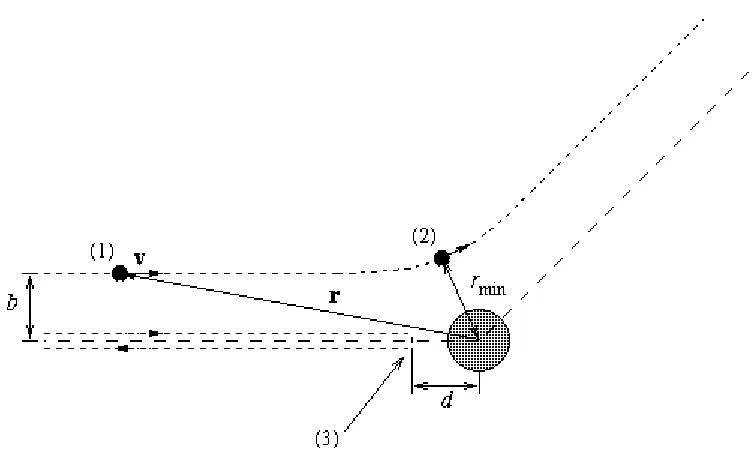
Figure 2.1 The trajectory of a particle undergoing Rutherford scattering, showing the impact parameter b, the minimum separation distance rmin, and the distance of closest approach d.
The geometry for Rutherford scattering can be seen in Figure (2.1). A charged
particle approaches the target nucleus along a trajectory that would pass a distance b from
the nucleus in the absence of the Coulomb force; this distance is known as the impact
parameter. Far from the nucleus at point (1), the incident particle has negligible Coulomb
potential energy, so all of its energy is accounted for in its kinetic energy
2 0 0
2 1
mv
E = , (2.6)
where m and v0 are the mass and initial velocity of the particle, respectively. At this point
the particle’s angular momentum relative to the nucleus is given by
b mv
m = 0
´ = r v
l , (2.7)
point (2). For a positively charged particle, the absolute minimum value for rmin occurs in
a head-on collision course (corresponding to b=0) at the point (3), when the particle
comes to rest and then changes direction. At this point, all of the initial kinetic energy of
the particle has been converted into Coulomb potential energy, so
d zZe mv 2 2 0 4 1 2 1 0 =
pe , (2.8)
where ze is the charge of the particle, Ze is the charge of the nucleus, and d is the distance
of closest approach as shown in Figure (2.1). This distance of closest approach
corresponds to the absolute minimum value for rmin.
Since the electron is interacting with a nucleus much more massive than itself,
and since this is an elastic scattering event, the magnitude of the electron’s momentum
before and after the event can be taken to be the same. Thus, if pI and pf are the initial
and final momentum of the electron, respectively, we have that pf = pi =mv0. The
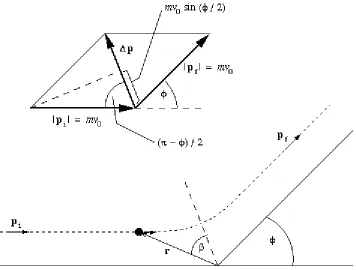
change in momentum vector shown in Figure (2.2) then has magnitude
2 sin 2mv0 f p=
D , (2.9)
where f is the scattering angle for the incident particle. Using Newton’s second law,
dt dp
F = , we can now write the net impulse of the Coulomb force in the direction of Dp
as dt r zZe dt F dp
p=
ò
=ò
=ò
D 2
0 2
4pe , (2.10)
Figure 2.2 The hyperbolic path of a particle undergoing Rutherford scattering. The coordinates of the particle at any given instant are r, b. The vector representing the change in momentum, Dp, bisects the angle in the upper figure with magnitude (p - f).
2 0
2
4 r
zZe F
pe
= (2.11)
is the Coulomb force between the nucleus and the incident particle. If we sum the
infinitesimal momentum vectors indicated in the first integral of Equation (2.10), only the
components of these vectors oriented along the direction of the angle bisector (dashed
line) in Figure (2.2) will contribute to Dp. Thus, we can write
dt r zZe
p=
ò
D 2
0 2 cos
4
b
where b is the angle between the bisector and the particle’s position vector r (see Figure
2.2). The integral in this expression should be evaluated over the temporal limits t =-¥
to t=¥, which correspond to the angular limits b =-(p -f) 2 to b =+(p -f) 2.
The instantaneous velocity vector v for the particle can be written in terms of
radial and tangential components as
β r
v ˆ ˆ
dt d r dt
dr + b
= , (2.13)
where rˆ and βˆ are the radial and tangential unit vectors, respectively. The instantaneous
angular momentum of the particle relative to the nucleus is therefore given by
dt d mr
m = 2 b
´ = r v
l . (2.14)
Since the initial angular momentum is just mv0b, conservation of angular momentum
gives
dt d mr b
mv 2 b
0 = , (2.15)
so that db b v r dt 0 2 1
= . (2.16)
Substituting this result into Equation (2.12) gives
( )
b b pe f p f pò
-+ - -=D (( ))//22 0
0 2
cos 1
4 v b d
zZe
p , (2.17)
which simplifies to
÷ ø ö ç è æ = D 2 cos
2 0 0
2 f
pe v b zZe
Now, combining this last result with Equations (2.8) and (2.9), we obtain the Rutherford
scattering formula:
d b 2 2 cot ÷=
ø ö ç è
æf . (2.19)
This formula relates the scattering angle, f, to the impact parameter, b, and the distance
of closest approach, d. Although this derivation assumes a positively charged particle in
defining the distance of closest approach, the general form of the Rutherford scattering
3
Modeling Electron Interactions With Solids
3.1
Assumptions of the Model
In modeling the interaction of an electron with a solid, the basic idea is to trace
the incident electron from one distinct scattering event to the next until it either leaves the
solid or loses all of its energy. The model must determine how the trajectory and energy
of the electron are affected at each event, and how far the electron will travel between
successive scattering events. In reality, each scattering event could be either elastic or
inelastic, so changes in the energy and trajectory of the electron should be computed
based on the specific sequence of scattering events experienced by the particular electron.
In practice, however, all scattering events are not equally important in terms of their
effect on the trajectory or energy of the electron. Therefore, we make two important
assumptions suggested by Joy (1995) in developing our model.
First, we assume that only elastic scattering events are important in determining
the path of an electron. Elastic scattering, which is described by the Rutherford scattering
formula, typically results in angular deflections in the range 5 to 10 degrees. Inelastic
scattering, on the other hand, causes the incident electron to lose energy to the solid, but
causes relatively little angular deflection. In fact, the angular deflection in an inelastic
scattering event is of the order DE E (that is, the ratio of energy loss, DE, to the energy
of the electron, E). An inelastic scattering event that results in a larger energy loss will
about 1/DE (Egerton, 1986). Since only a very small fraction of inelastic events produce
significant angular deflections, elastic scattering events dominate in determining the
spatial distribution of the interaction. Therefore, ignoring the trajectory-changing effects
of inelastic scattering produces little error.
We also assume that the electron loses energy continuously along its trajectory
rather than losing energy in discrete amounts through inelastic scattering events. While
this assumption is consistent with some energy-loss mechanisms, such as the production
of Bremsstrahlung by the slowing down of the incident electron through its interactions
with other electrons in the solid, most energy losses are associated with a specific event,
such as the production of an inner shell ionization. However, considering all energy
losses along the path of an incident electron collectively leads to a convenient and simple
expression that accounts for all energy-loss phenomena. This simplification is based on a
continuous slowing-down approximation and is attributed to Bethe (1930). Bethe showed
that the rate at which an electron loses energy to a solid could be expressed as
÷ ø ö ç è æ × -= J E AE ZN e ds
dE 2p 4 Arln g , (3.1)
where E is energy of the electron, s is the distance the electron has traveled, e is the
electron charge, and NA is Avogadro’s number. The quantities Z, A, and r are the atomic
number, atomic weight, and density of the solid, respectively, and J is the mean
ionization potential of the solid. The constant g in the logarithmic term has the value
A
ZNAr , which gives the number of electrons per unit volume in the solid. It makes
sense that the total number of inelastic collisions suffered by an incident electron, and
thus the stopping power of the target, should be proportional to this term. Most current
electron scattering models implement Bethe’s model of continuous energy loss in one
form or another.
At this point we can develop a “single scattering” model, in which we account for
all elastic scattering events experienced by an electron along its trajectory. Following this
approach, we would use a screened Rutherford elastic cross section to determine the
“mean free path” for the electron, which represents the average distance the electron will
travel between successive elastic scattering events. From the mean free path we would
calculate the distance traveled between one particular scattering event and the next using
Monte Carlo techniques. Such a model gives excellent results, but we can greatly reduce
the amount of computation required with insignificant loss of accuracy by using a “plural
scattering” model instead (Joy, 1995). A plural scattering model attempts to compute the
net effect produced by a number of successive scattering events at each step of the
simulation, and is best suited to problems that involve incident electrons traveling into a
bulk specimens (as opposed to thin film specimens).
3.2
Basic Plural Scattering Model
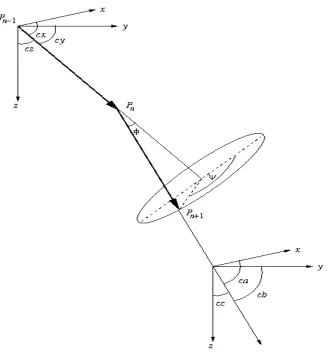
Figure (3.1) illustrates the geometry for an electron scattering simulation. Here,
traveled to Pn from a previous scattering event at Pn-1. The primary task of the model,
then, is to calculate the coordinates of the point Pn+1 to which the electron travels as a
result of the scattering event at Pn. When the electron arrives at Pn, we know its energy E,
and its trajectory as given by the direction cosines cx, cy, and cz. These direction cosines
are defined as the cosines of the angles between the velocity (trajectory) vector and the x,
y, and z axes. The x, y, and z axes are defined with the convention that the xy-plane
corresponds to the solid’s surface and the z-axis is directed into the solid.
In order to calculate the position of the new scattering point Pn+1, we first need to
determine the distance between Pn and Pn+1. Using Bethe’s continuous energy-loss
approximation we can determine the total distance (in cm) the electron will travel through
the material as
dE R E ds dE B
ò
ú ú û ù ê ê ë é-= 0 0 1 (3.2)where E0 is the initial energy of the incident electron, and (dE/ds) is the Bethe stopping
power given in Equation (3.1). Note, however, that substitution of the original Bethe
equation (3.1) into the integral in Equation (3.2) will result in a division by zero when the
argument of the logarithm term is identical to one. To remedy this we instead use a
modified version of the Bethe stopping power proposed by Joy and Luo (1989):
÷ ø ö ç è æ + × × -= J J E AE Z ds
dE 1.166( 0.85 )
ln 500
,
78 r (keV/cm). (3.3)
Also, rather than maintaining a table of values for the mean ionization potential, we can
approximate this quantity with good accuracy using a convenient relationship proposed
by Berger and Seltzer (1964):
3 19 . 0 10 5 . 58 76 .
9 ÷´
-ø ö ç è æ + = Z Z
J (keV). (3.4)
The Bethe range RB can now be divided into an arbitrary but sufficiently large number of
steps of equal length (Joy, 1995) to give the distance between one scattering event and
the next.
The stopping power can also be used to determine the energy of the electron at
ò
D - ÷ ø ö ç è æ -= n s n n ds ds dE EE 1 , (3.5)
where En-1 is the energy at Pn-1, Dsn is the path traveled between Pn-1 and Pn, and (dE/ds)
is the modified Bethe stopping power from Equation (3.3).
To determine the scattering angle, a randomized Rutherford-type scattering
formula can be applied to calculate a scattering angle for each event. One such scattering
formula suggested by Mykelbust et al. (1976) is given by
÷ ø ö ç è æ -= ÷ ø ö ç è
æ 1 1
2 tan L R E F
f , (3.6)
where f represents the scattering angle, E is the instantaneous energy of the electron (in
keV), and RL is a random number in the interval [0, 1]. The quantity F embodies the
parameters p and b in Equation (2.19), and is given by
0 0 0072 . 0 P ZE
F = , (3.7)
where
4 . 0 0 0.394 Z
P = × (3.8)
is a parameter that has been fitted to give the correct backscatter coefficient for a flat
specimen. Now, if we consider our random variable to be h =tan(f 2), then Equation
(3.6) corresponds to Equation (2.4) after it has been solved for h.
Since the electron can scatter (with equal probability) to any point on the base of
where RL is a new and independent random number in the interval [0, 1]. We now have
all the information (step length, scattering angle f, and azimuthal angle y) that we need
to relate Pn+1 to Pn.
3.3
Implementation Details
Before we summarize the complete plural scattering algorithm, we need to
provide some essential details required for the implementation. For instance, in order to
evaluate the integral expressions required by our plural scattering model, we will need to
incorporate some numerical integration techniques into our simulation package.
To evaluate the integral in Equation (3.2), for instance, we use a composite
Simpson’s rule numerical integration (Burden and Faires, 1993) as follows:
§ Define a function stop_pwr() based on Equation (3.3):
÷ ø ö ç è æ + × × = -= J J E AE Z ds dE E pwr
stop_ ( ) 78,500 r ln 1.166( 0.85 ) (3.10)
§ Define the integrand as
) ( _ 1 ) ( E pwr stop E
f = (3.11)
§ Choose an even number of subintervals, n, for the quadrature.
§ Define the width of each subinterval as
n E n E
h=( 0 -0) = 0 , (3.12)
where E0 and 0 are the two endpoints for the integral.
§ Set xj = jh for j =0,1,...,N (3.13)
§ Now the value of the Bethe range can be approximated as
ú ù ê é + + +
@ (0) 2(
å
2)-1 ( 2 ) 4å
2 ( 2 -1) ( 0)n n
j j
B f f x f x f E
h
The error for this approximation can be written as ) ( 180 ) 4 ( 4 0 h f m
E
Err= , (3.15)
where m is some particular value on the interval [0, E0].
For Equation (3.5), which is actually an initial value problem, we apply a fourth
order Runge-Kutta method (Burden and Faires, 1993). We want to approximate the
solution to
) ( _ )
(s stop pwr E
E¢ =- , 0£s£RB, E(0)=E0, (3.16)
at (N + 1) equally spaced numbers (s[i] for i = 0,1, …, N) in the interval [0, RB]. (Note
that s represents the distance the electron has traveled through the solid, RB represents the
Bethe range, and E0 is the initial energy of the electron.) The approximation to E(s) at
each s[i] will be assigned to E[i]. The Runge-Kutta method of order four can be
summarized as follows:
§ Set the step length to
N R
h= B (3.17)
§ The initial conditions are
0 ] 0
[ =
s , E[0]=E0 (3.18)
§ Fori = 1, 2, …, N do
§ Set ]) 1 [ ( _
1 =h×stop pwr E i
-V (3.19) ) 2 ] 1 [ ( _ 1
2 h stop pwr E i V
V = × - - (3.20)
) 2 ] 1 [ ( _ 2
3 h stop pwr E i V
V = × - - (3.21)
) ] 1 [ ( _ 3
4 h stop pwr E i V
(
1 2 2 2 3 4)
6 1 ] 1 [ ][i E i V V V V
E = - - + + + (3.23)
ih i
s[]= (3.24)
§ Endfor loop
Note that the local truncation error for a Runge-Kutta method of order four is O(h4).
Using this method, we can obtain an approximate value for the energy at each step of our
simulation. These energy values can, in turn, be used to calculate the scattering angle at
each step using Equation (3.7).
Now we are ready to summarize the steps involved in our basic plural scattering
simulation. The following pseudo code best describes the algorithm:
§ Initialize variables representing the properties of the solid: the atomic number Z, the atomic weight A, and the density r.
§ Initialize variables representing the properties of the electron: the initial
energy E0 and the initial trajectory c. The initial position can be set to
(
0,0,0)
=
x .
§ Set the number of steps for the electron trajectory simulation to N.
§ Calculate J according to Equation (3.4).
§ Calculate the Bethe range RB using Equations (3.10) – (3.14). § Set the step size for the simulation at step=RB N.
§ Calculate the scattering parameters P0 and F using Equations (3.7) and (3.8).
§ Fori = 1, 2, … Ndo
§ Generate a random number RL, then calculate f using Equation (3.6) with
E = E[i].
§ Generate another random number RL, then calculate y using Equation
§ Find a vector v that is orthogonal to c. We can easily accomplish this by letting v=c´xˆ. (On the rare occasion that c and x are perfectly parallel, we can let v=c´yˆ.)
§ Let cnew =c, then rotate cnew about v by f radians.
§ Rotate this cnew about c by y radians. This is the new trajectory vector. § Let xnew =x+step×cnew.
§ If i<N(if this was not the last step)
§ Reassign position and trajectory vectors: x¬xnew and c¬cnew.
§ Compute the energy for the next step, E[i], using E[i-1] and Equations (3.19) through (3.23).
§ Else (iºN)
§ Set E[N] = 0.
§ Go to end of for loop
§ End if-else statement
§ If xz <0 (if the electron has left the solid; i.e., if it has “backscattered”)
§ Go to end of for loop
§ End if statement
§ End for loop
§ Output exit trajectory cnew and exit energy E[i].
This plural scattering algorithm, which will henceforth be referred to as Scatter1,
is the basis for all of the electron trajectory simulation programs that we implemented. In
the next chapter, we describe the experiments we conducted using this code, and the
subsequent modifications that we made in order to improve the correlation between the
4
Comparisons With Experimental Data
4.1
Scatter1
Output vs. Experimental Data
As discussed previously, an incident electron will continue to propagate through a
solid, potentially undergoing thousands of scattering events, until it has either lost all of
its energy or it has left the target material as a backscattered electron. As the name
implies, backscattered electrons are those incident electrons that are scattered in the target
in such a way as to be collectible by some detector placed on the incident beam side of
the targeted material. The important values considered in this research are the backscatter
coefficient, which is the ratio of backscattered electrons to incident electrons, and the
energy and exit angle of the backscattered electrons.
Now that we have a working model, we can use it as discussed in Section 2.1 to
estimate probabilities related to our problem. In particular, we can use our plural
scattering algorithm Scatter1 to make an estimate of the backscatter coefficient h by
simulating a large number of electrons that enter a copper slab with normal incidence and
counting the number of electrons that are ejected. Since we have experimentally
measured values for h for several different values of incident energy (E0) in the range
3.93 to 41.0 keV (Hunger and Kuchler, 1979), we can run our simulations using these
same energy values and compare the resulting estimates of h with the experimental
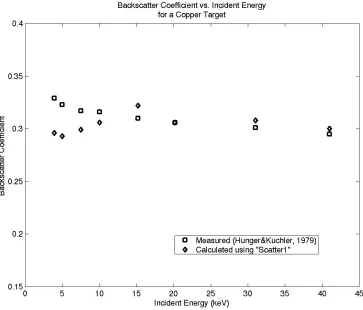
values. We performed this experiment for a copper target, using 1000 trajectory
between the measured values and the simulation values to be 4.6%. The results of this
experiment are displayed graphically in Figure (4.1).
Figure 4.1 A plot illustrating the variation of the backscatter coefficient, h, with the incident energy of the electron. Each “calculated” data point is based on 1000 simulations.
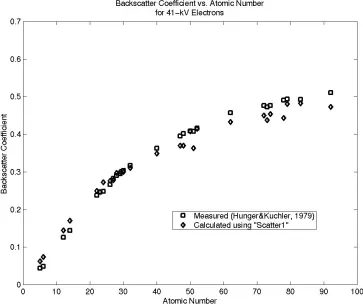
In a second experiment we used Scatter1 to predict the backscatter coefficient for
various different elements. For each data point in this experiment, we used 1000 41-keV
electrons and counted the number of electrons that were ejected. Again the results were
compared to the values measured by Hunger and Kuchler, but this time we found the
Figure 4.2 A plot illustrating the variation of the backscatter coefficient, h, with the atomic number of the target solid. Each “calculated” data point is based on 1000 simulations.
4.2
Development and Testing of
Scatter2
Seeking to improve upon the backscatter coefficient predictions generated with
Scatter1, we implemented a second scattering algorithm based on a slightly different
scattering formula. This scattering formula is an alternate version of the Rutherford
formula given in Equation (3.7) in which the scattering factor F is related to the
“minimum scattering angle” f0 by
0 0
2
tan E
F ÷×
ø ö ç è æ
÷ ø ö ç è æ -÷ ø ö ç è æ = ÷ ø ö ç è
æ 1 1
2 tan 2
tan 0 0
L
R E E
f
f . (4.2)
We can relate the minimum scattering angle to the backscatter coefficient, itself, as
suggested by Love et al. (1977) using a relation proposed by Joy (1996):
3 2
0 0.016697 0.55108 0.96777 1.8846
2
tan f ÷= + h- h + h
ø ö ç è
æ . (4.3)
Now, we just need an easy way to estimate what the backscatter coefficient should be so
we can use that value in evaluating our new scattering formula. In the same paper in
which Hunger and Kuchler present their experimental data on backscatter coefficients,
they propose an analytical expression that accomplishes just this. The formula predicts
the backscatter coefficient h (at normal beam incidence) using both the atomic number Z
and the incident energy E0:
), ( )
,
(Z E0 =E0m(Z)×C Z
h (4.4)
where
Z Z
m( )=0.1382-0.9211 (4.5)
and
3 2 0.01491(ln )
) (ln 1292 . 0 ln 2236 . 0 1904 . 0 )
(Z Z Z Z
C = - + - . (4.6)
Our second algorithm, which we call Scatter2, is essentially identical to Scatter1,
except that the quantity F is calculated using Equation (4.1) in conjunction with
Equations (4.3) through (4.6). Note that, as before, the quantity F only needs to be
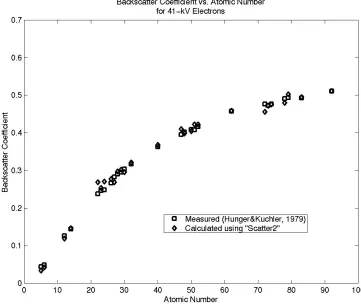
Figure 4.3 Another plot illustrating the variation of the backscatter coefficient, h, with the incident energy of the electron. This time, the data generated by both Scatter1 and Scatter2 are displayed.
We performed the first experiment described in Section 4.1 using Scatter2, and
again using 1000 trajectory simulations for each value of incident energy. This time we
found the average percent difference between the measured values and the simulation
values to be 2.48%, which represents a significant improvement over the results of
Scatter1. Figure (4.3) illustrates the results obtained for the backscatter coefficient vs.
incident energy experiments for both Scatter1 and Scatter2.
Scatter2 also outperforms Scatter1 for the backscatter coefficient vs. atomic
number experiment. In this case, the average percent difference between the simulation
comes from the first few data points, where the value of h is relatively small and the
value for percent difference can therefore become quite large. If we omit the first two
data points, which correspond to solids with atomic numbers less than 10, the average
percent difference becomes 3.34%. The results of this experiment are shown in Figure
(4.4).
Figure 4.4 A plot illustrating the variation of the backscatter coefficient, h, with the atomic number of the target solid. Each “calculated” data point is based on 1000 simulations.
predict other interesting quantities, however. For instance, while the Hunger-Kuchler
formula can only predict the backscatter coefficient for electrons entering a solid with
normal incidence, Scatter2 can predict the situtation for electrons entering the solid at any
angle.
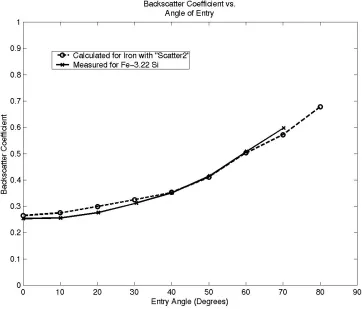
Myklebust et al. (1976) measured the backscatter coefficient as it varied with
specimen tilt for 30-keV electrons incident on an iron alloy containing 3.22% silicon.
Here, “tilt” refers to the angle through which the specimen surface is rotated relative to
the incident electron beam. A tilt of 0 degrees would correspond to normal incidence,
whereas a tilt of 90 degrees would correspond to grazing incidence.
So, we once again used Scatter2 to calculate backscatter coefficients, but this time
we simulated trajectories for 30-keV electrons using entry angles ranging from 0 to 80
degrees in 10-degree increments. As shown in Figure (4.5), the calculated backscatter
coefficients predict the experimentally measured values very well. In fact the percent
difference between the calculated values and the measured values is about 3.83%.
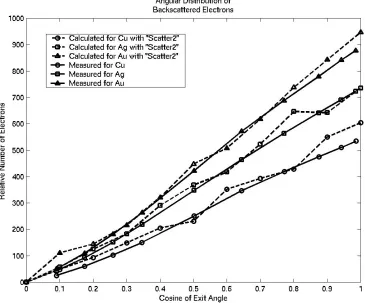
The Scatter2 program can also be used to predict exit angles for backscattered
electrons. Since we have some experimentally determined angular distributions for
electrons backscattered from copper, silver, and gold (Bishop, 1966), we calculated
angular distributions for these materials using Scatter2. Essentially, the procedure we
followed was to model 10,000 30-keV electrons for each type of target. We then
examined the trajectory of each backscattered electron, and calculated the cosine of the
angle q between this trajectory and the surface normal. Next, we set up 10 counting bins
corresponding to 10 equal divisions of the interval 0 to 1 (where 0 to 1 is the range of
possible cosine values). Finally, for each backscattered electron, we just incremented the
count in the bin corresponding to the value of cos(q). In order to compare this calculated
data with the measured data, we plotted the number of electrons in the bin corresponding
to 0.0£cos(q)£0.1 at the x-coordinate 0.1, and so on. Since the measured data provided
by Bishop only shows the relative electron counts (i.e., no scale is provided for the
electron count data), it was necessary to match the predicted curves to the measured
curves in a qualitative way. Figure (4.6) shows that the relative spacing and shapes of the
Figure 4.6 A plot illustrating the angular distribution of backscattered electrons. The data was measured by Bishop (1966) using 30-keV incident electrons.
Thus, Scatter2 does a reasonably good job of predicting backscatter coefficients
and angular distributions of backscattered electrons, but we also need to predict with
reasonable accuracy the energy distributions of backscattered electrons. Bishop made
some measurements of the “energy spectrum” dh
( )
q dW vs. W, where h( )
q is therelative number of backscattered electrons with exit angle q, and W is the ratio of the exit
energy to the incident energy of the electron; therefore, we constructed a simulation
experiment to derive an energy spectrum using Scatter2.
electron, and calculated the angle q between this trajectory and the surface normal.
Bishop examined backscattered electrons for which q = 45 degrees, so we considered
electrons for which 40£q £50. Next, we set up 10 counting bins corresponding to 10
equal divisions of the interval 0 to 1 (where 0 to 1 is the range of possible values for W).
For each backscattered electron, we just incremented the count in the bin corresponding
to the value of W. At this point, plotting the number of electrons in the bin corresponding
to 0.0£W £0.1 at the x-coordinate 0.1, and so on, would give a curve representing h vs.
W. However, we need a plot of dh/dW vs. W to compare with the measured data of
Bishop. To get such a curve, we used a three-point numerical differentiation rule (Burden
and Faires, 1993). Figure (4.7) shows the results of this experiment, and unfortunately it
Figure 4.7 A plot illustrating the energy spectrum of backscattered electrons. The values actually plotted are values of dh/dW vs. W, where h is the ratio of electrons ejected at 45 degrees (from the surface normal) to incident electrons, and W = E/E0. The data was measured by Bishop (1966) using 30-keV electrons.
4.3
Development and Testing of
Scatter3
,
Scatter4
, and
Scatter6
Since Myklebust et al. were able to improve their predictions of backscattered
electron energy distributions by using an energy-dependent variable step length in their
simulation algorithm, we attempted to incorporate this technique into our own algorithm.
The basic idea can be summarized as follows. Assuming a trajectory comprised of 60
steps of equal length, use a Runge-Kutta method as before to calculate the energy at each
corresponding to that step. This fraction was chosen because with it, the sum of 60
variable-length steps gives a total trajectory length that is approximately equal to the
original Bethe range (Myklebust et al., 1976).
Figure 4.8 A plot illustrating the variation of the backscatter coefficient, h, with the incident energy of the electron. Each “calculated” data point is based on 1000 simulations.
By incorporating this variable step length technique into Scatter2, we created a
new algorithm, which we called Scatter3. Unfortunately, Scatter3 performed terribly
when used to predict backscatter coefficients (see Figure 4.8). Upon closer examination
of the algorithm described by Myklebust et al. (the NBS code), we discovered that this
Equation 3.7), except that the scattering parameter P0 (compare with Equation 3.9) is
given by
4 . 0 0 0.263 Z
P = × . (4.7)
Apparently the enhancements featured in Scatter2 are not readily applicable to the NBS
code because of subtle differences such as this in corresponding parts of the two
algorithms.
Still hoping to improve our predictions for backscattered electron energy
distributions, we made the variable step length modifications to Scatter1. Then, after
making the appropriate change to the scattering parameter P0 by replacing Equation (3.9)
with Equation (4.7), we named this new algorithm Scatter4.
We also created an algorithm that uses the average energy between steps for the
scattering formula calculation. That is, at step i, this algorithm uses the value
2 ] 1 [ ]
[ + +
= E i E i
E (4.8)
in evaluating the scattering formula (Equation 3.7). This modification was made based on
the suggestion of Myklebust et al. (1976) to use the midpoint energy at each step. Finding
the midpoint energy would require doubling the number of steps in the Runge-Kutta
subroutine. Finding the mean energy, it was decided, would give a comparable value but
would require significantly less computation. This algorithm, which is otherwise identical
to Scatter4, we called Scatter6.
Scatter4 and Scatter6 both outperform the previous algorithms in predicting the
closely match those of the experimentally measured energy spectrums. The magnitudes
of the calculated curves (for Scatter4 and Scatter6) show significant (but approximately
equal) deviation from the measured curves, but the estimated errors for the experimental
values themselves are of the order of 10% (Bishop, 1966).
Figure 4.9 A plot illustrating the energy spectrum of electrons backscattered from copper. The values actually plotted are values of dh/dW vs. W, where h is the ratio of electrons ejected at 45 degrees (from the surface normal) to incident electrons, and W = E/E0. The data was measured by Bishop (1966) using
Figure 4.10 A plot illustrating the energy spectrum of electrons backscattered from silver. The values actually plotted are values of dh/dW vs. W, where h is the ratio of electrons ejected at 45 degrees (from the surface normal) to incident electrons, and W = E/E0. The data was measured by Bishop (1966) using
Figure 4.11 A plot illustrating the energy spectrum of electrons backscattered from gold. The values actually plotted are values of dh/dW vs. W, where h is the ratio of electrons ejected at 45 degrees (from the surface normal) to incident electrons, and W = E/E0. The data was measured by Bishop (1966) using
30-keV electrons.
As for predictions of the backscatter coefficient, Scatter4 and Scatter6 both fall
somewhat behind the capabilities of Scatter2. When applied to the problem of predicting
the backscatter coefficient from copper at various incident energies, the average percent
difference between Scatter4 data and measured data is 5.72% (see Figure 4.12).
However, the average percent difference between Scatter6 data and measured data for
this experiment is 2.92% (see Figure 4.13). Thus, Scatter6 nearly matches the accuracy of
Figure 4.13 A plot illustrating the variation of the backscatter coefficient, h, with the incident energy of the electron. Each “calculated” data point is based on 1000 simulations.
When applied to the problem of predicting the backscatter coefficient for 41-keV
electrons incident on various elements, Scatter6 again performs better than Scatter4, but
both of these new algorithm again fall behind Scatter2. The average percent difference
between Scatter4 and the measured data is 10.97% (see Figure 4.14), while the average
percent difference between Scatter6 and the measured data is 9.02% (Figure 4.15).
Again, much of this error is attributed to the first two data points, which have small
magnitude. If we eliminate these two data points from our percent difference calculation,
Figure 4.15 A plot illustrating the variation of the backscatter coefficient, h, with the atomic number of the target solid. Each “calculated” data point is based on 1000 simulations.
Next, we used Scatter4 and Scatter6 to predict the backscatter coefficient of
30-keV electrons incident on copper at various angles. As seen in Figure (4.16), both of the
curves constructed from the predicted data have the correct shape, but both have slightly
less accurate values for the magnitudes of the backscatter coefficients compared to
Scatter2. In fact the average percent difference between the calculated and measured
backscatter coefficients in this case is about 8.83% for Scatter4 and about 7.92% for
Figure 4.16 A plot illustrating the variation of the backscatter coefficient, h, with the incident angle of the electron. Each “calculated” data point is based on 1000 simulations of 30-keV electrons. The measured data comes from Myklebust et al. (1976).
Finally, we used Scatter4 and Scatter6 to predict the exit angles of electrons
backscattered from copper, silver, and gold. Both do a reasonable job of predicting the
angular distributions, but as is the case with Scatter2, it is difficult to compare the data
from the predictions with the measured data because explicit information about the
scaling of the data is not available in the reference. However, it is clear from Figures
(4.17) and (4.18) that the relative magnitudes and shapes of the calculated distribution
Figure 4.18 A plot illustrating the angular distribution of backscattered electrons. The data was measured by Bishop (1966) using 30-keV incident electrons.
4.4
Concluding Remarks
In an attempt to produce a single algorithm capable of predicting all of the desired
qualities of backscattered electrons, several other algorithms were developed and tested.
Some of these (Scatter7 and Scatter8) were based on the NBS strategy of using the
mid-point energy along each step for the scattering formula calculations (Myklebust et al.,
1976). Others (Scatter5) attempted to reconcile the discrepancies seen in the data
generated by Scatter3 by adjusting coefficients in the scattering formula. Unfortunately,
Scatter2 and Scatter4. Out of all the algorithms we implemented Scatter6 comes closest
to being an all-purpose algorithm, as it predicts values within about 8% of most of the
5
Conclusions and Future Plans
As pointed out by Joy (1996), it is “an apparently irresistible temptation in Monte
Carlo modeling” to implement an all-purpose computer program that can answer any
question about any effect related to a given phenomenon. Unfortunately, in the case of
the electron backscattering problem, this proves to be all but impossible. With the
Scatter2 algorithm, we can calculate with excellent accuracy backscatter coefficients and
angular distributions, but we fail completely to predict the energy spectra seen in
experiments. With the Scatter4 algorithm, we can get much better predictions of energy
spectra, but the accuracy of our backscatter coefficient estimates declines. Scatter6 does
not predict the shapes of the energy spectra as well as Scatter4, and does not predict
backscatter coefficient data as well as Scatter2, but it seems to be the best “all-around”
algorithm in the sense that it minimizes the total error if we consider all the experiments
together. Thus, it would seem that Joy’s synopsis is correct: “A Monte Carlo model is
most efficient and effective when it is constructed as a special tool to solve a particular
[specific] problem.”
Concurrent with the research presented in this thesis, a California-based company
called Calabazas Creek Research (CCR) has been working on a general-purpose charged
particle modeling code that is based on adaptive meshing and a finite element approach to
solving the Maxwell equations. This code models the movement of charged particles
(typically electrons) through user-specified fields and physical geometries, and calculates
collisions with surfaces contained in the model. In particular, the model needs to account
for the so-called “secondary emission” that results from the interaction of electrons with
surfaces. The research presented in this thesis was actually conducted with this particular
application in mind.
Since most energetic secondary electrons are actually backscattered primary
electrons (rather than “true” secondary electrons), we focused our efforts on predicting
the behavior of backscattered electrons. As discussed in the preceeding chapters of this
thesis, such predictions can be accomplished by simulating the trajectories of electrons as
they enter and move through a solid, and examining those electrons that happen to exit,
or backscatter, from the solid. The next logical step for this research process is to develop
and implement a subroutine for the CCR code that is based on the algorithms discussed in
this thesis. This subroutine should take as input all the electron data structures that are
incident upon surfaces within the model at a given instant, and return as output a new set
Bibliography
Berger, M.J., and Seltzer, S.M. Studies in Penetration of Charged Particles in Matter. Nuclear Science Series Report #39, NAS-NRC Publication 1133 (Natl. Acad. Sci.: Washington, D.C.), p. 205, 1964.
Bethe, H.A. “Zur Theorie des Durchgangs Schneller Korpuskularstrahlen durch Materie.” Annalen der Physik 5:5, pp. 325-400, 1930.
Bishop, H.E. “Some Electron Backscattering Measurements for Solid Targets.” International Symposium on X-ray Optics and X-ray Microanalysis (4th: 1965: Orsay, France), 153-8, 1966.
Burden, Richard L., and Faires, J.Douglas. Numerical Analysis. 5th Ed. PWS Publishing Co., Boston, 1993.
Egerton, R.F. Electron Energy –Loss Spectroscopy in the Electron Microscope. New
York: Plenum Press, 1986.
Hammersley, J.M., and Handscomb, D.C. Monte Carlo Methods. New York: Wiley,
1964.
Hunger, H.-J., and Kuchler, L. “Measurements of the Electron Backscattering Coefficient
for Quantitative EPMA in the Energy Range of 4 to 40 keV.” Physica Status
Solidi (a) 56, K45-48, 1979.
Joy, David C. Monte Carlo Methods for Electron Microscopy and Microanalysis. New
York: Oxford UP, 1995.
Joy, D.C., and Luo, S. “An Empirical Stopping Power Relationship for Low-Energy Electrons.” Scanning, Vol. 11, 176-180, 1989.
Krane, Kenneth S. Introductory Nuclear Physics. New York: Wiley, 1988.
Larson, Harold J. Introduction to Probability Theory and Statistical Inference. New York: Wiley, 1982.
Love, G., Cox, M.G.C., and Scott, V.D. “A Simple Monte Carlo Method for Simulating Electron-Solid Interactions and its Application to Electron Probe Microanalysis.” Journal of Physics D: Applied Physics 10:1, pp. 7-23, 1977.
Myklebust, Robert L., Newbury, Dale E., and Yakowitz, Harvey. “NBS Monte Carlo
Electron Trajectory Calculation Program” (1976) in Use of Monte Carlo
Calculations in Electron Probe Microanalysis and Scanning Electron