ISSN(Online): 2319-8753 ISSN (Print): 2347-6710
I
nternational
J
ournal of
I
nnovative
R
esearch in
S
cience,
E
ngineering and
T
echnology
(An ISO 3297: 2007 Certified Organization)
Website: www.ijirset.com
Vol. 6, Issue 8, August 2017
Evaluation of Subbase layer Performance on
Design Life of Flexible Pavement
Dr. Ahmed S. D. AL-Ridha
1, Sinan K. Ibrahim
2Assistant Professor, Department of Civil Engineering, College of Engineering, Al-Mustansiriya
University, Baghdad, Iraq1
Assistant Lecturer, Department of Highway and Transportation Engineering, College of Engineering, Al-Mustansiriya
University Baghdad, Iraq2
Abstract
Assessment of Performance for Subbase course on Design Life was outlighted in this paper. The research consisted of studying the effect of variation of subbase layer depths (12", 14" ,16"), resilient modulus (30 ,35 ,40) Ksi and number of load repetitions(10000, 15000 , 20000) on the design life of flexible pavement subbase by using KENPAVE software. It was found that the percentage of increasing the design life of pavement results from increasing subbase layer thickness was increased with the increasing the resilient modulus, and the percentage of increasing the design life of pavement results from increasing subbase resilient modulus was increased with the increasing of thickness layer. but the repeated load has no effect on the percentage of increasing the design life of pavement when that thickness of subbase layer and resilient modulus is increased. The design life of pavement increased, with increasing subbase layer thickness for variable resilient modulus and layer thicknesses.
Keyword: design life of flexible pavement, subbase layer, repetition of load, Kenpave program.
1. Introduction
In the latest years, the maximum allowable gross vehicle weights and axle loads were raised. This enhance the allowable gross vehicle weight and led to more than proportional raise in the deterioration of pavement environment (Luskin and Walton 2001). The mechanistic – empirical design method mixed the elements of mechanistic modeling and performance models in calculating the required pavement depth for a set of design conditions. A performance model which is a set of laboratory based models is used to forecast the performance of pavement in terms of physical distresses such as rutting and fatigue during the design life (Ibrahim , 2010). Effective properties of pavement materials are a solution requirement for a good design. To be efficient and useful for pavement design, characterization should be based on material properties that correctly capture the material response to external stimulus of traffic loading as subjective by erection quality and environmental conditions. The proposed AASHTO guide is mechanistic-empirical in nature and advocates the use of a number of mechanical properties such as the resilient modulus of unbound materials, which contain granular materials and local soils (Zaghloul, 1993).
2. Objective of the Study
The main objective of this research was studying the effect of variation of subbase layer thickness(12", 14" ,16") , Resilient Modulus (30 ,35 ,40 ) ksi and number of load repetitions(10000, 15000 , 20000) on the design life of flexible pavement, also studied the relationships among those parameters. This objective was done by using KENPAVE program that analysis an example about flexible pavement when these variables were considered.
3. KENPAVE Distress Models
ISSN(Online): 2319-8753 ISSN (Print): 2347-6710
I
nternational
J
ournal of
I
nnovative
R
esearch in
S
cience,
E
ngineering and
T
echnology
(An ISO 3297: 2007 Certified Organization)
Website: www.ijirset.com
Vol. 6, Issue 8, August 2017
These models could be used to forecast the design life of new flexible pavement with assuming pavement pattern and if the reliability for a certain distress is less than the minimum level necessary, the assumed pavement pattern should be changed (Huang, 2004).
3.1 Fatigue Cracking Models
Miner’s cumulative damage theory has been widely used to forecast fatigue cracking (Miner , 1945). It is commonly approved that the allowable number of load repetitions is related to the tensile strain at the lower of the asphalt layer. The amount of damage is expressed as a damage ratio, which is the relation between predicted and allowable number of load repetitions. The damage occurs when the total of damage ratio reaches to one.
The main difference in the various design methods is the transfer formulas that transmit the HMA tensile strains to the allowable amount of load repetitions. The allowable amount of load repetitions (Nf) could be calculated by using
Equation 1. Nf= f1 (Ɛt )
-f2
(E)-f3 ...(1) where
tis tensile strain at the lower of HMA, E is modulus of elasticity of HMA and
f1, f2 and f3are constants calculated by calibration.
3.2 Rutting Models
Rutting models are used to estimated the normal compressive strain on the upper of the subgrade and are extensively used. The allowable amount of load repetitions (Nd) is related to the normal compressive strain (c) on upper of the
subgrade by Equation 2:
Ndf c)- f5 ... (2)
where f4 and f5are calibrated values using forecast performance and field inspection.
In the subgrade strain technique, it is assumed that if the subgrade compressive strain is restricted, logical surface rut depths will not be exceeded. Unless standard depth and materials are used for design, the assessment of surface rutting that based on the subgrade strain does not appear to be logical (Gedafa , 2006).
4. Methodology
This work studies the effect of subbase layer thickness, resilient modulus and amount of load repetitions for flexible pavement on the design life of pavement, this was achieved by using KENPAVE program. the example that applied in this program was assumed a flexible pavement with four layers (surface , base , subbase , subgrade) and subject to repeated load produced from one load group. this load group represented in single axle - dual tire load with (6")contact tire radius and (60 )psi contact tire pressure.
5. Application of KENPAVE Program
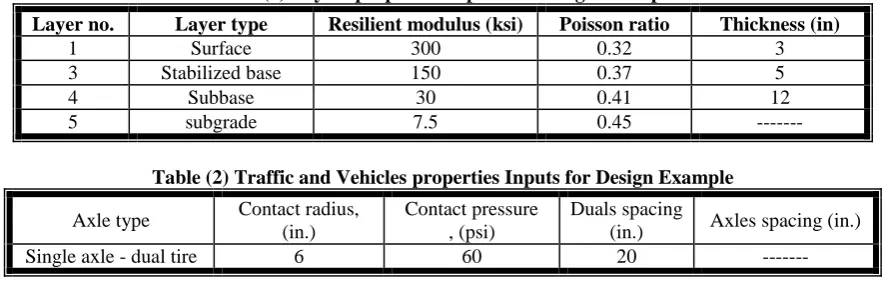
Tables (1), (2) represent the inputs data for the example of flexible pavement used to achieve the objective of this study.
Table (1) Layers properties Inputs for Design Example
Layer no. Layer type Resilient modulus (ksi) Poisson ratio Thickness (in)
1 Surface 300 0.32 3
3 Stabilized base 150 0.37 5
4 Subbase 30 0.41 12
5 subgrade 7.5 0.45 ---
Table (2) Traffic and Vehicles properties Inputs for Design Example
Axle type Contact radius, (in.)
Contact pressure , (psi)
Duals spacing
(in.) Axles spacing (in.)
ISSN(Online): 2319-8753 ISSN (Print): 2347-6710
I
nternational
J
ournal of
I
nnovative
R
esearch in
S
cience,
E
ngineering and
T
echnology
(An ISO 3297: 2007 Certified Organization)
Website: www.ijirset.com
Vol. 6, Issue 8, August 2017
6. Results and Discussions
6-1 Effect of Subbase Thickness on Design Life of pavement with Variable Resilient Modulus
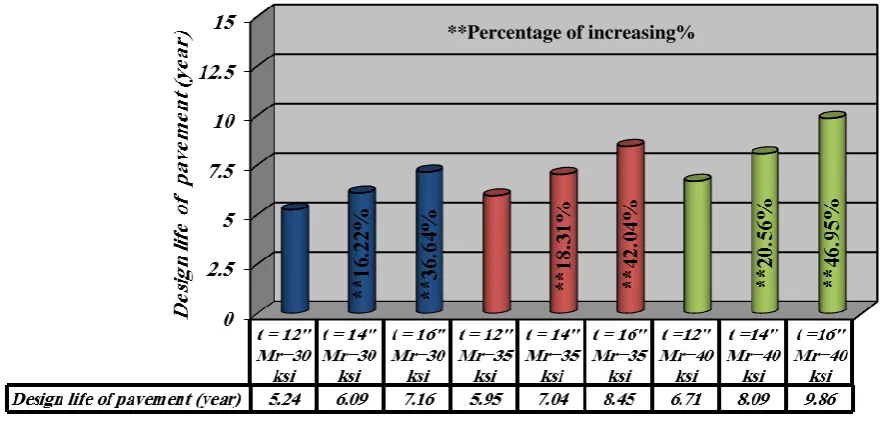
The results of analysis of design example that assumed in this study by using KENPAVE program were illustrated in the following figures. Figures (1, 2, 3) show that, when the thickness of subbase layer increased, the design life of pavement was increased for resilient modulus (30, 35, 40) ksi. Figures (4, 5, 6) illustrated that, the percentage of increasing in design life of pavement results from increases thickness of subbase layer, increased with increasing resilient modulus. The same trend was obtained for all repeated load (10000, 15000, 20000).
Figure (1) Effect of Subbase Thickness on Design Life of pavement with Variable Resilient Modulus (repeated load= 10000 repetition)
**Percentage of increasing%
**Percentage of increasing%
ISSN(Online): 2319-8753 ISSN (Print): 2347-6710
I
nternational
J
ournal of
I
nnovative
R
esearch in
S
cience,
E
ngineering and
T
echnology
(An ISO 3297: 2007 Certified Organization)
Website: www.ijirset.com
Vol. 6, Issue 8, August 2017
0
10
20
30
40
50
t = 14" Mr=30ksi
t = 16" Mr=30ksi
t = 14" Mr=35ksi
t = 16" Mr=35ksi
t = 14" Mr=40ksi
t = 16" Mr=40ksi
Percentage of increasing% 16.16 36.77 18.39 42.04 20.46 46.87
Percent
age
of
i
ncreas
ing
%
Figure (3) Effect of Subbase Thickness on Design Life of pavement with Variable Resilient Modulus (repeated load= 20000 repetition)
Figure (4) Percentage of increasing design life of pavement resultant from increasing thickness of subbase layer, with variable resilient modulus (repeated load= 10000 repetition)
**Percentage of increasing%
*9.13
yea
r
*10.75 ye
ar
*6.09 yea
r
*7.16 yea
r
*4.57 yea
r
*5.37 yea
r
ISSN(Online): 2319-8753 ISSN (Print): 2347-6710
I
nternational
J
ournal of
I
nnovative
R
esearch in
S
cience,
E
ngineering and
T
echnology
(An ISO 3297: 2007 Certified Organization)
Website: www.ijirset.com
Vol. 6, Issue 8, August 2017
0
10
20
30
40
50
t = 14" Mr=30ksi
t = 16" Mr=30ksi
t = 14" Mr=35ksi
t = 16" Mr=35ksi
t = 14" Mr=40ksi
t = 16" Mr=40ksi
Percentage of increasing% 16.22 36.64 18.32 42.02 20.46 46.87
Perc
ent
age
of
i
ncr
eas
ing%
0
10
20
30
40
50
t = 14" Mr=30ksi
t = 16" Mr=30ksi
t = 14" Mr=35ksi
t = 16" Mr=35ksi
t = 14" Mr=40ksi
t = 16" Mr=40ksi
Percentage of increasing% 16.29 36.64 18.39 42.04 20.44 46.63
Percent
age
of
i
ncreas
ing
%
Figure (5) Percentage of increasing design life of pavement resultant from increasing thickness of subbase layer, with variable resilient modulus (repeated load= 15000 repetition)
Figure (6) Percentage of increasing design life of pavement resultant from increasing thickness of subbase layer, with variable resilient modulus (repeated load= 20000 repetition)
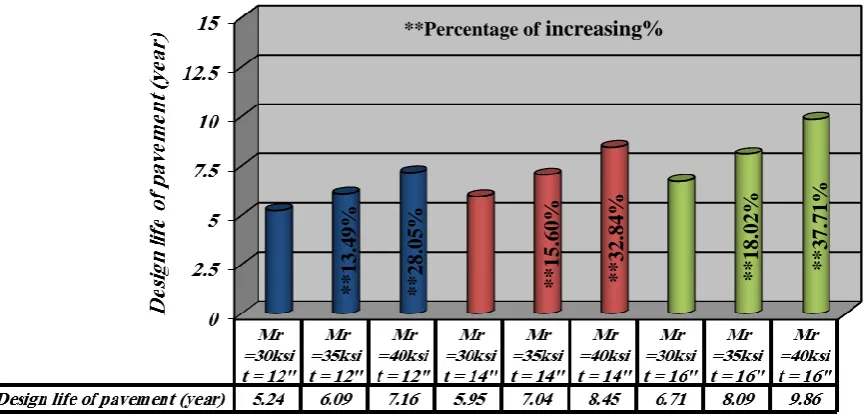
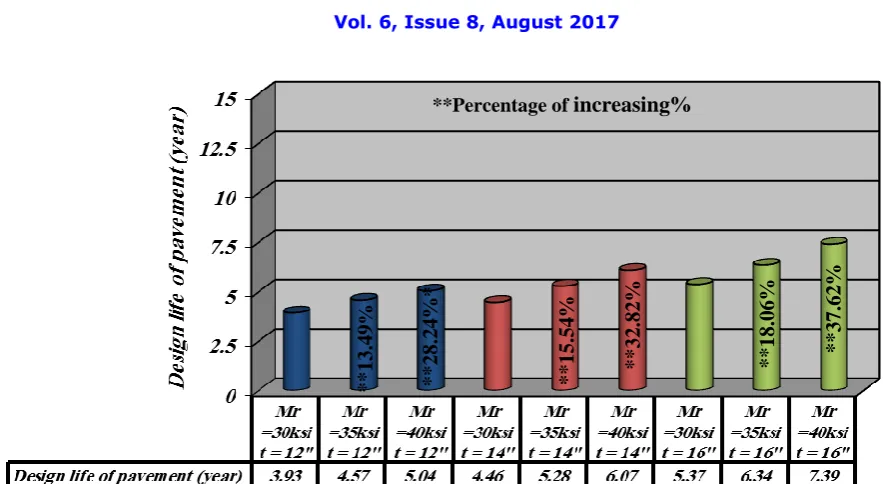
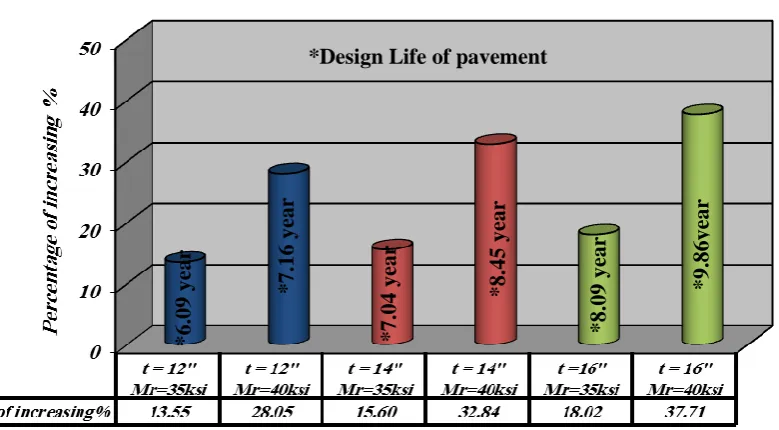
6-2- Effect of Resilient Modulus for Subbase Layer on Design Life of pavement with Variable thickness of layer Figures (7, 8, 9) show that, when the resilient modulus of subbase layer increased, the design life of pavement was increased for thickness (12 , 14, 16) inch. Figures (10, 11, 12) illustrated that, the percentage of increasing the design life of pavement results from increasing the resilient modulus of subbase layer, increased with the increasing of subbase layer thickness. The same trend was obtained for all load repetition (10000, 15000, 20000).
*6.09 yea
r
*7.16 yea
r
*7.04 yea
r
*8.45 yea
r
*8.09 yea
r
*9.86 yea
r
*Design Life of pavement
*Design Life of pavement
ISSN(Online): 2319-8753 ISSN (Print): 2347-6710
I
nternational
J
ournal of
I
nnovative
R
esearch in
S
cience,
E
ngineering and
T
echnology
(An ISO 3297: 2007 Certified Organization)
Website: www.ijirset.com
Vol. 6, Issue 8, August 2017
Figure (7) Effect of Resilient Modulus for Subbase Layer on Design Life of pavement with Variable layer thickness (repeated load= 10000 repetition)
Figure (8) Effect of Resilient Modulus for Subbase Layer on Design Life of pavement with Variable layer thickness (repeated load= 15000 repetition)
**13.4
9%
**15.6
6%
**32.8
6%
*
**17.8
0%
**37.7
6%
*7
**28.1
2%
**13.4
9%
**28.0
5%
**15.6
0%
**32.8
4%
**18.0
2%
**37.7
1%
**Percentage of
increasing%
**13.4
9%
ISSN(Online): 2319-8753 ISSN (Print): 2347-6710
I
nternational
J
ournal of
I
nnovative
R
esearch in
S
cience,
E
ngineering and
T
echnology
(An ISO 3297: 2007 Certified Organization)
Website: www.ijirset.com
Vol. 6, Issue 8, August 2017
**13.4
9
%
**28.2
4%
*
**15.5
4%
**32.8
2%
**18.0
6%
**37.6
2%
**Percentage of
increasing%
**Percentage of increasing%
Figure (9) Effect of Resilient Modulus for Subbase Layer on Design Life of pavement with Variable layer thickness (repeated load= 20000 repetition)
Figure(10) Percentage of increasing design life of pavement resultant from increasing Resilient Modulus of subbase layer, with variable thickness layer(repeated load= 10000 repetition)
*Design Life of pavement
*
8
.9
2
y
ea
r
*10.07 ye
ar
*
1
0
.5
6
y
ea
r
*12.13 ye
ar
*12.67 ye
ar
*14.76 ye
ISSN(Online): 2319-8753 ISSN (Print): 2347-6710
I
nternational
J
ournal of
I
nnovative
R
esearch in
S
cience,
E
ngineering and
T
echnology
(An ISO 3297: 2007 Certified Organization)
Website: www.ijirset.com
Vol. 6, Issue 8, August 2017
Figure(11) Percentage of increasing design life of pavement resultant from increasing Resilient Modulus of subbase layer, with variable thickness layer (repeated load= 15000 repetition)
Figure (12) Percentage of increasing design life of pavement resultant from increasing Resilient Modulus of subbase layer, with variable thickness layer (repeated load= 20000 repetition)
*Design Life of pavement
*6.09 yea
r
*7.16 yea
r
*7.04 yea
r
*8.45 yea
r
*8.0
9
yea
r
*9.86yea
r
*4.46
49
%
*5.04 yea
r
*5.28 yea
r
*6.07 yea
r
*6.34 yea
r
*7.39 yea
r
ISSN(Online): 2319-8753 ISSN (Print): 2347-6710
I
nternational
J
ournal of
I
nnovative
R
esearch in
S
cience,
E
ngineering and
T
echnology
(An ISO 3297: 2007 Certified Organization)
Website: www.ijirset.com
Vol. 6, Issue 8, August 2017
VII. CONCLUSIONS
The following conclusions was obtained from this study:
a-The design life of pavement increases with the increasing subbase layer thickness for variable resilient modulus. b-The design life of pavement increases with the increasing subbase resilient modulus for variable layer thickness. c-The percentage of increases of design life of pavement results from increases subbase layer thickness was increased with the increasing resilient modulus.
d-The percentage of increasing the design life of pavement results from increased subbase resilient modulus was increased with the increasing thickness layer.
e-The repeated load has no effect on the percentage of increasing the design life of pavement when thickness of subbase layer and resilient modulus was increased.
REFERENCES
- Asphalt Institute (AI). Thickness Design —Asphalt Pavement for Highways and Streets. Manual Series No. 1 (MS-1), Lexington, 1981.
- Gedafa Daba S., (2006)"Comparison Of Flexible Pavement Performance Using Kenlayer And Hdm-4",Midwest Transportation Consortium, Ames, Iowa.
- Huang, Y.H. Pavement Analysis and Design. 2nd Edition, New Jersey, Prentice Hall, 2004.
- Ibrahim Sinan K. (2010) " Mechanistic-Empirical Approach For Structural Design Of Flexible Pavements Using Matlab" University of Baghdad, Iraq.
- Luskin, D.M. and C.M. Walton, “Effects of Truck Size and Weights on Highway Infrastructure and Operations: A Synthesis Report,” Research Report 2122-1, March 2001.
- Miner, M.A.Cumulative Damage in Fatigue, ” Transactions of the ASME, Vol.67, 1945, pp. A159-A164.