DOI: 10.1534/genetics.108.092577
A Genomewide Suppressor and Enhancer Analysis of
cdc13-1
Reveals
Varied Cellular Processes Influencing Telomere Capping in
Saccharomyces cerevisiae
S. G. Addinall,* M. Downey,
†,‡M. Yu,* M. K. Zubko,*
,1J. Dewar,* A. Leake,* J. Hallinan,*
,§O. Shaw,*
,§K. James,*
,§D. J. Wilkinson,*
,** A. Wipat,*
,§D. Durocher
†,‡and D. Lydall*
,2*Centre for Integrated Systems Biology of Ageing and Nutrition, Ageing Research Laboratories, Institute for Ageing and Health, Newcastle University, Campus for Ageing and Vitality, Newcastle upon Tyne NE4 5PL, United Kingdom,†Samuel Lunenfeld Research Institute,
Toronto, Ontario M5G 1X5, Canada,‡Department of Molecular Genetics, University of Toronto, Ontario M5S 1A8, Canada,
**School of Mathematics and Statistics, Newcastle University, Newcastle upon Tyne NE1 7RU, United Kingdom and §
School of Computing Science, Newcastle University, Newcastle upon Tyne NE1 7RU, United Kingdom
Manuscript received June 11, 2008 Accepted for publication September 25, 2008
ABSTRACT
InSaccharomyces cerevisiae, Cdc13 binds telomeric DNA to recruit telomerase and to ‘‘cap’’ chromosome ends. In temperature-sensitivecdc13-1mutants telomeric DNA is degraded and cell-cycle progression is inhibited. To identify novel proteins and pathways that cap telomeres, or that respond to uncapped telomeres, we combinedcdc13-1with the yeast gene deletion collection and used high-throughput spot-test assays to measure growth. We identified 369 gene deletions, in eight different phenotypic classes, that reproducibly demonstrated subtle genetic interactions with thecdc13-1mutation. As expected, we identified DNA damage checkpoint, nonsense-mediated decay and telomerase components in our screen. However, we also identified genes affecting casein kinase II activity, cell polarity, mRNA degradation, mitochondrial function, phosphate transport, iron transport, protein degradation, and other functions. We also identified a number of genes of previously unknown function that we termRTC, forrestriction oftelomerecapping, or
MTC, formaintenance oftelomerecapping. It seems likely that many of the newly identified pathways/ processes that affect growth of budding yeastcdc13-1mutants will play evolutionarily conserved roles at telomeres. The high-throughput spot-testing approach that we describe is generally applicable and could aid in understanding other aspects of eukaryotic cell biology.
L
INEAR chromosomes are a feature of all eukaryotes. The single-celled model eukaryote Saccharomyces cerevisiae, for example, has 16 linear chromosomes with ends that are, in principle, no different from double-stranded breaks elsewhere in the genome. However, whereasS. cerevisiaecells can tolerate 32 or more chro-mosome ends throughout its cell cycle, a single double-stranded DNA break (DSB) elsewhere in the genome elicits a swift and precise response (Sandelland Zakian 1993). This response includes checkpoint activation, which leads to cell-cycle arrest prior to repair of the break. The difference between DSBs and chromsosome ends, then, comes down to specific nucleoprotein com-plexes that occupy the ends of chromosomes to form a structure referred to as a telomere (Longhese2008).A further issue at the ends of chromosomes is the inability of semi-conservative DNA replication to reach the
very ends of linear double-stranded DNA molecules—the ‘‘end replication problem’’ (Olovnikov1973). Telomer-ase (Greiderand Blackburn1985), a telomere-specific reverse-transcriptase complex, solves this problem by adding G-rich repeat sequences to the 39-end of chromo-somes, using a bound RNA molecule as a template. As a result, eukaryotic chromosomes have long stretches of TG repeats at their ends. These sequences serve as a binding platform for proteins involved in end pro-tection and telomerase recruitment.
The length of telomere repeat sequences in growing and dividing cells depends on a balance between short-ening, due to the end replication problem, and length-ening, due to the actions of telomerase. Should the length of telomere repeat sequences fall below a critical level, budding yeast and mammalian cells stop dividing in a checkpoint-dependent process referred to as senes-cence (Reaperet al.2004). In rare instances, cells can evade this fate by employing telomerase-independent, recombination-based pathways for maintaining a func-tional number of TG repeats at the ends of chromo-somes. In cells that lack telomerase—as is the case for the majority of human somatic cells—telomere length reduces with each cellular division until senescence is
1Present address: School of Biology, Chemistry and Health Science,
Manchester Metropolitan University, John Dalton Bldg., Manchester M1 5GD, United Kingdom.
2Corresponding author:Centre for Integrated Systems Biology of Ageing
and Nutrition, Ageing Research Laboratories, Institute for Ageing and Health, Newcastle University, Campus for Ageing and Vitality, Newcastle upon Tyne NE4 5PL, United Kingdom. E-mail: [email protected]
induced at a critical length. This is considered to serve as a mechanism for determining a finite cellular life span, and thus the link between telomeres, cancer, and aging has been of wide interest (Blasco2007; Cheungand Deng 2008). A fuller understanding of telomere ho-meostasis is therefore an important goal, critical for understanding cellular senescence and the mechanisms by which the response to DNA damage is appropriately regulated and/or limited in eukaryotic cells.S. cerevisiae provides an excellent model in which to carry out such studies.
In S. cerevisiae, Cdc13 is a single-stranded DNA (ssDNA)-binding protein that binds to short ssDNA overhangs at telomeres and plays at least two important roles at telomeres: (1) recruitment of telomerase (Nugent et al.1996) and (2) telomere capping (Garviket al.1995). Thecdc13-1point mutation confers temperature sensitivity such that Cdc13-1 is proficient in telomere capping at the permissive temperature (23°) but deficient at the non-permissive temperature (.26°). Thus, incdc13-1mutant cells grown at$26°, telomeres become ‘‘uncapped’’ and recognized as sites of DNA damage, eliciting a checkpoint response (Garvik et al. 1995). Once uncapped, the telomeres are vulnerable to 59–39 exonuclease activity, which can generate extensive regions of ssDNA, thus amplifying the DNA damage signal.
Applying a temperature shift to S. cerevisiae cells harboring thecdc13-1mutation is a simple method by which telomere capping can be compromised and the response to DNA damage at chromosome ends can be induced and studied. For this reasoncdc13-1has proven to be an informative tool for identifying genes whose products function at uncapped telomeres and in the DNA damage response. For example,cdc13-1 was the primary tool used to show that Mec1, Mec3, Rad53 (Mec2), Rad17, and Rad24 are involved in DNA damage checkpoint control (Weinert et al. 1994). Similarly, deletion of theEXO1gene, which encodes a 59–39 exo-nuclease, allowscdc13-1mutant cells to grow and divide at 27°, thus efficiently suppressing the temperature-sensitive telomere-capping defect (Maringele and Lydall2002; Zubko et al.2004). This led to the dis-covery that Exo1 resects the ends of unprotected telo-meres in at least two different situations (cdc13-1mutants andyku70Dcells), resulting in long stretches of ssDNA, which, in turn, act as a potent DNA damage signal (Maringele and Lydall 2002; Zubko et al. 2004). Importantly, the role ofEXO1and checkpoint genes in responding to uncapped telomeres appears to be con-served in mammals because it has been shown that deletion of exonuclease-1 or the CDK inhibitor p21 leads to an extension of life span in a mouse telomerase knockout model (Choudhuryet al.2007; Schaetzlein et al.2007). Therefore the identification of new genetic interactions similar to those betweenRAD9orEXO1and cdc13-1 in yeast has the potential to identify novel conserved molecular pathways involved in the response
to telomere uncapping, for example (Maringele and Lydall2002; Zubkoet al.2004).
Here we describe a genomewide screen for gene deletion mutations that demonstrate synthetic genetic, suppressor, or enhancer interactions with the cdc13-1 mutation. Previously, we described the identification and characterization of a novel, evolutionarily conser-ved, telomere regulator complex (Downeyet al.2006). The results of the complete screen reveals that multiple cellular processes influence telomere capping and/or the response to telomere uncapping.
MATERIALS AND METHODS
Genomewide screens:During the progression of this study, approaches to performing genomewide genetic screens evolved considerably; for example, yeast growth tests progressed from manual to robotic spotting and from scoring by eye to scoring by photography and automated image analysis. The evolution of the screening process is described in supplemental material and supplemental Table S1.
Strains: Strains used in this study are described in supple-mental Table S2.
Synthetic genetic array:The synthetic genetic array (SGA) technique (Tonget al.2001; Tongand Boone2006) was used to combine a genomewide collection of gene deletions with the recessivecdc13-1temperature-sensitive mutation, flanked by the selectableLEU2andURA3markers (Tonget al.2001; Downeyet al.2006; Tongand Boone2006). This technique was first performed on a Virtek Versarray Robot (BioRad) in 768-spot format, using a 768- 3 1-mm pin tool and, subse-quently, in 1536-spot format on a Biomatrix BM3-09 robot (S&P Robotics, Toronto) using a 384- 3 1-mm pin tool (supplemental Table S1).
Temperature oscillation: The UP–DOWN assay was per-formed in a programmable Sanyo 153 incubator. Plates were incubated at 20°for 5 hr followed by 36°for 5 hr, and this cycle was repeated a total of three times. Incubation was then con-tinued at 20°for the remainder of the experiment and plates were photographed as described above.
Gene ontology analysis:Version 2.4.0 of GOStats (Falcon and Gentleman2007) was used with the cutoff set to P¼ 0.00001 (empirically determined as returning no overrepre-sented terms from random lists of genes) and the test-type set as conditional. Genes identified in this study were compared to a list of 4292 screened genes, not including slow growers, strains that consistently perform poorly in SGA analysis (Tong
et al.2001), or genes encoding markers used in strain con-struction (e.g.,CAN1). Gene ontology (GO) term annotations were current as of December 18, 2007.
Gene list analysis: For systematic analysis of ontology annotations and convenient access to gene functional infor-mation, OSPREY (Breitkreutzet al.2003) was used to access the Biogrid database (Starket al.2006; Breitkreutzet al. 2008).
cate-gories: suppressors, enhancers, UP–DOWN assay, telomere length (Askreeet al.2004; Gatbontonet al.2006; Shachar
et al.2008), nonsense-mediated decay upregulation (Heet al. 2003), regulation in response to MMS ( Jelinskyand Samson 1999), sensitivity to MMS (Changet al.2002), sensitivity to UV (Birrell et al. 2001), sensitivity to ionizing radiation (Bennett et al. 2001), and requirement for replication of Brome mosaic virus (Kushneret al.2003); see supplemental Methods. Clustering was displayed using Treeview (Saldanha 2004).
RESULTS
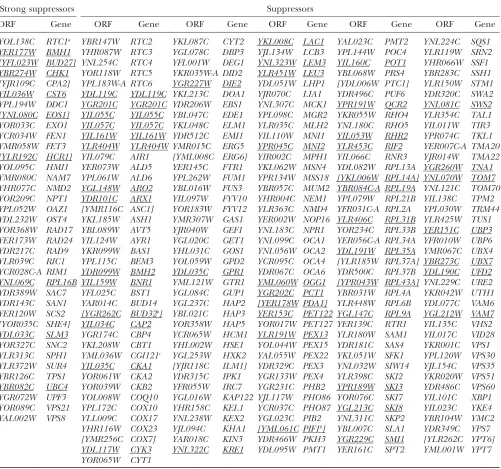
A screen for gene deletions that suppress or enhance cdc13-1temperature sensitivity was undertaken using the SGA technique (Tonget al.2001; Tongand Boone2006) as described in materials and methods and supple-mental Methods. High-throughput yeast spot tests (materials and methods; supplemental Methods; Fig-ure 1) were used to identify gene deletions, which allowed growth of strains carrying thecdc13-1mutation at the otherwise nonpermissive temperature of 27°. Five of these (identified during initial screens 1 and 2; sup-plemental Table S1) were described previously (Downey et al. 2006). At the end of a comprehensive screening process during which a minimum of 4 and a maximum of 15 biological replicates for each viable gene deletion had been tested (supplemental Table S1), a high confidence list of 238 gene deletion suppressors ofcdc13-1 temper-ature sensitivity was obtained (Table 1). Of these 238, 37 strains that grew at the higher nonpermissive tempera-ture of 28° (screens 3 and 4, supplemental Table S1) were classed as strong suppressors (Table 1). A number of gene deletions that have previously been described as cdc13-1suppressors were identified in our screen (Table 2). These included deletions ofRAD9,RAD17,RAD24, EXO1, andCHK1among the group of strong suppressors
(Table 1), consistent with previous studies (e.g., Maringele and Lydall2002; Zubkoet al.2004).
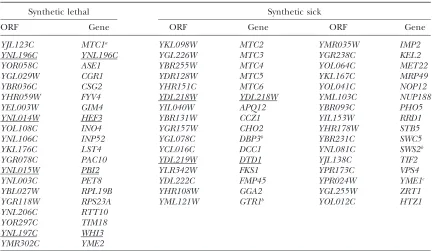
Our approach also allowed us to identify gene dele-tions that were lethal or sick in combination withcdc13-1 because double mutants were either missing or poor growers after SGA (materials and methods; supple-mental Methods; supplesupple-mental Figure S2). Twenty genes demonstrated synthetic lethal and 32 showed synthetic-sick interactions withcdc13-1at 20°(Table 3). In thediscussion, we speculate on the roles of these cdc13-1 suppressor and enhancer genes in telomere biology.
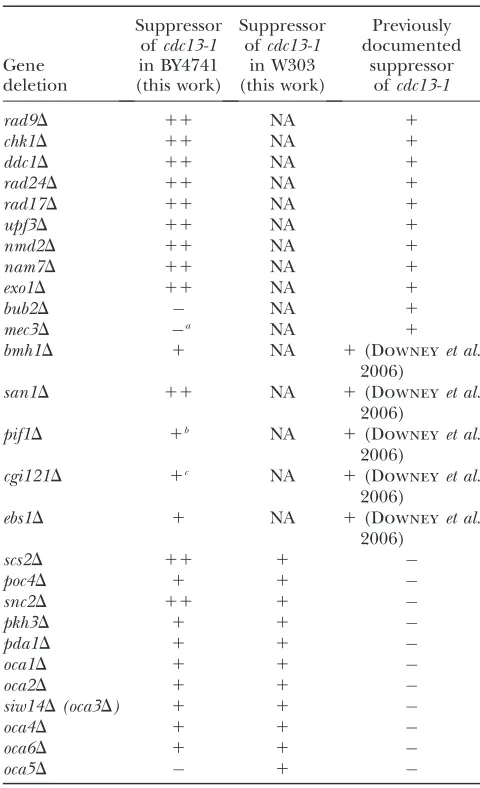
Conservation of suppression in an alternative genetic background: It is possible that second-site mu-tations in gene deletion strains were responsible for suppression of the cdc13-1 temperature-sensitive phe-notype. Therefore, to confirm that the relevant gene deletions suppressedcdc13-1, 10 suppressor genes were deleted by transformation in the different W303cdc13-1 genetic background and tested for growth at 26°, 26.5°, and/or 27°. In all 10 cases, growth was observed at a higher temperature than the control cdc13-1 strains (Table 2). In addition, as a result of identification of OCA1,OCA2,SIW14(OCA3),OCA4, andOCA6as sup-pressors ofcdc13-1, we also tested deletion of theOCA5 gene in the W303 genetic background and found it to suppress (Table 2);OCA5was dropped from the list of suppressors in this study at the screen 5 stage (see supplemental Methods). Since 10/10 gene deletions that we identified through high-throughput screening also suppresscdc13-1in the W303 genetic background, we conclude that the majority of thecdc13-1suppressors that we have identified are likely to be true suppressors. The UP–DOWN screen: Given the large number of cdc13-1suppressors, we wanted to differentiate between different types of cdc13-1 suppressors. Therefore, we Figure 1.—High-throughput robotic yeast growth assay in 384-spot format. A total of 384 yeast strains were spotted onto four solid agar plates, each of which was incubated under differ-ent conditions, indicated in the top left corner of each panel (20°, 27°, 36°, and the UP–DOWN as-say). Circles are drawn around examples of UDS (9, rad9D; 17, rad17D) and UDR (E, exo1D; S,
srn2D) strains, all four of which are alsocdc13-1
also screened for gene deletions that, when combined with thecdc13-1mutation, significantly enhanced or re-duced cell viability in a temperature oscillation (or ‘‘UP– DOWN’’) experiment (materials and methods). The cdc13-1mutation has a reversible temperature-sensitive phenotype; that is, cells with thecdc13-1mutation main-tain high viability and efficiently form colonies when
re-turned to permissive temperature after short periods at nonpermissive temperature. DNA damage checkpoint pathways, which inhibit cell division in response to un-capped telomeres incdc13-1mutants, are important for maintainingcdc13-1cell viability (Weinertet al. 1994; Zubkoet al.2004). In addition, nucleases and nuclease inhibitors, which affect single-stranded DNA
produc-TABLE 1
Genes whose deletion rescues temperature sensitivity ofcdc13-1
Strong suppressors Suppressors
ORF Gene ORF Gene ORF Gene ORF Gene ORF Gene ORF Gene
YOL138C RTC1a YBR147W RTC2 YKL087C CYT2 YKL008C LAC1 YAL023C PMT2 YNL224C SQS1
YER177W BMH1 YHR087W RTC3 YGL078C DBP3 YJL134W LCB3 YPL144W POC4 YLR119W SRN2
[YFL023W BUD27] YNL254C RTC4 YFL001W DEG1 YNL323W LEM3 YIL160C POT1 YHR066W SSF1
YBR274W CHK1 YOR118W RTC5 YKR035W-A DID2 YLR451W LEU3 YBL068W PRS4 YBR283C SSH1
[YJR109C CPA2] YPL183W-A RTC6 YGR227W DIE2 YDL051W LHP1 [YDL006W PTC1] YLR150W STM1
YIL036W CST6 YDL119C YDL119C YKL213C DOA1 YJR070C LIA1 YDR496C PUF6 YDR320C SWA2
YPL194W DDC1 YGR201C YGR201C YDR206W EBS1 YNL307C MCK1 YPR191W QCR2 YNL081C SWS2
[YNL080C EOS1] YIL055C YIL055C YBL047C EDE1 YPL098C MGR2 YKR055W RHO4 YLR354C TAL1
YOR033C EXO1 YIL057C YIL057C YKL048C ELM1 YLR035C MLH2 YNL180C RHO5 YIL011W TIR3
YCR034W FEN1 YIL161W YIL161W YDR512C EMI1 YIL110W MNI1 YIL053W RHR2 YPR074C TKL1
YMR058W FET3 YLR404W YLR404W YMR015C ERG5 YPR045C MNI2 YLR453C RIF2 YER007C-A TMA20
[YLR192C HCR1] YIL079C AIR1 [YML008C ERG6] YIR002C MPH1 YIL066C RNR3 YJR014W TMA22
YOL095C HMI1 YER073W ALD5 YER145C FTR1 YKL062W MSN4 YDL082W RPL13A YGR260W TNA1
YMR080C NAM7 YPL061W ALD6 YPL262W FUM1 YPR134W MSS18 [YKL006W RPL14A] YNL070W TOM7
YHR077C NMD2 YGL148W ARO2 YBL016W FUS3 YBR057C MUM2 YBR084C-A RPL19A YNL121C TOM70
YOR209C NPT1 YDR101C ARX1 YIL097W FYV10 YHR004C NEM1 YPL079W RPL21B YIL138C TPM2
YPL052W OAZ1 [YMR116C ASC1] YOR183W FYV12 YLR363C NMD4 YFR031C-A RPL2A YPL030W TRM44
YDL232W OST4 YKL185W ASH1 YMR307W GAS1 YER002W NOP16 YLR406C RPL31B YLR425W TUS1
YOR368W RAD17 YBL089W AVT5 YJR040W GEF1 YNL183C NPR1 YOR234C RPL33B YER151C UBP3
YER173W RAD24 YIL124W AYR1 YGL020C GET1 YNL099C OCA1 YER056C-A RPL34A YFR010W UBP6
YDR217C RAD9 YKR099W BAS1 YHL031C GOS1 YNL056W OCA2 YDL191W RPL35A YMR067C UBX4
YLR039C RIC1 YPL115C BEM3 YOL059W GPD2 YCR095C OCA4 [YLR185W RPL37A] YBR273C UBX7
YCR028C-A RIM1 YDR099W BMH2 YDL035C GPR1 YDR067C OCA6 YDR500C RPL37B YDL190C UFD2
YNL069C RPL16B YIL159W BNR1 YML121W GTR1 YML060W OGG1 [YPR043W RPL43A] YNL229C URE2
YDR389W SAC7 YFL025C BST1 YGL084C GUP1 YGR202C PCT1 YBR031W RPL4A YKR042W UTH1
YDR143C SAN1 YAR014C BUD14 YGL237C HAP2 [YER178W PDA1] YLR448W RPL6B YDL077C VAM6
YER120W SCS2 [YGR262C BUD32b] YBL021C HAP3 YER153C PET122 YGL147C RPL9A YGL212W VAM7
[YOR035C SHE4] YIL034C CAP2 YOR358W HAP5 YOR017W PET127 YER139C RTR1 YIL135C VHS2
YDL033C SLM3 YGR174C CBP4 YCR065W HCM1 YLR191W PEX13 YLR180W SAM1 YIL017C VID28
YOR327C SNC2 YKL208W CBT1 YHL002W HSE1 YOL044W PEX15 YDR181C SAS4 YKR001C VPS1
YLR313C SPH1 YML036W CGI121c YGL253W HXK2 YAL055W PEX22 YKL051W SFK1 YPL120W VPS30
YLR372W SUR4 YIL035C CKA1 [YJR118C ILM1] YDR329C PEX3 YNL032W SIW14 YJL154C VPS35
YBR126C TPS1 YOR061W CKA2 YDR315C IPK1 YGR133W PEX4 YLR398C SKI2 YKR020W VPS51
YBR082C UBC4 YOR039W CKB2 YFR055W IRC7 YGR231C PHB2 YPR189W SKI3 YDR486C VPS60
YGR072W UPF3 YOL008W COQ10 YGL016W KAP122 YJL117W PHO86 YOR076C SKI7 YIL101C XBP1
YOR089C VPS21 YPL172C COX10 YHR158C KEL1 YCR037C PHO87 YGL213C SKI8 YIL023C YKE4
YAL002W VPS8 YLL009C COX17 YNL238W KEX2 YGL023C PIB2 YNL311C SKP2 YBR104W YMC2
YHR116W COX23 YJL094C KHA1 [YML061C PIF1b] YBL007C SLA1 YDR349C YPS7
[YMR256C COX7] YAR018C KIN3 YDR466W PKH3 YGR229C SMI1 [YLR262C YPT6]
YDL117W CYK3 YNL322C KRE1 YDL095W PMT1 YER161C SPT2 YML001W YPT7
YOR065W CYT1
Underlined genes lie adjacent to other genes whose deletion rescuescdc13-1. In such cases, an effect on transcription of the neighboring gene cannot be discounted. Brackets indicate genes previously identified as synthetic with wild-type during SGA (Tonget al.2001).
a
TheRTCgene name is reserved for previously unnamed ORFs.
b
Deletion ofPIF1andBUD32rescuescdc13-1(Downeyet al.2006) but these genes were not tested further in robotic assays due to slow growth.
c
tion at uncapped telomeres ofcdc13-1 mutants, affect the ability ofcdc13-1to grow for periods at nonpermis-sive temperature.
In an UP–DOWN assay, cdc13-1 mutants are cycled between permissive and nonpermissive conditions and then allowed to form colonies at permissive temperature. In an UP–DOWN assay,rad9Dcdc13-1strains do not form colonies efficiently because they do not arrest cell division in response to telomere uncapping and accumulate very high levels of single-stranded DNA. Conversely, exo1D cdc13-1cells grow demonstrably faster thanEXO1
RAD1
cdc13-1strains in this assay (Zubkoet al.2004; Figure 1),
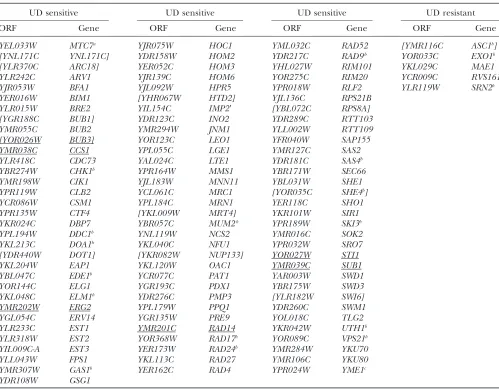
presumably because high levels of Exo1-dependent ssDNA at telomeres ofcdc13-1 cells inhibit cell division for long periods even after cells are returned to permis-sive temperature. Therefore, we hypothesized that an UP–DOWN screen would allow us to identify genes that interact withcdc13-1in aRAD9-like orEXO1-like manner. The UP–DOWN assay was performed on between 2 and 10 biological replicates of cdc13-1 SGA strains. Those gene deletions that, in conjunction withcdc13-1, showed consistently poor growth (Figure 1) were scored as UP– DOWN sensitive (UDS) while those that grew consis-tently better thancdc13-1 his3TKANMX controls (Figure 1) were scored as UP–DOWN resistant (UDR) (Table 4). A total of 96 UDSand five UDRgenes were identified. Interestingly, both classes included both genes that sup-presscdc13-1when deleted and genes that do not. The 15 UDSgenes that arecdc13-1suppressors includedRAD9, RAD17,RAD24, andCHK1, which have well-characterized roles in coordinating the DNA damage response to uncapped telomeres, indicating that other novel genes with this ‘‘RAD9-like’’ phenotype are likely to be of in-terest. The 81 UDSgenes that are notcdc13-1 suppres-sors included YKU70, YKU80, EST1, EST2, and EST3. These, too, have well-defined roles in telomere biology, indicating that this class is also likely to contain novel genes of interest. Deletion ofYKU70,YKU80, and others in this category has previously been reported to be syn-thetically sick with cdc13-1 (Polotnianka et al.1998). However, since we germinated spores at 20°, rather than the 23°or 25°that is more usually used to growcdc mu-tants, we probably masked theYKU70/80 cdc13-1 synthetic-sick interactions previously reported. Presumably, other synthetic-sick interactions were also missed. There was only one gene (YME1) that reproducibly fell into both categories. Three of the five UDRgenes were alsocdc13-1 suppressors and hence EXO1-like; however, the only gene in this category that has previously been connected to telomere biology isEXO1itself.
Thus, through a systematic and iterative process, we arrived at a reliable classification of genes as one or more of the following:cdc13-1 suppressor, UDS, RAD9-like, UDR,EXO1-like,cdc13-1synthetic lethal, andcdc13-1 synthetic sick (Tables 1, 3, and 4; Figure 2).
Neighboring genes that interact with cdc13-1:In our lists ofcdc13-1interactors, we identified a number of pairs or sets of genes that are adjacent to each other in the genome. For example,YIL034C(CAP2),YIL035C(CKA1), andYIL036W(CST5) are all classed ascdc13-1 suppres-sors (Table 1). A likely explanation for such a group is that one gene has a true genetic interaction withcdc13-1 and disruption of the neighboring gene(s) affects the expression of the gene of interest. Indeed, a previous study (Alvaroet al.2007) has demonstrated that deletion of either overlapping or adjacent open reading frames can occasionally result in false positives in genomewide screens such as these. An inference can be made as to whether a gene is a true interactor or is having an effect
TABLE 2
Comparison of expectedcdc13-1suppressors with actual results and testing of novel suppressors in an
alternative genetic background
Gene deletion
Suppressor ofcdc13-1
in BY4741 (this work)
Suppressor ofcdc13-1
in W303 (this work)
Previously documented
suppressor ofcdc13-1
rad9D 11 NA 1
chk1D 11 NA 1
ddc1D 11 NA 1
rad24D 11 NA 1
rad17D 11 NA 1
upf3D 11 NA 1
nmd2D 11 NA 1
nam7D 11 NA 1
exo1D 11 NA 1
bub2D NA 1
mec3D a NA 1
bmh1D 1 NA 1(Downeyet al.
2006)
san1D 11 NA 1(Downeyet al.
2006)
pif1D 1b NA 1(Downeyet al.
2006)
cgi121D 1c NA 1(Downeyet al.
2006)
ebs1D 1 NA 1(Downeyet al.
2006)
scs2D 11 1
poc4D 1 1
snc2D 11 1
pkh3D 1 1
pda1D 1 1
oca1D 1 1
oca2D 1 1
siw14D(oca3D) 1 1
oca4D 1 1
oca6D 1 1
oca5D 1
11, yes, a strong suppressor;1, yes;, no.
aDeletion ofMEC3rescuescdc13-1but was not tested in
ro-botic assays due to slow growth.
bDeletion ofPIF1rescuescdc13-1(Downeyet al.2006) but
was not tested further in robotic assays due to slow growth.
c
on transcription of neighboring genes. In the case of CKA1 (above), for example, the identification of two other subunits of casein kinase, CKA2 and CKB2, as suppressors (neither of which lie adjacent to other suppressors in the yeast genome) supports classification ofCKA1as a suppressor. Also, genes with previously well-characterized roles in telomere/checkpoint biology such asCHK1(adjacent toUBX7) may safely be assumed to be classified correctly. However, in most cases, inferring a role is potentially misleading. We have therefore highlighted (by underlining or boldface text in Tables 1, 3, 4, and 5; Figure 3) genes that, within a particular classification, lie near each other on the chromosome and have omitted them from statistical analyses of GO.
Gene ontology analysis of interactors: To better understand the types of processes that interact with uncapped telomeres, the different classes of cdc13-1-interacting genes were subjected to statistical analysis using the GOstats Bioconductor package (Falconand Gentleman2007). GOstats analysis (supplemental Table S3) allowed us to identify GO terms that were over-represented. Genes previously identified as having roles in telomere maintenance (GO:0000723) are overrepre-sented in the results from both the cdc13-1 suppressor screen (23 genes annotated as GO:0000723) and the UP– DOWN assay (18 more genes annotated as GO:0000723); 3 genes annotated as both ‘‘telomerase activity’’ (GO:
0003720) and ‘‘telomerase holoenzyme complex’’ (GO: 0005697):EST1,EST2, andEST3(supplemental Table S3). The list of strong suppressors (Table 1) is enriched for genes involved in DNA damage checkpoint con-trol—namelyDDC1,RAD17,RAD24, andRAD9—and in nonsense-mediated decay—namelyNAM7,NMD2, and UPF3. RAD9-like genes (see Table 4) included the same four genes involved in DNA damage checkpoint control (DDC1, RAD17,RAD24, and RAD9) together with the ‘‘cell-cycle checkpoint’’ (GO:0000075) annotatedELM1. Finally, the UDS genes that do not suppress cdc13-1 temperature sensitivity when deleted had multiple over-represented GO terms describing aspects of chromo-some architecture (supplemental Table S3).
All of the processes highlighted by statistical analysis of cdc13-1 interactors have well-characterized links to telomere biology. This analysis clearly shows that our screens were successful in identifying known CDC13 interactors and suggests therefore that genes identified in this study that were not previously linked to telomeres are likely to have telomere-related roles.
Systematic analysis of gene lists: One caveat with statistical analysis of GO terms is that annotations may be biased toward processes that have been extensively studied. Also, we used a relatively high P-value cutoff (materials and methods) to mitigate the likelihood of false positives. We therefore performed a different
sys-TABLE 3
Genes whose deletion exacerbates the growth defects ofcdc13-1cells
Synthetic lethal Synthetic sick
ORF Gene ORF Gene ORF Gene
YJL123C MTC1a YKL098W MTC2 YMR035W IMP2
YNL196C YNL196C YGL226W MTC3 YGR238C KEL2
YOR058C ASE1 YBR255W MTC4 YOL064C MET22
YGL029W CGR1 YDR128W MTC5 YKL167C MRP49
YBR036C CSG2 YHR151C MTC6 YOL041C NOP12
YHR059W FYV4 YDL218W YDL218W YML103C NUP188
YEL003W GIM4 YIL040W APQ12 YBR093C PHO5
YNL014W HEF3 YBR131W CCZ1 YIL153W RRD1
YOL108C INO4 YGR157W CHO2 YHR178W STB5
YNL106C INP52 YGL078C DBP3b YBR231C SWC5
YKL176C LST4 YCL016C DCC1 YNL081C SWS2b
YGR078C PAC10 YDL219W DTD1 YJL138C TIF2
YNL015W PBI2 YLR342W FKS1 YPR173C VPS4
YNL003C PET8 YDL222C FMP45 YPR024W YME1c
YBL027W RPL19B YHR108W GGA2 YGL255W ZRT1
YGR118W RPS23A YML121W GTR1b YOL012C HTZ1
YNL206C RTT10
YOR297C TIM18
YNL197C WHI3
YMR302C YME2
Underlined genes lie adjacent to other genes whose deletion has synthetic interactions withcdc13-1. In such cases, an effect on transcription of the neighboring gene cannot be discounted.
aThe
MTCgene name is reserved for previously unnamed ORFs.
tematic analysis ofcdc13-1 interactors, which this time included all genes identified in our study (see above; Tables 1, 3, and 4). We grouped genes with clearly related functions together, irrespective of GO term frequency and chromosomal position, using the functional descriptions in BioGrid (Starket al.2006; Breitkreutzet al.2008).
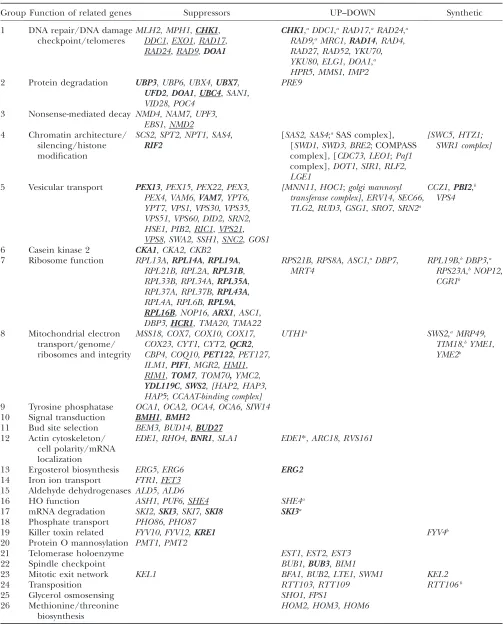
Suppressors ofcdc13-1temperature sensitivity (Table 1) included clusters of genes involved in bud-site selec-tion; mitochondrial function (including multiple genes for electron transport, mitochondrial genome integrity, mitochondrial ribosomes, and mitochondrial integrity); nonsense-mediated decay; chromatin architecture; phos-phate transport; signal transduction; ribosome function; protein degradation; mRNA degradation; vesicular transport; response to DNA damage; iron ion transport;
the actin cytoskeleton, cell polarity and mRNA local-ization; and HO function (Table 5). Also of note in this category were five putative tyrosine phosphatases of largely unknown function [OCA1, OCA2, SIW14 (OCA3), OCA4, and OCA6)], four killer-toxin-related genes, two aldehyde dehydrogenase genes, three genes from the CCAAT-binding complex, and three of four subunits of casein kinase 2 (Table 5).
A similar analysis of UDSgenes (Table 4) identified groups of genes with roles in the telomerase holoen-zyme: the spindle checkpoint; the mitotic exit network; the DNA damage checkpoint; regulation of transcrip-tion terminatranscrip-tion and transpositranscrip-tion; ribosome functranscrip-tion; chromosome architecture (including multiple SAS com-plex, COMPASS comcom-plex, and Paf1 complex genes); the
TABLE 4
Genes whose deletion imparts a phenotype in thecdc13-1UP–DOWN assay
UD sensitive UD sensitive UD sensitive UD resistant
ORF Gene ORF Gene ORF Gene ORF Gene
YEL033W MTC7a YJR075W HOC1 YML032C RAD52 [YMR116C ASC1b]
[YNL171C YNL171C] YDR158W HOM2 YDR217C RAD9b YOR033C EXO1b
[YLR370C ARC18] YER052C HOM3 YHL027W RIM101 YKL029C MAE1
YLR242C ARV1 YJR139C HOM6 YOR275C RIM20 YCR009C RVS161
YJR053W BFA1 YJL092W HPR5 YPR018W RLF2 YLR119W SRN2b
YER016W BIM1 [YHR067W HTD2] YJL136C RPS21B
YLR015W BRE2 YIL154C IMP29 [YBL072C RPS8A]
[YGR188C BUB1] YDR123C INO2 YDR289C RTT103
YMR055C BUB2 YMR294W JNM1 YLL002W RTT109
[YOR026W BUB3] YOR123C LEO1 YFR040W SAP155
YMR038C CCS1 YPL055C LGE1 YMR127C SAS2
YLR418C CDC73 YAL024C LTE1 YDR181C SAS4b
YBR274W CHK1b YPR164W MMS1 YBR171W SEC66
YMR198W CIK1 YJL183W MNN11 YBL031W SHE1
YPR119W CLB2 YCL061C MRC1 [YOR035C SHE4b]
YCR086W CSM1 YPL184C MRN1 YER118C SHO1
YPR135W CTF4 [YKL009W MRT4] YKR101W SIR1
YKR024C DBP7 YBR057C MUM2b YPR189W SKI3b
YPL194W DDC1b YNL119W NCS2 YMR016C SOK2
YKL213C DOA1b YKL040C NFU1 YPR032W SRO7
[YDR440W DOT1] [YKR082W NUP133] YOR027W STI1
YKL204W EAP1 YKL120W OAC1 YMR039C SUB1
YBL047C EDE1b YCR077C PAT1 YAR003W SWD1
YOR144C ELG1 YGR193C PDX1 YBR175W SWD3
YKL048C ELM1b YDR276C PMP3 [YLR182W SWI6]
YMR202W ERG2 YPL179W PPQ1 YDR260C SWM1
YGL054C ERV14 YGR135W PRE9 YOL018C TLG2
YLR233C EST1 YMR201C RAD14 YKR042W UTH1b
YLR318W EST2 YOR368W RAD17b YOR089C VPS21b
YIL009C-A EST3 YER173W RAD24b YMR284W YKU70
YLL043W FPS1 YKL113C RAD27 YMR106C YKU80
YMR307W GAS1b YER162C RAD4 YPR024W YME1c
YDR108W GSG1
Underlined genes lie adjacent to other genes whose deletion imparts a phenotype in the UP–DOWN assay distinct fromcdc13-1
alone. In such cases, an effect on transcription of the neighboring gene cannot be discounted. Brackets indicate genes previously identified as synthetic with wild type during SGA (Tonget al.2001).
actin cytoskeleton, cell polarity and mRNA localization; glycerol osmosensing; methionine and threonine syn-thesis; and vesicular transport (Table 5).
Finally, analysis of genes whose deletion exacerbates thecdc13-1phenotype (Table 3) provided multiple ‘‘hits’’ affecting ribosome function, mitochondrial integrity, and histone H2AZ exchange (chromatin remodeling) (Table 5).
Uncharacterized genes identified in the cdc13-1 screen: A number of genes identified as cdc13-1 inter-actors in this study were of previously unknown func-tion. Suppressor genes, when present, have a negative effect on telomere capping incdc13-1mutant cells at the nonpermissive temperature; therefore we have named such genesRTC(restriction oftelomerecapping; Table 1). Genes of previously unknown function whose de-letion exacerbates the cdc13-1 phenotype have been namedMTC(maintenance oftelomerecapping) since their presence increases the fitness ofcdc13-1 mutant
cells at permissive temperature or during the UP– DOWN assay (Tables 3 and 4). We did not apply new acronyms to otherwise uncharacterizedcdc13-1 interac-tors if (1) they lay next to othercdc13-1 interactors in the genome (see above) or (2) they were classified as dubious open reading frames in the Saccharomyces GenomeDatabase(2008) and were adjacent to other genes that could reasonably account for their deletion phenotype (see supplemental Table S4); however, this could be updated in the future.
DISCUSSION
TABLE 5
Groups of functionally related genes amongcdc13-1interactors
Group Function of related genes Suppressors UP–DOWN Synthetic
1 DNA repair/DNA damage checkpoint/telomeres
MLH2,MPH1,CHK1,
DDC1,EXO1,RAD17,
RAD24,RAD9,DOA1
CHK1,aDDC1,aRAD17,aRAD24,a
RAD9,aMRC1,RAD14,RAD4,
RAD27,RAD52,YKU70,
YKU80,ELG1,DOA1,a
HPR5,MMS1,IMP2
2 Protein degradation UBP3,UBP6,UBX4,UBX7,
UFD2,DOA1,UBC4,SAN1,
VID28,POC4
PRE9
3 Nonsense-mediated decay NMD4,NAM7,UPF3,
EBS1,NMD2
4 Chromatin architecture/ silencing/histone modification
SCS2,SPT2,NPT1,SAS4,
RIF2
[SAS2,SAS4;aSAS complex],
[SWD1,SWD3,BRE2; COMPASS complex], [CDC73,LEO1;Paf1
complex],DOT1,SIR1,RLF2,
LGE1
[SWC5, HTZ1; SWR1 complex]
5 Vesicular transport PEX13,PEX15,PEX22,PEX3,
PEX4,VAM6,VAM7,YPT6,
YPT7,VPS1,VPS30,VPS35,
VPS51,VPS60,DID2,SRN2,
HSE1,PIB2,RIC1,VPS21,
VPS8,SWA2,SSH1,SNC2,GOS1
[MNN11,HOC1;golgi mannosyl transferase complex],ERV14,SEC66,
TLG2,RUD3,GSG1,SRO7,SRN2a
CCZ1,PBI2,b
VPS4
6 Casein kinase 2 CKA1,CKA2,CKB2
7 Ribosome function RPL13A,RPL14A,RPL19A,
RPL21B,RPL2A,RPL31B,
RPL33B,RPL34A,RPL35A,
RPL37A,RPL37B,RPL43A,
RPL4A,RPL6B,RPL9A,
RPL16B,NOP16,ARX1,ASC1,
DBP3,HCR1,TMA20,TMA22
RPS21B,RPS8A,ASC1,aDBP7,
MRT4
RPL19B,bDBP3,a
RPS23A,bNOP12,
CGR1b
8 Mitochondrial electron transport/genome/ ribosomes and integrity
MSS18,COX7,COX10,COX17,
COX23,CYT1,CYT2,QCR2,
CBP4,COQ10,PET122,PET127,
ILM1,PIF1,MGR2,HMI1,
RIM1,TOM7,TOM70,YMC2,
YDL119C,SWS2,[HAP2,HAP3,
HAP5;CCAAT-binding complex]
UTH1a SWS2,aMRP49,
TIM18,bYME1,
YME2b
9 Tyrosine phosphatase OCA1,OCA2, OCA4,OCA6,SIW14
10 Signal transduction BMH1,BMH2
11 Bud site selection BEM3,BUD14,BUD27
12 Actin cytoskeleton/ cell polarity/mRNA localization
EDE1,RHO4,BNR1,SLA1 EDE1*,ARC18,RVS161
13 Ergosterol biosynthesis ERG5,ERG6 ERG2
14 Iron ion transport FTR1,FET3
15 Aldehyde dehydrogenases ALD5,ALD6
16 HO function ASH1,PUF6,SHE4 SHE4a
17 mRNA degradation SKI2,SKI3,SKI7,SKI8 SKI3a
18 Phosphate transport PHO86,PHO87
19 Killer toxin related FYV10,FYV12,KRE1 FYV4b
20 Protein O mannosylation PMT1,PMT2
21 Telomerase holoenzyme EST1,EST2,EST3
22 Spindle checkpoint BUB1,BUB3,BIM1
23 Mitotic exit network KEL1 BFA1,BUB2,LTE1,SWM1 KEL2
24 Transposition RTT103,RTT109 RTT106b
25 Glycerol osmosensing SHO1,FPS1
26 Methionine/threonine biosynthesis
HOM2,HOM3,HOM6
Genes in boldface lie adjacent to othercdc13-1interactors of the same category (e.g., synthetic); strong suppressors are underlined. A number for each group of genes is indicated on the left.
a
Also a suppressor ofcdc13-1.
b
developed and optimized high-throughput yeast growth assays. Although others have looked systematically for synthetic lethality with temperature-sensitive mutations (e.g., Measdayet al.2005; Baetzet al.2006), to the best of our knowledge, a genomewide screen for gene deletions that confer subtle suppressor/enhancer
phe-notypes on a temperature-sensitive mutation has not previously been reported. Our approach therefore com-plements other high-throughput genetic techniques such as SGA (Tonget al.2001; Roguevet al.2007) and synthetic dosage lethal analysis (Measdayet al.2005).
We screened for gene deletions that suppress the lethality of cdc13-1 at the nonpermissive temperature and genes that compromise or contribute to the ‘‘re-versibility’’ ofcdc13-1mutants. Combined with synthetic-lethal and synthetic-sick data from the SGA procedure, this resulted in five overlapping categories of CDC13 interactors: suppressors ofcdc13-1, synthetic lethal with cdc13-1, synthetic sick withcdc13-1, UDS, and UDR—the latter two categories, respectively, havingRAD9-like and EXO1-like subclasses, giving eight classes in all. Many of the genes identified as interacting withCDC13fit into pathways with previously recognized roles in telomere biology (Table 5). However, a significant number of genes identified in this study have previously uncharac-terized relationships to telomere function. A more detailed analysis of their roles is likely to provide novel information about eukaryotic telomere biology; for exam-ple, in the same way as Exo1, discovered to have telomere-related function in yeast (Maringeleand Lydall2002), plays a role in life-span determination of telomerase knockout mice (Schaetzleinet al.2007).
cdc13-1suppressors:cdc13-1suppressors encode pro-teins that inhibit growth ofcdc13-1 mutant cells at the nonpermissive temperature. Previous work has shown that suppression of the temperature sensitivity ofcdc13-1 can occur through different pathways and to different extents. For example, deletion ofEXO1(which encodes a 59–39exonuclease required for resection at telomere ends in the event of telomere uncapping) suppresses cdc13-1temperature sensitivity through a different mech-anism from suppression by deletion ofRAD9, which is required for signaling cell-cycle arrest. There is there-fore no single, simple explanation for the actions of the many novel gene deletions that we have identified as suppressingcdc13-1(Table 1).
Some of the biological functions common to genes identified as cdc13-1 suppressors (Table 5) have well-understood relationships with telomere function. DNA damage checkpoint and related genes, for example, act at telomeres to detect uncapping and transduce signals to the DNA repair and cell-cycle machinery (group 1, Table 5; supplemental Figure S3) (Lydall 2003; Longhese2008).
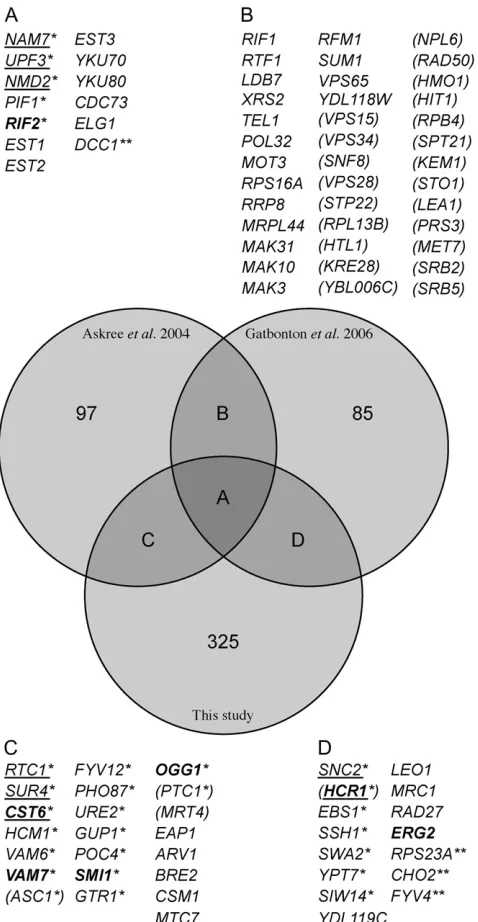
For other ‘‘clusters’’ of genes, there are plausible hypotheses to explain how they might affect telomeres. Genes involved in protein degradation (group 2, Table 5; supplemental Figure S3) could potentially affect the levels of many telomere-associated proteins. An exam-ple isSAN1, the product of which functions in ubiquitin-dependent degradation of aberrant proteins in the cell nucleus. San1 degrades the defective Cdc13-1 protein and therefore deletion ofSAN1stabilizes Cdc13-1 levels Figure 3.—Comparison of CDC13-interacting genes with
telomere length genes. A Venn diagram shows hits from two separate genomewide screens for telomere length regu-lating genes compared to a list ofcdc13-1 interactors. Lists of genes that make up the cross sections between studies are displayed and indicated by letters. The numbers of genes in each segment are indicated. Boldface text highlights genes that have neighboring genes in the genome whose deletion results in a similar phenotype. *cdc13-1 suppressor (strong suppressors are underlined); **synthetic (sick or lethal) with
(Gardneret al.2005). What little function Cdc13-1 has at elevated temperature might therefore be increased in the absence of SAN1. Deletion of nonsense-mediated decay genes (group 3, Table 5; supplemental Figure S3) alters the stoichiometry of telomere cap components and in particular elevates transcript levels for the essen-tial Cdc13-interacting Stn1 protein (Dahlseidet al.2003; Enomotoet al.2004).
Genes that affect chromatin architecture, silencing, and/or histone modification influence telomere bi-ology, presumably by modifying the accessibility of chromatin to telomere proteins, for example (Yuet al. 2007). Chromatin modifiers are represented both as cdc13-1 suppressors and as UDSgenes in this category (group 4, Table 5) and at least one silencing gene (SAS4) isRAD9-like in that it is both a suppressor and UDS. Therefore, the relationship between chromatin and the telomere cap is complex. Recent experiments show how the histone H3K79 methyl transferase Dot1 (identifed as UDSin our study) is required for check-point activation and inhibition of resection incdc13-1 mutants (Lazzaroet al.2008).
A large number of suppressor genes have vesicular trafficking functions (group 5, Table 5). This is consis-tent with the observation that many vesicular traffic genes affect telomere length (Askree et al. 2004). At least some of those were shown to act upon telomere length in aYKU70-dependent manner (Roget al.2005); however, it seems likely from our studies that others may influence Cdc13 function. There are extensive inter-actions, described in BioGrid, between vesicular traffic genes and other types ofcdc13-1 suppressors (supple-mental Figure S3); hence mutations that alter vesicular trafficking may affect telomeres through multiple dif-ferent pathways. It is interesting to note that transport of telomerase proteins and TLC1RNA across the nu-clear membrane is important for telomerase function (Teixeira et al. 2002; Gallardo et al. 2008) and that deletion ofKAP122, required for import of TLC1 from the cytoplasm to the nucleus (Gallardoet al.2008), sup-pressescdc13-1.
Phosphorylation by human casein kinase 2 (CK2) has been shown to regulate binding of human Trf1 to telo-meres (Kimet al. 2008). Human Trf1 negatively regu-lates telomere length by inhibiting access of telomerase to telomeres. Possible Trf1 functional homologs in S. cerevisiaeare Tbf1 and Rap1, both of which are essential TTAGGG-binding proteins with roles in gene silencing at telomeres (Fourelet al. 1999; Koering et al.2000; Bhattacharyaand Warner2008; Hogueset al.2008). It is possible therefore that yeast CK2 (group 6, Table 5; supplemental Figure S3) acts directly upon either Tbf1 or Rap1. Alternatively, multiple interactions between CK2 subunits and genes involved in modulating chro-matin architecture are known, including multiple genes identified in this study (supplemental Figure S4) and so S. cerevisiae CK2 may exert an influence on telomere
function through a general effect on chromatin. A third alternative route through which CK2 might influence the cdc13-1 phenotype is its influence on checkpoint control, which was reported previously (Toczyskiet al. 1997). Further studies will be required to distinguish among these possibilities.
A large group of ribosomal protein genes (group 7, Table 5; supplemental Figure S3) and a smaller number of other genes with ribosome-related function were iden-tified as suppressors of cdc13-1. We have no clear ex-planation for this; however, a clue may come from the observation that chromosomal regions containing ribo-somal protein genes and telomeres have similar mech-anisms for regulating their chromatin architecture (Bhattacharya and Warner 2008; Hogues et al. 2008). Remarkably, this group includes 16 large ribo-somal protein subunit genes but only one component of the small ribososmal subunit.
Numerous groups of genes identified in this study have not previously been linked to telomere function. Genes affecting mitochrondrial function (group 8, Table 5) (particularly those involved in electron transport and import into mitochondria), for example, are cdc13-1 suppressors when deleted. Interestingly, Nautiyalet al. (2002) showed that many mitochondrial genes are transcriptionally upregulated in telomerase-deficient mutants and we have recently found similar results in cdc13-1 mutants (A. Greenall and D. Lydall, per-sonal communication). Furthermore, there appear to be evolutionarily conserved interactions between mito-chondria and telomeres (Passoset al.2007). Therefore, one possible explanation of why so many genes involved in mitochondrial function suppresscdc13-1when deleted is that loss of mitochondrial function, and the ability to respire, suppresses the poor growth ofcdc13-1mutants. Indeed, we find that many petite mutants suppress the cdc13-1defect (Table 1).
Five genes (OCA1,OCA2,OCA4,OCA6,SIW14; group 9, Tables 2 and 5; supplemental Figure S3) containing a highly conserved tyrosine phosphatase motif were identified as suppressors of cdc13-1. Little is known about their function except thatOCA1andSIW14have roles in checkpoint response to oxidative stress and actin filament organization, respectively (Alic et al. 2001; Careet al.2004). Suppression ofcdc13-1has been confirmed in a separate genetic background (W303) for OCA2,OCA4,OCA6, andSIW14. It was also found that OCA5, which lacks the tyrosine phosphatase motif and was not detected as a suppressor in this screen, does suppress cdc13-1 temperature sensitivity in the W303 background (Table 2). It will be interesting to deter-mine how the OCA gene family interacts with uncapped telomeres, possibly by interacting with the checkpoint kinase cascade or perhaps by affecting telomere capping. The partially redundant BMH1 and BMH2 genes (group 10, Table 5; supplemental Figure S3) encode 14-3-3 proteins, which bind phosphopeptides (van Heusdenand Steensma2006). It has been shown that Bmh1 and Bmh2 affect checkpoint signal transduction (Lottersbergeret al.2003, 2006, 2007) and therefore, like Rad9 and Rad24, their absence is expected to im-prove the growth ofcdc13-1mutants. Further experiments will be necessary to explain the roles of other groups of genes (groups 11–20, Table 5; supplemental Figure S3) in exacerbating thecdc13-1telomere-capping defect.
UP–DOWN sensitive genes:We classify UDSgenes as those that contribute to the viability ofcdc13-1mutant cells during brief incubation periods at high tempera-ture. Their deletion causescdc13-1cells to grow poorly in the UP–DOWN assay. Deletion ofRAD9suppresses the temperature sensitivity ofcdc13-1, as well as rendering cdc13-1cells sensitive to temperature oscillation (Figure 1) and we predicted that other UDSgenes that similarly suppressed cdc13-1 would be identified in this screen and classed as truly ‘‘RAD9-like.’’ Indeed,RAD9,CHK1, DDC1,RAD17,RAD24, and other genes with DNA-repair-related roles (DOA1) were identified. However, also included were genes for cell polarity and cellular mor-phogenesis (ELM1, SHE4), membrane traffic (EDE1, VPS21), response to oxidative stress (UTH1), mRNA de-gradation (SKI3), DNA replication in meiosis (MUM2), chromatin architecture (SAS4), and cell-wall biogenesis (GAS1). SHE4 in particular is interesting since its de-letion causes strong suppression (Table 1) and a strong UDSphenotype (Table 4 and data not shown). She4 is an
UNC domain protein that interacts with type I and type V myosins and has roles in mating-type switching (by helping to localize the mRNA for Ash1) and endocytosis. Since other genes involved in both vesicular traffic and Ash1 function have been identified in this study, it remains to be determined through which of these pathwaysSHE4exerts an influence on telomere biology. Rather less predictable was a large number of UDS genes (81), which do not suppresscdc13-1temperature sensitivity when deleted (Table 4, Figure 2). Deletion of some of these genes caused reduced growth during spot tests (not detected in SGA analysis; supplemental Figure S2), even at the permissive temperature of 20°(data not shown). They were classed as UDSbecause growth was still poor in the UP–DOWN assay relative to growth at the permissive temperature. There is a subtle distinc-tion, therefore, between this class of genes and those that exhibit a synthetic sick interaction with cdc13-1at temperatures.23°.
Only deletion ofYME1appeared to demonstrate both UDS(in screens 3 and 4; supplemental Table S1) and synthetic sick (in screen 7; supplemental Table S1) interactions with cdc13-1; null mutations in this mito-chondrial protease have previously been shown to be pleiotropic, including exhibiting cold sensitivity on rich glucose medium (Thorsnesset al. 1993). Genes such as this with apparently ‘‘variable’’ phenotypes were rare. However, another example is ASC1. Deletion of ASC1 has previously resulted in synthetic interactions with wild-type query strains in the SGA procedure (Tong et al. 2001; see supplemental Methods); however, we obtained viable progeny from SGA in 5 of 10 biological replicates with this gene deletion. Four of five of these demonstrated suppression ofcdc13-1and UDRsoASC1 is, tentatively, classified as a suppressor and UDR, that is, EXO1-like.
EST1, EST2, and EST3 genes encoding telomerase holoenzyme components fell into the UDS category (group 21, Table 5; supplemental Figure S4). This is almost certainly because telomerase, and its product telomeric DNA, contribute to forming the telomere cap. The absence of telomerase therefore sensitizes cdc13-1 mutants to high temperature. Conversely, deletingPIF1, which encodes a helicase that removes telomerase, sup-presses the temperature sensitivity ofcdc13-1mutants.
The UDSgenes included genes for both subunits of the Ku complex (YKU70andYKU80),BRE2, andDOT1. The latter encodes the H3K79 methylase and appears to
help recruit Rad9 to chromatin and, like Rad9, inhibits resection at uncapped telomeres (Lazzaroet al.2008). Spindle checkpoint and mitotic exit genes (groups 22 and 23, Table 5; supplemental Figure S4) also helped cdc13-1cells to recover from shifts to high temperature, presumably because, after a period of arrest prior to entry into mitosis, the mitotic exit network is important for efficient completion of the cell cycle.
The telomere-related roles of genes involved in trans-position, glycerol osmosensing, or methionine and threonine synthesis (groups 24–26, Table 5; supplemen-tal Figure S4) remain unclear, although the former group has been implicated in chromatin remodeling.
UP–DOWN-resistant genes: EXO1 encodes a nucle-ase that contributes to the vulnerability of cdc13-1 mutant cells to brief incubation periods at high tem-perature. A likely explanation for this is that deletion of EXO1results in less resection and thus less DNA damage at the nonpermissive temperature, thus hastening the cells’ recovery when returned to the permissive temper-ature (Zubko et al.2004). We have hypothesized that other nucleases, such as a putative RAD24-dependent nuclease ExoX, also regulate resection at uncapped telomeres ( Jiaet al.2004; Zubkoet al.2004). Therefore, we searched for other EXO1-like genes. Deletion of EXO1suppresses the temperature sensitivity ofcdc13-1, as well as renderingcdc13-1 cells less sensitive to tem-perature oscillation (Figure 1). In fact, only two genes— ASC1andSRN2—fall into this category.ASC1encodes a core component of the 40S ribosomal subunit, which acts as a guanine nucleotide dissociation inhibitor for Gpa2 (Zeller et al. 2007), and its deletion results in longer telomeres (Askreeet al.2004). Srn2 is a member of the ESCRT-1 endosomal sorting complex (Kostelansky et al. 2007), which targets proteins to endosomes in a ubiquitin-dependent manner. The other two subunits of this complex (Stp22 and Vps28) were in the group of slow-growing deletion strains that were not tested in this study but have been shown previously to have shorter telomeres, whereas deletion ofSRN2is not reported to affect telomere length (Askreeet al. 2004; Gatbontonet al.2006). Two other genes were UDRwithout beingcdc13-1suppressors: MAE1andRVS161. RVS161encodes an amphiphysin-like raft protein, which acts (with Rvs167) to regulate polar-ization of the actin cytoskeleton; thus its deletion has pleiotropic effects, which include disruption of endocytosis (Bretonet al.2001; Lombardiand Riezman2001).MAE1 encodes a mitochondrial malic enzyme that catalyzes the oxidative decarboxylation of malate to pyruvate (Boles et al.1998). None of theEXO1-like genes identified here are likely candidates for ExoX. Therefore, ExoX does not exist, was missing from our library, is encoded by an essential gene, or its activity is encoded by multiple, redundant genes.
Comparisons with telomere length screens: Two previous genomewide studies of telomere biology have measured the length of telomere repeat regions in gene
deletion strains (Askree et al.2004; Gatbonton et al. 2006). Interestingly, there was less overlap than might have been expected between the two studies in terms of the specific genes identified; however, the processes that af-fected telomere length in each study were similar (Gatbonton et al. 2006). Comparison of our results with these two previous studies reveals moderate overlap (Figure 3) but, again, some similar cellular processes were identified.
Thirteen genes were identified in all three studies and this clearly represents an important set of telomere-related genes. Seven of these were found to support telomere capping in our study—EST1,EST2, andEST3 (encoding subunits of telomerase);YKU70andYKU80 (encoding the Ku heterodimer); andCDC73andDCC1— and show reduced telomere length when deleted. Dele-tion ofELG1(UDS) results in longer telomeres. Deletion ofPIF1(Downeyet al.2006), which encodes a helicase that removes telomerase from telomeres, and of RIF2 (Wottonand Shore1997), which inhibits telomerase activity, results in long telomeres and suppression of cdc13-1. Deletion of NAM7, UPF3, and NMD2, which regulate nonsense-mediated RNA decay, affecting levels of the Cdc13-interacting protein Stn1, results in strong suppression ofcdc13-1 and short telomeres. Clearly, the implications of altered telomere length or genetic in-teraction withcdc13-1arising from a gene deletion study are complex.
Many of the genes identified by Askreeet al.(2004) or Gatbontonet al.(2006), which were not identified by our screens, are particularly poor growing strains or those previously demonstrated as working poorly in the SGA techniques (in parentheses in Figure 3; Tonget al. 2001). Conversely, there are 326 genes identified in our study as interacting withcdc13-1, which do not signifi-cantly alter telomere length. These include genes that are known to affect the response to telomere uncapping without affecting telomere length (e.g., the checkpoint genes RAD9andCHK1). However, it also seems likely thatcdc13-1 mutants are sensitive to deletion of some genes where the resulting changes in telomere length are too small to be detected using high-throughput Southern blot analysis.
may provide clues to their putative function. For example, MTC7lies in a cluster of genes that, when deleted, confer UP–DOWN sensitivity and short telomeres. This cluster includes telomere maintenance, histone methylation, and silencing genes (Figure 4), indicating that Mtc7 might influence telomere biology through one of these pro-cesses.RTC1lies in a cluster of genes that, when deleted, confer suppression of cdc13-1 temperature sensitivity and short telomeres (Figure 4). This cluster includes genes involved in nonsense-mediated decay and mem-brane transport, indicating that Rtc1 might influence telomere biology through one of these processes.
In conclusion, the budding yeast telomere cap and the response to telomere uncapping induced incdc13-1 mutants appear to be affected by numerous and diverse cellular pathways and processes. Further analyses will be necessary to understand how these pathways and pro-cesses interact at yeast telomeres. It seems likely that a significant fraction of the pathways and processes iden-tified in yeast will play roles at human telomeres and thereby affect cancer and/or aging.
The authors thank Charlie Boone and Renee Brost for providing strains and advice on the SGA technique; Centre for Integrated Systems Biology of Ageing and Nutrition colleagues past and present (in particular, Allyson Lister for help with the Robot Object Database, Dan Swan for computer support, and Suzanne Advani for excellent technical help); Tim Humphrey for helpful suggestions regarding the manuscript; Cammie Lesser and Roger Kramer for productive discussions about spot scoring; and Sasan Raghibizadeh, Pedram Raghibizadeh, and Ewan Grant for help with robotics. This work was supported by the Wellcome Trust (075294) and the Biotechnology and Biological Sciences Research Council (BB/C008200/1).
LITERATURE CITED
Alic, N., V. J. Higginsand I. W. Dawes, 2001 Identification of a
Sac-charomyces cerevisiaegene that is required for G1 arrest in response to the lipid oxidation product linoleic acid hydroperoxide. Mol. Biol. Cell12:1801–1810.
Alvaro, D., M. Lisbyand R. Rothstein, 2007 Genomewide
analy-sis of Rad52 foci reveals diverse mechanisms impacting recombi-nation. PLoS Genet.3:e228.
Askree, S. H., T. Yehuda, S. Smolikov, R. Gurevich, J. Hawket al.,
2004 A genome-wide screen forSaccharomyces cerevisiaedeletion mutants that affect telomere length. Proc. Natl. Acad. Sci. USA 101:8658–8663.
Baetz, K., V. Measdayand B. Andrews, 2006 Revealing hidden
re-lationships among yeast genes involved in chromosome segrega-tion using systematic synthetic lethal and synthetic dosage lethal screens. Cell Cycle5:592–595.
Bennett, C. B., L. K. Lewis, G. Karthikeyan, K. S. Lobachev, Y. H.
Jinet al., 2001 Genes required for ionizing radiation resistance
in yeast. Nat. Genet.29:426–434.
Bhattacharya, A., and J. R. Warner, 2008 Tbf1 or not Tbf1? Mol.
Cell29:537–538.
Birrell, G. W., G. Giaever, A. M. Chu, R. W. Davisand J. M. Brown,
2001 A genome-wide screen in Saccharomyces cerevisiae for genes affecting UV radiation sensitivity. Proc. Natl. Acad. Sci. USA98:12608–12613.
Blasco, M. A., 2007 Telomere length, stem cells and aging. Nat.
Chem. Biol.3:640–649.
Boles, E., P.deJong-Gubbelsand J. T. Pronk, 1998 Identification
and characterization ofMAE1, theSaccharomyces cerevisiae struc-tural gene encoding mitochondrial malic enzyme. J. Bacteriol. 180:2875–2882.
Breitkreutz, B. J., C. Starkand M. Tyers, 2003 Osprey: a network
visualization system. Genome Biol.4:R22.
Breitkreutz, B. J., C. Stark, T. Reguly, L. Boucher, A. Breitkreutz
et al., 2008 The BioGRID Interaction Database: 2008 update. Nucleic Acids Res.36:D637–D640.
Breton, A. M., J. Schaefferand M. Aigle, 2001 The yeast Rvs161
and Rvs167 proteins are involved in secretory vesicles targeting the plasma membrane and in cell integrity. Yeast18:1053–1068. Care, A., K. A. Vousden, K. M. Binley, P. Radcliffe, J. Trevethick
et al., 2004 A synthetic lethal screen identifies a role for the cor-tical actin patch/endocytosis complex in the response to nutri-ent deprivation inSaccharomyces cerevisiae.Genetics166:707–719. Chang, M., M. Bellaoui, C. Booneand G. W. Brown, 2002 A
genome-wide screen for methyl methanesulfonate-sensitive mutants reveals genes required for S phase progression in the presence of DNA damage. Proc. Natl. Acad. Sci. USA99:16934–16939.
Cheung, A. L., and W. Deng, 2008 Telomere dysfunction, genome
instability and cancer. Front. Biosci.13:2075–2090.
Choudhury, A. R., Z. Ju, M. W. Djojosubroto, A. Schienke, A. Lechel
et al., 2007 Cdkn1a deletion improves stem cell function and life-span of mice with dysfunctional telomeres without accelerating cancer formation. Nat. Genet.39:99–105.
Dahlseid, J. N., J. Lew-Smith, M. J. Lelivelt, S. Enomoto, A. Ford
et al., 2003 mRNAs encoding telomerase components and reg-ulators are controlled by UPF genes in Saccharomyces cerevisiae.
Eukaryot. Cell2:134–142.
Downey, M., R. Houlsworth, L. Maringele, A. Rollie, M. Brehme
et al., 2006 A genome-wide screen identifies the evolutionarily conserved KEOPS complex as a telomere regulator. Cell 124: 1155–1168.
Eisen, M. B., P. T. Spellman, P. O. Brown and D. Botstein,
1998 Cluster analysis and display of genome-wide expression patterns. Proc. Natl. Acad. Sci. USA95:14863–14868.
Enomoto, S., L. Glowczewski, J. Lew-Smith and J. G. Berman,
2004 Telomere cap components influence the rate of senes-cence in telomerase-deficient yeast cells. Mol. Cell. Biol. 24: 837–845.
Falcon, S., and R. Gentleman, 2007 Using GOstats to test gene lists
for GO term association. Bioinformatics23:257–258.
Fourel, G., E. Revardel, C. E. Koering and E. Gilson,
1999 Cohabitation of insulators and silencing elements in yeast subtelomeric regions. EMBO J.18:2522–2537.
Gallardo, F., C. Olivier, A. T. Dandjinou, R. J. Wellingerand P.
Chartrand, 2008 TLC1RNA nucleo-cytoplasmic trafficking links
telomerase biogenesis to its recruitment to telomeres. EMBO J.27: 748–757.
Gardner, R. G., Z. W. Nelson and D. E. Gottschling,
2005 Degradation-mediated protein quality control in the nu-cleus. Cell120:803–815.
Garvik, B., M. Carson and L. Hartwell, 1995 Single-stranded
DNA arising at telomeres incdc13mutants may constitute a specific signal for theRAD9checkpoint. Mol. Cell. Biol.15:6128–6138. Gatbonton, T., M. Imbesi, M. Nelson, J. M. Akey, D. M. Ruderfer
et al., 2006 Telomere length as a quantitative trait: genome-wide survey and genetic mapping of telomere length-control genes in yeast. PLoS Genet.2:e35.
Greider, C. W., and E. H. Blackburn, 1985 Identification of a
spe-cific telomere terminal transferase activity in Tetrahymena ex-tracts. Cell43:405–413.
He, F., X. Li, P. Spatrick, R. Casillo, S. Donget al., 2003
Genome-wide analysis of mRNAs regulated by the nonsense-mediated and 59to 39mRNA decay pathways in yeast. Mol. Cell12:1439–1452. Hogues, H., H. Lavoie, A. Sellam, M. Mangos, T. Roemeret al.,
2008 Transcription factor substitution during the evolution of fungal ribosome regulation. Mol. Cell29:552–562.
Jelinsky, S. A., and L. D. Samson, 1999 Global response of Saccharomyces
cerevisiae to an alkylating agent. Proc. Natl. Acad. Sci. USA96:1486– 1491.
Jia, X., T. Weinertand D. Lydall, 2004 Mec1 and Rad53 inhibit
formation of single-stranded DNA at telomeres ofSaccharomyces cerevisiae cdc13-1mutants. Genetics166:753–764.
Kim, M. K., M. R. Kang, H. W. Nam, Y. S. Bae, Y. S. Kimet al.,
Koering, C. E., G. Fourel, E. Binet-Brasselet, T. Laroche, F. Klein
et al., 2000 Identification of high affinity Tbf1p-binding sites within the budding yeast genome. Nucleic Acids Res.28:2519– 2526.
Kostelansky, M. S., C. Schluter, Y. Y. Tam, S. Lee, R. Ghirlando
et al., 2007 Molecular architecture and functional model of the complete yeast ESCRT-I heterotetramer. Cell129:485–498. Kushner, D. B., B. D. Lindenbach, V. Z. Grdzelishvili, A. O.
Noueiry, S. M. Paulet al., 2003 Systematic, genome-wide
iden-tification of host genes affecting replication of a positive-strand RNA virus. Proc. Natl. Acad. Sci. USA100:15764–15769. Lazzaro, F., V. Sapountzi, M. Granata, A. Pellicioli, M. Vazeet al.,
2008 Histone methyltransferase Dot1 and Rad9 inhibit single-stranded DNA accumulation at DSBs and uncapped telomeres. EMBO J.27:1502–1512.
Lombardi, R., and H. Riezman, 2001 Rvs161p and Rvs167p, the two
yeast amphiphysin homologs, function together in vivo. J. Biol. Chem.276:6016–6022.
Longhese, M. P., 2008 DNA damage response at functional and
dys-functional telomeres. Genes Dev.22:125–140.
Lottersberger, F., F. Rubert, V. Baldo, G. Lucchiniand M. P.
Longhese, 2003 Functions ofSaccharomyces cerevisiae14-3-3
pro-teins in response to DNA damage and to DNA replication stress. Genetics165:1717–1732.
Lottersberger, F., A. Panza, G. Lucchini, S. Piatti and M. P.
Longhese, 2006 The Saccharomyces cerevisiae 14-3-3 proteins
are required for the G1/S transition, actin cytoskeleton organi-zation and cell wall integrity. Genetics173:661–675.
Lottersberger, F., A. Panza, G. Lucchini and M. P. Longhese,
2007 Functional and physical interactions between yeast 14-3-3 proteins, acetyltransferases, and deacetylases in response to DNA replication perturbations. Mol. Cell. Biol.27:3266–3281. Lydall, D., 2003 Hiding at the ends of yeast chromosomes:
telo-meres, nucleases and checkpoint pathways. J. Cell Sci. 116: 4057–4065.
Maringele, L., and D. Lydall, 2002 EXO1-dependent
single-stranded DNA at telomeres activates subsets of DNA damage and spindle checkpoint pathways in budding yeast yku70Delta mutants. Genes Dev.16:1919–1933.
Measday, V., K. Baetz, J. Guzzo, K. Yuen, T. Kwok et al.,
2005 Systematic yeast synthetic lethal and synthetic dosage le-thal screens identify genes required for chromosome segrega-tion. Proc. Natl. Acad. Sci. USA102:13956–13961.
Nautiyal, S., J. L. DeRisiand E. H. Blackburn, 2002 The
genome-wide expression response to telomerase deletion inSaccharomyces cerevisiae.Proc. Natl. Acad. Sci. USA99:9316–9321.
Nugent, C. I., T. R. Hughes, N. F. Lue and V. Lundblad,
1996 Cdc13p: a single-strand telomeric DNA-binding protein with a dual role in yeast telomere maintenance. Science 274: 249–252.
Olovnikov, A. M., 1973 A theory of marginotomy. The incomplete
copying of template margin in enzymic synthesis of polynucleo-tides and biological significance of the phenomenon. J. Theor. Biol.41:181–190.
Passos, J. F., G. Saretzki, S. Ahmed, G. Nelson, T. Richteret al.,
2007 Mitochondrial dysfunction accounts for the stochastic het-erogeneity in telomere-dependent senescence. PLoS Biol.5:e110. Polotnianka, R. M., J. Liand A. J. Lustig, 1998 The yeast Ku
het-erodimer is essential for protection of the telomere against nu-cleolytic and recombinational activities. Curr. Biol.8:831–834.
Reaper, P. M., F.diFagagnaand S. P. Jackson, 2004 Activation of
the DNA damage response by telomere attrition: a passage to cel-lular senescence. Cell Cycle3:543–546.
Rog, O., S. Smolikov, A. Krauskopfand M. Kupiec, 2005 The yeast
VPS genes affect telomere length regulation. Curr. Genet.47:18–28. Roguev, A., M. Wiren, J. S. Weissmanand N. J. Krogan, 2007
High-throughput genetic interaction mapping in the fission yeast Schiz-osaccharomyces pombe.Nat. Methods4:861–866.
Saldanha, A. J., 2004 Java Treeview: extensible visualization of
mi-croarray data. Bioinformatics20:3246–3248.
Sandell, L. L., and V. A. Zakian, 1993 Loss of a yeast telomere:
ar-rest, recovery, and chromosome loss. Cell75:729–739. Schaetzlein, S., N. R. Kodandaramireddy, Z. Ju, A. Lechel, A.
Stepczynskaet al., 2007 Exonuclease-1 deletion impairs DNA
damage signaling and prolongs lifespan of telomere-dysfunctional mice. Cell130:863–877.
SaccharomycesGenomeDatabase, 2008 Saccharomyces Genome
Database. http://www.yeastgenome.org.
Shachar, R., L. Ungar, M. Kupiec, E. Ruppin and R. Sharan,
2008 A systems-level approach to mapping the telomere length maintenance gene circuitry. Mol. Syst. Biol.4:172.
Stark, C., B. J. Breitkreutz, T. Reguly, L. Boucher, A. Breitkreutz
et al., 2006 BioGRID: a general repository for interaction data-sets. Nucleic Acids Res.34:D535–D539.
Teixeira, M. T., K. Forstemann, S. M. Gasser and J. Lingner,
2002 Intracellular trafficking of yeast telomerase components. EMBO Rep.3:652–659.
Thorsness, P. E., K. H. Whiteand T. D. Fox, 1993 Inactivation of
YME1, a member of theftsH-SEC18-PAS1-CDC48family of puta-tive ATPase-encoding genes, causes increased escape of DNA from mitochondria in Saccharomyces cerevisiae. Mol. Cell. Biol. 13:5418–5426.
Toczyski, D. P., D. J. Galgoczyand L. H. Hartwell, 1997 CDC5
and CKII control adaptation to the yeast DNA damage check-point. Cell90:1097–1106.
Tong, A. H., and C. Boone, 2006 Synthetic genetic array analysis in
Saccharomyces cerevisiae.Methods Mol. Biol.313:171–192. Tong, A. H., M. Evangelista, A. B. Parsons, H. Xu, G. D. Bader
et al., 2001 Systematic genetic analysis with ordered arrays of yeast deletion mutants. Science294:2364–2368.
vanHeusden, G. P., and H. Y. Steensma, 2006 Yeast 14-3-3 proteins.
Yeast23:159–171.
Weinert, T. A., G. L. Kiserand L. H. Hartwell, 1994 Mitotic
checkpoint genes in budding yeast and the dependence of mito-sis on DNA replication and repair. Genes Dev.8:652–665. Wotton, D., and D. Shore, 1997 A novel Rap1p-interacting factor,
Rif2p, cooperates with Rif1p to regulate telomere length in Sac-charomyces cerevisiae.Genes Dev.11:748–760.
Yu, E. Y., O. Steinberg-Neifach, A. T. Dandjinou, F. Kang, A. J.
Morrisonet al., 2007 Regulation of telomere structure and
func-tions by subunits of theINO80chromatin remodeling complex. Mol. Cell. Biol.27:5639–5649.
Zeller, C. E., S. C. Parnelland H. G. Dohlman, 2007 The RACK1
ortholog Asc1 functions as a G-protein beta subunit coupled to glucose responsiveness in yeast. J. Biol. Chem.282:25168–25176. Zubko, M. K., S. Guillardand D. Lydall, 2004 Exo1 and Rad24
differentially regulate generation of ssDNA at telomeres of Sac-charomyces cerevisiae cdc13-1mutants. Genetics168:103–115.