Development of ARM-based Hardware
Platform for Implementation of Low Power
Management and Fault Tolerance
Nilakshi V. Khapekar1, Sofia Pillai2
P.G. Student, Department of Computer Engineering, G. H. Raisoni College of Engineering, Nagpur, Maharashtra,
India1
Assistant Professor, Department of Computer Engineering, G.H. Raisoni College of Engineering , Nagpur,
Maharashtra, India2
ABSTRACT: Power consumption is the most critical issue in embedded devices. Not only power consumption but there are other embedded design challenges such as low-cost, fast processing speed, low-memory requirements and low energy. The basic requirements of embedded system are high fault tolerance and low power consumption. In this paper, we are implementing a hardware platform for experimenting with the different power management techniques and fault tolerance techniques. At the system level, most of the power management techniques concentrate on the core processor as, it consumes more power. But we can get the optimized solution for power management if we apply these techniques to the whole microcontroller. Total power consumption would be reduced by using these techniques on both core processor and peripherals. In this hardware platform, two ARM microcontrollers and a co-processor AT89C51 are used for its implementation. Dynamic power management and peripheral power down for power management and standby sparing techniques are used for experimenting with this hardware platform.
KEYWORDS: Dynamic power management (DPM), peripheral power down, fault tolerance.
I. INTRODUCTION
Low power and high performance are most important constraints of embedded system designs. Furthermore, low power involves lower cost of operation of device and smaller battery size to make system more mobile. . As, for many of these systems , there is no possibility of frequently charging or replacing their batteries , they are highly energy constrained[1],[2],[4].Most of the embedded products are battery operated, including portable data terminals handheld gaming consoles, media players ,portable medical diagnostic equipment , smart watches , communications hot spots , battery-backed home and building automation navigation system ,test and measurement devices, mobile robots, smart displays and many more[1]. Furthermore, with increasing facilities of embedded system its complexity is also increasing day-by-day.
experimentation with power management and fault tolerance is very important. In this paper, we are proposing a hardware platform for experimenting with low power and fault tolerance based on two ARM microcontrollers. In dealing with low-power techniques , selecting a particular embedded system criteria is important. Implementation of these techniques should have the goals as system are hard-real time or soft-real time and high reliability. This is a general concept, we need to customize this concept with particular application. DVFS and DPM are the most popular technique are used for power management [1][3]. But there are disadvantages of both of these techniques if not applied it on correct application. Considering an application is hard real time application, if we apply DPM technique on this system, then system will take time to come from idle mode to active mode. In such case, system can miss its deadline which is not beneficial in hard real time system, therefore DVFS technique is suitable for this system as it adjusts its voltage and frequency as per the given workload of the system. Unlike with the soft-real time system, DPM is more suitable. Dynamic voltage scaling(DVS) have negative impact on the system reliability [3]. Also for dynamic frequency techniques, at low-frequency processor gets low, as its execution time will increase which leads to more heat dissipation and slower the execution. We if are dealing with low-power hard-real time system we have to apply both methods simultaneously. Most of the techniques are only applied to the processor core, here we are applying these methods on both processor core and peripherals.
The main contribution of this paper are
1. We are implementing a hardware platform for low power management and fault tolerance with the development of application. Here we choose to develop soft real time and high reliability application. In this system, we are developing “Smart Library Assistant Device”. This device will simply show the book’s section like a human library assistant does.
2. As we select to develop a soft-real time system, we can implement the DPM for power management for processors and peripheral power down for peripherals.
3. For fault tolerance, we have selected a cold standby sparing techniques as it suitable for low-power consumption.
II. HARDWARE PLATFORM DESIGN
ARM7TDMI is the most popularly used COTS processor in embedded system as, it is a low-cost, high performance and versatile processor[1],[2],[4],[6]. Many embedded system designers (e.g., [9], [13], and [14]) combine the ARM7TDMI (ARM7) processor with internal memory devices and a wide range of peripherals on a single chip to obtain a microcontroller [1]. The computational power of ARM7 is quite enough for the majority of embedded applications. For example, ARM7 can easily executable in all benchmarks in MiBench benchmark suite [1],[2],. ARM7 can also execute complex operating systems (e.g., Real-Time Executive for Multiprocessor Systems (RTEMS) [1], [2,] and Keil RTX [1]). For highly computation applications, the performance of ARM7 might not be adequate [1]. In this case, it should be noted that our proposed platform is not only dependent on ARM7 [1].
A. Architectural Overview
Fig. ARM-7 based microcontroller architecture [1]
B. Platform Architecture
The architecture of hardware platform and physical implementation is shown in fig.2(a) and fig.2.(b) respectively . this platform consist of two LPC2148 microcontrollers connected via serial bus ie .UART1 . Max232 is used for the serial communication. ARM microcontroller 1 is and primary unit of our system. on this microcontroller we have implemented a ‘’Smart library assistant device”. 4x4 Keyboard and 16x2 LCD display are used as a input and output device respectively. This device will show the location of book’s section. Example- If user will search for the books for Microcontrollers, device will show “SECTION 6”. As all related books for microcontroller are kept in “Section 6”. For the DPM techniques, each processor will independently choose its modes of operation via software clock controlling. For peripheral power down, a separate circuitry is designed using opto-coupler circuit as shown in fig. 2.(a). the AT89c51 processor core 3 (3) microcontroller is controlling the opto-coupler circuit for peripheral power down. In this system, we are controlling two peripherals ADC and RTC.
Implementation of fault tolerance is done on secondary unit. ARM microcontroller 2 is used as spare unit. This unit is also connected to PC for observation of fault tolerance and replacement of keyboard and display.
Fig.2.(b) Hardware platform implementation
III.POWER MANAGEMENT UNIT
In any embedded system, high performance is needed only for a small fraction of time, while for the rest of time low -performance and low-power is allowed. The peak computing rate needed is much higher than average rate required.
A.DPM
DPM usually have only two operation states for systems component, namely active and idle. The processor power consumption can be reduced by switching off the processor clock when it enters to idle mode while waiting of an interrupt. In this technique, after completion of task each processor will enter itself in idle mode. Primary unit executes the task, as it will display the book’s section. After completion of task it will switch itself into idle mode. Secondary unit will be always in idle mode unless fault occurs.
B. Peripheral power down
We are using hardware peripheral power down technique. In this system, externally system peripherals will be switched on and switched off. As we have two peripherals to control, ie. ADC and RTC. Microcontroller AT89C51 will receive the signal from ARM microcontrollers based on workload peripherals are operated. In this system, we are using a opto-coupler circuit as shown in fig.2(a).
IV.FAULT TOLERANCE UNIT
Fault tolerance consists of fault detection and fault correction. In this system, hardware redundancy technique is used, as redundancy is simply the addition of information, resources, or time beyond what is required for normal system operation. However, we have chosen standby sparing hardware redundancy technique. There are two types of standby sparing techniques. If spare unit is continuously active and executing same task as primary unit is hot standby sparing, this system is prepared to take over any time. If spare unit is in idle mode, and fault has occurred then it is cold standby sparing technique. the proposed system is soft-real time, therefore cold standby sparing is applied.
Fig.3 . Fault tolerance design flow
V. EXPERIMENTAL RESULTS
The LPC2148 provides two reduced power mode: idle mode and Power down mode. Power consumption of ARM processor is given in following table -I
TABLE-I
POWER SAVING MODES OF PROCESSORS
No of Processors Active mode power down mode
One processor 165mW 265mW
Two processors 330mW 103mW
Three processors 430mW 3900µW
The power consumption of processors are more than the peripherals, but peripherals also contributes in power
Fault detected
Compare O/P
Result checking mechanism
Control shifted to spare
processor
(Processor 2)
Normal
operation
equalNot equal
consumption. In LPC2148 microcontroller, Power control register(PCON) special function register (SFR) is used to for selecting the operational modes. Also for 89C51 microcontroller, PCON is used for selecting modes. Peripheral power down can also be done by software method by using PCONP special function register.
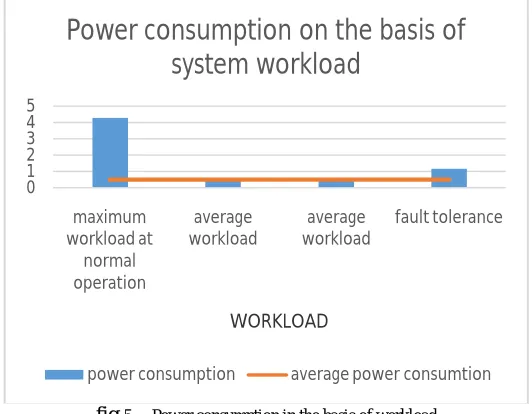
The power consumption increases with application as I/O pins consumes most of the power. At run time of application, power consumption observed in the system is given in TABLE-II.
The power consumption increases with application as I/O pins consumes maximum of the power. At run time of application, power consumption observed in the system is specified in TABLE-II.
TABLE-II
POWER CONSUMPTION SMART LIBRARY ASSISTANT DEVICE(WATT) Components Power Consumption
LCD Display 8.2mW GPIO 4W Processor 1 165mW
Total power 4.1732 W
The power consumption during fault tolerance is specified in TABLE-III TABLE-III
POWER CONSUMPTION DURING FAULT TOLERANCE(WATT)
Components Power Consumption
UART0 0.5W
UART1 0.5W
Processor 2 165mW
Total power 1.16W
Power consumption of proposed system on the basis of workload is represented as given in fig.5
fig 5. Power consumption in the basis of workload
VI.EXTENSION AND FUTURE WORK
The proposed hardware platform works as experimental setup for different research projects, various low power techniques and fault tolerance techniques. The platform can be used for following research work-
1. The low power hard real time system can be implemented by using this platform.
2. The different fault tolerance techniques can be implemented such as “2 out of “2 hardware redundancy with voter [1], [13], N- version programing [1][11] and many more.
3. The two microcontrollers are connected in such a way that they can interrupt, restart and turn on/ off each other [1].
4. Each of the microcontroller can access the internal parts of the other via JTAG [1], this will be helpful to implement fault detection mechanism that require comparing parts of a processor with their correspondents in the other one [1].
5. There are interconnections to transfer date, internal, states, and check points between the microcontrollers [1].
VII. CONCLUSION
In this system, we propose a platform for power management techniques and fault tolerance techniques for multiprocessor embedded system. By using Peripheral power down and DPM techniques minimum power consumption can be achieved for “Smart library assistant device”. The platform is also equipped with power measurement unit, debugging unit and facilities for experimenting with different fault tolerance techniques. Although this platform is general and can be designed for any COTS devices and embedded processors.
VIII. ACKNOWLEDGMENTS
The author(s) would like to thank the reviewers for selecting this article and giving me this wonderful opportunity. It has helped me in doing a lot of Research and I came to know about so many new things. And I will keep working on it in future also.
REFERENCES
[1] Mohammad Salehi and Alireza Ejlali , “A Hardware Platform for Evaluating Low-Energy Multiprocessor Embedded Systems Based on COTS Devices” , IEEE Transactions on industrial electronics , vol. 62 No 2, February 2015
0 1 2 3 4 5 maximum workload at normal operation average workload average workload fault tolerance WORKLOAD
Power consumption on the basis of
system workload
[2] A. Ejlali, B. M. Al-Hashimi, and P. Eles, “Low-energy standby-sparing for hard real-time systems,” IEEE Trans. Comput.-Aided Design Integr. Circuits Syst., vol. 31, no. 3, pp. 329–342, Mar. 2012.
[3] S. Aminzadeh and A. Ejlali, “A comparative study of system-level energy management methods for fault-tolerant hard real-time systems,” IEEE Trans. Comput., vol. 60, no. 9, pp. 1288–1299, Sep. 2011.
[4] A. Malinowski and H. Yu, “Comparison of embedded system design for industrial applications , ” IEEETrans.Ind.Informat.,vol.7,no.2,pp.244– 254, May 2011. [5] J. Henkel and S. Parameswaran, Designing Embedded Processors: A Low Power Perspective. Berlin, Germany: Springer-Verlag, 2007.
[6] P. Marti, M. Velasco, J. M. Fuertes, A. Camacho, and G. Buttazzo, “Design of an embedded control system laboratory experiment,” IEEE Trans. Ind. Electron., vol. 57, no. 10, pp. 3297–3307, Oct. 2010.
[7] T. Yang, G. Zhang, and X. Hu, “System design of current transformer accuracy tester based on ARM,” in Proc. 8th IEEE Conf. Ind. Electron. Appl., Jun. 19–21, 2013, pp. 634–639.
[8] H. Guzman-Miranda, L. Sterpone, M. Violante, M. A. Aguirre, and M. Gutierrez-Rizo, “Coping with the obsolescence of safety- or missioncritical embedded systems using FPGAs,” IEEE Trans. Ind. Electron., vol. 58, no. 3, pp. 814–821, Mar. 2011.
[9] Virtex-6 FPGA ML605 Evaluation Kit, Xilinx, San Jose, CA, USA, 2012. [10]ARM-basedFlashMCUSAM7xSeries,AtmelCorp.,SanJose,CA,USA, Feb. 11, 2014.
[11] R.-T. Wang, “A dependent model for fault tolerant software systems during debugging,” IEEE Trans. Rel., vol. 61, no. 2, pp. 504–515, Jun. 2012.
[12] J. Pouwelse, K. Langendoen, and H. Sips, “Dynamic voltage scaling on a low-power microprocessor , ”inProc.7thACMInt.Conf.MobiComNetw., 2001, pp. 251–259.
[13] Y. S. Hwang and K. S. Chung, “Dynamic power management technique for multicore based embedded mobile devices,” IEEE Trans. Ind. Informat., vol. 9, no. 3, pp. 1601–1612, Aug. 2013.
[14] M. Idirin, X. Aizpurua, A. Villaro, J. Legarda, and J. Melendez, “Implementation details and safety analysis of a microcontroller-based SIL-4 software voter,” IEEE Trans. Ind. Electron., vol. 58, no. 3, pp. 822–829, Mar. 2011.
[15]R.WangandS.Yang,“The design of a rapid prototype platform for ARM based embedded system,” IEEE Trans. Consum. Electron, vol. 50, no. 2,
BIOGRAPHY
![Fig. ARM-7 based microcontroller architecture [1]](https://thumb-us.123doks.com/thumbv2/123dok_us/1648001.1206260/3.595.150.464.535.720/fig-arm-based-microcontroller-architecture.webp)