LIU, XIAONI. New Methods Using Levene Type Tests For Hypotheses About
Dispersion Differences. (Under the direction of Professors Dennis Boos and Cavell
Brownie).
Testing equality of scale arises in many research areas including clinical data
analysis. In contrast to procedures for tests on means, tests for variances derived
assuming normality of the parent populations are highly non-robust to non-normality.
Levene type tests are well known to be robust tests for equality of scale for the
one-way design; the current standard test uses the ANOVAF test on absolute deviations
from the sample medians. We first develop a new modified version of the standard
Levene test that improves its null performance and power. Applying a Box-Andersen
correction to the ANOVAF test further improves the performance.
We also extend the robust Levene type tests to the two-way design with one
observation per cell, the randomized complete block design (RCB). Currently, the
available Levene type tests for RCB designs employ either standard ANOVAF tests
on the absolute values of ordinary least squares (OLS) residuals, or weighted least
squares (WLS) ANOVAF tests on the OLS residuals. These two tests can be liberal,
especially under non-normal distributions. Instead, we use OLS ANOVA F tests on
the absolute values of residuals obtained from models fit by least absolute deviation
by
Xiaoni Liu
A dissertation submitted to the Graduate Faculty of North Carolina State University
in partial fulfillment of the requirements for the Degree of
Doctor of Philosophy
STATISTICS
Raleigh 2006
Approved By:
Dennis Boos Cavell Brownie
Chair of Advisory Committee Co-Chair of Advisory Committee
Biography
Xiaoni Liu was born on December 1st, 1978 to Xinhua Liu and Zhongzhen Xie in
Shaoyang, China. She graduated from No. 2 High School in Shaoyang in 1996. From
September 1996 to July 2001, Xiaoni attended University of Science and
Technol-ogy of China (USTC), Hefei, Anhui Province, China, where she received a Bachelor
of Science degree in Science and English and a Bachelor of Engineering Degree in
Computer Science in July 2001. From August 2001 to July 2002, she studied in the
Department of Mathematics and Statistics at the University of North Florida. She
then joined the graduate program in the Department of Statistics at North Carolina
State University in August 2002. In May 2004, she earned her Master of Statistics
degree at North Carolina State University. She continued her studies towards a Ph.D
degree in statistics at North Carolina State University. Xiaoni was recognized as
Acknowledgements
First, I would like to express my deepest appreciation to both of my advisors: Dr.
Dennis Boos and Dr. Cavell Brownie and thank them for their valuable ideas, helpful
comments, great support, continuous encouragement and kind patience. Without
their help and advising, I can’t imagine completing my dissertation. I feel very lucky
to have worked with them and have benefited from their valuable experience. In
addition, I would like to extend my profound gratitude to Drs. David Dickey and
Jason Osborne for their great advice and the time they dedicated to reviewing my
thesis.
I would like to thank the entire statistics department for support in the past
four years with special thanks to Dr. Sastry Pantula, Dr. William Swallow and
Dr. Leonard Stefanski for financial support and supervision, Dr. Peter Bloomfield
for his great comments on my research, and Mr. Terry Byron for computing
sup-port. My special thanks also go to Drs. Bibhuti Bhattacharyya, Marie Davidian,
Jacqueline Hughes-Oliver, Anastasios Tsiatis, Daowen Zhang and Helen Zhang for
their wonderful lectures.
I also want to thank my dear friends, Xing Sun, Qiong Wang, Liyun Ma, Yun
Chen, Guozhi Gao, Zhaoling Meng, Xiaohui Luo, Xiang Guo, Jiajun Liu, Feng Liu
and Xi Chen for their friendship. They make me feel that life is so beautiful.
Finally, my most heartfelt thanks go to my dearest parents and brother, for their
Contents
List of Figures vii
List of Tables viii
1 The Modified LevMed Test for a One-Way Design 1
1.1 Introduction . . . 1
1.1.1 Normal Theory Tests . . . 2
1.1.2 Robust Variance Tests . . . 5
1.2 The LevMed Test and the Modified LevMed Test . . . 8
1.2.1 Model . . . 8
1.2.2 The LevMed Test . . . 9
1.2.3 The Modified LevMed Test . . . 12
1.2.4 Small Sample Properties of the LevMed and Modified LevMed Variables . . . 15
1.3 Simulations . . . 23
1.3.1 Other Tests for equality of variances or Scale . . . 23
1.3.2 Null Simulations . . . 26
1.3.3 Power . . . 33
1.4 Example . . . 34
1.5 Comparison with the Hines LevMed Test (Hines and Hines, 2000) . . 37
1.6 Conclusion . . . 40
1.7 Appendix . . . 41
2 New Methods Using Levene Type Tests for RCB Design 56 2.1 Introducation . . . 56
2.1.1 Model . . . 57
2.1.2 Normal-Theory Tests . . . 59
2.2 Levene Type Tests for the Two-Way RCB Design . . . 61
2.2.1 Existing Methods . . . 61
2.3 Simulation . . . 68
2.3.1 Situation I: HT0 and HB0 Both True . . . 70
2.3.2 Situation II: HT0 True, HB0 False . . . 73
2.3.3 Situation III: HT0 False, HB0 True . . . 76
2.3.4 Situation IV: HT0 and HB0 Both False . . . 79
2.3.5 Summary of Simulation Results . . . 81
2.4 Example . . . 83
2.5 Conclusion . . . 86
List of Figures
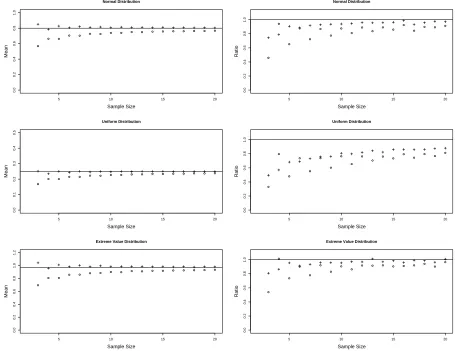
1.1 Left Side: Monte Carlo Estimates of Expectations of the Sample Means for each of the scale variables, Z and Z∗
versus Sample Size. Right Side: Monte Carlo Estimates (n∗s2
b
µ)/s2 for Z and Z
∗
versus Sample Size. ◦ ◦ ◦LevMed Scale or Z, +++ Modified LevMed Scale orZ∗
. 17 1.2 Estimated levels versus sample sizes for the normal distribution.
Stan-dard deviations of plotted values are bounded by (40000)−1/2
=.005. 42 1.3 Estimated levels versus sample sizes for the uniform distribution.
Stan-dard deviations of plotted values are bounded by (40000)−1/2
=.005. 43 1.4 Estimated levels versus sample sizes for the extreme value distribution.
Standard deviations of plotted values are bounded by (40000)−1/2
=.005. 44 1.5 Plots of estimated Type I error rates versus sample size for the modified
LevMed procedure local smoother added. . . 45 1.6 Local smoother of estimated Type I error rate versus sample size for
the modified LevMed procedure. . . 46 1.7 Estimated levels versus sample sizes for the normal distribution.
Stan-dard deviations of plotted values are bounded by (40000)−1/2
=.005. 47 1.8 Estimated levels versus sample sizes for the uniform distribution.
Stan-dard deviations of plotted values are bounded by (40000)−1/2
=.005. 48 1.9 Estimated levels versus sample sizes for the extreme value distribution.
Standard deviations of plotted values are bounded by (40000)−1/2
List of Tables
1.1 Estimates of Correlations within Samples for the Scale Variables . . . 20 1.2 Estimates of Correlation between SSR and SSE . . . 22 1.3 Estimated Levels for the Normal Distribution,α= 0.05 . . . 27 1.4 Estimated Levels for the Uniform distribution, α= 0.05 . . . 28 1.5 Estimated Levels for the Extreme Value distribution,α = 0.05 . . . . 29 1.6 Estimated Levels of Nominal 0.05 tests for Unbalanced Designs . . . 31 1.7 Comparison of Average Power Among the Six Tests . . . 34 1.8 Summary Statistics of Data from Off-Line Quality Control Study . . 35 1.9 P-Values for tests of equality of within chip variance using subsets of
data from an Off-Line Quality Control Study . . . 36 1.10 Comparison of Estimates of Levels between the Modified LevMed test
and Hines test for Even Sample Sizes . . . 38 1.11 Estimated Power for the Normal Distribution, α= 0.05. . . 50 1.12 Estimated Power for the Uniform Distribution, α= 0.05. . . 52 1.13 Estimated Power for the Extreme Value Distribution, α = 0.05. . . . 54 2.1 Data Array for the RCB Design . . . 57 2.2 Estimated Levels of Variance Tests in the RCB Design. . . 71 2.3 Estimated Levels of Variance Tests (Bootstrap Versions) in the RCB
Design . . . 72 2.4 Estimated Levels for Tests across Treatments and Power for Tests
across Blocks in the RCB Design . . . 74 2.5 Estimated Levels for Bootstrap Tests across Treatments and Power for
Bootstrap Tests across Blocks in the RCB Design . . . 75 2.6 Estimated Levels for Tests across Blocks and Power for Tests across
Treatments for the RCB Design . . . 77 2.7 Estimated Levels for Bootstrap Tests across Blocks and Power for
2.10 Part of Dataset GN24 on the FDA Website . . . 83 2.11 P-Values for Variance Equality across Blocks and Variance Equality
Chapter 1
The Modified LevMed Test for a
One-Way Design
1.1
Introduction
Testing equality of variances is of interest in many applications including quality
control in industry, development of educational methods, and studies on variability
in biological populations. Even in clinical research, comparing variability can be as
important as comparing averages. Zwinderman and Cleophas (2005) summarized the
main applications of variance tests in clinical research and gave some situations where
variability is more relevant than means in clinical data analysis. For example, it is
important to compare variability in response for different formulations of a drug,
also be used to compare variability in patient characteristics for different treatment
groups.
Another context in which homogeneity of variances is tested is as a preliminary to
some standard statistical procedures. For example, theF test for equality of variances
is sometimes suggested in order to decide whether to use the pooled variance t-test
or the unequal variance Welch t-test to test equality of two means. In general, it is
recommended not to use this preliminary test approach, partly because normal theory
tests for means, such as the pooledttest, are robust to non-normality, whereas normal
theory tests for variances, such as the F test, are highly sensitive to departures from
normality. So typically, it is better to decide whether to use the pooled variance
t-test or the unequal variance Welch t-test based on other grounds, such as whether
the groups were randomly assigned or not.
1.1.1
Normal Theory Tests
The common normal theory variance tests include the F test for two populations,
Bartlett’s test (Bartlett, 1937) and Hartley’s test (Hartley, 1950b) fork(k ≥2)
popu-lations. Let{Xi1,· · · , Xini, i= 1,· · · , k}representk independent samples, where for
theith sample,{Xij, j = 1,· · ·, ni}, the sample members are iid normally distributed,
N(µi, σ2
i). In this situation,s2i = ni1−1
Pni
The F Test for k = 2 Populations
The F test is the classical normal theory test to compare variability of two
pop-ulations. For the alternative hypothesis H1 :σ2
1 6=σ22, we use the F test statistic
F = s 2 1 s2 2
(1.1)
and reject the null hypothesis when F is greater than the 100(1−α/2)th percentile
or less than 100(α/2)th percentile of theF distribution withn1−1 andn2−1 degrees
of freedom, wheren1 and n2 are sample sizes for the two groups.
Bartlett’s Test for k ≥2 Populations
The normal theory likelihood ratio statistic for testing H0 :σ12 =· · ·=σk2 is
B = (N −k) lns2p− k
X
i=1
(ni −1) lns2i, (1.2)
where s2 p =
Pk
i=1(ni−1)s2i/(N −k) and N =
Pk
i=1ni. A correction factor is
C = 1 + 1
3(k−1) k
X
i=1 1 ni−1 −
1 N −k
!
. (1.3)
Bartlett’s test statistic is the bias-corrected statistic:
The null hypothesis is rejected when Bc is greater than the 100(1−α)th percentile
of the chi-squared distribution with (k−1) degrees of freedom.
Hartley’s Test for k≥2 Populations
Hartley (1950b) proposed the maximumF-ratio as a short-cut test for
homogene-ity of variances for unbalanced designs under the normal distribution. Supposes2 max is the largest sample variance ands2
min is the smallest sample variance among thek sample variances.
Hartley’s test statistic is
F = s 2 max s2
min
. (1.5)
The null hypothesis is rejected when F is greater than the 100(1−α)th percentile of
theFmax distribution (Hartley, 1950b) withk andn−1 degrees of freedom assuming
balanced designs.
The F test and Bartlett’s test are the most popular normal theory tests taught
in elementary statistical courses. In particular, Bartlett’s test has good power under
normality, even for unequal sample sizes. However, it is well known to be highly
sensitive to non-normality (Box, 1953). Therefore, it is not recommended to be used
1.1.2
Robust Variance Tests
The non-robustness of normal theory tests for equality of variances results because
test statistics are not asymptotically distribution-free but depend on the kurtosis of
the parent distribution. Thus, in the past 50 years, a number of tests have been
proposed to solve this problem, that is, to be Type I error robust to non-normality.
To paraphrase Boos and Brownie (2004), the three approaches used to construct
robust tests are:
1. to use an estimate of kurtosis to adjust the normal-theory test procedures (Box
and Andersen, 1955, Shoemaker, 2003)
2. to replace the observations in the original data set by scale variables such as
the absolute deviations from the mean or median followed by the ANOVA test
on the new data set (Levene, 1960, Miller, 1968, Brown and Forsythe, 1974);
a related procedure is to perform ANOVA on the jackknife pseudo-values of a
scale variable such as the log of the sample variance (Miller, 1968)
3. to get p values for a given test statistic with a resampling method (Box and
Andersen, 1955, Boos and Brownie, 1989).
Among the three approaches, we recommend the second approach in which t or
F tests on the scale variables are used to test homogeneity of variances or scale
for the original variables. The resulting tests are not only simple to implement but
propose procedures using the one-way ANOVA F test on the new variables Yij =
|Xij−Xi|, or more generally,Yij =g(|Xij−Xi|), whereg is monotonically increasing
on (0,∞). Miller (1968) showed that Yij =|Xij −Xi| is asymptotically incorrect for asymmetric populations, but that using the median instead of the mean to center
the spread variables is asymptotically correct. Brown and Forsythe (1974) formally
studied this modification of Levene’s method where the median was used instead
of the mean to center the variables. The one-way ANOVA F test on the spread
variables,Zij =|Xij−Mi|, whereMi is the sample median ofith group, is referred to
in the literature as the Brown-Forsythe test (e.g. SAS PROC GLM) or as Lev1:med
(Conover et al., 1981; Boos and Brownie, 1989, 2004). We will refer to it here as the
LevMed test. Brown and Forsythe (1974) and Conover et al. (1981) studied the small
sample properties of the LevMed test and demonstrated that it had satisfactory Type
I and Type II error properties for many distributions. However, Boos and Brownie
(1989), Lim and Loh (1996), and Shoemaker (2003) have noted that the LevMed test
can be conservative with loss of power. Boos and Brownie (1989) concluded that
null performance of the LevMed test will be generally good for sample sizes greater
than or equal to 8. However, for small and odd sample sizes, the test is extremely
conservative because of zero values of the scale variables inflating the estimate of
within-group variance in the denominator of the F statistic.
Layard (1973) developed the k-sample generalization of Miller’s two-sample
not as good as the LevMed test in terms of robustness. Boos and Brownie (1989)
applied the bootstrap technique to the LevMed test and to other tests for equality of
scale. The bootstrap version of the LevMed test performs better than the LevMed
test in terms of robustness and power, especially for small sample sizes. However,
these methods based on resampling are computationally more complicated than the
LevMed test, which can be performed with standard software.
Our aim is to propose a new test for equality of scale that is based on the LevMed
test, is simple to compute, and also performs better for small samples than the
LevMed test. The chapter is organized as follows. Section 2 defines the model,
describes the LevMed test in detail, introduces the modified LevMed test and
sum-marizes the results from preliminary simulations on the LevMed variables and the
modified LevMed variables. The asymptotic properties and small sample problems
of the LevMed test are introduced briefly. Section 3 describes the simulation results
for the performance of the modified LevMed test including the null performance and
power. This section also introduces some other tests and compares them to the
mod-ified LevMed test. Section 4 gives an example in which some of the robust tests are
compared. Section 5 compares the modified LevMed test to the Hines LevMed test
1.2
The LevMed Test and the Modified LevMed
Test
1.2.1
Model
Let {Xi1,· · · , Xini, i= 1,· · · , k} represent k independent samples, where for the
ith sample, {Xij, j = 1,· · · , ni}, the sample members are iid with distribution func-tion Gi(x) = G0((x − µi)/σi). Let N = Pki=1ni be the total sample size. We assume that G0(x) has mean 0 and variance 1, and finite fourth moment. To test
homogeneity of variances, the null hypothesis is H0 : σ12 = · · · = σ2k or equiva-lently H0 : σ1 = · · · = σk, where G0 and µi are unknown. Under the
location-scale family assumption, any other location-scale parameter such as the mean absolute
de-viation from the median is related to the standard dede-viation by E|Xij −θi| = cσi, i = 1, . . . , k, for some constant c. For example, if G0 is the standard normal
distri-bution, E|Xij−θi|=p2/πσi =.798σi, and herec= 0.798. Thus, a test for equality
1.2.2
The LevMed Test
Definition
Let Zij = |Xij −Mi|, where Mi is the sample median for the ith group. The
LevMed test is based on the one-way ANOVA statistic:
F =
Pk
i=1ni(Zi·−Z··)2/(k−1)
Pk i=1
Pni
j=1(Zij −Zi·)2/(N −k)
(1.6)
where Zi· =
Pni
j=1Zij/ni and Z·· =
Pk i=1
Pni
j=1Zij/N. The critical values of F in (1.6) are obtained from theF distribution withk−1 andN −k degrees of freedom.
Asymptotic Properties of the Mean Absolute Deviation from the Sample
Median
Here we use the M-estimator method to illustrate the asymptotic validity of
com-paring the LevMed F statistic to an F distribution. Basically, we demonstrate that
the denominator of the F statistic is estimating the common variance of the spread
variables under the null hypothesis. Miller (1968) was the first to give a related
asymptotic argument. To make the notation simpler, we work with a single sample
and just one subscript. Let X1,· · · , Xn be iid from distributionF, where F has
den-sity f, meanµ, median θ1, and the basic LevMed scale parameter is E|Xi−θ1|=θ2, and var(|Xi−θ1|) =θ3. We show that ntimes the asymptotic variance of the sample
Following the notation in Stefanski and Boos (2002), the estimators of interest
satisfy Pni=1ψ(Xi,θb) = 0, where
ψ(Xi, θ) =
1
2 −I(Xi ≤θ1)
|Xi−θ1| −θ2 (Xi−θ1)2−θ2
2 −θ3
. (1.7)
Note that θ3b is the sample variance of the basic spread variables |Xi −θ1b|. After
making some calculations, we have
A(θ0) =E[−ψ ′
(X1, θ0)] =
f(θ1) 0 0
0 1 0
2µ1−2θ1 2θ2 1
, (1.8)
B(θ0) =E[ψ(X1, θ0)ψ(X1, θ0)T], (1.9)
V(θ0) =A(θ0)
−1
B(θ0){A(θ0)
−1
}T. (1.10)
The (2,2) element of equation (1.10) is the asymptotic variance of √nθ2b:
v22 =µ′
where µ′
2 = E(Xi2). If the LevMed variable Zi = |Xi − θ1b| is a correct “spread variable,” we need v22 = θ3. On the other hand, expanding the definition of θ3, we
have
θ3 = E(Xi−θ1)2 −θ22 =µ′
2 −2µθ1+θ21−θ22, (1.12)
which is the same as v22. Thus, Zi is an appropriate spread variable to be used in t
orF statistics.
Shortcomings of the LevMed Test
Monte Carlo studies carried out by Conover et al. (1981) demonstrated the Type
I and Type II error robustness of the LevMed procedure for moderate sample sizes.
Boos and Brownie (1989) mentioned that when the sample size is odd and less than 8,
the test can be extremely conservative, because zero values ofZij inflate the estimate
of within-group variance in the denominator of the F statistic in equation (1.6).
Subtracting the sample median also causes correlation among the Zij within the
same group. To solve these problems due to subtracting the sample median (instead
of the true but unknown median), when sample sizes are odd and small, O’Brien
(1978) suggested deletion of one observation randomly from each group, and Conover
et al. (1981) suggested deletion of the middle observation in each group. O’Brien’s
suggestion leads to many possible outcomes for the same data set, and the idea of
deleting the smallest ordered Zi. A similar but different proposal was given in Hines
and Hines (2000).
1.2.3
The Modified LevMed Test
We propose a modification of the LevMed test with the goal of improving
perfor-mance when sample sizes are small (n <10). For the ith sample, let Zi(1),· · · , Zi(ni)
represent the ordered LevMed variables. The conservative behavior of the LevMed
test for ni small and odd, i = 1,· · ·, k, is explained in part by noting that Zi(1)
must be 0, and consequently the Zij tend to be negatively correlated and have an
inflated variance. Each of these properties will lead to conservative performance of
the ANOVAF test. When ni is even, a consequence of definingMi as the average of
the two middle Xij values is that Zi(1) =Zi(2). In small samples, Zi(1) =Zi(2) results in the within sample variance of Zij being too small, and liberal behavior of the F
test.
Our solution is to deleteZi(1) in each sample and carry out the ANOVAF test on the reduced set of Zij. The modified LevMed test (MLM) is carried out as follows:
1. Sort the set of the LevMed variables{Zij}within each sample, givingZi(1),· · · , Zi(ni).
2. Delete Zi(1) from each sample.
3. The remaining scale variables are the set of modified scale variables. We denote
them as{Z∗
Similar to the LevMed test, the modified LevMed test is based on the one-way
ANOVA statistic:
F∗
=
Pk
i=1(ni−1)(Z
∗
i·−Z ∗
··)
2/(k−1)
Pk i=1
Pni−1
j=1 (Z
∗
ij −Z
∗
i·)2/(N −2k)
(1.13)
whereZ∗i·=
Pni−1
j=1 Z
∗
ij/(ni−1) andZ
∗
·· =
Pk i=1
Pni−1
j=1 Z
∗
ij/(N−k). The critical values ofF∗
are obtained from theF distribution withk−1 andN−2k degrees of freedom.
The main step of the Levene type tests is to perform the one-way ANOVA test on
a scale variable such as the absolute deviation from the mean or the median. Such
scale variables are not normally distributed, which violates the normally-distributed
assumption of the ANOVA F test. However, the ANOVAF test has been shown to
be robust to non-normality due to the Central Limit Theorem. Box and Andersen
(1955) proposed a correction to the degrees of freedom of the ANOVA F test based
on permutation theory, which can improve the robustness of the ANOVA F test for
means. The main idea of this correction is to match the fourth sample moment of
the permutation test statistic to that of an F variable to get a correction factor by
which the degrees of freedom in the original ANOVA F test are multiplied.
Therefore, another test procedure is obtained by applying the Box-Andersen
de-grees of freedom correction to the one-way ANOVA F test on the modified LevMed
variables. We call this variation of the modified LevMed test the MLM-BA test which
is also based on the ANOVA statistic, F∗
n1 =n2 = 3, we can’t adjust the degrees of freedom of the ANOVA F test. In other
cases, we can adjust the degrees of freedom of the one-way ANOVAF test. Therefore,
except when k = 2, and n1 =n2 = 3, the critical values of F∗ are obtained from the
F distribution withd×(k−1) and d×(N−2k) degrees of freedom, whered relates
to the estimated kurtosis (Box and Andersen, 1955), and it is given by
d= 1 + N + 1 N −1
c2 (N−1
+A)−1
−c2,whereA=
N + 1 2(k−1)(N−k)
k2 N − k X i=1 1 ni ! . (1.14)
Herec2 is the estimated kurtosis for the whole sample,c2 =k4/k2
2, where
k4 = N(N + 1)S4−3(N −1)S 2 2
(N −1)(N −2)(N −3) , k2 = S2 N−1,
and Sr = k X i=1 ni X j=1
(Xij−X)r
where X is the overall mean of all N observations. For balanced designs with n1 =
n2 =· · ·=nk, we can simplify the formula (1.14) to
d= 1 + N + 1 N −1
1.2.4
Small Sample Properties of the LevMed and Modified
LevMed Variables
The LevMed test and the modified LevMed test are based on comparing the
one-way ANOVA F statistic to an F distribution. For the usual F statistic based
on sample means and variances, the main underlying assumptions are equality of
variances, independence of observations within samples, and normality of the
obser-vations. Various studies have focused on determining the impact of failures of these
assumptions. The effect of inequality of variances is fairly mild if the sample sizes
are roughly equal (Box, 1954). The effect of negative correlation within samples is
that the sample variance divided by sample size overestimates the variance of the
corresponding mean (Box, 1954), causing the test to be liberal. The F statistic is
fairly robust to deviations from normality. In general, kurtosis larger than the normal
distribution kurtosis causes the resulting test to be conservative (Box and Andersen,
1955). Skewness causes the numerator and denominator of the F statistic to be
correlated.
With spread variables used in the F statistics, we also have to worry about the
bias of the mean estimates and whether the sample variances of the variables
di-vided by sample size overestimate the variances of the estimated means due to the
correlation induced within samples by estimating the median. Thus, in the next
sub-sections we focus on these latter two concerns as well as on whether the numerator
Sample Means and Variances of LevMed and Modified LevMed Variables
In the usual one-way ANOVAF test, given independent samples{Xij, j = 1, . . . , ni},
i= 1,· · · , k, the sample meansXiand the sample variancess2
i are the building blocks of the F statistic. For the usual ANOVA F test, we have E(Xi) = µi (mean unbi-asedness), and var(Xi) can be estimated by s2
i/ni (unless there is correlation within samples). Actually, we use the pooled estimate of variance s2
P/ni. In a previous
sec-tion, we showed that for the ith sample, asymptotically the sample variance of the
LevMed Zij divided by the ith sample size, ni, estimates the variance of the mean
of the Zij, var(Zi·). Here we explore by simulation how well this property holds in
small samples. In addition we study the small sample bias of the sample mean of
the LevMed and the modified LevMed variables. The bias itself is not the concern,
but the fact that the bias changes with sample size is a problem for data sets where
the ni are small and different. Thus, under a null hypothesis of equal scale, if the bias is different for different sample sizes, then given unbalanced data, the numerator
of the F statistic will tend to be proportional to a variable more like a noncentral
chisquared distribution than the required central chisquared distribution.
Suppose that we draw a small sample {Xj, j = 1,· · · , n} from a population with
known distribution. The sample median is θ1b. The LevMed variables are {Zj =
|Xj−θb1|, j = 1,· · · , n}and the modified LevMed variables are{Zj∗, j = 1,· · · , n−1}. In the Monte Carlo simulation, we generate S = 10,000 such samples. For the ith
Monte Carlo sample, letµib be the sample mean of theZorZ∗
, and lets2
variance of the Z orZ∗
. The average over replicates of bµi isµb= (1/S)PSi=1bµi. This estimates E(1/n)Pnj=1|Xj−θ1b|, which in turn should estimate θ2 = E|X1−θ1|, the mean absolute deviation from the true median θ1.
5 10 15 20
0.0 0.2 0.4 0.6 0.8 1.0 Sample Size Mean Normal Distribution
5 10 15 20
0.0 0.1 0.2 0.3 0.4 0.5 Sample Size Mean Uniform Distribution
5 10 15 20
0.0 0.2 0.4 0.6 0.8 1.0 1.2 Sample Size Mean
Extreme Value Distribution
5 10 15 20
0.0 0.2 0.4 0.6 0.8 1.0 Sample Size Ratio Normal Distribution
5 10 15 20
0.0 0.2 0.4 0.6 0.8 1.0 Sample Size Ratio Uniform Distribution
5 10 15 20
0.0 0.2 0.4 0.6 0.8 1.0 Sample Size Ratio
Extreme Value Distribution
Figure 1.1: Left Side: Monte Carlo Estimates of Expectations of the Sample Means for each of the scale variables,Z andZ∗
versus Sample Size. Right Side: Monte Carlo Estimates (n∗s2µb)/s2 for Z and Z∗
versus Sample Size. ◦ ◦ ◦ LevMed Scale or Z, +++ Modified LevMed Scale or Z∗
The left panels of Figure 1.1 give these average estimates µb versus sample size
value(0,1) distributions. The horizontal line is for the desired target θ2. Clearly the
“+” symbols for the modified LevMed variable are much more stable as n changes
than the LevMed variable represented by open circles. For example, the values
esti-mated by the mean of the LevMed variables at n = 3 and n = 6 are quite different,
whereas the corresponding values for the modified LevMed variables are quite close.
By n = 10 both sets of means are fairly stable, although the means of the
modi-fied variables, Z∗
are closer on average to the true values of θ2, 0.80, 0.25, and 0.97,
respectively, for the three distributions.
The average of the sample variances is s2 = (1/S)PS
i=1s2i. We also obtain the Monte Carlo sample variance of the µib, s2
b
µ = (S−1)
−1PS
i=1(bµi −µb)2. This latter quantity estimates var(µib), the true variance of the mean estimate. Validity of the
F test requires that var(µbi) be estimated by s2/n for each sample. Thus, we want s2 ≈ n∗s2
b
µ. To examine whether this relationship holds, we calculated the ratio (n∗s2
b
µ)/s2 for each of the two scale variables for each sample size and distribution. If this ratio is less than one, then the sample variances are too large on average, and
we might extrapolate that the denominator of the F statistic will be too large on
average.
The right panels of Figure 1.1 give these ratios for the three distributions. The
horizontal line is for the target value of 1. Again, we see that the modified LevMed
variables are more stable as n changes and also closer to the target value than the
distribution than for the other two distributions. The LevMed ratio is especially low
for n = 3. This can be anticipated due to the single 0 value inflating the sample
variance.
Correlation within the Samples
In the usual one-way ANOVA F test, one of the assumptions is that the
observa-tions within samples are independent. In this part, we focus on the correlation within
the samples for the scale variables Z and Z∗
.
In the simulation, the distributions are again normal, uniform, and extreme value.
The sample sizes configurations are: (I) n=3, (II) n=4, (III) n=5, (IV) n=6, (V)
n=20 and (VI) n=100. The number of Monte Carlo replications is S=10,000. The
within-sample correlation estimates are summarized in Table 1.1. We compute these
entries as follows. First, we generate a sample {X1,· · · , Xn}, then center them to
get the LevMed variables, {Zj, j = 1,· · · , n} , or the modified LevMed variables,
{Z∗
j, j = 1,· · · , n−1}. After that, we calculate the correlation between every pair of scale variables and get the average. For example, whenn = 3, we generate a random
sample, {X1, X2, X3}. After centering, we get the LevMed variables, {Z1, Z2, Z3}.
After that, we compute estimated correlations across all S samples between Z1 and
Z2, between Z1 and Z3 and between Z2 and Z3. The average of the 3 estimated
correlations is the entry for LevMed under n= 3.
medians instead of sample medians to calculate the Z values. As we expect, the
correlation estimates for the LevMed(θ1) are essentially 0 for all the cases. For small
sample sizes, both the LevMed variables and the modified LevMed variables lead to
negative within-sample correlations. The effect of negative correlation within samples
is that the sample variance divided by sample size overestimates the variance of the
corresponding mean, causing the test to be conservative. It is apparent that the
within-sample correlations are more strongly negative for the LevMed variables than
for the modified variables, for n odd and small.
Table 1.1: Estimates of Correlations within Samples for the Scale Variables Sample Size
Distribution Test n=3 n=4 n=5 n=6 n=20 n=100
Normal LevMed(θ1) 0.00 0.00 0.01 0.00 0.00 0.00
LevMed −0.21 −0.01 −0.07 −0.02 0.00 0.00 MLM −0.15 −0.07 −0.04 −0.02 0.00 0.00 Uniform LevMed(θ1) 0.00 0.00 0.00 0.00 0.00 0.00 LevMed −0.29 −0.05 −0.12 −0.04 −0.01 0.00 MLM −0.25 −0.16 −0.10 −0.06 −0.01 0.00 Extreme LevMed(θ1) 0.00 0.00 0.00 0.00 0.00 0.00 Value LevMed −0.18 0.00 −0.06 −0.02 0.00 0.00 MLM −0.12 −0.05 −0.03 −0.02 0.00 0.00 LevMed(θ1) is LevMed using known medians. Entries are based on 10,000 replications and have standard error ≤0.01.
Correlation between the Numerator and Denominator of the F Statistics
We also assess the correlation between SSR and SSE based on each of the two scale
variables because under the usual ANOVA assumptions, these two sums of squares
and SSE is the within-group or denominator sum of squares, for the F statistic.
For example, for the LevMed variables {Zij, i = 1,· · · , k;j = 1,· · · , ni}, SSR is
Pk
i=1ni(Zi·−Z··)2, and SSE is
Pk i=1
Pni
j=1(Zij −Zi·)2, where Zi·=
Pni
j=1Zij/ni and Z·· =
Pk i=1
Pni
j=1Zij/N. Thus the F statistic (1.6) can be written as
F = SSR/df(SSR)
SSE/df(SSE). (1.15)
In the simulation, the distributions are again normal, uniform, and extreme value.
The sample size configurations are: (I) n=3, (II) n=4, (III) n=5, (IV) n=6, (V) n=20
and (VI) n=100. The group size configurations are: (i) k=2, (ii) k=4 and (iii) k=8.
The number of Monte Carlo replications is S=10,000. The correlation estimates
between SSR and SSE are summarized in Table 1.2. The entries labeled LevMed(θ1)
are results for the LevMed variable using true medians instead of sample medians.
The point is that skewness of the variables will cause some amount of correlation, but
the best we might hope for is the correlation present when we use known medians.
For all distributions at n = 3, the correlations for the modified LevMed variables
are closer to the correlations of the known median case than are the original LevMed
variables. This reverses at the normal and uniform for n= 4. Generally, the
correla-tions are a little closer for the modified variables, but we have trouble drawing strong
Table 1.2: Estimates of Correlation between SSR and SSE
Sample Size
Distribution k Test n=3 n=4 n=5 n=6 n=20 n=100
Normal 2 LevMed(θ1) 0.12 0.11 0.11 0.08 0.05 0.03
LevMed 0.38 0.10 0.26 0.07 0.06 0.03
MLM 0.23 0.17 0.18 0.10 0.06 0.03
4 LevMed(θ1) 0.15 0.14 0.12 0.13 0.08 0.03
LevMed 0.47 0.12 0.29 0.14 0.10 0.03
MLM 0.26 0.22 0.19 0.17 0.10 0.03
8 LevMed(θ1) 0.17 0.14 0.14 0.13 0.08 0.03
LevMed 0.48 0.10 0.29 0.14 0.09 0.03
MLM 0.27 0.21 0.18 0.17 0.08 0.03
Uniform 2 LevMed(θ1) −0.28 −0.25 −0.25 −0.23 −0.15 −0.06 LevMed 0.12 −0.21 0.03 −0.17 −0.07 −0.04 MLM 0.09 −0.15 0.00 −0.12 −0.07 −0.04 4 LevMed(θ1) −0.34 −0.32 −0.30 −0.27 −0.16 −0.09 LevMed 0.15 −0.27 0.03 −0.22 −0.09 −0.08 MLM 0.11 −0.19 −0.03 −0.16 −0.09 −0.08 8 LevMed(θ1) −0.38 −0.36 −0.33 −0.32 −0.19 −0.09 LevMed 0.18 −0.29 0.04 −0.23 −0.11 −0.09 MLM 0.13 −0.21 −0.02 −0.16 −0.10 −0.09 Extreme Value 2 LevMed(θ1) 0.58 0.51 0.49 0.44 0.29 0.12
LevMed 0.65 0.35 0.50 0.37 0.24 0.10
MLM 0.53 0.48 0.45 0.41 0.24 0.10
4 LevMed(θ1) 0.63 0.60 0.53 0.51 0.32 0.17
LevMed 0.74 0.47 0.54 0.43 0.28 0.14
MLM 0.64 0.59 0.48 0.48 0.28 0.14
8 LevMed(θ1) 0.64 0.60 0.55 0.55 0.35 0.17
LevMed 0.77 0.45 0.59 0.47 0.30 0.14
MLM 0.65 0.59 0.53 0.51 0.30 0.14
LevMed(θ1) is LevMed using true medians. Entries are based on 10,000 replications and have standard error from 0.007 to 0.026.
Discussion
The simulation results of the previous subsections suggest that an F statistic
the original LevMed variables. However, because there are a number of competing
aspects, we proceed to a direct comparison of the test procedures in the next section.
1.3
Simulations
1.3.1
Other Tests for equality of variances or Scale
Our goal in this section is to compare by simulation the modified LevMed
proce-dures including the MLM test and the MLM-BA test to the classical LevMed
pro-cedure and to some other tests for equality of variances or scale. Because it is well
known that normal-theory tests such as Bartlett’s test are sensitive to non-normality,
and these have been reported on extensively elsewhere, we will not consider nonrobust
normal-theory tests here. The other robust tests used in our simulation are defined
in the next few subsections.
Shoemaker’s Test
Shoemaker (2003) proposed a new homogeneity of variances test that is robust to
non-normality. Let s2
i be the sample variance of theith sample,{Xij, j = 1,· · · , ni}, and qi = ln(s2i). Shoemaker (2003, p. 107) suggests
χ2 = k
X
i=1
(qi−q)2 1
ni−1
b
µ4
b
σ4 −
ni−3
ni
where µ4b = PiPj(Xij − Xi)4/N and bσ2 = P
i(ni − 1)s2i/N. The denominator of (1.16) is an estimate of var(qi) designed for small samples. Shoemaker (2003)
suggested using the harmonic mean of ni’s, nh = 1 k
n1+ 1
n2+
···+1
nk
instead of individual
ni in the formula (1.16). The critical values of χ2 are obtained from a chi-squared
distribution with k−1 degrees of freedom.
Procedure Based on Gini’s Mean Difference
Miller (1968) proposed a general method of constructing spread variables to be
used in the ANOVA F statistic based on jackknife pseudo-values. Here we use the
Miller idea with a well-known scale estimator, Gini’s mean difference, which is highly
efficient across a range of distributions (e.g., see Johnson and Kotz, 1970, p. 67).
For two independent observations from the ith group, Gini’s mean difference scale
parameter is θi = E|Xi1−Xi2|. It is unbiasedly estimated by the U-statistic
b
θi = 1 ni
2
X
j<k
|Xij −Xik|
or by the simpler to compute L-statistic version
b
θi = n1i 2
ni
X
j=1
(2j−ni−1)Xi(j),
To implement the Miller method, define the pseudo-values for the ith sample as
uij =niθib −(ni−1)θi,b−j,
where the notation θi,b−j refers to the estimator in the ith group with Xij removed
from the sample. The Gini test is then based on the one-way ANOVA F statistic of
the new variables,
FGINI = P
ini(¯ui·−u¯··)2/(k−1)
P
i
P
j(uij −u¯i·)2/
P
i(ni−1)
(1.17)
where ¯ui =Puij/ni and ¯u·· =
P P
uij/N. The critical values of FGINI are obtained
from the F-distribution withk−1 andN −k degrees of freedom.
Bootstrap Version of the LevMed Test
Boos and Brownie (1989) introduced the bootstrap technique for tests of scale
equality. Basically, the idea is to resample from the pooled set of residuals obtained
by subtracting group trimmed means within each sample. In the simulations of the
next subsection, we include a bootstrap version of LevMed. That is, the p-values
for the LevMed F statistic are obtained from a bootstrap resample procedure rather
than from the F distribution. Details may be found in Boos and Brownie (1989) or
1.3.2
Null Simulations
Comparison with Other Tests for Variances
We compare the Type I error robustness of the modified LevMed (MLM) test and
the MLM-BA test to the other four tests: the LevMed test (LM), Shoemaker’s (SH)
test, the F test on pseudo-values based on Gini’s mean difference (Gini), and the
bootstrap version of LevMed (BLM). The three distributions are: (1) Normal (0,1),
(2) Uniform (0,1), and (3) Extreme Value (0,1). The group size configurations are: (i)
k=2, (ii) k=4, and (iii) k=8. In the balanced design, the sample size configurations
are: (I) n = 3, (II) n = 4, (III) n = 5, (IV) n = 6, (V) n = 7, (VI) n = 8, (VII)
n = 9, (VIII) n = 10, (IX) n = 20, and (X) n = 100. We use S=1,000 Monte Carlo
replications. For BLM, the bootstrap replication size is B = 499. The nominal Type
I error rate is 0.05.
We summarize the results in Tables 1.3-1.5 for the three distributions, respectively.
Note that we only report two decimal places in the tables because the standard error
of the entries is approximately p(.95)(.05)/1000 =.007.
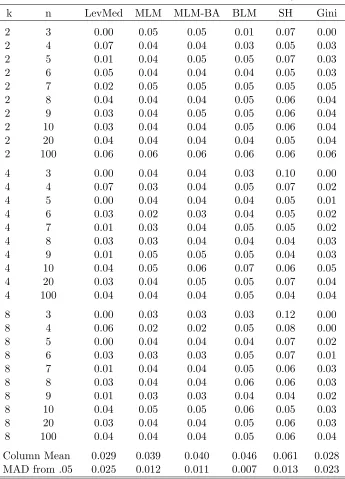
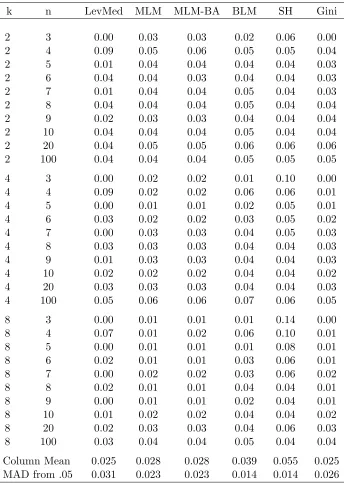
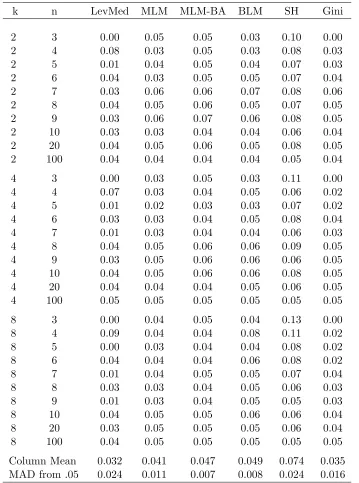
Tables 1.3-1.5 show that all six tests except Shoemaker’s test and LevMed for
n= 4 are conservative. Shoemaker’s test is liberal for many cases. At the bottom of
these three tables we have calculated a column mean and the mean absolute deviation
from .05, MAD = (1/30)P|entry −.05|. The column mean shows that the new
modified LevMed (MLM) is less conservative on average compared to the LevMed
Table 1.3: Estimated Levels for the Normal Distribution,α = 0.05
k n LevMed MLM MLM-BA BLM SH Gini
2 3 0.00 0.05 0.05 0.01 0.07 0.00
2 4 0.07 0.04 0.04 0.03 0.05 0.03
2 5 0.01 0.04 0.05 0.05 0.07 0.03
2 6 0.05 0.04 0.04 0.04 0.05 0.03
2 7 0.02 0.05 0.05 0.05 0.05 0.05
2 8 0.04 0.04 0.04 0.05 0.06 0.04
2 9 0.03 0.04 0.05 0.05 0.06 0.04
2 10 0.03 0.04 0.04 0.05 0.06 0.04
2 20 0.04 0.04 0.04 0.04 0.05 0.04
2 100 0.06 0.06 0.06 0.06 0.06 0.06
4 3 0.00 0.04 0.04 0.03 0.10 0.00
4 4 0.07 0.03 0.04 0.05 0.07 0.02
4 5 0.00 0.04 0.04 0.04 0.05 0.01
4 6 0.03 0.02 0.03 0.04 0.05 0.02
4 7 0.01 0.03 0.04 0.05 0.05 0.02
4 8 0.03 0.03 0.04 0.04 0.04 0.03
4 9 0.01 0.05 0.05 0.05 0.04 0.03
4 10 0.04 0.05 0.06 0.07 0.06 0.05
4 20 0.03 0.04 0.05 0.05 0.07 0.04
4 100 0.04 0.04 0.04 0.05 0.04 0.04
8 3 0.00 0.03 0.03 0.03 0.12 0.00
8 4 0.06 0.02 0.02 0.05 0.08 0.00
8 5 0.00 0.04 0.04 0.04 0.07 0.02
8 6 0.03 0.03 0.03 0.05 0.07 0.01
8 7 0.01 0.04 0.04 0.05 0.06 0.03
8 8 0.03 0.04 0.04 0.06 0.06 0.03
8 9 0.01 0.03 0.03 0.04 0.04 0.02
8 10 0.04 0.05 0.05 0.06 0.05 0.03
8 20 0.03 0.04 0.04 0.05 0.06 0.03
8 100 0.04 0.04 0.04 0.05 0.06 0.04
Column Mean 0.029 0.039 0.040 0.046 0.061 0.028
MAD from .05 0.025 0.012 0.011 0.007 0.013 0.023
Note: Entries based on 1,000 replications. Standard error of main
entries≤(.88∗.12/1000)1/2 =.01.“MAD from .05” is the mean
Table 1.4: Estimated Levels for the Uniform distribution, α= 0.05
k n LevMed MLM MLM-BA BLM SH Gini
2 3 0.00 0.03 0.03 0.02 0.06 0.00
2 4 0.09 0.05 0.06 0.05 0.05 0.04
2 5 0.01 0.04 0.04 0.04 0.04 0.03
2 6 0.04 0.04 0.03 0.04 0.04 0.03
2 7 0.01 0.04 0.04 0.05 0.04 0.03
2 8 0.04 0.04 0.04 0.05 0.04 0.04
2 9 0.02 0.03 0.03 0.04 0.04 0.04
2 10 0.04 0.04 0.04 0.05 0.04 0.04
2 20 0.04 0.05 0.05 0.06 0.06 0.06
2 100 0.04 0.04 0.04 0.05 0.05 0.05
4 3 0.00 0.02 0.02 0.01 0.10 0.00
4 4 0.09 0.02 0.02 0.06 0.06 0.01
4 5 0.00 0.01 0.01 0.02 0.05 0.01
4 6 0.03 0.02 0.02 0.03 0.05 0.02
4 7 0.00 0.03 0.03 0.04 0.05 0.03
4 8 0.03 0.03 0.03 0.04 0.04 0.03
4 9 0.01 0.03 0.03 0.04 0.04 0.03
4 10 0.02 0.02 0.02 0.04 0.04 0.02
4 20 0.03 0.03 0.03 0.04 0.04 0.03
4 100 0.05 0.06 0.06 0.07 0.06 0.05
8 3 0.00 0.01 0.01 0.01 0.14 0.00
8 4 0.07 0.01 0.02 0.06 0.10 0.01
8 5 0.00 0.01 0.01 0.01 0.08 0.01
8 6 0.02 0.01 0.01 0.03 0.06 0.01
8 7 0.00 0.02 0.02 0.03 0.06 0.02
8 8 0.02 0.01 0.01 0.04 0.04 0.01
8 9 0.00 0.01 0.01 0.02 0.04 0.01
8 10 0.01 0.02 0.02 0.04 0.04 0.02
8 20 0.02 0.03 0.03 0.04 0.06 0.03
8 100 0.03 0.04 0.04 0.05 0.04 0.04
Column Mean 0.025 0.028 0.028 0.039 0.055 0.025
MAD from .05 0.031 0.023 0.023 0.014 0.014 0.026
Note: Entries based on 1,000 replications. Standard error of main
entries≤(.86∗.14/1000)1/2 =.01.“MAD from .05” is the mean
Table 1.5: Estimated Levels for the Extreme Value distribution, α= 0.05
k n LevMed MLM MLM-BA BLM SH Gini
2 3 0.00 0.05 0.05 0.03 0.10 0.00
2 4 0.08 0.03 0.05 0.03 0.08 0.03
2 5 0.01 0.04 0.05 0.04 0.07 0.03
2 6 0.04 0.03 0.05 0.05 0.07 0.04
2 7 0.03 0.06 0.06 0.07 0.08 0.06
2 8 0.04 0.05 0.06 0.05 0.07 0.05
2 9 0.03 0.06 0.07 0.06 0.08 0.05
2 10 0.03 0.03 0.04 0.04 0.06 0.04
2 20 0.04 0.05 0.06 0.05 0.08 0.05
2 100 0.04 0.04 0.04 0.04 0.05 0.04
4 3 0.00 0.03 0.05 0.03 0.11 0.00
4 4 0.07 0.03 0.04 0.05 0.06 0.02
4 5 0.01 0.02 0.03 0.03 0.07 0.02
4 6 0.03 0.03 0.04 0.05 0.08 0.04
4 7 0.01 0.03 0.04 0.04 0.06 0.03
4 8 0.04 0.05 0.06 0.06 0.09 0.05
4 9 0.03 0.05 0.06 0.06 0.06 0.05
4 10 0.04 0.05 0.06 0.06 0.08 0.05
4 20 0.04 0.04 0.04 0.05 0.06 0.05
4 100 0.05 0.05 0.05 0.05 0.05 0.05
8 3 0.00 0.04 0.05 0.04 0.13 0.00
8 4 0.09 0.04 0.04 0.08 0.11 0.02
8 5 0.00 0.03 0.04 0.04 0.08 0.02
8 6 0.04 0.04 0.04 0.06 0.08 0.02
8 7 0.01 0.04 0.05 0.05 0.07 0.04
8 8 0.03 0.03 0.04 0.05 0.06 0.03
8 9 0.01 0.03 0.04 0.05 0.05 0.03
8 10 0.04 0.05 0.05 0.06 0.06 0.04
8 20 0.03 0.05 0.05 0.05 0.06 0.04
8 100 0.04 0.05 0.05 0.05 0.05 0.05
Column Mean 0.032 0.041 0.047 0.049 0.074 0.035
MAD from .05 0.024 0.011 0.007 0.008 0.024 0.016
Note: Entries based on 1,000 replications. Standard error of main
entries≤(.87∗.13/1000)1/2 =.01.“MAD from .05” is the mean
mean difference is the most conservative overall but appears to be slightly better than
the LevMed test for the extreme value distribution. An important conclusion from
these tables is that the new modified LevMed (MLM) is a definite improvement over
the established LevMed procedure for sample sizes n = 3 to n = 5. That was our
original goal for creating the modified procedure. Results from the MLM-BA test are
similar to the results from the MLM test for the normal distribution and the uniform
distribution. Under the extreme value distribution, the MLM-BA test improves the
performance of the MLM test, which shows that the Box-Andersen correction plays
an important role for skewed distributions. The good point is that the MLM-BA test
performs as well as the bootstrapped version, BLM.
Table 1.6 summarizes some results for unbalanced designs. The results for the
unbalanced designs are consistent with those for the balanced design. The modified
LevMed test also improves the null performance under the unbalanced design,
espe-cially for the normal and extreme value distributions. At the bottom of the table
we have also calculated a column mean and the MAD from .05. The column mean
shows that the modified LevMed test is less conservative on average compared to the
LevMed test, especially for the normal and extreme value distributions. The MAD
from .05 shows that the modified LevMed test can lead to estimates of significance
levels closer to the nominal rate than the LevMed test. Table 1.6 does not include
Table 1.6: Estimated Levels of Nominal 0.05 tests for Unbalanced Designs Distribution
Sample Size Normal Uniform Extreme Value
LevMed MLM LevMed MLM LevMed MLM
(5,15) 0.02 0.05 0.02 0.04 0.02 0.04
(3,4) 0.04 0.05 0.04 0.04 0.04 0.04
(3,8) 0.01 0.04 0.04 0.02 0.02 0.05
(4,7) 0.03 0.03 0.03 0.03 0.04 0.04
(5,20) 0.03 0.04 0.07 0.05 0.02 0.06
(6,19) 0.04 0.04 0.04 0.03 0.03 0.04
(5,5,15,15) 0.01 0.04 0.02 0.02 0.03 0.06
(5,5,5,15) 0.00 0.04 0.01 0.03 0.01 0.05
(5,15,15,15) 0.02 0.05 0.02 0.03 0.03 0.05
(3,3,4,4) 0.03 0.02 0.03 0.03 0.03 0.05
(3,3,3,4) 0.01 0.04 0.01 0.01 0.01 0.04
(3,4,4,4) 0.05 0.03 0.05 0.02 0.05 0.04
(4,4,7,7) 0.03 0.04 0.02 0.02 0.04 0.04
(4,4,4,7) 0.04 0.03 0.04 0.03 0.04 0.03
(4,7,7,7) 0.01 0.03 0.01 0.03 0.02 0.03
(3,3,8,8) 0.02 0.04 0.02 0.01 0.01 0.05
(3,3,3,8) 0.01 0.05 0.01 0.02 0.01 0.05
(3,8,8,8) 0.03 0.04 0.03 0.02 0.03 0.06
(5,5,5,5,15,15,15,15) 0.01 0.04 0.01 0.01 0.02 0.06
(5,5,5,5,5,5,5,15) 0.00 0.03 0.00 0.01 0.01 0.06
(5,15,15,15,15,15,15,15) 0.02 0.04 0.00 0.02 0.02 0.04
Column Mean 0.021 0.037 0.024 0.025 0.025 0.047
MAD from 0.05 0.029 0.013 0.027 0.025 0.025 0.009
Entries are based on 1,000 replications. Standard Error of individual entries
≤(.93∗.07/1000)1/2 = 0.01
Relationship between the Estimated Type I Error Rates and Sample Sizes
and Number of Groups
To further illustrate the comparison between the LevMed test and the new
modi-fication, we have increased the Monte Carlo sample size to S=10,000 replications and
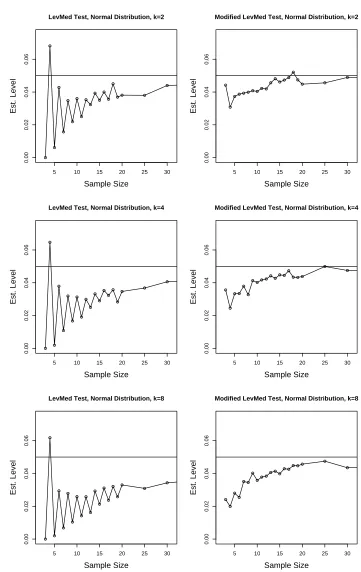
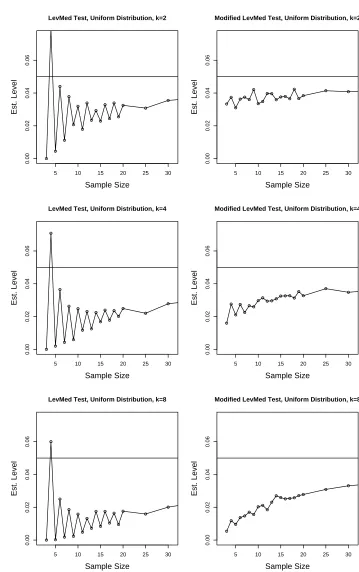
with the LevMed on the left and the new modification on the right. Figures 1.2-1.4
are for the normal distribution, the uniform distribution, and the extreme value
dis-tribution, respectively. Figures 1.2-1.4 are at the end of the chapter due to space
considerations.
The plots for the modified LevMed test are much more stable than those for the
LevMed test. The ranges of the estimated levels (from 0.02 to 0.05) for the modified
LevMed test are much smaller than the ranges of the LevMed test (from 0 to 0.07) for
small sample sizes. As k increases, both the LevMed test and the modified LevMed
test become more conservative for small sample sizes.
Finally, we give two more pages of plots at the end of the chapter to illustrate
better how the Type I error rates of the modified LevMed procedure change as k
increases. In Figure 1.5 we have taken the data from Figures 1.2-1.4 and put the
graphs for a given distribution on the same row with k increasing as we move from
left to right. In addition we have used a local smoother to track the trend as sample
size increases. In Figure 1.6 we have put the local smoothers for all three group
numbers, k = 2, k = 4, and k = 8, on the same plot but without the individual
points. In both sets of plots we can see that an increase ink causes the procedure to
1.3.3
Power
We now compare the power of the modified LevMed test (MLM) and the
MLM-BA test to power of the other 4 tests. The sample size configurations are n=3, 4, 5, 6,
7, 8, 9, 10, and 20. The variance configurations are (1:4), (1:8), (1:6:11:16), (1:1:1:16),
(1:1:1:8:8:8:16:16) and (1:1:1:1:1:1:16:16). We use S=1,000 Monte Carlo replications
with the nominal rate equal to 0.05. The results are summarized in Tables 1.11-1.13
at the end of the chapter.
In these tables we see important power gains at n= 3,5,7,and 9 for the modified
LevMed procedure compared to LevMed. When sample sizes reach n = 20 all the
procedures are similar in power. A very crude summary is to take the mean of the
columns for each table. The results are summarized in Table 1.7. The underline
emphasizes the most powerful test for every distribution. Thus, the modified
pro-cedure has an overall gain in power of about .05 when compared to LevMed, and
the bootstrapped LevMed has an average .02 gain in power compared to the
mod-ified procedure. Amazingly, the MLM-BA test generally has higher power than the
bootstrapped LevMed test and the MLM-BA test is much simpler to perform, which
indicates that the Box-Andersen correction can improve the power of the modified
LevMed test. The Gini procedure has power in between the LevMed and the modified
LevMed procedure. The Shoemaker procedure has good power, but the comparison
Table 1.7: Comparison of Average Power Among the Six Tests Distribution
Test Normal Uniform Extreme Value
LevMed 0.48 0.53 0.43
MLM 0.53 0.57 0.48
MLM-BA 0.56 0.60 0.52
BLM 0.55 0.59 0.50
SH 0.54 0.61 0.51
Gini 0.51 0.59 0.45
Note: Entries based on the results of Table 1.11-1.13.
Standard error of entries≤0.002.
1.4
Example
Phadke et. al (1983) reported on an off-line quality control experiment in the
fabrication of integrated circuit chips. We will use part of the data to illustrate the 6
tests used in the simulations.
In order to choose process conditions to minimize variance in contact window
sizes of integrated circuit chips, Phadke et. al (1983) conducted an experiment with
18 combinations of levels of factors. For every experimental unit (of 18
experimen-tal units), there are 5 specific measured locations such as “Top,” “Bottom,” “Left,”
“Right,” and “Center” locations. Most of the experimental units have 10
observa-tions (2 measurements for every location) except units 5, 15 and 18 which have 5
observations (only 1 measurement for every location). We use part of the “pre-etch”
window size data to compare the six tests. In our example, if we use the
experimen-tal units 1-4, then k = 4 and if we use experiments 1-8, then k = 8. If we use the
unit is measured at the “Top,” “Center,” “Bottom,” locations. If we use the first
4 observations for every experimental unit, then n = 4, and the experimental unit
is measured at the “Top,” “Center,” “Bottom,” and “Left” locations. When n = 5,
the experimental unit is measured at the “Top,” “Center,” “Bottom,” “Left,” and
“Right” locations.
Table 1.8 summarizes the data including the mean and the sample standard
devi-ation for every case. The standard devidevi-ation is a measure of varidevi-ation within a chip
and not between chips produced under the same factor settings.
Table 1.8: Summary Statistics of Data from Off-Line Quality Control Study
Statistic Mean SD
Size n=3 n=4 n=5 n=3 n=4 n=5
h=1 2.53 2.53 2.52 0.10 0.08 0.07 h=2 2.72 2.69 2.66 0.05 0.07 0.10 h=3 2.77 2.72 2.64 0.06 0.12 0.19 h=4 2.10 2.07 2.08 0.10 0.10 0.09 h=5 1.91 1.88 1.87 0.15 0.13 0.12 h=6 2.54 2.52 2.52 0.03 0.05 0.04 h=7 2.03 2.02 2.02 0.07 0.06 0.05 h=8 3.42 3.34 3.28 0.26 0.27 0.26 h=9 2.99 2.91 2.88 0.08 0.18 0.17 h=10 2.57 2.54 2.51 0.11 0.10 0.11 h=11 3.24 3.23 3.21 0.07 0.06 0.06 h=12 3.29 3.28 3.24 0.07 0.06 0.09 h=13 2.59 2.58 2.58 0.03 0.03 0.03 h=14 2.28 2.26 2.27 0.15 0.13 0.11 h=15 2.49 2.47 2.46 0.03 0.04 0.04 h=16 2.64 2.66 2.64 0.10 0.09 0.08
From Table 1.9, we can see that the MLM test, the MLM-BA test and the BLM
Table 1.9: P-Values for tests of equality of within chip variance using subsets of data from an Off-Line Quality Control Study
k=4 k=8 k=16
Test n=3 n=4 n=5 n=3 n=4 n=5 n=3 n=4 n=5
LevMed 0.83 0.87 0.32 0.37 0.03 0.18 0.73 0.07 0.13 MLM 0.63 0.90 0.18 0.04 0.12 0.09 0.29 0.24 0.03 MLM-BA 0.63 0.90 0.13 0.04 0.10 0.07 0.29 0.23 0.03 BLM 0.59 0.86 0.12 0.04 0.05 0.06 0.11 0.09 0.01 SH 0.67 0.84 0.41 0.51 0.54 0.17 0.80 0.61 0.18 Gini 0.83 0.92 0.28 0.37 0.19 0.10 0.73 0.39 0.06
sample sizes because they can’t detect difference in variances for the case with k = 8
and n = 3 or the case with k = 8 and n = 4. The LevMed test does not detect
heterogeneity of variances for the case with k = 8 and n = 3, while the MLM test
and the BLM test provide evidence of variance heterogeneity. On the other hand, the
MLM test misses the heterogeneity of variances for the case with k = 8 and n = 4,
while the LevMed test and the BLM test can detect it. This is in part because the
LevMed test tends to be liberal and consequently has more power than the MLM test
for small and even sample sizes. In contrast, the MLM test has more power than the
LevMed test for the small and odd sample sizes because it avoids the conservative
1.5
Comparison with the Hines LevMed Test (Hines
and Hines, 2000)
Hines and Hines (2000) proposed a modification of the LevMed test (the Hines
LevMed test) by removing linear dependencies (structural zeros) among the LevMed
variables, which is similar to our Modified LevMed test. Suppose that (Zi(1),· · · , Zi(ni))
are the ordered LevMed variables for the ith group. If the sample size ni is odd,
the Hines LevMed test deletes the smallest value, Zi(1) = 0. If the sample size is even, then Zi(1) = Zi(2) and the pair of values Zi(1) and Zi(2) is replaced by the pair
(Zi(2)−Zi(1))/√2 ( = 0) and (Zi(2)+Zi(1))/√2. The resulting structural zero is then
deleted. ANOVA is then applied to the remaining Z values. When the sample size
is odd for all k groups, the Hines test is the same as the MLM test. When any of
the sample sizes is even, the smallest Z value for that group is (Zi(1)+Zi(2))/√2 for
Hines LevMed, compared to (Zi(1)+Zi(2))/2 for the MLM procedure.
To further illustrate the comparison between the modified LevMed and the Hines
test, we have made a series of plots of the estimated Type I error versus sample sizes
per group with the Hines test on the left and the MLM on the right. Figures
1.7-1.9 are for the normal distribution, the uniform distribution, and the extreme value
distribution, respectively. These three figures are at the end of the chapter due to
space considerations. For n odd, the Hines and MLM tests are the same, but for n
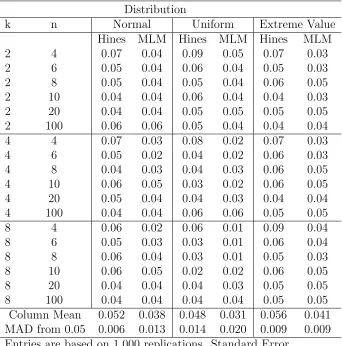
Table 1.10: Comparison of Estimates of Levels between the Modified LevMed test and Hines test for Even Sample Sizes
Distribution
k n Normal Uniform Extreme Value
Hines MLM Hines MLM Hines MLM
2 4 0.07 0.04 0.09 0.05 0.07 0.03
2 6 0.05 0.04 0.06 0.04 0.05 0.03
2 8 0.05 0.04 0.05 0.04 0.06 0.05
2 10 0.04 0.04 0.06 0.04 0.04 0.03
2 20 0.04 0.04 0.05 0.05 0.05 0.05
2 100 0.06 0.06 0.05 0.04 0.04 0.04
4 4 0.07 0.03 0.08 0.02 0.07 0.03
4 6 0.05 0.02 0.04 0.02 0.06 0.03
4 8 0.04 0.03 0.04 0.03 0.06 0.05
4 10 0.06 0.05 0.03 0.02 0.06 0.05
4 20 0.05 0.04 0.04 0.03 0.04 0.04
4 100 0.04 0.04 0.06 0.06 0.05 0.05
8 4 0.06 0.02 0.06 0.01 0.09 0.04
8 6 0.05 0.03 0.03 0.01 0.06 0.04
8 8 0.06 0.04 0.03 0.01 0.05 0.03
8 10 0.06 0.05 0.02 0.02 0.06 0.05
8 20 0.04 0.04 0.04 0.03 0.05 0.05
8 100 0.04 0.04 0.04 0.04 0.05 0.05
Column Mean 0.052 0.038 0.048 0.031 0.056 0.041 MAD from 0.05 0.006 0.013 0.014 0.020 0.009 0.009 Entries are based on 1,000 replications. Standard Error
of individual entries ≤(.91∗.09/1000)1/2 = 0.01
n, levels of MLM are consistently conservative, whereas levels of the Hines test show
an oscillating pattern with peaks when n is even. Although similar to the odd/even
pattern for levels of LevMed (Figures 1.2 - 1.4), the Hines modification is clearly an
improvement over LevMed.
The plots for the modified LevMed test are more stable than those for the Hines
test are much smaller than the ranges of the Hines Levene test (from 0.02 to 0.09)
for the small sample sizes.
Because the Hines test is the same with the MLM test for odd sample sizes, Table
1.10 presents levels for the MLM and Hines tests only for even sample sizes. When
n = 4, the Hines test is liberal under all the three distributions. Under the normal
distribution and the uniform distribution, as k, the number of groups, increases, the
Hines test holds its levels better than MLM which becomes more conservative. Under
the extreme value distribution, the Hines test tends to be liberal while the MLM test is
conservative. Except at the extreme value distribution, based on the MAD summary,
the Hines test appears to hold its level better than the MLM test for n small and
even.
We also compare the Hines test to the other tests in terms of power by simulation.
Using the same seeds, Monte Carlo samples were generated for the 30 non-null cases
summarized in Table 1.7 for the six other tests. Power was obtained for each case
for the Hines test and average power was calculated. The resulting average powers
under the normal distribution, the uniform and the extreme value for the Hines test
are 0.55, 0.59 and 0.49, respectively. Compared to the MLM test, the Hines has
slightly greater power for the normal distribution and the uniform distribution due
to its liberal performance for n even and small. However, it does not perform as well
1.6
Conclusion
This chapter demonstrates that the modified LevMed (MLM) test can yield valid
levels and good power for most configurations studied. The MLM test performs
well for small and odd sample sizes, where the shortcomings of the LevMed test are
most pronounced. MLM, which differs from the Hines test only if some ni are even,
performs better than the Hines test under skewed distributions, in this case. Although
the modified LevMed test is inferior to the BLM test in terms of level and power, it
is much simpler than the BLM test. The Box-Andersen correction can improve the
power of the Modified LevMed test, especially for skewed distributions. In general
5 10 15 20 25 30 0.00 0.02 0.04 0.06 Sample Size Est. Level
LevMed Test, Normal Distribution, k=2
5 10 15 20 25 30
0.00 0.02 0.04 0.06 Sample Size Est. Level
Modified LevMed Test, Normal Distribution, k=2
5 10 15 20 25 30
0.00 0.02 0.04 0.06 Sample Size Est. Level
LevMed Test, Normal Distribution, k=4
5 10 15 20 25 30
0.00 0.02 0.04 0.06 Sample Size Est. Level
Modified LevMed Test, Normal Distribution, k=4
5 10 15 20 25 30
0.00 0.02 0.04 0.06 Sample Size Est. Level
LevMed Test, Normal Distribution, k=8
5 10 15 20 25 30
0.00 0.02 0.04 0.06 Sample Size Est. Level
Modified LevMed Test, Normal Distribution, k=8
Figure 1.2: Estimated levels versus sample sizes for the normal distribution. Standard deviations of plotted values are bounded by (40000)−1/2
5 10 15 20 25 30 0.00 0.02 0.04 0.06 Sample Size Est. Level
LevMed Test, Uniform Distribution, k=2
5 10 15 20 25 30
0.00 0.02 0.04 0.06 Sample Size Est. Level
Modified LevMed Test, Uniform Distribution, k=2
5 10 15 20 25 30
0.00 0.02 0.04 0.06 Sample Size Est. Level
LevMed Test, Uniform Distribution, k=4
5 10 15 20 25 30
0.00 0.02 0.04 0.06 Sample Size Est. Level
Modified LevMed Test, Uniform Distribution, k=4
5 10 15 20 25 30
0.00 0.02 0.04 0.06 Sample Size Est. Level
LevMed Test, Uniform Distribution, k=8
5 10 15 20 25 30
0.00 0.02 0.04 0.06 Sample Size Est. Level
Modified LevMed Test, Uniform Distribution, k=8
Figure 1.3: Estimated levels versus sample sizes for the uniform distribution. Stan-dard deviations of plotted values are bounded by (40000)−1/2
5 10 15 20 25 30 0.00 0.02 0.04 0.06 Sample Size Est. Level
LevMed Test, Extreme Value Distribution, k=2
5 10 15 20 25 30
0.00 0.02 0.04 0.06 Sample Size Est. Level
Modified LevMed Test, Extreme Value Distribution, k=2
5 10 15 20 25 30
0.00 0.02 0.04 0.06 Sample Size Est. Level
LevMed Test, Extreme Value Distribution, k=4
5 10 15 20 25 30
0.00 0.02 0.04 0.06 Sample Size Est. Level
Modified LevMed Test, Extreme Value Distribution, k=4
5 10 15 20 25 30
0.00 0.02 0.04 0.06 Sample Size Est. Level
LevMed Test, Extreme Value Distribution, k=8
5 10 15 20 25 30
0.00 0.02 0.04 0.06 Sample Size Est. Level
Modified LevMed Test, Extreme Value Distribution, k=8
Figure 1.4: Estimated levels versus sample sizes for the extreme value distribution. Standard deviations of plotted values are bounded by (40000)−1/2
5 10 15 20 25 30 0.00 0.01 0.02 0.03 0.04 0.05 0.06 Sample Size Est. Level k=2
5 10 15 20 25 30
0.00 0.01 0.02 0.03 0.04 0.05 0.06 Sample Size Est. Level k=4 Normal Distribution
5 10 15 20 25 30
0.00 0.01 0.02 0.03 0.04 0.05 0.06 Sample Size
Est. Level k=8
5 10 15 20 25 30
0.00 0.01 0.02 0.03 0.04 0.05 0.06 Sample Size Est. Level k=2
5 10 15 20 25 30
0.00 0.01 0.02 0.03 0.04 0.05 0.06 Sample Size Est. Level k=4 Uniform Distribution
5 10 15 20 25 30
0.00 0.01 0.02 0.03 0.04 0.05 0.06 Sample Size Est. Level k=8
5 10 15 20 25 30
0.00 0.01 0.02 0.03 0.04 0.05 0.06 Sample Size Est. Level k=2
5 10 15 20 25 30
0.00 0.01 0.02 0.03 0.04 0.05 0.06 Sample Size Est. Level k=4
Extreme Value Distribution
5 10 15 20 25 30
0.00 0.01 0.02 0.03 0.04 0.05 0.06 Sample Size Est. Level k=8