DOI: 10.1534/genetics.106.066134
Epigenetic Modifications of Distinct Sequences of the
p1
Regulatory
Gene Specify Tissue-Specific Expression Patterns in Maize
Rajandeep S. Sekhon,* Thomas Peterson
†and Surinder Chopra*
,1*Department of Crop and Soil Sciences, Pennsylvania State University, University Park, Pennsylvania 16802 and
†Department of Genetics, Development and Cell Biology, Iowa State University, Ames, Iowa 50011
Manuscript received September 20, 2006 Accepted for publication December 5, 2006
ABSTRACT
Tandemly repeated endogenous genes are common in plants, but their transcriptional regulation is not well characterized. In maize, theP1-wrallele ofpericarp color1is composed of multiple copies arranged in a head-to-tail fashion.P1-wrconfers a white kernel pericarp and red cob glume pigment phenotype that is stably inherited over generations. To understand the molecular mechanisms that regulate tissue-specific expression ofP1-wr, we have characterizedP1-wr*, a spontaneous loss-of-function epimutation that shows a white kernel pericarp and white cob glume phenotype. As compared to its progenitorP1-wr, theP1-wr* is hypermethylated in exon 1 and intron 2 regions. In the presence of the epigenetic modifierUfo1(Unstable factor for orange1),P1-wr* plants exhibit a range of cob glume pigmentation whereas pericarps remain colorless. In these plants, the level of cob pigmentation directly correlates with the degree of DNA de-methylation in the intron 2 region ofp1. Further, genomic bisulfite sequencing indicates that a 168-bp re-gion of intron 2 is significantly hypomethylated in both CG and CNG context in P1-wr* Ufo1 plants. Interestingly,P1-wr*Ufo1plants did not show any methylation change in a distal enhancer region that has previously been implicated inUfo1-induced gain of pericarp pigmentation of theP1-wrallele. These results suggest that distinct regulatory sequences in the P1-wr promoter and intron 2 regions can undergo independent epigenetic modifications to generate tissue-specific expression patterns.
T
HE variants of genetic loci generated through epi-genetic modifications, or epimutations, are known as epialleles. Epialleles may be metastable and revert to wild type or produce novel phenotypes. Epimutations have been identified in several important plant bio-logical processes including floral symmetry and develop-ment ( Jacobsen and Meyerowitz 1997; Cubas et al.1999), disease resistance (Stokeset al.2002), and plant
and seed pigmentation (Das and Messing 1994;
Dorweileret al. 2000; Hoekengaet al.2000). Stable
epialleles in natural populations provide new sources of variation as well as tools to study mechanisms that gen-erate these epialleles (Kishimotoet al.2001; reviewed in
Kaliszand Purugganan2004).
Formation of epialleles has been attributed to two mutually dependent epigenetic processes: changes in DNA methylation and chromatin modifications (Kalisz
and Purugganan2004; reviewed in Richards2006).
DNA methylation, covalent attachment of methyl group to cytosine base, is a heritable genetic modification in eukaryotes. A growing body of evidence has implicated DNA methylation as a key epigenetic regulator of stable
gene expression patterns (see reviews by Chan et al.
2005; Richards 2006). In many cases, regulation of
tissue-specific gene expression has been attributed to developmental changes in cytosine methylation (Bao
et al.2004; Kinoshitaet al.2004). In plants, the role of
DNA methylation has also been established in transcrip-tional and post-transcriptranscrip-tional gene silencing (Vaucheret
and Fagard2001; Vaucheretet al.2001), inactivation of
transposons and transgenes (Chandler and Walbot
1986; Bankset al.1988; Ingelbrechtet al.1994), genomic
imprinting (Allemanand Doctor2000; Gehringet al.
2006), and paramutation (Walker1998; Sidorenkoand
Peterson2001).
In maize, anthocyanin and phlobaphene pigments have been used as convenient markers to identify spon-taneous epimutations in loci that encode transcription factors; meiotically stable epialleles have been isolated and characterized forbooster1(b1),red1(r1),purple plant 1(pl1), andpericarp color1(p1) (Brink1956; Cocciolone
and Cone 1993; Das and Messing 1994; Stam et al.
2002). Thep1gene encodes a Myb transcription factor that regulates biosynthesis of brick red pigments known as phlobaphenes. These p1-regulated 3-deoxyflavonoid pigments can be observed in kernel pericarp, cob and tassel glumes, husk, and leaf sheath (Coe et al. 1988;
Stylesand Ceska1989). Alleles ofp1are identified by a
two-letter suffix that denotes their expression in pericarp and cob glume (Emerson1917; Anderson1924; Brink
Sequence data from this article have been deposited with the EMBL/ GenBank Data Libraries under accession no. EF165349.
1Corresponding author: Department of Crop and Soil Sciences, 116
Agricultural Sciences and Industries Bldg., Pennsylvania State University, University Park, PA 16802. E-mail: [email protected]
and Styles1966). For example,P1-rrconditions red
peri-carp and red cob glume phenotype whileP1-wrspecifies white (colorless) pericarp and red cob glume pattern. The mechanisms of tissue-specific variation observed in
P1-rrand P1-wrare not completely understood. These alleles differ considerably with respect to their gene structure:P1-rris a single-copy allele in which the coding sequence is flanked by two 5.2-kb direct repeats (Lechelt
et al.1989; Grotewold et al.1991), whereasP1-wr
con-tains six or more copies of 12.6 kb each that are tandemly arranged in a head-to-tail fashion (Chopraet al. 1998).
However, these alleles share high sequence similarities in their upstream promoter (99%) and coding (99.9%) regions (Chopraet al.1998). Unique expression patterns
of these alleles have been proposed to be regulated through epigenetic mechanisms: the multicopyP1-wris hypermethylated as compared to the single-copy P1-rr
(Chopraet al.1998). The hypermethylated state and the
white pericarp/red cob glume phenotype ofP1-wr are stably inherited. However, in the presence of atrans-acting modifierUnstable factor for orange1(Ufo1),P1-wrbecomes less methylated and shows increased p1 transcription (Chopraet al.2003). As a result,P1-wr Ufo1plants exhibit
gain of pigmentation in kernel pericarp, cob and tassel glumes, husk, and leaf sheath. TheUfo1-induced pheno-types show a range of pigmentation that positively correlates with the degree of demethylation of theP1-wr
repeat complex. Although the effect ofUfo1is not fully penetrant, it provides an effective genetic and molecular tool to characterize mechanisms that regulate tissue-specific expression patterns ofp1.
Here, we describe a spontaneous epiallele of P1-wr, designated asP1-wr*, that specifies a white pericarp and white cob glume phenotype. Our results show that the loss of cob glume pigmentation phenotype is associated with hypermethylation of cytosine residues in the exon 1 and intron 2 regions ofP1-wr*. In addition,Ufo1 inter-acts with the silentP1-wr* in a tissue-preferred manner that results in gain of cob (but not pericarp) pigmen-tation. Furthermore, theUfo1-induced gain of cob func-tion is correlated with demethylafunc-tion of sequences in intron 2 to a level similar to that of standardP1-wr. Our study suggests that the intron 2 region may contain
cis-regulatory elements and that epigenetic modification of these sequences can impact the cob-specific expression ofP1-wr.
MATERIALS AND METHODS
Maize stocks: Recombinant inbred (RI) line RI41 and its sibling lines were obtained from Benjamin Burr, Brookhaven National Laboratories, New York. These RI lines belong to a mapping population (T3CM family) developed from a cross of T2323CM37 (Burret al.1988). The T232 inbred line
carries a functionalP1-wr allele and has a white (colorless) kernel pericarp and red cob glume (WR) phenotype, while the CM37 inbred has ap1-wwallele and exhibits white (colorless) kernel pericarp and white cob glume (WW) phenotype (Figure
1). Genetic and molecular analyses (seeresults) indicate that
the RI41 line contains an epigenetically silencedP1-wrallele referred to here asP1-wr*.The RI41 line and its selfed progeny plants maintain a WW phenotype, while a low percentage of ears (2.5%) show pink or red patches of cob glumes. Biochemical analysis using acid–methanol extracts of these tissues indicated the presence of low levels of flavan-4-ols (data not shown) that are precursors of phlobaphenes (Stylesand
Ceska1989). Plants grown from kernels attached to pink/red
cob glume areas did not produce ears with pigmented cobs, indicating that these pigmented areas are not associated with heritable reversions. Further, genetic tests (data not shown) established the following: (1) the structural genesc2anda1
that encode flavonoid biosynthetic enzymes are in a functional condition in RI41; (2) the F1plants produced by crossing RI41 withP1-wrin three inbred genetic backgrounds (T232, W22, and W23) have colorless pericarp and red cobs; thus, the WW phenotype of RI41 is recessive toP1-wr; and (3) the progeny plants produced by test crossing F1plants of genotypeP1-wr*/
P1-wr with a standard p1-ww allele segregate WR and WW phenotypes in a 1:1 ratio.
A stock containingUfo1in aP1-wrbackground was obtained from Derek Styles, University of Victoria (Victoria, BC, Canada) and has previously been described (Chopra et al.
2003). TheUfo1 factor was introgressed into an inbred line 4Co63 (genotypep1-ww c1 r-r; National Seed Storage Labora-tory, Fort Collins, CO) and ap1-ww Ufo1homozygous stock was developed by self fertilization for several generations. Since
Ufo1 does not induce any pigmentation change in p1-ww
plants, the presence ofUfo1was tested by outcrossing toP1-wr
plants. Individual plants fromp1-ww Ufo1stock were crossed to W22 or W23 (genotype P1-wr; Maize Genetics Cooperation Stock Center, Urbana, IL) and 20 plants were grown from each outcross. Orange pigmentation of ligules, leaf sheath, husk, and kernel pericarp in these progeny plants confirmed the presence ofUfo1inp1-ww Ufo1stock.
Genetic crosses: Homozygous p1-ww Ufo1 plants were crossed to RI41 and a total of 133 F1plants derived from seven crosses were grown. These F1 plants were crossed with
p1-ww[4Co63] to develop test-cross progenies. Twenty-four test-cross ears showing a gain of cob glume pigmentation phe-notypes (red or pink) were further selected to obtain progeny plants for molecular characterization and inheritance studies. From each test-cross progeny, six to eight plants were used for DNA methylation and genotypic analysis. Plants that did not survive until harvest were excluded from the analysis. Pheno-typic data from 117 progeny plants were obtained and correlated with the results of genotypic and DNA methylation analyses to determine the heritability of the Ufo1 effect on
P1-wr*.
DNA gel blot hybridizations: Plant genomic DNA was isolated using a modified CTAB method (Saghai-Maroof
Figure 1.—Pericarp and cob glume phenotypes of RI41
et al.1984). Restriction enzyme digestions were performed to completion using enzymes, reagents, and incubation condi-tions from Promega (Madison, WI). Restricted genomic DNA was fractionated on agarose gels, transferred to nylon mem-branes, and the resulting blots were sequentially probed with DNA fragments representing different regions ofp1. DNA gel blot hybridizations were performed using a hybridization mixture containing dextran sulfate (10%), NaCl (1m), SDS
(1%), Tris–HCl (10 mm), and 0.25 mg/ml salmon sperm DNA.
Blots were prehybridized at 65°for 6 hr in the hybridization buffer followed by hybridization in the same buffer containing a32P-labeled probe for20 hr at 65°. Blots were washed twice
in 0.13SSC and 0.5% SDS at 65°for 15–30 min and exposed to X-OMAT film (Kodak, Rochester, NY). Before rehybridization, the blots were stripped by washing for 15 min in a boiling solution of 0.1% SDS.
Genomic bisulfite sequencing: DNA methylation of target regions was assayed by genomic bisulfite sequencing. These included the top DNA strand from a 333-bp region from the promoter (region I), a 312-bp region near the 59end of intron 2 (region II), and a 435-bp region near the 39end of intron 2 (regions III and IV). For bisulfite treatment, 8mg of leaf genomic DNA from the appropriate genotypes were com-pletely digested with restriction enzymes that cut outside the regions of interest. Sodium bisulfite treatment was performed on the basis of a previously published protocol (Jacobsenet al.
2000) with minor modifications. Primers specifically designed to amplify DNA modified with sodium bisulfite were used for PCR. Sequences of primers used for bisulfite genomic se-quencing are available upon request. The PCR products were gel purified and cloned using a TOPO TA cloning kit (In-vitrogen, Carlsbad, CA), and 25 individual clones of each ligation reaction were subjected to DNA sequencing.
RESULTS
RI41 carries an epiallele of P1-wr: The presence of occasional areas of red phlobaphene pigments on cobs of RI41 plants prompted us to investigate the gene structure of thep1allele in this line. Gel blots prepared from leaf DNA of RI41, T232, and W23 digested with several restriction enzymes were hybridized with three
p1probe fragments (Figure 2). The restriction patterns produced bySacI andKpnI digests were similar in T232, RI41, and W23. For example, probe fragment 15, corre-sponding to thep1distal enhancer region, hybridized to aSacI band (see lanes labeled ‘‘Sc’’ in Figure 2A) of 0.87 kb in all three genotypes. Hybridization of the same blot with another fragment from the 59upstream promoter region (fragment 6) gave two prominent bands with expected sizes of 4.08 and 0.87 kb in all three genotypes. Similarly, SacI digestion produced a common 5.98-kb band upon hybridization with probe fragment 8B that corresponds to thep1intron 2 region. In summary, no restriction fragment length polymorphism (RFLP) dif-ferences were detected forp1in comparisons of RI41 with standardP1-wrpresent in T232 or W23 inbred lines. Furthermore, no differences inp1-hybridizing band in-tensities were observed, indicating that copy number of
p1 tandem repeats was not affected, for example, by recombination between closely linked repeated copies. Taken together, these DNA gel blot analyses indicate that
RI41 carries a P1-wrallele that is structurally similar to standardP1-wr. To distinguish it from the standardP1-wr
allele present in W23 or T232, the RI41 allele is de-signated asP1-wr*.
In the absence of any obvious RFLP, we tested the possibility of epigenetic silencing ofP1-wr*. DNA meth-ylation ofP1-wrandP1-wr* was compared using meth-ylation-sensitive enzymes SalI and HpaII (Figure 2).
P1-wr[W23]was used as a reference since DNA methyl-ation of this allele has been extensively studied (Chopra
et al.1998, 2003). As expected, hybridization of each of the three probes gave an 12.6-kbSalI band in P1-wr
(Figure 2A). This band results from cleavage of twoSalI sites in intron 2 of each of the adjoining P1-wr gene copies; the other two internalSalI sites are hypermethy-lated in all copies and are shown asSalI* in Figure 2B (Chopraet al.1998). InP1-wr*, however, a higher
molec-ular weight band (.12.6 kb) was observed upon hy-bridization with each probe, indicating that additional
SalI sites are methylated.HpaII digests ofP1-wrin W23 or T232 gave two bands with probes 15 and 6: one prominent band of7.9 kb and a second relatively weak band of12.0 kb (Figure 2A). The7.9-kb band is pro-duced by digestion at HpaII site(s) in two distinct re-gions of thep1gene (cluster 3 and cluster 7; see Figure 2B). The12.0-kb band is derived by cutting ofHpaII sites in the same region (cluster 7) of two adjoining copies, indicating that HpaII sites in the intervening area (cluster 3) are partially methylated in some of the gene copies and/or cells. Compared withP1-wr, hybrid-ization ofP1-wr* with probes 15 and 6 produced an 12-kb band that was more prominent than the 7.9-kb band. This pattern could result from increased methyl-ation ofHpaII sites in cluster 3 inP1-wr*. This result was confirmed with intron 2 probe fragment 8B, which hybridized to 12.0- and 4.5-kb bands in P1-wr but gave only the 12.0-kb band inP1-wr*. Thus, the ab-sence of the4.5-kb band inP1-wr* further established that the HpaII sites in cluster 3 are more methylated than those inP1-wr. In summary, these results indicated thatP1-wr* is more methylated than P1-wr. However, it should be noted that the large number of HpaII sites (57 per P1-wr gene copy) together with the multiple methylation patterns hampers the precise determina-tion of methyladetermina-tion status by DNA gel blots.
Ufo1 reverts the P1-wr* epiallele to P1-wr: Previous results showed thatUfo1interacts with wild-typeP1-wrto induce pigmentation of kernel pericarp and vegetative tissues (Chopraet al.2003). To test the interaction of
P1-wr* withUfo1, we crossedP1-wr* withp1-ww Ufo1(see
materials and methods; Figure 3). The resulting F1
tassel glume margins in the expresser group also showed red or pink pigmentation that correlated with cob color phenotype of that plant. In addition, RNA gel blot results identifiedp1transcripts in the cobs of expressers, while no transcripts were detected in nonexpressers (data not shown). To summarize, these results estab-lished that the silent state ofP1-wr* is reactivated upon crossing with theUfo1stock. Surprisingly, unlike the P1-wr3Ufo1interaction, none of theP1-wr*Ufo1expresser plants showed any gain of pigmentation in pericarp, leaf sheath, husk, or silk. These results indicate that Ufo1
affects P1-wr* differently than P1-wr; however, the in-complete penetrance ofUfo1persists in both the alleles.
P1-wr* is hypomethylated in the presence of Ufo1: We have previously demonstrated that theUfo1-induced gain of pericarp, cob, and plant body pigmentation is correlated with hypomethylation ofP1-wr(Chopraet al.
2003). We tested if gain of cob pigmentation inP1-wr*
Ufo1 plants is also associated with hypomethylation of
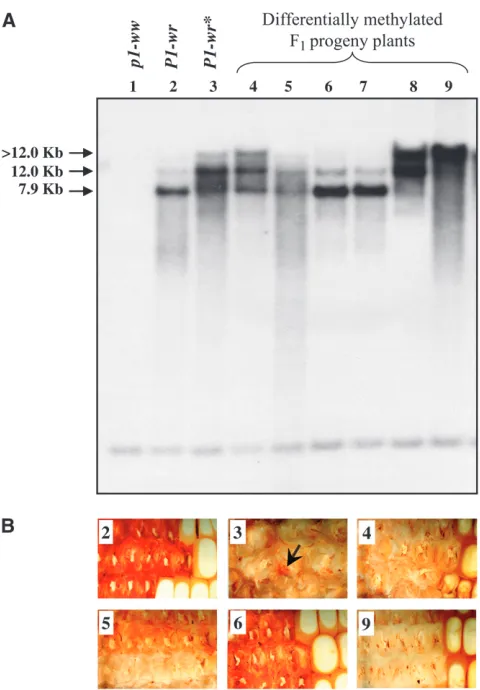
P1-wr*. DNA gel blots prepared fromHpaII-digested leaf DNA of the F1plants were hybridized withp1genomic probe fragment 15, and the results are presented in Figure 4. On the basis of DNA methylation and cob color, F1plants could be divided into three groups. The first group (Figure 4A, lanes 6 and 7) was characterized by the presence of a very intense7.9-kb band and a faint12.0-kb band, a pattern similar to that of the wild-typeP1-wr (see lane 2). As expected, the cob pigment phenotypes of this category also resembled that ofP1-wr
(Figure 4B, sections 2 and 6). The second group had moderate methylation levels indicated by roughly equal intensities of 7.9- and 12.0-kb bands (Figure 4A, lanes 4 and 5). The cobs of these plants showed pink to red variegations or sharp red/white sectors that covered the entire length of the ear (Figure 4B, compare sec-tions 4 and 5). Interestingly, plants belonging to the third group had the highest degree of DNA methylation as shown by the absence of the7.9-kb band and pres-ence of high molecular weight bands (Figure 4A, lanes 8
Figure 2.—Comparison of restriction fragment length
polymorphism and DNA methylation of p1 alleles present in RI41 and T232. (A) A gel blot containing leaf genomic DNA digests of RI41, T232, and W23 was sequentially hybrid-ized with radioactively labeled probes of p1gene fragments 15, 6, and 8B. Lanes showing restriction enzymes are Sl,SalI; Sc,SacI; Sl1Sc,SalI1SacI; H,HpaII; Sl1H,SalI1HpaII; and K,KpnI.lDNA digested withPstI was used as a molecular weight marker and is shown at left in kilobases. Poor signal strength in the W23 lanes is due to less DNA loading. (B) De-duced restriction and methylation map ofP1-wr*. Top, gene structure and restriction map of the standardP1-wrallele de-rived from the W23 sequence (Chopraet al.1998). Shaded
arrows represent the 39end of a partial distalp1repeat fol-lowed by a full-length 12,596-bp gene copy; coordinates of each copy are shown below the shaded arrows. Boxes embed-ded in this gene structure represent three exons indicated as E1, E2, and E3; UTRs are shown as open boxes. The transcrip-tion start site (inferred from theP1-rrgene; Grotewoldet al.
1991) is represented by a bent arrow and marked as11. Re-striction enzyme sites are indicated above the gene structure;
SalI* represents methylated sites in theP1-wrsequence. Posi-tions of probe fragments are shown below the gene structure. Restriction fragments generated by digestion withSalI,SacI,
KpnI, andHpaII and hybridizing to corresponding probe frag-ments are shown in kilobases. TheHpaII methylation map for
and 9). These individuals produced ears with white cob phenotypes (Figure 4B, section 9). To rule out any effect of the 4Co63 genetic backgroundper seonP1-wr*, F1plants of several independent crosses (P1-wr*3p1-ww[4Co63]) were also examined for their DNA methylation levels; no changes in cob phenotype or DNA methylation ofP1-wr* were observed (data not shown). In summary, these results established thatUfo1-induced gain of cob color inP1-wr* is accompanied by hypomethylation of theP1-wrsequence and that the extent of demethylation is positively corre-lated with the level of cob pigmentation.
Gain of cob color correlates with DNA hypometh-ylation of the intron 2 region:Our results showed that, compared with P1-wr, P1-wr* is hypermethylated at
HpaII site 2 and clusters 3 and 7 (see Figure 2B for position of these sites/clusters). Exposure ofP1-wr* to
Ufo1 resulted in gain of cob pigmentation that was associated with demethylation ofP1-wr* (see Figure 4).
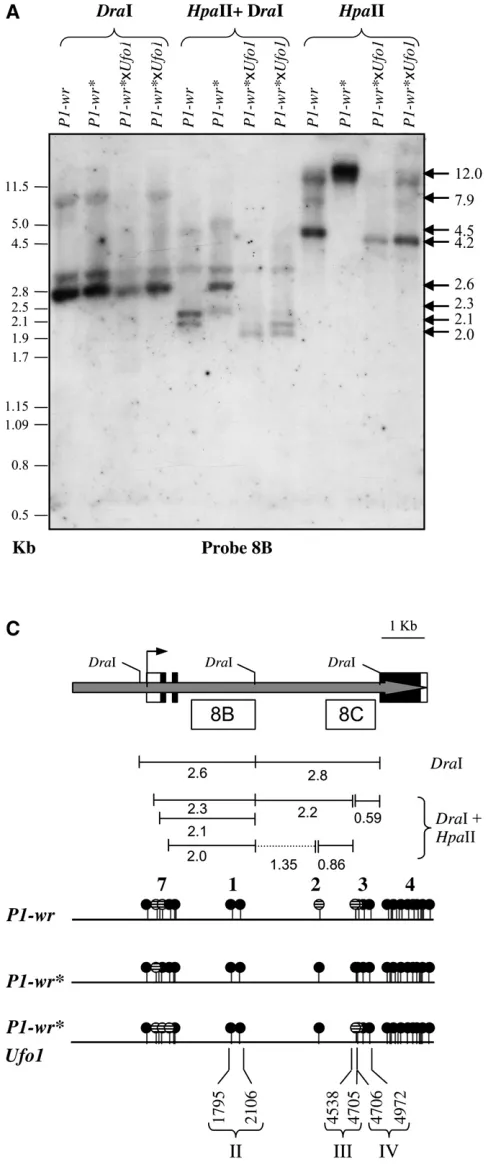
To delineate specific sequence(s) ofP1-wr* that may be playing a role in Ufo1-induced cob-specific expression, methylation of candidateHpaII site 2 and clusters 3 and 7 was assayed. We usedDraI in combination withHpaII and probed these digests withp1intron 2 probes 8B and 8C (Figure 5). SinceDraI endonuclease is methylation insensitive, probe 8B detected an expected band of 2.6 kb in single digests for all three genotypes (Figure 5A). This probe also hybridizes to two other bands of9.0 and3.0 kb that may come from a polymorphic copy (copies) of theP1-wrmulticopy complex (S. Chopraand
T. Peterson, unpublished results). The hybridization of
HpaII-digestedP1-wrproduced a 4.5-kb band, which was absent from P1-wr* because of hypermethylation of cluster 3 sites. The presence of a 4.2-kb band inP1-wr*
Ufo1indicated hypomethylation ofHpaII sites in clusters 3 and 7 (see below). InHpaII andDraI double digests of
P1-wr, probe 8B hybridized to two prominent bands of Figure2.—Continued.
Figure 3.—Interaction of Ufo1 with P1-wr*
leads to gain of cob glume pigmentation pheno-types. F1plants grown from crosses ofP1-wr*3
Ufo1were examined for pericarp and cob glume pigmentation. Expected phenotypes are based on
2.3 and 2.1 kb. The 59ends of these bands are produced by digestion at two partially methylatedHpaII sites in the middle of cluster 7 and the 39ends result from digestion byDraI (see Figure 5, A and C). InP1-wr*, the presence of a prominent 2.6-kb band and a faint 2.3-kb band established thatHpaII sites in cluster 7 were highly, but not completely, methylated. In twoP1-wr*Ufo1 express-ers, theHpaII1DraI digestion generated two fragments of 2.1 and 2.0 kb. The 2.1-kb fragment, which is also observed inP1-wr, indicates hypomethylation ofHpaII sites within cluster 7. Presence of the unique 2.0-kb band indicated thatHpaII sites in cluster 7 were slightly less methylated in P1-wr* Ufo1 as compared to P1-wr
plants. To more precisely determine the methylation status ofHpaII site 2 and sites in cluster 3, the blot was
reprobed with fragment 8C.DraI produced an expected fragment of 2.8 kb in all the genotypes. Double digests ofP1-wrwithHpaII andDraI produced two bands of 2.2 and 0.59 kb, indicating hypomethylation of one or both overlappingHpaII sites in cluster 3 (shown as hatched circles in Figure 5C). Additionally, inP1-wr, the presence of faint bands of 2.8 and 0.86 kb indicated thatHpaII site 2 and sites in cluster 3 are partially hypomethylated. InP1-wr*,DraI andHpaII1DraI digests produced sim-ilar banding patterns, establishing that theHpaII sites (site 2 and cluster 3) are completely methylated. In
P1-wr* Ufo1expressers,DraI1HpaII digests produced 2.2- and 0.59-kb fragments, indicating that one or both sites present in cluster 3 became hypomethylated. Taken together, these results indicated that the gain of cob pigmentation inP1-wr* Ufo1plants strongly correlates with hypomethylation ofHpaII sites in the 39end of in-tron 2.
To map specific cytosine methylation changes in P1-wr* Ufo1 plants, we performed genomic bisulfite se-quencing (Figure 6; see also supplemental Table 1 at http://www.genetics.org/supplemental/). Four repre-sentative regions spanning the 12.6 kb of a single P1-wrgene repeat were assayed. Region I is part of a distal enhancer element while region II is present at the 59
end of intron 2; these regions have previously been implicated in gain of pigmentation inP1-wr Ufo1plants (Chopraet al.2003). Selection of regions III and IV was
based on theirHpaII methylation differences between
P1-wr* and P1-wr* Ufo1 expressers (see cluster 3 in Figure 5C). The region encompassing cluster 7 was not selected for bisulfite assay because its methylation status did not produce correlative cob glume pigmentation patterns in different genotypes under study. Of the four regions studied, region III (168-bp sequence) had dramatic differences in cytosine methylation among the three genotypes (Figure 6B). This region had very high CG and moderately high CNG methylation in P1-wr* as compared to P1-wr in which methylation was negligible. Presence ofUfo1resulted in complete loss of CG and CNG methylation in region III of P1-wr*. Further, in P1-wr and P1-wr* Ufo1 plants, regions III and IV were separated by a sharp boundary of DNA methylation; region IV had exceptionally elevated CG and CNG methylation as compared to region III. This observation indicated that methylation of region IV does not affect cob glume pigmentation. Interestingly, region IV was the only region in the gene that has substantial asymmetric (CHH) methylation inP1-wrand
P1-wr* Ufo1, whereas this region in P1-wr* was not methylated in CHH context. The bisulfite assay showed that all three genotypes had high and nearly similar levels of CG and CNG methylation in regions I and II. In summary, gain of cob pigmentation in P1-wr* Ufo1
plants was accompanied by a sharp decrease in CG and CNG methylation of the 168-bp sequence (region III) of intron 2 that was highly methylated in P1-wr*. Figure4.—Effect ofUfo1on methylation ofP1-wr* and
These results demonstrated thatUfo1restores methyla-tion ofP1-wr* to a state similar to that of wild-typeP1-wr.
Ufo1 is required for establishment but may not be needed for maintenance of cob expression: To test if
Ufo1-induced changes in cob glume color and DNA methylation of P1-wr* Ufo1 expressers were heritable,
F1 plants were test crossed with p1-ww[4Co63] (see
materials and methods). Phenotypic analysis of 117
test-cross progeny plants revealed three classes of cob color phenotypes: white, light to dark pink, and red (see Table 1). To genotype these plants for thep1allele and to compare their DNA methylation, gel blots prepared Figure5.—DNA methylation modifications of the coding
region ofP1-wrin the presence ofUfo1. (A and B) Gel blots showing DNA methylation of P1-wr, P1-wr*, and two P1-wr*
Ufo1expresser plants. Leaf genomic DNA of each of the ge-notypes was digested with the restriction enzymes shown, and the blot was sequentially hybridized with p1 intron 2 probe fragments 8B (A) and 8C (B). Molecular weights based on lDNA digested with PstI are indicated on the left. The size and the position of hybridizing fragments are shown by arrows on the right. (C) Methylation map of HpaII sites in thep1coding region ofP1-wr,P1-wr*, andP1-wr*Ufo1 ex-presser plants. Top, the complete coding and the partial pro-moter region of one of the P1-wr copies. Boxes within the shaded arrow represent three exons; UTRs are shown as open boxes. The transcription start site is indicated by a bent arrow. Positions of restriction enzyme sites are above the gene struc-ture while positions of probe fragments are shown below. Fragments generated by different restriction enzymes are shown below the gene structure. In theHpaII andDraI double digest, a 1.35-kb fragment shown as a broken line indicates that this fragment does not hybridize to the probes used here.
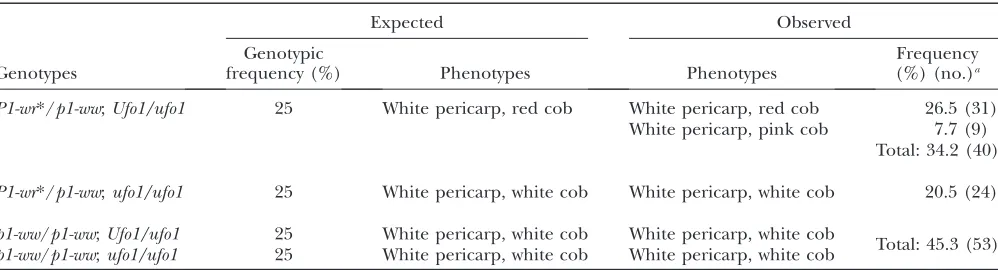
fromHpaII-digested leaf genomic DNA were hybridized withp1probe fragment 6, and a representative blot is shown in Figure 7. Since p1-ww/p1-ww plants do not showP1-wr-specificHpaII bands (7.9 and 12.0 kb), we could easily genotypeP1-wr*/p1-ww and p1-ww/p1-wwplants. This allowed separation of test-cross proge-nies with white cob phenotype into two classes: plants carryingp1-ww (Figure 7, lanes A) and those carrying silencedP1-wr* (Figure 7, lanes W). Among expresser plants, the intensity of the7.9- and 12.0-kb HpaII bands established thatP1-wr* in red cob plants (Figure 7, lanes R) was hypomethylated as compared to that in pink cob plants (Figure 7, lanes P). These combined phenotypic and molecular data allowed us to perform segregation analysis (Table 1). The progeny plants segregated in a 1:1 (P1-wr*/p1-ww:p1-ww/p1-ww) ratio as expected from a test cross (64:53;x2¼1.03;P,0.05).
Among P1-wr*/p1-ww plants, half of the individuals were expected to carry Ufo1 and show gain of cob pigmentation assuming that Ufo1 is fully penetrant. However, within this class, significantly more plants showed red or pink cob pigmentation than expected [40/64 (62%);x2¼4.0;P,0.05]. This result indicated
that, in some of these plants, theP1-wr* allele retained its active state even though Ufo1 segregated away. In other words, some of theP1-wr*/p1-ww;ufo1/ufo1plants had pigmented cobs, indicating that P1-wr* was func-tional in these plants. This observation indicated that, following establishment of the active state of P1-wr*,
Ufo1 may not be required for maintenance of cob pigmentation. However, further testing is needed to establish the absence ofUfo1from these segregants.
DISCUSSION
To elucidate the epigenetic mechanisms that estab-lish and maintain stable allele-specific patterns of expression, we have characterized P1-wr*, a natural loss-of-function epiallele of P1-wr. P1-wr* shows a low frequency of mitotic instability in the form of red/white somatic sectors on cob glumes; however, it is meiotically stable as indicated by the absence of germinal red cob revertants. Our results established thatP1-wr* exhibits a greater degree of DNA methylation than the standard
P1-wrallele. The genesis of theP1-wr* epiallele seems to be a rare spontaneous event, because sibling recombi-nant inbred lines carrying P1-wr (WR phenotype) did not show any detectable methylation or phenotypic alterations (data not shown). In plants, several environ-mental, physiological, and genetic modifications may cause epigenetic instability. For example, cold temper-ature can alter DNA methylation and chromatin struc-ture, thereby generating natural epialleles (Steward
Figure6.—Genomic bisulfite sequencing analysis to study
et al.2002; Bastowet al.2004). Additionally, chemical
mutagens (Axtelland Brink1967) as well as
regener-ation of plants through tissue culture have been reported to form new epialleles with DNA methylation changes (Kaepplerand Phillips1993; Kaeppleret al.
2000). Maize is an open-pollinated crop and it is pos-sible that genetic stress as a result of the inbreeding during development of the recombinant inbred lines led to the epigenetic modifications of P1-wr. Indeed, both inbreeding depression and heterosis have been proposed to involve an epigenetic component; self pollination may lead to gene silencing while outcrossing may relieve silencing (Augeret al.2004). Such a
pheno-menon was observed at the maize regulatory locuspl1in which an epiallele Pl9-mah had increased expression when heterozygous with otherplalleles than as a homo-zygote (Hollickand Chandler1998). However, in a
study of the maize regulatory locusr1, a correlation
be-tween epigenetic modifications and inbreeding depres-sion or heterosis was not observed (Augeret al.2004).
We have previously shown that the stable WR expres-sion pattern of wild-type P1-wr can be perturbed by a
trans-acting epigenetic modifierUfo1. P1-wr Ufo1plants produce a red pericarp/red cob glume (RR) phenotype (Chopra et al. 2003). In the current study, the
in-teraction ofUfo1with theP1-wr* epiallele resulted only in gain of cob glume pigmentation (WR pattern). Bi-sulfite sequencing established that the recovery of cob color inP1-wr*Ufo1plants is correlated with demethyl-ation of a 168-bp region ofp1intron 2 to a level similar to that of standard P1-wr. Further, the extent of DNA methylation of the 168-bp region directly correlated with p1 transcription (data not shown). These results suggested that the 168-bp region may contain regula-tory elements. A search for regularegula-tory elements in the intron 2 region manually, as well as using the PlantCare database (Lescot et al.2002), identified CAAT boxes
and a RY element. Similar cis sequences have been shown to play a role in the regulation of gene expression (Bobb et al. 1997). Generally, regulatory elements are
found in the promoter; however, their occurrence in other genic regions has also been documented. In Arabidopsis, whorl-specific regulation of AGAMOUS, a class C floral organ identity gene, has been attributed to enhancer and suppresser elements present in the second intron of the gene (Sieburthand Meyerowitz
1997; Deyholosand Sieburth2000). Similarly, intron
1 sequences of the Arabidopsis FLOWERING LOCUS C
gene are required for its epigenetic repression through vernalization (Sheldon et al. 2006). In both these
examples, DNA methylation and/or chromatin modifi-cations of the intronic sequences containing regulatory elements may cause transcriptional silencing (Chan
et al.2005; Sheldonet al.2006).
The idea that distinct pericarp- and cob-specific ele-ments are associated with the p1 gene sequence was perceived very early on and presented in the ‘‘presetting Figure7.—DNA methylation pattern and cob glume
pheno-types of representative test-cross progeny plants. F1 plants grown from P1-wr* 3 p1-ww Ufo1 (see Figure 3) were test crossed withp1-ww[4Co63]and 117 test-cross progeny plants were scored for their cob glume pigmentation. Gel blots carry-ingHpaII-digested leaf DNA of these test-cross progeny plants were hybridized withp1fragment 6. On the basis of the pheno-typic data (presented in Table 1) and molecular characteriza-tion (DNA gel blot shown), test-cross progeny plants were categorized as A, white cob (p1-wwallele); W, white cob ( P1-wr* allele); P, pink cob; and R, red cob. The categories of rep-resentative plants are listed at the top of each lane.
TABLE 1
Heritability ofUfo1-induced gain of cob glume pigmentation in the test cross:P1-wr*/p1-ww;Ufo1/ufo13p1-ww/p1-ww;ufo1/ufo1
Expected Observed
Genotypes
Genotypic
frequency (%) Phenotypes Phenotypes
Frequency (%) (no.)a
P1-wr*/p1-ww;Ufo1/ufo1 25 White pericarp, red cob White pericarp, red cob 26.5 (31)
White pericarp, pink cob 7.7 (9) Total: 34.2 (40)
P1-wr*/p1-ww;ufo1/ufo1 25 White pericarp, white cob White pericarp, white cob 20.5 (24)
p1-ww/p1-ww;Ufo1/ufo1 25 White pericarp, white cob White pericarp, white cob
Total: 45.3 (53)
p1-ww/p1-ww;ufo1/ufo1 25 White pericarp, white cob White pericarp, white cob
aFrequency is based on phenotypic, genotypic, and molecular analyses; see Figure 7 for molecular data used for genotypic
and erasure’’ model (Schwartz1982). Indeed, inP1-rr,
a single-copy allele ofp1, a 1.2-kb sequence present5 kb upstream from the start of transcription contains basal enhancer element(s) shown to function in peri-carp and cob glumes (Sidorenkoet al.2000). Further,
inP1-rr9,a transgene-induced paramutagenic allele, and inP1-pr (patterned pericarp/light red cob), a natural epiallele, loss of pericarp and cob pigmentation was correlated with hypermethylation of this region. Addi-tionally, recent analysis of a transposon mutagenesis-derivedP1-rw (for red pericarp, white cob) allele has identified a cob-specific 386-bp enhancer sequence (Zhang and Peterson 2005). In P1-rr, there are two
copies of the 386-bp enhancer; one is part of the 1.2-kb enhancer while the other lies upstream of this region. In
P1-wr, however, there is only one copy of the 386-bp sequence that is present within the 1.2-kb homologous region. The bisulfite sequencing results showed that the 386-bp enhancer (region I in Figure 6) is heavily meth-ylated inP1-wr,P1-wr*, andP1-wr*Ufo1plants. Moreover, the 168-bp intron 2 sequence is hypomethylated in the
P1-wrandP1-wr*Ufo1plants exhibiting cob glume color. These observations further support the idea that the 168-bp sequence may have an independent cob-specific enhancer activity inP1-wr. We propose that the 168-bp putative enhancer region in intron 2 acts either alone or in combination with the distal enhancers. Hypometh-ylation of all these enhancers inP1-wr Ufo1plants and correlated enhancement of pericarp and cob glume color (Chopraet al.2003) suggest that, when
function-ing together, these enhancers have an additive effect. It is possible that, due to the multicopy gene structure of P1-wr, the 168-bp intron 2 region of the previous gene copy will effectively function as a distal enhancer for the proximal copy. Experiments are in progress to determine if these sequences function as combinatorial enhancers ofp1gene expression in the multicopyP1-wr
allele.
The tissue-specific expression pattern generated by
P1-wrhas previously been attributed to repeat-induced gene silencing through a mechanism that may in-volve intrachromosomal interactions among repeats (Chopra et al. 1998). In P1-wr, the direct repeats are
coordinately methylated. Coordinate methylation also occurs inP1-wr* copies, although the level of methyla-tion is higher than inP1-wr. Although not completely understood, the role of epigenetic mechanisms in regulating expression of tandem repeated endogenous genes or genes with repeated sequences has been in-vestigated in many systems (see reviews by Birchler
et al.2000; Chan et al. 2005). In Arabidopsis, the
ex-pression ofFWAis developmentally controlled by DNA methylation of two direct repeats in the transcribed re-gion. Hypermethylation of the repeats silences the gene in vegetative tissues whereas their demethylation by DEMETER, a DNA glycosylase, leads to expression of
FWAin endosperm (Soppeet al.2000; Kinoshitaet al.
2004). In maize, theB-Iallele of theb1locus is regulated by epigenetic modifications of tandem direct repeats that are present 100 kb upstream of the transcription start site (Stamet al.2002). These repeats have a dual
role inb1 regulation: they have enhancer activity and are also required for paramutation of B-I. A better insight intoB-Iparamutation has been provided by the recent cloning of mop1 (mediator of paramutation1), which encodes an RNA-dependent RNA polymerase that is required for epigenetic modifications of the direct repeats (Allemanet al.2006). From the current
study it appears that the wild-type ufo1 interacts with different regions of p1 and maintains their specific epigenetic states to produce stable tissue-specific ex-pression patterns.
The gain of cob pigmentation inP1-wr*Ufo1was ac-companied with demethylation of the intron 2 region in the CG as well as the CNG context. Since maintenance of CG and CNG methylation requires different genetic components (Chanet al.2005), this result implies that
Ufo1 is not a lesion in any of the known DNA methyl-transferases. If that were the case, the loss of either CG or non-CG methylation should have been observed. In fact, this feature of Ufo1 resembles mutations in
DE-CREASE IN DNA METHYLATION1 (DDM1), a SWI2/
SNF2-like ATP-dependent chromatin remodeling pro-tein that, when mutated, leads to disruption of the main-tenance of both CG and non-CG methylation (reviewed in Rangwalaand Richards2004). Inheritance studies
of Ufo1 in a test cross indicate that a gain of cob pigmentation inP1-wr* plants is observed even following removal ofUfo1by meiotic segregation. Similar exam-ples of independent segregation of the effecting muta-tions and their resulting phenotypes have also been observed in the case ofmop1andddm1(Kakutaniet al.
1996; Dorweileret al.2000). However, bothUfo1and
mop1 differ from ddm1 in that they do not alter DNA methylation of highly repetitive genomic sequences. These observations allow us to propose thatufo1(wild type) could be acting upstream of DNA methylation and may be involved in maintaining a specific chromatin state. This study also shows that the interaction ofUfo1is not only allele specific, but epiallele specific; i.e., the phenotypic modification observed is dependent upon the initial epigenetic state of each allele. Whether a tandemly repeated gene structure is an absolute require-ment of Ufo1 interaction remains to be determined. Experiments are in progress to study the interaction of
Ufo1 with other p1 alleles that have single-copy gene structure and are either hyper- or hypomethylated. The results of these experiments, together with the cloning ofUfo1, will provide new insight into the action of this unique modifier whose action seems to maintain the tissue-specific expression patterns ofp1alleles.
assistance and to Michael Robbins and Dawn Luthe for critical reading of the manuscript. This research was performed under the Hatch pro-jects 3855 and 4154 and supported by a National Science Foundation grant 0416425 to S.C.
LITERATURE CITED
Alleman, M., and J. Doctor, 2000 Genomic imprinting in plants:
observations and evolutionary implications. Plant Mol. Biol.43: 147–161.
Alleman, M., L. Sidorenko, K. McGinnis, V. Seshadri, J. E.
Dorweileret al., 2006 An RNA-dependent RNA polymerase
is required for paramutation in maize. Nature442:295–298. Anderson, E. G., 1924 Pericarp studies in maize: II. The
allelo-morphism of a series of factors for pericarp color. Genetics9: 442–453.
Auger, D. L., T. S. Reamand J. A. Birchler, 2004 A test for a
meta-stable epigenetic component of heterosis using haploid induc-tion in maize. Theor. Appl. Genet.108:1017–1023.
Axtell, J. D., and R. A. Brink, 1967 Chemically induced
paramu-tation at theRlocus in maize. Proc. Natl. Acad. Sci. USA58: 181–187.
Banks, J. A., P. Massonand N. Fedoroff, 1988 Molecular
mecha-nisms in the developmental regulation of the maize Suppres-sor-mutator transposable element. Genes Dev.2:1364–1380. Bao, N., K. W. Lyeand M. K. Barton, 2004 MicroRNA binding sites
in Arabidopsis class III HD-ZIP mRNAs are required for methyl-ation of the template chromosome. Dev. Cell7:653–662. Bastow, R., J. S. Mylne, C. Lister, Z. Lippman, R. A. Martienssen
et al., 2004 Vernalization requires epigenetic silencing ofFLCby histone methylation. Nature427:164–167.
Birchler, J. A., M. P. Bhadraand U. Bhadra, 2000 Making noise
about silence: repression of repeated genes in animals. Curr. Opin. Genet. Dev.10:211–216.
Bobb, A. J., M. S. Chernand M. M. Bustos, 1997 Conserved
RY-repeats mediate transactivation of seed-specific promoters by the developmental regulator PvALF. Nucleic Acids Res. 25: 641–647.
Brink, R. A., 1956 A genetic change associated with theRlocus in
maize which is directed and potentially reversible. Genetics41: 872–890.
Brink, R. A., and E. D. Styles, 1966 A collection of pericarp factors.
Maize Genet. Coop. News Lett.40:149–160.
Burr, B., F. A. Burr, K. H. Thompson, M. C. Albertsonand C. W.
Stuber, 1988 Gene mapping with recombinant inbreds in
maize. Genetics118:519–526.
Chan, S. W., I. R. Hendersonand S. E. Jacobsen, 2005 Gardening
the genome: DNA methylation inArabidopsis thaliana.Nat. Rev. Genet.6:351–360.
Chandler, V. L., and V. Walbot, 1986 DNA modification of a maize
transposable element correlates with loss of activity. Proc. Natl. Acad. Sci. USA83:1767–1771.
Chopra, S., P. Athma, X. G. Liand T. Peterson, 1998 A maize Myb
homolog is encoded by a multicopy gene complex. Mol. Gen. Genet.260:372–380.
Chopra, S., S. M. Cocciolone, S. Bushman, V. Sangar, M. D.
McMullenet al., 2003 The maizeUnstable factor for orange1is
a dominant epigenetic modifier of a tissue specifically silent al-lele ofpericarp color1.Genetics163:1135–1146.
Cocciolone, S. M., and K. C. Cone, 1993 Pl-Bh, an anthocyanin
reg-ulatory gene of maize that leads to variegated pigmentation. Genetics135:575–588.
Coe, E. H., M. G. Neufferand D. A. Hoisingto, 1988 The genetics
of corn, pp. 81–258 inCorn and Corn Improvement, edited by G. F. Sprague and J. Dudlley. American Society of Agronomy,
Madison, WI.
Cubas, P., C. Vincentand E. Coen, 1999 An epigenetic mutation
responsible for natural variation in floral symmetry. Nature 401:157–161.
Das, O. P., and J. Messing, 1994 Variegated phenotype and
devel-opmental methylation changes of a maize allele originating from epimutation. Genetics136:1121–1141.
Deyholos, M. K., and L. E. Sieburth, 2000 Separable
whorl-specific expression and negative regulation by enhancer
ele-ments within the AGAMOUS second intron. Plant Cell 12: 1799–1810.
Dorweiler, J. E., C. C. Carey, K. M. Kubo, J. B. Hollick, J. L.
Kermicleet al., 2000 mediator of paramutation1is required for
establishment and maintenance of paramutation at multiple maize loci. Plant Cell12:2101–2118.
Emerson, R. A., 1917 Genetic studies of variegated pericarp in
maize. Genetics2:1–35.
Gehring, M., J. H. Huh, T. F. Hsieh, J. Penterman, Y. Choiet al.,
2006 DEMETER DNA glycosylase establishesMEDEApolycomb gene self-imprinting by allele-specific demethylation. Cell124: 495–506.
Grotewold, E., P. Athma and T. Peterson, 1991 Alternatively
spliced products of the maize P gene encode proteins with homology to the DNA-binding domain ofmyb-like transcription factors. Proc. Natl. Acad. Sci. USA88:4587–4591.
Hoekenga, O. A., M. G. Muszynskiand K. C. Cone, 2000
Develop-mental patterns of chromatin structure and DNA methylation re-sponsible for epigenetic expression of a maize regulatory gene. Genetics155:1889–1902.
Hollick, J. B., and V. L. Chandler, 1998 Epigenetic allelic states of
a maize transcriptional regulatory locus exhibit overdominant gene action. Genetics150:891–897.
Ingelbrecht, I., H. VanHoudt, M. VanMontaguand A. Depicker,
1994 Posttranscriptional silencing of reporter transgenes in tobacco correlates with DNA methylation. Proc. Natl. Acad. Sci. USA91:10502–10506.
Jacobsen, S. E., and E. M. Meyerowitz, 1997 Hypermethylated
SU-PERMAN epigenetic alleles in Arabidopsis. Science277:1100– 1103.
Jacobsen, S. E., H. Sakai, E. J. Finnegan, X. Cao and E. M.
Meyerowitz, 2000 Ectopic hypermethylation of flower-specific
genes in Arabidopsis. Curr. Biol.10:179–186.
Kaeppler, S. M., and R. L. Phillips, 1993 Tissue culture-induced
DNA methylation variation in maize. Proc. Natl. Acad. Sci. USA90:8773–8776.
Kaeppler, S. M., H. F. Kaepplerand Y. Rhee, 2000 Epigenetic
as-pects of somaclonal variation in plants. Plant Mol. Biol. 43: 179–188.
Kakutani, T., J. A. Jeddeloh, S. K. Flowers, K. Munakataand E. J.
Richards, 1996 Developmental abnormalities and
epimuta-tions associated with DNA hypomethylation mutaepimuta-tions. Proc. Natl. Acad. Sci. USA93:12406–12411.
Kalisz, S., and M. D. Purugganan, 2004 Epialleles via DNA
meth-ylation: consequences for plant evolution. Trends Ecol. Evol.19: 309–314.
Kinoshita, T., A. Miura, Y. Choi, Y. Kinoshita, X. Cao et al.,
2004 One-way control ofFWAimprinting in Arabidopsis endo-sperm by DNA methylation. Science303:521–523.
Kishimoto, N., H. Sakai, J. Jackson, S. E. Jacobsen, E. M. Meyerowitz
et al., 2001 Site specificity of the Arabidopsis METI DNA methyl-transferase demonstrated through hypermethylation of the super-man locus. Plant Mol. Biol.46:171–183.
Lechelt, C., T. Peterson, A. Laird, J. Chen, S. L. Dellaportaet al.,
1989 Isolation and molecular analysis of the maizePlocus. Mol. Gen. Genet.219:225–234.
Lescot, M., P. Dehais, G. Thijs, K. Marchal, Y. Moreau et al.,
2002 PlantCARE, a database of plant cis-acting regulatory ele-ments and a portal to tools for in silico analysis of promoter se-quences. Nucleic Acids Res.30:325–327.
Rangwala, S. H., and E. J. Richards, 2004 The value-added
ge-nome: building and maintaining genomic cytosine methylation landscapes. Curr. Opin. Genet. Dev.14:686–691.
Richards, E. J., 2006 Inherited epigenetic variation—revisiting soft
inheritance. Nat. Rev. Genet.7:395–401.
Saghai-Maroof, M. A., K. M. Soliman, R. A. Jorgensenand R. W.
Allard, 1984 Ribosomal DNA spacer-length polymorphisms
in barley: Mendelian inheritance, chromosomal location, and population dynamics. Proc. Natl. Acad. Sci. USA81:8014– 8018.
Schwartz, D., 1982 Tissue-specific regulation of gene function:
presetting and erasure. Proc. Natl. Acad. Sci. USA79:5991–5992. Sheldon, C. C., E. J. Finnegan, E. S. Dennisand W. J. Peacock,
Sidorenko, L. V., and T. Peterson, 2001 Transgene-induced
silenc-ing identifies sequences involved in the establishment of paramu-tation of the maizep1gene. Plant Cell13:319–335.
Sidorenko, L. V., X. Li, S. M. Cocciolone, S. Chopra, L. Tagliani
et al., 2000 Complex structure of a maizeMybgene promoter: functional analysis in transgenic plants. Plant J.22:471–482. Sieburth, L. E., and E. M. Meyerowitz, 1997 Molecular
dissec-tion of the AGAMOUScontrol region shows that ciselements for spatial regulation are located intragenically. Plant Cell 9: 355–365.
Soppe, W. J., S. E. Jacobsen, C. Alonso-Blanco, J. P. Jackson, T.
Kakutaniet al., 2000 The late flowering phenotype offwa
mu-tants is caused by gain-of-function epigenetic alleles of a homeo-domain gene. Mol. Cell6:791–802.
Stam, M., C. Belele, J. E. Dorweiler and V. L. Chandler,
2002 Differential chromatin structure within a tandem array 100 kb upstream of the maize b1 locus is associated with paramu-tation. Genes Dev.16:1906–1918.
Steward, N., M. Ito, Y. Yamaguchi, N. Koizumi and H. Sano,
2002 Periodic DNA methylation in maize nucleosomes and
de-methylation by environmental stress. J. Biol. Chem.277:37741– 37746.
Stokes, T. L., B. N. Kunkeland E. J. Richards, 2002 Epigenetic
variation inArabidopsisdisease resistance. Genes Dev.16:171– 182.
Styles, E. D., and O. Ceska, 1989 Pericarp flavonoids in genetic
strains ofZea mays.Maydica34:227–237.
Vaucheret, H., and M. Fagard, 2001 Transcriptional gene
silenc-ing in plants: targets, inducers and regulators. Trends Genet. 17:29–35.
Vaucheret, H., C. Beclin and M. Fagard, 2001
Post-transcrip-tional gene silencing in plants. J. Cell Sci.114:3083–3091. Walker, E. L., 1998 Paramutation of ther1locus of maize is
associ-ated with increased cytosine methylation. Genetics148:1973– 1981.
Zhang, F., and T. Peterson, 2005 Comparisons of maizepericarp
color1 alleles reveal paralogous gene recombination and an organ-specific enhancer region. Plant Cell17:903–914.