Study on Strength and Durability Properties of
Self Curing Concrete Incorporating PEG-400
K.Dasthagiri1, D.Gayathri2, T.Naresh Kumar3
PG-student, Department of Civil Engineering, AITS, Rajampet, Kadapa District, Andhra Pradesh, India1
Assistant Professor, Department of Civil Engineering, AITS, Rajampet, Kadapa District, Andhra Pradesh, India2
Assistant Professor, Department of Civil Engineering, AITS, Rajampet, Kadapa District, Andhra Pradesh, India3
ABSTRACT: Concrete is the considerable man made material in the global. it is broadly used introduction material
because of its compressive strength and durability. Depending upon the nature of work the cement, fine aggregate, coarse aggregate and water are jumbled collectively in precise proportions to provide plain concrete. Plain concrete needs congenial environment by manner of offering moisture for a minimum duration of 28 days for exact hydration and to gain preferred strength. Any laxity in curing will badly have an effect on the general performance of concrete. Self-curing concrete is one of the unique concrete in dry regions, inaccessibility of systems in tough terrains and in regions where in the presence of fluoride content material water will badly have an impact on the concrete. The present take a look at use of shrinkage lowering admixture polyethylene glycol (PEG 400) in concrete that enables in self curing. Inside the present study Pottery powder 5% may be replaced in cement and PEG 400 may be changed with the resource of the load of water with various proportions 0.5%, 1%, 1.5% and 2% in M25 grade of concrete. Within the present study influences, of self curing agent and pottery powder on the Mechanical properties like Compressive strength, split tensile strength and Flexural strength and the durable properties like Permeability test and rapid Chloride Permeability test can be accomplished. And the comparative study of normal curing concrete and Self curing concrete of M25 grade.
KEYWORDS: Poly Ethylene Glycol 400 (PEG 400) and Pottery powder
I. INTRODUCTION
Concrete is a manmade building material that looks like stone. The phrase “concrete” is derived from the Latin word “concretus” meaning “to grow collectively.” Concrete is a composite fabric composed of coarse granular material (the aggregate or filler) embedded in a tough matrix of material (the cement or binder) that fills the gap a few of the aggregate particles and glues them together. Instead, we can say that concrete is a composite material that consists essentially of a binding medium in which can be embedded particles or fragments of aggregates. The most effective definition of concrete can be written as
Concrete = filler + binder
II. LITERATURE REVIEW
In the literature the use of Poly Ethylene Glycol 400 and Pottery Powder are defined, the effect of admixtures inside the fresh concrete and the harden concrete are explained with the aid of the authors who're studied within the past.
M.V. Jagannadha Kumar (2012)1 became located that the greatest dosage of PEG400 for optimum strengths
(compressive, tensile and modulus of rupture) was determined to be 1% for M20 and 0.5% for M40 grades of concrete. As percent of PEG400 increased slump extended for each M20 and M40 grades of concrete. Strength of self curing concrete is on par with conventional concrete. Self curing concrete is the answer to many problems confronted because of lack of proper curing.
J. Balaji Praveen (2013)2 changed into located that the choicest dosage of steel fiber for peg four hundred is 0.5% of
weight of cement is 0.75% in compression and 0.75% for tensile and Flexural strength. it is also observed that compressive strength, Splitting Tensile strength, Flexural strength Of Self Curing Concrete Is higher Than conventional Concrete.
Vinayak Vijapur (2013)3was found that Higher compressive strength for self-curing and water curing concrete when
subjected to 90 days acidic attack may be obtained by replacing 20% of coarse aggregate by pumice aggregate, water cured concrete shows little higher compressive strength as compared to self-curing concrete. Higher tensile strength for self-curing and water curing concrete when subjected to 90 days acidic attack may be obtained by replacing 20% of coarse aggregate by pumice aggregate, water cured concrete shows little higher tensile strength as compared to self-curing concrete. Higher flexural strength for self-self-curing and water self-curing concrete when subjected to 90 days acidic attack may be obtained by replacing 20% of coarse aggregate by pumice aggregate, water cured concrete shows little higher flexural strength as compared to self-curing concrete. Higher Shear strength for self-curing and water curing concrete when subjected to 90 days acidic attack may be obtained by replacing 20% of coarse aggregate by pumice aggregate, water cured concrete shows little higher shear strength as compared to self-curing concrete. Higher impact strength for self-curing and water curing concrete when subjected to 90 days acidic attack may be obtained by replacing 20% of coarse aggregate by pumice aggregate, water cured concrete shows little higher impact strength as compared to self-curing concrete.
Patel Manish Kumar Dahyabhai (2013)4 become subsequently said that the most effective dosage of PEG400 for
optimum strengths (compressive, tensile and modulus of rupture) turned into determined to be 1% for the M20. As percent of PEG400 increased slump increased forM20 grade of concrete. strength of self curing concrete is on par with conventional concrete. Self curing concrete is the solution to many problems faced because of lack of right curing. Self-Curing concrete is an opportunity to conventional concrete in wilderness areas where scarcity of water is a primary problem.
III. MATERIALS
The materials used within the present examine are:
1. Cement: Cement is used as a binding fabric in concrete. The Cement used in the present is manufactured at Zuari
Cement business enterprise of 53 grade OPC (ordinary Portland Cement) confirming to IS 12269-1987 is used in this observe. The properties of cement are given underneath.
Table 1: Properties of Cement
S.NO PARTICULARS RESULTS
2. Aggregates: Aggregates represent a skeleton of concrete. More or less three-quarters of the amount of conventional concrete is occupied by aggregate. It’s inevitable that a constituent occupying one of these large percentages of the mass have to make a contribution of essential properties to both the fresh and hardened product.
a. Fine aggregates: Aggregates passing through 4.75 mm sieve and predominately retained on 75 μm sieve are
classified as fine aggregate. River sand is the most commonly used fine aggregate. In addition, crushed rock fines can be used as fine aggregate. However, the finish of concrete with crushed rock fines is not as good as that with river sand. In the present study we are using River sand for the good finishing and to fill the voids between the coarse aggregate. River sand is taken from Cheyyeru River near Nandalur. The properties of sand are given in below.
Table 2: Properties of Fine Aggregate
S.No Particulars Results
1 Type River Sand
2 Specific gravity 2.64
3 Size 4.75 mm
4 Water absorption 1% 5 Grade of sand Zone II 6 Fineness modulus 2.88
b. Coarse Aggregates: Aggregates predominately retained on 4.75 mm sieve are categorized as coarse
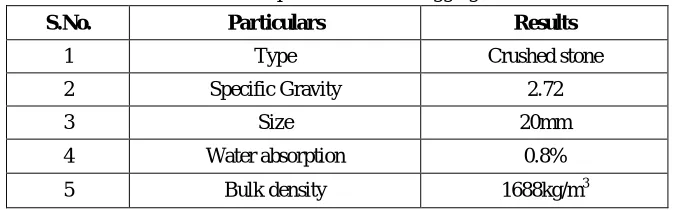
aggregate. Usually, the size of coarse aggregate is from 5 to 150 mm. For normal concrete used for structural members including beams and columns, the maximum size of coarse aggregate is about 25 mm. For mass concrete used for dams or deep foundations, the maximum size may be as large as 150 mm. In this study the size of the aggregate is 20 mm and it is taken from the quarry Akepadu village near Rajampet. The physical properties of coarse aggregate are listed in below table.
Table 3: Properties of Coarse Aggregate
S.No. Particulars Results
1 Type Crushed stone
2 Specific Gravity 2.72
3 Size 20mm
4 Water absorption 0.8%
5 Bulk density 1688kg/m3
3. Pottery Powder: Pottery powder is a range of refractory clays used in the manufacture of ceramics, especially fire
Fig.1: Pottery Powder
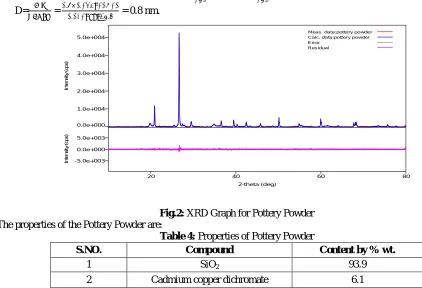
From XRD test results for Pottery Powder, By using Debye – Scherer equation Nano particle size can be obtained D=β λƟ where =1.54 Ao, β= full width at maximum intensity (FWHM) of the peak in radians.Ɵ= angle, K is constant 0.9. Sample calculation for particle size of Pottery Powder is given below by using Debye – Scherer equation for calculating particle, K=0.9, = 0.154 nm, β = π × FWHM = π × 1.2 = 0.021, 2Ɵ= 77.40o » Ɵ=38.7o
D=β λƟ = . × .. . = 0.8 nm.
Fig.2: XRD Graph for Pottery Powder
The properties of the Pottery Powder are:
Table 4: Properties of Pottery Powder
S.NO. Compound Content by % wt.
1 SiO2 93.9
2 Cadmium copper dichromate 6.1
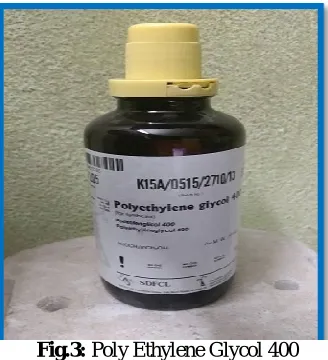
4. Poly Ethylene Glycol 400: Polyethylene glycol is a condensation polymer of ethylene oxide and water with the
overall components H(OCH2CH2)nOH, in which n is the average quantity of repeating oxy-ethylene agencies commonly from 4 to approximately 180. The abbreviation (PEG) is termed in mixture with a numeric suffix which suggests the average molecular weights. One commonplace function of PEG appears to be the water-soluble nature. Polyethylene glycol is non-poisonous, smell much less, impartial, lubricating, non-unstable and non-stressful and is utilized in an expansion of prescribed drugs.
Meas. data:pottery powder Calc. data:pottery powder Error
Residual
In
te
n
s
it
y
(
c
p
s
)
0.0e+000 1.0e+004 2.0e+004 3.0e+004 4.0e+004 5.0e+004
2-theta (deg)
In
te
n
s
it
y
(
c
p
s
)
20 40 60 80
Fig.3: Poly Ethylene Glycol 400
5. Water: Water is an essential ingredient of concrete, and a well designed concrete mixture, normally with 15 to
25% water with the aid of quantity, will possess the desired workability for fresh concrete and the specified durability and strength for hardened concrete. The entire quantity of water in concrete and the water-to-cement ratio can be the most important factors in the production of good-quality concrete.
IV. EXPERIMENTAL PROGRAM
a. Mix Proportions: In the present investigation M25 concrete is prepared with the water cement ratio 0.5. Concrete
mixes are prepared by different proportions of cement replacing with Pottery Powder and PEG 400 can be replaced in water with different proportions i.e. 0.5%, 1%, 1.5% and 2%.
The mix designations are follows:
1. M0 refers to the conventional OPC concrete
2. M1 refers to 5% P.P in cement+ 0.5% PEG 400 in water 3. M2 refers to 5% P.P in cement+ 1% PEG 400 in water 4. M3 refers to 5% P.P in cement+ 1.5% PEG 400 in water 5. M4 refers to 5% P.P in cement+ 2% PEG 400 in water 6. M5 refers to 5% P.P in cement
b. Casting of Specimens: The specimens are casted in the present study are cubes of size 150X150X150 mm,
Cylinders of size 150 mm diameter and 300 mm height, Beam specimens of size 150X150X700 mm for 7 days, 14 days and 28 days. RCPT of size 10 mm diameter and 5 mm height used for 28 days and 60 days. and water permeability of 200mm diameter and 120 mm height are used for 60 days.
c. Mix Proportions: Mix Proportions for M25 concrete are:
Table 5: Mix Proportions of Concrete
Material Quantity
Cement 351.5 Kg/m3 Fine Aggregate 718.43 Kg/m3 Coarse Aggregate 1163.6 Kg/m3
V. EXPERIMENTAL RESULTS
A. compressive strength of concrete on pottery powder: The compressive strength of concrete for mortar cubes
to get the optimum mix are shown in below table.6
Table 6: Compressive Strength Test Results for P.P in 7 days mortar cubs
% Replacement of P.P in cement
Compressive Strength,
N/mm2
0 33.3
5 33.3
10 17.1
15 14.6
The graphical representation of compressive strength for 7 days mortar cubes for getting optimum proportion as shown in below figure. The compressive strength of mortar cubes is high for 5% replacement of pottery powder when compared with normal cement mortar cubes.
Fig.4: compressive strength for mortar cubes
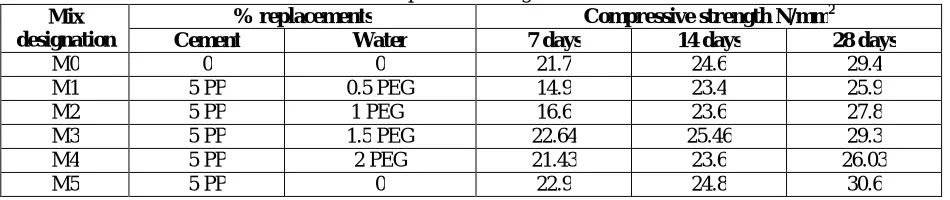
The compressive strength of M25 grade concrete mixes by replacing OPC with pottery powder 5% in cement and 0.5%, 1%, 1.5%, 2% poly ethylene glycol 400 is replaced by the weight of water is investigated. The results of compressive strength for these concrete mixtures tested at 7 days, 14 days and 28 days are presented in table no.7. The graphical representation between compressive strength versus curing age of concrete is represented in Fig.5.
Table 7: Compressive Strength Test Results
Mix designation
% replacements Compressive strength N/mm2
Cement Water 7 days 14 days 28 days
M0 0 0 21.7 24.6 29.4
M1 5 PP 0.5 PEG 14.9 23.4 25.9 M2 5 PP 1 PEG 16.6 23.6 27.8 M3 5 PP 1.5 PEG 22.64 25.46 29.3 M4 5 PP 2 PEG 21.43 23.6 26.03 M5 5 PP 0 22.9 24.8 30.6
0 5 10 15 20 25 30 35
0 5 10 15
str
e
n
gth
N
/m
m
2
The compressive strength decreased by 11.9% for M1, decreased by 5.44% for M2, decreased by 0.334% for M3, decreased by 11.46% for M4 and increased by 4.08% for M5 when compared with conventional concrete. The compressive strength is more for concrete with only pottery powder.
.
Fig.5: Compressive strength of Concrete
B.Tensile Strength of Concrete: Split Tensile Strength of M25 grade concrete mix replacing OPC by Pottery Powder
at 5% constant and Poly Ethylene Glycol 400 can be replaced self curing agent 0.5%, 1%, 1.5% and 2% weight of water. The results of Split Tesnsile strength of concrete tested at 28 days are shown in table 8.
Table 8: Split Tensile Strength Test Results
Mix Designation % replacement
Split tensile strength
N/mm2
Cement Water 7 days 14 days 28 days
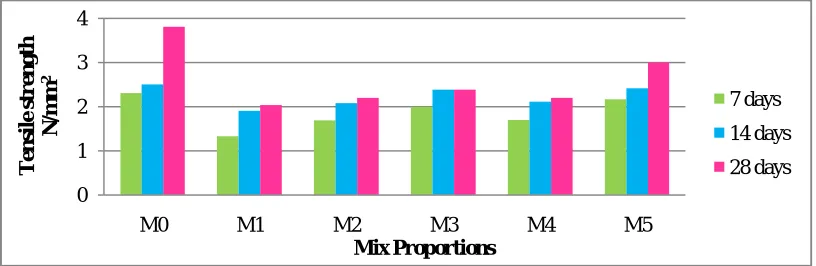
M0 0 0 2.3 2.5 3.8 M1 5 PP 0.5 PEG 1.33 1.9 2.03 M2 5 PP 1 PEG 1.68 2.08 2.2 M3 5 PP 1.5 PEG 1.99 2.38 2.4 M4 5 PP 2 PEG 1.7 2.11 2.2 M5 5 PP 0 2.16 2.41 3.0
The tensile strength of the concrete is decreased by 46.57% for M1, decreased by 42.1% for M2, decreased by 36.84% for M3, decreased by 42.1% for M4and decreased by 21.05% for M5. The tensile strength is more for conventional concrete and the concrete with pottery powder is more when compared with self curing concrete.
.
Fig.6: Split tensile Strength of concrete 0
10 20 30 40
M0 M1 M2 M3 M4 M5
A
x
is
Ti
tl
e
Mix Proportions
7 days
14 days
28 days
0 1 2 3 4
M0 M1 M2 M3 M4 M5
Te
n
si
le
s
tr
e
n
gth
N
/m
m
2
Mix Proportions
7 days
14 days
C. Flexural strength of concrete: Flexural Strength of M25 grade concrete mix replacing OPC by Pottery Powder at 5% constant and Poly Ethylene Glycol 400 can be replaced self curing agent 0.5%, 1%, 1.5% and 2% weight of water. The results of flexural strength of concrete tested at 28 days are shown in table 9.
Table 9: Flexural strength test results
Mix Designation
replacement in cement and water Split tensile
strength N/mm2
Cement Water 28 days
M0 0% PP 0% PEG 7.21 M1 5% PP 0.5% PEG 6.23 M2 5% PP 1% PEG 6.25 M3 5% PP 1.5% PEG 6.97 M4 5% PP 2% PEG 6.7 M5 5% PP 0%PEG 7.17
The flexural strength of self curing concrete is decreased by 13.59% for M1, decreased by 13.31% for M2, decreased by 3.32% for M3, decreased by 7.07% for M4 and 0.55% for M5 when compared with normal concrete. The concrete with pottery powder is more when compared with self curing concrete proportions.
.
Fig.7: Flexural strength for beams
D. Rapid Chloride Permeability Test: Rapid Chloride Permeability Test of M25 grade concrete mix replacing OPC
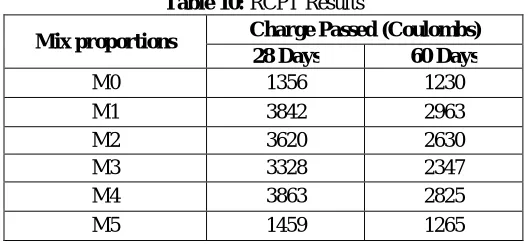
by Pottery Powder at 5% constant and Poly Ethylene Glycol 400 can be replaced self curing agent 0.5%, 1%, 1.5% and 2% weight of water. The results of Rapid Chloride Permeability of concrete tested at 28 days and 60 days are shown in table 4.4.1.
Table 10: RCPT Results
Mix proportions Charge Passed (Coulombs)
28 Days 60 Days
M0 1356 1230 M1 3842 2963 M2 3620 2630 M3 3328 2347 M4 3863 2825 M5 1459 1265 5.5
6 6.5 7 7.5
M0 M1 M2 M3 M4 M5
S
tr
e
n
gth
% of replacements
The chloride permeability is less for concrete with pottery powder when compared with self curing concrete proportions and the chloride penetration is less for 60 days curing of concrete when compared with 28 days of concrete.
Fig.8: RCPT for different Proportions
E. Water Permeability Test: The Water Penetration test of M25 grade of concrete by replaces in ordinary Portland cement with pottery powder at constant 5% and poly ethylene glycol 400 can be replaced by the water at various percentages like 0, 0.5, 1, 1.5 and 2%.
F. Table.11: Water Permeability results
Mix Proportion Depth of penetration
(d in cm)
Coefficient of permeability (K in m/sec)
M0 0.4 7.22x10⁻¹⁴
M1 8 1.09x10⁻¹¹
M2 8.5 1.54x10⁻¹¹
M3 6 6.54 x10⁻¹²
M4 8 1.68x10⁻¹¹
M5 2 1.45x10⁻¹³
The water permeability of concrete is less for conventional normal curing when compared with self curing concrete. The concrete with pottery powder is less when compared with self curing concrete. The results of Water Penetration of self curing concrete mixtures tested at 60 days the data are presented in above table and graphical presentation of Water Penetration.
0 1000 2000 3000 4000 5000
M0 M1 M2 M3 M4 M5
C
h
ar
ge
P
as
se
d
i
n
C
o
u
lo
m
b
s
Mix Proportions
28 Days
\
Fig.9: Water Permeability for different mix Proportions
VI. CONCLUSION
The compressive strength of cement mortar cubes having 5% Pottery powder replacement in cement is more strength than while adding the pottery powder of 10% and 15%. The compressive strength of concrete with 5% pottery powder in cement + 1.5% PEG 400 in water gives more strength for self curing concrete and the compressive strength of concrete having only 5% pottery powder is more strength compared to self curing concrete and normal conventional concrete. Tensile strength of normal concrete is more than that of concrete with 5% pottery powder. Tensile strength of self curing concrete is more in 5% pottery powder in cement + 1.5% PEG 400 in water compared to self curing concrete having remaining proportions. Flexural strength of normal concrete is more than that of concrete with 5% pottery powder. Flexural strength of self curing concrete is more in 5% pottery powder in cement + 1.5% PEG 400 in water compared to self curing concrete having remaining proportions. The chloride penetration in self curing concrete is less in case of 5% pottery powder in cement + 1.5% PEG 400 in water while compared to other proportions. The chloride penetration of concrete with 5% pottery powder is less compared to conventional normal concrete. The water permeability in self curing concrete is less in case of 5% pottery powder in cement + 1.5% PEG 400 in water while compared to other proportions. The water permeability of concrete with 5% pottery powder is greater compared to conventional normal concrete.
Suggestions for SCC:
Theself curing concrete does not having any curing in water, so we have to sprinkle some water at the time of self curing process, when you are using PEG 400 in water. Due to sprinkling of water the permeability of concrete is reduced and also strength can be increases.
REFERENCES
[1]. Selvamony, M. S. Ravi Kumar, “investigations on self-compacted self-curing concrete the usage of limestone powder and clinkers”, journal
published in VOL. five, NO. three, March 2010 ISSN 1819-6608, ARPN magazine of Engineering and carried out Sciences, 2010.
[2]. M.V.Jagannadha Kumar, M. Srikanth, “energy characteristics of self-curing concrete”, journal published in worldwide magazine of research in
Engineering and generation ISSN: 2319-1163,2012.
[3]. J.balajirainbow Praveen, S. Manju Soniya, “An Experimental observe on Mechanical homes of metal Fiber bolstered Self Curing Concrete”
journal published on worldwide journal of Engineering studies in Mechanical and Civil Engineering, extent 1, trouble 2 .
[4]. Vinayak Vijapur, Mohammed Noorulla, “An Experimental research at the conduct of Self Curing Concrete beneath Acidic assault”, journal
published in international magazine of Engineering research-on line A Peer Reviewed international magazine ISSN: 2321-7758, Vol.1., problem.3., 2013.
[5]. M.S Shetty, “Concrete generation concept and practice” published through S. Chand & corporation Ltd. pp. 1-3.
[6]. IS 10262:2009, “endorsed guidelines for concrete mix design”, Bureau of Indian requirements, New Delhi.
[7]. IS 456:2000, “Indian trendy code of exercise for plain and strengthened concrete”, Bureau of Indian standards, New Delhi.
[8]. IS 5816:1999, “Splitting tensile electricity of concrete technique of test”, Bureau of Indian requirements, New Delhi.
0 2 4 6 8 10
M0 M1 M2 M3 M4 M5
D
e
p
th
o
f
p
e
n
e
tr
ati
o
n
[9]. IS 383: 1970, “Specification for coarse mixture and exceptional aggregate from natural assets for concrete”, Bureau of Indian standards, New Delhi.
[10].IS 516:1959, “strategies to checks for energy of concrete”, Bureau of Indian requirements, New Delhi.
[11].Mohanraj A, Manoj Prabhakar S, Rajendran M, “Predicting the power of Self-Compacting Self-curing Concrete the usage of synthetic Neural
community” magazine posted in worldwide convention on emerging trends in Engineering and technology ISSN 0976 – 6308 (Print), ISSN 0976– 6316(on line),extent 5, trouble 12, December (2014), pp. 239-247.