Abstract
BRIGGS, CHRISTOPHER MICHAEL. Multicycle Adaptive Simulation of Boiling Water Reactor Core Simulators. (Under the direction of Paul J. Turinsky).
Adaptive simulation (AS) is an algorithm utilizing a regularized least squares
methodol-ogy to correct for the discrepancy between core simulators predictions and actual plant
mea-surements [1]. This is an inverse problem that will adjust the cross sections input to a core
simulator within their range of uncertainty to obtain better agreement with the plant
measure-ments. The cross section adjustments are constrained to their range of uncertainty using the
covariance matrix of the few-group cross sections and in imposing the regularization on the
least squares solution. This few-group covariance matrix is obtained using the covariance
matrix of the multi-group cross sections and the corresponding lattice physics sensitivity
matrix. To perform the adaption, one must also have the sensitivity matrix of the core
simula-tor. Constructing the sensitivity matrix of both the lattice physics code and core simulator
would be a daunting task using the traditional brute-force method of computing a forward
solve for a perturbation of every input. To avoid this, a singular value decomposition (SVD) is
used to construct a low rank approximation of the covariance matrices, thus drastically
reduc-ing the number of required forward solves.
Until now, AS has been used on a single depletion cycle to correct for discrepancies
result-ing from errors introduced by incorrect cross sections only. Adaptresult-ing to a sresult-ingle depletion
cycle means that the cross sections of cycle m were adjusted so that the core simulator better
predicts the actual measurements of cycle m (and future cycles if the algorithm is robust).
This, however, does not account for the reloaded burnt fuel number density errors at the
previous cycle. If adaption changes the cross sections of that burnt assembly in cycle m, those
cross sections should have also been changed in any cycle preceding m which would have
resulted in different BOC m number densities. This means that the number densities obtained
using the original cross sections are not consistent with the newly adapted cross sections.
Hence, the number densities input to a core simulator are not the actual values in the
reac-tor’s fuel assemblies for the burnt fuel. This discrepancy in isotopics is another component to
the discrepancy between the core simulator and actual observables. This means that the
adap-tion algorithm is adjusting cross secadap-tions to account for number density errors.
It is the goal of this research to 1) remove these inconsistencies between the adapted cross
sections and the burnt fuel BOC n number densities, and 2) ensure that adjusting cross
sec-tions to make up for number density errors does not corrupt the adaption. To do this, we
assume that to best predict cycle n (by correcting both cross sections and BOC number
densi-ties of cycle n), one must adapt cycles m through n-1 simultaneously, where cycle m is the
cycle in which the oldest assembly in cycle n is a fresh assembly. After adaption, the cross
sections must be used to deplete from cycle m to n. This will remove the number density
errors in two ways: 1) burnup healing, and 2) beginning the depletion of fresh assemblies in
cycles m through n-1 with the correct cross sections. To ensure the cross sections adjustments
are not overcompensating for the number density errors, we restrain their adjustment to stay
Multicycle Adaptive Simulation
of Boiling Water Reactor
Core Simulators
by
Christopher Michael Briggs
A thesis submitted to the Graduate Faculty of North Carolina State University
in partial fulfillment of the requirements of the Degree of
Master of Science
Nuclear Engineering
Raleigh, North Carolina 2007
APPROVED BY:
~,)(l/~--Semyon V. Tsynkov
Co-chair of Advisory Committee
ii
Dedication
iii
Biography
Christopher M. Briggs was born in Houston, TX on February 2nd, 1983. He received his
primary education locally in Houston, graduating from Scarborough High School in 2001. He
attended Texas A&M and received his Bachelor of Science in May 2005 from the Department
of Nuclear Engineering, graduating Magna Cum Laude. After A&M, Chris began his work
towards a Master’s of Science in Nuclear Engineering at North Carolina State University
under the direction of Dr. Paul J. Turinsky. He has accepted a position at Westinghouse
iv
Acknowledgements
There isn’t enough room on this page to properly thank those that made it possible for me
to complete my master’s work here at N.C. State. I would like to thank my family for the
bot-tomless well of support that kept me going through the hardest and most stressful of times
starting from day one. Their continuous self-sacrifice gave me all the time and resources I
could have ever needed to be where I am today. I would also like to thank Dr. Turinsky for
accepting me as a master’s student and teaching more than I ever imagined I could learn in
only two years. Next I would like to thank Dr. Paul Keller for his uncanny ability to fix
FOR-MOSA B when I broke it, without which I would have never been able to get my research off
the ground. At the opposite end of my research, I also want to thank both Dr. Abdel-Khalik
and Mr. Matthew Jessee for the long hours they both contributed to ensure my final product
withstood the most intense scrutiny. It is also worth noting the unwavering patience of Dr.
Turinsky and Dr. Abdel-Khalik for withstanding the endless stream of mindless mistakes I put
them through.
I would also like to thank my peers for their insight, support, and most importantly their
constant source of comical relief. This includes Kenny Anderson, Doug DeJulio, Jason Harp,
Ross Hays, Tyler Hickle, Matt Jessee, Tracy Stover, and Tim Wright. Lastly, even though
v
Table of Contents
List of Figures. . . vii
1. Introduction . . . 1
1.1 Scope of Work . . . 3
1.2 Core Simulators Overview. . . 4
1.2.1 Core Simulator Basics . . . 4
1.2.2 Various Core Simulators . . . 5
1.2.3 Core Simulator Input . . . 6
1.2.4 Simulation Errors . . . 7
1.2.5 Simulator Output . . . 9
1.3 Adaptive Simulation . . . 9
1.3.1 Necessary Traits . . . 10
1.3.2 Adaption Benefits . . . 12
1.3.3 Previous Adaption Methods . . . 12
2. Adaptive Simulation . . . 14
2.1 Least Squares Development. . . 14
2.1.1 Regularization Parameter. . . 16
2.2 Least Squares Continued . . . 19
2.3 Completing the Adaption. . . 20
3. Design and Virtual Cores . . . 25
3.1 Cross Section Perturbations . . . 26
3.2 Number Density Perturbation . . . 30
3.2.1 Core Simulator Software and Design Core . . . 31
3.2.2 Introducing the Number Density Errors . . . 32
4. Results . . . 34
4.1 Pre-Adaption Number Density Behavior. . . 34
4.1.1 Linear Response. . . 34
4.1.2 Burnup Healing and Fresh Fuel Loading. . . 35
4.2 Adaption Inputs . . . 37
4.2.1 Regularization Parameter. . . 37
vi
4.2.3 Cycle Weights . . . 39
4.3 Number Density Decrease vs. Adaption Inputs. . . 40
4.3.1 Constant Cycle Weight . . . 42
4.3.2 Constant keff Weight . . . 47
4.3.3 Constant Alpha . . . 48
4.3.4 Linearization Error. . . 49
4.4 Summary . . . 50
5. Conclusions. . . 65
6. Future Work. . . 67
vii
List of Figures
Figure 3.1: Singular values vs. principal direction. . . 28
Figure 4.1: keff and pcm errors of cycles 15 and 16 resulting from cross section and number density errors . . . 52
Figure 4.2: keff and pcm errors of cycles 17 and 18 resulting from cross section and number density errors . . . 53
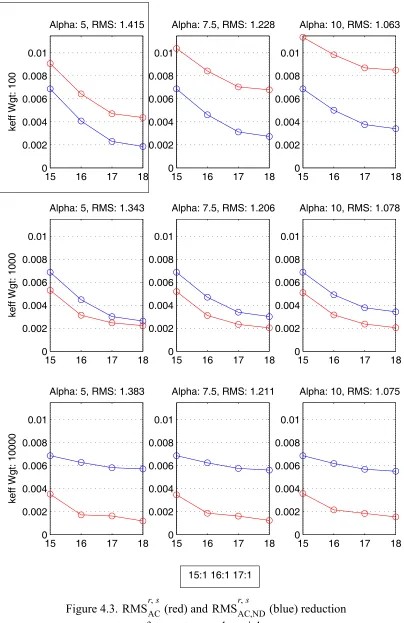
Figure 4.3: (red) and (blue) reduction for constant cycle weight . . . . 54
Figure 4.4: keff (blue) and nodal power (red) misfit for constant cycle weight . . . 55
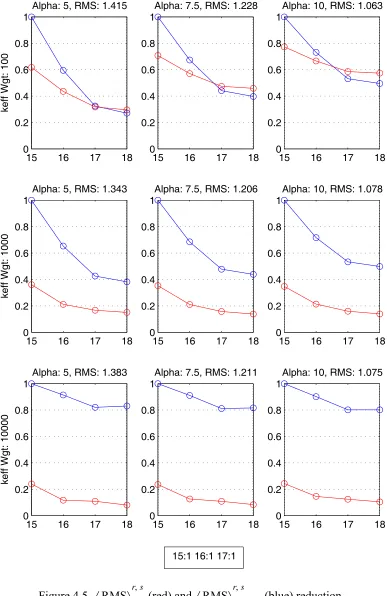
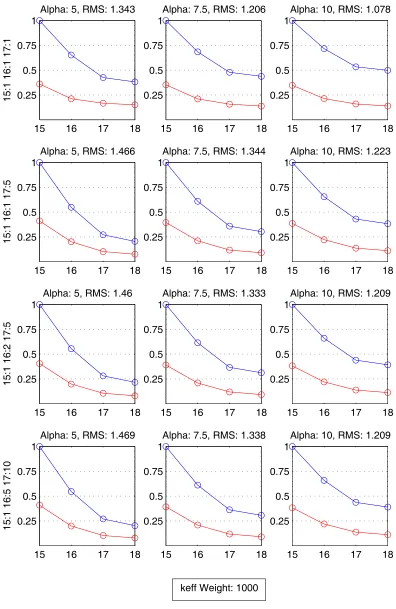
Figure 4.5: (red) and (blue) reduction for constant cycle weight 56 Figure 4.6: (red) and (blue) reduction for constant keff weight . . . 57
Figure 4.7: keff (blue) and nodal power (red) misfit for constant keff weight . . . 58
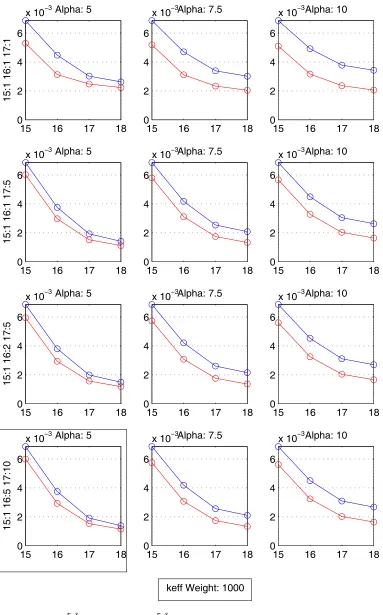
Figure 4.8: (red) and (blue) reduction for constant keff weight. . 59
Figure 4.9: (red) and (blue) reduction for constant alpha. . . 60
Figure 4.10: keff (blue) and nodal power (red) misfit for constant alpha . . . 61
Figure 4.11: Number density reduction for constant alpha . . . 62
Figure 4.12: Cycle 18 keff and pcm error for each core . . . 63
Figure 4.13: Nodal power RMS error: (blue), (green), and (black) . . . 64
RMSr sAC, RMSr sAC,ND,
RMS
〈 〉r sAC, 〈RMS〉r sAC,ND,
RMSr sAC, RMSr sAC,ND,
RMS
〈 〉r sAC, 〈RMS〉r sAC,ND,
RMSr sAC, RMSr sAC,ND,
RMSr
DC NP, RMS
r
AC NP,
RMSr
CHAPTER 1: INTRODUCTION 1
Chapter 1: Introduction
In the present day nuclear power industry, a reliable reactor core simulator for light water
reactor (LWR) cores is a crucial part of reactor design, economics, and safety. The
development of such a crucial tool is no trivial task, requiring design, construction, and testing
that can take years. These steps can require an exorbitant amount of time and money before
any worthwhile results are produced that justify the effort dedicated. Furthermore, even when
the core simulator is complete, it will inevitably have its own limitations that prevent it from
completely reproducing actual real plant data. To avoid this scenario, and for multiple reasons
to be discussed later, there has been an effort to improve the input data to existing core
simulators so that the simulator’s prediction of a reactor’s behavior are closer to that of the
real world reactor. Throughout this paper, this effort is known as adaptive simulation.
Adaptive simulation is a methodology that makes use of both real plant data and core
simulator output to change (adapt) the simulator inputs in such a way as to reduce the
discrepancy between the two. Crucial to the process, adaption can be executed without
changing any of the models used within the core simulator. In fact, adaption can account for
different modeling algorithms. It was shown in previous work by Abdel-Khalik and Turinsky
that adaptive simulation is capable of improving the agreement between two simulator’s that
use different thermal hydraulic models [1]. This is evidence that adaption can account for the
shortcomings of a model’s ability to correctly replicate the actual behavior inside the core.
This enables the continued use of currently available core simulators rather than devoting
precious resources to altering a currently available simulator or developing a new, superior
simulator. Furthermore, note that a preliminary uncertainty analysis study [4] for a boiling
CHAPTER 1: INTRODUCTION 2 core reactivity and power distribution are of the same magnitude as the uncertainties in these
core attributes that originate due to nuclear data uncertainties, implying that pursuing the
development of higher fidelity core simulator models may not prove beneficial.
This improvement in the accuracy of the simulator’s output is accomplished by modifying
its inputs in such a way as to improve the simulator’s agreement with plant data. For core
simulators, this includes microscopic cross sections and thermal hydraulic data. Due to the
discrete nature of the simulator input and output data, the adaption can be performed by using
well developed linear algebra techniques. The methods used to alter the input data prevent any
adapted values from changing to a nonphysical value (such as a negative cross section), which
would render the method ineffective. Further, adaption of input data must factor the
uncertainty associated with this data by assuring the adapted data values are probable. It is
important to note that even though the isotopic number densities are also inputs to a core
simulator, these values are not adapted since they are not independent of the other inputs. If
the number densities were adapted at the same time as the cross sections, there is no guarantee
that the adapted number density values will be within the range predicted by the Bateman
depletion equations using the adapted nuclear data.
Current adaption capability treats the change in number densities due to the change in
adapted input data by solving the Bateman equations. However, if completing adaption on
reload cores, which by definition contain partially burnt fuel from earlier cycles, one must
address the issue that the isotopic number densities associated with the burnt fuel, which are
input data, would be inconsistent with the adapted core simulation. To get the best adaption
for cycle n, one would need to go all the way back and adapt cycle one followed by a cycle
CHAPTER 1: INTRODUCTION 3 not using consistent number densities for burnt fuel since cycle one only contains fresh fuel.
Cycle one adaption is done to update the number densities to correspond with the adapted
cross sections, providing consistent number densities for burnt fuel that appears in the cycle
two input data. One would successively repeat this process all the way to cycle n using the
core simulator to ensure that the cycle n number densities are consistent. Since this is
impractical for reactors that have been operating for a substantial time due to the high number
of reload cycles and lack of pedigree of experimental data, the focus of this research is on the
impact of starting the adaption on a cycle that is not the first cycle of a reactor’s life, i.e. cycle
m (where 1 < m < n), and it’s impact on the simulation of future cycles greater than m, in
particular cycle n. This is accomplished by iterating, if necessary to correct for linearization
errors associated with the adaption method, an adaption and depletion sequence starting at a
cycle close to n. These iterations should eventually converge to the consistent number
densities with respect to the adapted cross sections.
Due to simplicity of the pressurized water reactor (PWR) core relative to the BWR core,
the fidelity of PWR core simulators is superior to that of BWRs. Currently, the prediction
accuracy of BWR core attributes is such that large design margins are necessary to account for
uncertainties, which adversely impacts power plant economics, e.g., cost of electrical energy
generated. Therefore, the focus of adaptive simulation has been on BWRs, since these systems
have the most room for improvement.
1.1: Scope of Work
The subsequent sections will discuss the general concepts and characteristics of core
CHAPTER 1: INTRODUCTION 4 and sources of errors will be explored. This will be followed by the desired traits of the
adaptive method and how we propose to satisfy these traits. The chapter will be concluded by
discuss the benefits of cross section adjustment and its history.
The following chapter will present a terse derivation of the mathematics behind adaptive
core simulation. Chapter three will describe the virtual approach used to create the measured
observables, as opposed to using actual plant data. In Chapter Four, several cases will be
investigated to determine the capabilities of adaption. Lastly, Chapter Five and Six will
summarize our work and present some ideas for the future of adaptive core simulation.
1.2: Core Simulators Overview
As previously indicated, technological complexity of present day nuclear reactors has
made the nuclear power industry heavily reliant on reactor simulators. Small scale tests and
experiments are still vital to developing empirical models and collecting data, but these
models inevitably serve as the foundation of some sort of computational recreation. This
happens largely because repeatedly performing the small scale tests can quickly become
impractical due to the time and costs of such procedures, and possible lack of applicability of
scaling to the commercial reactor. Due to their importance to the nuclear industry, it is
worthwhile to cover the fundamentals of core simulators.
1.2.1 : Core Simulator Basics
In general, the main purpose of a core simulator is to accurately model the neutronic and
thermal-hydraulic behavior of a nuclear reactor. The core of a reactor is composed of many
structures, including fuel assemblies, control rods, structural support, and monitoring
CHAPTER 1: INTRODUCTION 5 multitude of properties for these materials such as dimensions, compositions, and nuclear
properties of the compositions for example. Using this information, the simulator then
determines the distribution of neutrons, or neutron flux. The neutron flux, referred to as the
flux from here on, is used to determine neutron interaction rates inside various media that
make up the reactor core. The flux and reaction rates can then be used to calculate a wide
variety of parameters used in design, control, safety, and other reactor fields, such as power
distribution and material behavior.
1.2.2 : Various Core Simulators
One type of reactor core simulator is the online simulator. This is most important at a
power plant site while the reactor is in operation. The reactor operators take advantage of the
online simulator for a wide variety of functions. For example, online simulators aid in the
monitoring of the current state of the reactor and predict if the reactor state will be shifting to
an unsafe configuration. If the reactor is moving towards an unsafe situation, the simulator
can help to correct this by advising the operator to manipulate the control systems. If the
control systems aren’t enough, the reactor will be shut down by activating the appropriate
safety systems. Training simulators, another type of simulator, are used to train future and
current reactor operators through the simulations of accidents and other various pedagogues.
The other type of reactor simulator is the design simulator. This type performs an innumerable
number of functions beyond that of the online and training simulators. The design simulator is
used in the design process to determine the core loading pattern (LP), the control rod program
(CRP) for the current fuel cycle, interpret physics tests, and evaluate various operational,
CHAPTER 1: INTRODUCTION 6
1.2.3 : Core Simulator Input
Now that we have introduced the concepts of reactor core simulators, it will be beneficial
to further elaborate on the type of simulator adapted in this research. This includes the
assorted models employed, the input data required, the output obtained, and a brief discussion
of the work that must be done to generate these input data. This will lead to where the
simulations can go wrong and why. Combining the characteristics of the simulator with the
impact and causes of the error will immediately reveal the driving force behind pursuing
adaptive techniques.
To determine the flux, a variety of phenomena must be numerically modeled by the
simulator. Most importantly, this includes neutron physics and thermal-hydraulics due to the
nonlinear behavior of the former with respect to the latter and vice versa. One essential
component of the neutron physics is the cross section. This is a fundamental parameter
required for any calculation involving neutron interactions. The cross section of a material (or
group of materials such as a fuel assembly) can be evaluated so that it describes the
probability of neutron interaction (e.g. scatter or absorption) within a media based only on the
incident energy of the neutron and current state (such as burnup and temperature) of the
interacting media. The evaluation of these cross sections for a core simulator is performed by
lattice physics codes. For a core simulator, these codes take the detailed cross section energy
dependence and combine it with the complex geometry (from a traversing neutron’s
perspective) of a fuel assembly to collapse all the cross section information of the entire
assembly down to a set of more manageable numbers. These new manageable numbers
homogenize the spatial detail of the corresponding assembly that would be impractical to
CHAPTER 1: INTRODUCTION 7 cross sections being energy dependent in an almost continuous fashion, the lattice physics
code produces cross sections that are held constant over several energy ranges, but done so as
to preserve reaction rates. Also, the cross section is now spatially dependent on an assembly
by assembly basis, rather than dependent on its exact location inside a specific lattice position
in the core.
The number of cross sections input to a core simulator is extremely large. The exact
number will depend on the models used within the simulator. For example, this can depend on
the number of isotopes tracked in the fuel assemblies, the number of discrete neutron energy
groups used, the number of time steps over the cycle length, and so on. Also, since the state of
fuel at a given core location is constantly changing inside the core due to burnup, control rod
movement, and thermal-hydraulic conditions, a cross section is evaluated for a variety of
states [6]. The core simulator can then interpolate between the state point values to get the
cross section that best represents the current state of the fuel at a specific core location. The
end result is that the full set of cross sections alone constitute a copious amount of input data.
1.2.4 : Simulation Errors
In general, all complex numerical computations suffer from the same base set of
weaknesses due to finite precision floating point arithmetic and modeling errors. These can be
significant sources of error even with the current advances in computer technology. It is
impossible to eliminate the effects of round-off error and its propagating effects on
computations that require a high precision of accuracy even with employment of iterative
CHAPTER 1: INTRODUCTION 8 reduce the run time to something practical relative to frequency of use. Core simulators are no
exception to these issues.
To begin, there are neutron transport models that are capable of describing the flight
behavior of individual or ensemble average of neutrons within the reactor core. This can be
done stochastically, i.e., Monte Carlo, or deterministically, e.g., Sn method, with time, spatial,
angular, and energy dependence of the flux represented with detail. However, this is
computationally prohibitive to use in a routine fashion. Nuclear engineers developed a simpler
model known as few-group, diffusion theory that uses the energy and angular integrated
behavior of the neutrons to determine the flux. The assumptions made to employ the diffusion
simplification come with a price however. On top of these diffusion simplifications, there are
many numerical methods available to solve the few-group diffusion equations, each with their
own strengths and weaknesses.
The simulator must also be able to handle the simplifications of the lattice physics codes.
Many of these simplifications are done to aid diffusion theory. The detailed energy
dependence of the cross sections is removed so that the few-group diffusion equations can be
solved for the few-group flux. The fine spatial detail of the fuel assemblies is also removed
from the cross sections by creating assembly averaged cross sections to implement diffusion
theory on a coarse mesh. Also, the collapsed cross sections generated by the lattice physics
codes are computed using vast amounts of experimentally tabulated data. These data bring
along its own experimental uncertainties that propagate through the core simulator. As noted
earlier, a preliminary assessment has indicated that for BWR cores, nuclear data uncertainties
CHAPTER 1: INTRODUCTION 9 in predicted and measured values of these attributes. This implies that other sources of
uncertainties, such as due to modeling and numerical methods, may be of less significance.
1.2.5 : Simulator Output
The outputs of a core simulator that are important to adaption can be divided into two
categories: core observables and core attributes. Core observables are reactor quantities
measured by in-core instrumentation such as in-core detectors. These detectors are located
throughout the BWR core by-pass in flow channel corners that do not contain control rods. It
is these instrument readings that the core simulator is adapted to. The cross sections are
changed in such a way that the core simulator predicted observables better agree with the
plant observables.
Core attributes differ from core observables in that they are not directly measured.
Examples of core attributes include local power peaking and thermal margins. It is crucial for
an adapted simulator to also be capable of correctly predicting these quantities. These terms
will be used to describe the associated output for the remainder of the paper.
1.3: Adaptive Simulation
As has already been indicated, adaptive simulation for core simulators is the process of
using real plant data and core simulator output to adjust the simulator input in such a way as to
improve the agreement between the two. All of the simulator’s inadequacies create a
discrep-ancy between the simulator’s output and the collected data of an actual plant. Adaptive
simu-lation is used to minimize the effects of the input data errors of a core simulator without
altering any of the simulator’s design. To be capable of successfully utilizing an adaptive
CHAPTER 1: INTRODUCTION 10 run times). If it does, the potential benefits of adaptive simulation go beyond merely a
simula-tor that better matches real plant behavior. It is the pursuit of these three qualities that is the
subject of this research. The following expands on these ideas.
1.3.1 : Necessary Traits
As previously indicated, the nuclear reactor simulator has become a ubiquitous part of
nuclear design and operation. The examples given are only a small fraction of the many ways
researchers are using simulators to develop and test better ways to overcome the latest
obstacles of the nuclear industry. One obvious fact that was never mentioned, but needs
discussion, is that all of the research utilizing adaptive simulations is worthwhile only if a
capable simulator is available. Before one can reap the benefits of an adapted simulator, there
are a number of required traits of the final product. Several important characteristics (among
many) of an adapted simulator, for its use to be viable to engineers, include: high fidelity,
robustness, and practical run times. The difficulty with globally quantifying each of these
terms is that they are all relative to the purpose of the simulator. For the current intentions,
fidelity denotes the ability of an adapted simulator to accurately predict the measured
observables. Robustness is the ability of the adapted simulator to accurately predict core
attributes which are not directly observed and for core operating conditions beyond those for
which the core simulator had measurements to adapt to. This could be the measured
observables recorded at future times for example [1]. Lastly, one could say that a practical run
time would be one that is substantially shorter than the frequency of the simulator’s intended
CHAPTER 1: INTRODUCTION 11 It is the last two items of this list (robustness and run time) that brings us to what is driving
the current research, recognizing that as a side product improved fidelity should also be
obtained. An adapted simulator will be extremely robust if it can accurately predict the core
behavior of future cycles. To do this, the isotopic number densities of an adapted cycle must
be updated to be within the range of the Bateman equations using the newly adapted cross
sections. The Bateman equations are used to compute the change in isotopics as a fuel
assembly is depleted. This can be done by starting the adaption at the first cycle, and
sequentially adapting and depleting all the way to the cycle of interest, but this will violate the
practical run time trait if the cycle of interest is relatively high. This may also be impossible if
the required data from previous cycles in unavailable or of questionable pedigree to be
adapted for whatever reasons. To resolve both of these issues, it is the subject of this research
to attempt starting the adaption at a cycle close to the cycle of interest. To accomplish this, if
the cycle of interest is cycle n and the cycle where the adaption will be started is cycle m
(where 1 < m < n), then cycles m through n-1 will be simultaneously adapted at one time. To
update the number densities, the simulator will then use the adapted cross sections to deplete
from cycle m to n-1. As will be explained later, the adaption over cycles m to n-1 may need to
be recomputed, e.g., iterated, since the adaptive method to be utilized is only first-order
accurate. Once iterations are completed, these final cross sections and number densities can
now be used to predict cycle n and beyond. This process shrinks the run time needed for a
CHAPTER 1: INTRODUCTION 12
1.3.2 : Adaption Benefits
The ability to reduce the error between simulation and actual plant measurements has
significant impacts on nuclear reactor economics. The more accurate the simulator, the tighter
the thermal margins can be that limit important characteristics of the reactor design due to the
reduced uncertainty in the safety calculations. This can reduce the conservatism that has to be
built into reactor design to compensate for simulator inadequacies. A more accurate simulator
can reduce capital, operations and maintenance, and fuel costs. For example, if an adapted
simulator is used to simulate a future cycle, one can potentially reduce the conservatism of the
thermal margins, allowing a reduction in fuel cycle costs via a more aggressive core design or
allow the core to be run at higher powers producing more electric energy to provide
consumers.
Adaption is not only limited to changing the input parameters to provide the output with
the smallest difference with observables. It can also be used to: estimate the bounds on the
range of acceptable model parameters; estimate the formal uncertainties in the model
parameters; show the sensitivity of the solution to perturbations in the data; determine the best
set of data suited to estimate a certain set of model parameters; and compare different models.
[1]
1.3.3 : Previous Adaption Methods
There have been previous attempts at adjusting input data to get better agreement based on
measured data. During the 1970s, researchers tried to manipulate the cross sections needed for
fast reactors. The researchers used integral experiments to get the ‘actual’ plant data for which
CHAPTER 1: INTRODUCTION 13 assemblies that operates at nearly zero power. The configuration of the assemblies is a small
scale version of an actual fast reactor core.
There are several fundamental differences between the previous attempts at data
adjustment and the current adaption algorithm. For one, the current method uses actual plant
data, instead of these integral experiments. The disadvantage to this is the actual plant data
may be distorted by feedback effects such as depletion and thermal-hydraulics. The data may
also be corrupted if an instrument is out of calibration, or even worse had unknowingly failed.
The advantage, however, is that there is a copious amount of core follow data from currently
operating plants. Another difference is the way the data adjustment is performed. For the
integral experiments, the researchers took advantage of Data Adjustment Techniques (DAT).
Due to the discrete nature of the simulator input and output data, this adaption takes advantage
of Discrete Inverse Theory (DIT). For ill-posed problems such as this one, DIT is much more
CHAPTER 2: ADAPTIVE SIMULATION 14
Chapter 2: Adaptive Simulation
Since the focus of this research is not on the development of adaption itself, the
mathemat-ical details will only be reviewed - for full development see previous work [2]. The first part
of this chapter is a mathematical description of the general least squares problem adaption is
designed to solve. This will be followed by our multicycle adaption algorithm. In this
discus-sion, it is assumed that the reader has a good understanding of linear algebra, least squares
methodology, and inverse theory concepts.
2.1: Least Squares Development
To develop the least squares problem, it will be advantageous to first revisit the single
cycle adaption, and then introduce our development of multicycle adaption. To begin,
adap-tive simulation of a core simulator is a substantial least squares problem in which the goal is to
minimize the difference between the predicted and measured observables while
simulta-neously restricting the adapted parameters to their uncertainty bounds. Let the core simulator
be represented as the following vector nonlinear equation:
2-1
where is a vector of dimension k whose components are the selected core parameters to be
adapted. The 0 in the vector represents the known vector (i.e., core simulator input vector)
that will be adapted to reduce the mismatch between the measured and predicted observables.
The is a vector of dimension q whose components represent the predicted core observables. d0c = Θ( )p0
p
p0
CHAPTER 2: ADAPTIVE SIMULATION 15
The 0 in the vector is the calculated observable vector resulting from operating on . The
adaption algorithm adjusts the parameters according to the following minimization problem:
2-2
where
2-3
The input parameters for which the uncertainty is required in include the few-group
cross sections and other neutronic parameters such as the diffusion coefficient. Since the
uncertainty information of these input parameters is not readily available in the required
few-group form, it must be calculated before the solution of Eq 2-2 can be found. Starting from
scratch, the values are available in the very detailed ENDF point-wise format. The PUFF-III
code developed at ORNL is able to propagate the point-wise uncertainties to the multi-group
level. This is not sufficient though because the core simulator uses few group parameters.
Pre-vious work by Jessee[5] developed the capability using ORNL codes to compute the desired
few-group covariance matrix and propagating the few-group uncertainties through the core
simulator and its associated preprocessor codes. In this method, the rank deficiency of the
covariance matrices is utilized to reduce the computational burden of such a calculation. The
rank deficiency makes it beneficial to approximate the action of the covariance matrices by
another set of matrices of much smaller size, the SVD factorization. The SVD factors can be
calculated directly without ever storing or evaluating the original large matrices.
dc0 p0
min Wd–1(dm–Θ( )p ) 2 subject to Wp–1(p p– 0) <ε
dm = vector of measured core observables
WdWdT = Cd (the observables covariance matrix)
WpWpT = Cp (the core parameters covariance matrix)
CHAPTER 2: ADAPTIVE SIMULATION 16
The covariance matrix for the observables is currently an input to the code that
per-forms the adaption. As will be explained later, since plant data are not actually used as the
observables, a representative Gaussian noise error is introduced into the simulated measured
core observables that are used for adaption (keff and nodal powers). The magnitude of the
Gaussian noise error is reflected in .
With the covariance data of the parameters and observables no longer unknowns, the
min-imization problem given in Eq 2-2 can be solved using adaptive simulation. The minmin-imization
equation can be rewritten as [3]
2-4
The first term is known as the misfit term and the second is the regularizaiton term. The in
the previous equation is know as the regularization parameter. Before further developing the
multicycle least squares problem, it is worthwhile to explore this very important parameter
that is used to diminish the adjustment of input parameters that could corrupt the robustness of
the adaption.
2.1.1 : Regularization Parameter
It is the goal of adaption to focus on parameters that have a high uncertainty and strong
sensitivity. This is so the difference between the measured and calculated observables can be
minimized by adjusting important parameters that have room for substantial adjustment
within uncertainty bounds. Adaption makes use of to single out these parameters [8]. To Cd
( )
Cd
min W
d T
dm–Θ( )p
( ) 2+α2 Wp–1(p p– 0) 2
⎩ ⎭
⎨ ⎬
⎧ ⎫
α
CHAPTER 2: ADAPTIVE SIMULATION 17 show the regularization parameter’s impact, we must introduce the SVD. If we denote the
Jacobian of the operator as , then the SVD of can be written as
2-5
where is a matrix composed of the left singular vectors, a matrix of the
singular values, and a matrix of the right singular vectors. If we project and
along the singular vectors as and , then the
un-regular-ized minimum norm least squares solution can be written as
2-6
where is the singular value of the operator, is the difference (in the left singular
vector subspace) between the measured and predicted observable, and is the resulting
size of the adjustment of the input parameter (in the right singular vector subspace). The
regularization parameter is employed by modifying the first equation in Eq 2-6 to be
2-7
where
2-8
Θ A (q k× ) A
A = USVT
U (q q× ) S (q k× )
VT (k k× ) ∆p
∆d ∆p˜j = VTj ⋅∆p ∆d˜j = UTj ⋅∆d
∆p˜j ∆d˜ m
[ ]j sj
--- where 1≤ ≤j q =
∆p˜j = 0 where q j< ≤k
sj jth A ∆d˜m
jth ∆p˜j
jth
∆p˜j fj ∆d˜ m
[ ]j sj
--- where 1≤ ≤j q =
f s( j ,e) sj
2
CHAPTER 2: ADAPTIVE SIMULATION 18
The in Eq 2-7 is the standard deviation of the measurement noise. The action of the
regular-ization filtering can be seen by way of the following example:
• Regularization is used to filter out those parameters whose adjustment will be corrupted by
the large amplification of inherent noise. First, rewrite the as ,
where f represents the noise free component and n represents the noise term. Equation 2-6
can then be rewritten
2-9
Here it can be seen that if the singular value is small, the noise of the measurement is
severely amplified, which can instantly ruin the adaption’s fidelity and robustness. If is
large in the sense , the will be small and thus reduce the parameter
adjust-ment in Eq 2-7.
The effect of a large in the above example is to make the in Eq 2-6 as small as
possi-ble for parameters with high noise and/or low uncertainty. Adjusting such parameters will ruin
both the fidelity and robustness of an adapted simulator. In the current work, the
regulariza-tion parameter is determined by ‘trial and error.’ This involves adapting the cross secregulariza-tions
with various magnitudes of and selecting the best results based on whichever metric of
interest is most important to the work being done (the RMS cross section adjustment in
stan-dard deviations for this work, to be discussed later). One could also produce an ‘L-curve’ to
determine the best . The L-curve is a plot in which the regularization term is on the oridnate
axis and the misfit term is on the abscissa. This curve is shaped like an L, and the optimum
is located in the bend of the L, known as the knee. e
∆d˜m ∆d˜m = ∆d˜f+∆d˜n
∆p˜j
[ ] ∆d˜
f
[ ]
sj
--- ∆d˜ n
[ ]
sj
--- where 1≤ ≤j q +
=
α
αe» sj f s( j ,ε)
α ∆p˜m
α
α
CHAPTER 2: ADAPTIVE SIMULATION 19
2.2: Least Squares Continued
Returning to the least squares development, if one defines as the Jacobian of the core
simulator such that
2-10
2-11
then the minimization problem can be rewritten as
2-12
If the regularization parameter is zero, then Eq 2-12 reduces to the standard least squares
problem that solely uses the observables to adjust the parameters. If the regularization
param-eter approaches infinity the misfit term becomes negligible and Eq 2-12 keeps the a prior
val-ues. The mathematical methods used to solve this minimization problem can be found in [7].
To extend this to a multi-cycle adaption, the minimization equation is modified to contain the
misfit terms for each cycle to be adapted and can be written as
2-13
where
A
dc = Θ( )p = dc0+A p p( – 0)+Higher Order Terms
A
[ ]i j, ∂∂ddi
j ---=
min Wd–1(∆dm–A∆p) 2+α2 Wp–1∆p 2
⎩ ⎭
⎨ ⎬
⎧ ⎫
min
∆p
w j
∑
2j ∆djm–Aj∆p 2 C†dj
α2 ∆p 2 C†
p +
⎩ ⎭
⎨ ⎬
CHAPTER 2: ADAPTIVE SIMULATION 20
2.3: Completing the Adaption
Adaptive simulation solves the minimization problem given in Eq. 2-11. The purpose of
formulating such a multicycle problem is because a single cycle adaption is not sufficient to
fully update all of the core simulator inputs. This brings up two questions:
1) Why can only certain inputs be adapted?, and
2) Why are multiple cycles necessary?
The answer to the first question is because there are other inputs (number densities) to the
core simulator that are dependent on the cross sections (the independent parameters). This
dependency is a problem because if the dependent parameters are simultaneously adapted
with their independent counterparts, there is no guarantee they will be within the range of their
governing equations. The governing equation is the relationship that correlates the dependent
parameters to the independent parameters. For example, consider isotope j such that it is only
destroyed in a core, e.g. U235. Its number density is given by the associated Bateman depletion
equation
j = cycle number
w2
j = the weight of cycle j
∆djm = the difference between the measured and predicted observables for cycle j
Aj = the Jacobian of cycle j C†
p = the generalized inverse of the parameter covariance matrix C†
d j, = the generalized inverse of the observables covariance matrix
α = regularization parameter
CHAPTER 2: ADAPTIVE SIMULATION 21
2-14
where
(This equation has spatial and time (burnup) dependence for all terms appearing in the
equa-tion, but we suppress notationally those dependencies for clarity.) Now if nuclear data are
adjusted via adaption, is directly changed in the adaption process and is changed due
to its indirect dependence on . This will change the time dependence of in Eq.
2-13, implying that is dependent upon nuclear data adjustment and cannot be adjusted
independently. The correct procedure is to obtain the adapted cross sections alone and then
solve the depletion equations using the new cross sections to update the number densities. If
the number densities are simultaneously adapted with the cross sections, the resulting number
densities may not correspond to the values that would be determined using Eq. 2-13.
To answer the second question, note that if and other isotopes’ number densities
change, so do macroscopic cross sections and hence flux; that is, the Bateman equations and
neutron diffusion equation are coupled in a nonlinear fashion. In previous work on adaptive
simulation, this coupling effect is addressed via a predictor-corrector method. However,
previ-ous work was limited to a single cycle. If the adaption is robust, the adapted nuclear data
should also apply to earlier reload cycles than the cycle being adapted. The implication is that dN( )j
dt
--- –σ( )aj φN( )j with the intial condition N( )j ( )0 N( )j 0
= =
N( )j = isotopic number density
σ( )j
a = isotopic one-group absorption cross section
φ = neutron scalar flux t = time
σ( )j
a φ
σ( )aj N( )j ( )t
N( )j ( )t
CHAPTER 2: ADAPTIVE SIMULATION 22 the number densities associated with partially burnt fuel loaded into the reload cycle being
adapted should be changed to be consistent with the adapted nuclear data. This aspect of
adap-tion was not addressed in the earlier work.
To put it another way, note that the initial condition , which corresponds to the
beginning of cycle condition given in Eq. 2-13, was not updated in the adaption. All of the
subsequent number densities that are updated by using the adapted cross sections are based on
the ‘un-updated’ initial condition. Since the initial number densities of fresh fuel are correct,
this is only a concern for burnt fuel. Realizing that the initial number densities of one cycle are
the final number densities of the previous cycle, to obtain the correct initial number densities,
one would need to start adapting from the very first cycle of the reactor’s history, and adapt all
the way to the cycle of interest. This would provide correct initial conditions for the cycle of
interest. For reactors that have been operating for a substantial amount of time (practically
every reactor in the U.S), this would 1) be computationally impractical, and 2) the quality of
the old measured data used in the adaption would be questionable at the very least. This
bur-den is the driving force behind the current research.
Our hypothesis is that only starting several cycles before the cycle of interest, cycle n, is
sufficient to get the correct initial number densities in cycle n. This is based on the fact that the
number densities of all fresh fuel assemblies in cycle n are correct. This leaves only the
burned assemblies in cycle n of interest to be corrected. To account for these burned
assem-blies, we propose to start the adaption at the cycle, denoted cycle m, in which the oldest fuel
assembly in cycle n was a fresh assembly. This way the adaption spans all cycles in which
CHAPTER 2: ADAPTIVE SIMULATION 23 going back around three cycles to start the adaption. This is much better than going back
fif-teen cycles for reactors that have been operating for extended periods of time.
Since the proposed adaption to remove number density errors is only first-order accurate
due to linearizing the dependence of observables or parameters, an iterative procedure will be
employed. The iterations will proceed as follows:
1) Adapt all cycles starting in cycle m and ending in cycle n-1 such that burnt fuel
assemblies used in cycle n are loaded as fresh assemblies in one of these earlier
cycles.
2) Using the adapted parameters, deplete all adapted cycles to update the number
den-sities and determine the new calculated observables vector, i.e.,
3) Check for convergence (see below for convergence method)
4) If converged, stop
5) If not converged, relinearize the problem (redetermine ) about the updated
param-eter values and return to step 1.
To determine whether or not to continue the iterations, a stopping criteria must be satisfied.
This is done by using the misfit term in Equation 2-12. If the misfit terms of the linear model
are negligibly far from the misfit terms of the core simulator, then no iteration would be
nec-essary. This is known as the linearization error. As will be discussed later, we are restricting
our average adjustments to be near one standard deviation. If the linearization error is small at
the upper limit of adjustments we are comfortable with, then updating the Jacobian would not
provide much benefit.
dΘc = Θ( )p
CHAPTER 2: ADAPTIVE SIMULATION 24 Once this convergence is satisfied, we believe it is acceptable to assume the cross sections
and associated number densities have been completely updated. This will allow for a better
simulator prediction of cycles n and higher. As discussed in the introduction, a better
predic-tion of future cycles will allow for substantially reducing cost by ways such as reducing fuel
CHAPTER 3: DESIGN AND VIRTUAL CORES 25
Chapter 3: Design and Virtual Cores
As discussed in Chapter 2, the cross sections of cycles m through n-1 are adjusted within
their uncertainties such that the predicted observables (core simulator output) better agree
with the measured observables (plant data). There are two options available for providing the
measured observables: 1) real plant data and 2) artificial plant data. Real plant data is actual
measurements taken by the in-core detectors while the reactor is operating. For BWRs these
detectors include local power range monitors (LPRMs) and traversing in-core probes (TIPs).
Such detectors are generally located throughout the core between flow channels without
con-trol rods.
Conversely, artificial plant data is ‘measured’ observables generated by perturbing the
inputs to a core simulator and simulating the LPRM and TIP readings, or any other
measure-ment to be used in the adaption. For the research at hand, it was chosen to use the artificial
plant data approach for multiple reasons. First, by doing this, we know the right answer since
we produced it. This can be very beneficial in exploratory research such as this when there
still may be undiscovered influences on the adaption results. This helps remove any unknown
sources of error. Furthermore, there is no issue with detector drift and/or improper detector
calibration. Finally, and most importantly, this allows for the easy introduction of cross
sec-tion and number density errors. This makes it almost trivial to easily test the fidelity and
robustness of the adaptive routine for a wide variety of cases. The set of artificially created
measured observables is associated with what we refer to as the virtual core (VC). The set of
predicted observables that is created using the original unperturbed cross sections is
CHAPTER 3: DESIGN AND VIRTUAL CORES 26
3.1: Cross Section Perturbations
One of the two steps in generating the VC is to perturb the microscopic cross sections of
all the lattice types used in cycles m through n. Note that special care must be taken to
uni-formly perturb any lattices repeatedly used in multiple cycles. This must be observed since the
base cross sections and all the branch cases associated with lattice physics calculations of a
lattice do not change just because the cycle of depletion has changed. To perturb the cross
sec-tions, two criteria must be satisfied:
1) The cross sections must be perturbed in a consistent fashion. This is done since it would
not be physical to arbitrarily perturb the individual cross sections independent of one
another. There is some degree of correlation between the cross sections that must not be
ignored.
2) The VC must be created by perturbing only those cross sections with a sufficiently large
uncertainty.
To fully explain how the cross sections are perturbed, the work of Jessee [5] must be
briefly discussed. Part of their work consisted of propagating multi-group cross section
uncer-tainties through the lattice physics code to the few-group cross sections, and then propagating
the few-group cross section uncertainties through the core simulator to the core observables.
The sheer number of inputs and outputs to both the lattice physics code (~103) and core
simu-lator (~106) makes this a daunting task to complete using the traditional method of computing
a forward solve for a perturbation in every input. This was overcome using low rank
approxi-mations of both the multi-group and few-group covariance matrices. After computing the
covariance matrix of the multigroup cross sections (using ORNL PUFF-III), the few-group
CHAPTER 3: DESIGN AND VIRTUAL CORES 27
3-1
where is the few-group covariance matrix, is the multi-group covariance matrix,
and is the lattice physics sensitivity matrix. In determining , advantage is taken of the low
effective rank of making possible the need for only forward lattice physics runs,
where is the effective rank of . The effective rank of a matrix is the number of
sin-gular values whose magnitude is above a user-defined value. On a side note, is the
cova-riance matrix used in the regularization term of the minimization problem in Chapter 2.
Both of the criteria for creating the VC can be met utilizing the SVD of ,
. To consistently perturb the cross sections, we must utilize the left singular
vectors, i.e. the columns of , called the principal directions from here on. Just like the
cova-riance matrix itself, these principal directions contain the information that correlates
adjust-ments of one cross section to the adjustment of another. The expression to consistently perturb
the cross sections is
3-2
where is the vector of reference cross sections, is the desired vector of perturbed cross
sections, is the set of principal directions, and is any vector of expansion coefficients.
Given , this satisfies the first condition of cross section adjustment since we are using the CFG = ACMGAT
CFG CMG
A A
CMG rMG
r
MG CMG
CFG
CFG
CFG = USUT
U
x x 0
– = Uz
x
0 x
U z
CHAPTER 3: DESIGN AND VIRTUAL CORES 28
covariance information contained in to perturb the reference cross sections. Equation 3-2
will consistently adjust all of the cross sections according to their covariances.
Now that we can adjust the cross sections in a fashion consistent with the real world
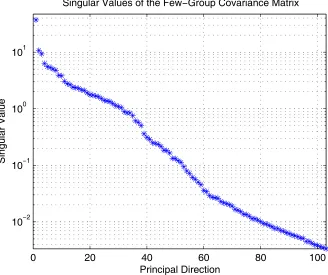
phys-ics, we must ensure that only cross sections with sufficiently large uncertainties are being
per-turbed. If we order the singular values of in decreasing order, a precipitous drop in their
magnitude is observed.
Figure 3.1. Singular Values vs. Principal Direction
Since the singular value of a principal direction is the variance of that direction, a very
small singular value represents a very small uncertainty. It doesn’t make since to perturb a
cross section that we have confidence in. The goal of adaptive simulation is to correct cross
sections that we are uncertain about, so introducing errors in those values we have accurately
measured would not test our adaptive algorithm since the regularization term would restrict U
CFG
0 20 40 60 80 100
10Ŧ2 10Ŧ1 100 101
Principal Direction
Singular Value
CHAPTER 3: DESIGN AND VIRTUAL CORES 29
adapted values to be very close to a priori values. Thus we elect to only use a subset of
principal directions in equation 3-2 to completely perturb those cross sections that are
uncer-tain enough to justify adjustment. To accomplish this, we constructed a vector composed
of perturbed principal directions denoted by the following (the parenthesis have been added to
aid the following discussion)
3-3
where siis the singular value corresponding to the principal direction, is a random
num-ber selected from a uniform distribution, is the effective rank of , and f is a user
input scaling factor. Within the first set of parenthesis, we randomly scale the singular value of
each principal direction where the random number uniformly falls between 1 and -1. Since the
singular value of a principal direction is equal to its variance, this randomly scales the
uncer-tainty of each principal direction up to one standard deviation. We then normalize each
princi-pal direction with the infinity norm so that its largest element is one. This is then multiplied by
the user defined scaling factor f. Normalizing and scaling the vector allows us to control the
largest perturbation of any principal direction, equal to f. This produces two parameters
avail-able to generate different virtual cores: 1) the random seed used in generating , and 2) the
scaling factor f. Adjusting these two inputs becomes a game of trial and error to produce a
vir-tual core that has representative perturbation sizes in core observables. Finally, as previously
discussed, only the first r principal directions are perturbed because these are the only
direc-tions with a large enough uncertainty to warrant adjustment.
U
z VC
zVC (βi si) f ui ui ∞
---⎝ ⎠ ⎛ ⎞
i=1
rFG
∑
=
ui βi
r
FG CFG
CHAPTER 3: DESIGN AND VIRTUAL CORES 30 After the perturbed cross section set has been constructed through equations 3-2 and 3-3,
they are run through the nonlinear core model to create
3-4
where is the set of virtual core observables and is the nonlinear core simulator. In real
plants the core observables are measured using in- and out-of-core detectors. These readings
are subject to detector noise, drift, incorrect calibration, and even detector failure. In an
attempt to account for detector noise, 4% Gaussian noise is added to the core observables
. Currently this includes the nodal power of every node in the core and is represented as
3-5
where j corresponds to any component of subject to noise (nodal powers for this
research), and is selected from a Gaussian distribution with a mean of zero and a standard
deviation of 0.04.
3.2: Number Density Perturbation
As previously discussed, the goal of this research is to try to anneal out any errors in burnt
fuel number densities in the cycle on interest. Before describing how the number density
per-turbations are introduced into the problem, it will be necessary to briefly explore the software
employed. Once the mechanics of how the simulator transfers the number densities are clear,
extending this to perturbing these values will be trivial.
dVCc = Θ(pVC) = Θ(p0+UzVC)
dVCc Θ
dVCc
dVCc j = dVCc j+δj
dVCc
CHAPTER 3: DESIGN AND VIRTUAL CORES 31
3.2.1 : Core Simulator Software and Design Core
Although we had access to real world cycles that we could use in our core simulator, the
data required to introduce realistic number density errors to these cycles were not available.
The concept of realistic number density errors will be discussed in the next section. Since
these data were unavailable, we improvised by taking advantage of the ‘multicycle restart’ [6]
capability of FORMOSA. At the end of a depletion, FORMOSA’s multicycle restart function
will generate a new loading pattern and all of the required input files. This new loading pattern
can then be depleted, and so on. To create this new loading pattern, FORMOSA stores the
beginning-of-cycle (BOC) kinf profile of the current cycle to be depleted. After the cycle is
depleted, the new loading pattern is generated by using the end-of-cycle (EOC) fuel and fresh
bundle types to best match the BOC kinf profile while retaining core symmetry.
To create the design core for our experiments, we started with a real world loading pattern
and used the multicycle restart capability to deplete until all of the burnt fuel that was in the
initial cycle had been discharged. This represents our initial design core cycle and initial
refer-ence number densities. Using previously established notation, this became cycle m in the
mul-ticycle adaption. Cycle n was created by continuing the mulmul-ticycle depletion four more cycles.
At this point, all of the fuel in BOC m was either discharged, or would be discharged by EOC
n. Since the real world cycle used to initiate this depletion sequence was a cycle 12 core,
cycles m through m-1 became cycles 15-17, and cycle n became cycle 18. Cycles 15-17 are
used in the multicycle adaption as the design core because no burnt fuel assembly in cycle 18
goes back farther than cycle 15. This was the basic assumption driving this research. These
CHAPTER 3: DESIGN AND VIRTUAL CORES 32
3.2.2 : Introducing the Number Density Errors
Now that the multicycle approach has been introduced, the method used to introduce
num-ber density errors can be presented. To complete the VC, it is necessary to perturb the initial
number densities of cycle m. Perturbing the cycle m BOC number densities will then
propa-gate through the subsequent cycles to perturb their number densities. One must take care to
perturb the number densities in a manner consistent with the perturbed cross sections. This
means the BOC m number densities should be changed relative to the size of the cross
sec-tions perturbasec-tions. It is tempting to simply randomly perturb the BOC number densities about
their initial values; however, this would lead to a nonphysical situation because of the
correla-tion of isotopic cross seccorrela-tions with number densities of other isotopes. To see this, suppose
that the cross section perturbation routine described previously leads to a decrease in the
U-238 radiative capture cross section. This indirectly implies that the Pu-239 number density
should decrease since Pu-239 production is initiated by neutron capture in U-238. This
corre-lation can’t be applied via a random number density perturbation. Instead of a random
pertur-bation, the core simulator was used to account for these correlations between the change in the
cross section of one isotope with the change in the number densities of other isotopes. The
core simulator is capable of capturing these correlations contained in thermal hydraulic and
neutronic feedbacks.
Ultimately, to introduce number density perturbations that are consistent with the cross
section perturbations, we simply depleted from BOC 12 to EOC 18 with the perturbed cross
sections. By the time the multicycle depletion sequence reached BOC 15, the number
CHAPTER 3: DESIGN AND VIRTUAL CORES 33 associated perturbed number densities, served as the VC to generate measurement
CHAPTER 4: RESULTS 34
Chapter 4: Results
The current adaptive method was constructed to correct for discrepancies between the
simulator and some other set of observables induced by cross sections errors only. As
dis-cussed in Chapter 3, for this research we introduced both cross section and number density
errors so that we could test the abilities of adaption under influences the algorithm is not
designed to correct. The following chapter will first discuss the impacts of cross section and
number density errors. This will be followed by an examination of the inputs to adaption and
their impact on the cross section adjustments. Finally, the results for a the three-cycle adaption
will be presented. This means that cycles 15, 16, and 17 are adapted to enhance the
simula-tor’s prediction of cycle 18.
4.1: Pre-Adaption Number Density Behavior
Before discussing the abilities of the proposed adaption/depletion sequence, it is necessary
to show the core’s response to perturbing cross sections and/or number densities. The
individ-ual and combined effects of these cross section and number density errors for each cycle can
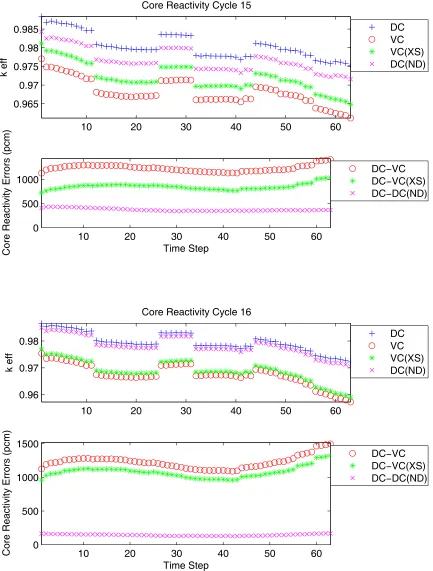
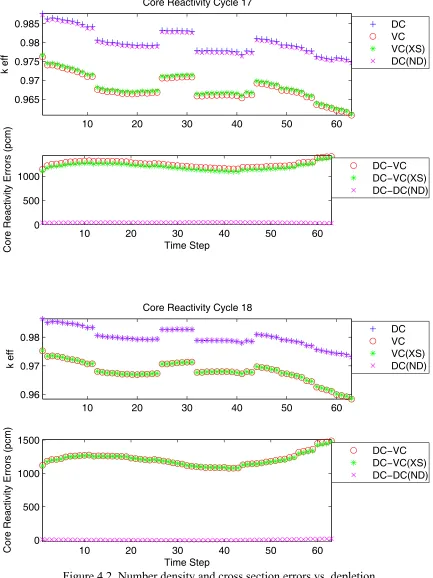
be seen in Figures 4.1 and 4.2.
4.1.1 : Linear Response
For each cycle in the Figures 4.1 and 4.2, there are two graphs; the first shows keff for
each time step of the cycle and the second shows the absolute difference between the design
core (DC) and each other core’s keff. The curves labeled ‘DC’ used the DC cross sections and
the DC number densities. The DC curves shown are the actual set of reference responses used