Segmentation Based Feature Point (FP)
Matching in Image Forgery Detection (IFD):
A Review
Shahabuddin. S. K1, DR. A. R. Aswatha2
M. Tech Student, Dept. of Telecommunication, Dayananda Sagar College of Engineering, Bangalore, Karnataka India1
Prof and Head, Dept. of Telecommunication, Dayananda Sagar College of Engineering, Bangalore, Karnataka India2
ABSTRACT:The digital images are widely implemented in many areas as it expresses the image processing ability in many areas such as communication, business, surveillance, medical, military etc. The implementation of these images necessitates the security, as they can be modified/changed or damaged. The main reason behind this manipulation of digital image is happening due to the easily available and accessible image editing tools, those made the integrity and authenticity of digital images very difficult and it can be considered as image forgery (IF). In this sense there is a need of proper IF detection tool and many researchers have experimented and provided various IF detection tools and many of them are succeeded. Among the techniques of IF detection feature point (FP) matching by segmentation has out formed with greater efficiency. This review of IF detection represents the existing researches and techniques of detection and also describes the FP matching based on segmentation. The paper provides the future necessary aspects of image forgery detection.
KEYWORDS:Digital image, Feature point (FP) matching, Image forgery (IF) detection.
I.INTRODUCTION
Since long ago the photographs are playing a major role in almost all areas such as, journalism, medical, forensic, investigation, surveillance, insurance etc. The present digital era has given many disadvantages with respect to the disadvantages. The image processing or the image editing/manipulation tools can be used in image tampering and is become the one of the biggest issue of security for the digital images. Hence the control on the digital image authentication and integrity is necessary, which helps more in criminal activity detection.
A digital image can have many processing stages in its entire life cycle; hence accordingly the editing of these images is much needed. Generally, the addition, removal of content in the featured image or the resize or rotation of the image is considered as the forged image. In order to detect or identify or examine the image content there must be some desired approaches. The present advancement in the tools for editing the image has brought complexity in identifying the image forgery with normal vision. In past many of the authors have expressed their views how the digital images will be tampered or forged. Among the image tampering following are the kinds of it,
Copying the one part of the image and pasting it over the same image at other place (Cut-paste).
Cutting the part of the image and pasting it at other image (Image splicing).
Adding the noise into the image like sharpening or blurring the image.
of approaches the authentication for the image content is evolved, hence it doesn’t require any other information referring the image.
The IF detection mechanism generally used to examine the digital image integrity and authenticity. The feature point (FP) matching is the technique is been used for detection of image forgery, in which the feature points will be extracted from every blocks of the image and will be considered as the block features. These features are can be extracted with the help of segmentation. This paper presents the survey of IF detection aspects, approaches to detect and existing research work. The survey paper is comprised of following sections like background (section II) - discusses the aspects of IF, techniques for detection of IF, literature review (section III) -discussing the existing research work over FP matching and segmentation, the survey analysis is represented in section IV, advantages of the IF detection is prescribed in section V and in later case the paper is concluded in section VI.
II.BACKGROUND Image forgery (IF) aspects
:
The digital media (DM) of digital images and records should be affirmed against the original images due to the availability of proficient tools in the field of adjusting and controlling these media. Digital imaging has created to wind up the overall advancement for making, taking care of, and securing image memory and affirmation. Regardless of the way that this advancement brings various purposes of interest, it can be used as a image forgery for disguising substances and affirmations. This is by virtue of digital images can be controlled in such faultlessness that misrepresentation can't be recognized apparently. Honestly, the security stress of cutting edge substance has developed a long time back and differing frameworks for tolerating the respectability of modernized images have been created. In medical area, like medical imaging, forensics, e commerce etc., digital image integrity and authenticity. In medical specialists and researchers make diagnosis considering imaging. The presentation and growth in DM control to image forgery raises moral issues of truth, deception, and integrity of digital image.
Types of image forgery:
The image forgery (IF) types are described as below.
i. Copy-move IF:-
The commonly used IF type, where the part of the image will be covered to remove or add the information. Generally for the copy-move IF, Textured regions will be taken as ideal parts of image. The textured areas exhibit similar dynamic range, colour, noise variation factors of the image, and it cannot be noticed by normal vision of human eye to identify the forgery.
ii. Image splicing IF
This is like paste-up done by together sticking of photographic images. The image Splicing type of forgery is involves two or more composite of images to make forged image.
iii. Resize
The kind of IF is done by shrinking or enlarging the image or the section of the image. The Image reduction is can be done by interpolating among the pixel values within the local neighbourhoods.
iv. Cropping
In this IF borders of the images will be cropped or the image canvas will be reduced where the image is to be displayed. The operation is done to remove the information border which is not required while displaying.
v. Noising or Blurring
Original image Forged image
Table 1. Comparison of forged and original image .
The above table 1 shows the original (left) image while the forged (right) image. In the above table the some parts of the original image are copied and moved to the same image with the noise, color and other factors compatibility. In this kind of forgery the forgery detection techniques cannot favor the condition.
Existing techniques for detection of image forgery
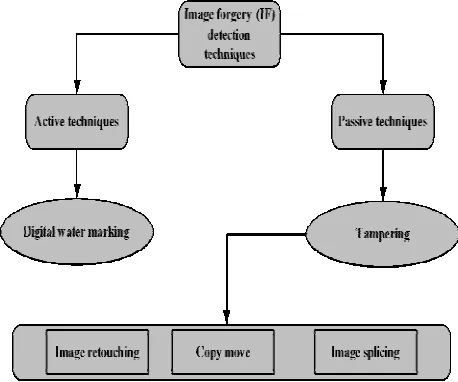
The existing techniques of image forgery (IF) detection is mainly classified as active and passive techniques. For Active technique; the digital images must need some kind of preprocessing like generation of signature or embedding the watermark while creating the image. This preprocessing will limit the application of the image. Presently, in internet billions of images are not having watermark or digital signature; in such cases the active technique will fail to identify the image authentication. For the passive technique does not need any factors of active techniques i.e., generation of signature or embedding the watermark. The classification of IF detection techniques is represented in figure 1.
c. To identify the forgery carried by post processing by camera, lens, sensors etc, (camera based technique).
d. To detect the forgery done by 3D interaction among the object, camera, light (Physically based technique).
e. Geometric-based techniques which measures the object ant its position according to camera [
III.EXISTINGLITERATUREREVIEW
This chapter explains the significances and drawbacks of the existing research work in the field of image forgery (IF), detection methods of IF, feature point (FP) matching and segmentation in IF. This existing study helps for designing a better detection mechanism for the image forgery.
Tu and Dong [1] have significantly explained the image feature matching and also the histogram equalization mechanism. The algorithm implemented for features matching of an image will provide the better efficiency with the image scale, rotation, illumination difference for practical applications. The image acquisition process includes various conditions like posture, position and camera performance etc., for the image area. The projective distortion of the image area will affect the accuracy in FP matching/extraction. The author has given the preprocessing mechanism to enhance the significant features of the image by using the histogram equalization. Later the image is subjected to ASIFT and SIFT algorithms for matching and extraction. The experiment conducted by the author gives the improved way to get more number of feature points by histogram equalization.
Liang et al. [2] have presented a mechanism to detect the feature points based on Saliency for the purpose of image matching. The saliency is a part of image region, which can b defined by using the Kullback-Leibler (K-L) divergence among the background probability density functions (pdfs) and conditional pdfs. The modelings of pdfs are done with the elliptically symmetric distributions (ESDs). In this work, the author has remodeled the ESD by less number of parameters, without affecting the image regions modeling. The study experimental results configurations with the Middlebury stereo dataset provides more accurate image matching based on Saliency region.
The color spaces evaluation to detect the feature point of image for the matching application is explained in Sirisha and Sandhya [3]. The study of the authors includes the inspection of the color information according to the FP detection. These color information’s are expressed as HSV, XYZ, RGB, LAB, YIQ, CMY, CbCr and opponent. Later more relevant color space will be problem and hence the processing of color image is done. The image matching is done with the Hybrid color space while the Principal Component Analysis (PCA) is used for feature selection. The experiment is conducted by keeping the total repeatability measurement and total feature points for evaluation.
Hong et al. [4] have given the Harris corner detection based algorithm for image mosaic, where the Harris operator performs the detection of image corner, adopts the feature (correlation) registration to identify the registration pair and take out the false registration pair by constraint registration algorithm. After identifying the correct image mosaic the image fusion is done with the gradual fade out method. The experiments carried out for robustness and accuracy enhancement of UAV aerial by using image mosaic.
Donoser and Schmalstieg [5] have given the discriminative FP matching for localization based on image. The author described the solution for classification and matching issues by 3D point sets. The experimental results yield the fast, accurate matching performance with the proposed algorithm for localization scenario.
Wang and Wang [6] have illustrated an algorithm for background image feature point matching. Author has focused on the issues of the matching the feature points of an complex background image having weak robustness and low reliability. The authors have carried multiple time real time experimental analysis over the image by using SURF and SIFT algorithm and hence concluded that,
Both the algorithms are effective for rotation change, noise, light and other integrated point of concerns.
The synthesis analysis says that SURF algorithm has efficiency than SIFT algorithm.
For faster, accurate and robust match SURF algorithm is preferable.
Cai et al. [8] have described and algorithm stating for extraction and matching of feature point in wireless capsule endoscope (WCE) images. The evaluation of the algorithm is done at various area and noises. The algorithm experimental results concluded with the high accuracy and feasibility.
Qin et al. [9] have presented the Oriented FAST and Rotated BRIEF (ORB) algorithm based FP matching of an image. The algorithm is subjected to the deficiency issue, where ORB has the bit variance in feature scale. The method is carried in following way:
Building of scale spaces for extreme stable point detection by considering the invariance in feature points.
Describing the ORB descriptor to get binary descriptor with variance in rotation and scale.
Using Hamming distance the point matching has been conducted.
The experimental results with this algorithm come with the faster computation and accuracy under scale variance. Zandi et al. [10] have given the adaptive matching algorithm (AMA) for the detection of forgery by copy move of the image. The copy moving type of the image forgery is copying the part of image and moving it within the same image. The author have used the AMA algorithm to overcome the issues of block based algorithms which consider only smooth areas and gives more false matches. The implementation of AMA algorithm for the analysis gives the
reduced false matches with better performance and low computational cost
.
IV.SUMMARYOFTHELITERATURESURVEY
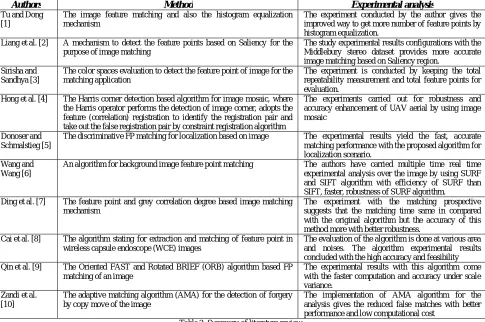
The survey summary of the previous sections is tabled and described in table 2
Authors Method Experimental analysis
Tu and Dong [1]
The image feature matching and also the histogram equalization mechanism
The experiment conducted by the author gives the improved way to get more number of feature points by histogram equalization.
Liang et al. [2] A mechanism to detect the feature points based on Saliency for the
purpose of image matching
The study experimental results configurations with the Middlebury stereo dataset provides more accurate image matching based on Saliency region.
Sirisha and Sandhya [3]
The color spaces evaluation to detect the feature point of image for the matching application
The experiment is conducted by keeping the total repeatability measurement and total feature points for evaluation.
Hong et al. [4] The Harris corner detection based algorithm for image mosaic, where
the Harris operator performs the detection of image corner, adopts the feature (correlation) registration to identify the registration pair and take out the false registration pair by constraint registration algorithm
The experiments carried out for robustness and accuracy enhancement of UAV aerial by using image mosaic
Donoser and Schmalstieg [5]
The discriminative FP matching for localization based on image The experimental results yield the fast, accurate
matching performance with the proposed algorithm for localization scenario.
Wang and Wang [6]
An algorithm for background image feature point matching The authors have carried multiple time real time
experimental analysis over the image by using SURF and SIFT algorithm with efficiency of SURF than SIFT, faster, robustness of SURF algorithm.
Ding et al. [7] The feature point and grey correlation degree based image matching
mechanism
The experiment with the matching prospective suggests that the matching time same in compared with the original algorithm but the accuracy of this method more with better robustness.
Cai et al. [8] The algorithm stating for extraction and matching of feature point in
wireless capsule endoscope (WCE) images
The evaluation of the algorithm is done at various area and noises. The algorithm experimental results concluded with the high accuracy and feasibility
Qin et al. [9] The Oriented FAST and Rotated BRIEF (ORB) algorithm based FP
matching of an image
V. SURVEY OF TOTAL PUBLICATIONS
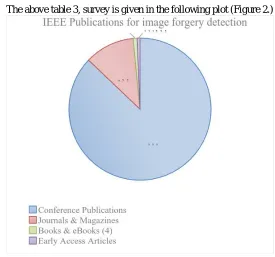
The survey of total study published in IEEE Xplore is taken account for image forgery detection and is given in following table.3
Publications/Types IEEE
Conference Publications 399 Journals & Magazines 52 Books & eBooks(4) 4 Early Access Articles 3
Table 3. Survey of total publications
The above table 3, survey is given in the following plot (Figure 2.)
Figure 2: Percentage IEEE Publications
VI. CONCLUSION AND FUTURE SCOPE
This paper presents the survey of image forgery (IF) detection, techniques and existing research work survey. In background discussed the basic aspects of image forgery and types of image forgery with techniques to detect the forgeries. The literature of existing research work is carried out with ten most recent and relevant papersfrom the IEEE publications and respectively summary of its is tabled. The survey of total study published in IEEE Xplore is described with plot.
Some new techniques are need to be developed which can afford the analysis of recent algorithms, video forgery detection, database of forged image and GUI software implementation in windows environment.
REFERENCES
1. Lyon, David. Surveillance as social sorting: Privacy, risk, and digital discrimination. Psychology Press, 2003.
2. Hood, Christopher C., and Helen Z. Margetts. The tools of government in the digital age. Palgrave Macmillan, 2007.
3. Mahdian, Babak, and Stanislav Saic. "A bibliography on blind methods for identifying image forgery." Signal Processing: Image
Communication 25.6 (2010): 389-399.
4. Birajdar, Gajanan K., and Vijay H. Mankar. "Digital image forgery detection using passive techniques: A survey." Digital Investigation 10.3
(2013): 226-245.
5. Farid, Hany. "Image forgery detection." IEEE Signal processing magazine 26.2 (2009): 16-25.
6. Farid, Hany. "Image forgery detection--A survey." (2009).
7. L. Tu and C. Dong, "Histogram equalization and image feature matching," Image and Signal Processing (CISP), 2013 6th International
Congress on, Hangzhou, 2013, pp. 443-447.
8. J. Liang, Y. Zhang, S. Maybank and X. Zhang, "Salient feature point detection for image matching," Signal and Information Processing
(ChinaSIP), 2014 IEEE China Summit & International Conference on, Xi'an, 2014, pp. 485-489.
9. B. Sirisha and B. Sandhya, "Evaluation of Color Spaces for Feature Point Detection in Image Matching Application," Advances in Computing
and Communications (ICACC), 2013 Third International Conference on, Cochin, 2013, pp. 216-219.
10. Y. X. Hong, Z. Q. Jie, Z. Dan Dan, S. X. Xin and X. Jing, "UAV image automatic mosaic method based on matching of feature points,"
Chinese Automation Congress (CAC), 2013, Changsha, 2013, pp. 33-36.
11. M. Donoser and D. Schmalstieg, "Discriminative Feature-to-Point Matching in Image-Based Localization," 2014 IEEE Conference on
Computer Vision and Pattern Recognition, Columbus, OH, 2014, pp. 516-523.
12. X. Wang, D. Liu and L. Wang, "A Feature Point Matching Algorithm for Complex Background Image," Big Data and Cloud Computing
(BDCloud), 2015 IEEE Fifth International Conference on, Dalian, 2015, pp. 243-247.
13. Z. Ding, S. Qian, Y. Li and Z. Li, "An image matching method based on the analysis of grey correlation degree and feature points," NAECON
2014 - IEEE National Aerospace and Electronics Conference, Dayton, OH, 2014, pp. 157-162.
14. Z. Cai, C. Hu, W. Lin and W. a. Yang, "A feature point extraction and matching algorithm for Wireless Capsule Endoscope image,"
Information and Automation (ICIA), 2013 IEEE International Conference on, Yinchuan, 2013, pp. 608-613.
15. Y. Qin, H. Xu and H. Chen, "Image feature points matching via improved ORB," Progress in Informatics and Computing (PIC), 2014
International Conference on, Shanghai, 2014, pp. 204-208.
16. M. Zandi, A. Mahmoudi-Aznaveh and A. Mansouri, "Adaptive matching for copy-move Forgery detection," 2014 IEEE International