Multiple Signature Processing-Based Fault Detection
Schemes for Broken Rotor Bar in Induction Motors
Bulent Ayhan
, Student Member, IEEE
, Mo-Yuen Chow
, Senior Member, IEEE
, and Myung-Hyun Song
, Member, IEEE
Abstract—The existence of broken rotor bars in induction motors can be detected by monitoring any abnormality of the spectrum amplitudes at certain frequencies in the motor current spectrum. It has been shown that these broken rotor bar-specific frequencies are settled around the fundamental stator current frequency and are termed lower and upper sideband compo-nents. Broken rotor bar fault detection schemes should depend on multiple signatures in order to overcome or reduce the effect of any misinterpretation of the signatures that are obscured by factors such as measurement noises and different load conditions. Multiple discriminant analysis (MDA) provides an appropriate environment to develop such fault detection schemes because of its multi-input processing capabilities. The focus of this paper is to provide a new fault detection methodology for broken rotor bar fault detection and diagnostics in terms of its multiple signature processing feature and the motor operation partitioning concept to improve the overall detection performance. This paper de-scribes two fault detection schemes within this methodology, and demonstrates that multiple signature processing is more efficient than single signature processing. The first scheme, which will be named the “monolith scheme,” is based on a single large-scale MDA unit representing the complete operating load torque region of the motor, while the second scheme, which will be named the “partition scheme,” consists of many small-scale MDA units, each unit representing a particular load torque operating region.
Index Terms—Broken rotor bar, discriminant analysis, fault di-agnosis, induction motors, monitoring.
I. INTRODUCTION
I
NDUCTION motors have dominated the field of electro-mechanical energy conversion, featuring 80% of the motors in use [1]. The applications of induction motors are widespread. Some induction motors are key elements in assuring the conti-nuity of the process and production chains of many industries. A majority of induction motors are used in electric utility in-dustries, mining inin-dustries, petrochemical inin-dustries, and do-mestic appliances industries. The list of the industries and appli-cations that induction motors take place in is rather long. Induc-tion motors are also often used in critical applicaInduc-tions such as nuclear plants, aerospace, and military applications, where the reliability must be of high standards.Induction motors often operate in hostile environments such as corrosive and dusty places. They are also exposed to a variety
Manuscript received September 3, 2003; revised December 2, 2003. This work was supported in part by the National Science Foundation under Grant ECS-0245383. Paper no. TEC-00229-2003.
B. Ayhan and M.-Y. Chow are with the Department of Electrical and Com-puter Engineering, North Carolina State University, Raleigh, NC 27695 USA (e-mail: [email protected]; [email protected]).
M.-H. Song is with the Department of Electrical Control Engineering, Sun-chon University, Maegokdong 315, Korea (e-mail: [email protected]).
Digital Object Identifier 10.1109/TEC.2004.842393
of undesirable conditions and situations such as misoperations. These unwanted conditions can cause the induction motor to go into a premature failure period, which may result in an unser-viceable condition of the motor, if not detected at its early stages of the failure period [2], [3]. The early detection of the incipient motor fault is thus of great concern. Rotor failures are among these failures, and they now account for 5%–10% of total induc-tion motor failures [4]. Several monitoring techniques have been developed for broken rotor bar fault detection, most of which are based on motor current signature analysis (MCSA). In re-cent years, several advanced signal processing techniques such as high-resolution spectral analysis, higher-order statistics, and wavelet analysis have been applied to broken rotor bar and other motor fault detection problems [1].
MCSA techniques include parametric and nonparametric spectrum analysis methods of motor current in general. In the parametric methods, autoregressive models have been fitted with time series of the signal, and model parameters have been used in order to compute the frequency spectrum. Non-parametric methods, on the other hand, are based on Fourier transform and search for periodicities of the signal. Power spectral density (PSD) analysis of motor current is one of the widely used MCSA techniques. There are several approaches to calculate PSD. The periodogram method and Welch’s pe-riodogram methods are two of the nonparametric spectrum methods.
Broken rotor bar fault in induction motors can be detected by monitoring any abnormality of the motor current power spec-trum amplitudes at several certain frequency components. These frequency components are located around the main frequency line and are determined according to the number of poles and mechanical speed of the motor. However, there are other ef-fects that may obscure the detection of the broken rotor bar fault or cause false alarms. For example, these effects can be intrinsic manufacturing dissymmetry, or load torque oscillation that can produce stator currents with the frequency values that are the same as the monitored frequencies. In monitoring these frequency components, it is assumed that the load torque is con-stant. Any variation of the load torque with the rotational speed can produce frequency harmonics, which may overlap the har-monics caused by broken rotor bar fault [5]. A broken rotor bar fault detection scheme based on multiple frequency signatures thus should be more reliable in overcoming or reducing the fect of misinterpreted signatures, which are caused by the ef-fects discussed formerly or some other unknown reasons. Mul-tiple discriminant analysis (MDA) provides an appropriate en-vironment to develop such fault detection schemes because of its multi-input processing capabilities.
The focus of this paper is to provide a new fault detection methodology for broken rotor bar fault detection and diagnostics in terms of its multi signature processing feature and the motor operation partitioning concept to improve the overall detection performance. This paper presents two fault detection schemes within this methodology, and demonstrates that multiple signa-ture processing is more effective than single signasigna-ture processing. The first scheme will be named the “monolith scheme,” and is based on a single MDA unit representing the complete motor operating load torque region. The second scheme will be named the “partition scheme,” and it consists of several small MDA units, each of which represents a particular load torque operating region. In the partition scheme, the computational load and com-plexity of the single units in the monolith scheme are distributed to smaller units, which, as a result, increase the broken rotor bar fault detection performance. The partition scheme thus can be thought of as partitioning a highly nonlinear mapping problem in a high dimension space into linear or low-order nonlinear map-ping problems in a reduced dimensional space. The two detection schemes have been investigated using experimental data.
This paper is organized as follows: Section II discusses the frequencies of interest to the broken rotor bar problem and outlines the frequencies to be used in the MDA units. Section III briefly describes the fundamental properties of MDA. Section IV presents the experiment setup and motor data specifications. Section V outlines the fault detection schemes together with experimental results and analysis. Section VI concludes the findings of this paper.
II. MOTOR CURRENTSPECTRAL COMPONENTS FORBROKENROTORBAR
Kliman and Filipetti [6], [7] used MCSA methods to detect broken rotor bar faults by investigating the sideband compo-nents around the supplied current fundamental frequency (i.e., the line frequency)
(1) where are the sideband frequencies associated with the broken rotor bar, and is the per-unit motor slip. The slip is defined as the relative mechanical speed of the motor with respect to the motor synchronous speed as
(2) The motor synchronous speed is related to the line fre-quency as
(3) where is the number of poles of the motor and the constant “120” is used to express the motor synchronous speed in revolutions per minute (r/min) unit.
The broken bars also give rise to a sequence of other side-bands given by [7]
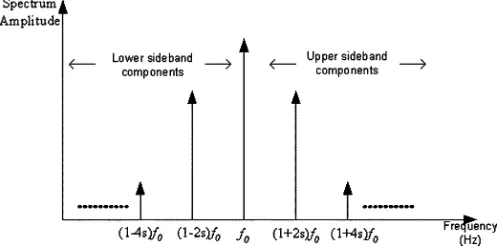
where (4) and are depicted conceptually in Fig. 1.
Fig. 1. Sideband frequencies around the fundamental line frequency.
Fig. 1 shows the frequency components specific to a broken rotor bar fault, which is given in (4) for and 2. These fre-quencies are located around the fundamental line frequency and are termed as lower sideband and upper sideband components as indicated in Fig. 1. There are other spectral components that can be observed in the stator line current due to the broken rotor bar fault [6]
where (5) The fault detection schemes investigated in this paper depend on multiple signature processing. These signatures correspond to the power spectrum amplitudes of the motor current (phase-a) data at the selected frequencies. A detailed explanation about the experiment setup and specifications of the collected motor data will be given in Section IV. We use Welch’s periodogram method to compute the power spectrum of phase-a motor cur-rent data. In Welch’s periodogram method, we apply a Hanning window and 50% overlapping percentage among the partitioned segments. It has been noted that the use of a Hanning window and 50% overlap leads to an efficient implementation of the fast Fourier transform (FFT) algorithm [8]. In the fault detection schemes, we consider four of the broken rotor bar fault-spe-cific frequency components. Let be the set of broken rotor bar fault-specific frequency components, and be the set of Welch’s spec-trum amplitudes at these frequencies. The frequency compo-nents in set are , , , and , where is the fundamental stator current frequency and is the slip. and
are the first lower and upper sidebands, while and are the second lower and upper sidebands around , which are expressed mathematically in (4). The inputs for the MDA units in the monolith and partition schemes thus consist of the signa-ture set .
included signatures provide discriminative information about the broken rotor bar fault.
The methodology in the investigated fault detection schemes uses the Welch’s spectrum amplitudes of motor current data at the broken rotor bar fault-specific frequencies as the discrimina-tive signatures in the fault detection decision. However, the lo-cations of the monitored frequencies depend on the slip factor , which is a function of the motor mechanical speed. When the no-load case of the motor is considered, the slip factor value ap-proaches 0. This results in the interference of the monitored fre-quencies with the main supply frequency or its harmonics. The current detection schemes will thus not be able to perform effi-ciently for the no-load condition of the motor. On the other hand, signatures that are not dependent on the slip factor and that carry discriminative information, can be included within the method-ology in order to make the detection schemes provide reliable fault decision in the no-load condition of the motor.
III. MULTIPLEDISCRIMINANTANALYSIS
In this section, we will briefly describe the fundamental prop-erties of MDA, which is used as the detection methodology in the fault detection schemes.
Multiple discriminant analysis considers the problem of as-signing individuals to certain groups that have been identified beforehand. The objective in multiple discriminant analysis is thus to find a set of linear combinations of the variables whose values are as close as possible within groups and as far apart as possible between groups [9]. Let be the data matrix with rows and columns, where each row stands for the ob-servations and each column stands for the variables. The mean of the column variable in , , can then be expressed as
(6)
Suppose that the rows of are separated into groups, and each group is defined by a set of values of index , where the relation between and is expressed in (7)
(7)
Let be the mean of the column variable in group ; can then be expressed as
(8)
We can also express the mean as
(9)
The total covariance between two variables can be described in two different ways, which are expressed in (10) and (11), respectively
(10)
(11)
The total covariance can be decomposed into two parts: one of the two parts stands for the within-group variances and the other part stands for the between-group variances. This decom-position is known as Huyghens decomdecom-position formula [9] and is expressed in (12)
(12)
Equation (12) can be interpreted as the sum of the covariance within the groups (first term) and the covariance between the groups (second term), and is expressed in matrix form as
(13) where denotes the total covariance, denotes the covariance within the groups, and denotes the covariance between the groups.
In order to define the problem addressed by multiple discrim-inant analysis, let us introduce , where is equal to the value of a linear combination of the -centered variables for in-dividual
(14)
The variance , where is the vector composed of com-ponents , can then be expressed as
(15)
By expanding (15), is found as
(16)
Equation (16) can be expressed in matrix form as . The variance of a linear combination of the variables can then be separated into within variance and between variance as
Fig. 2. Motor data collection scheme.
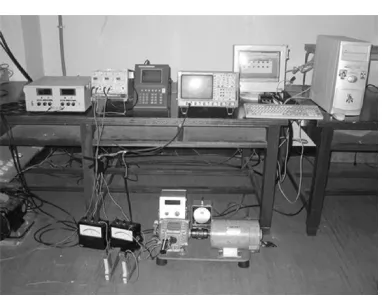
Fig. 3. Actual experiment setup to collect healthy and faulty motor data.
variance. The aim is to find such that is max-imum. This linear combination is termed as the linear discrimi-nant function. The process to find the linear discrimidiscrimi-nant func-tion is well described in the literature, and readers can refer to [9] for further information.
MDA with linear discriminant functions is perhaps the most widely used discriminant analysis technique and is also known as LDA. In addition, there are many MDA methods developed with nonlinear discriminant functions for problems with non-linear classification boundaries [9].
IV. EXPERIMENTSETUP ANDMOTORDATASPECIFICATIONS
We performed invasive experiments on an actual induction motor for our analyses. The characteristics of the three-phase induction motor used in our experiment are listed in Table I. The motor was tested with a healthy rotor and with a faulty rotor that had one broken rotor bar. The broken rotor bar fault was induced by filling one of the rotor bars with anchoring cement before the diecasting process. Anchoring cement is a high-strength, fast-setting gypsum cement with low conductivity. The overall data collection scheme and the actual experiment setup picture are depicted in Figs. 2 and 3, respectively.
The induction motor was fed through a three-phase ABB, ACS 501 inverter. A Tektronix TM 5003 current amplifier amplifies the induction motor stator currents before they are sent to the in-terfacing Pentium PC through the oscilloscope. The needed load
TABLE I
INDUCTIONMOTORCHARACTERISTICSUSED IN THEEXPERIMENT
Fig. 4. Healthy phase-a motor current data collected from the experiment setup under full-load condition of the motor.
condition of the induction motor was established by connecting the test motor to a dc motor, which is used as a generator and is ca-pable of simulating any desired load condition. The speed of the induction motor was measured by a digital stroboscope.
The experiments involved collecting phase-a stator induction motor current data for spectrum signature extraction and speed data for computing locations of the broken rotor bar-specific frequencies at four different load conditions of the motor, both with one broken rotor bar fault and without any fault. The load conditions of the motor are 25%, 50%, 75%, and full load, re-spectively. These load condition percentages are determined according to the motor nameplate information given in Table I. Thus, there are a total of eight different experiment cases. For each individual case, 20 sets of motor current data were collected with a sampling frequency of 10 kHz. Thus, each motor current data set contains 10 000 samples for a duration of 1 s. A sample phase-a motor current data waveform corresponding to a healthy state of motor under full-load condition is demonstrated in Fig. 4.
Fig. 5. PSD estimates atf = (1 0 2s)f under motor load conditions
T 2 fT ; T ; T ; T g.
V. FAULTDETECTIONSCHEMES ANDEXPERIMENTALRESULTS
Let denote the motor condition, which is comprised of the two states of the motor: healthy condition and faulty condi-tion with one broken rotor bar . From the motor current power spectrum analysis and broken rotor bar-specific frequency components knowledge, there exists a mapping from to as expressed in (17)
(17) where is the set of Welch’s periodogram power spectrum amplitudes at frequencies and is the motor load con-dition. In our experiments, we have collected data at four different load conditions of the motor as discussed in Sec-tion III, where is either at full load, 75%, 50%, or 25% load, . In these ex-periments, motor speed variation in the collected motor speed data is less than 1.4% in all of the four investigated motor load conditions. Fig. 5 demonstrates the PSD esti-mates at one of the broken rotor bar fault-specific frequencies under four different motor load conditions . In this figure, symbol “ ” represents the PSD estimate of a healthy motor data, while symbol “ ” represents the PSD estimate of a faulty motor data with one broken rotor bar.
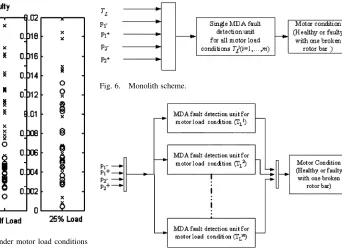
In the monolith scheme, we use a single fault mapping unit , which maps the signatures extracted throughout the com-plete motor operating load condition to the motor condition. This scheme is depicted in Fig. 6. Inputs of the MDA map-ping unit consist of the signature set , where is the motor load condition, are the first and are the second lower and upper sidebands’ Welch’s pe-riodogram power spectrum amplitudes around the fundamental
Fig. 6. Monolith scheme.
Fig. 7. Partition scheme.
current frequency , respectively. The mapping for the mono-lith scheme is depicted in (18)
(18) In the partition scheme, the single mapping unit , which is used in the monolith scheme, is divided into disjoint submap-ping units , where corresponds to a submapping unit for a particular motor load condition and, ,
. In our case, . Thus, the submapping units in the parti-tion scheme consist of the spectrum amplitude signatures only. A submapping unit is depicted in (19)
(19) The conceptual diagram of the partition scheme is presented in Fig. 7. The mapping units in the partition scheme provide par-titioning of the complete motor operating load region into subre-gions, each subregion corresponds to a constant load condition. This procedure thus transforms the nonlinear mapping problem into linear mapping problems or mapping problems with a lower order of nonlinearities. The partition scheme needs motor load condition information as a prerequisite for the preparation of the corresponding mapping units.
In our case, we partition the motor’s load op-erating region into four subregions, depicted as . We then form MDA units for each particular load subregion using the corresponding motor current signatures.
For analyses and performance comparisons of the fault detec-tion schemes with MDA units, two different cases are consid-ered in this paper.
Case 1: Motor signature data set is treated as one whole training data set, where DataSet D
Case 2: Motor signature data set is separated into two sets: training and test, where DataSet
Training Set Test Set and Training Set Test Set .
In this work, experimental motor data are collected such that they fall into two main groups: healthy state and faulty state of the motor (with one broken rotor bar). We have applied linear discriminant functions in the MDA units depicted in the mono-lith and the partition schemes for both Case 1 and Case 2; thus, we will use the term LDA instead of MDA in the remainder of this section and the following section of this paper. The training process for the two cases consists of computing the coefficients of the linear discriminant functions. Detailed information about the general principles of MDA with the emphasis on linear dis-criminant functions is presented in Section III.
In order to compare the fault detection performances of single signature and multiple signature processing, we have applied LDA to each of the four signatures individually for both Case 1 and Case 2.
In analyzing fault detection performances of the two detection schemes, we will use statistical hypothesis testing, Type I error , and Type II error . Hypothesis testing is one of the most common aspects in statistical inference. An experimenter first determines a hypothesis about a population parameter. This hypothesis is termed as “null hypothesis” and is depicted with the notation . The term “population” is used to indicate that the population is composed of an entire set of objects or observa-tions that have something in common. In our case, for example, healthy and faulty motor data are two different populations. The aim of hypothesis testing is to test the applicability of the null hypothesis in the knowledge of experimental data. If the null hypothesis is rejected while it is actually true, this error is termed as Type I error . In a similar way, if the null hypothesis fails to be rejected while it is actually false, this error is termed as Type II error . The definitions of Type I and Type II error are depicted in Table II. We use a hypothesis test to analyze the fault detection performances of the investigated monolith and partition schemes with LDA. The null hypothesis in our case, is stated as
incoming motor signature test data corresponding to the healthy state of the motor.
Type I error will then correspond to the ratio of the healthy motor data, which are classified as faulty according to LDA, to the total number of motor data. Likewise, Type II error will cor-respond to the ratio of the faulty motor data, which are classified as healthy, to the total number of motor data. Apparently, Type II error has more severe consequences than Type I error in en-gineering applications. For example, in a motor manufacturing company, Type II error causes labeling faulty motors as healthy motors and shipment of these faulty motors to the consumers. With Type I error, on the other hand, healthy motors are labeled as faulty; however, a further analysis of these motors helps to iden-tify and fix the problem without affecting any consumers.
We will use the term “correct detection rate,” (CDR), in our analyses, which is mathematically expressed in (20)
CDR (20)
Tables III and IV depict the CDRs of each single signature under Cases 1 and 2 together with Type I-II error measures.
TABLE II
TYPEIANDTYPEII ERRORDEFINITION
TABLE III
CDRS OFSINGLE-FREQUENCYCOMPONENTSUNDERCASE1
These tables indicate that CDRs change significantly according to each individual signature. Among these signatures,
has the highest CDR, while the other three signatures have lower CDRs. The seventh to ninth rows of Table IV simply sums CDRs and Type I-II errors of training and test data sets. We have then considered four of the signatures together and applied the mono-lith and partition schemes.
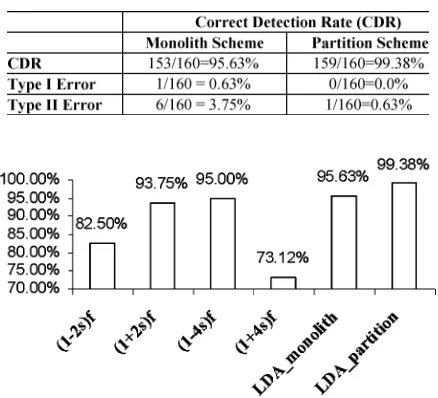
Table V depicts the CDR of LDA for the two schemes under Case 1 together with Type I and Type II error measures. Note that the LDA’s correct detection performance improves with the partition scheme. It is also observed that CDRs in both schemes are higher than any of the single signature CDRs given in Ta-bles III and IV.
The bar chart depicted in Fig. 8 presents the CDRs of both single signature processing and multiple signature processing for the two schemes under Case 1. This bar chart affirms that multiple signature processing is more efficient in broken rotor bar fault detection as expressed mathematically in (21)
CDR CDR CDR
CDR CDR CDR (21) Similarly, Table VI depicts the CDRs and Type I-II errors of LDA for the two schemes under Case 2. In Case 2, since we have separated the data into training and test sets, we have included the sum of training and test data sets’ CDRs, in addition to each set’s separate CDR. There is a considerable improvement ex-amined in the CDR with the partition scheme. In addition, these CDRs are higher than any of the single signature’s CDRs that are depicted in Tables III and IV with the exception of one equal case.
The partition scheme has provided a way to cope with the nonlinearities in the mapping process and demonstrates an im-proved correct detection performance with LDA. Partitioning the initial mapping space of the fault detection problem with respect to one of its input variables into smaller disjoint subre-gions and introducing submapping units, for each of these small subregions, provides an increase in the correct detection perfor-mance.
TABLE IV
CDRS OFSINGLEFREQUENCYCOMPONENTSUNDERCASE2
TABLE V
CDRSWITHMONOLITH ANDPARTITIONSCHEMEUNDERCASE1
Fig. 8. CDRs with single signature processing and multiple signature processing under Case 1.
TABLE VI
CDRSWITHMONOLITH ANDPARTITIONSCHEMESUNDERCASE2
signature processing for the two schemes under Case 2. This bar chart clearly indicates that the multiple signature processing is advantageous to the single signature processing and is math-ematically expressed in (22). It can be also noticed that CDR is improved with the partition scheme
CDR
(22)
Fig. 9. CDRs with single signature processing and multiple signature processing under Case 2.
In this study, we have investigated two multiple signature pro-cessing-based fault detection schemes for a broken rotor bar in induction motors. The investigated fault detection schemes can be adapted to more than one broken rotor bar fault. In ad-dition, the methodology has the appropriate structural forma-tion to be applied to other severe inducforma-tion motor faults, such as stator winding and bearing faults, where multiple signatures exist within the induction motor that can be utilized in the deci-sion process.
In the monolith and partition schemes, we have applied LDA in the detection units. However, we believe that other method-ologies other than LDA can also be applied to the detection units in order to increase the correct detection performance. Among these methodologies, artificial neural networks (ANNs) are per-haps the first methodology that comes to mind. ANN, because of its nonlinear mapping capability, is thought to surmount the non-linearities in the mapping process and provide an improved de-tection performance when compared to LDA. Future work will thus investigate the ANN’s correct detection performance.
VI. CONCLUSION
signature processing because of the possibility of the obscuring effects that can overlap the significance of the one and only inspected signature. LDA provides a suitable environment to process multiple signatures for broken rotor bar fault detection. In this paper, we have demonstrated that multiple signature pro-cessing provides better accuracy with respect to fault detection performance when compared to single signature processing. In addition to this finding, we have investigated two fault detec-tion schemes for broken rotor bar fault detecdetec-tion with a mul-tiple signature processing feature: the monolith and the tion schemes. Experimental results show that with the parti-tion scheme, correct detecparti-tion performance of LDA improves. The partition scheme reduces the dimension of the initial map-ping space by partitioning it into smaller disjoint subregions and introduces LDA-based submapping units for each particular subregion. This, at the end, provides a better discrimination of broken rotor bar fault from the healthy state of the motor.
REFERENCES
[1] M. E. H. Benbouzid and G. B. Kliman, “What stator current processing based technique to use for induction motor rotor faults diagnosis?,”IEEE Trans. Energy Convers., vol. 18, no. 2, pp. 238–244, Jun. 2003. [2] B. Li, M.-Y. Chow, Y. Tipsuwan, and J. C. Hung, “Neural-network-based
motor rolling bearing fault diagnosis,”IEEE Trans. Ind. Electron., vol. 47, no. 5, pp. 1060–1069, Oct. 2000.
[3] S. Altug, M.-Y. Chow, and H. J. Trussell, “Fuzzy inference systems im-plemented on neural architectures for motor fault detection and diag-nosis,”IEEE Trans. Ind. Electron., vol. 46, no. 6, pp. 1069–1079, Dec. 1999.
[4] M. Haji and H. A. Toliyat, “Pattern recognition – A technique for induc-tion machines rotor broken bar detecinduc-tion,”IEEE Trans. Energy Convers., vol. 16, no. 4, pp. 312–317, Dec. 2001.
[5] R. Schoen and T. G. Habetler, “Effects of time varying loads on rotor fault detection in induction machines,”IEEE Trans. Ind. Appl., vol. 31, no. 4, pp. 900–906, Jul./Aug. 1995.
[6] G. B. Klimanet al., “Non-invasive detection of broken rotor bars in op-erating induction motors,”IEEE Trans. Energy Convers., vol. EC-3, no. 4, pp. 873–879, Dec. 1988.
[7] F. Filipettiet al., “AI techniques in induction machines diagnosis in-cluding the speed rifle effect,” inProc. IEEE Industry Applications So-ciety Annu. Meet. Conf., San Diego, CA, Oct. 6–10, 1996, pp. 655–662. [8] S. L. Marple, Digital Spectral Analysis with Applications. Upper
Saddle River, NJ: Prentice-Hall, 1987.
[9] L. Lebart, A. Morineau, and K. M. Warwick,Multivariate Descriptive Statistical Analysis. New York: Wiley, 1984.
Bulent Ayhan(S’01) received the B.S. and M.S. de-grees in electrical and electronics engineering from Bogazici University, Istanbul, Turkey, in 1998 and 2000, respectively. He is currently pursuing the Ph.D. degree as a Research Assistant in Advanced Diag-nosis Automation and Control Lab (ADAC) at North Carolina State University, Raleigh.
His research interests include intelligent health monitoring of rotating machinery systems.
Mo-Yuen Chow(S’81–M’82–SM’93) received the B.S. degree in electrical and computer engineering from the University of Wisconsin, Madison, in 1982, and the M.Eng. and Ph.D. degrees from Cornell Uni-versity, Ithaca, NY, in 1983 and 1987, respectively.
Currently, he is Professor in the Department of Electrical and Computer Engineering, North Carolina State University (NCSU), Raleigh. His core technology is diagnosis and control, artificial neural network (ANN) and fuzzy logic with applications to areas including motors, process control, power systems, and communication systems. He has established the Advanced Diagnosis Automation and Control (ADAC) Laboratory at NCSU.
Myung-Hyun Song(M’95) was born in Jeju, Korea, in 1953. He received the B.S., M.S., and Ph.D. de-grees in electrical engineering from Korea University, Seoul.